C
YOUNG ONSET
DEMENTIA
Dr Zuber Ali Quazi
Senior Resident
3rd Yr DM Neurology
GMC Kota
Introduction
o“Presenile Dementia”
• “Young-onset Dementia”,
• “Younger-onset Dementia”,
• “Younger people with Dementia”
Includes patients with onset of Dementia before 65 years of
age.
Rossor MN, Fox NC, Mummery CJ, et al. The diagnosis of young-onset dementia. Lancet Neurol 2010; 9: 793-806.
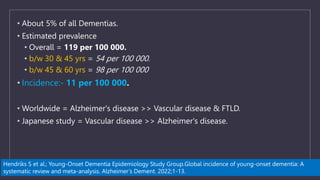
• About 5% of all Dementias.
• Estimated prevalence
• Overall = 119 per 100 000.
• b/w 30 & 45 yrs = 54 per 100 000.
• b/w 45 & 60 yrs = 98 per 100 000
• Incidence:- 11 per 100 000.
• Worldwide = Alzheimer's disease >> Vascular disease & FTLD.
• Japanese study = Vascular disease >> Alzheimer's disease.
Hendriks S et al.; Young-Onset Dementia Epidemiology Study Group.Global incidence of young-onset dementia: A
systematic review and meta-analysis. Alzheimer’s Dement. 2022;1-13.
•“Is this Young-Onset Dementia
or
is this Psychiatric?”.
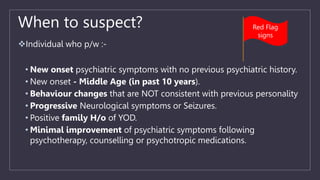
When to suspect?
Individual who p/w :-
• New onset psychiatric symptoms with no previous psychiatric history.
• New onset - Middle Age (in past 10 years).
• Behaviour changes that are NOT consistent with previous personality
• Progressive Neurological symptoms or Seizures.
• Positive family H/o of YOD.
• Minimal improvement of psychiatric symptoms following
psychotherapy, counselling or psychotropic medications.
Red Flag
signs
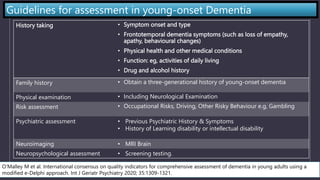
History taking • Symptom onset and type
• Frontotemporal dementia symptoms (such as loss of empathy,
apathy, behavioural changes)
• Physical health and other medical conditions
• Function: eg, activities of daily living
• Drug and alcohol history
Family history • Obtain a three-generational history of young-onset dementia
Physical examination • Including Neurological Examination
Risk assessment • Occupational Risks, Driving, Other Risky Behaviour e.g, Gambling
Psychiatric assessment • Previous Psychiatric History & Symptoms
• History of Learning disability or intellectual disability
Neuroimaging • MRI Brain
Neuropsychological assessment • Screening testing.
Guidelines for assessment in young-onset Dementia
O’Malley M et al. International consensus on quality indicators for comprehensive assessment of dementia in young adults using a
modified e-Delphi approach. Int J Geriatr Psychiatry 2020; 35:1309-1321.
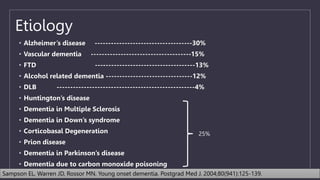
Etiology
• Alzheimer’s disease ------------------------------------30%
• Vascular dementia -------------------------------------15%
• FTD -------------------------------------13%
• Alcohol related dementia --------------------------------12%
• DLB ---------------------------------------------------4%
• Huntington’s disease
• Dementia in Multiple Sclerosis
• Dementia in Down’s syndrome
• Corticobasal Degeneration
• Prion disease
• Dementia in Parkinson’s disease
• Dementia due to carbon monoxide poisoning
25%
Sampson EL, Warren JD, Rossor MN. Young onset dementia. Postgrad Med J. 2004;80(941):125-139.
Reversible processes
• Chronic SDH
• Tuberculosis/Fungal Meningitis
• Brain Tumour
• Paraneoplastic Limbic Encephalitis
• Anti-VGKCC syndrome
• Hashimoto’s Encephalopathy
• Cerebral vasculitis
• Drug toxicities
• Whipple’s disease
Irreversible processes
•DLB, Alzheimer’s disease
•FTD
•Prion diseases: Sporadic,
Familial, & vCJD.
•PML
•SSPE
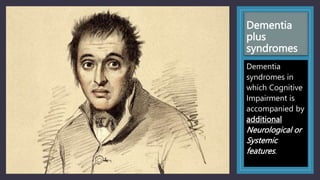
Dementia
plus
syndromes
Dementia
syndromes in
which Cognitive
Impairment is
accompanied by
additional
Neurological or
Systemic
features.
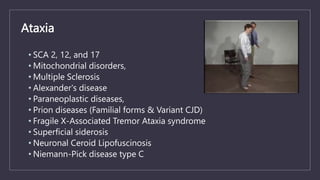
Ataxia
• SCA 2, 12, and 17
• Mitochondrial disorders,
• Multiple Sclerosis
• Alexander's disease
• Paraneoplastic diseases,
• Prion diseases (Familial forms & Variant CJD)
• Fragile X-Associated Tremor Ataxia syndrome
• Superficial siderosis
• Neuronal Ceroid Lipofuscinosis
• Niemann-Pick disease type C
Pyramidal signs
• Multiple sclerosis
• FTD with MND,
• Hereditary spastic paraparesis (SPG4),
• Adrenoleukodystrophy,
• Alzheimer's disease (some Presenilin mutations)
• Phenylketonuria,
• Vanishing White Matter Disease,
• Polyglucosan Body Disease,
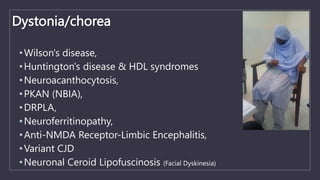
Dystonia/chorea
•Wilson's disease,
•Huntington's disease & HDL syndromes
•Neuroacanthocytosis,
•PKAN (NBIA),
•DRPLA,
•Neuroferritinopathy,
•Anti-NMDA Receptor-Limbic Encephalitis,
•Variant CJD
•Neuronal Ceroid Lipofuscinosis (Facial Dyskinesia)
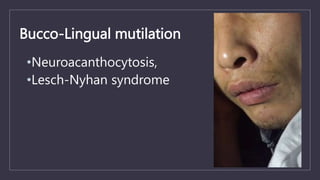
Bucco-Lingual mutilation
•Neuroacanthocytosis,
•Lesch-Nyhan syndrome
Akinetic-Rigid syndrome
•PKAN (NBIA)
•Wilson's disease,
•Dementia Pugilistica,
•DLB
Peripheral Neuropathy
•Porphyria,
•Alcohol-related Dementia,
•HIV infection,
•Mitochondrial disorders,
•Neuroacanthocytosis,
•Cerebrotendinous Xanthomatosis,
•Metachromatic leukodystrophy,
•Adrenoleukodystrophy
Dementia plus syndromes & Associated
diseases—Systemic features
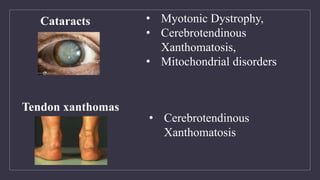
• Myotonic Dystrophy,
• Cerebrotendinous
Xanthomatosis,
• Mitochondrial disorders
Cataracts
• Cerebrotendinous
Xanthomatosis
Tendon xanthomas
• Niemann-Pick disease type C,
• Gaucher's disease
Splenomegaly
• Polycystic Lipomembranous
Sclerosing Leucoencephalopathy
Bone cysts
• Vitamin B12 deficiency,
• Neuroacanthocytosis
• Wilson's disease
• Gaucher's disease
Anaemia
• Fabry's disease,
• Lesch-Nyhan syndrome,
• Mitochondrial disorders
Renal impairment
• Wilson's disease,
• Gaucher's disease,
• Mitochondrial disorders
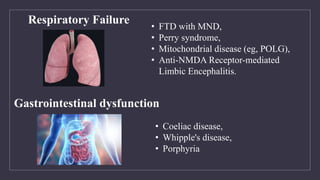
Hepatic dysfunction
• FTD with MND,
• Perry syndrome,
• Mitochondrial disease (eg, POLG),
• Anti-NMDA Receptor-mediated
Limbic Encephalitis.
Respiratory Failure
• Coeliac disease,
• Whipple's disease,
• Porphyria
Gastrointestinal dysfunction
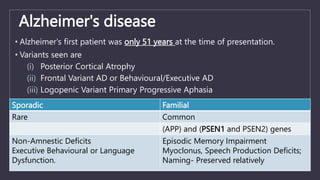
Alzheimer's disease
• Alzheimer's first patient was only 51 years at the time of presentation.
• Variants seen are
(i) Posterior Cortical Atrophy
(ii) Frontal Variant AD or Behavioural/Executive AD
(iii) Logopenic Variant Primary Progressive Aphasia
Sporadic Familial
Rare Common
(APP) and (PSEN1 and PSEN2) genes
Non-Amnestic Deficits
Executive Behavioural or Language
Dysfunction.
Episodic Memory Impairment
Myoclonus, Speech Production Deficits;
Naming- Preserved relatively
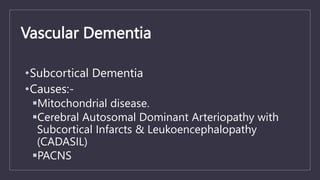
Vascular Dementia
•Subcortical Dementia
•Causes:-
Mitochondrial disease.
Cerebral Autosomal Dominant Arteriopathy with
Subcortical Infarcts & Leukoencephalopathy
(CADASIL)
PACNS
Dementia with Lewy bodies and
Parkinson's Disease Dementia
•Very rare.
•PDD
• Less frequently and with a longer latency in pts with YOPD.
• Common with :-
• α-synuclein Triplications &
• Mutations in the Glucocerebrosidase gene
• Rare with :-
• Parkin (PARK2) gene mutation.
Frontotemporal Lobar Degeneration
•Behavioural variant - most heritable
•Semantic variant - least heritable.
•Genes affected –
• Microtubule-associated protein tau (MAPT)
• Progranulin(GRN)
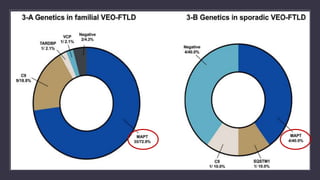
• Fused-in-sarcoma (FUS)
•Family history is positive ~up to 50%
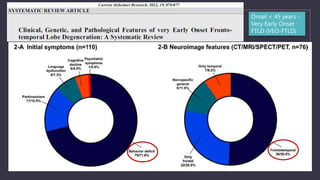
•VEO-FTD (<45yrs)
Onset < 45 years -
Very Early Onset
FTLD (VEO-FTLD)
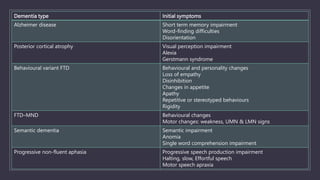
Dementia type Initial symptoms
Alzheimer disease Short term memory impairment
Word-finding difficulties
Disorientation
Posterior cortical atrophy Visual perception impairment
Alexia
Gerstmann syndrome
Behavioural variant FTD Behavioural and personality changes
Loss of empathy
Disinhibition
Changes in appetite
Apathy
Repetitive or stereotyped behaviours
Rigidity
FTD–MND Behavioural changes
Motor changes: weakness, UMN & LMN signs
Semantic dementia Semantic impairment
Anomia
Single word comprehension impairment
Progressive non-fluent aphasia Progressive speech production impairment
Halting, slow, Effortful speech
Motor speech apraxia
Investigations
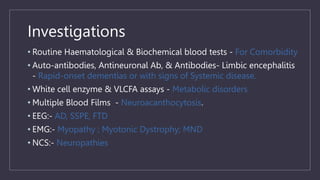
• Routine Haematological & Biochemical blood tests - For Comorbidity
• Auto-antibodies, Antineuronal Ab, & Antibodies- Limbic encephalitis
- Rapid-onset dementias or with signs of Systemic disease.
• White cell enzyme & VLCFA assays - Metabolic disorders
• Multiple Blood Films - Neuroacanthocytosis.
• EEG:- AD, SSPE, FTD
• EMG:- Myopathy ; Myotonic Dystrophy; MND
• NCS:- Neuropathies
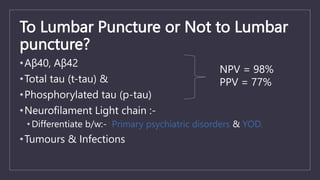
To Lumbar Puncture or Not to Lumbar
puncture?
•Aβ40, Aβ42
•Total tau (t-tau) &
•Phosphorylated tau (p-tau)
•Neurofilament Light chain :-
• Differentiate b/w:- Primary psychiatric disorders & YOD.
•Tumours & Infections
NPV = 98%
PPV = 77%
Genetic Testing
•About 15% c/b AD genetic mutation.
•Highly recommended -
Positive Family h/o YOD,
Onset <45 years of age.
With a Dementia type with a high Heritability Rate.
• Nearly 50% of people with onset <45 years = Directly inherited.
•Techniques available
(i) Targeted gene panels
-Include specific genes for a particular d/o
(ii)Whole Exome sequencing
(iii)Whole Genome sequencing
Genetic testing (….contd)
•Probable bvFTD with at least one first-degree relative with bvFTD, late-
onset PPD, ALS or other Early Onset Neurodegenerative disease = All FTD
mutations
•All cases with possible or probable bvFTD, regardless of family history
= C9orf72 mutation.
•Late-onset PPD with at least one first-degree relative with FTD or ALS =
C9orf72 mutation.
•All cases of suspected bvFTD not meeting full diagnostic criteria if there
is Prominent Psychiatric symptoms or Family h/o Late-onset PPD =
C9orf72 screening
Ducharme S et al. Recommendations to distinguish behavioural variant Frontotemporal Dementia from
psychiatric disorders. Brain. 2020;143(6):1632-1650.
Limitations
• Large duplications & Structural variations cannot be read by
these techniques,
• Triplicate repeat disorders (e.g HD, MD)
• Disorders related to the C9orf72 mutation.
• Clinical significance - Genetic variants ?
Ruling In:-
•Repeated Assessments:-
-Normal Neuropsychological testing
•Phenocopy syndrome.
Tissue Biopsy
•Skin biopsy- CADASIL, NPC.
•Muscle biopsy - Mitochondrial d/o
•Tonsillar biopsy – suspected vCJD
•Brain biopsy - [Exceptional cases]
Imaging
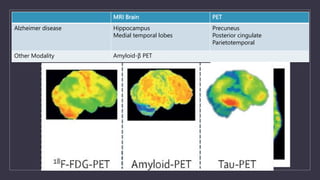
MRI Brain PET
Alzheimer disease Hippocampus
Medial temporal lobes
Precuneus
Posterior cingulate
Parietotemporal
Other Modality Amyloid-β PET
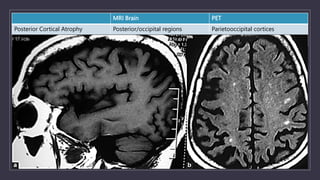
MRI Brain PET
Posterior Cortical Atrophy Posterior/occipital regions Parietooccipital cortices
Other Modality Amyloid-β PET
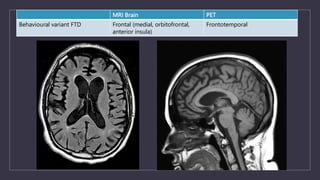
MRI Brain PET
Behavioural variant FTD Frontal (medial, orbitofrontal,
anterior insula)
Frontotemporal
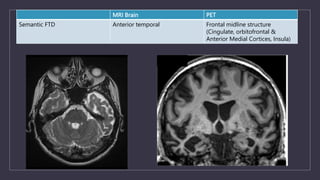
MRI Brain PET
Semantic FTD Anterior temporal Frontal midline structure
(Cingulate, orbitofrontal &
Anterior Medial Cortices, Insula)
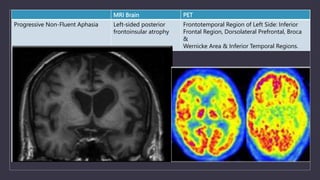
MRI Brain PET
Progressive Non-Fluent Aphasia Left-sided posterior
frontoinsular atrophy
Frontotemporal Region of Left Side: Inferior
Frontal Region, Dorsolateral Prefrontal, Broca
&
Wernicke Area & Inferior Temporal Regions.
Management
• Management of cardiovascular risk factors and other lifestyle modification.
• Suicide risk = 2.8 times.
• For young-onset AD,
-Donepezil, Memantine
• Low mood, Depression & Anxiety
-Psychotherapy &
-Antidepressants (Short term BZD)
• Sleep Disturbances
-Non-pharmacological
-Melatonin or Short term low dose BZD.
Prognosis
• Average time for diagnosis = 3.5 yrs
• Median Survival YOD d/t:-
AD = 11.3 years
FTD = 10.6 years
Vascular dementia = 12.3 years
• AD gene mutations (eg, MAPT-type FTD) - Earlier age of onset
& age at Death
• FTD a/w MND has the shortest duration of survival.
• Overall, people with YOD lose 10 to 15 years of life expectancy.
Loi SM et al. Time to diagnosis in younger-onset dementia and the impact of a specialist diagnostic service. Int
Psychogeriatr. 2022;34(4):367-375.
THANK
YOU
References
1. Rossor MN et al. The diagnosis of young-onset dementia. Lancet Neurol 2010; 9: 793-806.
2. Knopman DS et al. Practice parameter: diagnosis of dementia (an evidence-based review). Report of the
Quality Standards Subcommittee of the AAN. Neurology 2001;56:1143–53.
3. Waldemar G et al. Diagnosis and management of Alzheimer's disease and other disorders associated
with dementia. The role of neurologists in Europe. EFNS. Eur J Neurol 2000;7:133–44.
4. Hendriks S et al.; Young-Onset Dementia Epidemiology Study Group.Global incidence of young-onset
dementia: A systematic review and meta-analysis. Alzheimer’s Dement. 2022;1-13.
5. O’Malley M et al. International consensus on quality indicators for comprehensive assessment of
dementia in young adults using a modified e-Delphi approach. Int J Geriatr Psychiatry 2020; 35:1309-
1321.
6. Ducharme S et al. Recommendations to distinguish behavioural variant Frontotemporal Dementia from
psychiatric disorders. Brain. 2020;143(6):1632-1650.
7. Dumba M et al. Clinical 18F-FDG and amyloid brain positron emission tomography/CT in the
investigation of cognitive impairment: where are we now?. Br J Radiol 2019; 92: 20181027.

Young Onset Dementia.pptx

  • 1.
    C YOUNG ONSET DEMENTIA Dr ZuberAli Quazi Senior Resident 3rd Yr DM Neurology GMC Kota
  • 2.
    Introduction o“Presenile Dementia” • “Young-onsetDementia”, • “Younger-onset Dementia”, • “Younger people with Dementia” Includes patients with onset of Dementia before 65 years of age. Rossor MN, Fox NC, Mummery CJ, et al. The diagnosis of young-onset dementia. Lancet Neurol 2010; 9: 793-806.
  • 3.
    • About 5%of all Dementias. • Estimated prevalence • Overall = 119 per 100 000. • b/w 30 & 45 yrs = 54 per 100 000. • b/w 45 & 60 yrs = 98 per 100 000 • Incidence:- 11 per 100 000. • Worldwide = Alzheimer's disease >> Vascular disease & FTLD. • Japanese study = Vascular disease >> Alzheimer's disease. Hendriks S et al.; Young-Onset Dementia Epidemiology Study Group.Global incidence of young-onset dementia: A systematic review and meta-analysis. Alzheimer’s Dement. 2022;1-13.
  • 4.
    •“Is this Young-OnsetDementia or is this Psychiatric?”.
  • 5.
    When to suspect? Individualwho p/w :- • New onset psychiatric symptoms with no previous psychiatric history. • New onset - Middle Age (in past 10 years). • Behaviour changes that are NOT consistent with previous personality • Progressive Neurological symptoms or Seizures. • Positive family H/o of YOD. • Minimal improvement of psychiatric symptoms following psychotherapy, counselling or psychotropic medications. Red Flag signs
  • 6.
    History taking •Symptom onset and type • Frontotemporal dementia symptoms (such as loss of empathy, apathy, behavioural changes) • Physical health and other medical conditions • Function: eg, activities of daily living • Drug and alcohol history Family history • Obtain a three-generational history of young-onset dementia Physical examination • Including Neurological Examination Risk assessment • Occupational Risks, Driving, Other Risky Behaviour e.g, Gambling Psychiatric assessment • Previous Psychiatric History & Symptoms • History of Learning disability or intellectual disability Neuroimaging • MRI Brain Neuropsychological assessment • Screening testing. Guidelines for assessment in young-onset Dementia O’Malley M et al. International consensus on quality indicators for comprehensive assessment of dementia in young adults using a modified e-Delphi approach. Int J Geriatr Psychiatry 2020; 35:1309-1321.
  • 7.
    Etiology • Alzheimer’s disease------------------------------------30% • Vascular dementia -------------------------------------15% • FTD -------------------------------------13% • Alcohol related dementia --------------------------------12% • DLB ---------------------------------------------------4% • Huntington’s disease • Dementia in Multiple Sclerosis • Dementia in Down’s syndrome • Corticobasal Degeneration • Prion disease • Dementia in Parkinson’s disease • Dementia due to carbon monoxide poisoning 25% Sampson EL, Warren JD, Rossor MN. Young onset dementia. Postgrad Med J. 2004;80(941):125-139.
  • 8.
    Reversible processes • ChronicSDH • Tuberculosis/Fungal Meningitis • Brain Tumour • Paraneoplastic Limbic Encephalitis • Anti-VGKCC syndrome • Hashimoto’s Encephalopathy • Cerebral vasculitis • Drug toxicities • Whipple’s disease Irreversible processes •DLB, Alzheimer’s disease •FTD •Prion diseases: Sporadic, Familial, & vCJD. •PML •SSPE
  • 9.
    Dementia plus syndromes Dementia syndromes in which Cognitive Impairmentis accompanied by additional Neurological or Systemic features.
  • 10.
    Ataxia • SCA 2,12, and 17 • Mitochondrial disorders, • Multiple Sclerosis • Alexander's disease • Paraneoplastic diseases, • Prion diseases (Familial forms & Variant CJD) • Fragile X-Associated Tremor Ataxia syndrome • Superficial siderosis • Neuronal Ceroid Lipofuscinosis • Niemann-Pick disease type C
  • 11.
    Pyramidal signs • Multiplesclerosis • FTD with MND, • Hereditary spastic paraparesis (SPG4), • Adrenoleukodystrophy, • Alzheimer's disease (some Presenilin mutations) • Phenylketonuria, • Vanishing White Matter Disease, • Polyglucosan Body Disease,
  • 12.
    Dystonia/chorea •Wilson's disease, •Huntington's disease& HDL syndromes •Neuroacanthocytosis, •PKAN (NBIA), •DRPLA, •Neuroferritinopathy, •Anti-NMDA Receptor-Limbic Encephalitis, •Variant CJD •Neuronal Ceroid Lipofuscinosis (Facial Dyskinesia)
  • 13.
  • 14.
    Akinetic-Rigid syndrome •PKAN (NBIA) •Wilson'sdisease, •Dementia Pugilistica, •DLB
  • 15.
    Peripheral Neuropathy •Porphyria, •Alcohol-related Dementia, •HIVinfection, •Mitochondrial disorders, •Neuroacanthocytosis, •Cerebrotendinous Xanthomatosis, •Metachromatic leukodystrophy, •Adrenoleukodystrophy
  • 16.
    Dementia plus syndromes& Associated diseases—Systemic features
  • 17.
    • Myotonic Dystrophy, •Cerebrotendinous Xanthomatosis, • Mitochondrial disorders Cataracts • Cerebrotendinous Xanthomatosis Tendon xanthomas
  • 18.
    • Niemann-Pick diseasetype C, • Gaucher's disease Splenomegaly • Polycystic Lipomembranous Sclerosing Leucoencephalopathy Bone cysts • Vitamin B12 deficiency, • Neuroacanthocytosis • Wilson's disease • Gaucher's disease Anaemia
  • 19.
    • Fabry's disease, •Lesch-Nyhan syndrome, • Mitochondrial disorders Renal impairment • Wilson's disease, • Gaucher's disease, • Mitochondrial disorders Hepatic dysfunction
  • 20.
    • FTD withMND, • Perry syndrome, • Mitochondrial disease (eg, POLG), • Anti-NMDA Receptor-mediated Limbic Encephalitis. Respiratory Failure • Coeliac disease, • Whipple's disease, • Porphyria Gastrointestinal dysfunction
  • 21.
    Alzheimer's disease • Alzheimer'sfirst patient was only 51 years at the time of presentation. • Variants seen are (i) Posterior Cortical Atrophy (ii) Frontal Variant AD or Behavioural/Executive AD (iii) Logopenic Variant Primary Progressive Aphasia Sporadic Familial Rare Common (APP) and (PSEN1 and PSEN2) genes Non-Amnestic Deficits Executive Behavioural or Language Dysfunction. Episodic Memory Impairment Myoclonus, Speech Production Deficits; Naming- Preserved relatively
  • 22.
    Vascular Dementia •Subcortical Dementia •Causes:- Mitochondrialdisease. Cerebral Autosomal Dominant Arteriopathy with Subcortical Infarcts & Leukoencephalopathy (CADASIL) PACNS
  • 23.
    Dementia with Lewybodies and Parkinson's Disease Dementia •Very rare. •PDD • Less frequently and with a longer latency in pts with YOPD. • Common with :- • α-synuclein Triplications & • Mutations in the Glucocerebrosidase gene • Rare with :- • Parkin (PARK2) gene mutation.
  • 24.
    Frontotemporal Lobar Degeneration •Behaviouralvariant - most heritable •Semantic variant - least heritable. •Genes affected – • Microtubule-associated protein tau (MAPT) • Progranulin(GRN) • Fused-in-sarcoma (FUS) •Family history is positive ~up to 50% •VEO-FTD (<45yrs)
  • 25.
    Onset < 45years - Very Early Onset FTLD (VEO-FTLD)
  • 27.
    Dementia type Initialsymptoms Alzheimer disease Short term memory impairment Word-finding difficulties Disorientation Posterior cortical atrophy Visual perception impairment Alexia Gerstmann syndrome Behavioural variant FTD Behavioural and personality changes Loss of empathy Disinhibition Changes in appetite Apathy Repetitive or stereotyped behaviours Rigidity FTD–MND Behavioural changes Motor changes: weakness, UMN & LMN signs Semantic dementia Semantic impairment Anomia Single word comprehension impairment Progressive non-fluent aphasia Progressive speech production impairment Halting, slow, Effortful speech Motor speech apraxia
  • 28.
    Investigations • Routine Haematological& Biochemical blood tests - For Comorbidity • Auto-antibodies, Antineuronal Ab, & Antibodies- Limbic encephalitis - Rapid-onset dementias or with signs of Systemic disease. • White cell enzyme & VLCFA assays - Metabolic disorders • Multiple Blood Films - Neuroacanthocytosis. • EEG:- AD, SSPE, FTD • EMG:- Myopathy ; Myotonic Dystrophy; MND • NCS:- Neuropathies
  • 29.
    To Lumbar Punctureor Not to Lumbar puncture? •Aβ40, Aβ42 •Total tau (t-tau) & •Phosphorylated tau (p-tau) •Neurofilament Light chain :- • Differentiate b/w:- Primary psychiatric disorders & YOD. •Tumours & Infections NPV = 98% PPV = 77%
  • 30.
    Genetic Testing •About 15%c/b AD genetic mutation. •Highly recommended - Positive Family h/o YOD, Onset <45 years of age. With a Dementia type with a high Heritability Rate. • Nearly 50% of people with onset <45 years = Directly inherited.
  • 31.
    •Techniques available (i) Targetedgene panels -Include specific genes for a particular d/o (ii)Whole Exome sequencing (iii)Whole Genome sequencing
  • 32.
    Genetic testing (….contd) •ProbablebvFTD with at least one first-degree relative with bvFTD, late- onset PPD, ALS or other Early Onset Neurodegenerative disease = All FTD mutations •All cases with possible or probable bvFTD, regardless of family history = C9orf72 mutation. •Late-onset PPD with at least one first-degree relative with FTD or ALS = C9orf72 mutation. •All cases of suspected bvFTD not meeting full diagnostic criteria if there is Prominent Psychiatric symptoms or Family h/o Late-onset PPD = C9orf72 screening Ducharme S et al. Recommendations to distinguish behavioural variant Frontotemporal Dementia from psychiatric disorders. Brain. 2020;143(6):1632-1650.
  • 33.
    Limitations • Large duplications& Structural variations cannot be read by these techniques, • Triplicate repeat disorders (e.g HD, MD) • Disorders related to the C9orf72 mutation. • Clinical significance - Genetic variants ?
  • 34.
    Ruling In:- •Repeated Assessments:- -NormalNeuropsychological testing •Phenocopy syndrome.
  • 35.
    Tissue Biopsy •Skin biopsy-CADASIL, NPC. •Muscle biopsy - Mitochondrial d/o •Tonsillar biopsy – suspected vCJD •Brain biopsy - [Exceptional cases]
  • 36.
  • 37.
    MRI Brain PET Alzheimerdisease Hippocampus Medial temporal lobes Precuneus Posterior cingulate Parietotemporal Other Modality Amyloid-β PET
  • 38.
    MRI Brain PET PosteriorCortical Atrophy Posterior/occipital regions Parietooccipital cortices Other Modality Amyloid-β PET
  • 39.
    MRI Brain PET Behaviouralvariant FTD Frontal (medial, orbitofrontal, anterior insula) Frontotemporal
  • 40.
    MRI Brain PET SemanticFTD Anterior temporal Frontal midline structure (Cingulate, orbitofrontal & Anterior Medial Cortices, Insula)
  • 41.
    MRI Brain PET ProgressiveNon-Fluent Aphasia Left-sided posterior frontoinsular atrophy Frontotemporal Region of Left Side: Inferior Frontal Region, Dorsolateral Prefrontal, Broca & Wernicke Area & Inferior Temporal Regions.
  • 42.
    Management • Management ofcardiovascular risk factors and other lifestyle modification. • Suicide risk = 2.8 times. • For young-onset AD, -Donepezil, Memantine • Low mood, Depression & Anxiety -Psychotherapy & -Antidepressants (Short term BZD) • Sleep Disturbances -Non-pharmacological -Melatonin or Short term low dose BZD.
  • 43.
  • 44.
    • Average timefor diagnosis = 3.5 yrs • Median Survival YOD d/t:- AD = 11.3 years FTD = 10.6 years Vascular dementia = 12.3 years • AD gene mutations (eg, MAPT-type FTD) - Earlier age of onset & age at Death • FTD a/w MND has the shortest duration of survival. • Overall, people with YOD lose 10 to 15 years of life expectancy. Loi SM et al. Time to diagnosis in younger-onset dementia and the impact of a specialist diagnostic service. Int Psychogeriatr. 2022;34(4):367-375.
  • 45.
  • 46.
    References 1. Rossor MNet al. The diagnosis of young-onset dementia. Lancet Neurol 2010; 9: 793-806. 2. Knopman DS et al. Practice parameter: diagnosis of dementia (an evidence-based review). Report of the Quality Standards Subcommittee of the AAN. Neurology 2001;56:1143–53. 3. Waldemar G et al. Diagnosis and management of Alzheimer's disease and other disorders associated with dementia. The role of neurologists in Europe. EFNS. Eur J Neurol 2000;7:133–44. 4. Hendriks S et al.; Young-Onset Dementia Epidemiology Study Group.Global incidence of young-onset dementia: A systematic review and meta-analysis. Alzheimer’s Dement. 2022;1-13. 5. O’Malley M et al. International consensus on quality indicators for comprehensive assessment of dementia in young adults using a modified e-Delphi approach. Int J Geriatr Psychiatry 2020; 35:1309- 1321. 6. Ducharme S et al. Recommendations to distinguish behavioural variant Frontotemporal Dementia from psychiatric disorders. Brain. 2020;143(6):1632-1650. 7. Dumba M et al. Clinical 18F-FDG and amyloid brain positron emission tomography/CT in the investigation of cognitive impairment: where are we now?. Br J Radiol 2019; 92: 20181027.
Editor's Notes

  • #3  Dementia term means being out of one's mind then…. Presenile Dementia, was used widely in the published literature until about 10 years ago, is no longer favoured. But this age has no specific biological significance and there is a range of disease features across this arbitrary divide. Childhood dementia ≤14 years
  • #5 The general misbelief……dementia occurs in elderly…& when such similar symptoms occur in Young….psychiatric…this belief is prevalent in Primary physicians….who r the 1st one to encounter such pts…even for a neurologist….
  • #6 loss of social conduct Cognitive/behavioural/psychiatric changes in a person with a family H/o of young-onset Dementia
  • #9 Drug toxicities (especially lithium)..[Amitryptylline, anticholinergic, antispsyhotic] 50% increased odds of dementia a/w Anti ACh exposure of 3 years daily use Neurofilament inclusion body disease [?]
  • #10 man diagnosed as suffering from acute dementia. Lithograph, 1892 Melanocholia…Extreme sadness, feeling guilty and having no appetite
  • #11 dementia syndromes in which cognitive impairment is accompanied by additional neurological or systemic features
  • #14 Lesch-Nyhan syndrome
  • #15 Huntington's disease (Juvenile onset), Dementia pugilistica
  • #16 Alcohol-related diseases, Giant Axonal Neuropathy, Fabry's disease, Polyglucosan Body Disease Krabbe's disease, Sialidosis
  • #21 Perry syndrome = rapidly progressive parkinsonism, depression, weight loss, sleep disturbance, and central hypoventilation
  • #22 Majority of cases are due to mutations in the presenilin (PS)1 gene
  • #24 In one case series 8/9 had an onset before 40 years of age
  • #25 Range 20–75 years; FTDP-17 (frontotemporal dementia with parkinsonism linked to chromosome 17 Two broad histopathological groupings:- With tau-positive cellular inclusions and With tau-negative, ubiquitin-positive cellular inclusions containing TAR-DNA binding protein (TARDBP; also known as TDP-43).
  • #26 Disinhibition (81.8%) & Apathy (80.9%)
  • #27 48 pts Familial 10 pts from sporadic
  • #29 Ab in limbic encephalitis[?] VCLFA in ? Multiple ….how much? EEG:- AD=slowing or loss of alpha rhythm FTD= relative preservation of this alpha rhythm
  • #30 A lumbar puncture is recommended by both the AAN & EFNS guidelines. NFL chain:- Sensitivity = 87%; Specificity = 90%
  • #31 Eg HD,
  • #32 WES - Reads sequences from all coding regions; WGS - Analyses sequences in coding and non-coding regions-increases Diagnostic Accuracy.
  • #34 Clinical significance of genetic variants factors, such as the APOE risk allele, have unclear significance.
  • #35 Some Dementias r difficult to diagnose at one timepoint & individuals may perform within normal limits on neuropsychological testing e.g bv-FTD. So are often misdiagnosed with a psychiatric condition, a different dementia. Phenocopy syn: people p/w the neuropsychiatric symptoms that mimic bv-FTD but who may not have frontotemporal atrophy or hypometabolism on neuroimaging.
  • #36 CADASIL- apocrine glands; NPC – skin fibroblasts Brain biopsy= blind procedure, generally from the non-dominant frontal lobe. A full thickness open biopsy including cortex, white matter, and meninges. Specific diagnosis >50% of cases & treatable process in about 10% . Procedure 10% risk morbidity.
  • #38 The degree of amyloid accumulation on Aβ imaging may not correlate with severity of cognitive impairment, as the accumulation of amyloid likely reaches a threshold
  • #43 Longer than those with older-onset dementia. Suicide risk declines with time from diagnosis. Galantamine, Rivastigmine