REMOTE ROBOTIC MECHANICAL
THROMBECTOMY
DR PRAKARSH SHARMA
SR NEUROLOGY
GMC KOTA
Why remote robotic thrombectomy??
• acute ischemic stroke due to large vessel occlusion, endovascular thrombectomy
(ET) significantly reduces disability and mortality.(1)
• Max of the US population cannot reach an ET-capable centre within 1 hour of
stroke onset.
• Geographic limitations prevents certain patients assess to expert NEURO IR
• Time is brain
• problematic as thrombectomy delays associate with increased stroke-related
disability.
Endovascular thrombectomy after large-vessel ischaemic stroke: a meta-analysis of individual patient data from five randomised
trials. Lancet 2016;387:1723–31. 10.1016/S0140-6736(16)00163-X
How ??
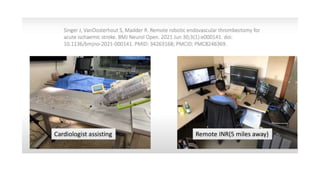
• In contrast to the shortage of ET-capable centres, PCI performing centres are good
in number.
• Leveraging primary PCI hospitals to also perform ET would likely increase access
to ET
• But it would require dissemination of neurointerventionist expertise to less
specialised hospitals.
• possible using telerobotics if an off-site neurointerventionist uses remotely
controlled a robot at the PCI hospital to perform ET where groin access can be
provided by a cardiologist/ vascular surgeon.
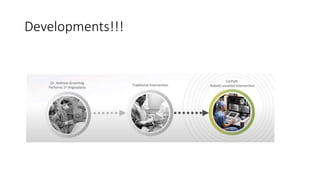
Developments!!!
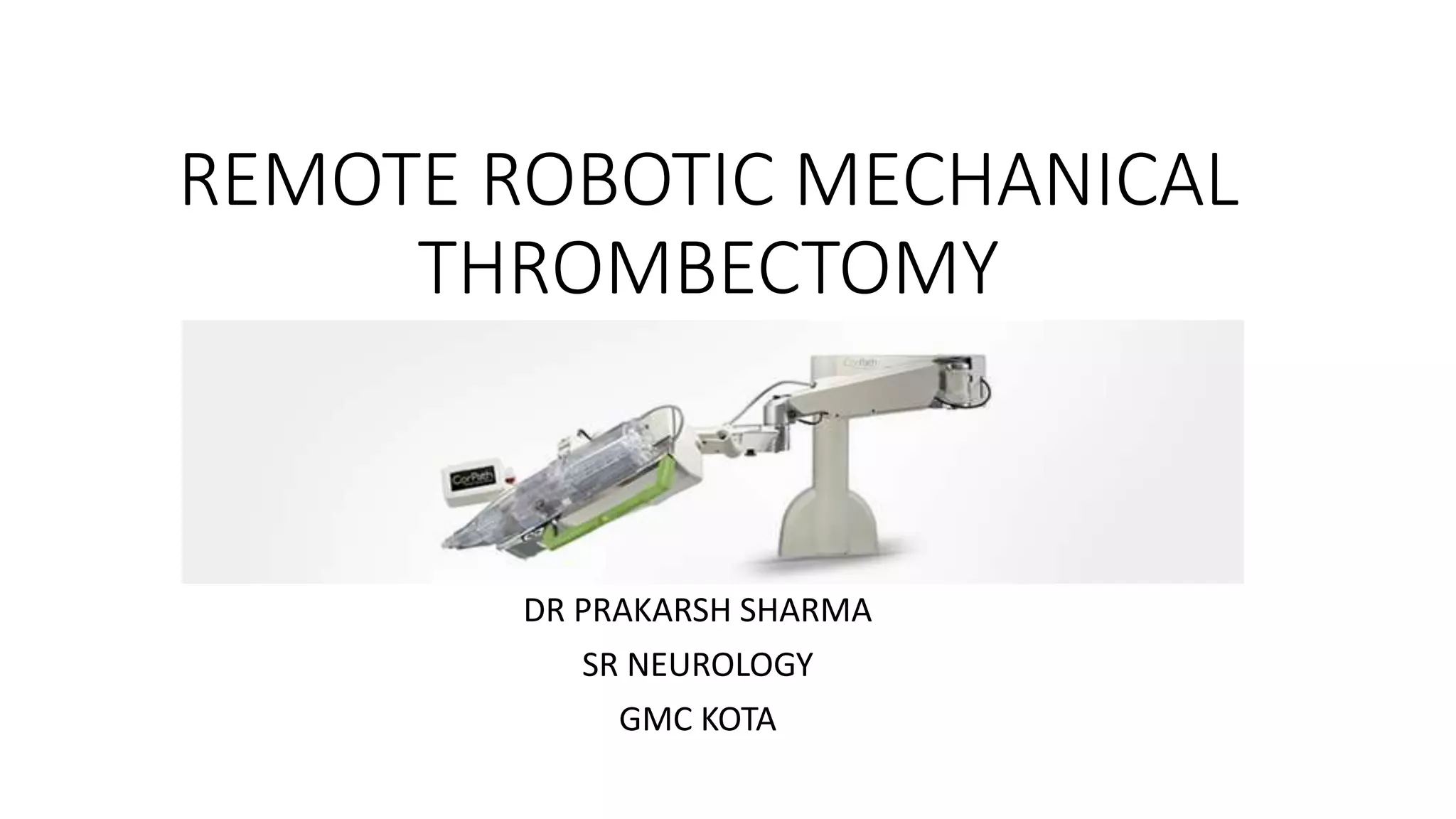
ABOUT THE MACHINE: Corindus
• Corindus's first commercially available endovascular system was
the CorPath 200.
• designed primarily for PCI, but it was used in peripheral vascular
interventions as well.
• currently in widespread use, is the CorPath GRX.
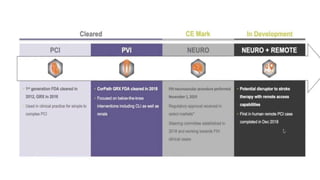
• CE MARK APPROVAL: JANUARY 2018
• FDA MARK APPROVAL: MARCH 2018 FOR PCI/PVI
Telerobotic Endovascular Interventions and Their Potential for Cerebrovascular Treatment. Tex Heart Inst J. 2022 Mar 1;49(2):e217608. doi: 10.14503/THIJ-21-7608.
PMID: 35481863; PMCID: PMC9053666.
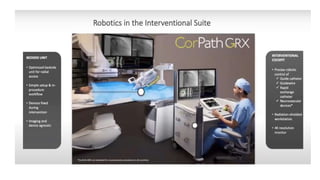
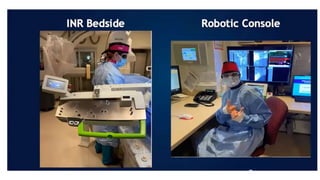
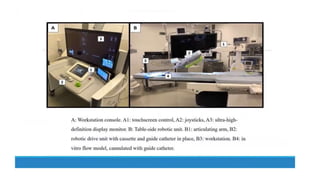
• It has 2 major components: a bedside unit that can be mounted on
the operating table,
• and the interventional cockpit—a mobile station that has a
radiation shield, a console panel, and monitors .
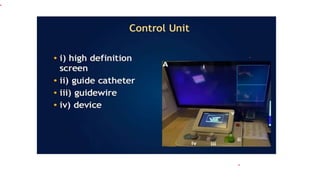
• The console panel has a touchscreen; a turbo button for faster tool
movement;
• and 3 joysticks, which are used to control the guidewire, a guide
catheter, and the device being inserted (for example, a balloon or
stent).
• Monitors show real-time fluoroscopic images, saved angiographic
images, and the patient's vital signs.
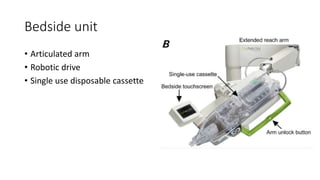
Bedside unit
• Articulated arm
• Robotic drive
• Single use disposable cassette
• The bedside unit consists of –
• flexible robotic arm that can be positioned at the optimal angle to
maintain easy transition to the access site.
• a single-use cassette that holds the guidewire, the guiding catheter,
and a stent or balloon catheter.
• To prevent access site complications, the cassette has a support
track to keep it firmly connected during manipulation.
• The connection between the 2 major components is maintained
through communication cables.
• Every generation of the Corindus system is compatible with every type of
catheterization laboratory and operating table.
• The drive can be draped and prepared for intervention in approximately 2 minutes.
• The system's estimated cost is between $500,000 and $650,000, plus the cost of
extra single-use cassettes and devices. ( ~ 5cr rs)
• The GRX system is approved by the US Food and Drug Administration (FDA) and has
a Conformité Européenne (CE) mark for coronary angioplasty and peripheral
vascular interventions.
Evolution
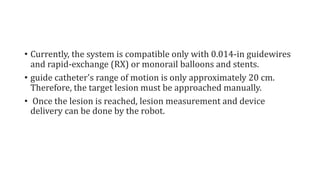
• Currently, the system is compatible only with 0.014-in guidewires
and rapid-exchange (RX) or monorail balloons and stents.
• guide catheter's range of motion is only approximately 20 cm.
Therefore, the target lesion must be approached manually.
• Once the lesion is reached, lesion measurement and device
delivery can be done by the robot.
VARIOUS REPORTED EVIDENCES
• The earliest report of robotic-assisted PCI was published in 2011.
Granada and associates reported on 8 patients who underwent the
procedure, with a 97.9% success rate and a 97% decrease in
radiation exposure.
• Percutaneous Robotically-Enhanced Coronary Intervention
(PRECISE) study, a multicenter study that enrolled 164 patients
with simple coronary lesions short enough to be covered by one
stent. The results were promising: a 97.6% success rate and a 95%
decrease in radiation exposure.
PRECISE (Percutaneous Robotically-Enhanced Coronary Intervention) Study. J Am Coll Cardiol . 2013;61(15):1596–600
• The first trial of the CorPath robotic system for treating peripheral
vascular disease was the Robotic-Assisted Peripheral Intervention
for Peripheral Arterial Disease (RAPID) trial.
• It involved patients with critical limb ischemia or claudication and
at least 50% stenosis in the femoropopliteal arteries.
• The results showed 100% technical and clinical success rates for
the 20 patients treated.
Feasibility and safety of robotic peripheral vascular interventions: results of the RAPID trial. JACC Cardiovasc Interv . 2016;9(19):2058–
64.
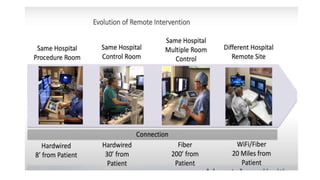
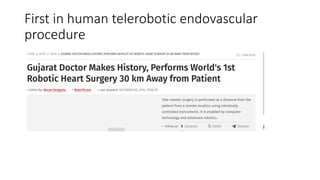
First in human telerobotic endovascular
procedure
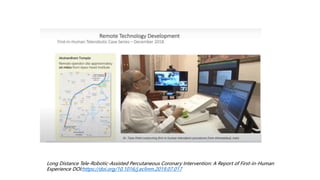
Long Distance Tele-Robotic-Assisted Percutaneous Coronary Intervention: A Report of First-in-Human
Experience DOI:https://doi.org/10.1016/j.eclinm.2019.07.017
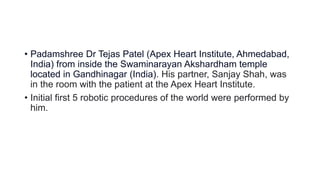
• Padamshree Dr Tejas Patel (Apex Heart Institute, Ahmedabad,
India) from inside the Swaminarayan Akshardham temple
located in Gandhinagar (India). His partner, Sanjay Shah, was
in the room with the patient at the Apex Heart Institute.
• Initial first 5 robotic procedures of the world were performed by
him.
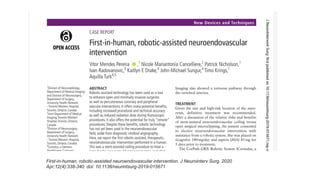
First-in-human, robotic-assisted neuroendovascular intervention. J Neurointerv Surg. 2020
Apr;12(4):338-340. doi: 10.1136/neurintsurg-2019-015671
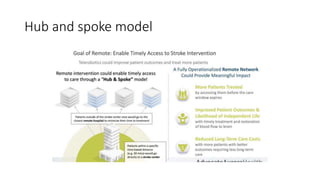
Hub and spoke model
ADVANTAGES OF ROBOTIC INTERVENTION
• Advantages for interventionist
- Reduction in radiation exposure(97%)
- Doing procedure with a comfort of sitting on a chair
- Prevents wearing of heavy lead aprons in-turn reducing orthopedic injuries
- Multiple procedures can be done back to back
- Increased accuracy and precision in measuring lesion size, stent length, and
stent placement, as well as enhanced close-up viewing of angiographic
angiographic images.
• Advantages for the patient
-timely treatment as ET centre is within reach
- Prevents life long disability
- Reduces long term healthcare cost
- potentially reduce endothelial damage, contrast doses, and radiation
exposure, minimal chanches of perforation.
Limitations
• Need for 2nd operator.
• the risk of sudden breakdown in robotic signal transmission
• Conversion to manual
• Time consuming initially(30-45 minutes on average)
• Loss of haptic touch feedback
• Availablity, affordability and cost
• Communication errors
• Requires significant training in robotics and patient simulators.
• Regular software and hardware updates required.
Future aspects
• additions might include fiberoptic endovascular
angioscopy with the possibility for direct visualization of
thrombectomy with mechanical, aspiration, ultrasonic, or a
combination of these techniques.
Learning points
• Neuroendovascular intervention using robotic assistance is
feasible.
• Robotic assistance improves the precision of
neuroendovascular procedures while reducing radiation
exposure to the interventionalist.
• Robotic systems such as the one described here open up the
possibility of remote intervention, such as for stroke treatment.
• Team training, communication and preparation are essential in
the successful adoption of this technology.
References
• Endovascular thrombectomy after large-vessel ischaemic stroke: a meta-analysis of individual patient data
from five randomised trials. Lancet 2016;387:1723–31. 10.1016/S0140-6736(16)00163-X
• Telerobotic Endovascular Interventions and Their Potential for Cerebrovascular Treatment. Tex Heart Inst J.
2022 Mar 1;49(2):e217608. doi: 10.14503/THIJ-21-7608. PMID: 35481863; PMCID: PMC9053666.
• PRECISE (Percutaneous Robotically-Enhanced Coronary Intervention) Study. J Am Coll
Cardiol . 2013;61(15):1596–600
• Feasibility and safety of robotic peripheral vascular interventions: results of the RAPID trial. JACC Cardiovasc
Interv . 2016;9(19):2058–64.
• Long Distance Tele-Robotic-Assisted Percutaneous Coronary Intervention: A Report of First-in-Human
Experience DOI:https://doi.org/10.1016/j.eclinm.2019.07.017
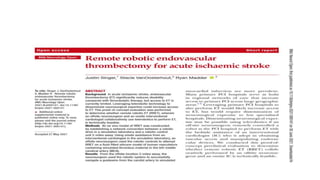
• Remote robotic endovascular thrombectomy for acute ischaemic stroke doi: 10.1136/bmjno-2021-000141
• First-in-human, robotic-assisted neuroendovascular intervention. J Neurointerv Surg. 2020 Apr;12(4):338-
340. doi: 10.1136/neurintsurg-2019-015671.
Thank you

REMOTE ROBOTIC.pptx

  • 1.
    REMOTE ROBOTIC MECHANICAL THROMBECTOMY DRPRAKARSH SHARMA SR NEUROLOGY GMC KOTA
  • 2.
    Why remote roboticthrombectomy?? • acute ischemic stroke due to large vessel occlusion, endovascular thrombectomy (ET) significantly reduces disability and mortality.(1) • Max of the US population cannot reach an ET-capable centre within 1 hour of stroke onset. • Geographic limitations prevents certain patients assess to expert NEURO IR • Time is brain • problematic as thrombectomy delays associate with increased stroke-related disability. Endovascular thrombectomy after large-vessel ischaemic stroke: a meta-analysis of individual patient data from five randomised trials. Lancet 2016;387:1723–31. 10.1016/S0140-6736(16)00163-X
  • 3.
    How ?? • Incontrast to the shortage of ET-capable centres, PCI performing centres are good in number. • Leveraging primary PCI hospitals to also perform ET would likely increase access to ET • But it would require dissemination of neurointerventionist expertise to less specialised hospitals. • possible using telerobotics if an off-site neurointerventionist uses remotely controlled a robot at the PCI hospital to perform ET where groin access can be provided by a cardiologist/ vascular surgeon.
  • 4.
  • 5.
    ABOUT THE MACHINE:Corindus • Corindus's first commercially available endovascular system was the CorPath 200. • designed primarily for PCI, but it was used in peripheral vascular interventions as well. • currently in widespread use, is the CorPath GRX. • CE MARK APPROVAL: JANUARY 2018 • FDA MARK APPROVAL: MARCH 2018 FOR PCI/PVI Telerobotic Endovascular Interventions and Their Potential for Cerebrovascular Treatment. Tex Heart Inst J. 2022 Mar 1;49(2):e217608. doi: 10.14503/THIJ-21-7608. PMID: 35481863; PMCID: PMC9053666.
  • 6.
    • It has2 major components: a bedside unit that can be mounted on the operating table, • and the interventional cockpit—a mobile station that has a radiation shield, a console panel, and monitors .
  • 9.
    • The consolepanel has a touchscreen; a turbo button for faster tool movement; • and 3 joysticks, which are used to control the guidewire, a guide catheter, and the device being inserted (for example, a balloon or stent). • Monitors show real-time fluoroscopic images, saved angiographic images, and the patient's vital signs.
  • 11.
    Bedside unit • Articulatedarm • Robotic drive • Single use disposable cassette
  • 12.
    • The bedsideunit consists of – • flexible robotic arm that can be positioned at the optimal angle to maintain easy transition to the access site. • a single-use cassette that holds the guidewire, the guiding catheter, and a stent or balloon catheter. • To prevent access site complications, the cassette has a support track to keep it firmly connected during manipulation. • The connection between the 2 major components is maintained through communication cables.
  • 15.
    • Every generationof the Corindus system is compatible with every type of catheterization laboratory and operating table. • The drive can be draped and prepared for intervention in approximately 2 minutes. • The system's estimated cost is between $500,000 and $650,000, plus the cost of extra single-use cassettes and devices. ( ~ 5cr rs) • The GRX system is approved by the US Food and Drug Administration (FDA) and has a Conformité Européenne (CE) mark for coronary angioplasty and peripheral vascular interventions.
  • 16.
  • 18.
    • Currently, thesystem is compatible only with 0.014-in guidewires and rapid-exchange (RX) or monorail balloons and stents. • guide catheter's range of motion is only approximately 20 cm. Therefore, the target lesion must be approached manually. • Once the lesion is reached, lesion measurement and device delivery can be done by the robot.
  • 19.
    VARIOUS REPORTED EVIDENCES •The earliest report of robotic-assisted PCI was published in 2011. Granada and associates reported on 8 patients who underwent the procedure, with a 97.9% success rate and a 97% decrease in radiation exposure. • Percutaneous Robotically-Enhanced Coronary Intervention (PRECISE) study, a multicenter study that enrolled 164 patients with simple coronary lesions short enough to be covered by one stent. The results were promising: a 97.6% success rate and a 95% decrease in radiation exposure. PRECISE (Percutaneous Robotically-Enhanced Coronary Intervention) Study. J Am Coll Cardiol . 2013;61(15):1596–600
  • 20.
    • The firsttrial of the CorPath robotic system for treating peripheral vascular disease was the Robotic-Assisted Peripheral Intervention for Peripheral Arterial Disease (RAPID) trial. • It involved patients with critical limb ischemia or claudication and at least 50% stenosis in the femoropopliteal arteries. • The results showed 100% technical and clinical success rates for the 20 patients treated. Feasibility and safety of robotic peripheral vascular interventions: results of the RAPID trial. JACC Cardiovasc Interv . 2016;9(19):2058– 64.
  • 23.
    First in humantelerobotic endovascular procedure
  • 24.
    Long Distance Tele-Robotic-AssistedPercutaneous Coronary Intervention: A Report of First-in-Human Experience DOI:https://doi.org/10.1016/j.eclinm.2019.07.017
  • 25.
    • Padamshree DrTejas Patel (Apex Heart Institute, Ahmedabad, India) from inside the Swaminarayan Akshardham temple located in Gandhinagar (India). His partner, Sanjay Shah, was in the room with the patient at the Apex Heart Institute. • Initial first 5 robotic procedures of the world were performed by him.
  • 26.
    First-in-human, robotic-assisted neuroendovascularintervention. J Neurointerv Surg. 2020 Apr;12(4):338-340. doi: 10.1136/neurintsurg-2019-015671
  • 27.
  • 28.
    ADVANTAGES OF ROBOTICINTERVENTION • Advantages for interventionist - Reduction in radiation exposure(97%) - Doing procedure with a comfort of sitting on a chair - Prevents wearing of heavy lead aprons in-turn reducing orthopedic injuries - Multiple procedures can be done back to back - Increased accuracy and precision in measuring lesion size, stent length, and stent placement, as well as enhanced close-up viewing of angiographic angiographic images.
  • 29.
    • Advantages forthe patient -timely treatment as ET centre is within reach - Prevents life long disability - Reduces long term healthcare cost - potentially reduce endothelial damage, contrast doses, and radiation exposure, minimal chanches of perforation.
  • 30.
    Limitations • Need for2nd operator. • the risk of sudden breakdown in robotic signal transmission • Conversion to manual • Time consuming initially(30-45 minutes on average) • Loss of haptic touch feedback • Availablity, affordability and cost • Communication errors
  • 31.
    • Requires significanttraining in robotics and patient simulators. • Regular software and hardware updates required.
  • 32.
    Future aspects • additionsmight include fiberoptic endovascular angioscopy with the possibility for direct visualization of thrombectomy with mechanical, aspiration, ultrasonic, or a combination of these techniques.
  • 33.
    Learning points • Neuroendovascularintervention using robotic assistance is feasible. • Robotic assistance improves the precision of neuroendovascular procedures while reducing radiation exposure to the interventionalist. • Robotic systems such as the one described here open up the possibility of remote intervention, such as for stroke treatment. • Team training, communication and preparation are essential in the successful adoption of this technology.
  • 34.
    References • Endovascular thrombectomyafter large-vessel ischaemic stroke: a meta-analysis of individual patient data from five randomised trials. Lancet 2016;387:1723–31. 10.1016/S0140-6736(16)00163-X • Telerobotic Endovascular Interventions and Their Potential for Cerebrovascular Treatment. Tex Heart Inst J. 2022 Mar 1;49(2):e217608. doi: 10.14503/THIJ-21-7608. PMID: 35481863; PMCID: PMC9053666. • PRECISE (Percutaneous Robotically-Enhanced Coronary Intervention) Study. J Am Coll Cardiol . 2013;61(15):1596–600 • Feasibility and safety of robotic peripheral vascular interventions: results of the RAPID trial. JACC Cardiovasc Interv . 2016;9(19):2058–64. • Long Distance Tele-Robotic-Assisted Percutaneous Coronary Intervention: A Report of First-in-Human Experience DOI:https://doi.org/10.1016/j.eclinm.2019.07.017 • Remote robotic endovascular thrombectomy for acute ischaemic stroke doi: 10.1136/bmjno-2021-000141 • First-in-human, robotic-assisted neuroendovascular intervention. J Neurointerv Surg. 2020 Apr;12(4):338- 340. doi: 10.1136/neurintsurg-2019-015671.
  • 35.