CHAPTER 7
COMPRESSIBILITY AND CONSOLIDATION
7.1 INTRODUCTION
Structures are built on soils. They transfer loads to the subsoil through the foundations. The effect
of the loads is felt by the soil normally up to a depth of about two to three times the width of the
foundation. The soil within this depth gets compressed due to the imposed stresses. The
compression of the soil mass leads to the decrease in the volume of the mass which results in the
settlement of the structure.
The displacements that develop at any given boundary of the soil mass can be determined on
a rational basis by summing up the displacements of small elements of the mass resulting from the
strains produced by a change in the stress system. The compression of the soil mass due to the
imposed stresses may be almost immediate or time dependent according to the permeability
characteristics of the soil. Cohesionless soils which are highly permeable are compressed in a
relatively short period of time as compared to cohesive soils which are less permeable. The
compressibility characteristics of a soil mass might be due to any or a combination of thefollowing
factors:
1. Compression of the solid matter.
2. Compression of water and air within the voids.
3. Escape of water and air from the voids.
It is quite reasonable and rational to assume that the solid matter and the pore water are
relatively incompressible under the loads usuallyencountered in soil masses. The change in volume
of a mass under imposed stresses mustbe due to the escape of water if the soil is saturated. But if the
soil is partially saturated, the change in volume of the mass is partly due to the compression and
escape of air from the voids and partly due to the dissolution of air in the pore water.
The compressibility of a soil mass is mostly dependent on the rigidity of the soil skeleton.
The rigidity, in turn, is dependent on the structural arrangement of particles and, in fine grained
207
208 Chapter 7
soils, on the degree to which adjacent particles are bonded together. Soils which possess a
honeycombed structure possess high porosity and as such are more compressible. A soil composed
predominantly of flat grains is more compressible than one containing mostly spherical grains. A
soil in an undisturbed state is less compressible than the same soil in a remolded state.
Soils are neither truly elastic nor plastic. When a soil mass is under compression, the volume
change is predominantly due to the slipping of grains one relative to another . The grains do not
spring back to their original positions upon removal of the stress. However, a small elastic rebound
under low pressures could be attributed to the elastic compression of the adsorbed water
surrounding the grains.
Soil engineering problems are of two types. The first type includes all cases wherein there is
no possibility of the stress being sufficiently large to exceed the shear strength of the soil, but
wherein the strains lead to what may be a serious magnitude of displacement of individual grains
leading to settlements within the soil mass. Chapter 7 deals with this type of problem. The second
type includes cases in which there is danger of shearing stresses exceeding the shear strength of the
soil. Problems of this type are called Stability Problems which are dealt with under the chapters of
earth pressure, stability of slopes, and foundations.
Soil in nature may be found in any of the following states
1. Dry state.
2. Partially saturated state.
3. Saturated state.
Settlements of structures built on granular soils are generally considered only under two
states, that is, either dry or saturated. The stress-strain characteristics of dry sand, depend primarily
on the relative density of the sand, and to a much smaller degree on the shape and size of grains.
Saturation does not alter the relationship significantly provided the water content of the sand can
change freely. However, in very fine-grained or silty sands the water content may remain almost
unchanged during a rapid change in stress. Under this condition, the compression is time-
dependent. Suitablehypotheses relating displacement and stress changes in granular soils have not
yet been formulated. However, the settlements may be determined by semi-empirical methods
(Terzaghi, Peck and Mesri, 1996).
In the case of cohesive soils, the dry state of the soils is not considered as this state is only of
a temporary nature. When the soil becomes saturated during the rainy season, the soil becomes
more compressible under the same imposed load. Settlement characteristics of cohesive soils are,
therefore, considered only under completely saturated conditions. It is quite possible that there are
situations where the cohesive soils may remain partially saturated due to the confinement of air
bubbles, gases etc. Current knowledge on the behavior of partially saturated cohesive soils under
external loads is not sufficient to evolve a workable theory to estimate settlements of structures built
on such soils.
7.2 CONSOLIDATION
When a saturated clay-water system is subjected to an external pressure, the pressure applied is
initially taken by the water in the pores resulting thereby in an excess pore water pressure. If
drainage is permitted, the resulting hydraulic gradients initiate a flow of water out of the clay mass
and the mass begins to compress. A portion of the applied stress is transferred to the soil skeleton,
which in turn causes a reduction in the excess pore pressure. This process, involving a gradual
compression occurring simultaneously with a flow of water out of the mass and with a gradual
transfer of the applied pressure from the pore water to the mineral skeleton is called consolidation.
The process opposite to consolidation is called swelling, which involves an increase in the water
content due to an increase in the volume of the voids.
Compressibility and Consolidation 209
Consolidation may be due to one or more of the following factors:
1. External static loads from structures.
2. Self-weight of the soil such as recently placed fills.
3. Lowering of the ground water table.
4. Desiccation.
The total compression of a saturated clay strata under excess effective pressure may be
considered as the sum of
1. Immediate compression,
2. Primary consolidation, and
3. Secondary compression.
The portion of the settlement of a structure which occurs more or less simultaneouslywith the
applied loads is referred to as the initial or immediate settlement. This settlement is due to the
immediate compression of the soil layer under undrained condition and is calculated by assuming
the soil mass to behave as an elastic soil.
If the rate of compression of the soil layer is controlled solely by the resistance of the flow of
water under the induced hydraulic gradients, the process is referred to as primary consolidation.
The portion of the settlement that is due to the primary consolidation is called primary
consolidation settlement or compression. At the present time the only theory of practical value for
estimating time-dependent settlement due to volume changes, that is under primary consolidation
is the one-dimensional theory.
The third part of the settlement is due to secondary consolidation or compression of the clay
layer. This compression is supposed to start after the primary consolidation ceases, that is after the
excess pore water pressure approaches zero. It is often assumed that secondary compression
proceeds linearly with the logarithm of time. However, a satisfactory treatment of this phenomenon
has not been formulated for computing settlement under this category.
The Process of Consolidation
The process of consolidation of a clay-soil-water system may be explained with the help of a
mechanical model as described by Terzaghi and Frohlich (1936).
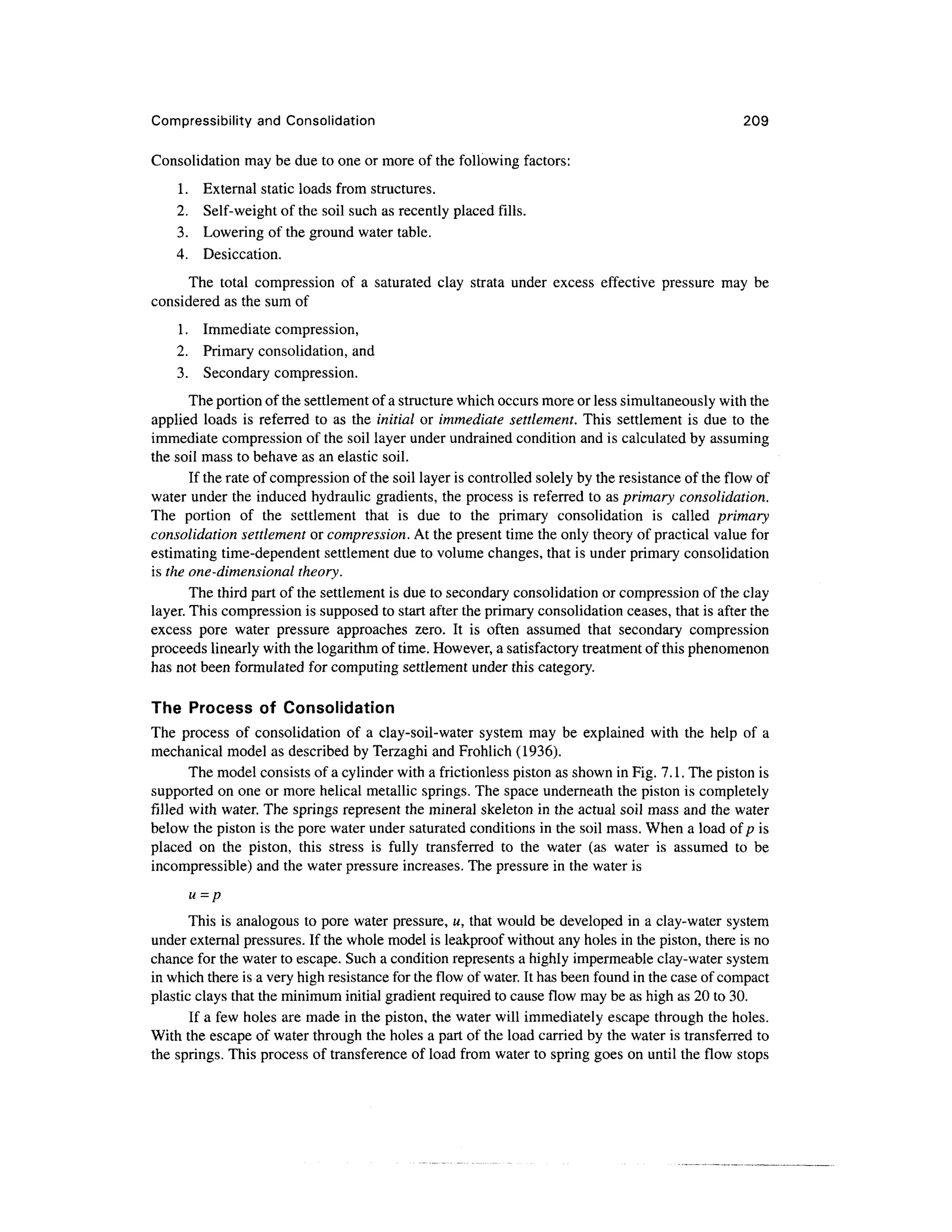
The model consists of a cylinder with a frictionless piston as shown in Fig. 7.1. The piston is
supported on one or more helical metallic springs. The space underneath the piston is completely
filled with water. The springs represent the mineral skeleton in the actual soil mass and the water
below the piston is the pore water under saturated conditions in the soil mass. When a load of p is
placed on the piston, this stress is fully transferred to the water (as water is assumed to be
incompressible) and the water pressure increases. The pressure in the water is
u = p
This is analogous to pore water pressure, u, that would be developed in a clay-water system
under external pressures. If the whole model is leakproof without any holes in the piston, there is no
chance for the water to escape. Such a condition represents a highly impermeable clay-water system
in which there is a very high resistance for the flow of water. It has been found in the case of compact
plastic clays that the minimum initial gradient required to cause flow may be as high as 20 to 30.
If a few holes are made in the piston, the water will immediately escape through the holes.
With the escape of water through the holes a part of the load carried by the water is transferred to
the springs. This process of transference of load from water to spring goes on until the flow stops
210 Chapter 7
Piston
Spring
Pore water
Figure 7.1 Mechanical model to explain the process of consolidation
when all the load will be carried by the spring and none by the water. The time required to attain this
condition depends upon the number and size of the holes made in the piston. A few small holes
represents a clay soil with poor drainage characteristics.
When the spring-water system attains equilibrium condition under the imposed load, the
settlement of the piston is analogous to the compression of the clay-water system under external
pressures.
One-Dimensional Consolidation
In many instances the settlement of a structure is due to the presence of one or more layers of soft
clay located between layers of sand or stiffer clay as shown in Fig. 7.2A. The adhesion between the
soft and stiff layers almost completely prevents the lateral movement of the soft layers. The theory
that was developed by Terzaghi (1925) on the basis of this assumption is called the
one-dimensional consolidation theory. In the laboratory this condition is simulated most closely by
the confined compression or consolidation test.
The process of consolidation as explained with reference to a mechanical model may now be
applied to a saturated clay layer in the field. If the clay strata shown in Fig 7.2 B(a) is subjected to an
excess pressure Ap due to a uniformly distributedload/? on the surface, the clay layer is compressed over
Sand
Sand
Drainage
faces
Figure 7.2A Clay layer sandwiched between sand layers
Compressibility and Consolidation 211
Drainage
boundary
Ap = 55 kPa
Impermeable
boundary
10 20 30 40 50
Excess porewater pressure (kPa) (a)
Properties of clay:
wn = 56-61%, w, =46%
w =24%,pc/p0=l3l
Clay from Berthier-Ville, Canada
3 4 5 6 7
Axial compression (mm) (b)
Figure 7.2B (a) Observed distribution of excess pore water pressure during
consolidation of a soft clay layer; (b) observed distribution of vertical compression
during consolidation of a soft clay layer (after Mesri and Choi, 1985, Mesri and
Feng, 1986)
time and excess pore water drains out of it to the sandy layer. This constitutes the process of
consolidation. At the instant of application of the excess load Ap, the load is carried entirely by water in
the voids of the soil. As time goes on the excess pore water pressure decreases, and the effective vertical
212 Chapter 7
pressure in the layer correspondingly increases. At any point within the consolidating layer, the value u
of the excess pore water pressure at a given time may be determined from
u = M. -
where, u = excess pore water pressure at depth z at any time t
u{ = initial total pore water pressure at time t = 0
Ap, = effective pressure transferred to the soil grains at depth i and time t
At the end of primary consolidation, the excess pore water pressure u becomes equal to zero.
This happens when u =0 at all depths.
The time taken for full consolidation depends upon the drainage conditions, the thickness of the
clay strata, the excess load at the top of the clay strata etc. Fig. 7.2B (a) gives a typical example of an
observed distribution of excess pore water pressure during the consolidation of a soft clay layer 50 cm
thick resting on an impermeable stratum with drainage at the top. Figure 7.2B(b) shows the
compression of the strata with the dissipation of pore water pressure. It is clear from the figure that the
time taken for the dissipation of pore water pressure may be quite long, say a year or more.
7.3 CONSOLIDOMETER
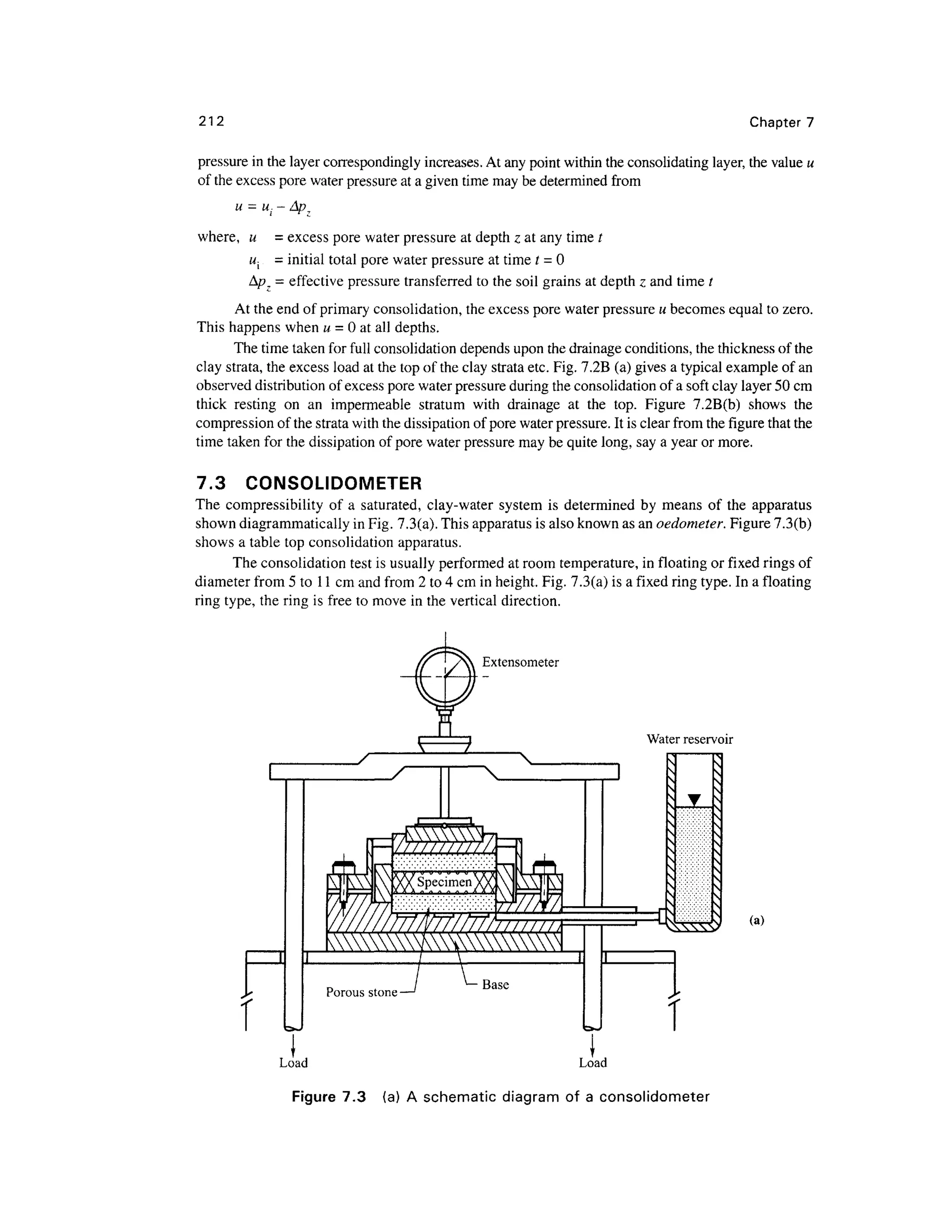
The compressibility of a saturated, clay-water system is determined by means of the apparatus
shown diagrammatically in Fig. 7.3(a). This apparatus is also known as an oedometer. Figure 7.3(b)
shows a table top consolidation apparatus.
The consolidation test is usually performed at room temperature, in floating or fixed rings of
diameter from 5 to 11 cm and from 2 to 4 cm in height. Fig. 7.3(a) is a fixed ring type. In a floating
ring type, the ring is free to move in the vertical direction.
Extensometer
Water reservoir
(a)
Figure 7.3 (a) A schematic diagram of a consolidometer
Compressibility and Consolidation 213
Figure 7.3 (b) Table top consolidation apparatus (Courtesy: Soiltest, USA)
The soil sample is contained in the brass ring between two porous stones about 1.25 cm thick. By
means of the porous stones water has free access to and from both surfaces of the specimen. The
compressive load is applied to the specimen through a piston, either by means of a hanger and dead
weights or by a system of levers. The compression is measured on a dial gauge.
At the bottom of the soil sample the water expelled from the soil flows through the filter stone
into the water container. At the top, a well-jacket filled with water is placed around the stone in
order to prevent excessive evaporation from the sample during the test. Water from the sample also
flows into thejacket through the upper filter stone. The soil sample is kept submerged in a saturated
condition during the test.
7.4 THE STANDARD ONE-DIMENSIONAL CONSOLIDATION TEST
The main purpose of the consolidation test on soil samples is to obtain the necessary information about
the compressibility properties of a saturated soil for use in determining the magnitude and rate of
settlement of structures. The following test procedure is applied to any type of soil in the standard
consolidation test.
Loads are applied in steps in such a way that the successive load intensity, p, is twice the
preceding one. The load intensities commonly used being 1/4, 1/2,1, 2,4, 8, and 16 tons/ft2
(25, 50,
100,200,400, 800 and 1600 kN/m2
). Each load is allowed to stand until compression has practically
ceased (no longer than 24 hours). The dial readings are taken at elapsed times of 1/4, 1/2, 1,2,4,8,
15, 30, 60, 120, 240, 480 and 1440 minutes from the time the new increment of load is put on the
sample (or at elpased times as per requirements). Sandy samples are compressed in a relatively short
time as compared to clay samples and the use of one day duration is common for the latter.
After the greatest load required for the test has been applied to the soil sample, the load is
removed in decrements to provide data for plotting the expansion curve of the soil in order to learn
214 Chapter 7
its elastic properties and magnitudes of plastic or permanent deformations. The following data
should also be obtained:
1. Moisture content and weight of the soil sample before the commencement of the test.
2. Moisture content and weight of the sample after completion of the test.
3. The specific gravity of the solids.
4. The temperature of the room where the test is conducted.
7.5 PRESSURE-VOIDRATIO CURVES
The pressure-void ratio curve can be obtained if the void ratio of the sample at the end of each
increment of load is determined. Accurate determinations of void ratio are essential and may be
computed from the following data:
1. The cross-sectional area of the sample A, which is the same as that of the brass ring.
2. The specific gravity, G^, of the solids.
3. The dry weight, Ws, of the soil sample.
4. The sample thickness, h, at any stage of the test.
Let Vs =• volume of the solids in the sample
where
w
where yw - unit weight of water
We can also write
Vs=hsA or hs=^
where, hs = thickness of solid matter.
If e is the void ratio of the sample, then
Ah -Ah, h- h.
e =
Ah.. h.. (7.1)
In Eq. (7.1) hs is a constant and only h is a variable which decreases with increment load. If
the thickness h of the sample is known at any stage of the test, the void ratio at all the stages of the
test may be determined.
The equilibrium void ratio at the end of any load increment may be determined by the change
of void ratio method as follows:
Change of Void-Ratio Method
In one-dimensional compression the change in height A/i per unit of original height h equals the
change in volume AV per unit of original volume V.
(7.2)
h V
V may now be expressed in terms of void ratio e.
Compressibility and Consolidation 215
; I
V
">
(a) Initial condition (b) Compressed condition
Figure 7.4 Change of void ratio
We may write (Fig. 7.4),
V
Therefore,
A/i _
~h~
or
V-V
V
e-e
V l+e l + e
l +e
h
(7.3)
wherein, t±e =change in void ratio under a load, h =initial height of sample, e = initial void ratio of
sample, e' - void ratio after compression under a load, A/i = compression of sample under the load
which may be obtained from dial gauge readings.
Typical pressure-void ratio curves for an undisturbed clay sample are shown in Fig. 7.5,
plotted both on arithmetic and on semilog scales. The curve on the log scale indicates clearly two
branches, a fairly horizontal initial portion and a nearly straight inclined portion. The coordinates
of point A in the figure represent the void ratio eQ and effective overburden pressure pQ
corresponding to a state of the clay in the field as shown in the inset of the figure. When a sample is
extracted by means of the best of techniques, the water content of the clay does not change
significantly. Hence, the void ratio eQ at the start of the test is practically identical with that of the
clay in the ground. When the pressure on the sample in the consolidometer reaches p0, the e-log p
curve should pass through the pointA unless the test conditions differ in some manner from those in
the field. In reality the curve always passes below point A, because even the best sample is at least
slightly disturbed.
The curve that passes through point A is generally termed as afield curve or virgin curve. In
settlement calculations, the field curve is to be used.
216 Chapter 7
Virgin
curve
A)
Figure 7.5 Pressure-void ratio curves
Pressure-Void Ratio Curves for Sand
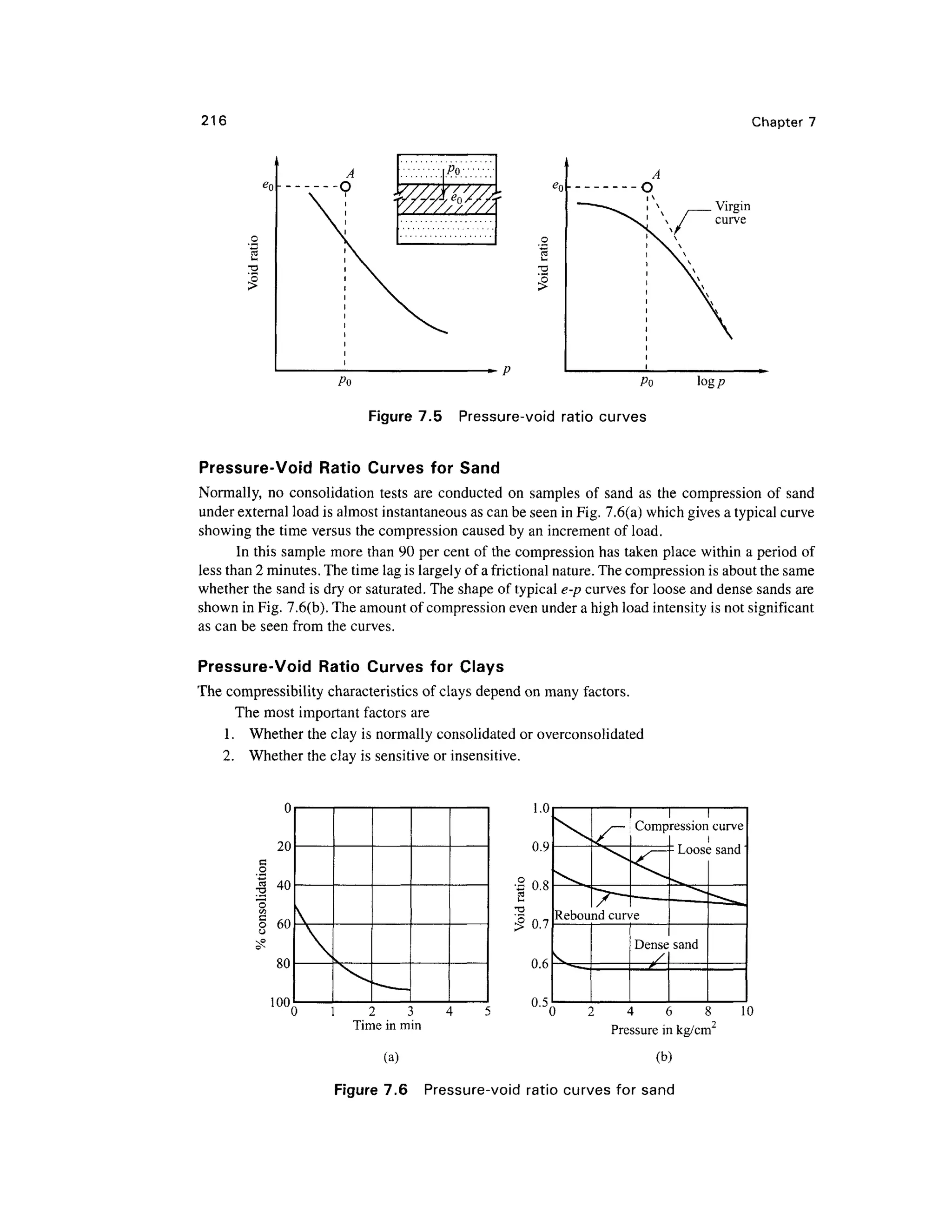
Normally, no consolidation tests are conducted on samples of sand as the compression of sand
under external load is almost instantaneousas can be seen in Fig. 7.6(a) which gives a typicalcurve
showing the time versus the compression caused by an increment of load.
In this sample more than 90 per cent of the compression has taken place within a period of
less than 2 minutes. The time lag is largely of a frictional nature.The compression is about the same
whether the sand is dry or saturated. The shape of typical e-p curves for loose and dense sands are
shown in Fig. 7.6(b). The amountof compression even under a high load intensityis notsignificant
as can be seen from the curves.
Pressure-Void Ratio Curves for Clays
The compressibility characteristics of clays depend on many factors.
The most important factors are
1. Whether the clay is normally consolidated or overconsolidated
2. Whether the clay is sensitive or insensitive.
%
consolidation
O
OO
ON
-fc'
KJ
O
O
O
O
O
C

V
V1
) 1 2 3 4 5
Time in min
l.U
0.9
•2 0.8
£
*o
'
| 0.7
0.6
0.5£

^
Rebou
^
S~

r
nd cun
Comp
<^
•
/e
Dense
/
ression
—^
™
sand
curve
j sand
^=^
) 2 4 6 8 1(
(a)
Pressure in kg/cm^
(b)
Figure 7.6 Pressure-void ratio curves for sand
Compressibility and Consolidation 217
Normally Consolidated and Overconsolidated Clays
A clay is said to be normally consolidated if the present effective overburden pressure pQ is the
maximum pressure to which the layer has ever been subjected at any time in its history, whereas a
clay layer is said to be overconsolidated if the layer was subjected at one time in its history to a
greater effective overburden pressure,/?c, than the present pressure,pQ. The ratio pc IpQ is called the
overconsolidation ratio (OCR).
Overconsolidation of a clay stratum may have been caused due to some of the following
factors
1. Weight of an overburden of soil which has eroded
2. Weight of a continental ice sheet that melted
3. Desiccation of layers close to the surface.
Experience indicates that the natural moisture content, wn, is commonly close to the liquid
limit, vv;, for normally consolidated clay soil whereas for the overconsolidated clay, wn is close to
plastic limit w .
Fig. 7.7 illustrates schematically the difference between a normally consolidated clay strata
such as B on the left side of Section CC and the overconsolidated portion of the same layer B on the
right side of section CC. Layer A is overconsolidated due to desiccation.
All of the strata located above bed rock were deposited in a lake at a time when the water level
was located above the level of the present high ground when parts of the strata were removed by
erosion, the water content in the clay stratum B on the right hand side of section CC increased
slightly, whereas that of the left side of section CC decreased considerably because of the lowering
of the water table level from position DQDQ to DD. Nevertheless, with respect to the present
overburden, the clay stratum B on the right hand side of section CC is overconsolidated clay, and
that on the left hand side is normally consolidated clay.
While the water table descended from its original to its final position below the floor of the
eroded valley, the sand strata above and below the clay layer A became drained. As a consequence,
layer A gradually dried out due to exposure to outside heat. Layer A is therefore said to be
overconsolidated by desiccation.
Overconsolidated by
desiccation
DO
C Original water table
Original ground surface
Structure
Present ground
surface
J
Normally consolidated clay
• . ;^— Overconsolidated clay/ _••: '.
Figure 7.7 Diagram illustrating the geological process leading to overconsolidation
of clays (After Terzaghi and Peck, 1967)
218 Chapter 7
7.6 DETERMINATION OF PRECONSOLIDATION PRESSURE
Several methods have been proposed for determining the value of the maximum consolidation
pressure. They fall under the following categories. They are
1. Field method,
2. Graphical procedure based on consolidation test results.
Field Method
The field method is based on geological evidence. The geology and physiography of the site may
help to locate the original ground level. The overburden pressure in the clay structure with respect
to the original ground level may be taken as the preconsolidation pressure pc. Usually the
geological estimate of the maximumconsolidation pressure is very uncertain. In such instances, the
only remaining procedure for obtaining an approximate value of pc is to make an estimate based on
the results of laboratory tests or on some relationships established between pc and other soil
parameters.
Graphical Procedure
There are a few graphical methods for determining the preconsolidation pressure based on
laboratory test data. No suitable criteria exists for appraising the relative merits of the various
methods.
The earliest and the most widely used method was the one proposed by Casagrande (1936).
The method involves locating the point of maximum curvature, 5, on the laboratory e-log p curve
of an undisturbed sample as shown in Fig. 7.8. From B, a tangent is drawn to the curve and a
horizontal line is also constructed. The angle between these two lines is then bisected. The abscissa
of the point of intersection of this bisector with the upward extension of the inclined straight part
corresponds to the preconsolidation pressure/^,.
Tangent at B
e-log p curve
log p Pc
Figure 7.8 Method of determining p by Casagrande method
Compressibility and Consolidation 219
7.7 e-log p FIELD CURVES FOR NORMALLY CONSOLIDATED AND
OVERCONSOLIDATED CLAYS OF LOW TO MEDIUM SENSITIVITY
It has been explained earlier with reference to Fig. 7.5, that the laboratory e-log p curve of an
undisturbed sample does not pass through point A and always passes below the point. It has been
found from investigation that the inclined straight portion of e-log p curves of undisturbed or
remolded samples of clay soil intersect at one point at a low void ratio and corresponds to 0.4eQ
shown as point C in Fig. 7.9 (Schmertmann, 1955). It is logical to assume the field curve labelled as
Kf should also pass through this point. The field curve can be drawn from point A, having
coordinates (eQ, /?0), which corresponds to the in-situ condition of the soil. The straight line AC in
Fig. 7.9(a) gives the field curve AT,for normally consolidated clay soil of low sensitivity.
The field curve for overconsolidated clay soil consists of two straight lines, represented by
AB and BC in Fig. 7.9(b). Schmertmann (1955) has shown that the initial section AB of the field
curve is parallel to the mean slope MNof the rebound laboratory curve. Point B is the intersection
point of the vertical line passing through the preconsolidation pressure pc on the abscissa and the
sloping line AB. Since point C is the intersection of the laboratory compression curve and the
horizontal line at void ratio 0.4eQ, line BC can be drawn. The slope of line MN which is the slope
of the rebound curve is called the swell index Cs.
Clay of High Sensitivity
If the sensitivity St is greater than about 8 [sensitivity is defined as the ratio of unconfmed
compressive strengths of undisturbed and remolded soil samples refer to Eq. (3.50)], then the clay
is said to be highly sensitive. The natural water contents of such clay are more than the liquid
limits. The e-log p curve Ku for an undisturbed sample of such a clay will have the initial
branch almost flat as shown in Fig. 7.9(c), and after this it drops abruptly into a steep segment
indicating there by a structural breakdown of the clay such that a slight increase of pressure
leads to a large decrease in void ratio. The curve then passes through a point of inflection at d
and its slope decreases. If a tangent is drawn at the point of inflection d, it intersects the line
eQA at b. The pressure corresponding to b (pb) is approximately equal to that at which the
structural breakdown takes place. In areas underlain by soft highly sensitive clays, the excess
pressure Ap over the layer should be limited to a fraction of the difference of pressure (pt-p0).
Soil of this type belongs mostly to volcanic regions.
7.8 COMPUTATION OF CONSOLIDATION SETTLEMENT
Settlement Equations for Normally Consolidated Clays
For computing the ultimate settlement of a structure founded on clay the following data are
required
1. The thickness of the clay stratum, H
2. The initial void ratio, eQ
3. The consolidation pressure pQ or pc
4. The field consolidation curve K,
The slope of the field curve K.on a semilogarithmic diagram is designated as the compression
index Cc (Fig. 7.9)
The equation for Cc may be written as
C e
°~e e
°~e Ag
Iogp-logp0 logp/Po logp/pQ
(7
'4)
220 Chapter 7
0.46>0
Remolded
compression curve
Laboratory
compression
curve of an
undisturbed
sample ku
Field curve
K,
Po P
lOg/7
(a) Normally consolidated clay soil
A b
Laboratory compression curve
Ae Field curve
or virgin
compression
curve
Po PC Po +
logp
(b) Preconsolidated clay soil
0.4 e
PoPb
e-log p curve
(c) Typical e-log p curve for an undisturbed sample of clay of high sensitivity (Peck et al., 1974)
Figure 7.9 Field e-log p curves
In one-dimensional compression, as per Eq. (7.2), the change in height A// per unit of
original H may be written as equal to the change in volume AV per unit of original volume V
(Fig. 7.10).
Art _ AV
H ~ V
Considering a unit sectional area of the clay stratum, we may write
(7.5)
Vl=Hl
= Hs (eQ -
Compressibility and Consolidation 221
H
f
n,
I J
A//
Figure 7.10 Change of height due to one-dimensional compression
Therefore,
Substituting for AWVin Eq. (7.5)
Ae
(7.6)
(7.7)
If we designate the compression A// of the clay layer as the total settlement St of the structure
built on it, we have
A// = S =
l + er
(7.8)
Settlement Calculation from e-log p Curves
Substituting for Ae in Eq. (7.8) we have
Po
or •/flog-
Po
(7.9)
(7.10)
The net change in pressure Ap produced by the structure at the middle of a clay stratum is
calculated from the Boussinesq or Westergaard theories as explained in Chapter 6.
If the thickness of the clay stratum is too large, the stratum may be divided into layers of
smaller thickness not exceeding 3 m. The net change in pressure A/? at the middle of each layer will
have to be calculated. Consolidation tests will have to be completed on samples taken from the
middle of each of the strata and the corresponding compression indices will have to be determined.
The equation for the total consolidation settlement may be written as
(7.11)
222 Chapter 7
where the subscript ;' refers to each layer in the subdivision. If there is a series of clay strata of
thickness Hr //2, etc., separated by granular materials, the same Eq. (7.10) may be used for
calculating the total settlement.
Settlement Calculation from e-p Curves
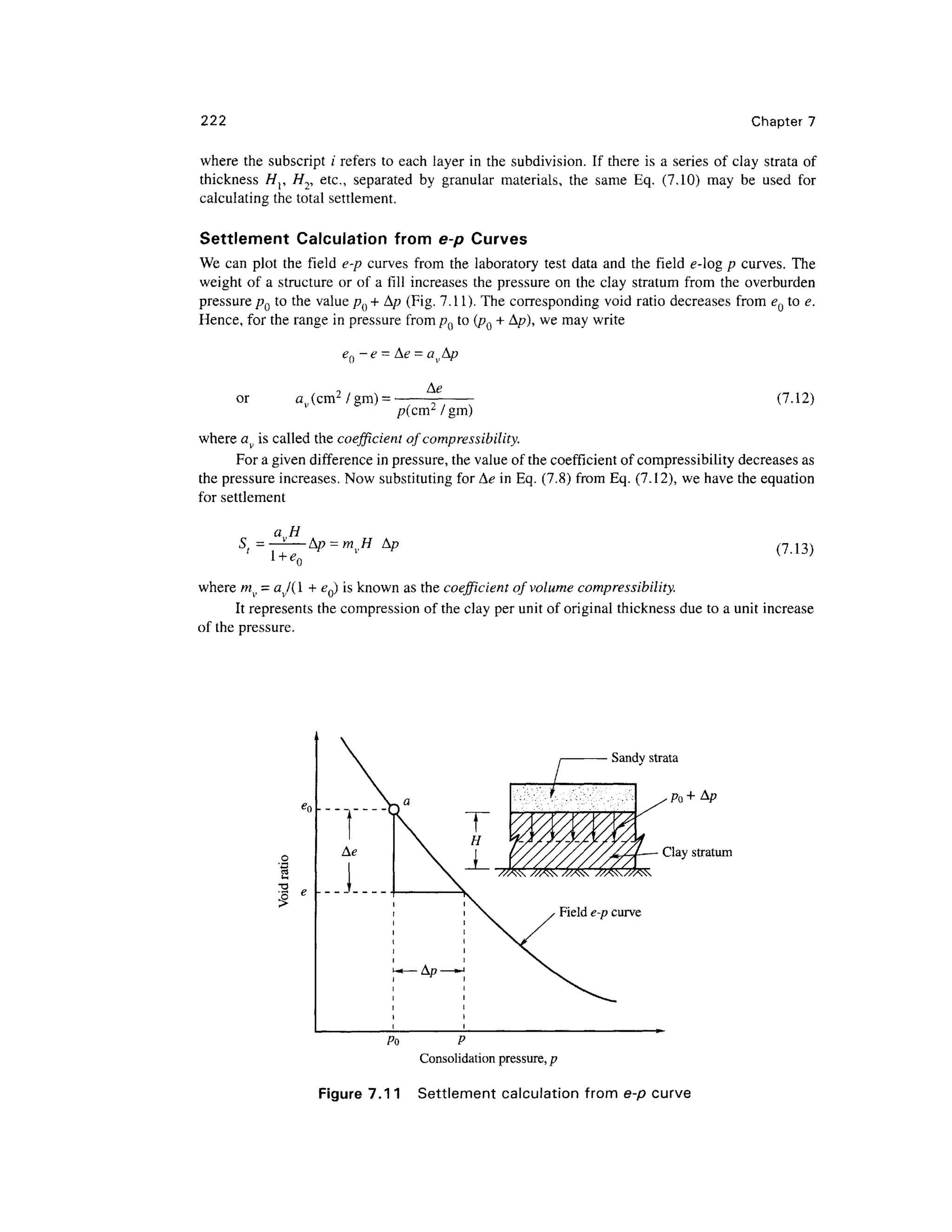
We can plot the field e-p curves from the laboratory test data and the field e-og p curves. The
weight of a structure or of a fill increases the pressure on the clay stratum from the overburden
pressure pQ to the value p() + A/? (Fig. 7.11). The corresponding void ratio decreases from eQ to e.
Hence, for the range in pressure from pQ to (pQ + A/?), we may write
-e -
or av (cm2
/gm) = (7.12)
/?(cm2
/gin)
where av is called the coefficient of compressibility.
For a given difference in pressure, the value of the coefficient of compressibility decreases as
the pressure increases. Now substituting for Ae in Eq. (7.8) from Eq. (7.12), we have the equation
for settlement
a H
S; = —-—Ap = mvH A/? (7.13)
where mv = av/( 1 + eQ) is known as the coefficient of volume compressibility.
It represents the compression of the clay per unit of original thickness due to a unit increase
of the pressure.
Clay stratum
Po P
Consolidation pressure, p
Figure 7.11 Settlement calculation from e-p curve
Compressibility and Consolidation 223
Settlement Calculation from e-log p Curve for Overconsolidated Clay Soil
Fig. 7.9(b) gives the field curve Kffor preconsolidated clay soil. The settlement calculation depends
upon the excess foundation pressure Ap over and above the existing overburden pressure pQ.
Settlement Computation, if pQ + A/0 < pc (Fig. 7.9(b))
In such a case, use the sloping line AB. If Cs = slope of this line (also called the swell index), we
have
a
c =
log(p
o+Ap)
(7.14a)
Po
or A* = C,log^ (7.14b)
By substitutingfor A<? in Eq. (7.8), we have
(7.15a)
Settlement Computation, if p0 < pc < p0 + Ap
We may write from Fig.7.9(b)
Pc
(715b)
In this case the slope of both the lines AB and EC in Fig.7.9(b) are required to be considered.
Now the equation for St may be written as [from Eq. (7.8) and Eq. (7.15b)]
CSH pc CCH
log— + —-— log
* Pc
The swell index Cs « 1/5 to 1/10Cc can be used as a check.
Nagaraj and Murthy (1985) have proposed the following equation for Cs as
C =0.0463 -^- G
100 s
where wl = liquid limit, Gs = specific gravity of solids.
Compression Index Cc —Empirical Relationships
Research workers in different parts of the world have established empirical relationships between
the compression index C and other soil parameters. A few of the important relationships are given
below.
Skempton's Formula
Skempton (1944) established a relationship between C, and liquid limits for remolded clays as
Cc =0.007 (wl - 10) (7.16)
where wl is in percent.
224 Chapter 7
Terzaghi and Peck Formula
Based on the work of Skempton and others, Terzaghi and Peck (1948) modified Eq. (7.16)
applicable to normally consolidated clays of low to moderate sensitivityas
Cc = 0.009 (w, -10) (7.17)
Azzouz et al., Formula
Azzouz et al., (1976) proposed a number of correlations based on the statistical analysis of a
number of soils. The one of the many which is reported to have 86 percent reliability is
Cc =0.37 (eQ +0.003 w{ +0.0004 wn - 0.34) (7.18)
where eQ = in-situ void ratio, wf and wn are in per cent. For organic soil they proposed
Cc = 0.115wn (7.19)
Hough's Formula
Hough (1957), on the basis of experiments on precompressed soils, has given the following
equation
Cc = 0.3 (e0- 0.27) (7.20)
Nagaraj and Srinivasa Murthy Formula
Nagaraj and Srinivasa Murthy (1985) have developed equations based on their investigation as
follows
Cc = 0.2343 e, (7.21)
Cc = 0.39*0 (7.22)
where el is the void ratio at the liquid limit, and eQ is the in-situ void ratio.
In the absence of consolidation test data, one of the formulae given above may be used for
computing Cc according to the judgment of the engineer.
7.9 SETTLEMENT DUE TO SECONDARY COMPRESSION
In certain types of clays the secondary time effects are very pronounced to the extent that in some
cases the entire time-compression curve has the shape of an almost straight sloping line when
plotted on a semilogarithmic scale, instead of the typical inverted S-shape with pronounced
primary consolidation effects. These so called secondary time effects are a phenomenon somewhat
analogous to the creep of other overstressed material in a plastic state. A delayed progressive
slippage of grain upon grain as the particles adjust themselves to a more dense condition, appears to
be responsible for the secondary effects. When the rate of plastic deformations of the individualsoil
particles or of their slippage on each other is slower than the rate of decreasing volume of voids
between the particles, then secondary effects predominate and this is reflected by the shape of the
time compression curve. The factors which affect the rate of the secondary compression of soils are
not yet fully understood, and no satisfactory method has yet been developed for a rigorous and
reliable analysis and forecast of the magnitude of these effects. Highly organic soils are normally
subjected to considerable secondary consolidation.
The rate of secondary consolidation may be expressed by the coefficient of secondary
compression, Ca as
Compressibility and Consolidation 225
c = cn or Ae = Ca log —
*
(7.23)
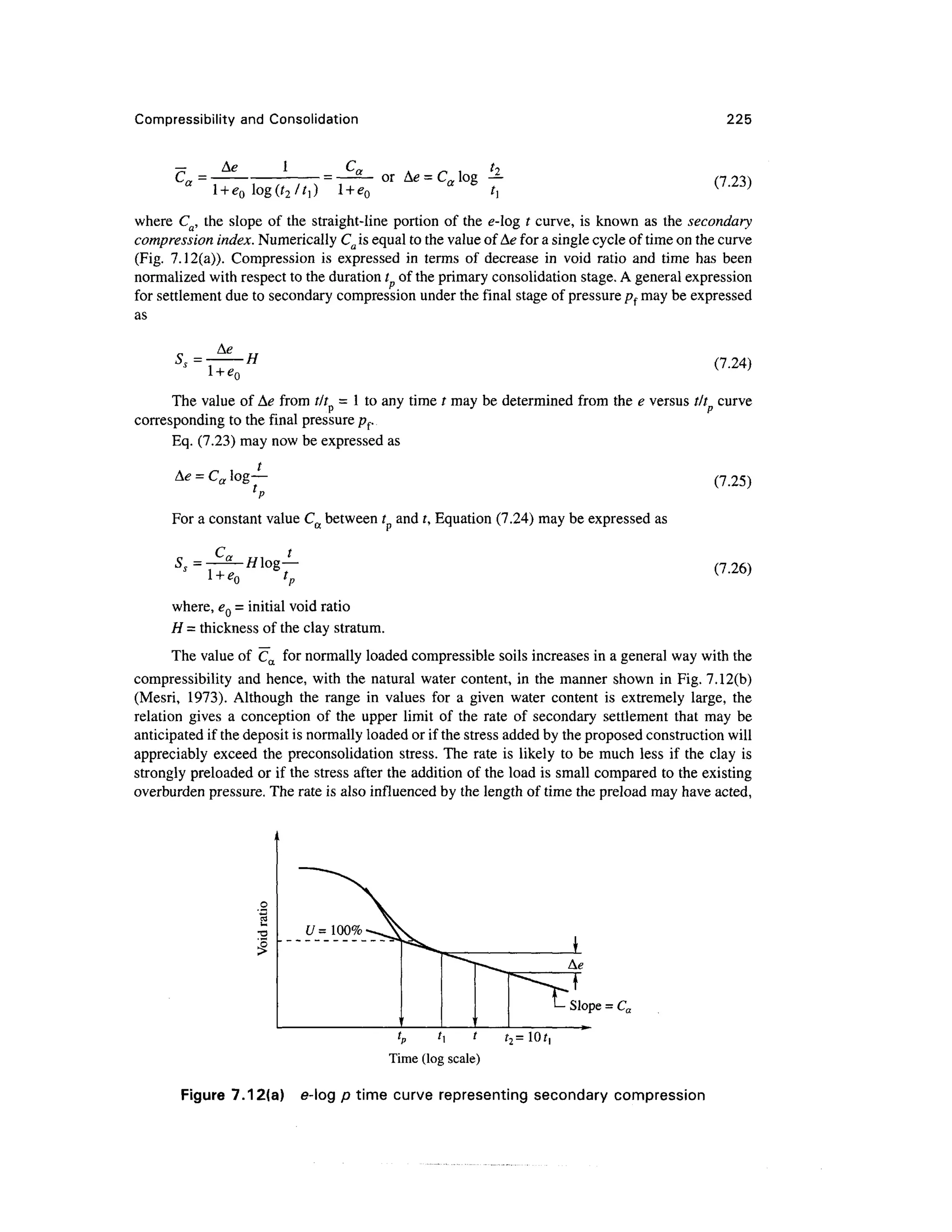
where Ca, the slope of the straight-line portion of the e-log t curve, is known as the secondary
compression index. Numerically Ca is equal to the value of Ae for a single cycle of time on the curve
(Fig. 7.12(a)). Compression is expressed in terms of decrease in void ratio and time has been
normalized with respect to the duration t of the primary consolidation stage. A general expression
for settlement due to secondary compression under the final stage of pressure pf may be expressed
as
5 = •H (7.24)
The value of Ae from tit = 1 to any time / may be determined from the e versus tit curve
corresponding to the final pressure pf.
Eq. (7.23) may now be expressed as
A<? = Ca log—
For a constant value Ca between t and t, Equation (7.24) may be expressed as
(7.25)
(7.26)
where, eQ - initial void ratio
H = thickness of the clay stratum.
The value of Ca for normally loaded compressible soils increases in a general way with the
compressibility and hence, with the natural water content, in the manner shown in Fig. 7.12(b)
(Mesri, 1973). Although the range in values for a given water content is extremely large, the
relation gives a conception of the upper limit of the rate of secondary settlement that may be
anticipated if the deposit is normally loaded or if the stress added by the proposed constructionwill
appreciably exceed the preconsolidation stress. The rate is likely to be much less if the clay is
strongly preloaded or if the stress after the addition of the load is small compared to the existing
overburden pressure. The rate is also influenced by the length of time the preload may have acted,
Slope = Ca
r2 =10f,
Time (logscale)
Figure 7.12(a) e-log p time curve representing secondary compression
226 Chapter 7
100
10
1.0-
0.1
10
1. Sensitive marine clay, New
Zealand
2. Mexico city clay
3. Calcareous organic clay
4. Leda clay
5. Norwegian plastic clay
6. Amorphous and fibrous peat
7. Canadian muskeg
8. Organic marine deposits
9. Boston blue clay
10. Chicago blue clay
11. Organic silty clay
O Organic silt, etc.
100
Natural water content, percent
1000 3000
Figure 7.12(b) Relationship between coefficient of secondary consolidation and
natural water content of normally loaded deposits of clays and various compressible
organic soils (after Mesri, 1973)
by the existence of shearing stresses and by the degree of disturbance of the samples. The effects of
these various factors have not yet been evaluated. Secondary compression is high in plastic clays
and organic soils. Table 7.1 provides a classification of soil based on secondary compressibility. If
'young, normally loaded clay', having an effective overburden pressure of p0 is left undisturbed for
thousands of years, there will be creep or secondary consolidation. This will reduce the void ratio
and consequently increase the preconsolidation pressure which will be much greater than the
existing effective overburden pressure pQ. Such a clay may be called an aged, normally
consolidated clay.
Mesri and Godlewski (1977) report that for any soil the ratio Ca/Cc is a constant (where Cc is
the compression index).This is illustrated in Fig. 7.13 for undisturbed specimens of brown Mexico
City clay with natural water content wn = 313 to 340%, vv; = 361%, wp = 9% andpc/po = 1.4
Table 7.2 gives values of Ca/Ccfor some geotechnical materials (Terzaghi, et al., 1996).
It is reported (Terzaghi et al., 1996) that for all geotechnical materials Ca/Cc ranges from
0.01 to 0.07. The value 0.04 is the most common value for inorganic clays and silts.
Compressibility and Consolidation 227
0.3
0.2
•o
§
0.1
i i
Mexico City clay
calcc = 0.046
0 1 2 3 4 5 6
Compression index Cc
Figure 7.13 An example of the relation between Ca and Cc (after Mesri and
Godlewski, 1977)
Table 7.1 Classification of soil based on secondary compressibility (Terzaghi,
et al., 1996)
C Secondary compressibility
< 0.002
0.004
0.008
0.016
0.032
0.064
Very low
Low
Medium
High
Very high
Extremely high
Table 7.2 Values of CaICc for geotechnical materials (Terzaghi, et al., 1996)
Material
Granular soils including rockfill 0.02 ± 0.01
Shale and mudstone 0.03 ± 0.01
Inorganic clay and silts 0.04 ± 0.01
Organic clays and silts 0.05 ± 0.01
Peat and muskeg 0.06 ± 0.01
Example 7.1
During a consolidation test, a sample of fully saturated clay 3 cm thick (= hQ) is consolidated under
a pressure increment of 200 kN/m2
. When equilibrium is reached, the sample thickness is reduced
to 2.60cm. The pressure is then removed and the sample is allowed to expand and absorb water.
The final thickness is observed as 2.8 cm (ft,) and the final moisture content is determined as 24.9%.
228 Chapter 7
K, = 0.672 cm3
Figure Ex. 7.1
If the specific gravity of the soil solids is 2.70, find the void ratio of the sample before and after
consolidation.
Solution
Use equation (7.3)
-
h
A/z
1. Determination of 'e*
Weight of solids = Ws = VsGs Jm = 1 x 2.70 x 1 = 2.70 g.
W
W
= 0.249 or Ww =0.249 x 2.70 = 0.672 gm, ef = Vw= 0.672.
2. Changes in thickness from final stage to equilibrium stage with load on
(1+ 0.672)0.20
A/i = 2.80 -2.60 = 0.20 cm,
2.80
• = 0.119.
Void ratio after consolidation = e,- &e =0.672 - 0.119 = 0.553.
3. Change in void ratiofrom the commencement to the end of consolidation
1+0
-553
(3.00 - 2.60) = x 0.40 = 0.239.
2.6 2.6
Void ratio at the start of consolidation = 0.553 + 0.239 = 0.792
Example 7.2
A recently completed fill was 32.8 ft thick and its initial average void ratio was 1.0. The fill was
loaded on the surface by constructing an embankment covering a large area of the fill. Some
months after the embankment was constructed, measurements of the fill indicated an average void
ratio of 0.8. Estimate the compression of the fill.
Compressibility and Consolidation 229
Solution
Per Eq. (7.7), the compression of the fill may be calculated as
where AH = the compression, Ae = change in void ratio, eQ =initial void ratio, HQ =thickness of fill.
Substituting, A/f = L0
~0
-8
x 32.8 = 3.28 ft .
Example 7.3
A stratum of normally consolidated clay 7 m thick is located at a depth 12m below ground level.
The natural moisture content of the clay is 40.5 per cent and its liquid limit is 48 per cent. The
specific gravity of the solid particles is 2.76. The water table is located at a depth 5 m below ground
surface. The soil is sand above the clay stratum.The submerged unit weight of the sand is 1 1 kN/m3
and the same weighs 18 kN/m3
above the water table. The average increase in pressure at the center
of the clay stratum is 120 kN/m2
due to the weight of a building that will be constructed on the sand
above the clay stratum. Estimate the expected settlement of the structure.
Solution
1. Determination of e and yb for the clay [Fig. Ex. 7.3]
W
=1x2.76x1= 2.76 g
405
W = — x2.76 = 1.118 g
w
100
„
r
vs i
= UI& +2.76 = 3.878 g
W
' 1 Q - J / 3
Y, = - = - = 1-83 g/cm
' 2.118
Yb =(1.83-1) = 0.83 g/cm3
.
2. Determination of overburden pressure pQ
PO =yh
i +Y2h
i +yA °r
P0= 0.83x9.81x3.5 + 11x7 + 18x5 = 195.5 kN/m2
3. Compression index [Eq. 11.17]
Cc = 0.009(w, -10) = 0.009 x (48 -10) = 0.34
230 Chapter 7
w
w.
5m
7m J
7m
I
(b)
Fig. Ex. 7.3
4. Excess pressure
A;? = 120 kN/m2
5. Total Settlement
C
st =
0.34 __n i 195.5+ 120 000
x 700log = 23.3 cm
2.118 " 195.5
Estimated settlement = 23.3 cm.
Example 7.4
A column of a buildingcarries a load of 1000 kips. The load is transferred to sub soil through a square
footing of size 16 x 16 ft founded at a depth of 6.5 ft below ground level. The soil below the footing
is fine sand up to a depth of 16.5 ft and below this is a soft compressible clay of thickness 16 ft. The
water table is found at a depth of 6.5 ft below the base of the footing.The specific gravities of the solid
particles of sand and clay are 2.64 and 2.72 and their natural moisture contents are 25 and 40 percent
respectively. The sand above the water table may be assumed to remain saturated. If the plastic limit
and the plasticity index of the clay are 30 and 40 percent respectively, estimate the probable settlement
of the footing (see Fig. Ex. 7.4)
Solution
1. Required A/? at the middle of the clay layer using the Boussinesq equation
24.5
16
= 1.53< 3.0
Divide the footing into 4 equal parts so that Z/B > 3
The concentrated load at the center of each part = 250 kips
Radial distance, r = 5.66 ft
By the Boussinesq equation the excess pressure A/? at depth 24.5 ft is (IB = 0.41)
0.41 = 0.683k/ft2
24.5'
Compressibility and Consolidation 231
. - . * ' . . •
.•6.5 ft W.
CX
3
^^ferief,.
24.5 ft = Z
16ft
16ft - r = 5.66 ft
Figure Ex. 7.4
2. Void ratio and unit weights
Per the procedure explained in Ex. 7.3
For sand y, = 124 lb/ft3
yfc = 61.6 lb/ft3
For clay yb = 51.4 lb/ft3
<?0 = 1.09
3. Overburden pressure pQ
pQ = 8 x 51.4 + 10 x 62 + 13 x 124 = 2639 lb/ft2
4. Compression index
w/ = Ip + wp =40 + 30 = 70%, Cc =0.009 (70 - 10)= 0.54
0.54 ... . 2639 +683 ft/liaA A 0, .
Settlement S, = . ._x!6xlog = 0.413 ft = 4.96m.
1+ 1.09 2639
Example 7.5
Soil investigation at a site gave the following information. Fine sand exists to a depth of 10.6 m and
below this lies a soft clay layer 7.60 m thick. The water table is at 4.60 m below the ground surface.
The submerged unit weight of sand yb is 10.4 kN/m3
, and the wet unit weight above the water table
is 17.6 kN/m3
. The water content of the normally consolidated clay wn = 40%, its liquid limit
wt = 45%, and the specific gravity of the solid particles is 2.78. The proposed construction will
transmit a net stress of 120 kN/m2
at the center of the clay layer. Find the average settlement of the
clay layer.
232 Chapter 7
Solution
For calculating settlement [Eq. (7.15a)]
C pn +A/?
S = —— Hlog^-- where &p = 120 kN/ m2
l +eQ pQ
From Eq. (7.17), Cr = 0.009 (w, - 10)= 0.009(45 - 10)= 0.32
wG
From Eq.(3.14a), eQ = - = wG =0.40 x2.78 =1.11 since S= 1
tJ
Yb, the submerged unit weight of clay, is found as follows
MG.+«.) = 9*1(2.78+ Ul) 3
' ^"t 1 , 1 . 1 1 1
l +eQ l + l.ll
Yb=Y^-Yw =18.1-9.81= 8.28 kN/m3
The effective vertical stress pQ at the mid height of the clay layer is
pQ =4.60 x 17.6 + 6x 10.4 +— x 8.28 = 174.8 kN / m2
_ 0.32x7.60, 174.8 + 120
Now St = - log- = 0.26m = 26 cm
1
1+1.11 174.8
Average settlement = 26 cm.
Example 7.6
A soil sample has a compression index of 0.3. If the void ratio e at a stress of 2940 Ib/ft2
is 0.5,
compute (i) the void ratio if the stress is increased to 4200 Ib/ft2
, and (ii) the settlement of a soil
stratum 13 ft thick.
Solution
Given: Cc =0.3, el =0.50, /?, = 2940 Ib/ft2
, p2 =4200 Ib/ft2
.
(i) Now from Eq. (7.4),
p — p
C i %."-)
C = l
- 2
—
or e2 = e]-c
substituting the known values, we have,
e- = 0.5 - 0.31og - 0.454
2
2940
(ii) The settlement per Eq. (7.10) is
c c
c „, Pi 0.3x13x12, 4200
S = —— //log— = - log- = 4.83m.
pl 1.5 2940
Compressibility and Consolidation 233
Example 7.7
Two points on a curve for a normally consolidated clay have the following coordinates.
Point 1 : *, = 0.7, Pl =2089 lb/ft2
Point 2: e2 = 0.6, p2 = 6266 lb/ft2
If the average overburden pressure on a 20 ft thick clay layer is 3133 lb/ft2
, how much
settlement will the clay layer experience due to an induced stress of 3340 lb/ft2
at its middepth.
Solution
From Eq. (7.4) we have
C - e
^e
> = °-7
"a6
-021
c
ogp2/pl log(6266/2089)
We need the initial void ratio eQ at an overburden pressure of 3133 lb/ft2
.
en -e~
C =—2—T2
— = 0.21
or (eQ - 0.6) = 0.21 log (6266/3133) = 0.063
or eQ = 0.6 + 0.063 = 0.663.
Settlement, s =
Po
Substituting the known values, with Ap = 3340 lb/ft2
„ 0.21x20x12, 3133 +3340 nee.
$ =- log- = 9.55 in
1.663 &
3133
7.10 RATE OF ONE-DIMENSIONAL CONSOLIDATION THEORY OF
TERZAGHI
One dimensional consolidation theory as proposed by Terzaghi is generally applicable in all cases
that arise in practice where
1. Secondary compression is not very significant,
2. The clay stratum is drained on one or both the surfaces,
3. The clay stratum is deeply buried, and
4. The clay stratum is thin compared with the size of the loaded areas.
The following assumptions are made in the development of the theory:
1. The voids of the soil are completely filled with water,
2. Both water and solid constituents are incompressible,
3. Darcy's law is strictly valid,
4. The coefficient of permeability is a constant,
5. The time lag of consolidation is due entirely to the low permeability of the soil, and
6. The clay is laterally confined.
234 Chapter 7
Differential Equation for One-Dimensional Flow
Consider a stratum of soil infinite in extent in the horizontal direction (Fig. 7.14) but of such
thickness //, that the pressures created by the weight of the soil itself may be neglected in
comparison to the applied pressure.
Assume that drainage takes place only at the top and further assume that the stratum has been
subjected to a uniform pressure of pQ for such a long time that it is completely consolidated under
that pressure and that there is a hydraulic equilibrium prevailing, i.e., the water level in the
piezometric tube at any section XY in the clay stratum stands at the level of the water table
(piezometer tube in Fig. 7.14).
Let an increment of pressure A/? be applied. The total pressure to which the stratum is
subjected is
Pl=pQ +Ap (7.27)
Immediately after the increment of load is applied the water in the pore space throughout the
entire height, H, will carry the additional load and there will be set up an excess hydrostatic
pressure ui throughout the pore water equal to Ap as indicated in Fig. 7.14.
After an elapsed time t = tv some of the pore water will have escaped at the top surface and as a
consequence, the excess hydrostaticpressure will have been decreased and a part of the load transferred to
the soil structure.The distributionof the pressure between the soil and the pore water,p and u respectively
at any time t, may be represented by the curve as shown in the figure. It is evidentthat
Pi=p + u (7.28)
at any elapsed time t and at any depth z, and u is equal to zero at the top. The pore pressure u, at any
depth, is therefore a function of z and / and may be written as
u =f(z, t) (7.29)
Piezometers
Impermeable
(a) (b)
Figure 7.14 One-dimensional consolidation
Compressibility and Consolidation 235
Consider an element of volume of the stratum at a depth z, and thickness dz (Fig. 7.14). Let
the bottom and top surfaces of this element have unit area.
The consolidation phenomenon is essentially a problem of non-steady flow of water through a
porous mass. The difference between the quantity of water that enters the lower surface at level X'Y'
and the quantityof water which escapes the upper surface at level XY in time element dt must equal the
volume change of the material which has taken place in this element of time. The quantity of water is
dependent on the hydraulic gradient which is proportional to the slope of the curve t.
The hydraulic gradients at levels XY and X'Y' of the element are
, 1 d du 1 du ^ 1 d2
u ,
iss
^-*u+
** =
TwTz+
Tw^dz (7
-30)
If k is the hydraulic conductivity the outflow from the element at level XY in time dt is
k du
dql=ikdt =——dt (7.31)
' W **
The inflow at level X'Y' is
k du d2
u
dq2 =ikdt = ~^dt + -^dzdt (7.32)
The difference in flow is therefore
k
dq =dq^ -dq2 = -—-r-^dz dt (7.33)
• w
From the consolidation test performed in the laboratory, it is possible to obtain the
relationship between the void ratios corresponding to various pressures to which a soil is subjected.
This relationship is expressed in the form of a pressure-void ratio curve which gives the
relationship as expressed in Eq. (7.12)
de = avdp (7.34)
The change in volume Adv of the element given in Fig. 7.14 may be written as per
Eq. (7.7).
de
Mv = Mz = --dz (7.35)
i + e
Substituting for de, we have
(7.36)
Here dp is the change in effective pressure at depth z during the time element dt. The increase
in effective pressure dp is equal to the decrease in the pore pressure, du.
du
Therefore, dp = -du =-^~dt (7.37)
at
236 Chapter 7
av du du
Hence, Mv =— — dtdz =-tnv—dtdz (7.38)
l +e at v
dt v
'
Since the soil is completely saturated, the volume change AJv of the element of thickness
dz in time dt is equal to the change in volume of water dq in the same element in time dt.
Therefore, dq = Mv (7.39)
or
or
k d2
u
-, -, di L
rw di2
k( +e}d2
u
Ywav dz2
a du
-it -i -if
u — , ^ az at
l +e dt
dt v
dz2
k
y a y m
' W V ' W V
is defined as the coefficient of consolidation.
(7.40)
(7.41)
Eq. (7.40) is the differential equation for one-dimensional flow. The differential equation for
three-dimensional flow may be developed in the same way. The equation may be written as
du l +e d2
u d2
u d2
u
(7
'42)
where kx, ky and kz are the coefficients of permeability (hydraulic conductivity) in the coordinate
directions of jc, y and z respectively.
As consolidation proceeds, the values of k, e and av all decrease with time but the ratio
expressed by Eq. (7.41) may remain approximately constant.
Mathematical Solution for the One-Dimensional Consolidation Equation
To solve the consolidation Eq. (7.40) it is necessary to set up the proper boundary conditions. For
this purpose, consider a layer of soil having a total thickness 2H and having drainage facilities at
both the top and bottom faces as shown in Fig. 7.15. Under this condition no flow will take place
across the center line at depth H. The center line can therefore be considered as an impervious
barrier. The boundary conditions for solving Eq. (7.40) may be written as
1. u = 0 when z = 0
2. u = 0 when z = 2H
3. u = <p for all depths at time t = 0
On the basis of the above conditions, the solution of the differential Eq. (7.40) can be
accomplished by means of Fourier Series.
The solution is
mz _m2r
u= - sin —eml
(7.43)
m H
1)* cvt .
where m -- , / = —— = a non-dimensional time factor.
2 H2
Eq. (7.43) can be expressed in a general form as
Compressibility and Consolidation 237
H
H
Clay
'• Sand y..'•:.': I
P
Figure 7.15 Boundary conditions
~Kp=f
~H'T (7
'44)
Equation (7.44) can be solved by assuming T constant for various values of z/H. Curves
corresponding to different values of the timefactor T may be obtained as given in Fig. 7.16. It is of
interest to determine how far the consolidation process under the increment of load Aphas progressed
at a time t corresponding to the timefactor T at a given depth z. The term £/, is used to express this
relationship. It is defined as the ratio of the amount of consolidation which has already taken place to
the total amount which is to take place under the load increment.
The curves in Fig. 7.16 shows the distribution of the pressure Apbetween solid and liquid phases
at various depths. At a particular depth, say z/H =0.5, the stress in the soil skeleton is represented by AC
and the stress in water by CB. AB represents the original excess hydrostatic pressure ui =Ap.The degree
of consolidation Uz percent at this particular depth is then
AC Ap-« u
u %= ioox—- = -t
-— =100 i-—
z
AB Ap Ap (7.45)
r
1.0
A/7-U
0.5
z/H 1.0
r=o
1.5
2.0
T= oo
Figure 7.16 Consolidation of clay layer as a function T
238 Chapter 7
Following a similar reasoning, the average degree of consolidation U% for the entire layer at
a time factor Tis equal to the ratio of the shaded portion (Fig. 7.16) of the diagram to the entire area
which is equal to 2H A/?.
Therefore
2H
U% = u
_.. xlOO
2H
or £/% = 2H—— udz
2H ^p
o
Hence, Eq. (7.46) after integration reduces to
(7.46)
£/%=100 1- —-£ -m2
T
(7.47)
It can be seen from Eq. (7.47) that the degree of consolidation is a function of the time factor T
only which is a dimensionless ratio. The relationship between Tand U% may therefore be established
once and for all by solving Eq. (7.47) for various values of T. Values thus obtained are given in
Table 7.3 and also plotted on a semilog plot as shown in Fig. 7.17.
For values of U% between 0 and 60%, the curve in Fig. 7.17 can be represented almost
exactly by the equation
T =
4 100
which is the equation of a parabola. Substituting for T, Eq. (7.48) may be written as
U%
oo
(7.48)
(7.49)
u%
u
20
40
60
80
100
O.C
—•—„
--

,
k

^^
)03 0.01 0.03 0.1 0.3 1.0 3.0 10
Time factor T(log scale)
Figure 7.17 U versus T
Compressibility and Consolidation 239
Table 7.3 Relationship between U and T
u%
0
10
15
20
25
30
35
T
0
0.008
0.018
0.031
0.049
0.071
0.096
U%
40
45
50
55
60
65
70
T
0.126
0.159
0.197
0.238
0.287
0.342
0.405
U%
75
80
85
90
95
100
T
0.477
0.565
0.684
0.848
1.127
oo
In Eq. (7.49), the values of cv and H are constants. One can determine the time required to
attain a given degree of consolidation by using this equation. It should be noted that H represents
half the thickness of the clay stratum when the layer is drained on both sides, and it is the full
thickness when drained on one side only.
TABLE 7.4 Relation between U% and T (Special Cases)
Permeable Permeable
U%
Impermeable
Case 1
Impermeable
Case 2
Time Factors, T
Consolidation pressure
increase with depth
Consolidation pressure
decreases with depth
00
10
20
30
40
50
60
70
80
90
95
100
0
0.047
0.100
0.158
0.221
0.294
0.383
0.500
0.665
0.94
1
oo
0
0.003
0.009
0.024
0.048
0.092
0.160
0.271
0.44
0.72
0.8
oo
240 Chapter 7
For values of U% greater than 60%, the curve in Fig. 7.17 may be represented by the equation
T= 1.781 - 0.933 log (100 - U%) (7.50)
Effect of Boundary Conditions on Consolidation
A layer of clay which permits drainage through both surfaces is called an open layer. The thickness
of such a layer is always represented by the symbol 2H, in contrast to the symbol H used for the
thickness of half-closed layers which can discharge their excess water only through one surface.
The relationshipexpressed between rand (/given in Table 7.3 applies to the following cases:
1. Where the clay stratum is drained on both sides and the initial consolidation pressure
distribution is uniform or linearly increasing or decreasing with depth.
2. Where the clay stratum is drained on one side but the consolidation pressure is uniform
with depth.
Separate relationships between T and U are required for half closed layers with thickness H
where the consolidation pressures increase or decrease with depth. Such cases are exceptional and
as such not dealt with in detail here. However, the relations between U% and 7"for these two cases
are given in Table 7.4.
7.11 DETERMINATION OF THE COEFFICIENT OF CONSOLIDATION
The coefficient of consolidation c can be evaluated by means of laboratory tests by fitting the
experimental curve with the theoretical.
There are two laboratory methods that are in common use for the determination of cv. They
are
1. Casagrande Logarithm of Time Fitting Method.
2. Taylor Square Root of Time Fitting Method.
Logarithm of Time Fitting Method
This method was proposed by Casagrande and Fadum (1940).
Figure 7.18 is a plot showing the relationship between compression dial reading and the
logarithm of time of a consolidation test. The theoretical consolidation curve using the log scale for
the time factor is also shown. There is a similarity of shape between the two curves. On the
laboratory curve, the intersection formed by the final straight line produced backward and the
tangent to the curve at the point of inflection is accepted as the 100 per cent primary consolidation
point and the dial reading is designated as /?100. The time-compression relationship in the early
stages is also parabolic just as the theoretical curve. The dial reading at zero primary consolidation
RQ can be obtained by selectingany two points on the parabolic portion of the curve where times are
in the ratio of 1 : 4. The difference in dial readings between these two points is then equal to the
difference between the first point and the dial reading corresponding to zero primary consolidation.
For example, two points A and B whose times 10 and 2.5 minutes respectively, are marked on the
curve. Let z{ be the ordinate difference between the two points.A point C is marked vertically over
B such that BC = zr Then the point C corresponds to zero primary consolidation. The procedure is
repeated with several points. An average horizontal line is drawn through these points to represent
the theoretical zero percent consolidation line.
The interval between 0 and 100% consolidation is divided into equal intervals of percent
consolidation. Since it has been found that the laboratory and the theoretical curves have better
Compressibility and Consolidation 241
Asymptote
Rf-
f i/4
t} log (time)
(a) Experimental curve (b) Theoretical curve
Figure 7.18 Log of time fitting method
correspondence at the central portion, the value of cy is computed by taking the time t and time
factor T at 50 percent consolidation. The equation to be used is
T
-~H
lr (7.51)
T -
1
5Q
c t
v 50
or
l
dr
where Hdr = drainage path
From Table 7.3, we have at U = 50%, T= 0.197. From the initial height //. of specimen and
compression dial reading at 50% consolidation, Hdr for double drainage is
H: ~
(7.52)
where hH= Compression of sample up to 50% consolidation.
Now the equation for c may be written as
c = 0.197
H
(7.53)
Square Root of Time Fitting Method
This method was devised by Taylor (1948). In this method, the dial readings are plotted against the
square root of time as given in Fig. 7.19(a). The theoretical curve U versus ^JT is also plotted and
shown in Fig. 7.19(b). On the theoretical curve a straight line exists up to 60 percent consolidation
while at 90 percent consolidation the abscissa of the curve is 1.15 times the abscissa of the straight
line produced.
The fitting method consists of first drawing the straight line which best fits the early portion of the
laboratory curve.Next a straight lineis drawnwhich at all points has abscissa 1.15 times as great as those
of the first line. The intersection of this line and the laboratory curve is taken as the 90 percent (RQQ)
consolidation point. Its value may be read and is designated as tgQ.
242 Chapter 7
(a) Experimental curve (b) Theoretical curve
Figure 7.19 Square root of time fitting method
Usually the straight line through the early portion of the laboratory curve intersects the zero
time line at a point (Ro) differing somewhat from the initial point (/?f.). This intersection point is
called the corrected zero point. If one-ninth of the vertical distance between the corrected zero
point and the 90 per cent point is set off below the 90 percent point, the point obtained is called the
"100 percent primary compression point" (Rloo). The compression between zero and 100 per cent
point is called "primary compression".
At the point of 90 percent consolidation, the value of T =0.848. The equation of cv may now
be written as
H2
c =0.848-^ (7.54)
'90
where H, - drainage path (average)
7.12 RATE OF SETTLEMENT DUE TO CONSOLIDATION
It has been explained that the ultimate settlement St of a clay layer due to consolidation may be
computed by using either Eq. (7.10) or Eq. (7.13). If S is the settlement at any time t after the
imposition of load on the clay layer, the degree of consolidation of the layer in time t may be
expressed as
U% = — x 100 percent
Since U is a function of the time factor T, we may write
(7.55)
= —xlOO
O
(7.56)
The rate of settlement curve of a structure built on a clay layer may be obtained by the
following procedure:
Compressibility and Consolidation 243
Time t
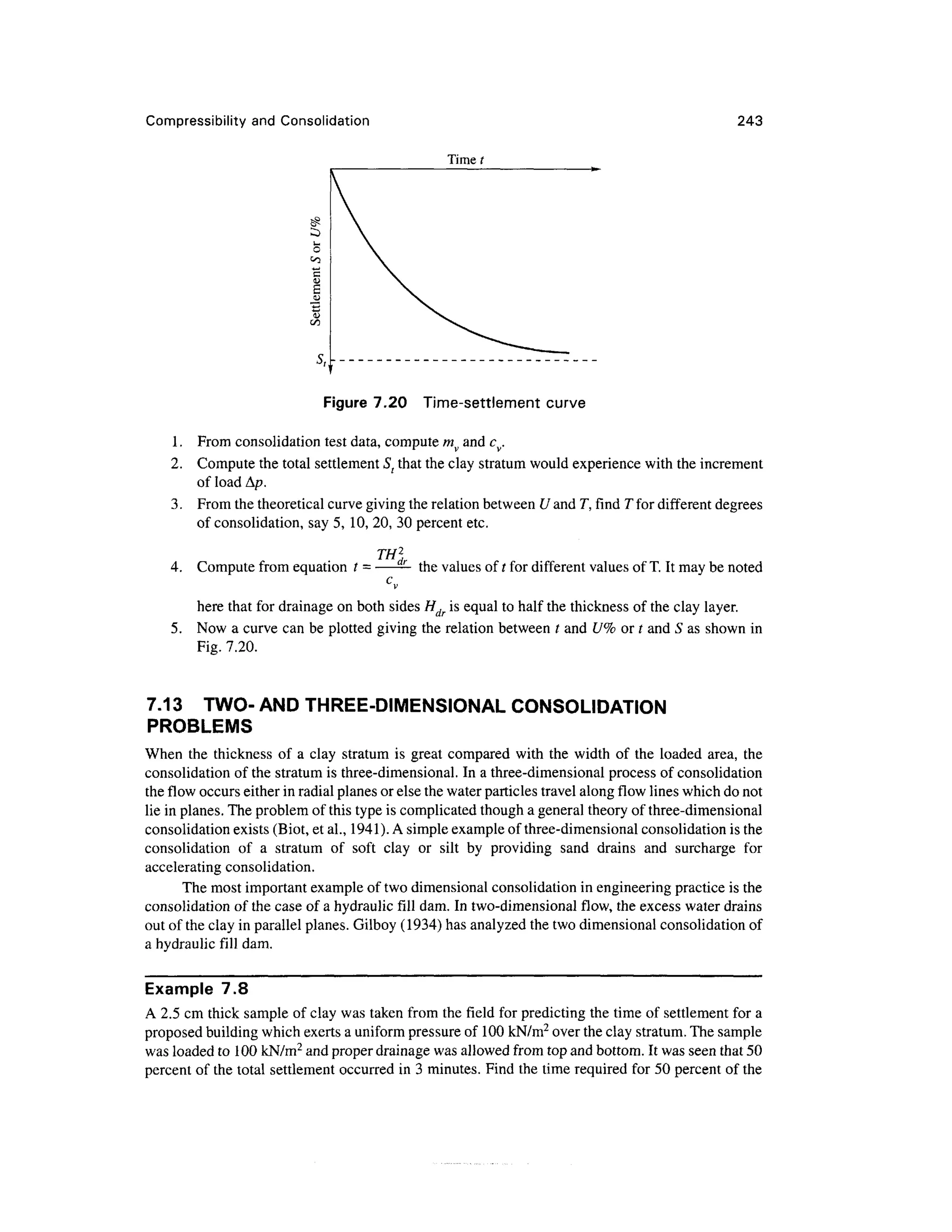
Figure 7.20 Time-settlement curve
1. From consolidation test data, compute mv and cv.
2. Compute the total settlement St that the clay stratum would experience with the increment
of load Ap.
3. From the theoretical curve giving the relation between U and T, find T for different degrees
of consolidation, say 5, 10, 20, 30 percent etc.
TH2
,
4. Compute from equation t =—— the values of t for different values of T. It may be noted
C
v
here that for drainage on both sides Hdr is equal to half the thickness of the clay layer.
5. Now a curve can be plotted giving the relation between t and U% or t and S as shown in
Fig. 7.20.
7.13 TWO- AND THREE-DIMENSIONAL CONSOLIDATION
PROBLEMS
When the thickness of a clay stratum is great compared with the width of the loaded area, the
consolidation of the stratum is three-dimensional. In a three-dimensional process of consolidation
the flow occurs either in radial planes or else the water particles travel along flow lines which do not
lie in planes. The problem of this type is complicated though a general theory of three-dimensional
consolidation exists (Biot, et al., 1941). A simple example of three-dimensional consolidation is the
consolidation of a stratum of soft clay or silt by providing sand drains and surcharge for
accelerating consolidation.
The most important example of two dimensional consolidation in engineering practice is the
consolidation of the case of a hydraulic fill dam. In two-dimensional flow, the excess water drains
out of the clay in parallel planes. Gilboy (1934) has analyzed the two dimensional consolidation of
a hydraulic fill dam.
Example 7.8
A 2.5 cm thick sample of clay was taken from the field for predicting the time of settlement for a
proposed building which exerts a uniform pressure of 100 kN/m2
over the clay stratum. The sample
was loaded to 100 kN/m2
and proper drainage was allowed from top and bottom. It was seen that 50
percent of the total settlement occurred in 3 minutes. Find the time required for 50 percent of the
244 Chapter 7
total settlement of the building,if it is to be constructed on a 6 m thick layer of clay which extends
from the ground surface and is underlain by sand.
Solution
Tfor 50% consolidation = 0.197.
The lab sample is drained on both sides. The coefficient of consolidation c is found from
TH2
(2 5)2
1
c = — =0.197 x —— x - = 10.25 x 10~2
cm2
/min.
t 4 3
The time t for 50% consolidation in the field will be found as follows.
0.197x300x300x100 ,„„_,
t = :
= 120 days.
10.25x60x24
Example 7.9
The void ratio of a clay sample A decreased from 0.572 to 0.505 under a change in pressure from
122 to 180 kN/m2
. The void ratio of another sample B decreased from 0.61to 0.557 under the same
increment of pressure. The thickness of sample A was 1.5 times that of B. Nevertheless the time
taken for 50% consolidation was 3 times larger for sample B than for A. What is the ratio of
coefficient of permeability of sample A to that of Bl
Solution
Let Ha = thickness of sample A, Hb = thickness of sample B, mva = coefficient of volume
compressibility of sample A, mvb = coefficient of volume compressibility of sample B, cva =
coefficient of consolidation for sample A, cvb = coefficient of consolidation for sample B, A/?a =
increment of load for sample A, A/?fe = increment of load for sample B, ka = coefficient of
permeability for sample A, and kb = coefficient of permeability of sample B.
We may write the following relationship
Ae 1 A<?, l
m = -a
---—,mh= -b
---—
va
 +e Aw vb
l +e, Ap,
a * a b rb
where e is the void ratio of sample A at the commencement of the test and Aea is the change in void
ratio. Similarly eb and keb apply to sample B.
-, and T =^K T, = ^fy-
wherein Ta, ta, Tb and tb correspond to samples A and B respectively. We may write
c T H2
t,
— =
"F^p *« = c
vam
varw> k
b =c
vbm
vbyw
vb b b a
k c m
™ r. a va va
Therefore, k c m
b vb vb
Given ea = 0.572, and eb = 0.61
A<? = 0.572-0.505 = 0.067, Ae. =0.610-0.557 = 0.053
a ' o
Compressibility and Consolidation 245
A D = Ap, = 180-122 = 58kN/m2
, H=l.5H,
But tb = 3ta
Q.Q67 1 + 0.61
a
We have, m = 0.053 * 1 + 0.572 = L29
vb
k
Therefore, T2
-= 6.75 x 1.29 = 8.7
K
b
The ratio is 8.7 : 1.
Example 7.10
A strata of normally consolidated clay of thickness 10 ft is drained on one side only. It has a
hydraulic conductivity of h = 1.863 x 10~8
in/sec and a coefficient of volume compressibility
rav = 8.6 x 10"4
in2
/lb. Determine the ultimate value of the compression of the stratum by assuming
a uniformly distributed load of 5250 lb/ft2
and also determine the time required for 20 percent and
80 percent consolidation.
Solution
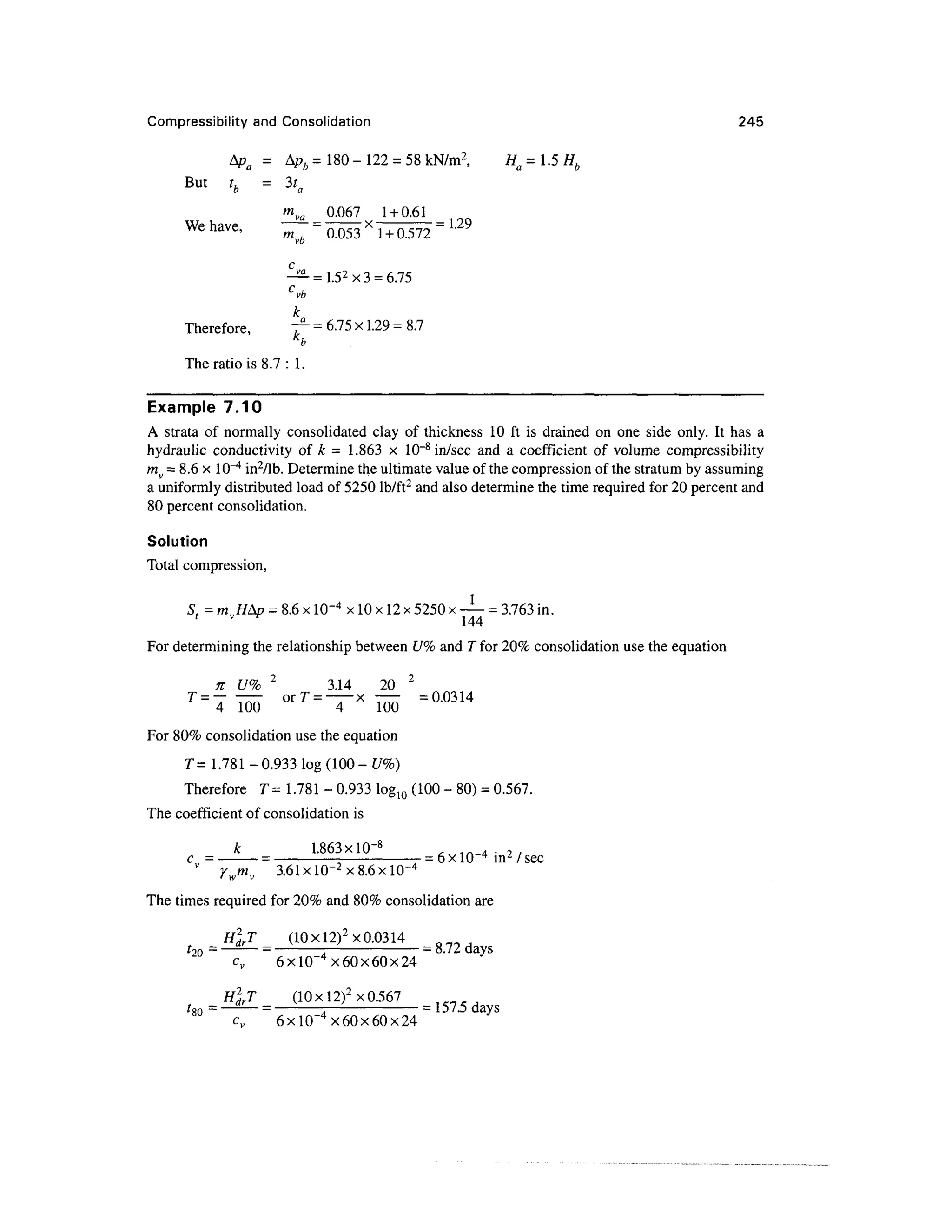
Total compression,
S = m //A/? = 8.6x 10~4
x 10 x 12x 5250 x — = 3.763 in.
< v f 144
For determining the relationship between U% and T for 20% consolidation use the equation
n U% 2
3.14 20 2
T
= ^m orT
=~x
m =a
°314
For 80% consolidation use the equation
T =1.781 - 0.933 log (100 - £/%)
Therefore T= 1.781 - 0.933 Iog10 (100 - 80) = 0.567.
The coefficient of consolidation is
k 1.863xlO~8
, m 4 • ? /
c = = - 6x 10~4
in2
/sec
ywmv 3.61xlO~2
x8.
The times required for 20% and 80% consolidation are
H2
drT (10xl2)2
x0.0314
f2o = —££L
— = ~A = 8.72 days
cv 6xlO"4
x60x60x24
H2
drT (10 x!2)2
x 0.567
?
so = =
A =
157.5 days
cv 6xlO"4
x60x60x24
246 Chapter 7
Example 7.11
The loading period for a new building extended from May 1995 to May 1997. In May 2000, the
average measured settlement was found to be 11.43 cm. It is known that the ultimate settlement will
be about 35.56 cm. Estimate the settlement in May 2005. Assume double drainage to occur.
Solution
For the majority of practical cases in which loading is applied over a period, acceptable accuracy is
obtained when calculating time-settlement relationships by assuming the time datum to be midway
through the loading or construction period.
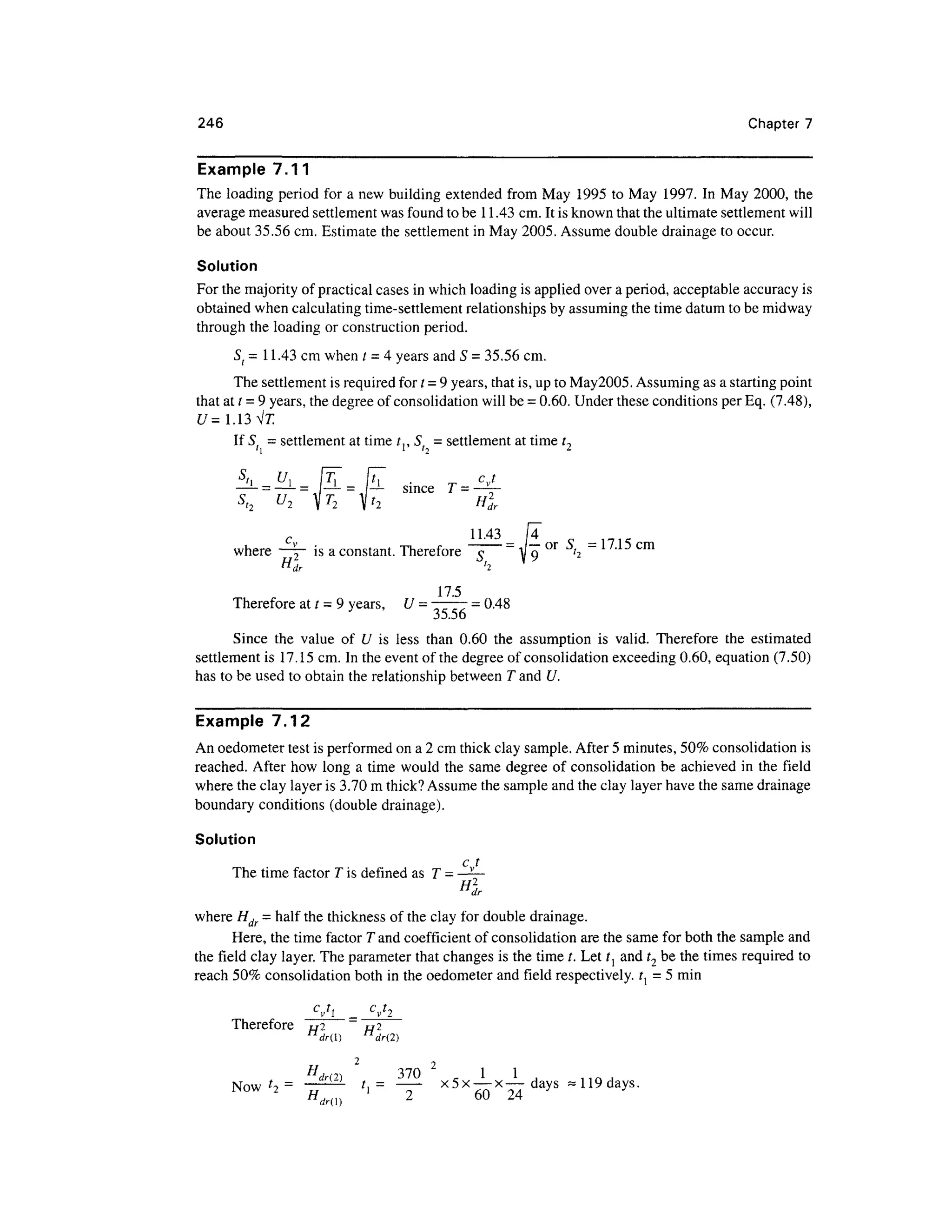
St = 11.43 cm when t = 4 years and 5 = 35.56 cm.
The settlement is required for t =9 years, that is, up to May2005. Assuming as a starting point
that at t =9 years, the degree of consolidation will be = 0.60. Under these conditions per Eq. (7.48),
U= 1.13 Vl
If St = settlement at time t,, S, = settlement at time t,
' l
= — since
H2
dr
IT
°r
~ cm
_
where ~~ is a constant. Therefore ~T ~ A o" '2
VL
^ , 1 -*
H
dr h
17.5
Therefore at t = 9 years, U =7777 = 0.48
35.56
Since the value of U is less than 0.60 the assumption is valid. Therefore the estimated
settlement is 17.15 cm. In the event of the degree of consolidation exceeding 0.60, equation (7.50)
has to be used to obtain the relationship between T and U.
Example 7.12
An oedometer test is performed on a 2 cm thick clay sample. After 5 minutes, 50% consolidation is
reached. After how long a time would the same degree of consolidation be achieved in the field
where the clay layer is 3.70 m thick?Assume the sample and the clay layer have the same drainage
boundary conditions (double drainage).
Solution
c,.t
The time factor T is defined as T -
where Hdr - half the thickness of the clay for double drainage.
Here, the time factor T and coefficient of consolidation are the same for both the sample and
the field clay layer. The parameter that changes is the time /. Let tl and t2 be the times required to
reach 50% consolidation both in the oedometer and field respectively. t{ = 5 min
=
Therefore t/2 t/2
n
dr() n
dr(2)
2 j
H, n, 3 7 0 1 1
Now f
i = t,= x5x — x—days ~ 119days.
WOW 2
Hd ' 2 6 0 2 4 y
Compressibility and Consolidation 247
Example 7.13
A laboratory sample of clay 2 cm thick took 15 min to attain 60 percent consolidation under a
double drainage condition. What time will be required to attain the same degree of consolidation
for a clay layer 3 m thick under the foundation of a building for a similar loading and drainage
condition?
Solution
Use Eq. (7.50) for U > 60% for determining T
T= 1.781-0.933 log(l00-£/%)
= 1.781-0.933 log (100-60) = 0.286.
From Eq. (7.51) the coefficient of consolidation, cv is
TH2
0.286 x (I)2
c = • = 1.91xlO~2
cm2
/min.
15
The value of cv remains constant for both the laboratory and field conditions. As such, we
may write,
lab  J field
where Hdr - half the thickness = 1cm for the lab sample and 150cm for field stratum, and
15 min.
Therefore,
tlab = 15 min.
or tf= (150)2
x 0.25 = 5625 hr or 234 days (approx).
for the field stratum to attain the same degree of consolidation.
7.14 PROBLEMS
7.1 A bed of sand 10m thick is underlain by a compressible of clay 3 m thick under which lies
sand. The water table is at a depth of 4 m below the ground surface. The total unit weights
of sand below and above the water table are 20.5 and 17.7 kN/m3
respectively. The clay has
a natural water content of 42%, liquid limit 46% and specific gravity 2.76. Assuming the
clay to be normally consolidated, estimate the probable final settlement under an average
excess pressure of 100 kN/m2
.
7.2 The effective overburden pressure at the middle of a saturated clay layer 12 ft thick is
2100 lb/ft2
and is drained on both sides. The overburden pressure at the middle of the clay
stratum is expected to be increased by 3150 lb/ft2
due to the load from a structure at the
ground surface. An undisturbed sample of clay 20 mm thick is tested in a consolidometer.
The total change in thickness of the specimen is 0.80 mm when the applied pressure is
2100 lb/ft2
. The final water content of the sample is 24 percent and the specific gravity of
the solids is 2.72. Estimate the probable final settlement of the proposed structure.
248 Chapter 7
7.3 The following observations refer to a standard laboratory consolidation test on an
undisturbed sample of clay.
Pressure
kN/m2
0
50
100
200
Final Dial Gauge
Reading x 10~2
mm
0
180
250
360
Pressure
kN/m2
400
100
0
Final Dial Gauge
Reading x 10~2
mm
520
470
355
The sample was 75 mm in diameter and had an initial thickness of 18 mm. The moisture
content at the end of the test was 45.5%; the specific gravity of solids was 2.53.
Compute the void ratio at the end of each loading increment and also determine whether
the soil was overconsolidated or not. If it was overconsolidated, what was the
overconsolidation ratio if the effective overburden pressure at the time of sampling was
60 kN/m2
?
7.4 The following points are coordinates on a pressure-void ratio curve for an undisturbed clay.
p 0.5 1 2 4 8 16 kips/ft2
e 1.202 1.16 1.06 0.94 0.78 0.58
Determine (i) Cc,and (ii) the magnitude of compression in a 10 ft thick layer of this clay for
a load increment of 4 kips/ft2
. Assume eQ = 1.320, andp0 =1.5 kips/ft2
7.5 The thickness of a compressible layer, prior to placing of a fill covering a large area, is 30
ft. Its original void ratio was 1.0. Sometime after the fill was constructed measurements
indicated that the average void ratio was 0.8. Determine the compression of the soil layer.
7.6 The water content of a soft clay is 54.2% and the liquid limit is 57.3%. Estimate the
compression index, by equations (7.17) and (7.18). Given eQ = 0.85
7.7 A layer of normally consolidated clay is 20 ft thick and lies under a recently constructed
building. The pressure of sand overlying the clay layer is 6300 lb/ft2
, and the new construction
increases the overburden pressure at the middle of the clay layer by 2100 lb/ft2
. If the
compression index is 0.5, compute the final settlement assuming vvn = 45%, Gs = 2.70, and the
clay is submerged with the water table at the top of the clay stratum.
7.8 A consolidation test was made on a sample of saturated marine clay. The diameter and
thickness of the sample were 5.5 cm and 3.75 cm respectively. The sample weighed 650 g
at the start of the test and 480 g in the dry state after the test. The specific gravity of solids
was 2.72. The dial readings corresponding to the final equilibrium condition under each
load are given below.
Pressure, kN/m2
0
6.7
11.3
26.6
53.3
DR cm x 10~4
0
175
275
540
965
Pressure, kN/m2
106
213
426
852
£>/?cm x 10-4
1880
3340
5000
6600
(a) Compute the void ratios and plot the e-og p curve.
(b) Estimate the maximum preconsolidation pressure by the Casagrande method.
(c) Draw the field curve and determine the compression index.
Compressibility and Consolidation 249
7.9 The results of a consolidation test on a soil sample for a load increased from 200 to
400 kN/m2
are given below:
Time in Min.
0
0.10
0.25
0.50
1.00
2.25
4.00
9.00
Dial reading division
1255
1337
1345
1355
1384
1423
1480
1557
Time in Min.
16
25
36
49
64
81
100
121
Dial reading division
1603
1632
1651
1661
1670
1677
1682
1687
The thickness of the sample corresponding to the dial reading 1255 is 1.561 cm. Determine
the value of the coefficient of consolidation using the square root of time fitting method in
cm2
/min. One division of dial gauge corresponds to 2.5 x lO^4
cm. The sample is drained
on both faces.
7.10 A 2.5 cm thick sample was tested in a consolidometer under saturated conditions with
drainage on both sides. 30 percent consolidation was reached under a load in
15 minutes. For the same conditions of stress but with only one way drainage, estimate the
time in days it would take for a 2 m thick layer of the same soil to consolidate in the field to
attain the same degree of consolidation.
7.11 The dial readings recorded during a consolidation test at a certain load increment are given
below.
Time
min
0
0.10
0.25
0.50
1.00
2.00
4.00
8.00
Dial Reading
cm x 10~4
240
318
340
360
385
415
464
530
Time
min
15
30
60
120
240
1200
-
Dial Reading
cm x 10~4
622
738
842
930
975
1070
-
Determine cv by both the square root of time and log of time fitting methods. The thickness
of the sample at DR 240 = 2 cm and the sample is drained both sides.
7.12 In a laboratory consolidation test a sample of clay with a thickness of 1 in. reached 50%
consolidation in 8 minutes. The sample was drained top and bottom. The clay layer from
which the sample was taken is 25 ft thick. It is covered by a layer of sand through which
water can escape and is underlain by a practically impervious bed of intact shale. How long
will the clay layer require to reach 50 per cent consolidation?
7.13 The following data were obtained from a consolidation test performed on an undisturbed
clay sample 3 cm in thickness:
(i) pl = 3.5 kips/ft2
, e{= 0.895
(ii) p2 = 6.5 kips/ft2
, e2 = 0.782
250 Chapter 7
By utilizing the known theoretical relationship between percent consolidation and time
factor, compute and plot the decrease in thickness with time for a 10 ft thick layer of this
clay, which is drained on the upper surface only. Given : eQ = 0.92 /?0 = 4.5 kips/ft2
,
Ap = 1.5 kips/ft2
, c, = 4.2 x 10~5
ft2
/min.
7.14 A structure built on a layer of clay settled 5 cm in 60 days after it was built. If this settlement
corresponds to 20 percent average consolidation of the clay layer, plot the time settlement
curve of the structure for a period of 3 years from the time it was built. Given : Thickness of
clay layer = 3m and drained on one side
7.15 A 30 ft thick clay layer with single drainage settles 3.5 in. in 3.5 yr. The coefficient
consolidation for this clay was found to be 8.43 x 10"4
in.2
/sec. Compute the ultimate
consolidation settlement and determine how long it will take to settle to 90% of this
amount.
7.16 The time factor T for a clay layer undergoing consolidation is 0.2. What is the average
degree of consolidation (consolidation ratio) for the layer?
7.17 If the final consolidation settlement for the clay layer in Prob. 7.16 is expected to be 1.0 m,
how much settlement has occurred when the time factor is (a) 0.2 and (b) 0.7?
7.18 A certain compressible layer has a thickness of 12 ft. After 1 yr when the clay is 50%
consolidated, 3 in. of settlement has occurred. For similar clay and loading conditions, how
much settlement would occur at the end of 1 yr and 4 yr, if the thickness of this new layer
were 20 ft?
7.19 A layer of normally consolidated clay 14 ft thick has an average void ratio of 1.3. Its
compression index is 0.6. When the induced vertical pressure on the clay layer is doubled,
what change in thickness of the clay layer will result? Assume: pQ = 1200 lb/ft2
and
A/? = 600 lb/ft2
.
7.20 Settlement analysis for a proposed structureindicates that 2.4 in. of settlement will occur in
4 yr and that the ultimate total settlement will be 9.8 in. The analysis is based on the
assumption that the compressible clay layer is drained on both sides. However, it is
suspected that there may not be drainage at the bottom surface. For the case of single
drainage, estimate the time required for 2.4 in. of settlement.
7.21 The time to reach 60% consolidation is 32.5 sec for a sample 1.27 cm thick tested in a
laboratory under conditions of double drainage. How long will the corresponding layer in
nature require to reach the same degree of consolidation if it is 4.57 m thick and drained on
one side only?
7.22 A certain clay layer 30 ft thick is expected to have an ultimate settlement of 16 in. If the
settlement was 4 in. after four years, how much longer will it take to obtain a settlement of
6 in?
7.23 If the coefficient of consolidation of a 3 m thick layer of clay is 0.0003 cm2
/sec, what is the
average consolidation of that layer of clay (a) in one year with two-way drainage, and (b)
the same as above for one-way drainage.
7.24 The average natural moisture content of a deposit is 40%; the specific gravity of the solid
matter is 2.8, and the compression index Cc is 0.36. If the clay deposit is 6.1 m thick
drained on both sides, calculate the final consolidation settlement St. Given: pQ = 60 kN/m2
and A/? = 30 kN/m2
7.25 A rigid foundation block, circular in plan and 6 m in diameter rests on a bed of compact
sand 6 m deep. Below the sand is a 1.6 m thick layer of clay overlying on impervious bed
rock. Ground water level is 1.5 m below the surface of the sand. The unit weight of sand
above water table is 19.2 kN/m3
, the saturated unit weight of sand is 20.80 kN/m3
, and the
saturated unit weight of the clay is 19.90 kN/m3
.
Compressibility and Consolidation 251
A laboratory consolidation test on an undisturbed sample of the clay, 20 mm thick and
drained top and bottom, gave the following results:
Pressure (kN/m2
) 50 100 200 400 800
Void ratio 0.73 0.68 0.625 0.54 0.41
If the contact pressure at the base of the foundation is 200 kN/m2
, and eQ = 0.80,
calculate the final average settlement of the foundation assuming 2:1 method for the
spread of the load.
7.26 A stratum of clay is 2 m thick and has an initial overburden pressure of 50 kN/m2
at the
middle of the clay layer. The clay is overconsolidated with a preconsolidation pressure of
75 kN/m2
. The values of the coefficients of recompression and compression indices are
0.05 and 0.25 respectively. Assume the initial void ratio eQ = 1.40. Determine the final
settlement due to an increase of pressure of 40 kN/m2
at the middle of the clay layer.
7.27 A clay stratum 5 m thick has the initial void ration of 1.50 and an effective overburden
pressure of 120 kN/m2
. When the sample is subjected to an increase of pressure of
120 kN/m2
, the void ratio reduces to 1.44. Determine the coefficient of volume
compressibility and the final settlement of the stratum.
7.28 A 3 m thick clay layer beneath a building is overlain by a permeable stratum and is
underlain by an impervious rock. The coefficient of consolidation of the clay was found to
be 0.025 cm2
/min. The final expected settlement for the layer is 8 cm. Determine (a) how
much time will it take for 80 percent of the total settlement, (b) the required time for a
settlement of 2.5 cm to occur, and (c) the settlement that would occur in one year.
7.29 An area is underlain by a stratum of clay layer 6 m thick. The layer is doubly drained and
has a coefficient of consolidation of 0.3 m2
/month. Determine the time required for a
surcharge load to cause a settlement of 40 cm if the same load cause a final settlement of
60cm.
7.30 In an oedometer test, a clay specimen initially 25 mm thick attains 90% consolidation in
10 minutes. In the field, the clay stratum from which the specimen was obtained has a
thickness of 6 m and is sandwiched between two sand layers. A structure constructed on
this clay experienced an ultimate settlement of 200 mm. Estimate the settlement at the end
of 100 days after construction.
Chapter 07

Chapter 07

  • 1.
    CHAPTER 7 COMPRESSIBILITY ANDCONSOLIDATION 7.1 INTRODUCTION Structures are built on soils. They transfer loads to the subsoil through the foundations. The effect of the loads is felt by the soil normally up to a depth of about two to three times the width of the foundation. The soil within this depth gets compressed due to the imposed stresses. The compression of the soil mass leads to the decrease in the volume of the mass which results in the settlement of the structure. The displacements that develop at any given boundary of the soil mass can be determined on a rational basis by summing up the displacements of small elements of the mass resulting from the strains produced by a change in the stress system. The compression of the soil mass due to the imposed stresses may be almost immediate or time dependent according to the permeability characteristics of the soil. Cohesionless soils which are highly permeable are compressed in a relatively short period of time as compared to cohesive soils which are less permeable. The compressibility characteristics of a soil mass might be due to any or a combination of thefollowing factors: 1. Compression of the solid matter. 2. Compression of water and air within the voids. 3. Escape of water and air from the voids. It is quite reasonable and rational to assume that the solid matter and the pore water are relatively incompressible under the loads usuallyencountered in soil masses. The change in volume of a mass under imposed stresses mustbe due to the escape of water if the soil is saturated. But if the soil is partially saturated, the change in volume of the mass is partly due to the compression and escape of air from the voids and partly due to the dissolution of air in the pore water. The compressibility of a soil mass is mostly dependent on the rigidity of the soil skeleton. The rigidity, in turn, is dependent on the structural arrangement of particles and, in fine grained 207
  • 2.
    208 Chapter 7 soils,on the degree to which adjacent particles are bonded together. Soils which possess a honeycombed structure possess high porosity and as such are more compressible. A soil composed predominantly of flat grains is more compressible than one containing mostly spherical grains. A soil in an undisturbed state is less compressible than the same soil in a remolded state. Soils are neither truly elastic nor plastic. When a soil mass is under compression, the volume change is predominantly due to the slipping of grains one relative to another . The grains do not spring back to their original positions upon removal of the stress. However, a small elastic rebound under low pressures could be attributed to the elastic compression of the adsorbed water surrounding the grains. Soil engineering problems are of two types. The first type includes all cases wherein there is no possibility of the stress being sufficiently large to exceed the shear strength of the soil, but wherein the strains lead to what may be a serious magnitude of displacement of individual grains leading to settlements within the soil mass. Chapter 7 deals with this type of problem. The second type includes cases in which there is danger of shearing stresses exceeding the shear strength of the soil. Problems of this type are called Stability Problems which are dealt with under the chapters of earth pressure, stability of slopes, and foundations. Soil in nature may be found in any of the following states 1. Dry state. 2. Partially saturated state. 3. Saturated state. Settlements of structures built on granular soils are generally considered only under two states, that is, either dry or saturated. The stress-strain characteristics of dry sand, depend primarily on the relative density of the sand, and to a much smaller degree on the shape and size of grains. Saturation does not alter the relationship significantly provided the water content of the sand can change freely. However, in very fine-grained or silty sands the water content may remain almost unchanged during a rapid change in stress. Under this condition, the compression is time- dependent. Suitablehypotheses relating displacement and stress changes in granular soils have not yet been formulated. However, the settlements may be determined by semi-empirical methods (Terzaghi, Peck and Mesri, 1996). In the case of cohesive soils, the dry state of the soils is not considered as this state is only of a temporary nature. When the soil becomes saturated during the rainy season, the soil becomes more compressible under the same imposed load. Settlement characteristics of cohesive soils are, therefore, considered only under completely saturated conditions. It is quite possible that there are situations where the cohesive soils may remain partially saturated due to the confinement of air bubbles, gases etc. Current knowledge on the behavior of partially saturated cohesive soils under external loads is not sufficient to evolve a workable theory to estimate settlements of structures built on such soils. 7.2 CONSOLIDATION When a saturated clay-water system is subjected to an external pressure, the pressure applied is initially taken by the water in the pores resulting thereby in an excess pore water pressure. If drainage is permitted, the resulting hydraulic gradients initiate a flow of water out of the clay mass and the mass begins to compress. A portion of the applied stress is transferred to the soil skeleton, which in turn causes a reduction in the excess pore pressure. This process, involving a gradual compression occurring simultaneously with a flow of water out of the mass and with a gradual transfer of the applied pressure from the pore water to the mineral skeleton is called consolidation. The process opposite to consolidation is called swelling, which involves an increase in the water content due to an increase in the volume of the voids.
  • 3.
    Compressibility and Consolidation209 Consolidation may be due to one or more of the following factors: 1. External static loads from structures. 2. Self-weight of the soil such as recently placed fills. 3. Lowering of the ground water table. 4. Desiccation. The total compression of a saturated clay strata under excess effective pressure may be considered as the sum of 1. Immediate compression, 2. Primary consolidation, and 3. Secondary compression. The portion of the settlement of a structure which occurs more or less simultaneouslywith the applied loads is referred to as the initial or immediate settlement. This settlement is due to the immediate compression of the soil layer under undrained condition and is calculated by assuming the soil mass to behave as an elastic soil. If the rate of compression of the soil layer is controlled solely by the resistance of the flow of water under the induced hydraulic gradients, the process is referred to as primary consolidation. The portion of the settlement that is due to the primary consolidation is called primary consolidation settlement or compression. At the present time the only theory of practical value for estimating time-dependent settlement due to volume changes, that is under primary consolidation is the one-dimensional theory. The third part of the settlement is due to secondary consolidation or compression of the clay layer. This compression is supposed to start after the primary consolidation ceases, that is after the excess pore water pressure approaches zero. It is often assumed that secondary compression proceeds linearly with the logarithm of time. However, a satisfactory treatment of this phenomenon has not been formulated for computing settlement under this category. The Process of Consolidation The process of consolidation of a clay-soil-water system may be explained with the help of a mechanical model as described by Terzaghi and Frohlich (1936). The model consists of a cylinder with a frictionless piston as shown in Fig. 7.1. The piston is supported on one or more helical metallic springs. The space underneath the piston is completely filled with water. The springs represent the mineral skeleton in the actual soil mass and the water below the piston is the pore water under saturated conditions in the soil mass. When a load of p is placed on the piston, this stress is fully transferred to the water (as water is assumed to be incompressible) and the water pressure increases. The pressure in the water is u = p This is analogous to pore water pressure, u, that would be developed in a clay-water system under external pressures. If the whole model is leakproof without any holes in the piston, there is no chance for the water to escape. Such a condition represents a highly impermeable clay-water system in which there is a very high resistance for the flow of water. It has been found in the case of compact plastic clays that the minimum initial gradient required to cause flow may be as high as 20 to 30. If a few holes are made in the piston, the water will immediately escape through the holes. With the escape of water through the holes a part of the load carried by the water is transferred to the springs. This process of transference of load from water to spring goes on until the flow stops
  • 4.
    210 Chapter 7 Piston Spring Porewater Figure 7.1 Mechanical model to explain the process of consolidation when all the load will be carried by the spring and none by the water. The time required to attain this condition depends upon the number and size of the holes made in the piston. A few small holes represents a clay soil with poor drainage characteristics. When the spring-water system attains equilibrium condition under the imposed load, the settlement of the piston is analogous to the compression of the clay-water system under external pressures. One-Dimensional Consolidation In many instances the settlement of a structure is due to the presence of one or more layers of soft clay located between layers of sand or stiffer clay as shown in Fig. 7.2A. The adhesion between the soft and stiff layers almost completely prevents the lateral movement of the soft layers. The theory that was developed by Terzaghi (1925) on the basis of this assumption is called the one-dimensional consolidation theory. In the laboratory this condition is simulated most closely by the confined compression or consolidation test. The process of consolidation as explained with reference to a mechanical model may now be applied to a saturated clay layer in the field. If the clay strata shown in Fig 7.2 B(a) is subjected to an excess pressure Ap due to a uniformly distributedload/? on the surface, the clay layer is compressed over Sand Sand Drainage faces Figure 7.2A Clay layer sandwiched between sand layers
  • 5.
    Compressibility and Consolidation211 Drainage boundary Ap = 55 kPa Impermeable boundary 10 20 30 40 50 Excess porewater pressure (kPa) (a) Properties of clay: wn = 56-61%, w, =46% w =24%,pc/p0=l3l Clay from Berthier-Ville, Canada 3 4 5 6 7 Axial compression (mm) (b) Figure 7.2B (a) Observed distribution of excess pore water pressure during consolidation of a soft clay layer; (b) observed distribution of vertical compression during consolidation of a soft clay layer (after Mesri and Choi, 1985, Mesri and Feng, 1986) time and excess pore water drains out of it to the sandy layer. This constitutes the process of consolidation. At the instant of application of the excess load Ap, the load is carried entirely by water in the voids of the soil. As time goes on the excess pore water pressure decreases, and the effective vertical
  • 6.
    212 Chapter 7 pressurein the layer correspondingly increases. At any point within the consolidating layer, the value u of the excess pore water pressure at a given time may be determined from u = M. - where, u = excess pore water pressure at depth z at any time t u{ = initial total pore water pressure at time t = 0 Ap, = effective pressure transferred to the soil grains at depth i and time t At the end of primary consolidation, the excess pore water pressure u becomes equal to zero. This happens when u =0 at all depths. The time taken for full consolidation depends upon the drainage conditions, the thickness of the clay strata, the excess load at the top of the clay strata etc. Fig. 7.2B (a) gives a typical example of an observed distribution of excess pore water pressure during the consolidation of a soft clay layer 50 cm thick resting on an impermeable stratum with drainage at the top. Figure 7.2B(b) shows the compression of the strata with the dissipation of pore water pressure. It is clear from the figure that the time taken for the dissipation of pore water pressure may be quite long, say a year or more. 7.3 CONSOLIDOMETER The compressibility of a saturated, clay-water system is determined by means of the apparatus shown diagrammatically in Fig. 7.3(a). This apparatus is also known as an oedometer. Figure 7.3(b) shows a table top consolidation apparatus. The consolidation test is usually performed at room temperature, in floating or fixed rings of diameter from 5 to 11 cm and from 2 to 4 cm in height. Fig. 7.3(a) is a fixed ring type. In a floating ring type, the ring is free to move in the vertical direction. Extensometer Water reservoir (a) Figure 7.3 (a) A schematic diagram of a consolidometer
  • 7.
    Compressibility and Consolidation213 Figure 7.3 (b) Table top consolidation apparatus (Courtesy: Soiltest, USA) The soil sample is contained in the brass ring between two porous stones about 1.25 cm thick. By means of the porous stones water has free access to and from both surfaces of the specimen. The compressive load is applied to the specimen through a piston, either by means of a hanger and dead weights or by a system of levers. The compression is measured on a dial gauge. At the bottom of the soil sample the water expelled from the soil flows through the filter stone into the water container. At the top, a well-jacket filled with water is placed around the stone in order to prevent excessive evaporation from the sample during the test. Water from the sample also flows into thejacket through the upper filter stone. The soil sample is kept submerged in a saturated condition during the test. 7.4 THE STANDARD ONE-DIMENSIONAL CONSOLIDATION TEST The main purpose of the consolidation test on soil samples is to obtain the necessary information about the compressibility properties of a saturated soil for use in determining the magnitude and rate of settlement of structures. The following test procedure is applied to any type of soil in the standard consolidation test. Loads are applied in steps in such a way that the successive load intensity, p, is twice the preceding one. The load intensities commonly used being 1/4, 1/2,1, 2,4, 8, and 16 tons/ft2 (25, 50, 100,200,400, 800 and 1600 kN/m2 ). Each load is allowed to stand until compression has practically ceased (no longer than 24 hours). The dial readings are taken at elapsed times of 1/4, 1/2, 1,2,4,8, 15, 30, 60, 120, 240, 480 and 1440 minutes from the time the new increment of load is put on the sample (or at elpased times as per requirements). Sandy samples are compressed in a relatively short time as compared to clay samples and the use of one day duration is common for the latter. After the greatest load required for the test has been applied to the soil sample, the load is removed in decrements to provide data for plotting the expansion curve of the soil in order to learn
  • 8.
    214 Chapter 7 itselastic properties and magnitudes of plastic or permanent deformations. The following data should also be obtained: 1. Moisture content and weight of the soil sample before the commencement of the test. 2. Moisture content and weight of the sample after completion of the test. 3. The specific gravity of the solids. 4. The temperature of the room where the test is conducted. 7.5 PRESSURE-VOIDRATIO CURVES The pressure-void ratio curve can be obtained if the void ratio of the sample at the end of each increment of load is determined. Accurate determinations of void ratio are essential and may be computed from the following data: 1. The cross-sectional area of the sample A, which is the same as that of the brass ring. 2. The specific gravity, G^, of the solids. 3. The dry weight, Ws, of the soil sample. 4. The sample thickness, h, at any stage of the test. Let Vs =• volume of the solids in the sample where w where yw - unit weight of water We can also write Vs=hsA or hs=^ where, hs = thickness of solid matter. If e is the void ratio of the sample, then Ah -Ah, h- h. e = Ah.. h.. (7.1) In Eq. (7.1) hs is a constant and only h is a variable which decreases with increment load. If the thickness h of the sample is known at any stage of the test, the void ratio at all the stages of the test may be determined. The equilibrium void ratio at the end of any load increment may be determined by the change of void ratio method as follows: Change of Void-Ratio Method In one-dimensional compression the change in height A/i per unit of original height h equals the change in volume AV per unit of original volume V. (7.2) h V V may now be expressed in terms of void ratio e.
  • 9.
    Compressibility and Consolidation215 ; I V "> (a) Initial condition (b) Compressed condition Figure 7.4 Change of void ratio We may write (Fig. 7.4), V Therefore, A/i _ ~h~ or V-V V e-e V l+e l + e l +e h (7.3) wherein, t±e =change in void ratio under a load, h =initial height of sample, e = initial void ratio of sample, e' - void ratio after compression under a load, A/i = compression of sample under the load which may be obtained from dial gauge readings. Typical pressure-void ratio curves for an undisturbed clay sample are shown in Fig. 7.5, plotted both on arithmetic and on semilog scales. The curve on the log scale indicates clearly two branches, a fairly horizontal initial portion and a nearly straight inclined portion. The coordinates of point A in the figure represent the void ratio eQ and effective overburden pressure pQ corresponding to a state of the clay in the field as shown in the inset of the figure. When a sample is extracted by means of the best of techniques, the water content of the clay does not change significantly. Hence, the void ratio eQ at the start of the test is practically identical with that of the clay in the ground. When the pressure on the sample in the consolidometer reaches p0, the e-log p curve should pass through the pointA unless the test conditions differ in some manner from those in the field. In reality the curve always passes below point A, because even the best sample is at least slightly disturbed. The curve that passes through point A is generally termed as afield curve or virgin curve. In settlement calculations, the field curve is to be used.
  • 10.
    216 Chapter 7 Virgin curve A) Figure7.5 Pressure-void ratio curves Pressure-Void Ratio Curves for Sand Normally, no consolidation tests are conducted on samples of sand as the compression of sand under external load is almost instantaneousas can be seen in Fig. 7.6(a) which gives a typicalcurve showing the time versus the compression caused by an increment of load. In this sample more than 90 per cent of the compression has taken place within a period of less than 2 minutes. The time lag is largely of a frictional nature.The compression is about the same whether the sand is dry or saturated. The shape of typical e-p curves for loose and dense sands are shown in Fig. 7.6(b). The amountof compression even under a high load intensityis notsignificant as can be seen from the curves. Pressure-Void Ratio Curves for Clays The compressibility characteristics of clays depend on many factors. The most important factors are 1. Whether the clay is normally consolidated or overconsolidated 2. Whether the clay is sensitive or insensitive. % consolidation O OO ON -fc' KJ O O O O O C V V1 ) 1 2 3 4 5 Time in min l.U 0.9 •2 0.8 £ *o ' | 0.7 0.6 0.5£ ^ Rebou ^ S~ r nd cun Comp <^ • /e Dense / ression —^ ™ sand curve j sand ^=^ ) 2 4 6 8 1( (a) Pressure in kg/cm^ (b) Figure 7.6 Pressure-void ratio curves for sand
  • 11.
    Compressibility and Consolidation217 Normally Consolidated and Overconsolidated Clays A clay is said to be normally consolidated if the present effective overburden pressure pQ is the maximum pressure to which the layer has ever been subjected at any time in its history, whereas a clay layer is said to be overconsolidated if the layer was subjected at one time in its history to a greater effective overburden pressure,/?c, than the present pressure,pQ. The ratio pc IpQ is called the overconsolidation ratio (OCR). Overconsolidation of a clay stratum may have been caused due to some of the following factors 1. Weight of an overburden of soil which has eroded 2. Weight of a continental ice sheet that melted 3. Desiccation of layers close to the surface. Experience indicates that the natural moisture content, wn, is commonly close to the liquid limit, vv;, for normally consolidated clay soil whereas for the overconsolidated clay, wn is close to plastic limit w . Fig. 7.7 illustrates schematically the difference between a normally consolidated clay strata such as B on the left side of Section CC and the overconsolidated portion of the same layer B on the right side of section CC. Layer A is overconsolidated due to desiccation. All of the strata located above bed rock were deposited in a lake at a time when the water level was located above the level of the present high ground when parts of the strata were removed by erosion, the water content in the clay stratum B on the right hand side of section CC increased slightly, whereas that of the left side of section CC decreased considerably because of the lowering of the water table level from position DQDQ to DD. Nevertheless, with respect to the present overburden, the clay stratum B on the right hand side of section CC is overconsolidated clay, and that on the left hand side is normally consolidated clay. While the water table descended from its original to its final position below the floor of the eroded valley, the sand strata above and below the clay layer A became drained. As a consequence, layer A gradually dried out due to exposure to outside heat. Layer A is therefore said to be overconsolidated by desiccation. Overconsolidated by desiccation DO C Original water table Original ground surface Structure Present ground surface J Normally consolidated clay • . ;^— Overconsolidated clay/ _••: '. Figure 7.7 Diagram illustrating the geological process leading to overconsolidation of clays (After Terzaghi and Peck, 1967)
  • 12.
    218 Chapter 7 7.6DETERMINATION OF PRECONSOLIDATION PRESSURE Several methods have been proposed for determining the value of the maximum consolidation pressure. They fall under the following categories. They are 1. Field method, 2. Graphical procedure based on consolidation test results. Field Method The field method is based on geological evidence. The geology and physiography of the site may help to locate the original ground level. The overburden pressure in the clay structure with respect to the original ground level may be taken as the preconsolidation pressure pc. Usually the geological estimate of the maximumconsolidation pressure is very uncertain. In such instances, the only remaining procedure for obtaining an approximate value of pc is to make an estimate based on the results of laboratory tests or on some relationships established between pc and other soil parameters. Graphical Procedure There are a few graphical methods for determining the preconsolidation pressure based on laboratory test data. No suitable criteria exists for appraising the relative merits of the various methods. The earliest and the most widely used method was the one proposed by Casagrande (1936). The method involves locating the point of maximum curvature, 5, on the laboratory e-log p curve of an undisturbed sample as shown in Fig. 7.8. From B, a tangent is drawn to the curve and a horizontal line is also constructed. The angle between these two lines is then bisected. The abscissa of the point of intersection of this bisector with the upward extension of the inclined straight part corresponds to the preconsolidation pressure/^,. Tangent at B e-log p curve log p Pc Figure 7.8 Method of determining p by Casagrande method
  • 13.
    Compressibility and Consolidation219 7.7 e-log p FIELD CURVES FOR NORMALLY CONSOLIDATED AND OVERCONSOLIDATED CLAYS OF LOW TO MEDIUM SENSITIVITY It has been explained earlier with reference to Fig. 7.5, that the laboratory e-log p curve of an undisturbed sample does not pass through point A and always passes below the point. It has been found from investigation that the inclined straight portion of e-log p curves of undisturbed or remolded samples of clay soil intersect at one point at a low void ratio and corresponds to 0.4eQ shown as point C in Fig. 7.9 (Schmertmann, 1955). It is logical to assume the field curve labelled as Kf should also pass through this point. The field curve can be drawn from point A, having coordinates (eQ, /?0), which corresponds to the in-situ condition of the soil. The straight line AC in Fig. 7.9(a) gives the field curve AT,for normally consolidated clay soil of low sensitivity. The field curve for overconsolidated clay soil consists of two straight lines, represented by AB and BC in Fig. 7.9(b). Schmertmann (1955) has shown that the initial section AB of the field curve is parallel to the mean slope MNof the rebound laboratory curve. Point B is the intersection point of the vertical line passing through the preconsolidation pressure pc on the abscissa and the sloping line AB. Since point C is the intersection of the laboratory compression curve and the horizontal line at void ratio 0.4eQ, line BC can be drawn. The slope of line MN which is the slope of the rebound curve is called the swell index Cs. Clay of High Sensitivity If the sensitivity St is greater than about 8 [sensitivity is defined as the ratio of unconfmed compressive strengths of undisturbed and remolded soil samples refer to Eq. (3.50)], then the clay is said to be highly sensitive. The natural water contents of such clay are more than the liquid limits. The e-log p curve Ku for an undisturbed sample of such a clay will have the initial branch almost flat as shown in Fig. 7.9(c), and after this it drops abruptly into a steep segment indicating there by a structural breakdown of the clay such that a slight increase of pressure leads to a large decrease in void ratio. The curve then passes through a point of inflection at d and its slope decreases. If a tangent is drawn at the point of inflection d, it intersects the line eQA at b. The pressure corresponding to b (pb) is approximately equal to that at which the structural breakdown takes place. In areas underlain by soft highly sensitive clays, the excess pressure Ap over the layer should be limited to a fraction of the difference of pressure (pt-p0). Soil of this type belongs mostly to volcanic regions. 7.8 COMPUTATION OF CONSOLIDATION SETTLEMENT Settlement Equations for Normally Consolidated Clays For computing the ultimate settlement of a structure founded on clay the following data are required 1. The thickness of the clay stratum, H 2. The initial void ratio, eQ 3. The consolidation pressure pQ or pc 4. The field consolidation curve K, The slope of the field curve K.on a semilogarithmic diagram is designated as the compression index Cc (Fig. 7.9) The equation for Cc may be written as C e °~e e °~e Ag Iogp-logp0 logp/Po logp/pQ (7 '4)
  • 14.
    220 Chapter 7 0.46>0 Remolded compressioncurve Laboratory compression curve of an undisturbed sample ku Field curve K, Po P lOg/7 (a) Normally consolidated clay soil A b Laboratory compression curve Ae Field curve or virgin compression curve Po PC Po + logp (b) Preconsolidated clay soil 0.4 e PoPb e-log p curve (c) Typical e-log p curve for an undisturbed sample of clay of high sensitivity (Peck et al., 1974) Figure 7.9 Field e-log p curves In one-dimensional compression, as per Eq. (7.2), the change in height A// per unit of original H may be written as equal to the change in volume AV per unit of original volume V (Fig. 7.10). Art _ AV H ~ V Considering a unit sectional area of the clay stratum, we may write (7.5) Vl=Hl = Hs (eQ -
  • 15.
    Compressibility and Consolidation221 H f n, I J A// Figure 7.10 Change of height due to one-dimensional compression Therefore, Substituting for AWVin Eq. (7.5) Ae (7.6) (7.7) If we designate the compression A// of the clay layer as the total settlement St of the structure built on it, we have A// = S = l + er (7.8) Settlement Calculation from e-log p Curves Substituting for Ae in Eq. (7.8) we have Po or •/flog- Po (7.9) (7.10) The net change in pressure Ap produced by the structure at the middle of a clay stratum is calculated from the Boussinesq or Westergaard theories as explained in Chapter 6. If the thickness of the clay stratum is too large, the stratum may be divided into layers of smaller thickness not exceeding 3 m. The net change in pressure A/? at the middle of each layer will have to be calculated. Consolidation tests will have to be completed on samples taken from the middle of each of the strata and the corresponding compression indices will have to be determined. The equation for the total consolidation settlement may be written as (7.11)
  • 16.
    222 Chapter 7 wherethe subscript ;' refers to each layer in the subdivision. If there is a series of clay strata of thickness Hr //2, etc., separated by granular materials, the same Eq. (7.10) may be used for calculating the total settlement. Settlement Calculation from e-p Curves We can plot the field e-p curves from the laboratory test data and the field e-og p curves. The weight of a structure or of a fill increases the pressure on the clay stratum from the overburden pressure pQ to the value p() + A/? (Fig. 7.11). The corresponding void ratio decreases from eQ to e. Hence, for the range in pressure from pQ to (pQ + A/?), we may write -e - or av (cm2 /gm) = (7.12) /?(cm2 /gin) where av is called the coefficient of compressibility. For a given difference in pressure, the value of the coefficient of compressibility decreases as the pressure increases. Now substituting for Ae in Eq. (7.8) from Eq. (7.12), we have the equation for settlement a H S; = —-—Ap = mvH A/? (7.13) where mv = av/( 1 + eQ) is known as the coefficient of volume compressibility. It represents the compression of the clay per unit of original thickness due to a unit increase of the pressure. Clay stratum Po P Consolidation pressure, p Figure 7.11 Settlement calculation from e-p curve
  • 17.
    Compressibility and Consolidation223 Settlement Calculation from e-log p Curve for Overconsolidated Clay Soil Fig. 7.9(b) gives the field curve Kffor preconsolidated clay soil. The settlement calculation depends upon the excess foundation pressure Ap over and above the existing overburden pressure pQ. Settlement Computation, if pQ + A/0 < pc (Fig. 7.9(b)) In such a case, use the sloping line AB. If Cs = slope of this line (also called the swell index), we have a c = log(p o+Ap) (7.14a) Po or A* = C,log^ (7.14b) By substitutingfor A<? in Eq. (7.8), we have (7.15a) Settlement Computation, if p0 < pc < p0 + Ap We may write from Fig.7.9(b) Pc (715b) In this case the slope of both the lines AB and EC in Fig.7.9(b) are required to be considered. Now the equation for St may be written as [from Eq. (7.8) and Eq. (7.15b)] CSH pc CCH log— + —-— log * Pc The swell index Cs « 1/5 to 1/10Cc can be used as a check. Nagaraj and Murthy (1985) have proposed the following equation for Cs as C =0.0463 -^- G 100 s where wl = liquid limit, Gs = specific gravity of solids. Compression Index Cc —Empirical Relationships Research workers in different parts of the world have established empirical relationships between the compression index C and other soil parameters. A few of the important relationships are given below. Skempton's Formula Skempton (1944) established a relationship between C, and liquid limits for remolded clays as Cc =0.007 (wl - 10) (7.16) where wl is in percent.
  • 18.
    224 Chapter 7 Terzaghiand Peck Formula Based on the work of Skempton and others, Terzaghi and Peck (1948) modified Eq. (7.16) applicable to normally consolidated clays of low to moderate sensitivityas Cc = 0.009 (w, -10) (7.17) Azzouz et al., Formula Azzouz et al., (1976) proposed a number of correlations based on the statistical analysis of a number of soils. The one of the many which is reported to have 86 percent reliability is Cc =0.37 (eQ +0.003 w{ +0.0004 wn - 0.34) (7.18) where eQ = in-situ void ratio, wf and wn are in per cent. For organic soil they proposed Cc = 0.115wn (7.19) Hough's Formula Hough (1957), on the basis of experiments on precompressed soils, has given the following equation Cc = 0.3 (e0- 0.27) (7.20) Nagaraj and Srinivasa Murthy Formula Nagaraj and Srinivasa Murthy (1985) have developed equations based on their investigation as follows Cc = 0.2343 e, (7.21) Cc = 0.39*0 (7.22) where el is the void ratio at the liquid limit, and eQ is the in-situ void ratio. In the absence of consolidation test data, one of the formulae given above may be used for computing Cc according to the judgment of the engineer. 7.9 SETTLEMENT DUE TO SECONDARY COMPRESSION In certain types of clays the secondary time effects are very pronounced to the extent that in some cases the entire time-compression curve has the shape of an almost straight sloping line when plotted on a semilogarithmic scale, instead of the typical inverted S-shape with pronounced primary consolidation effects. These so called secondary time effects are a phenomenon somewhat analogous to the creep of other overstressed material in a plastic state. A delayed progressive slippage of grain upon grain as the particles adjust themselves to a more dense condition, appears to be responsible for the secondary effects. When the rate of plastic deformations of the individualsoil particles or of their slippage on each other is slower than the rate of decreasing volume of voids between the particles, then secondary effects predominate and this is reflected by the shape of the time compression curve. The factors which affect the rate of the secondary compression of soils are not yet fully understood, and no satisfactory method has yet been developed for a rigorous and reliable analysis and forecast of the magnitude of these effects. Highly organic soils are normally subjected to considerable secondary consolidation. The rate of secondary consolidation may be expressed by the coefficient of secondary compression, Ca as
  • 19.
    Compressibility and Consolidation225 c = cn or Ae = Ca log — * (7.23) where Ca, the slope of the straight-line portion of the e-log t curve, is known as the secondary compression index. Numerically Ca is equal to the value of Ae for a single cycle of time on the curve (Fig. 7.12(a)). Compression is expressed in terms of decrease in void ratio and time has been normalized with respect to the duration t of the primary consolidation stage. A general expression for settlement due to secondary compression under the final stage of pressure pf may be expressed as 5 = •H (7.24) The value of Ae from tit = 1 to any time / may be determined from the e versus tit curve corresponding to the final pressure pf. Eq. (7.23) may now be expressed as A<? = Ca log— For a constant value Ca between t and t, Equation (7.24) may be expressed as (7.25) (7.26) where, eQ - initial void ratio H = thickness of the clay stratum. The value of Ca for normally loaded compressible soils increases in a general way with the compressibility and hence, with the natural water content, in the manner shown in Fig. 7.12(b) (Mesri, 1973). Although the range in values for a given water content is extremely large, the relation gives a conception of the upper limit of the rate of secondary settlement that may be anticipated if the deposit is normally loaded or if the stress added by the proposed constructionwill appreciably exceed the preconsolidation stress. The rate is likely to be much less if the clay is strongly preloaded or if the stress after the addition of the load is small compared to the existing overburden pressure. The rate is also influenced by the length of time the preload may have acted, Slope = Ca r2 =10f, Time (logscale) Figure 7.12(a) e-log p time curve representing secondary compression
  • 20.
    226 Chapter 7 100 10 1.0- 0.1 10 1.Sensitive marine clay, New Zealand 2. Mexico city clay 3. Calcareous organic clay 4. Leda clay 5. Norwegian plastic clay 6. Amorphous and fibrous peat 7. Canadian muskeg 8. Organic marine deposits 9. Boston blue clay 10. Chicago blue clay 11. Organic silty clay O Organic silt, etc. 100 Natural water content, percent 1000 3000 Figure 7.12(b) Relationship between coefficient of secondary consolidation and natural water content of normally loaded deposits of clays and various compressible organic soils (after Mesri, 1973) by the existence of shearing stresses and by the degree of disturbance of the samples. The effects of these various factors have not yet been evaluated. Secondary compression is high in plastic clays and organic soils. Table 7.1 provides a classification of soil based on secondary compressibility. If 'young, normally loaded clay', having an effective overburden pressure of p0 is left undisturbed for thousands of years, there will be creep or secondary consolidation. This will reduce the void ratio and consequently increase the preconsolidation pressure which will be much greater than the existing effective overburden pressure pQ. Such a clay may be called an aged, normally consolidated clay. Mesri and Godlewski (1977) report that for any soil the ratio Ca/Cc is a constant (where Cc is the compression index).This is illustrated in Fig. 7.13 for undisturbed specimens of brown Mexico City clay with natural water content wn = 313 to 340%, vv; = 361%, wp = 9% andpc/po = 1.4 Table 7.2 gives values of Ca/Ccfor some geotechnical materials (Terzaghi, et al., 1996). It is reported (Terzaghi et al., 1996) that for all geotechnical materials Ca/Cc ranges from 0.01 to 0.07. The value 0.04 is the most common value for inorganic clays and silts.
  • 21.
    Compressibility and Consolidation227 0.3 0.2 •o § 0.1 i i Mexico City clay calcc = 0.046 0 1 2 3 4 5 6 Compression index Cc Figure 7.13 An example of the relation between Ca and Cc (after Mesri and Godlewski, 1977) Table 7.1 Classification of soil based on secondary compressibility (Terzaghi, et al., 1996) C Secondary compressibility < 0.002 0.004 0.008 0.016 0.032 0.064 Very low Low Medium High Very high Extremely high Table 7.2 Values of CaICc for geotechnical materials (Terzaghi, et al., 1996) Material Granular soils including rockfill 0.02 ± 0.01 Shale and mudstone 0.03 ± 0.01 Inorganic clay and silts 0.04 ± 0.01 Organic clays and silts 0.05 ± 0.01 Peat and muskeg 0.06 ± 0.01 Example 7.1 During a consolidation test, a sample of fully saturated clay 3 cm thick (= hQ) is consolidated under a pressure increment of 200 kN/m2 . When equilibrium is reached, the sample thickness is reduced to 2.60cm. The pressure is then removed and the sample is allowed to expand and absorb water. The final thickness is observed as 2.8 cm (ft,) and the final moisture content is determined as 24.9%.
  • 22.
    228 Chapter 7 K,= 0.672 cm3 Figure Ex. 7.1 If the specific gravity of the soil solids is 2.70, find the void ratio of the sample before and after consolidation. Solution Use equation (7.3) - h A/z 1. Determination of 'e* Weight of solids = Ws = VsGs Jm = 1 x 2.70 x 1 = 2.70 g. W W = 0.249 or Ww =0.249 x 2.70 = 0.672 gm, ef = Vw= 0.672. 2. Changes in thickness from final stage to equilibrium stage with load on (1+ 0.672)0.20 A/i = 2.80 -2.60 = 0.20 cm, 2.80 • = 0.119. Void ratio after consolidation = e,- &e =0.672 - 0.119 = 0.553. 3. Change in void ratiofrom the commencement to the end of consolidation 1+0 -553 (3.00 - 2.60) = x 0.40 = 0.239. 2.6 2.6 Void ratio at the start of consolidation = 0.553 + 0.239 = 0.792 Example 7.2 A recently completed fill was 32.8 ft thick and its initial average void ratio was 1.0. The fill was loaded on the surface by constructing an embankment covering a large area of the fill. Some months after the embankment was constructed, measurements of the fill indicated an average void ratio of 0.8. Estimate the compression of the fill.
  • 23.
    Compressibility and Consolidation229 Solution Per Eq. (7.7), the compression of the fill may be calculated as where AH = the compression, Ae = change in void ratio, eQ =initial void ratio, HQ =thickness of fill. Substituting, A/f = L0 ~0 -8 x 32.8 = 3.28 ft . Example 7.3 A stratum of normally consolidated clay 7 m thick is located at a depth 12m below ground level. The natural moisture content of the clay is 40.5 per cent and its liquid limit is 48 per cent. The specific gravity of the solid particles is 2.76. The water table is located at a depth 5 m below ground surface. The soil is sand above the clay stratum.The submerged unit weight of the sand is 1 1 kN/m3 and the same weighs 18 kN/m3 above the water table. The average increase in pressure at the center of the clay stratum is 120 kN/m2 due to the weight of a building that will be constructed on the sand above the clay stratum. Estimate the expected settlement of the structure. Solution 1. Determination of e and yb for the clay [Fig. Ex. 7.3] W =1x2.76x1= 2.76 g 405 W = — x2.76 = 1.118 g w 100 „ r vs i = UI& +2.76 = 3.878 g W ' 1 Q - J / 3 Y, = - = - = 1-83 g/cm ' 2.118 Yb =(1.83-1) = 0.83 g/cm3 . 2. Determination of overburden pressure pQ PO =yh i +Y2h i +yA °r P0= 0.83x9.81x3.5 + 11x7 + 18x5 = 195.5 kN/m2 3. Compression index [Eq. 11.17] Cc = 0.009(w, -10) = 0.009 x (48 -10) = 0.34
  • 24.
    230 Chapter 7 w w. 5m 7mJ 7m I (b) Fig. Ex. 7.3 4. Excess pressure A;? = 120 kN/m2 5. Total Settlement C st = 0.34 __n i 195.5+ 120 000 x 700log = 23.3 cm 2.118 " 195.5 Estimated settlement = 23.3 cm. Example 7.4 A column of a buildingcarries a load of 1000 kips. The load is transferred to sub soil through a square footing of size 16 x 16 ft founded at a depth of 6.5 ft below ground level. The soil below the footing is fine sand up to a depth of 16.5 ft and below this is a soft compressible clay of thickness 16 ft. The water table is found at a depth of 6.5 ft below the base of the footing.The specific gravities of the solid particles of sand and clay are 2.64 and 2.72 and their natural moisture contents are 25 and 40 percent respectively. The sand above the water table may be assumed to remain saturated. If the plastic limit and the plasticity index of the clay are 30 and 40 percent respectively, estimate the probable settlement of the footing (see Fig. Ex. 7.4) Solution 1. Required A/? at the middle of the clay layer using the Boussinesq equation 24.5 16 = 1.53< 3.0 Divide the footing into 4 equal parts so that Z/B > 3 The concentrated load at the center of each part = 250 kips Radial distance, r = 5.66 ft By the Boussinesq equation the excess pressure A/? at depth 24.5 ft is (IB = 0.41) 0.41 = 0.683k/ft2 24.5'
  • 25.
    Compressibility and Consolidation231 . - . * ' . . • .•6.5 ft W. CX 3 ^^ferief,. 24.5 ft = Z 16ft 16ft - r = 5.66 ft Figure Ex. 7.4 2. Void ratio and unit weights Per the procedure explained in Ex. 7.3 For sand y, = 124 lb/ft3 yfc = 61.6 lb/ft3 For clay yb = 51.4 lb/ft3 <?0 = 1.09 3. Overburden pressure pQ pQ = 8 x 51.4 + 10 x 62 + 13 x 124 = 2639 lb/ft2 4. Compression index w/ = Ip + wp =40 + 30 = 70%, Cc =0.009 (70 - 10)= 0.54 0.54 ... . 2639 +683 ft/liaA A 0, . Settlement S, = . ._x!6xlog = 0.413 ft = 4.96m. 1+ 1.09 2639 Example 7.5 Soil investigation at a site gave the following information. Fine sand exists to a depth of 10.6 m and below this lies a soft clay layer 7.60 m thick. The water table is at 4.60 m below the ground surface. The submerged unit weight of sand yb is 10.4 kN/m3 , and the wet unit weight above the water table is 17.6 kN/m3 . The water content of the normally consolidated clay wn = 40%, its liquid limit wt = 45%, and the specific gravity of the solid particles is 2.78. The proposed construction will transmit a net stress of 120 kN/m2 at the center of the clay layer. Find the average settlement of the clay layer.
  • 26.
    232 Chapter 7 Solution Forcalculating settlement [Eq. (7.15a)] C pn +A/? S = —— Hlog^-- where &p = 120 kN/ m2 l +eQ pQ From Eq. (7.17), Cr = 0.009 (w, - 10)= 0.009(45 - 10)= 0.32 wG From Eq.(3.14a), eQ = - = wG =0.40 x2.78 =1.11 since S= 1 tJ Yb, the submerged unit weight of clay, is found as follows MG.+«.) = 9*1(2.78+ Ul) 3 ' ^"t 1 , 1 . 1 1 1 l +eQ l + l.ll Yb=Y^-Yw =18.1-9.81= 8.28 kN/m3 The effective vertical stress pQ at the mid height of the clay layer is pQ =4.60 x 17.6 + 6x 10.4 +— x 8.28 = 174.8 kN / m2 _ 0.32x7.60, 174.8 + 120 Now St = - log- = 0.26m = 26 cm 1 1+1.11 174.8 Average settlement = 26 cm. Example 7.6 A soil sample has a compression index of 0.3. If the void ratio e at a stress of 2940 Ib/ft2 is 0.5, compute (i) the void ratio if the stress is increased to 4200 Ib/ft2 , and (ii) the settlement of a soil stratum 13 ft thick. Solution Given: Cc =0.3, el =0.50, /?, = 2940 Ib/ft2 , p2 =4200 Ib/ft2 . (i) Now from Eq. (7.4), p — p C i %."-) C = l - 2 — or e2 = e]-c substituting the known values, we have, e- = 0.5 - 0.31og - 0.454 2 2940 (ii) The settlement per Eq. (7.10) is c c c „, Pi 0.3x13x12, 4200 S = —— //log— = - log- = 4.83m. pl 1.5 2940
  • 27.
    Compressibility and Consolidation233 Example 7.7 Two points on a curve for a normally consolidated clay have the following coordinates. Point 1 : *, = 0.7, Pl =2089 lb/ft2 Point 2: e2 = 0.6, p2 = 6266 lb/ft2 If the average overburden pressure on a 20 ft thick clay layer is 3133 lb/ft2 , how much settlement will the clay layer experience due to an induced stress of 3340 lb/ft2 at its middepth. Solution From Eq. (7.4) we have C - e ^e > = °-7 "a6 -021 c ogp2/pl log(6266/2089) We need the initial void ratio eQ at an overburden pressure of 3133 lb/ft2 . en -e~ C =—2—T2 — = 0.21 or (eQ - 0.6) = 0.21 log (6266/3133) = 0.063 or eQ = 0.6 + 0.063 = 0.663. Settlement, s = Po Substituting the known values, with Ap = 3340 lb/ft2 „ 0.21x20x12, 3133 +3340 nee. $ =- log- = 9.55 in 1.663 & 3133 7.10 RATE OF ONE-DIMENSIONAL CONSOLIDATION THEORY OF TERZAGHI One dimensional consolidation theory as proposed by Terzaghi is generally applicable in all cases that arise in practice where 1. Secondary compression is not very significant, 2. The clay stratum is drained on one or both the surfaces, 3. The clay stratum is deeply buried, and 4. The clay stratum is thin compared with the size of the loaded areas. The following assumptions are made in the development of the theory: 1. The voids of the soil are completely filled with water, 2. Both water and solid constituents are incompressible, 3. Darcy's law is strictly valid, 4. The coefficient of permeability is a constant, 5. The time lag of consolidation is due entirely to the low permeability of the soil, and 6. The clay is laterally confined.
  • 28.
    234 Chapter 7 DifferentialEquation for One-Dimensional Flow Consider a stratum of soil infinite in extent in the horizontal direction (Fig. 7.14) but of such thickness //, that the pressures created by the weight of the soil itself may be neglected in comparison to the applied pressure. Assume that drainage takes place only at the top and further assume that the stratum has been subjected to a uniform pressure of pQ for such a long time that it is completely consolidated under that pressure and that there is a hydraulic equilibrium prevailing, i.e., the water level in the piezometric tube at any section XY in the clay stratum stands at the level of the water table (piezometer tube in Fig. 7.14). Let an increment of pressure A/? be applied. The total pressure to which the stratum is subjected is Pl=pQ +Ap (7.27) Immediately after the increment of load is applied the water in the pore space throughout the entire height, H, will carry the additional load and there will be set up an excess hydrostatic pressure ui throughout the pore water equal to Ap as indicated in Fig. 7.14. After an elapsed time t = tv some of the pore water will have escaped at the top surface and as a consequence, the excess hydrostaticpressure will have been decreased and a part of the load transferred to the soil structure.The distributionof the pressure between the soil and the pore water,p and u respectively at any time t, may be represented by the curve as shown in the figure. It is evidentthat Pi=p + u (7.28) at any elapsed time t and at any depth z, and u is equal to zero at the top. The pore pressure u, at any depth, is therefore a function of z and / and may be written as u =f(z, t) (7.29) Piezometers Impermeable (a) (b) Figure 7.14 One-dimensional consolidation
  • 29.
    Compressibility and Consolidation235 Consider an element of volume of the stratum at a depth z, and thickness dz (Fig. 7.14). Let the bottom and top surfaces of this element have unit area. The consolidation phenomenon is essentially a problem of non-steady flow of water through a porous mass. The difference between the quantity of water that enters the lower surface at level X'Y' and the quantityof water which escapes the upper surface at level XY in time element dt must equal the volume change of the material which has taken place in this element of time. The quantity of water is dependent on the hydraulic gradient which is proportional to the slope of the curve t. The hydraulic gradients at levels XY and X'Y' of the element are , 1 d du 1 du ^ 1 d2 u , iss ^-*u+ ** = TwTz+ Tw^dz (7 -30) If k is the hydraulic conductivity the outflow from the element at level XY in time dt is k du dql=ikdt =——dt (7.31) ' W ** The inflow at level X'Y' is k du d2 u dq2 =ikdt = ~^dt + -^dzdt (7.32) The difference in flow is therefore k dq =dq^ -dq2 = -—-r-^dz dt (7.33) • w From the consolidation test performed in the laboratory, it is possible to obtain the relationship between the void ratios corresponding to various pressures to which a soil is subjected. This relationship is expressed in the form of a pressure-void ratio curve which gives the relationship as expressed in Eq. (7.12) de = avdp (7.34) The change in volume Adv of the element given in Fig. 7.14 may be written as per Eq. (7.7). de Mv = Mz = --dz (7.35) i + e Substituting for de, we have (7.36) Here dp is the change in effective pressure at depth z during the time element dt. The increase in effective pressure dp is equal to the decrease in the pore pressure, du. du Therefore, dp = -du =-^~dt (7.37) at
  • 30.
    236 Chapter 7 avdu du Hence, Mv =— — dtdz =-tnv—dtdz (7.38) l +e at v dt v ' Since the soil is completely saturated, the volume change AJv of the element of thickness dz in time dt is equal to the change in volume of water dq in the same element in time dt. Therefore, dq = Mv (7.39) or or k d2 u -, -, di L rw di2 k( +e}d2 u Ywav dz2 a du -it -i -if u — , ^ az at l +e dt dt v dz2 k y a y m ' W V ' W V is defined as the coefficient of consolidation. (7.40) (7.41) Eq. (7.40) is the differential equation for one-dimensional flow. The differential equation for three-dimensional flow may be developed in the same way. The equation may be written as du l +e d2 u d2 u d2 u (7 '42) where kx, ky and kz are the coefficients of permeability (hydraulic conductivity) in the coordinate directions of jc, y and z respectively. As consolidation proceeds, the values of k, e and av all decrease with time but the ratio expressed by Eq. (7.41) may remain approximately constant. Mathematical Solution for the One-Dimensional Consolidation Equation To solve the consolidation Eq. (7.40) it is necessary to set up the proper boundary conditions. For this purpose, consider a layer of soil having a total thickness 2H and having drainage facilities at both the top and bottom faces as shown in Fig. 7.15. Under this condition no flow will take place across the center line at depth H. The center line can therefore be considered as an impervious barrier. The boundary conditions for solving Eq. (7.40) may be written as 1. u = 0 when z = 0 2. u = 0 when z = 2H 3. u = <p for all depths at time t = 0 On the basis of the above conditions, the solution of the differential Eq. (7.40) can be accomplished by means of Fourier Series. The solution is mz _m2r u= - sin —eml (7.43) m H 1)* cvt . where m -- , / = —— = a non-dimensional time factor. 2 H2 Eq. (7.43) can be expressed in a general form as
  • 31.
    Compressibility and Consolidation237 H H Clay '• Sand y..'•:.': I P Figure 7.15 Boundary conditions ~Kp=f ~H'T (7 '44) Equation (7.44) can be solved by assuming T constant for various values of z/H. Curves corresponding to different values of the timefactor T may be obtained as given in Fig. 7.16. It is of interest to determine how far the consolidation process under the increment of load Aphas progressed at a time t corresponding to the timefactor T at a given depth z. The term £/, is used to express this relationship. It is defined as the ratio of the amount of consolidation which has already taken place to the total amount which is to take place under the load increment. The curves in Fig. 7.16 shows the distribution of the pressure Apbetween solid and liquid phases at various depths. At a particular depth, say z/H =0.5, the stress in the soil skeleton is represented by AC and the stress in water by CB. AB represents the original excess hydrostatic pressure ui =Ap.The degree of consolidation Uz percent at this particular depth is then AC Ap-« u u %= ioox—- = -t -— =100 i-— z AB Ap Ap (7.45) r 1.0 A/7-U 0.5 z/H 1.0 r=o 1.5 2.0 T= oo Figure 7.16 Consolidation of clay layer as a function T
  • 32.
    238 Chapter 7 Followinga similar reasoning, the average degree of consolidation U% for the entire layer at a time factor Tis equal to the ratio of the shaded portion (Fig. 7.16) of the diagram to the entire area which is equal to 2H A/?. Therefore 2H U% = u _.. xlOO 2H or £/% = 2H—— udz 2H ^p o Hence, Eq. (7.46) after integration reduces to (7.46) £/%=100 1- —-£ -m2 T (7.47) It can be seen from Eq. (7.47) that the degree of consolidation is a function of the time factor T only which is a dimensionless ratio. The relationship between Tand U% may therefore be established once and for all by solving Eq. (7.47) for various values of T. Values thus obtained are given in Table 7.3 and also plotted on a semilog plot as shown in Fig. 7.17. For values of U% between 0 and 60%, the curve in Fig. 7.17 can be represented almost exactly by the equation T = 4 100 which is the equation of a parabola. Substituting for T, Eq. (7.48) may be written as U% oo (7.48) (7.49) u% u 20 40 60 80 100 O.C —•—„ -- , k ^^ )03 0.01 0.03 0.1 0.3 1.0 3.0 10 Time factor T(log scale) Figure 7.17 U versus T
  • 33.
    Compressibility and Consolidation239 Table 7.3 Relationship between U and T u% 0 10 15 20 25 30 35 T 0 0.008 0.018 0.031 0.049 0.071 0.096 U% 40 45 50 55 60 65 70 T 0.126 0.159 0.197 0.238 0.287 0.342 0.405 U% 75 80 85 90 95 100 T 0.477 0.565 0.684 0.848 1.127 oo In Eq. (7.49), the values of cv and H are constants. One can determine the time required to attain a given degree of consolidation by using this equation. It should be noted that H represents half the thickness of the clay stratum when the layer is drained on both sides, and it is the full thickness when drained on one side only. TABLE 7.4 Relation between U% and T (Special Cases) Permeable Permeable U% Impermeable Case 1 Impermeable Case 2 Time Factors, T Consolidation pressure increase with depth Consolidation pressure decreases with depth 00 10 20 30 40 50 60 70 80 90 95 100 0 0.047 0.100 0.158 0.221 0.294 0.383 0.500 0.665 0.94 1 oo 0 0.003 0.009 0.024 0.048 0.092 0.160 0.271 0.44 0.72 0.8 oo
  • 34.
    240 Chapter 7 Forvalues of U% greater than 60%, the curve in Fig. 7.17 may be represented by the equation T= 1.781 - 0.933 log (100 - U%) (7.50) Effect of Boundary Conditions on Consolidation A layer of clay which permits drainage through both surfaces is called an open layer. The thickness of such a layer is always represented by the symbol 2H, in contrast to the symbol H used for the thickness of half-closed layers which can discharge their excess water only through one surface. The relationshipexpressed between rand (/given in Table 7.3 applies to the following cases: 1. Where the clay stratum is drained on both sides and the initial consolidation pressure distribution is uniform or linearly increasing or decreasing with depth. 2. Where the clay stratum is drained on one side but the consolidation pressure is uniform with depth. Separate relationships between T and U are required for half closed layers with thickness H where the consolidation pressures increase or decrease with depth. Such cases are exceptional and as such not dealt with in detail here. However, the relations between U% and 7"for these two cases are given in Table 7.4. 7.11 DETERMINATION OF THE COEFFICIENT OF CONSOLIDATION The coefficient of consolidation c can be evaluated by means of laboratory tests by fitting the experimental curve with the theoretical. There are two laboratory methods that are in common use for the determination of cv. They are 1. Casagrande Logarithm of Time Fitting Method. 2. Taylor Square Root of Time Fitting Method. Logarithm of Time Fitting Method This method was proposed by Casagrande and Fadum (1940). Figure 7.18 is a plot showing the relationship between compression dial reading and the logarithm of time of a consolidation test. The theoretical consolidation curve using the log scale for the time factor is also shown. There is a similarity of shape between the two curves. On the laboratory curve, the intersection formed by the final straight line produced backward and the tangent to the curve at the point of inflection is accepted as the 100 per cent primary consolidation point and the dial reading is designated as /?100. The time-compression relationship in the early stages is also parabolic just as the theoretical curve. The dial reading at zero primary consolidation RQ can be obtained by selectingany two points on the parabolic portion of the curve where times are in the ratio of 1 : 4. The difference in dial readings between these two points is then equal to the difference between the first point and the dial reading corresponding to zero primary consolidation. For example, two points A and B whose times 10 and 2.5 minutes respectively, are marked on the curve. Let z{ be the ordinate difference between the two points.A point C is marked vertically over B such that BC = zr Then the point C corresponds to zero primary consolidation. The procedure is repeated with several points. An average horizontal line is drawn through these points to represent the theoretical zero percent consolidation line. The interval between 0 and 100% consolidation is divided into equal intervals of percent consolidation. Since it has been found that the laboratory and the theoretical curves have better
  • 35.
    Compressibility and Consolidation241 Asymptote Rf- f i/4 t} log (time) (a) Experimental curve (b) Theoretical curve Figure 7.18 Log of time fitting method correspondence at the central portion, the value of cy is computed by taking the time t and time factor T at 50 percent consolidation. The equation to be used is T -~H lr (7.51) T - 1 5Q c t v 50 or l dr where Hdr = drainage path From Table 7.3, we have at U = 50%, T= 0.197. From the initial height //. of specimen and compression dial reading at 50% consolidation, Hdr for double drainage is H: ~ (7.52) where hH= Compression of sample up to 50% consolidation. Now the equation for c may be written as c = 0.197 H (7.53) Square Root of Time Fitting Method This method was devised by Taylor (1948). In this method, the dial readings are plotted against the square root of time as given in Fig. 7.19(a). The theoretical curve U versus ^JT is also plotted and shown in Fig. 7.19(b). On the theoretical curve a straight line exists up to 60 percent consolidation while at 90 percent consolidation the abscissa of the curve is 1.15 times the abscissa of the straight line produced. The fitting method consists of first drawing the straight line which best fits the early portion of the laboratory curve.Next a straight lineis drawnwhich at all points has abscissa 1.15 times as great as those of the first line. The intersection of this line and the laboratory curve is taken as the 90 percent (RQQ) consolidation point. Its value may be read and is designated as tgQ.
  • 36.
    242 Chapter 7 (a)Experimental curve (b) Theoretical curve Figure 7.19 Square root of time fitting method Usually the straight line through the early portion of the laboratory curve intersects the zero time line at a point (Ro) differing somewhat from the initial point (/?f.). This intersection point is called the corrected zero point. If one-ninth of the vertical distance between the corrected zero point and the 90 per cent point is set off below the 90 percent point, the point obtained is called the "100 percent primary compression point" (Rloo). The compression between zero and 100 per cent point is called "primary compression". At the point of 90 percent consolidation, the value of T =0.848. The equation of cv may now be written as H2 c =0.848-^ (7.54) '90 where H, - drainage path (average) 7.12 RATE OF SETTLEMENT DUE TO CONSOLIDATION It has been explained that the ultimate settlement St of a clay layer due to consolidation may be computed by using either Eq. (7.10) or Eq. (7.13). If S is the settlement at any time t after the imposition of load on the clay layer, the degree of consolidation of the layer in time t may be expressed as U% = — x 100 percent Since U is a function of the time factor T, we may write (7.55) = —xlOO O (7.56) The rate of settlement curve of a structure built on a clay layer may be obtained by the following procedure:
  • 37.
    Compressibility and Consolidation243 Time t Figure 7.20 Time-settlement curve 1. From consolidation test data, compute mv and cv. 2. Compute the total settlement St that the clay stratum would experience with the increment of load Ap. 3. From the theoretical curve giving the relation between U and T, find T for different degrees of consolidation, say 5, 10, 20, 30 percent etc. TH2 , 4. Compute from equation t =—— the values of t for different values of T. It may be noted C v here that for drainage on both sides Hdr is equal to half the thickness of the clay layer. 5. Now a curve can be plotted giving the relation between t and U% or t and S as shown in Fig. 7.20. 7.13 TWO- AND THREE-DIMENSIONAL CONSOLIDATION PROBLEMS When the thickness of a clay stratum is great compared with the width of the loaded area, the consolidation of the stratum is three-dimensional. In a three-dimensional process of consolidation the flow occurs either in radial planes or else the water particles travel along flow lines which do not lie in planes. The problem of this type is complicated though a general theory of three-dimensional consolidation exists (Biot, et al., 1941). A simple example of three-dimensional consolidation is the consolidation of a stratum of soft clay or silt by providing sand drains and surcharge for accelerating consolidation. The most important example of two dimensional consolidation in engineering practice is the consolidation of the case of a hydraulic fill dam. In two-dimensional flow, the excess water drains out of the clay in parallel planes. Gilboy (1934) has analyzed the two dimensional consolidation of a hydraulic fill dam. Example 7.8 A 2.5 cm thick sample of clay was taken from the field for predicting the time of settlement for a proposed building which exerts a uniform pressure of 100 kN/m2 over the clay stratum. The sample was loaded to 100 kN/m2 and proper drainage was allowed from top and bottom. It was seen that 50 percent of the total settlement occurred in 3 minutes. Find the time required for 50 percent of the
  • 38.
    244 Chapter 7 totalsettlement of the building,if it is to be constructed on a 6 m thick layer of clay which extends from the ground surface and is underlain by sand. Solution Tfor 50% consolidation = 0.197. The lab sample is drained on both sides. The coefficient of consolidation c is found from TH2 (2 5)2 1 c = — =0.197 x —— x - = 10.25 x 10~2 cm2 /min. t 4 3 The time t for 50% consolidation in the field will be found as follows. 0.197x300x300x100 ,„„_, t = : = 120 days. 10.25x60x24 Example 7.9 The void ratio of a clay sample A decreased from 0.572 to 0.505 under a change in pressure from 122 to 180 kN/m2 . The void ratio of another sample B decreased from 0.61to 0.557 under the same increment of pressure. The thickness of sample A was 1.5 times that of B. Nevertheless the time taken for 50% consolidation was 3 times larger for sample B than for A. What is the ratio of coefficient of permeability of sample A to that of Bl Solution Let Ha = thickness of sample A, Hb = thickness of sample B, mva = coefficient of volume compressibility of sample A, mvb = coefficient of volume compressibility of sample B, cva = coefficient of consolidation for sample A, cvb = coefficient of consolidation for sample B, A/?a = increment of load for sample A, A/?fe = increment of load for sample B, ka = coefficient of permeability for sample A, and kb = coefficient of permeability of sample B. We may write the following relationship Ae 1 A<?, l m = -a ---—,mh= -b ---— va +e Aw vb l +e, Ap, a * a b rb where e is the void ratio of sample A at the commencement of the test and Aea is the change in void ratio. Similarly eb and keb apply to sample B. -, and T =^K T, = ^fy- wherein Ta, ta, Tb and tb correspond to samples A and B respectively. We may write c T H2 t, — = "F^p *« = c vam varw> k b =c vbm vbyw vb b b a k c m ™ r. a va va Therefore, k c m b vb vb Given ea = 0.572, and eb = 0.61 A<? = 0.572-0.505 = 0.067, Ae. =0.610-0.557 = 0.053 a ' o
  • 39.
    Compressibility and Consolidation245 A D = Ap, = 180-122 = 58kN/m2 , H=l.5H, But tb = 3ta Q.Q67 1 + 0.61 a We have, m = 0.053 * 1 + 0.572 = L29 vb k Therefore, T2 -= 6.75 x 1.29 = 8.7 K b The ratio is 8.7 : 1. Example 7.10 A strata of normally consolidated clay of thickness 10 ft is drained on one side only. It has a hydraulic conductivity of h = 1.863 x 10~8 in/sec and a coefficient of volume compressibility rav = 8.6 x 10"4 in2 /lb. Determine the ultimate value of the compression of the stratum by assuming a uniformly distributed load of 5250 lb/ft2 and also determine the time required for 20 percent and 80 percent consolidation. Solution Total compression, S = m //A/? = 8.6x 10~4 x 10 x 12x 5250 x — = 3.763 in. < v f 144 For determining the relationship between U% and T for 20% consolidation use the equation n U% 2 3.14 20 2 T = ^m orT =~x m =a °314 For 80% consolidation use the equation T =1.781 - 0.933 log (100 - £/%) Therefore T= 1.781 - 0.933 Iog10 (100 - 80) = 0.567. The coefficient of consolidation is k 1.863xlO~8 , m 4 • ? / c = = - 6x 10~4 in2 /sec ywmv 3.61xlO~2 x8. The times required for 20% and 80% consolidation are H2 drT (10xl2)2 x0.0314 f2o = —££L — = ~A = 8.72 days cv 6xlO"4 x60x60x24 H2 drT (10 x!2)2 x 0.567 ? so = = A = 157.5 days cv 6xlO"4 x60x60x24
  • 40.
    246 Chapter 7 Example7.11 The loading period for a new building extended from May 1995 to May 1997. In May 2000, the average measured settlement was found to be 11.43 cm. It is known that the ultimate settlement will be about 35.56 cm. Estimate the settlement in May 2005. Assume double drainage to occur. Solution For the majority of practical cases in which loading is applied over a period, acceptable accuracy is obtained when calculating time-settlement relationships by assuming the time datum to be midway through the loading or construction period. St = 11.43 cm when t = 4 years and 5 = 35.56 cm. The settlement is required for t =9 years, that is, up to May2005. Assuming as a starting point that at t =9 years, the degree of consolidation will be = 0.60. Under these conditions per Eq. (7.48), U= 1.13 Vl If St = settlement at time t,, S, = settlement at time t, ' l = — since H2 dr IT °r ~ cm _ where ~~ is a constant. Therefore ~T ~ A o" '2 VL ^ , 1 -* H dr h 17.5 Therefore at t = 9 years, U =7777 = 0.48 35.56 Since the value of U is less than 0.60 the assumption is valid. Therefore the estimated settlement is 17.15 cm. In the event of the degree of consolidation exceeding 0.60, equation (7.50) has to be used to obtain the relationship between T and U. Example 7.12 An oedometer test is performed on a 2 cm thick clay sample. After 5 minutes, 50% consolidation is reached. After how long a time would the same degree of consolidation be achieved in the field where the clay layer is 3.70 m thick?Assume the sample and the clay layer have the same drainage boundary conditions (double drainage). Solution c,.t The time factor T is defined as T - where Hdr - half the thickness of the clay for double drainage. Here, the time factor T and coefficient of consolidation are the same for both the sample and the field clay layer. The parameter that changes is the time /. Let tl and t2 be the times required to reach 50% consolidation both in the oedometer and field respectively. t{ = 5 min = Therefore t/2 t/2 n dr() n dr(2) 2 j H, n, 3 7 0 1 1 Now f i = t,= x5x — x—days ~ 119days. WOW 2 Hd ' 2 6 0 2 4 y
  • 41.
    Compressibility and Consolidation247 Example 7.13 A laboratory sample of clay 2 cm thick took 15 min to attain 60 percent consolidation under a double drainage condition. What time will be required to attain the same degree of consolidation for a clay layer 3 m thick under the foundation of a building for a similar loading and drainage condition? Solution Use Eq. (7.50) for U > 60% for determining T T= 1.781-0.933 log(l00-£/%) = 1.781-0.933 log (100-60) = 0.286. From Eq. (7.51) the coefficient of consolidation, cv is TH2 0.286 x (I)2 c = • = 1.91xlO~2 cm2 /min. 15 The value of cv remains constant for both the laboratory and field conditions. As such, we may write, lab J field where Hdr - half the thickness = 1cm for the lab sample and 150cm for field stratum, and 15 min. Therefore, tlab = 15 min. or tf= (150)2 x 0.25 = 5625 hr or 234 days (approx). for the field stratum to attain the same degree of consolidation. 7.14 PROBLEMS 7.1 A bed of sand 10m thick is underlain by a compressible of clay 3 m thick under which lies sand. The water table is at a depth of 4 m below the ground surface. The total unit weights of sand below and above the water table are 20.5 and 17.7 kN/m3 respectively. The clay has a natural water content of 42%, liquid limit 46% and specific gravity 2.76. Assuming the clay to be normally consolidated, estimate the probable final settlement under an average excess pressure of 100 kN/m2 . 7.2 The effective overburden pressure at the middle of a saturated clay layer 12 ft thick is 2100 lb/ft2 and is drained on both sides. The overburden pressure at the middle of the clay stratum is expected to be increased by 3150 lb/ft2 due to the load from a structure at the ground surface. An undisturbed sample of clay 20 mm thick is tested in a consolidometer. The total change in thickness of the specimen is 0.80 mm when the applied pressure is 2100 lb/ft2 . The final water content of the sample is 24 percent and the specific gravity of the solids is 2.72. Estimate the probable final settlement of the proposed structure.
  • 42.
    248 Chapter 7 7.3The following observations refer to a standard laboratory consolidation test on an undisturbed sample of clay. Pressure kN/m2 0 50 100 200 Final Dial Gauge Reading x 10~2 mm 0 180 250 360 Pressure kN/m2 400 100 0 Final Dial Gauge Reading x 10~2 mm 520 470 355 The sample was 75 mm in diameter and had an initial thickness of 18 mm. The moisture content at the end of the test was 45.5%; the specific gravity of solids was 2.53. Compute the void ratio at the end of each loading increment and also determine whether the soil was overconsolidated or not. If it was overconsolidated, what was the overconsolidation ratio if the effective overburden pressure at the time of sampling was 60 kN/m2 ? 7.4 The following points are coordinates on a pressure-void ratio curve for an undisturbed clay. p 0.5 1 2 4 8 16 kips/ft2 e 1.202 1.16 1.06 0.94 0.78 0.58 Determine (i) Cc,and (ii) the magnitude of compression in a 10 ft thick layer of this clay for a load increment of 4 kips/ft2 . Assume eQ = 1.320, andp0 =1.5 kips/ft2 7.5 The thickness of a compressible layer, prior to placing of a fill covering a large area, is 30 ft. Its original void ratio was 1.0. Sometime after the fill was constructed measurements indicated that the average void ratio was 0.8. Determine the compression of the soil layer. 7.6 The water content of a soft clay is 54.2% and the liquid limit is 57.3%. Estimate the compression index, by equations (7.17) and (7.18). Given eQ = 0.85 7.7 A layer of normally consolidated clay is 20 ft thick and lies under a recently constructed building. The pressure of sand overlying the clay layer is 6300 lb/ft2 , and the new construction increases the overburden pressure at the middle of the clay layer by 2100 lb/ft2 . If the compression index is 0.5, compute the final settlement assuming vvn = 45%, Gs = 2.70, and the clay is submerged with the water table at the top of the clay stratum. 7.8 A consolidation test was made on a sample of saturated marine clay. The diameter and thickness of the sample were 5.5 cm and 3.75 cm respectively. The sample weighed 650 g at the start of the test and 480 g in the dry state after the test. The specific gravity of solids was 2.72. The dial readings corresponding to the final equilibrium condition under each load are given below. Pressure, kN/m2 0 6.7 11.3 26.6 53.3 DR cm x 10~4 0 175 275 540 965 Pressure, kN/m2 106 213 426 852 £>/?cm x 10-4 1880 3340 5000 6600 (a) Compute the void ratios and plot the e-og p curve. (b) Estimate the maximum preconsolidation pressure by the Casagrande method. (c) Draw the field curve and determine the compression index.
  • 43.
    Compressibility and Consolidation249 7.9 The results of a consolidation test on a soil sample for a load increased from 200 to 400 kN/m2 are given below: Time in Min. 0 0.10 0.25 0.50 1.00 2.25 4.00 9.00 Dial reading division 1255 1337 1345 1355 1384 1423 1480 1557 Time in Min. 16 25 36 49 64 81 100 121 Dial reading division 1603 1632 1651 1661 1670 1677 1682 1687 The thickness of the sample corresponding to the dial reading 1255 is 1.561 cm. Determine the value of the coefficient of consolidation using the square root of time fitting method in cm2 /min. One division of dial gauge corresponds to 2.5 x lO^4 cm. The sample is drained on both faces. 7.10 A 2.5 cm thick sample was tested in a consolidometer under saturated conditions with drainage on both sides. 30 percent consolidation was reached under a load in 15 minutes. For the same conditions of stress but with only one way drainage, estimate the time in days it would take for a 2 m thick layer of the same soil to consolidate in the field to attain the same degree of consolidation. 7.11 The dial readings recorded during a consolidation test at a certain load increment are given below. Time min 0 0.10 0.25 0.50 1.00 2.00 4.00 8.00 Dial Reading cm x 10~4 240 318 340 360 385 415 464 530 Time min 15 30 60 120 240 1200 - Dial Reading cm x 10~4 622 738 842 930 975 1070 - Determine cv by both the square root of time and log of time fitting methods. The thickness of the sample at DR 240 = 2 cm and the sample is drained both sides. 7.12 In a laboratory consolidation test a sample of clay with a thickness of 1 in. reached 50% consolidation in 8 minutes. The sample was drained top and bottom. The clay layer from which the sample was taken is 25 ft thick. It is covered by a layer of sand through which water can escape and is underlain by a practically impervious bed of intact shale. How long will the clay layer require to reach 50 per cent consolidation? 7.13 The following data were obtained from a consolidation test performed on an undisturbed clay sample 3 cm in thickness: (i) pl = 3.5 kips/ft2 , e{= 0.895 (ii) p2 = 6.5 kips/ft2 , e2 = 0.782
  • 44.
    250 Chapter 7 Byutilizing the known theoretical relationship between percent consolidation and time factor, compute and plot the decrease in thickness with time for a 10 ft thick layer of this clay, which is drained on the upper surface only. Given : eQ = 0.92 /?0 = 4.5 kips/ft2 , Ap = 1.5 kips/ft2 , c, = 4.2 x 10~5 ft2 /min. 7.14 A structure built on a layer of clay settled 5 cm in 60 days after it was built. If this settlement corresponds to 20 percent average consolidation of the clay layer, plot the time settlement curve of the structure for a period of 3 years from the time it was built. Given : Thickness of clay layer = 3m and drained on one side 7.15 A 30 ft thick clay layer with single drainage settles 3.5 in. in 3.5 yr. The coefficient consolidation for this clay was found to be 8.43 x 10"4 in.2 /sec. Compute the ultimate consolidation settlement and determine how long it will take to settle to 90% of this amount. 7.16 The time factor T for a clay layer undergoing consolidation is 0.2. What is the average degree of consolidation (consolidation ratio) for the layer? 7.17 If the final consolidation settlement for the clay layer in Prob. 7.16 is expected to be 1.0 m, how much settlement has occurred when the time factor is (a) 0.2 and (b) 0.7? 7.18 A certain compressible layer has a thickness of 12 ft. After 1 yr when the clay is 50% consolidated, 3 in. of settlement has occurred. For similar clay and loading conditions, how much settlement would occur at the end of 1 yr and 4 yr, if the thickness of this new layer were 20 ft? 7.19 A layer of normally consolidated clay 14 ft thick has an average void ratio of 1.3. Its compression index is 0.6. When the induced vertical pressure on the clay layer is doubled, what change in thickness of the clay layer will result? Assume: pQ = 1200 lb/ft2 and A/? = 600 lb/ft2 . 7.20 Settlement analysis for a proposed structureindicates that 2.4 in. of settlement will occur in 4 yr and that the ultimate total settlement will be 9.8 in. The analysis is based on the assumption that the compressible clay layer is drained on both sides. However, it is suspected that there may not be drainage at the bottom surface. For the case of single drainage, estimate the time required for 2.4 in. of settlement. 7.21 The time to reach 60% consolidation is 32.5 sec for a sample 1.27 cm thick tested in a laboratory under conditions of double drainage. How long will the corresponding layer in nature require to reach the same degree of consolidation if it is 4.57 m thick and drained on one side only? 7.22 A certain clay layer 30 ft thick is expected to have an ultimate settlement of 16 in. If the settlement was 4 in. after four years, how much longer will it take to obtain a settlement of 6 in? 7.23 If the coefficient of consolidation of a 3 m thick layer of clay is 0.0003 cm2 /sec, what is the average consolidation of that layer of clay (a) in one year with two-way drainage, and (b) the same as above for one-way drainage. 7.24 The average natural moisture content of a deposit is 40%; the specific gravity of the solid matter is 2.8, and the compression index Cc is 0.36. If the clay deposit is 6.1 m thick drained on both sides, calculate the final consolidation settlement St. Given: pQ = 60 kN/m2 and A/? = 30 kN/m2 7.25 A rigid foundation block, circular in plan and 6 m in diameter rests on a bed of compact sand 6 m deep. Below the sand is a 1.6 m thick layer of clay overlying on impervious bed rock. Ground water level is 1.5 m below the surface of the sand. The unit weight of sand above water table is 19.2 kN/m3 , the saturated unit weight of sand is 20.80 kN/m3 , and the saturated unit weight of the clay is 19.90 kN/m3 .
  • 45.
    Compressibility and Consolidation251 A laboratory consolidation test on an undisturbed sample of the clay, 20 mm thick and drained top and bottom, gave the following results: Pressure (kN/m2 ) 50 100 200 400 800 Void ratio 0.73 0.68 0.625 0.54 0.41 If the contact pressure at the base of the foundation is 200 kN/m2 , and eQ = 0.80, calculate the final average settlement of the foundation assuming 2:1 method for the spread of the load. 7.26 A stratum of clay is 2 m thick and has an initial overburden pressure of 50 kN/m2 at the middle of the clay layer. The clay is overconsolidated with a preconsolidation pressure of 75 kN/m2 . The values of the coefficients of recompression and compression indices are 0.05 and 0.25 respectively. Assume the initial void ratio eQ = 1.40. Determine the final settlement due to an increase of pressure of 40 kN/m2 at the middle of the clay layer. 7.27 A clay stratum 5 m thick has the initial void ration of 1.50 and an effective overburden pressure of 120 kN/m2 . When the sample is subjected to an increase of pressure of 120 kN/m2 , the void ratio reduces to 1.44. Determine the coefficient of volume compressibility and the final settlement of the stratum. 7.28 A 3 m thick clay layer beneath a building is overlain by a permeable stratum and is underlain by an impervious rock. The coefficient of consolidation of the clay was found to be 0.025 cm2 /min. The final expected settlement for the layer is 8 cm. Determine (a) how much time will it take for 80 percent of the total settlement, (b) the required time for a settlement of 2.5 cm to occur, and (c) the settlement that would occur in one year. 7.29 An area is underlain by a stratum of clay layer 6 m thick. The layer is doubly drained and has a coefficient of consolidation of 0.3 m2 /month. Determine the time required for a surcharge load to cause a settlement of 40 cm if the same load cause a final settlement of 60cm. 7.30 In an oedometer test, a clay specimen initially 25 mm thick attains 90% consolidation in 10 minutes. In the field, the clay stratum from which the specimen was obtained has a thickness of 6 m and is sandwiched between two sand layers. A structure constructed on this clay experienced an ultimate settlement of 200 mm. Estimate the settlement at the end of 100 days after construction.