R
E
T
A
I
N
I
N
G
W
A
L
L
S

ADITI VERMA
BARCH. 3RD YR
Types of Retaining Walls
 - Gravity walls
 - Pre-cast crib walls
 - Gabion walls
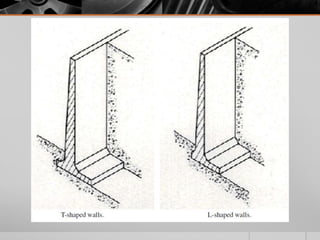
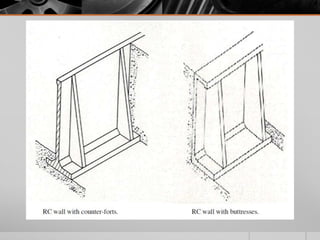
 - Reinforced concrete walls

 - Sheet pile walls
 - MS walls (mechanically stabilized)
 - Slurry and Secant Walls
 - Soil nailing
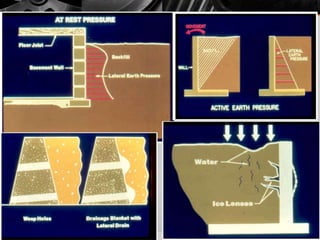
Retaining walls are structure used to retain soil, rock or other
materials in a vertical condition.
Hence they provide a lateral support to vertical slopes of soil that
would otherwise collapse
into a more natural shape.
Most common materials used for retaining walls are:
 -Wood sheets;
 - Steel and plastic interlocking sheets;
 - Reinforced concrete sheets;
 - Precast concrete elements (crib walls and block walls);
 - Closely spaced in-situ soil-cement piles;

 -Wire-mesh boxes (gabbions);
 - Anchors into the soil or rock mass (soil nailing).
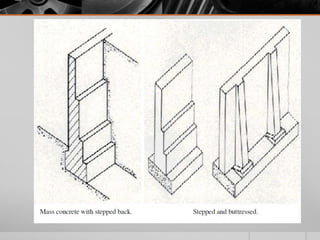
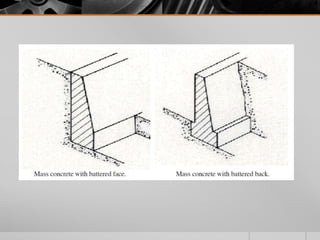
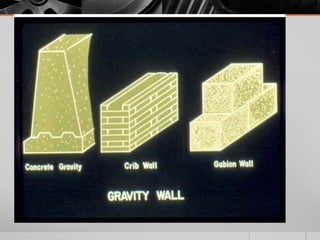
Massive Gravity Walls.
Gravity walls are the earliest known retaining structures. They are built from
solid concrete or
rock rubble mortared together. The lateral forces from backfill is resisted by the
weight of
wall itself, and due to their massive nature, they develop little or no tension.
Therefore, they
are usually not reinforced with steel. Gravity walls are economical for heights
up to 3 m (10
feet).
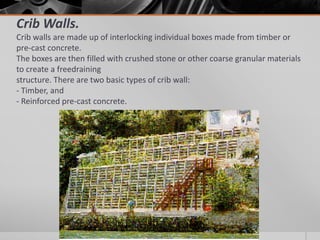
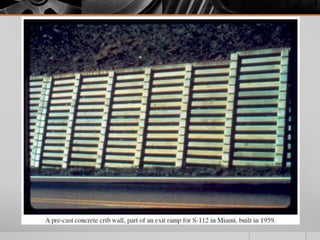
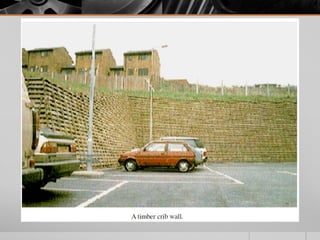
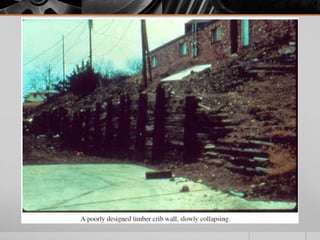
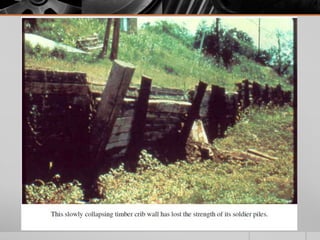
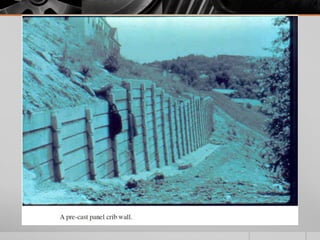
Crib Walls.
Crib walls are made up of interlocking individual boxes made from timber or
pre-cast concrete.
The boxes are then filled with crushed stone or other coarse granular materials
to create a freedraining
structure. There are two basic types of crib wall:
- Timber, and
- Reinforced pre-cast concrete.
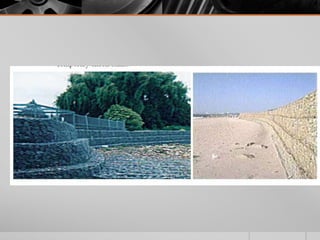
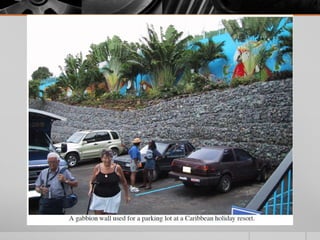
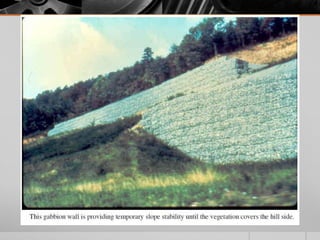
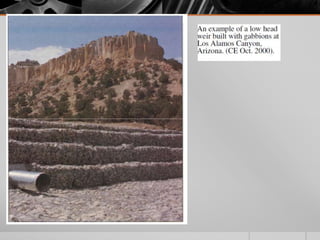
Gabbion walls.
Gabbions are multi-celled, welded wire or rectangular wire mesh boxes, which
are then rockfilled,
and used for construction of erosion control structures and to stabilize steep
slopes. Their
applications include,
- Retaining walls,
- Bridge abutments,
-Wing walls,
- Culvert headwalls,
- Outlet aprons,
- Shore and beach protection walls, and
- Temporary check dams.
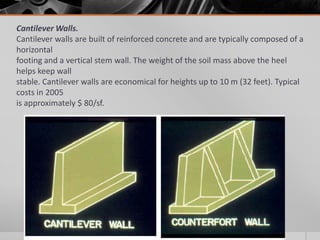
Cantilever Walls.
Cantilever walls are built of reinforced concrete and are typically composed of a
horizontal
footing and a vertical stem wall. The weight of the soil mass above the heel
helps keep wall
stable. Cantilever walls are economical for heights up to 10 m (32 feet). Typical
costs in 2005
is approximately $ 80/sf.
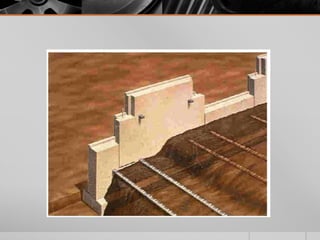
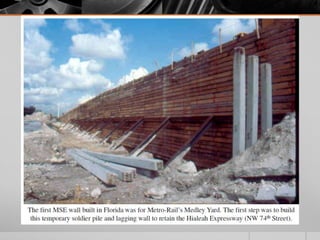
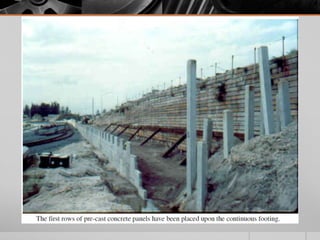
Mechanically Stabilized Earth (MSE) Walls.
These walls are among the most economical, and most commonly constructed.
Contrary to
other types, the MSE walls are supported by the soil, and not the other way
around. They are
supported by selected fills (granular) and held together by
reinforcements, which can be either
metallic strips or plastic meshes. Typical prices range from $ 25/sf to $ 45/sf.
The MSE Categories.
A) Panel Walls,
B) Concrete Block Walls, and
C) Temporary Earth Walls.
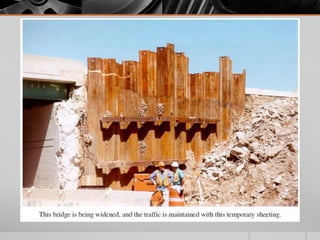
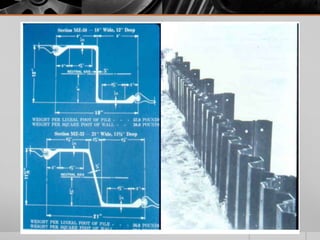
Sheet Pile Walls.
Used to build continuous walls for waterfront structures and for temporary
construction wall
heights > 6 m if used with anchors.
Can be made of steel, plastics, wood, pre-cast concrete.
The advantages of using steel sheet-piling:
1. Provides higher resistance to driving stresses;
2. Is of an overall lighter weight;
3. Can be reused on several projects;
4. Provides a long service life above or below the water table;
5. Easy to adapt the pile length by either welding or bolting; and
6. Their joints are less apt to deform during driving.
Soldier Piles and Lagging Walls.
This type of wall was known to Roman military engineers, and was used for
deep excavations.
It is a relatively inexpensive system, easy and fast to construct. It is primarily
limited to
temporary construction, and cannot be used in high water table conditions
without extensive
dewatering and expense. It is not as stiff as other types of retaining walls.
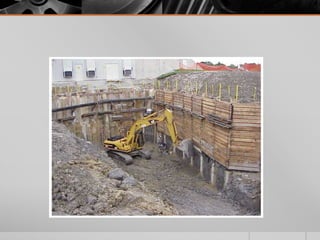
Slurry Walls.
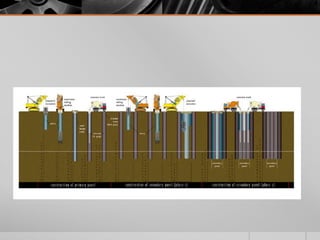
A slurry wall refers to the method of construction. Specifically, the digging of a
deep trench with a special bucket and crane. As the trench becomes
deeper, the soil is prevented from collapsing into the trench by keeping the
hole filled with a “slurry”.
This slurry is a mixture of water with bentonite (a member of the
Montmorrillonite family of clays). The bentonite
makes the slurry thick, but liquid. This keeps the soil lateral walls from
collapsing into the excavation.
When the excavation reaches the intended depth, the slurry filled excavation is
reinforced with steel and carefully filled with concrete.
These walls have been built to 100 foot depths and range from 2 feet to 4 feet
in thickness.
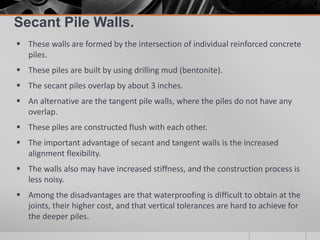
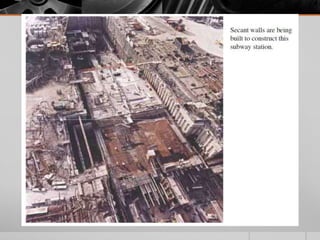
Secant Pile Walls.
 These walls are formed by the intersection of individual reinforced concrete
piles.
 These piles are built by using drilling mud (bentonite).
 The secant piles overlap by about 3 inches.
 An alternative are the tangent pile walls, where the piles do not have any
overlap.
 These piles are constructed flush with each other.
 The important advantage of secant and tangent walls is the increased
alignment flexibility.
 The walls also may have increased stiffness, and the construction process is
less noisy.
 Among the disadvantages are that waterproofing is difficult to obtain at the
joints, their higher cost, and that vertical tolerances are hard to achieve for
the deeper piles.
COFFERDAM WALLS
1. Braced: It is formed from a single wall of sheet piling which is driven into the ground to
form a “box” around the excavation site. The box is then braced on the inside and the
interior is dewatered. It is primarily used for bridge piers in shallow water (30 - 35 ft

depth)
2. Earth-Type: It is the simplest type of cofferdam. It consists of an earth bank with a clay
core or vertical sheet piling enclosing the excavation. It is used for low-level waters with
low velocity and easily scoured by water rising over the top.
3. Timber Crib: Constructed on land and floated into place. Lower portion of each cell is
matched with contour of river bed. It uses rock ballast and soil to decrease seepage and
sink into place, also known as “Gravity Dam”. It usually consists of 12’x12’ cells and is
used in rapid currents or on rocky river beds. It must be properly designed to resist lateral
forces such as tipping / overturning and sliding.
4. Double-Walled Sheet Pile: They are double wall cofferdams comprising two
parallel
rows of sheet piles driven into the ground and connected together by a system
of tie rods at one or more levels. The space between the walls is generally filled
with granular material such as sand, gravel or broken rock.
5. Cellular: Cellular cofferdams are used only in those circumstances where the
excavation size precludes the use of cross-excavation bracing. In this case, the
cofferdam must be stable by virtue of its own resistance to lateral forces.
HYBRID SYSTEM
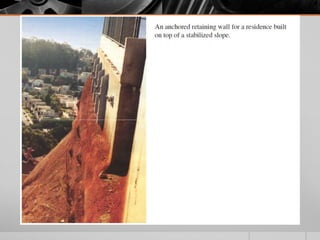
 Any wall which uses facing units (of any type) tied to rods or strips (of any
material) which havetheir ends anchored into the ground is a Hybrid
Wall.These are walls which combine elements of both externally stabilized
walls (e.g. gravity walls)and internally stabilized walls (e.g. reinforced soil):a)
Tailed Gabionb) Tieback Anchor Wall / Anchored Earthc) Steel Sheet Pile
Walld) Tailed Concrete Block
1. Tailed Gabion
Gabion walls are compartmented units filled with stone that are 4´ to 8´ in size.
Each unit is a rectangular basket made of galvanized steel, geosynthetic grid, or
polyvinylchloride (PVC)coated wire. Each gabion unit is laced together on-site
and filled with select stone. Gabion walls can be designed with wire mesh or
geosynthetic reinforcement that extends back into the retained soil from
between the gabion unit. These wall systems are termed tailed gabions.
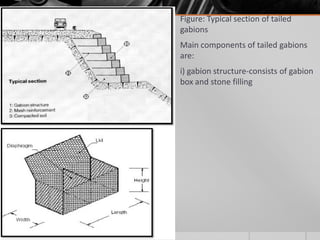
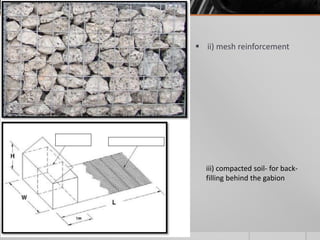
 Figure: Typical section of tailed
gabions
 Main components of tailed gabions
are:
 i) gabion structure-consists of gabion
box and stone filling
 ii) mesh reinforcement

iii) compacted soil- for backfilling behind the gabion

Types of retaining walls

  • 1.
  • 2.
    Types of RetainingWalls  - Gravity walls  - Pre-cast crib walls  - Gabion walls  - Reinforced concrete walls  - Sheet pile walls  - MS walls (mechanically stabilized)  - Slurry and Secant Walls  - Soil nailing
  • 4.
    Retaining walls arestructure used to retain soil, rock or other materials in a vertical condition. Hence they provide a lateral support to vertical slopes of soil that would otherwise collapse into a more natural shape. Most common materials used for retaining walls are:  -Wood sheets;  - Steel and plastic interlocking sheets;  - Reinforced concrete sheets;  - Precast concrete elements (crib walls and block walls);  - Closely spaced in-situ soil-cement piles;  -Wire-mesh boxes (gabbions);  - Anchors into the soil or rock mass (soil nailing).
  • 5.
    Massive Gravity Walls. Gravitywalls are the earliest known retaining structures. They are built from solid concrete or rock rubble mortared together. The lateral forces from backfill is resisted by the weight of wall itself, and due to their massive nature, they develop little or no tension. Therefore, they are usually not reinforced with steel. Gravity walls are economical for heights up to 3 m (10 feet).
  • 9.
    Crib Walls. Crib wallsare made up of interlocking individual boxes made from timber or pre-cast concrete. The boxes are then filled with crushed stone or other coarse granular materials to create a freedraining structure. There are two basic types of crib wall: - Timber, and - Reinforced pre-cast concrete.
  • 15.
    Gabbion walls. Gabbions aremulti-celled, welded wire or rectangular wire mesh boxes, which are then rockfilled, and used for construction of erosion control structures and to stabilize steep slopes. Their applications include, - Retaining walls, - Bridge abutments, -Wing walls, - Culvert headwalls, - Outlet aprons, - Shore and beach protection walls, and - Temporary check dams.
  • 20.
    Cantilever Walls. Cantilever wallsare built of reinforced concrete and are typically composed of a horizontal footing and a vertical stem wall. The weight of the soil mass above the heel helps keep wall stable. Cantilever walls are economical for heights up to 10 m (32 feet). Typical costs in 2005 is approximately $ 80/sf.
  • 25.
    Mechanically Stabilized Earth(MSE) Walls. These walls are among the most economical, and most commonly constructed. Contrary to other types, the MSE walls are supported by the soil, and not the other way around. They are supported by selected fills (granular) and held together by reinforcements, which can be either metallic strips or plastic meshes. Typical prices range from $ 25/sf to $ 45/sf. The MSE Categories. A) Panel Walls, B) Concrete Block Walls, and C) Temporary Earth Walls.
  • 29.
    Sheet Pile Walls. Usedto build continuous walls for waterfront structures and for temporary construction wall heights > 6 m if used with anchors. Can be made of steel, plastics, wood, pre-cast concrete. The advantages of using steel sheet-piling: 1. Provides higher resistance to driving stresses; 2. Is of an overall lighter weight; 3. Can be reused on several projects; 4. Provides a long service life above or below the water table; 5. Easy to adapt the pile length by either welding or bolting; and 6. Their joints are less apt to deform during driving.
  • 32.
    Soldier Piles andLagging Walls. This type of wall was known to Roman military engineers, and was used for deep excavations. It is a relatively inexpensive system, easy and fast to construct. It is primarily limited to temporary construction, and cannot be used in high water table conditions without extensive dewatering and expense. It is not as stiff as other types of retaining walls.
  • 34.
    Slurry Walls. A slurrywall refers to the method of construction. Specifically, the digging of a deep trench with a special bucket and crane. As the trench becomes deeper, the soil is prevented from collapsing into the trench by keeping the hole filled with a “slurry”. This slurry is a mixture of water with bentonite (a member of the Montmorrillonite family of clays). The bentonite makes the slurry thick, but liquid. This keeps the soil lateral walls from collapsing into the excavation. When the excavation reaches the intended depth, the slurry filled excavation is reinforced with steel and carefully filled with concrete. These walls have been built to 100 foot depths and range from 2 feet to 4 feet in thickness.
  • 37.
    Secant Pile Walls. These walls are formed by the intersection of individual reinforced concrete piles.  These piles are built by using drilling mud (bentonite).  The secant piles overlap by about 3 inches.  An alternative are the tangent pile walls, where the piles do not have any overlap.  These piles are constructed flush with each other.  The important advantage of secant and tangent walls is the increased alignment flexibility.  The walls also may have increased stiffness, and the construction process is less noisy.  Among the disadvantages are that waterproofing is difficult to obtain at the joints, their higher cost, and that vertical tolerances are hard to achieve for the deeper piles.
  • 40.
    COFFERDAM WALLS 1. Braced:It is formed from a single wall of sheet piling which is driven into the ground to form a “box” around the excavation site. The box is then braced on the inside and the interior is dewatered. It is primarily used for bridge piers in shallow water (30 - 35 ft depth) 2. Earth-Type: It is the simplest type of cofferdam. It consists of an earth bank with a clay core or vertical sheet piling enclosing the excavation. It is used for low-level waters with low velocity and easily scoured by water rising over the top. 3. Timber Crib: Constructed on land and floated into place. Lower portion of each cell is matched with contour of river bed. It uses rock ballast and soil to decrease seepage and sink into place, also known as “Gravity Dam”. It usually consists of 12’x12’ cells and is used in rapid currents or on rocky river beds. It must be properly designed to resist lateral forces such as tipping / overturning and sliding.
  • 41.
    4. Double-Walled SheetPile: They are double wall cofferdams comprising two parallel rows of sheet piles driven into the ground and connected together by a system of tie rods at one or more levels. The space between the walls is generally filled with granular material such as sand, gravel or broken rock. 5. Cellular: Cellular cofferdams are used only in those circumstances where the excavation size precludes the use of cross-excavation bracing. In this case, the cofferdam must be stable by virtue of its own resistance to lateral forces.
  • 42.
    HYBRID SYSTEM  Anywall which uses facing units (of any type) tied to rods or strips (of any material) which havetheir ends anchored into the ground is a Hybrid Wall.These are walls which combine elements of both externally stabilized walls (e.g. gravity walls)and internally stabilized walls (e.g. reinforced soil):a) Tailed Gabionb) Tieback Anchor Wall / Anchored Earthc) Steel Sheet Pile Walld) Tailed Concrete Block 1. Tailed Gabion Gabion walls are compartmented units filled with stone that are 4´ to 8´ in size. Each unit is a rectangular basket made of galvanized steel, geosynthetic grid, or polyvinylchloride (PVC)coated wire. Each gabion unit is laced together on-site and filled with select stone. Gabion walls can be designed with wire mesh or geosynthetic reinforcement that extends back into the retained soil from between the gabion unit. These wall systems are termed tailed gabions.
  • 43.
     Figure: Typicalsection of tailed gabions  Main components of tailed gabions are:  i) gabion structure-consists of gabion box and stone filling
  • 44.
     ii) meshreinforcement iii) compacted soil- for backfilling behind the gabion