GROUNDWATER
CONTAMINATION
GROUP MEMBERS
NAMITHA M.R. 2011-02-028
NIDHIN J.K. 2011-02-029
SAHLA N. 2011-02-030
POLLUTION
vs.
CONTAMINATION
 Pollution signifies any degradation of natural
ground water quality while contamination is
reserved for pollution that constitutes a hazard
to human health
POLLUTION OF GROUND WATER
 Defined as the artificially induced degradation
of natural groundwater quality
 Pollution can impair the use of water and can
create hazards to public health through toxicity
or the spread of disease
 In contrast with surface water pollution,
subsurface pollution is difficult to detect
and control, and may persists for
decades.
 Efforts are increasing to prevent, reduce
and eliminate water pollution
Pollution in relation to
water use
 The possible pollutants in groundwater are
virtually limitless
 The sources and causes of ground water
pollution are closely associated with human use
of water
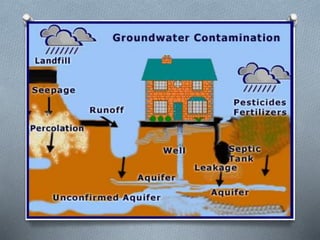
 Ground water contamination scenarios :-
a. Point sources : Storage tanks, landfills,
pipeline releases etc.
b. Nonpoint sources: Agricultural activities
 Contamination originates from the disposal of
groundwater following its use for a wide variety of
purposes
SOURCES AND CAUSES OF
POLLUTION
 All sources and causes of pollution can be classified
as to their geometry
a. Point sources : Originates from a single location
b. Line sources : Predominantly linear arrangement
c. Diffuse sources : Occupies an extensive area
 Principal sources and causes of pollution with
regard to their occurrence:-
a. Municipal sources and causes
b. Industrial sources and causes
c. Agricultural sources and causes
d. Miscellaneous sources and causes
1. Municipal sources and causes
a) Sewer leakage
 Sources: Poor workmanship, defective sewer
pipe, breakage by tree roots, ruptures from
heavy loads, earthquakes, loss of foundation
support etc.
 Results: Introduce high concentrations of
BOD,COD, nitrate, organic chemicals, bacteria
and heavy metals into groundwater
b) Liquid wastes
 Sources: Domestic wastes, Disposal wells
industries, storm, runoff etc.
 Results: Introduce bacteria, viruses, trace
elements and heavy metals, inorganic and
organic chemicals etc.
c) Solid wastes
 Sources: Landfills
 Results:
 Leachate from landfills can pollute groundwater
 Leachate include iron manganese, nitrate, trace
elements etc.
2. Industrial sources and causes
a) Liquid wastes
 Sources: Industrial waste water discharged into
pits, ponds, lagoons etc.
 Results: Introduction of hazardous and toxic
industrial wastes into the groundwater
b) Tank and pipeline leakage
 Sources: Gasoline stations, fuel oil tanks,
petroleum and petroleum products from
industrial pipelines and tanks
 Results: Immiscible liquids like oil and petroleum,
liquid radioactive wastes etc. reaches the water
table and pollutes the groundwater
c) Mining activities
 Sources:-
 Coal, phosphate and uranium mines
 Stone, sand and gravel quarries
 Results: Low pH, increase in iron, aluminium
and sulphate content in the soil
d) Oil-field brines
 Sources:-
 Substantial discharges of wastewater in the
form of brine
 Constituents of brine include sodium, calcium,
ammonia, boron, chloride, trace metals and
high total dissolved solids
 Results: Groundwater become saline
3. Agricultural sources and causes
a) Irrigation Return Flows
 Sources: Irrigation return flow drains to surface
channels or joins the underlying water
 Results:-
 Increases salinity of groundwater
 Increases the amount of bicarbonate, sulphate,
chlorides, nitrates etc. in the groundwater
b) Animal wastes
 Sources: Wastes from slaughter houses
 Results:-
 The natural assimilative capacity of the soil
become overtaxed
 Salts, organic loads and bacteria are transported
into the soil
 Nitrate-nitrogen is the most important persistent
pollutant that may reach the water table
c) Fertilizers and Soil Amendments
 Sources:
 Leachate of phosphate and potassium
fertilizers
 Leachate of soil amendments like lime,
gypsum and sulphur
 Results: Increases salinity of soil
d) Pesticides, insecticides and herbicides
 Sources: Leachate of pesticides, insecticides and
herbicides used in agricultural fields
 Results: Causes serious consequences in relation
to the portability of water
4. Miscellaneous sources and causes
a) Urbanisation
 Groundwater pollution can occur both in rural
as well as urban areas and is affected by
differences in chemical composition, biological
and chemical reactions, density and distance
from discharge areas
b) Spills and Surface Discharges
 Causal activities includes leaks from pipes and
valves, uncontrolled waste disposal, intermittent
dumping of fluids on ground, flushing hazardous
and flammable liquids into water etc.
 Washing aircraft with solvents and spills of fuel at
airports can form a layer of hydrocarbons floating
on the water table.
c) Stockpiles
 Solid materials are frequently stockpiled
near industrial plants, construction site etc.
 Precipitation falling on unsheltered stockpiles
causes leaching of heavy metals, salts and other
pollutants into the groundwater
d) Septic tanks and Cesspools
 Septic tank: A watertight basin intended
to decompose the domestic sewage and to
discharge this into the biologically active zone
of the soil mantle through a subsurface
percolation system
 Cesspools: large buried chamber with porous walls
designed to receive and percolate raw sewage
e) Roadway de-icing
 Results from the application of de-icing salts to
streets and highways in winter
 Sodium chloride and calcium chloride are
generally used
 Salt reaches the groundwater in solution after
spreading on roadways and also from stockpiles
g) Interchange through wells
 Because wells form highly permeable vertical
connections between aquifers, they can serve as
avenues for groundwater pollution where
inadequate attention is given to the proper
construction, sealing or abandonment of wells
f) Saline water intrusion
 Salt water may invade freshwater aquifers to
create point or diffuse pollution sources
 Polluted surface water bodies that contribute to
groundwater recharge become sources of
groundwater pollution
g) Surface water
Attenuation of pollution
 Pollutants in groundwater tend to be
removed or reduced in concentration with
time and with distance travelled
 The rate of pollution attenuation depends on
the type of pollutant and on the local hydro
geologic situation
 Mechanisms involved include:-
 Filtration
 Sorption
 Chemical processes
 Microbiological decomposition
 Dilution
conclusion
 The principal sources and causes of groundwater
pollution can be categorized- municipal, industrial,
agricultural and miscellaneous
 With the growing recognition of the importance of
underground water resources, efforts are increasing
to prevent, reduce and eliminate groundwater
pollution.
THANK YOU 

GROUNDWATER CONTAMINATION

  • 1.
  • 2.
    GROUP MEMBERS NAMITHA M.R.2011-02-028 NIDHIN J.K. 2011-02-029 SAHLA N. 2011-02-030
  • 3.
    POLLUTION vs. CONTAMINATION  Pollution signifiesany degradation of natural ground water quality while contamination is reserved for pollution that constitutes a hazard to human health
  • 4.
    POLLUTION OF GROUNDWATER  Defined as the artificially induced degradation of natural groundwater quality  Pollution can impair the use of water and can create hazards to public health through toxicity or the spread of disease
  • 5.
     In contrastwith surface water pollution, subsurface pollution is difficult to detect and control, and may persists for decades.  Efforts are increasing to prevent, reduce and eliminate water pollution
  • 6.
    Pollution in relationto water use  The possible pollutants in groundwater are virtually limitless  The sources and causes of ground water pollution are closely associated with human use of water
  • 7.
     Ground watercontamination scenarios :- a. Point sources : Storage tanks, landfills, pipeline releases etc. b. Nonpoint sources: Agricultural activities  Contamination originates from the disposal of groundwater following its use for a wide variety of purposes
  • 9.
    SOURCES AND CAUSESOF POLLUTION  All sources and causes of pollution can be classified as to their geometry a. Point sources : Originates from a single location b. Line sources : Predominantly linear arrangement c. Diffuse sources : Occupies an extensive area
  • 10.
     Principal sourcesand causes of pollution with regard to their occurrence:- a. Municipal sources and causes b. Industrial sources and causes c. Agricultural sources and causes d. Miscellaneous sources and causes
  • 11.
    1. Municipal sourcesand causes a) Sewer leakage  Sources: Poor workmanship, defective sewer pipe, breakage by tree roots, ruptures from heavy loads, earthquakes, loss of foundation support etc.  Results: Introduce high concentrations of BOD,COD, nitrate, organic chemicals, bacteria and heavy metals into groundwater
  • 12.
    b) Liquid wastes Sources: Domestic wastes, Disposal wells industries, storm, runoff etc.  Results: Introduce bacteria, viruses, trace elements and heavy metals, inorganic and organic chemicals etc.
  • 13.
    c) Solid wastes Sources: Landfills  Results:  Leachate from landfills can pollute groundwater  Leachate include iron manganese, nitrate, trace elements etc.
  • 14.
    2. Industrial sourcesand causes a) Liquid wastes  Sources: Industrial waste water discharged into pits, ponds, lagoons etc.  Results: Introduction of hazardous and toxic industrial wastes into the groundwater
  • 15.
    b) Tank andpipeline leakage  Sources: Gasoline stations, fuel oil tanks, petroleum and petroleum products from industrial pipelines and tanks  Results: Immiscible liquids like oil and petroleum, liquid radioactive wastes etc. reaches the water table and pollutes the groundwater
  • 16.
    c) Mining activities Sources:-  Coal, phosphate and uranium mines  Stone, sand and gravel quarries  Results: Low pH, increase in iron, aluminium and sulphate content in the soil
  • 17.
    d) Oil-field brines Sources:-  Substantial discharges of wastewater in the form of brine  Constituents of brine include sodium, calcium, ammonia, boron, chloride, trace metals and high total dissolved solids  Results: Groundwater become saline
  • 18.
    3. Agricultural sourcesand causes a) Irrigation Return Flows  Sources: Irrigation return flow drains to surface channels or joins the underlying water  Results:-  Increases salinity of groundwater  Increases the amount of bicarbonate, sulphate, chlorides, nitrates etc. in the groundwater
  • 19.
    b) Animal wastes Sources: Wastes from slaughter houses  Results:-  The natural assimilative capacity of the soil become overtaxed  Salts, organic loads and bacteria are transported into the soil  Nitrate-nitrogen is the most important persistent pollutant that may reach the water table
  • 20.
    c) Fertilizers andSoil Amendments  Sources:  Leachate of phosphate and potassium fertilizers  Leachate of soil amendments like lime, gypsum and sulphur  Results: Increases salinity of soil
  • 21.
    d) Pesticides, insecticidesand herbicides  Sources: Leachate of pesticides, insecticides and herbicides used in agricultural fields  Results: Causes serious consequences in relation to the portability of water
  • 22.
    4. Miscellaneous sourcesand causes a) Urbanisation  Groundwater pollution can occur both in rural as well as urban areas and is affected by differences in chemical composition, biological and chemical reactions, density and distance from discharge areas
  • 23.
    b) Spills andSurface Discharges  Causal activities includes leaks from pipes and valves, uncontrolled waste disposal, intermittent dumping of fluids on ground, flushing hazardous and flammable liquids into water etc.  Washing aircraft with solvents and spills of fuel at airports can form a layer of hydrocarbons floating on the water table.
  • 24.
    c) Stockpiles  Solidmaterials are frequently stockpiled near industrial plants, construction site etc.  Precipitation falling on unsheltered stockpiles causes leaching of heavy metals, salts and other pollutants into the groundwater
  • 25.
    d) Septic tanksand Cesspools  Septic tank: A watertight basin intended to decompose the domestic sewage and to discharge this into the biologically active zone of the soil mantle through a subsurface percolation system  Cesspools: large buried chamber with porous walls designed to receive and percolate raw sewage
  • 26.
    e) Roadway de-icing Results from the application of de-icing salts to streets and highways in winter  Sodium chloride and calcium chloride are generally used  Salt reaches the groundwater in solution after spreading on roadways and also from stockpiles
  • 27.
    g) Interchange throughwells  Because wells form highly permeable vertical connections between aquifers, they can serve as avenues for groundwater pollution where inadequate attention is given to the proper construction, sealing or abandonment of wells
  • 28.
    f) Saline waterintrusion  Salt water may invade freshwater aquifers to create point or diffuse pollution sources  Polluted surface water bodies that contribute to groundwater recharge become sources of groundwater pollution g) Surface water
  • 29.
    Attenuation of pollution Pollutants in groundwater tend to be removed or reduced in concentration with time and with distance travelled  The rate of pollution attenuation depends on the type of pollutant and on the local hydro geologic situation
  • 30.
     Mechanisms involvedinclude:-  Filtration  Sorption  Chemical processes  Microbiological decomposition  Dilution
  • 31.
    conclusion  The principalsources and causes of groundwater pollution can be categorized- municipal, industrial, agricultural and miscellaneous  With the growing recognition of the importance of underground water resources, efforts are increasing to prevent, reduce and eliminate groundwater pollution.
  • 32.