Contents
 What is retaining wall
 Parts of retaining wall
 Types of retaining wall
 Earth pressures
 Principles of the design of retaining wall
 Theories required to solve problem
 Design of retaining wall
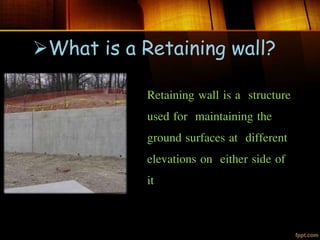
What is a Retaining wall?
Retaining wall is a structure
used for maintaining the
ground surfaces at different
elevations on either side of
it
 All permanent walls and components shall be designed for a
minimum service life of 75 years.
 Corrosion protection is required for allpermanent and temporary
walls in aggressive environments.
 Retaining walls are usually built to hold back soil mass.
 They are also provided to maintain the grounds at two different levels.
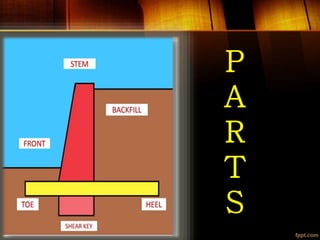
P
A
R
T
S
TYPES OF RETAINING WALLS
• 1. Gravity Retaining Walls
• 2. Semi-Gravity Retaining Walls
• 3. Cantilever Retaining Walls
• 4. Counter fort Retaining Walls
GRAVITY WALLS
• The “gravity wall” provides stability by
virtue of its own weight , and therefore,
is rather massive in size.
• It is usually built in stone masonry, and
occasionally in plain concrete
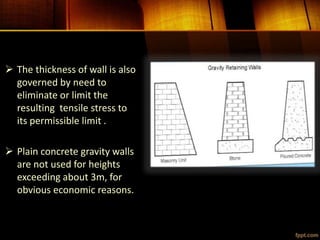
 The thickness of wall is also
governed by need to
eliminate or limit the
resulting tensile stress to
its permissible limit .
 Plain concrete gravity walls
are not used for heights
exceeding about 3m, for
obvious economic reasons.
Stress developed is very low
These walls are so proportioned that no
tension is developed anywhere and the
resultant of forces remain within the middle
third of the base.
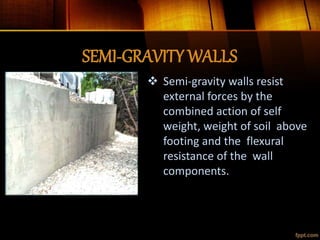
SEMI-GRAVITY WALLS
 Semi-gravity walls resist
external forces by the
combined action of self
weight, weight of soil above
footing and the flexural
resistance of the wall
components.
 Concrete cantilever wall is an example and consists
of a reinforced concrete stem and a base footing
 These walls are non-proprietary.
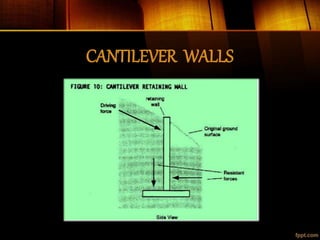
CANTILEVER WALLS
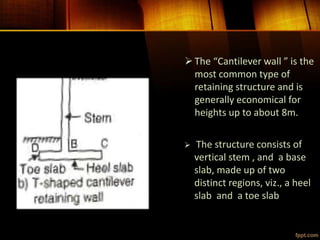
The “Cantilever wall ” is the
most common type of
retaining structure and is
generally economical for
heights up to about 8m.
 The structure consists of
vertical stem , and a base
slab, made up of two
distinct regions, viz., a heel
slab and a toe slab
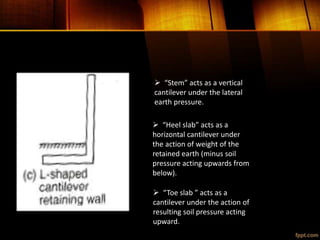
 “Stem” acts as a vertical
cantilever under the lateral
earth pressure.
 “Heel slab” acts as a
horizontal cantilever under
the action of weight of the
retained earth (minus soil
pressure acting upwards from
below).
 “Toe slab ” acts as a
cantilever under the action of
resulting soil pressure acting
upward.
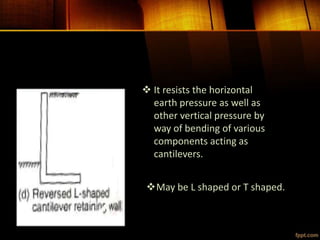
 It resists the horizontal
earth pressure as well as
other vertical pressure by
way of bending of various
components acting as
cantilevers.
May be L shaped or T shaped.
COUNTERFORT WALLS
 Stem and Heel slab are strengthened by providing
counterforts at some suitable intervals.
 The stability of the wall is maintained
essentially by the weight of the earth on the
heel slab plus the self weight of the structure.
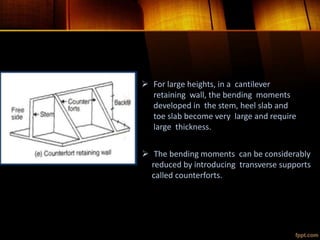
 For large heights, in a cantilever
retaining wall, the bending moments
developed in the stem, heel slab and
toe slab become very large and require
large thickness.
 The bending moments can be considerably
reduced by introducing transverse supports
called counterforts.
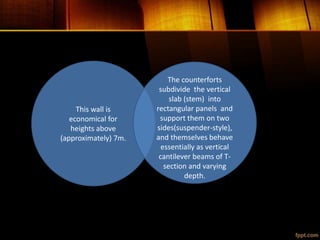
This wall is
economical for
heights above
(approximately) 7m.
The counterforts
subdivide the vertical
slab (stem) into
rectangular panels and
support them on two
sides(suspender-style),
and themselves behave
essentially as vertical
cantilever beams of T-
section and varying
depth.
PRESSURE AT REST
 When the soil behind the wall is
prevented from lateral movement
(towards or away from soil) of wall,
the pressure is known as earth
pressure at rest.
PRESSURE AT REST
This is the case when wall has a considerable
rigidity.
Basement walls generally fall in this category.
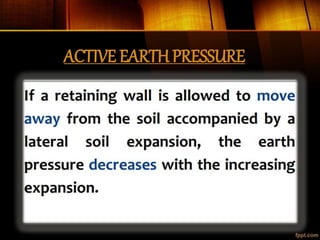
ACTIVE EARTH PRESSURE
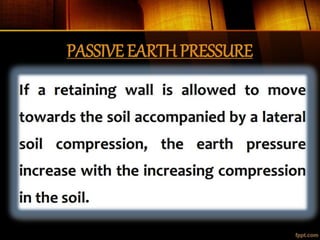
PASSIVE EARTH PRESSURE
STABILITY CONDITIONS
StabilityRequirement of retaining wall
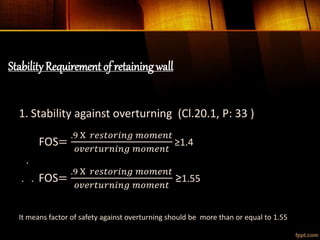
1. Stability against overturning (Cl.20.1, P: 33 )
FOS=
.9 X 𝑟𝑒𝑠𝑡𝑜𝑟𝑖𝑛𝑔 𝑚𝑜𝑚𝑒𝑛𝑡
𝑜𝑣𝑒𝑟𝑡𝑢𝑟𝑛𝑖𝑛𝑔 𝑚𝑜𝑚𝑒𝑛𝑡
≥1.4
.
. . FOS=
.9 X 𝑟𝑒𝑠𝑡𝑜𝑟𝑖𝑛𝑔 𝑚𝑜𝑚𝑒𝑛𝑡
𝑜𝑣𝑒𝑟𝑡𝑢𝑟𝑛𝑖𝑛𝑔 𝑚𝑜𝑚𝑒𝑛𝑡
≥1.55
It means factor of safety against overturning should be more than or equal to 1.55
StabilityRequirement of retaining wall
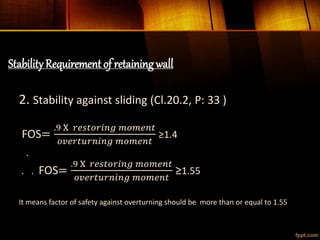
2. Stability against sliding (Cl.20.2, P: 33 )
FOS=
.9 X 𝑟𝑒𝑠𝑡𝑜𝑟𝑖𝑛𝑔 𝑚𝑜𝑚𝑒𝑛𝑡
𝑜𝑣𝑒𝑟𝑡𝑢𝑟𝑛𝑖𝑛𝑔 𝑚𝑜𝑚𝑒𝑛𝑡
≥1.4
.
. . FOS=
.9 X 𝑟𝑒𝑠𝑡𝑜𝑟𝑖𝑛𝑔 𝑚𝑜𝑚𝑒𝑛𝑡
𝑜𝑣𝑒𝑟𝑡𝑢𝑟𝑛𝑖𝑛𝑔 𝑚𝑜𝑚𝑒𝑛𝑡
≥1.55
It means factor of safety against overturning should be more than or equal to 1.55
StabilityRequirement of retaining wall
3. Stability against maximum pressure at the base
( stability against settlement)
If the maximum pressure at base less than safe bearing
capacity of soil, the wall is stable against settlement.
Max. Pressure
𝑃max =
𝑤
𝑏
[1 +
6𝑒
𝑏
] < SBC of Soil
StabilityRequirement of retaining wall
4. No tension at base
If the minimum pressure at base is greater than or equal to zero than,
the wall is not under tension.
Min. Pressure
𝑃max =
𝑤
𝑏
[1 −
6𝑒
𝑏
] ≥ 0
Bearing capacity:
Ability of the underlying soil to support the weight of
the retaining wall structure.
Factor of safety = 2.0
NO TENSION:
There should be no tension at the base of the wall. when
the eccentricity (e) is greater than b/6 , tension develops
at the heel

Retaining wall ppt Final year Civil ENGINEERING

  • 1.
    Contents  What isretaining wall  Parts of retaining wall  Types of retaining wall  Earth pressures  Principles of the design of retaining wall  Theories required to solve problem  Design of retaining wall
  • 2.
    What is aRetaining wall? Retaining wall is a structure used for maintaining the ground surfaces at different elevations on either side of it
  • 3.
     All permanentwalls and components shall be designed for a minimum service life of 75 years.  Corrosion protection is required for allpermanent and temporary walls in aggressive environments.  Retaining walls are usually built to hold back soil mass.  They are also provided to maintain the grounds at two different levels.
  • 4.
  • 5.
    TYPES OF RETAININGWALLS • 1. Gravity Retaining Walls • 2. Semi-Gravity Retaining Walls • 3. Cantilever Retaining Walls • 4. Counter fort Retaining Walls
  • 6.
    GRAVITY WALLS • The“gravity wall” provides stability by virtue of its own weight , and therefore, is rather massive in size. • It is usually built in stone masonry, and occasionally in plain concrete
  • 7.
     The thicknessof wall is also governed by need to eliminate or limit the resulting tensile stress to its permissible limit .  Plain concrete gravity walls are not used for heights exceeding about 3m, for obvious economic reasons.
  • 8.
    Stress developed isvery low These walls are so proportioned that no tension is developed anywhere and the resultant of forces remain within the middle third of the base.
  • 9.
    SEMI-GRAVITY WALLS  Semi-gravitywalls resist external forces by the combined action of self weight, weight of soil above footing and the flexural resistance of the wall components.
  • 10.
     Concrete cantileverwall is an example and consists of a reinforced concrete stem and a base footing  These walls are non-proprietary.
  • 11.
  • 12.
    The “Cantilever wall” is the most common type of retaining structure and is generally economical for heights up to about 8m.  The structure consists of vertical stem , and a base slab, made up of two distinct regions, viz., a heel slab and a toe slab
  • 13.
     “Stem” actsas a vertical cantilever under the lateral earth pressure.  “Heel slab” acts as a horizontal cantilever under the action of weight of the retained earth (minus soil pressure acting upwards from below).  “Toe slab ” acts as a cantilever under the action of resulting soil pressure acting upward.
  • 14.
     It resiststhe horizontal earth pressure as well as other vertical pressure by way of bending of various components acting as cantilevers. May be L shaped or T shaped.
  • 15.
    COUNTERFORT WALLS  Stemand Heel slab are strengthened by providing counterforts at some suitable intervals.  The stability of the wall is maintained essentially by the weight of the earth on the heel slab plus the self weight of the structure.
  • 16.
     For largeheights, in a cantilever retaining wall, the bending moments developed in the stem, heel slab and toe slab become very large and require large thickness.  The bending moments can be considerably reduced by introducing transverse supports called counterforts.
  • 18.
    This wall is economicalfor heights above (approximately) 7m. The counterforts subdivide the vertical slab (stem) into rectangular panels and support them on two sides(suspender-style), and themselves behave essentially as vertical cantilever beams of T- section and varying depth.
  • 20.
    PRESSURE AT REST When the soil behind the wall is prevented from lateral movement (towards or away from soil) of wall, the pressure is known as earth pressure at rest.
  • 21.
    PRESSURE AT REST Thisis the case when wall has a considerable rigidity. Basement walls generally fall in this category.
  • 22.
  • 23.
  • 24.
  • 25.
  • 26.
    StabilityRequirement of retainingwall 1. Stability against overturning (Cl.20.1, P: 33 ) FOS= .9 X 𝑟𝑒𝑠𝑡𝑜𝑟𝑖𝑛𝑔 𝑚𝑜𝑚𝑒𝑛𝑡 𝑜𝑣𝑒𝑟𝑡𝑢𝑟𝑛𝑖𝑛𝑔 𝑚𝑜𝑚𝑒𝑛𝑡 ≥1.4 . . . FOS= .9 X 𝑟𝑒𝑠𝑡𝑜𝑟𝑖𝑛𝑔 𝑚𝑜𝑚𝑒𝑛𝑡 𝑜𝑣𝑒𝑟𝑡𝑢𝑟𝑛𝑖𝑛𝑔 𝑚𝑜𝑚𝑒𝑛𝑡 ≥1.55 It means factor of safety against overturning should be more than or equal to 1.55
  • 27.
    StabilityRequirement of retainingwall 2. Stability against sliding (Cl.20.2, P: 33 ) FOS= .9 X 𝑟𝑒𝑠𝑡𝑜𝑟𝑖𝑛𝑔 𝑚𝑜𝑚𝑒𝑛𝑡 𝑜𝑣𝑒𝑟𝑡𝑢𝑟𝑛𝑖𝑛𝑔 𝑚𝑜𝑚𝑒𝑛𝑡 ≥1.4 . . . FOS= .9 X 𝑟𝑒𝑠𝑡𝑜𝑟𝑖𝑛𝑔 𝑚𝑜𝑚𝑒𝑛𝑡 𝑜𝑣𝑒𝑟𝑡𝑢𝑟𝑛𝑖𝑛𝑔 𝑚𝑜𝑚𝑒𝑛𝑡 ≥1.55 It means factor of safety against overturning should be more than or equal to 1.55
  • 28.
    StabilityRequirement of retainingwall 3. Stability against maximum pressure at the base ( stability against settlement) If the maximum pressure at base less than safe bearing capacity of soil, the wall is stable against settlement. Max. Pressure 𝑃max = 𝑤 𝑏 [1 + 6𝑒 𝑏 ] < SBC of Soil
  • 29.
    StabilityRequirement of retainingwall 4. No tension at base If the minimum pressure at base is greater than or equal to zero than, the wall is not under tension. Min. Pressure 𝑃max = 𝑤 𝑏 [1 − 6𝑒 𝑏 ] ≥ 0
  • 30.
    Bearing capacity: Ability ofthe underlying soil to support the weight of the retaining wall structure. Factor of safety = 2.0
  • 31.
    NO TENSION: There shouldbe no tension at the base of the wall. when the eccentricity (e) is greater than b/6 , tension develops at the heel