TEAM MEMBERS :-
1. KUMAR AMAN 7.HRIDKAMAL BISWAS
2. SONU KUMAR 8.ANKITA DEKA
3. KAMAL SINGH 9.RAJEEV KUMAR
4. RAVINDRA VERMA 10.DHEERAJ MEENA
5. VIKAS KUMAR
6. NIHAL SINGH
Design And Construction Of
Cantilevered Retaining Walls
RETAINING WALLS
• The structures which are constructed to retain
the earth or other loose material which are
unable to stand vertically by itself are called as
“retaining walls”.
• They can also be used to support grounds at
different levels on both sides of wall.
• The material retained by wall is called as
“backfill”.
TYPES OF RETAINING WALLS
On the basis of shape & mode of resisting
pressure due to backfill.
1. Gravity retaining wall
2. Semi-Gravity retaining wall
3. Cantilever retaining wall
4. Counterfort retaining wall
5. Buttress wall
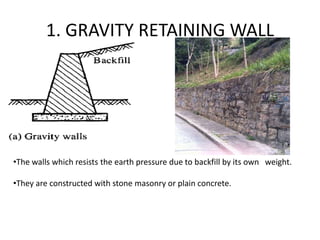
1. GRAVITY RETAINING WALL
•The walls which resists the earth pressure due to backfill by its own weight.
•They are constructed with stone masonry or plain concrete.
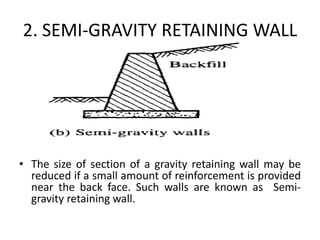
2. SEMI-GRAVITY RETAINING WALL
• The size of section of a gravity retaining wall may be
reduced if a small amount of reinforcement is provided
near the back face. Such walls are known as Semi-
gravity retaining wall.
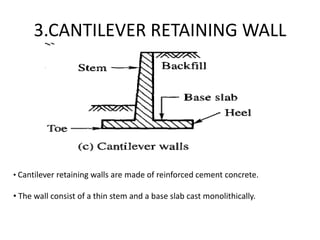
3.CANTILEVER RETAINING WALL
• Cantilever retaining walls are made of reinforced cement concrete.
• The wall consist of a thin stem and a base slab cast monolithically.
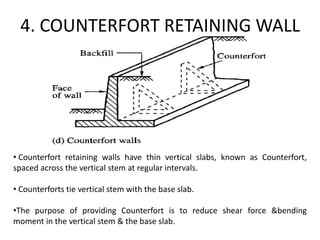
4. COUNTERFORT RETAINING WALL
• Counterfort retaining walls have thin vertical slabs, known as Counterfort,
spaced across the vertical stem at regular intervals.
• Counterforts tie vertical stem with the base slab.
•The purpose of providing Counterfort is to reduce shear force &bending
moment in the vertical stem & the base slab.
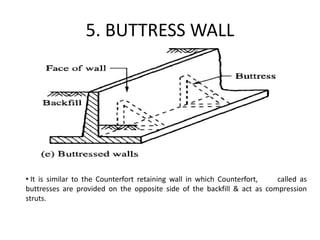
5. BUTTRESS WALL
• It is similar to the Counterfort retaining wall in which Counterfort, called as
buttresses are provided on the opposite side of the backfill & act as compression
struts.
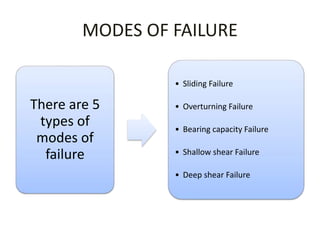
MODES OF FAILURE
There are 5
types of
modes of
failure
• Sliding Failure
• Overturning Failure
• Bearing capacity Failure
• Shallow shear Failure
• Deep shear Failure
Case 1
• In San Diego, California , failure in retaining
wall was observed.
• The wall was constructed as a basement wall
for a large building .In 1984, the building was
demolished and the site was turned into a
parking lot.
• The basement wall received lateral support
from the foundation , a bowstring roof truss,
and perpendicular building walls.
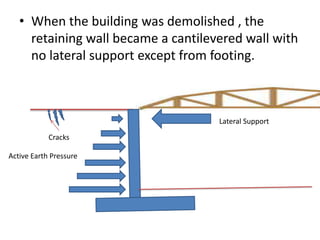
• When the building was demolished , the
retaining wall became a cantilevered wall with
no lateral support except from footing.
Active Earth Pressure
`
Cracks
Lateral Support
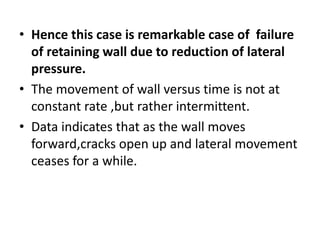
• Hence this case is remarkable case of failure
of retaining wall due to reduction of lateral
pressure.
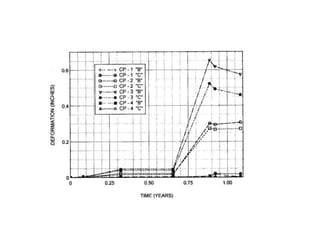
• The movement of wall versus time is not at
constant rate ,but rather intermittent.
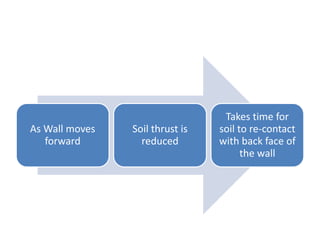
• Data indicates that as the wall moves
forward,cracks open up and lateral movement
ceases for a while.
As Wall moves
forward
Soil thrust is
reduced
Takes time for
soil to re-contact
with back face of
the wall
Case 2
• This case study involves damage of retaining
caused by Northridge earthquake(january 17
,1994) in california.
• The magnitude of earthquake was recorded to
be 6.7 in richter scale.
Factors affecting the magnitude of
earthquake forces on the wall-
• Size of wall.
• Distance of retaining wall from the earth
quake epicenter.
• Duration of earthquake.
• Mass of soil retained by wall.
• Property of soil.
• In this case the EQSEARCH a computer
programme was used to estimate the peak
ground acceleration at that location.
• So , we can estimate the additional force
exerted by earthquake.
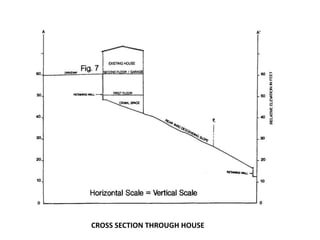
CROSS SECTION THROUGH HOUSE
• A retaining wall was constructed near the top
of the slop and the house was built in front of
the wall.
• The house provides lateral support to some
portion of retaining wall and those portions
didn’t sustain any damage during earthquake.
• The portion of retaining wall that didn’t
recieve lateral support from the house
experienced tilting and cracking during
Northridge earthquake .
• In this case additional earthquake force is
exerted on the wall.
• Also,The affect of Northridge earthquake was
to densify the backfill and increase the lateral
pressure.
• So, it is a case of failure of retaining wall in
which additional forces gerenated by
earthquake was not considered in design.
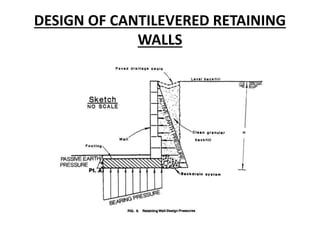
DESIGN OF CANTILEVERED RETAINING
WALLS
FACTOR OF SAFETY FOR SLIDING
• The factor of safety for sliding of the retaining
wall is defined as the resisting forces divided
by the driving force.
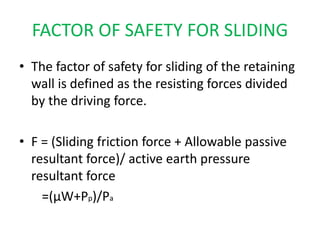
• F = (Sliding friction force + Allowable passive
resultant force)/ active earth pressure
resultant force
=(μW+Pp)/Pa
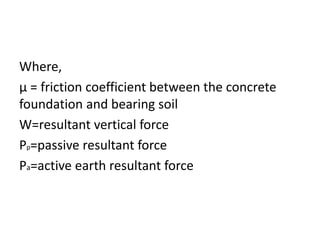
Where,
μ = friction coefficient between the concrete
foundation and bearing soil
W=resultant vertical force
Pp=passive resultant force
Pa=active earth resultant force
Factor Of safety for Overturning
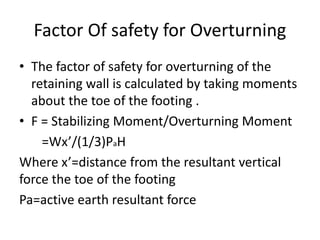
• The factor of safety for overturning of the
retaining wall is calculated by taking moments
about the toe of the footing .
• F = Stabilizing Moment/Overturning Moment
=Wx’/(1/3)PaH
Where x’=distance from the resultant vertical
force the toe of the footing
Pa=active earth resultant force
TYPE OF BACKFILL MATERIAL
1.) Clean granular sand or gravel
Because of the undesirable effect of clay or silt
(swelling pressure on the wall , hydrostatic
forces on the wall)
2.)Sometimes Soil available at site
Compaction of Backfill Material
• The best compaction equipment are small
vibrator plate , such as VPG 160B and
BP19/75.
• The vibrator plates effectively densify the
granular backfill but do not induce high lateral
loads because of their light weight.
Thank
You

Design And Construction Of Cantilevered Retaining Walls

  • 1.
    TEAM MEMBERS :- 1.KUMAR AMAN 7.HRIDKAMAL BISWAS 2. SONU KUMAR 8.ANKITA DEKA 3. KAMAL SINGH 9.RAJEEV KUMAR 4. RAVINDRA VERMA 10.DHEERAJ MEENA 5. VIKAS KUMAR 6. NIHAL SINGH
  • 2.
    Design And ConstructionOf Cantilevered Retaining Walls
  • 3.
    RETAINING WALLS • Thestructures which are constructed to retain the earth or other loose material which are unable to stand vertically by itself are called as “retaining walls”. • They can also be used to support grounds at different levels on both sides of wall. • The material retained by wall is called as “backfill”.
  • 4.
    TYPES OF RETAININGWALLS On the basis of shape & mode of resisting pressure due to backfill. 1. Gravity retaining wall 2. Semi-Gravity retaining wall 3. Cantilever retaining wall 4. Counterfort retaining wall 5. Buttress wall
  • 5.
    1. GRAVITY RETAININGWALL •The walls which resists the earth pressure due to backfill by its own weight. •They are constructed with stone masonry or plain concrete.
  • 6.
    2. SEMI-GRAVITY RETAININGWALL • The size of section of a gravity retaining wall may be reduced if a small amount of reinforcement is provided near the back face. Such walls are known as Semi- gravity retaining wall.
  • 7.
    3.CANTILEVER RETAINING WALL •Cantilever retaining walls are made of reinforced cement concrete. • The wall consist of a thin stem and a base slab cast monolithically.
  • 8.
    4. COUNTERFORT RETAININGWALL • Counterfort retaining walls have thin vertical slabs, known as Counterfort, spaced across the vertical stem at regular intervals. • Counterforts tie vertical stem with the base slab. •The purpose of providing Counterfort is to reduce shear force &bending moment in the vertical stem & the base slab.
  • 9.
    5. BUTTRESS WALL •It is similar to the Counterfort retaining wall in which Counterfort, called as buttresses are provided on the opposite side of the backfill & act as compression struts.
  • 10.
    MODES OF FAILURE Thereare 5 types of modes of failure • Sliding Failure • Overturning Failure • Bearing capacity Failure • Shallow shear Failure • Deep shear Failure
  • 11.
    Case 1 • InSan Diego, California , failure in retaining wall was observed. • The wall was constructed as a basement wall for a large building .In 1984, the building was demolished and the site was turned into a parking lot. • The basement wall received lateral support from the foundation , a bowstring roof truss, and perpendicular building walls.
  • 12.
    • When thebuilding was demolished , the retaining wall became a cantilevered wall with no lateral support except from footing. Active Earth Pressure ` Cracks Lateral Support
  • 13.
    • Hence thiscase is remarkable case of failure of retaining wall due to reduction of lateral pressure. • The movement of wall versus time is not at constant rate ,but rather intermittent. • Data indicates that as the wall moves forward,cracks open up and lateral movement ceases for a while.
  • 14.
    As Wall moves forward Soilthrust is reduced Takes time for soil to re-contact with back face of the wall
  • 16.
    Case 2 • Thiscase study involves damage of retaining caused by Northridge earthquake(january 17 ,1994) in california. • The magnitude of earthquake was recorded to be 6.7 in richter scale.
  • 17.
    Factors affecting themagnitude of earthquake forces on the wall- • Size of wall. • Distance of retaining wall from the earth quake epicenter. • Duration of earthquake. • Mass of soil retained by wall. • Property of soil.
  • 18.
    • In thiscase the EQSEARCH a computer programme was used to estimate the peak ground acceleration at that location. • So , we can estimate the additional force exerted by earthquake.
  • 19.
  • 20.
    • A retainingwall was constructed near the top of the slop and the house was built in front of the wall. • The house provides lateral support to some portion of retaining wall and those portions didn’t sustain any damage during earthquake. • The portion of retaining wall that didn’t recieve lateral support from the house experienced tilting and cracking during Northridge earthquake .
  • 21.
    • In thiscase additional earthquake force is exerted on the wall. • Also,The affect of Northridge earthquake was to densify the backfill and increase the lateral pressure. • So, it is a case of failure of retaining wall in which additional forces gerenated by earthquake was not considered in design.
  • 22.
    DESIGN OF CANTILEVEREDRETAINING WALLS
  • 23.
    FACTOR OF SAFETYFOR SLIDING • The factor of safety for sliding of the retaining wall is defined as the resisting forces divided by the driving force. • F = (Sliding friction force + Allowable passive resultant force)/ active earth pressure resultant force =(μW+Pp)/Pa
  • 24.
    Where, μ = frictioncoefficient between the concrete foundation and bearing soil W=resultant vertical force Pp=passive resultant force Pa=active earth resultant force
  • 25.
    Factor Of safetyfor Overturning • The factor of safety for overturning of the retaining wall is calculated by taking moments about the toe of the footing . • F = Stabilizing Moment/Overturning Moment =Wx’/(1/3)PaH Where x’=distance from the resultant vertical force the toe of the footing Pa=active earth resultant force
  • 26.
    TYPE OF BACKFILLMATERIAL 1.) Clean granular sand or gravel Because of the undesirable effect of clay or silt (swelling pressure on the wall , hydrostatic forces on the wall) 2.)Sometimes Soil available at site
  • 27.
    Compaction of BackfillMaterial • The best compaction equipment are small vibrator plate , such as VPG 160B and BP19/75. • The vibrator plates effectively densify the granular backfill but do not induce high lateral loads because of their light weight.
  • 28.