CONCEPT OF FLOATING
FOUNDATION
MILIND RAO
(184104213)
MTech - GEOTECHNICAL ENGINEERING
IIT - GUWAHATI
INTRODUCTION
When the soil is so soft that even friction piles will not support the
building , the final option is the use of the Floating Foundation.
A floating foundation is a type of foundation constructed by
excavating the soil in such a way that the weight of structure built on
the soil is nearly equal to the total weight of the soil excavated from
the ground including the weight of the water in the soil before the
construction of structure.
Floating foundation is also called balancing raft and causes zero
settlement to the structure.
INTRODUCTION
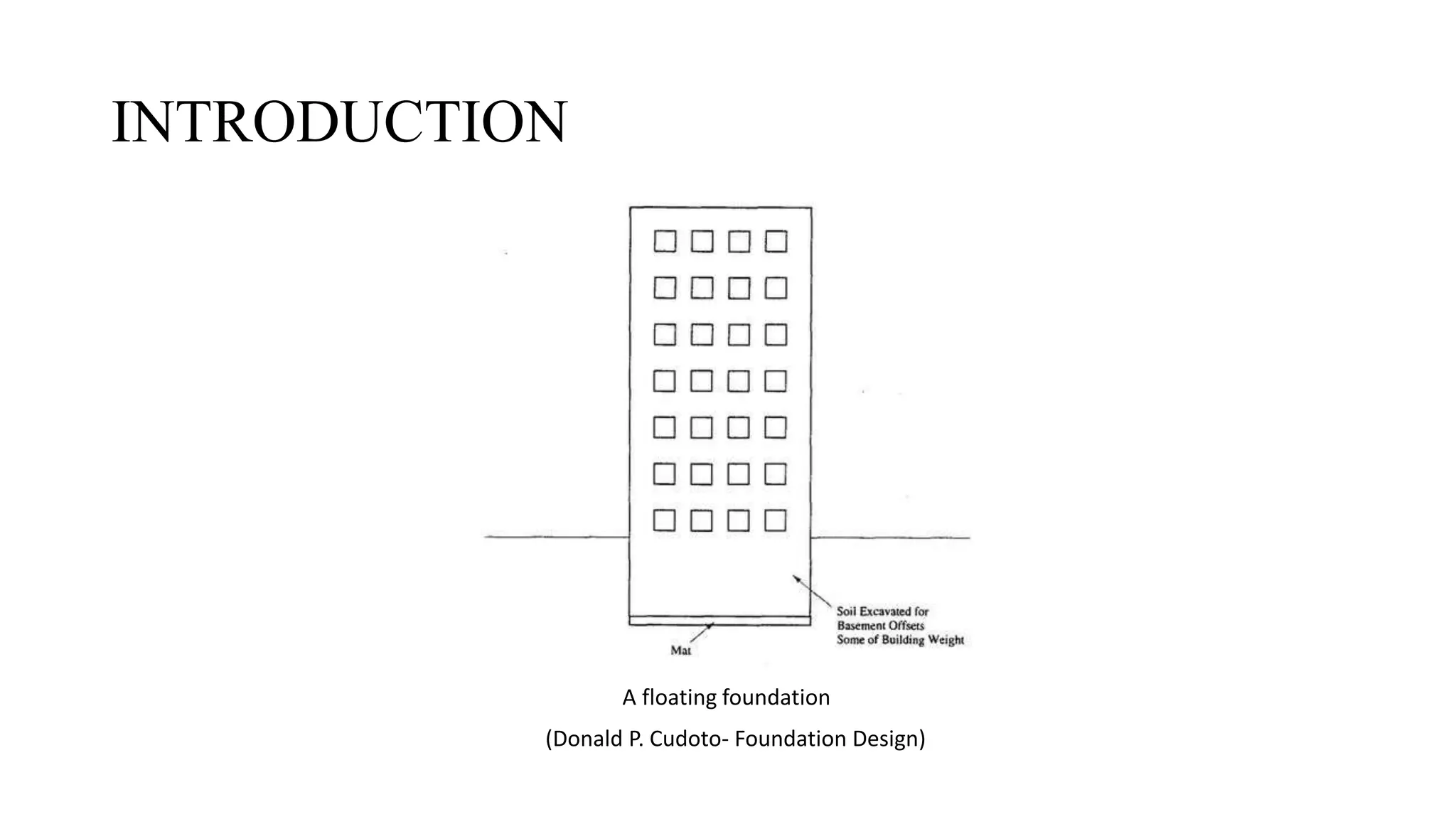
A floating foundation
(Donald P. Cudoto- Foundation Design)
PRINCIPLES OF FLOATING FOUNDATION
The main principle of floating foundation is to balance the weight of
removed soil by a structure of same weight which causes zero
settlement to the structure.
A floating foundation consists of box like rigid structures set at such a
depth below ground level that the weight of the soil removed to place
it equals the weight of the structure.
Thus, once the structure is completed, the soil under it will bear the
same weight it bore before the excavation was begun.
PRINCIPLES OF FLOATING FOUNDATION
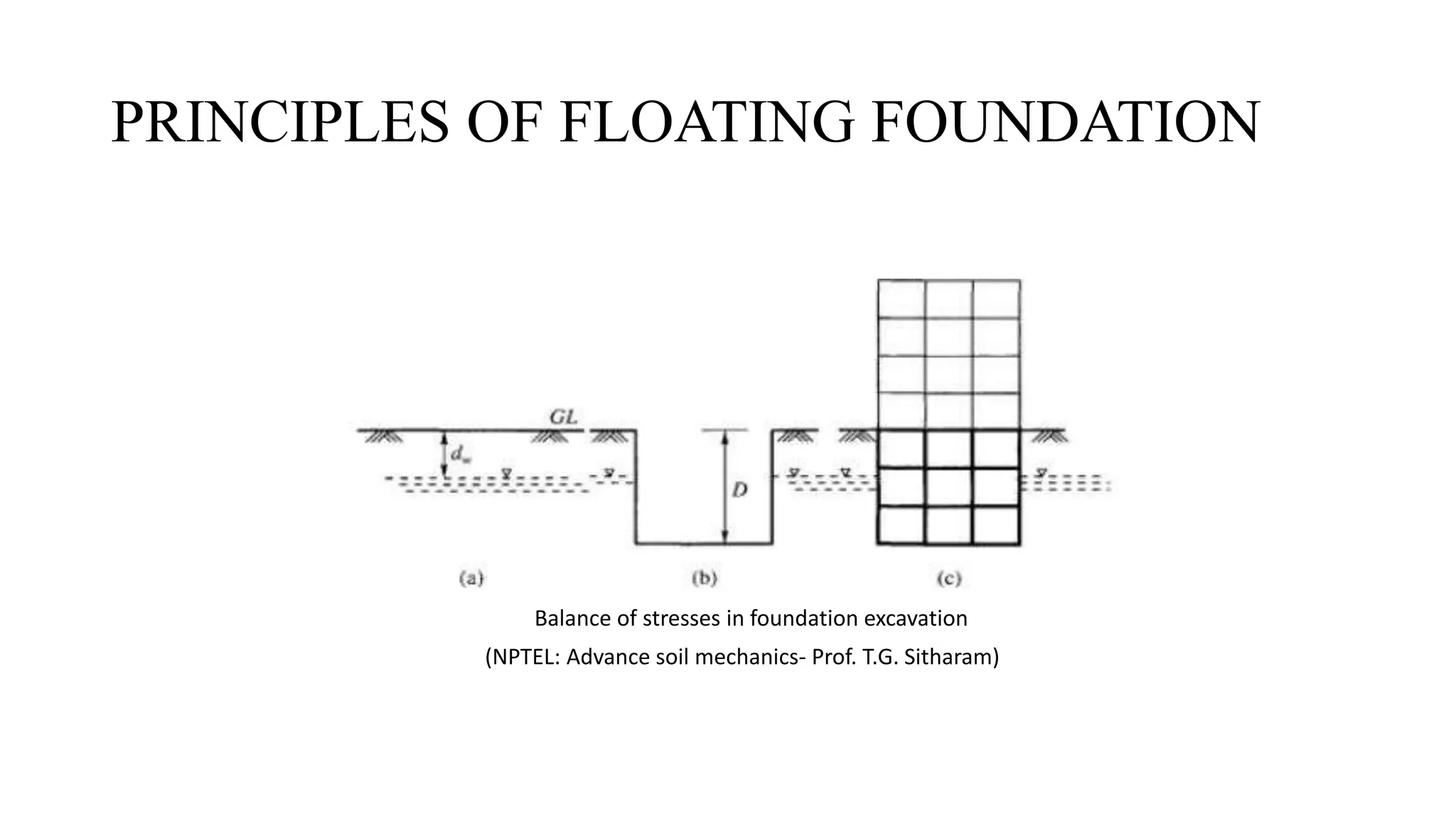
Balance of stresses in foundation excavation
(NPTEL: Advance soil mechanics- Prof. T.G. Sitharam)
PRINCIPLES OF FLOATING FOUNDATION
While dealing with floating foundation, it is important that we
consider following two types of soils,
• Type 1: The foundation soils are of such strength that shear failure of
soil will not occur under the building load. But the settlements,
differential settlements in particular are so large that they constitute
the failure of the structure. In such cases a floating foundation is used
to reduce settlements to an acceptable value.
PRINCIPLES OF FLOATING FOUNDATION
• Type 2: The shear strength of the foundation soil is so low that
rupture of the soil would occur if the building were to be founded at
ground level. At a reasonable depth, in the absence of a strong layer
the building can only be built on a floating foundation. This reduces
the shear stresses to an acceptable value.
In the above mentioned cases, a rigid raft or box type of foundation
is required for the floating foundation.
PROBLEMS TO BE CONSIDERED IN THE
DESIGN OF A FLOATING FOUNDATION
During the construction of floating foundation some problems may
arise which can be prevented by taking proper care. The problems will
arise during,
• Excavation
• Dewatering
• Critical depth
• Bottom heave
PROBLEMS TO BE CONSIDERED IN THE
DESIGN OF A FLOATING FOUNDATION
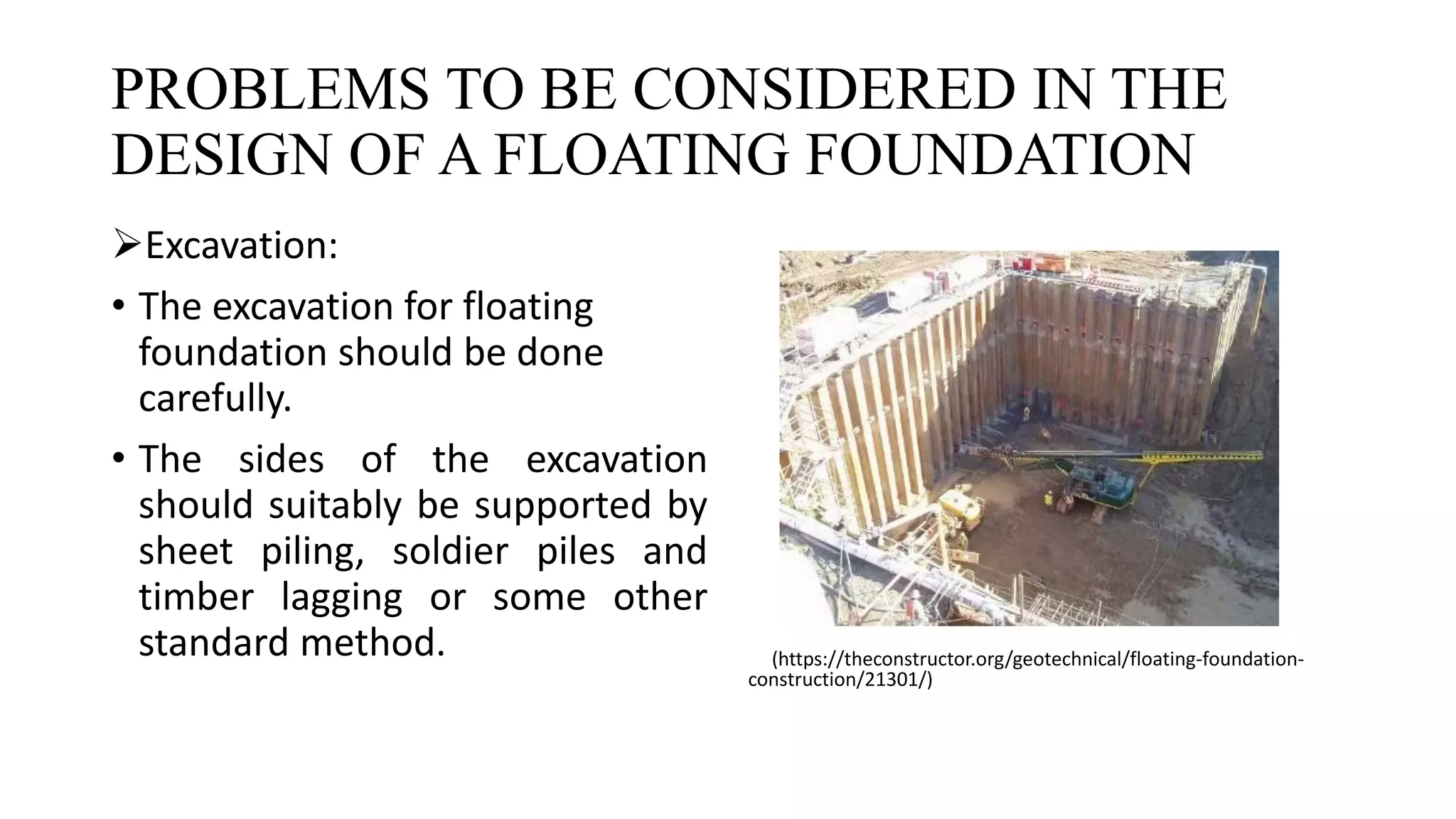
Excavation:
• The excavation for floating
foundation should be done
carefully.
• The sides of the excavation
should suitably be supported by
sheet piling, soldier piles and
timber lagging or some other
standard method. (https://theconstructor.org/geotechnical/floating-foundation-
construction/21301/)
PROBLEMS TO BE CONSIDERED IN THE
DESIGN OF A FLOATING FOUNDATION
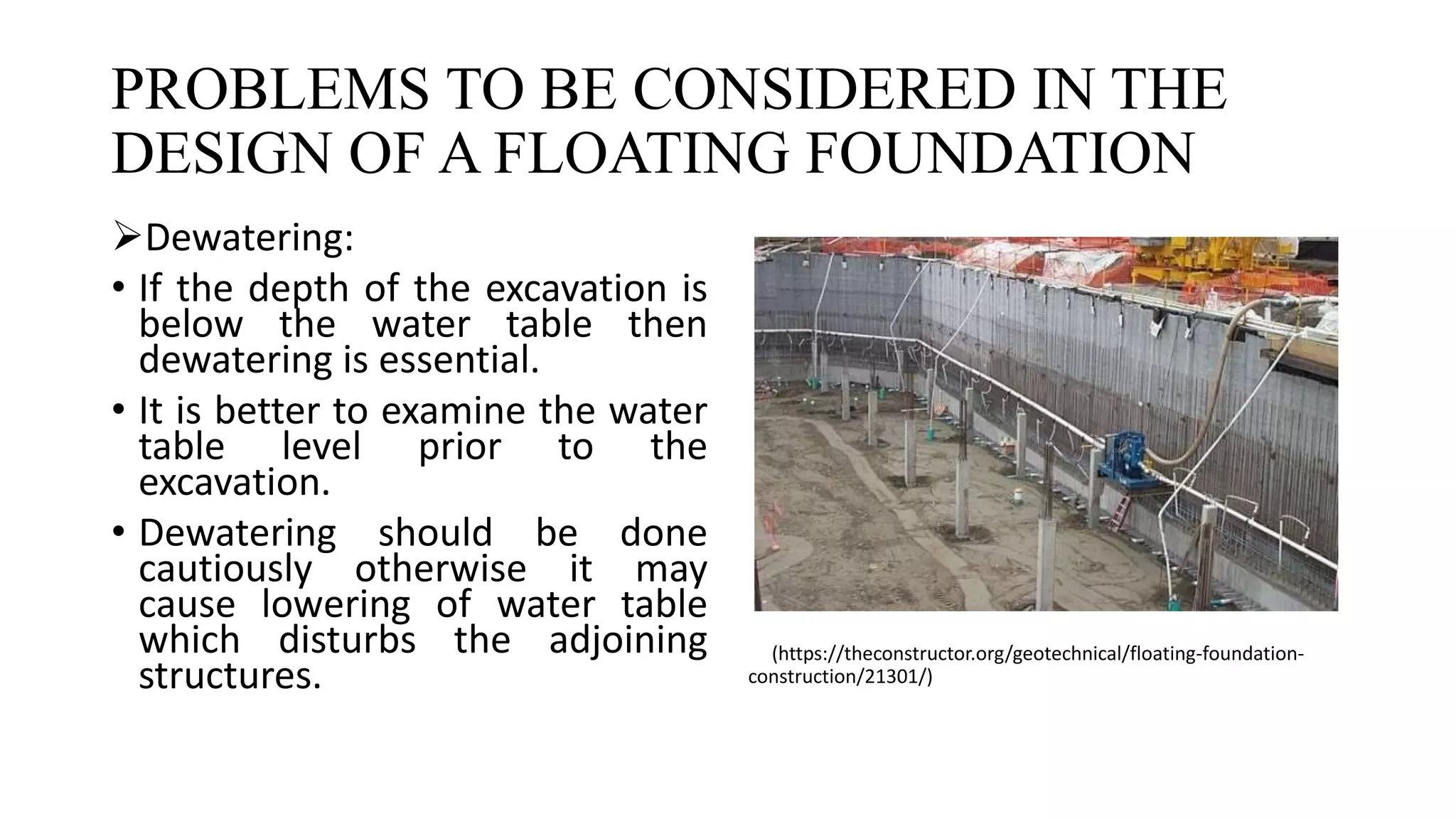
Dewatering:
• If the depth of the excavation is
below the water table then
dewatering is essential.
• It is better to examine the water
table level prior to the
excavation.
• Dewatering should be done
cautiously otherwise it may
cause lowering of water table
which disturbs the adjoining
structures.
(https://theconstructor.org/geotechnical/floating-foundation-
construction/21301/)
PROBLEMS TO BE CONSIDERED IN THE
DESIGN OF A FLOATING FOUNDATION
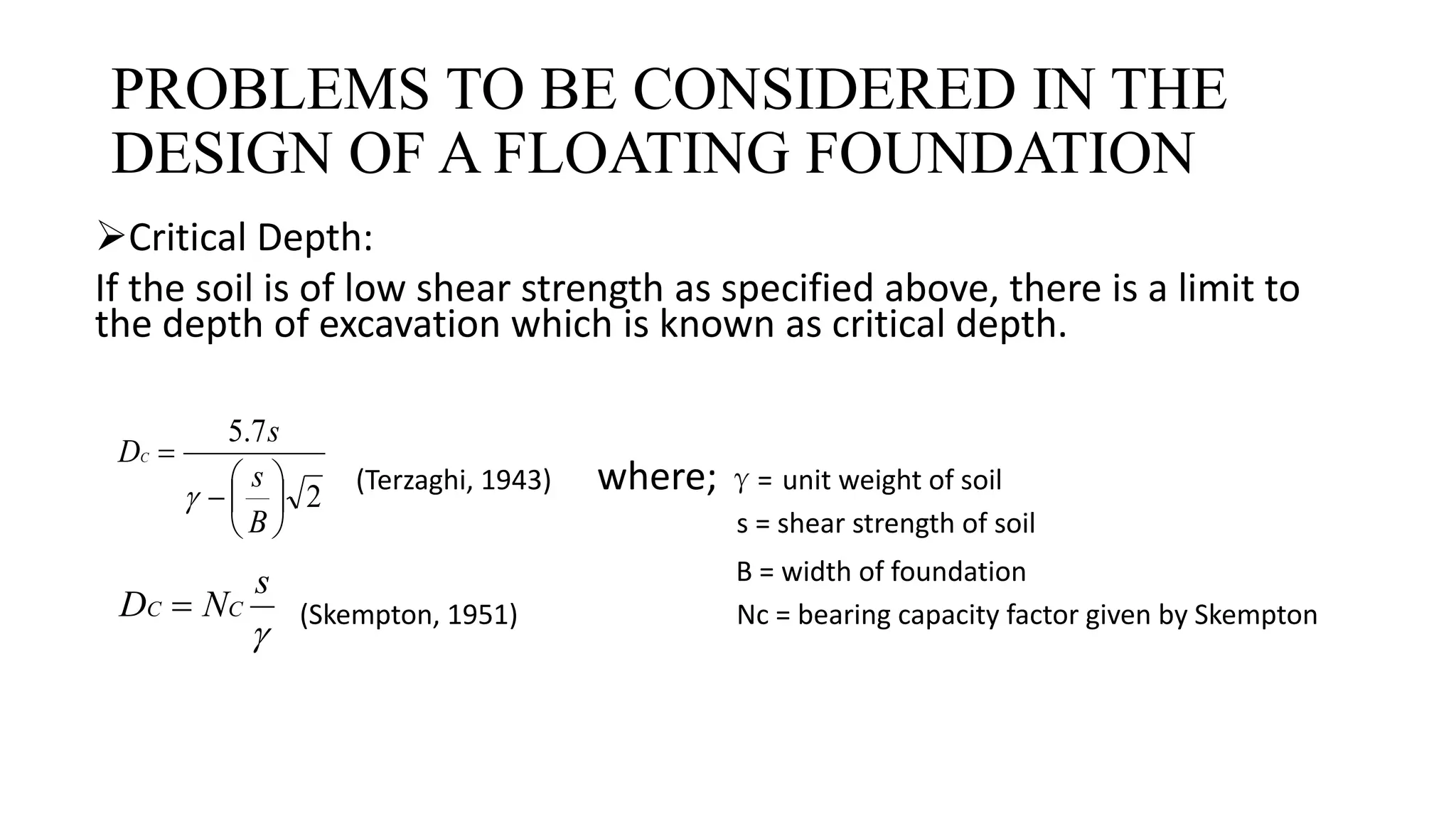
Critical Depth:
If the soil is of low shear strength as specified above, there is a limit to
the depth of excavation which is known as critical depth.
(Terzaghi, 1943) where; γ= unit weight of soil
s = shear strength of soil
B = width of foundation
(Skempton, 1951) Nc = bearing capacity factor given by Skempton
2
7.5








B
s
s
DC


s
ND CC 
PROBLEMS TO BE CONSIDERED IN THE
DESIGN OF A FLOATING FOUNDATION
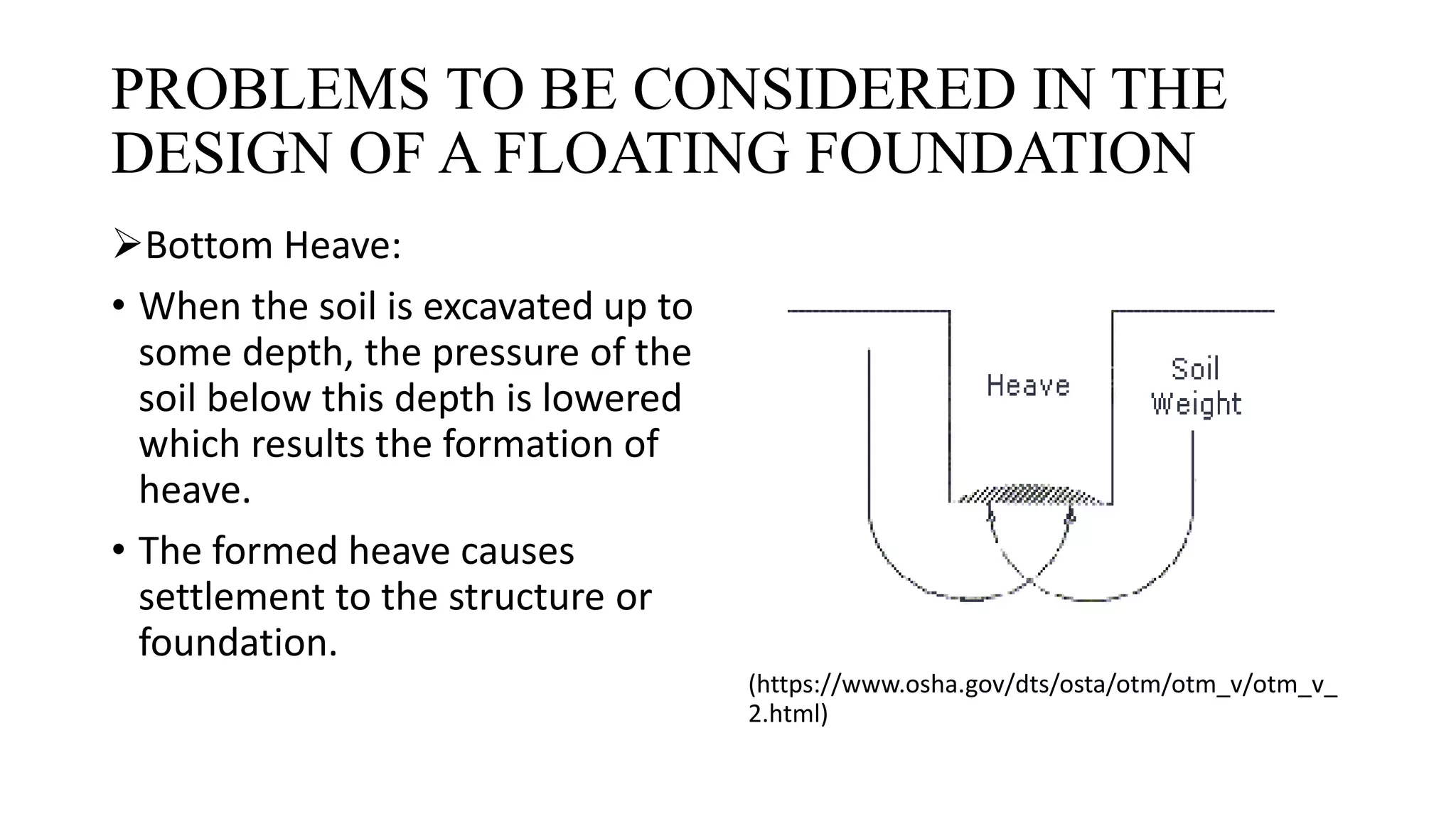
Bottom Heave:
• When the soil is excavated up to
some depth, the pressure of the
soil below this depth is lowered
which results the formation of
heave.
• The formed heave causes
settlement to the structure or
foundation.
(https://www.osha.gov/dts/osta/otm/otm_v/otm_v_
2.html)
ADVANTAGES OF FLOATING FOUNDATION
• Used for low bearing capacity soils.
• Minimizes the foundation settlement.
• Floating foundations can be used in on high moisture soils.
• Requires very less digging because deep footer trenches are needed.
• Most suitable for heavily used highways.
CONCLUSION
• Foundation settlement is the major problem faced by geotechnical
engineers. If the settlement is severe, it may lead to the complete
collapse of the structure even though the factor of safety against
shear failure is high.
• The floating foundation is the best choice for geotechnical engineers
to minimize the foundation settlement problems.
REFERENCES
• David J. D'Appolonia, (A.M.ASCE), T. William Lambe, (F.ASCE), Edmund
K. Turner (1971). Floating Foundations for Control of Settlement.
Journal of the Soil Mechanics and Foundations Division, 1971, Vol. 97,
Issue 6, Pg. 899-915.
• Donald P. Coduto, (2001). Foundation Design- Principles and
Practices. New Jersey: Prentice Hall. Inc.

Concept of floating foundation

  • 1.
    CONCEPT OF FLOATING FOUNDATION MILINDRAO (184104213) MTech - GEOTECHNICAL ENGINEERING IIT - GUWAHATI
  • 2.
    INTRODUCTION When the soilis so soft that even friction piles will not support the building , the final option is the use of the Floating Foundation. A floating foundation is a type of foundation constructed by excavating the soil in such a way that the weight of structure built on the soil is nearly equal to the total weight of the soil excavated from the ground including the weight of the water in the soil before the construction of structure. Floating foundation is also called balancing raft and causes zero settlement to the structure.
  • 3.
    INTRODUCTION A floating foundation (DonaldP. Cudoto- Foundation Design)
  • 4.
    PRINCIPLES OF FLOATINGFOUNDATION The main principle of floating foundation is to balance the weight of removed soil by a structure of same weight which causes zero settlement to the structure. A floating foundation consists of box like rigid structures set at such a depth below ground level that the weight of the soil removed to place it equals the weight of the structure. Thus, once the structure is completed, the soil under it will bear the same weight it bore before the excavation was begun.
  • 5.
    PRINCIPLES OF FLOATINGFOUNDATION Balance of stresses in foundation excavation (NPTEL: Advance soil mechanics- Prof. T.G. Sitharam)
  • 6.
    PRINCIPLES OF FLOATINGFOUNDATION While dealing with floating foundation, it is important that we consider following two types of soils, • Type 1: The foundation soils are of such strength that shear failure of soil will not occur under the building load. But the settlements, differential settlements in particular are so large that they constitute the failure of the structure. In such cases a floating foundation is used to reduce settlements to an acceptable value.
  • 7.
    PRINCIPLES OF FLOATINGFOUNDATION • Type 2: The shear strength of the foundation soil is so low that rupture of the soil would occur if the building were to be founded at ground level. At a reasonable depth, in the absence of a strong layer the building can only be built on a floating foundation. This reduces the shear stresses to an acceptable value. In the above mentioned cases, a rigid raft or box type of foundation is required for the floating foundation.
  • 8.
    PROBLEMS TO BECONSIDERED IN THE DESIGN OF A FLOATING FOUNDATION During the construction of floating foundation some problems may arise which can be prevented by taking proper care. The problems will arise during, • Excavation • Dewatering • Critical depth • Bottom heave
  • 9.
    PROBLEMS TO BECONSIDERED IN THE DESIGN OF A FLOATING FOUNDATION Excavation: • The excavation for floating foundation should be done carefully. • The sides of the excavation should suitably be supported by sheet piling, soldier piles and timber lagging or some other standard method. (https://theconstructor.org/geotechnical/floating-foundation- construction/21301/)
  • 10.
    PROBLEMS TO BECONSIDERED IN THE DESIGN OF A FLOATING FOUNDATION Dewatering: • If the depth of the excavation is below the water table then dewatering is essential. • It is better to examine the water table level prior to the excavation. • Dewatering should be done cautiously otherwise it may cause lowering of water table which disturbs the adjoining structures. (https://theconstructor.org/geotechnical/floating-foundation- construction/21301/)
  • 11.
    PROBLEMS TO BECONSIDERED IN THE DESIGN OF A FLOATING FOUNDATION Critical Depth: If the soil is of low shear strength as specified above, there is a limit to the depth of excavation which is known as critical depth. (Terzaghi, 1943) where; γ= unit weight of soil s = shear strength of soil B = width of foundation (Skempton, 1951) Nc = bearing capacity factor given by Skempton 2 7.5         B s s DC   s ND CC 
  • 12.
    PROBLEMS TO BECONSIDERED IN THE DESIGN OF A FLOATING FOUNDATION Bottom Heave: • When the soil is excavated up to some depth, the pressure of the soil below this depth is lowered which results the formation of heave. • The formed heave causes settlement to the structure or foundation. (https://www.osha.gov/dts/osta/otm/otm_v/otm_v_ 2.html)
  • 13.
    ADVANTAGES OF FLOATINGFOUNDATION • Used for low bearing capacity soils. • Minimizes the foundation settlement. • Floating foundations can be used in on high moisture soils. • Requires very less digging because deep footer trenches are needed. • Most suitable for heavily used highways.
  • 14.
    CONCLUSION • Foundation settlementis the major problem faced by geotechnical engineers. If the settlement is severe, it may lead to the complete collapse of the structure even though the factor of safety against shear failure is high. • The floating foundation is the best choice for geotechnical engineers to minimize the foundation settlement problems.
  • 15.
    REFERENCES • David J.D'Appolonia, (A.M.ASCE), T. William Lambe, (F.ASCE), Edmund K. Turner (1971). Floating Foundations for Control of Settlement. Journal of the Soil Mechanics and Foundations Division, 1971, Vol. 97, Issue 6, Pg. 899-915. • Donald P. Coduto, (2001). Foundation Design- Principles and Practices. New Jersey: Prentice Hall. Inc.