Diaphragm Wall:
Construction and Design
By
Umer farooq
GNDEC, Ludhia
na
DIAPHRAGM WALL
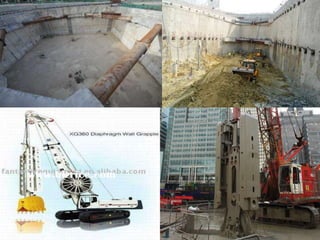
 Diaphragm walls are concrete or reinforced concrete walls
constructed in slurry-supported, open trenches below
existing ground.
 Concrete is placed using the Tremie installation method or
by installing pre-cast concrete panels (known as a pre-cast
diaphragm wall). Diaphragm walls can be constructed to
depths of 150 meters and to widths of 0.5 to 1.50 meters.
 Diaphragm wall construction methods are relatively quiet
and cause little or no vibration. Therefore, they are especially
suitable for civil engineering projects in densely-populated
inner city areas.
 Due to their ability to keep deformation low and provide low
water permeability, diaphragm walls are also used to retain
excavation pits in the direct vicinity of existing structures.
IS 14344 : 1996
DESIGN AND CONSTRUCTI-ON OF DIAPHRAGMS
FOR UNDER-SEEPAGE CONTROL - CODE OF
PRACTICE
Which code to use?
TYPES OF DIAPHRAGM WALL
Depending on the use of construction materials
there are the following types of diaphragm walls:
a) Rigid type
1) Reinforced cement concrete.
b) Flexible type
1) Plastic concrete,
2) Cement bentonite slurry trench, and
3) Earth backfilled slurry trench.
Depending on the function the following kinds of diaphragm walls are
used:
1) Structural walls
2) Load Bearing Elements
3) Cutoff walls
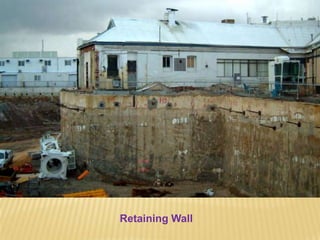
Structural Diaphragm walls: they are used as retaining walls for the
perimeter walls of deep basements and underground parking
facilities, subways, underpasses, etc
Load bearing walls: they are used in place of drilled piers in foundation
of tall buildings, bridge piers, etc
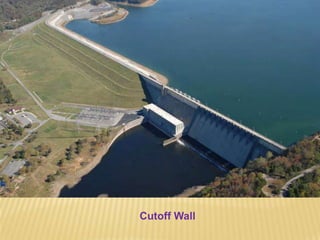
Cutoff walls: in hydraulic structures diaphragm walls are used as
impermeable cutoffs to prevent seepage below earth dams, weirs, and
leeves
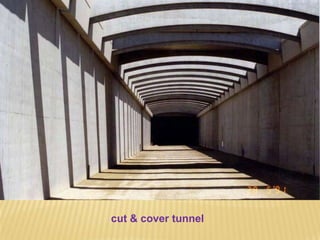
cut & cover tunnel
Cutoff Wall
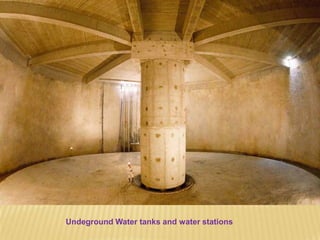
Undeground Water tanks and water stations
Retaining Wall
SELECTION OF TYPE OF DIAPHRAGM WALL
Selection of type of diaphragm depends upon a number of
factors such as:
a) Site conditions
b) Heterogeneity/perviousness of subsurface data
c) Geological features
d) Depth of overburden features
e) Anticipated stress and deformations due to embankment
construction and reservoir loading conditions
f) Availability of construction materials
g) Techno-economic considerations
Materials used for the construction of Diaphragm wall
1) Ordinary Portland Cement
2) Aggregate: Course aggregate of size 20mm
3) Sand: Well graded sand consisting of 50% coarse sand
4) Water: Clean water free from impurities
5) Admixtures: if required chemical admixtures shall be used
as per IS 456:1978
6) Reinforcement: Mild Steel bars
7) Bentonite: bentonite used shall conform to IS 12584:1989
8) Clay: Clay shall conform to IS1498:1970
9) Concrete Mix: For plastic concrete diaphragm wall the
water cement ratio shall not be greater than 0.5.
1. The excavation is carried out using a heavy self guided mechanical grab
suspended from a large crawler crane.
2. The diaphragm walls were excavated and constructed in discrete panels of
between 2.8m and 7.0m lengths, with a depth reaching 30m.
3. As the excavation proceeds, support fluid was added into the excavation to
maintain the stability of the surrounding ground and to prevent a collapse.
This fluid is called “Bentonite”, which is a poser made of a special type of
soluble clay and is mixed at the mixing plant with potable water.
4. A heavy chisel may be used if an obstruction of hard strata is
encountered, to break up the obstruction for removal by the grab.
5. When the excavation is completed, a submersible pump connected to
tremie pipes will be lowered into the panel excavation down to the toe level.
This pumped the fluid down to the toe level and then from the bottom of the
excavation back to a descending unit, in order to separate the bentonite from
the suspended particles contained in it. At the same time, fresh fluid will be
added to the top of the excavation to maintain the stability of the ground.
General Procedure of Construction
Design Considerations
Utmost consideration shall be given, while designing the diaphragm wall,
so as to achieve:
a) perfect embedment at both the ends, to avoid/minimize possibilities of
cracking both within and surrounding the diaphragm wall, and
b) imperviousness or water tightness.
The most important consideration in the design of a diaphragm wall is to
form an impervious wall having flexibility to avoid cracking.
c) The best location for a diaphragm wall within a structure is where the
loads are reasonably balanced on both sides of the wall.
Location of diaphragm wall is often influenced by site conditions. Location
shall, therefore, be decided after careful study of site requirements and
localised features.
GUIDELINES FOR STRUCTURAL DESIGN
Structural Analysis:
Rigid type of diaphragm wall is to be analyzed either by the
method of beam on elastic foundation or by finite element method
(FEM).
Method of beam on elastic foundation:
The diaphragm wall shall be considered in plane strain state and
as such, unit length of diaphragm wall with entire depth as the
span is to be considered as a beam resting on elastic soil media
on the downstream face. Loads are to be considered acting upon
the upstream face of the diaphragm wall. Analysis is to be carried
out using appropriate equations for bending moments and shear
stresses for a beam resting on elastic foundation with assumed
end conditions.
Finite element method (FEM):
Finite element analysis takes into account soil structure interaction.
Finite element analysis shall be carried out as sequential
construction analysis. Sequential construction analysis
is, however, preferred as it takes into account the elastic modulus of
soil changing with different stress Levels during construction. The
finite element analysis shall incorporate interface elements along
the contact boundary of the diaphragm wall and surrounding soil
mass. Elimination of interface elements results in faulty stress and
displacement computations, due to stress transfer through common
nodes.
Flexible types of Diaphragm wall
Structural Analysis:
Plastic concrete diaphragm wall or cement bentonite slurry trench
diaphragm wall or earth backfilled slurry trench diaphragm wall are
relatively flexible and capable to deform under stresses in surrounding
soil. Hence development is not a design problem. These diaphragm
wall shall, therefore be designed to undergo deformations compatible
with those in the surrounding soil without development of cracks.
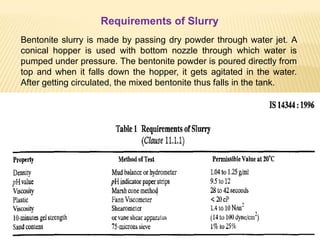
Requirements of Slurry
Bentonite slurry is made by passing dry powder through water jet. A
conical hopper is used with bottom nozzle through which water is
pumped under pressure. The bentonite powder is poured directly from
top and when it falls down the hopper, it gets agitated in the water.
After getting circulated, the mixed bentonite thus falls in the tank.

Diaphragm wall: Construction and Design

  • 1.
    Diaphragm Wall: Construction andDesign By Umer farooq GNDEC, Ludhia na
  • 2.
    DIAPHRAGM WALL  Diaphragmwalls are concrete or reinforced concrete walls constructed in slurry-supported, open trenches below existing ground.  Concrete is placed using the Tremie installation method or by installing pre-cast concrete panels (known as a pre-cast diaphragm wall). Diaphragm walls can be constructed to depths of 150 meters and to widths of 0.5 to 1.50 meters.  Diaphragm wall construction methods are relatively quiet and cause little or no vibration. Therefore, they are especially suitable for civil engineering projects in densely-populated inner city areas.  Due to their ability to keep deformation low and provide low water permeability, diaphragm walls are also used to retain excavation pits in the direct vicinity of existing structures.
  • 4.
    IS 14344 :1996 DESIGN AND CONSTRUCTI-ON OF DIAPHRAGMS FOR UNDER-SEEPAGE CONTROL - CODE OF PRACTICE Which code to use?
  • 5.
    TYPES OF DIAPHRAGMWALL Depending on the use of construction materials there are the following types of diaphragm walls: a) Rigid type 1) Reinforced cement concrete. b) Flexible type 1) Plastic concrete, 2) Cement bentonite slurry trench, and 3) Earth backfilled slurry trench.
  • 6.
    Depending on thefunction the following kinds of diaphragm walls are used: 1) Structural walls 2) Load Bearing Elements 3) Cutoff walls Structural Diaphragm walls: they are used as retaining walls for the perimeter walls of deep basements and underground parking facilities, subways, underpasses, etc Load bearing walls: they are used in place of drilled piers in foundation of tall buildings, bridge piers, etc Cutoff walls: in hydraulic structures diaphragm walls are used as impermeable cutoffs to prevent seepage below earth dams, weirs, and leeves
  • 7.
  • 8.
  • 9.
    Undeground Water tanksand water stations
  • 10.
  • 11.
    SELECTION OF TYPEOF DIAPHRAGM WALL Selection of type of diaphragm depends upon a number of factors such as: a) Site conditions b) Heterogeneity/perviousness of subsurface data c) Geological features d) Depth of overburden features e) Anticipated stress and deformations due to embankment construction and reservoir loading conditions f) Availability of construction materials g) Techno-economic considerations
  • 12.
    Materials used forthe construction of Diaphragm wall 1) Ordinary Portland Cement 2) Aggregate: Course aggregate of size 20mm 3) Sand: Well graded sand consisting of 50% coarse sand 4) Water: Clean water free from impurities 5) Admixtures: if required chemical admixtures shall be used as per IS 456:1978 6) Reinforcement: Mild Steel bars 7) Bentonite: bentonite used shall conform to IS 12584:1989 8) Clay: Clay shall conform to IS1498:1970 9) Concrete Mix: For plastic concrete diaphragm wall the water cement ratio shall not be greater than 0.5.
  • 13.
    1. The excavationis carried out using a heavy self guided mechanical grab suspended from a large crawler crane. 2. The diaphragm walls were excavated and constructed in discrete panels of between 2.8m and 7.0m lengths, with a depth reaching 30m. 3. As the excavation proceeds, support fluid was added into the excavation to maintain the stability of the surrounding ground and to prevent a collapse. This fluid is called “Bentonite”, which is a poser made of a special type of soluble clay and is mixed at the mixing plant with potable water. 4. A heavy chisel may be used if an obstruction of hard strata is encountered, to break up the obstruction for removal by the grab. 5. When the excavation is completed, a submersible pump connected to tremie pipes will be lowered into the panel excavation down to the toe level. This pumped the fluid down to the toe level and then from the bottom of the excavation back to a descending unit, in order to separate the bentonite from the suspended particles contained in it. At the same time, fresh fluid will be added to the top of the excavation to maintain the stability of the ground. General Procedure of Construction
  • 14.
    Design Considerations Utmost considerationshall be given, while designing the diaphragm wall, so as to achieve: a) perfect embedment at both the ends, to avoid/minimize possibilities of cracking both within and surrounding the diaphragm wall, and b) imperviousness or water tightness. The most important consideration in the design of a diaphragm wall is to form an impervious wall having flexibility to avoid cracking. c) The best location for a diaphragm wall within a structure is where the loads are reasonably balanced on both sides of the wall. Location of diaphragm wall is often influenced by site conditions. Location shall, therefore, be decided after careful study of site requirements and localised features.
  • 15.
    GUIDELINES FOR STRUCTURALDESIGN Structural Analysis: Rigid type of diaphragm wall is to be analyzed either by the method of beam on elastic foundation or by finite element method (FEM). Method of beam on elastic foundation: The diaphragm wall shall be considered in plane strain state and as such, unit length of diaphragm wall with entire depth as the span is to be considered as a beam resting on elastic soil media on the downstream face. Loads are to be considered acting upon the upstream face of the diaphragm wall. Analysis is to be carried out using appropriate equations for bending moments and shear stresses for a beam resting on elastic foundation with assumed end conditions.
  • 16.
    Finite element method(FEM): Finite element analysis takes into account soil structure interaction. Finite element analysis shall be carried out as sequential construction analysis. Sequential construction analysis is, however, preferred as it takes into account the elastic modulus of soil changing with different stress Levels during construction. The finite element analysis shall incorporate interface elements along the contact boundary of the diaphragm wall and surrounding soil mass. Elimination of interface elements results in faulty stress and displacement computations, due to stress transfer through common nodes.
  • 17.
    Flexible types ofDiaphragm wall Structural Analysis: Plastic concrete diaphragm wall or cement bentonite slurry trench diaphragm wall or earth backfilled slurry trench diaphragm wall are relatively flexible and capable to deform under stresses in surrounding soil. Hence development is not a design problem. These diaphragm wall shall, therefore be designed to undergo deformations compatible with those in the surrounding soil without development of cracks.
  • 18.
    Requirements of Slurry Bentoniteslurry is made by passing dry powder through water jet. A conical hopper is used with bottom nozzle through which water is pumped under pressure. The bentonite powder is poured directly from top and when it falls down the hopper, it gets agitated in the water. After getting circulated, the mixed bentonite thus falls in the tank.