RETAINING WALLS
RETAINING WALL


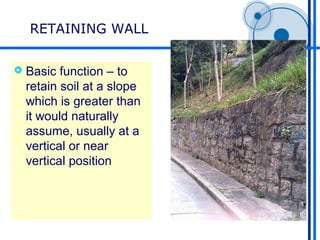
   Basic function – to
    retain soil at a slope
    which is greater than
    it would naturally
    assume, usually at a
    vertical or near
    vertical position
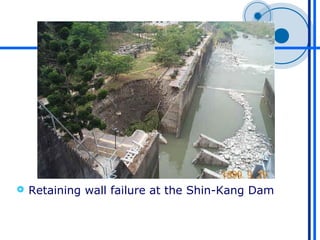
   Retaining wall failure at the Shin-Kang Dam
Design of retaining wall

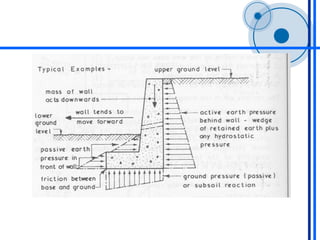
    retaining walls have primary function of
     retaining soils at an angle in excess of the
     soil’s nature angle of repose.
    Walls within the design height range are
     designed to provide the necessary resistance
     by either their own mass or by the principles
     of leverage.
    Design consideration:
1.   Overturning of the wall does not occur
2.   Forward sliding does not occur
3.   Materials used are suitable
4.   The subsoil is not overloaded
Factors which designer need to take
    account
 Nature and characteristics of the subsoil's
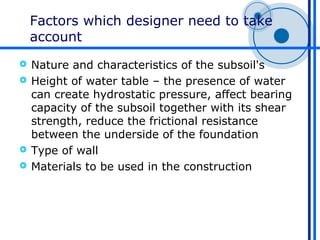
 Height of water table – the presence of water
  can create hydrostatic pressure, affect bearing
  capacity of the subsoil together with its shear
  strength, reduce the frictional resistance
  between the underside of the foundation
 Type of wall
 Materials to be used in the construction
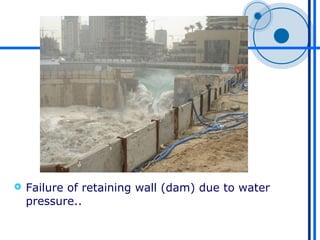
   Failure of retaining wall (dam) due to water
    pressure..
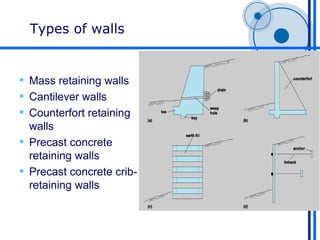
Types of walls


• Mass retaining walls
• Cantilever walls
• Counterfort retaining
    walls
•   Precast concrete
    retaining walls
•   Precast concrete crib-
    retaining walls
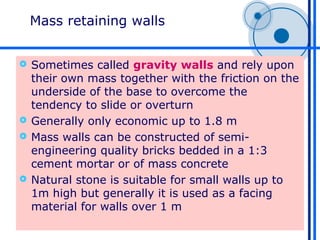
Mass retaining walls


 Sometimes called gravity walls and rely upon
  their own mass together with the friction on the
  underside of the base to overcome the
  tendency to slide or overturn
 Generally only economic up to 1.8 m
 Mass walls can be constructed of semi-
  engineering quality bricks bedded in a 1:3
  cement mortar or of mass concrete
 Natural stone is suitable for small walls up to
  1m high but generally it is used as a facing
  material for walls over 1 m
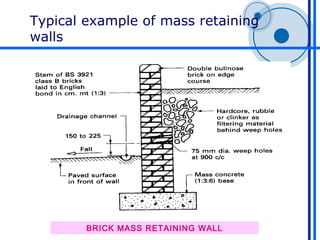
Typical example of mass retaining
walls


        BRICK MASS RETAINING WALL
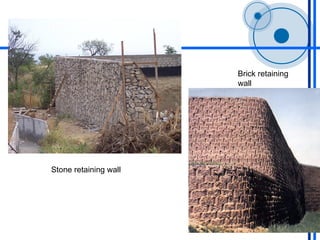
Brick retaining
                       wall


Stone retaining wall
Typical example of mass retaining
walls


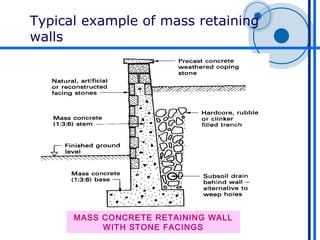
      MASS CONCRETE RETAINING WALL
           WITH STONE FACINGS
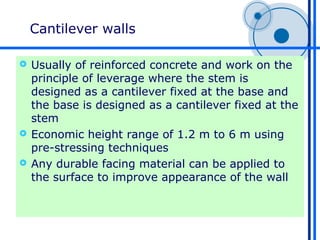
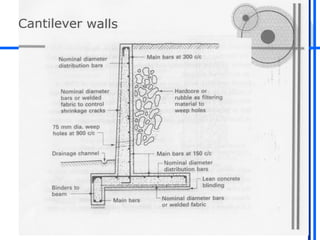
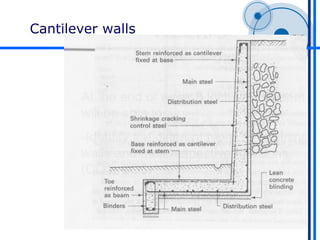
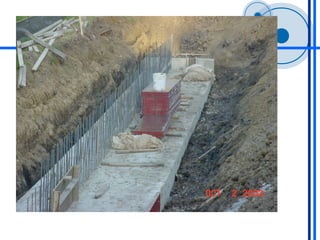
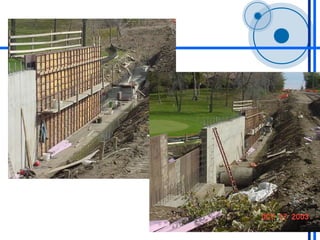
Cantilever walls

 Usually of reinforced concrete and work on the
  principle of leverage where the stem is
  designed as a cantilever fixed at the base and
  the base is designed as a cantilever fixed at the
  stem
 Economic height range of 1.2 m to 6 m using
  pre-stressing techniques
 Any durable facing material can be applied to
  the surface to improve appearance of the wall
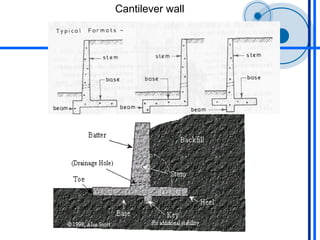
Cantilever wall
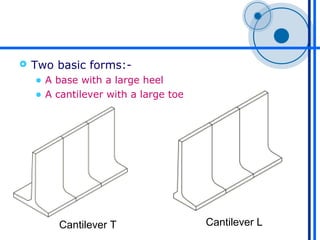
   Two basic forms:-
    • A base with a large heel
    • A cantilever with a large toe


         Cantilever T                 Cantilever L
Cantilever walls
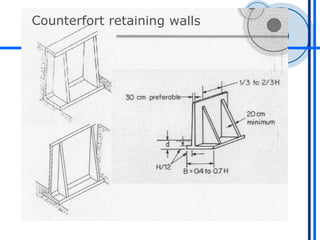
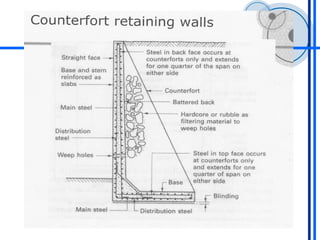
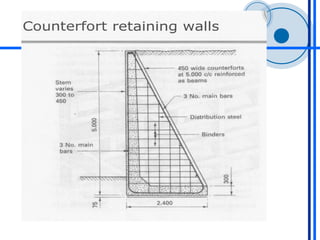
Counterfort retaining walls

 Can be constructed of reinforced or prestressed
  concrete
 Suitable for over 4.5 m
 Triangular beams placed at suitable centres
  behind the stem and above the base to enable
  the stem and base to act as slab spanning
  horizontally over or under the counterforts
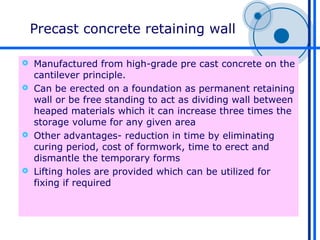
Precast concrete retaining wall

 Manufactured from high-grade pre cast concrete on the
  cantilever principle.
 Can be erected on a foundation as permanent retaining
  wall or be free standing to act as dividing wall between
  heaped materials which it can increase three times the
  storage volume for any given area
 Other advantages- reduction in time by eliminating
  curing period, cost of formwork, time to erect and
  dismantle the temporary forms
 Lifting holes are provided which can be utilized for
  fixing if required
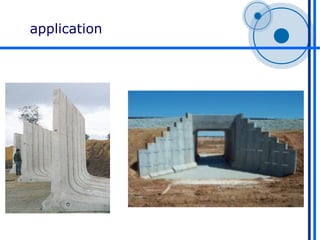
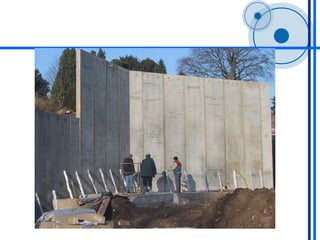
application
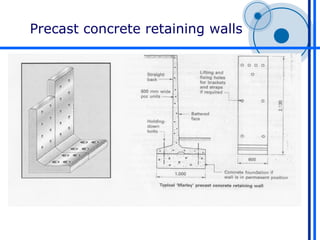
Precast concrete retaining walls
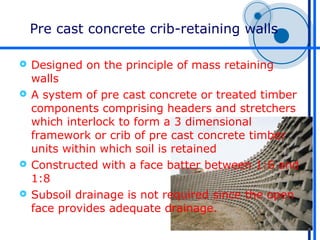
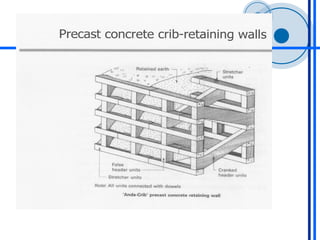
Pre cast concrete crib-retaining walls

 Designed on the principle of mass retaining
  walls
 A system of pre cast concrete or treated timber
  components comprising headers and stretchers
  which interlock to form a 3 dimensional
  framework or crib of pre cast concrete timber
  units within which soil is retained
 Constructed with a face batter between 1:6 and
  1:8
 Subsoil drainage is not required since the open
  face provides adequate drainage.
Retaining Walls

Retaining Walls

  • 1.
  • 2.
    RETAINING WALL  Basic function – to retain soil at a slope which is greater than it would naturally assume, usually at a vertical or near vertical position
  • 4.
    Retaining wall failure at the Shin-Kang Dam
  • 5.
    Design of retainingwall  retaining walls have primary function of retaining soils at an angle in excess of the soil’s nature angle of repose.  Walls within the design height range are designed to provide the necessary resistance by either their own mass or by the principles of leverage.  Design consideration: 1. Overturning of the wall does not occur 2. Forward sliding does not occur 3. Materials used are suitable 4. The subsoil is not overloaded
  • 6.
    Factors which designerneed to take account  Nature and characteristics of the subsoil's  Height of water table – the presence of water can create hydrostatic pressure, affect bearing capacity of the subsoil together with its shear strength, reduce the frictional resistance between the underside of the foundation  Type of wall  Materials to be used in the construction
  • 8.
    Failure of retaining wall (dam) due to water pressure..
  • 9.
    Types of walls •Mass retaining walls • Cantilever walls • Counterfort retaining walls • Precast concrete retaining walls • Precast concrete crib- retaining walls
  • 10.
    Mass retaining walls Sometimes called gravity walls and rely upon their own mass together with the friction on the underside of the base to overcome the tendency to slide or overturn  Generally only economic up to 1.8 m  Mass walls can be constructed of semi- engineering quality bricks bedded in a 1:3 cement mortar or of mass concrete  Natural stone is suitable for small walls up to 1m high but generally it is used as a facing material for walls over 1 m
  • 11.
    Typical example ofmass retaining walls BRICK MASS RETAINING WALL
  • 12.
    Brick retaining wall Stone retaining wall
  • 13.
    Typical example ofmass retaining walls MASS CONCRETE RETAINING WALL WITH STONE FACINGS
  • 14.
    Cantilever walls  Usuallyof reinforced concrete and work on the principle of leverage where the stem is designed as a cantilever fixed at the base and the base is designed as a cantilever fixed at the stem  Economic height range of 1.2 m to 6 m using pre-stressing techniques  Any durable facing material can be applied to the surface to improve appearance of the wall
  • 15.
  • 16.
    Two basic forms:- • A base with a large heel • A cantilever with a large toe Cantilever T Cantilever L
  • 18.
  • 21.
    Counterfort retaining walls Can be constructed of reinforced or prestressed concrete  Suitable for over 4.5 m  Triangular beams placed at suitable centres behind the stem and above the base to enable the stem and base to act as slab spanning horizontally over or under the counterforts
  • 25.
    Precast concrete retainingwall  Manufactured from high-grade pre cast concrete on the cantilever principle.  Can be erected on a foundation as permanent retaining wall or be free standing to act as dividing wall between heaped materials which it can increase three times the storage volume for any given area  Other advantages- reduction in time by eliminating curing period, cost of formwork, time to erect and dismantle the temporary forms  Lifting holes are provided which can be utilized for fixing if required
  • 26.
  • 28.
  • 29.
    Pre cast concretecrib-retaining walls  Designed on the principle of mass retaining walls  A system of pre cast concrete or treated timber components comprising headers and stretchers which interlock to form a 3 dimensional framework or crib of pre cast concrete timber units within which soil is retained  Constructed with a face batter between 1:6 and 1:8  Subsoil drainage is not required since the open face provides adequate drainage.