Acute Tonsillitis
Ieva Muižniece
MF III 1st group
Mentor: Dr. Gunta Sumeraga
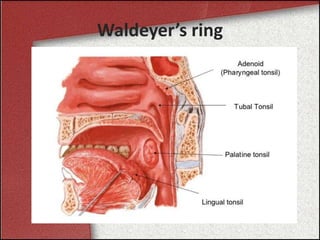
Waldeyer’s ring
• The lymphoid tissue surrounding opening into
respiratory and digestive systems forms a ring.
• The lateral part is formed by palatine tonsils and
tubal tonsils (around the auditory tube opening).
• The upper part is formed by pharyngeal tonsil
(on the roof of the nasopharynx).
• The lower part – lingual tonsil (on the posterior
1/3 of tongue)
Waldeyer’s ring
Anatomy of Palatine Tonsils
Situated bilaterally in the
lateral wall of the
oropharynx in the
tonsillar recess bounded
by the palatoglossal fold
anteriorly and the
palatopharyngeal fold
posteriorly.
Anatomy of Palatine Tonsils
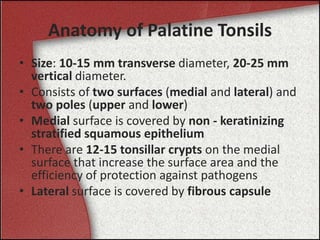
• Size: 10-15 mm transverse diameter, 20-25 mm
vertical diameter.
• Consists of two surfaces (medial and lateral) and
two poles (upper and lower)
• Medial surface is covered by non - keratinizing
stratified squamous epithelium
• There are 12-15 tonsillar crypts on the medial
surface that increase the surface area and the
efficiency of protection against pathogens
• Lateral surface is covered by fibrous capsule
Anatomy of Palatine Tonsils
• Upper pole extends
into soft palate and lower
pole is attached to
the tongue
• Total surface: 295 cm²
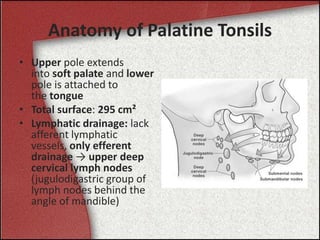
• Lymphatic drainage: lack
afferent lymphatic
vessels, only efferent
drainage → upper deep
cervical lymph nodes
(jugulodigastric group of
lymph nodes behind the
angle of mandible)
Functional Importance in the Immune
System
• Significant role in the defense against upper respiratory
infections.
• One of the MALT of the upper respiratory tract, which
has the ability to mount specific immune reactions in
response to antigens.
• Activity is pronounced during childhood, when
immunologic challenges from the environment induce
hyperplasia.
• ‘’Active phase’’ lasts until about 8 – 10 years of age.
• The lymphatic tonsillar tissue becomes less important as

an immune organ.
Functional Importance in the Immune
System
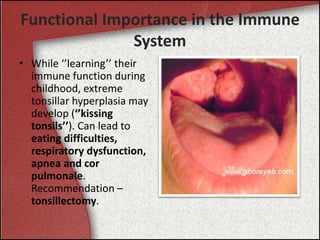
• While ‘’learning’’ their
immune function during
childhood, extreme
tonsillar hyperplasia may
develop (‘’kissing
tonsils’’). Can lead to
eating difficulties,
respiratory dysfunction,
apnea and cor
pulmonale.
Recommendation –
tonsillectomy.
Epidemiology of acute tonsillitis
• Affecting children between the ages of 5 and 15
years.
• Approximately 30% to 40% of tonsillitis cases in
children can be attributed to a bacterial cause.
Group A beta-hemolytic streptococcus is the most
common bacterial pathogen causing tonsillitis.
Definition
• Synonym: streptococcal
angina
• Acute tonsillitis is the
infectious disease of the
whole organism with
clinical manifestation in
tonsils. The most
common place – palatine
tonsils, but also lingual,
pharyngeal tonsil can be
involved.
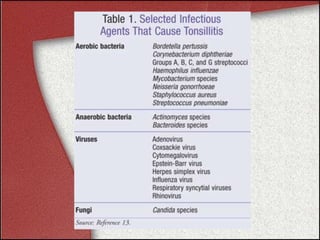
Etiology
• Generally caused by group A beta - haemolytic
streptococci (GABHS)
• Moraxella catarrhalis
• Haemophilus influenzae
• Staphylococcus aureus
• S. pneumoniae
• Bacteroides
• E. Coli
• diphtheria, syphilis, Neisseria
• viruses (adenovirus, influenza A and B virus, Epstein-Barr
virus (EBV), parainfluenza virus, enterovirus, herpes simplex
virus)
Etiology
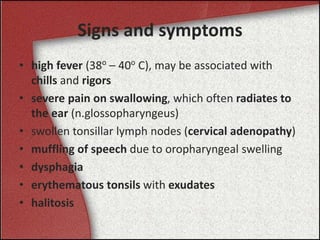
Signs and symptoms
• high fever (38o
– 40o
C), may be associated with
chills and rigors
• severe pain on swallowing, which often radiates to
the ear (n.glossopharyngeus)
• swollen tonsillar lymph nodes (cervical adenopathy)
• muffling of speech due to oropharyngeal swelling
• dysphagia
• erythematous tonsils with exudates
• halitosis
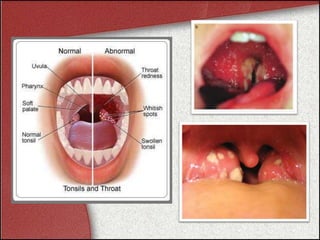
Signs and symptoms
• general – headache, malaise, anorexia, abdominal
pain, pain in the back and limbs
• viral infections tend to have lower grade fevers and
less exudative tonsils
• not all signs and symptoms are present in every
patient
Classification of Acute Tonsillitis
• Acute catarrhal/superficial
• Acute follicular
• Acute membranous
• Acute parenchymatous
• Acute ulcerative
Classification of Acute Tonsillitis
Acute catarrhal/superficial – tonsillitis is a part
of generalized infection of the oropharyngeal
mucosa, mostly in viral infections.
Classification of Acute Tonsillitis
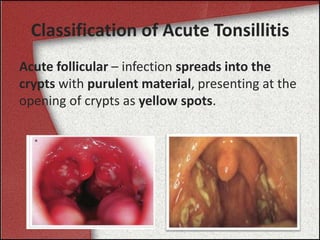
Acute follicular – infection spreads into the
crypts with purulent material, presenting at the
opening of crypts as yellow spots.
Classification of Acute Tonsillitis
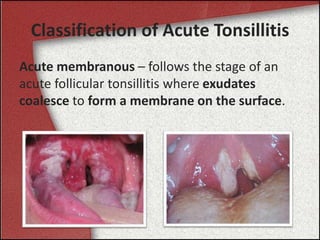
Acute membranous – follows the stage of an
acute follicular tonsillitis where exudates
coalesce to form a membrane on the surface.
Classification of Acute Tonsillitis
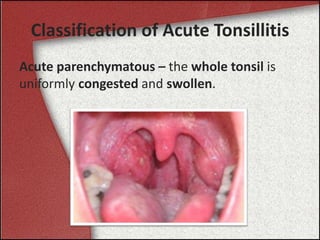
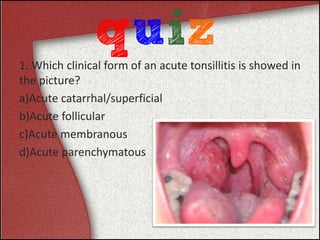
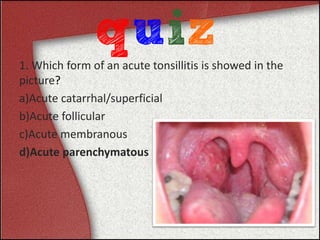
Acute parenchymatous – the whole tonsil is
uniformly congested and swollen.
Classification of Acute Tonsillitis
Acute ulcerative – various
subtypes, ulceration can
be superficial or deep.
Vincent’s angina is a form
of ulcerative tonsillitis,
ulceration also occurs
secondary in syphilis and
in diphtheria.
Diagnosis
• Complaints and symptoms
• Examination of the throat
• Inflammatory parameters – leukocytosis, ESR
and CRP are elevated
• Bacteriological testing – rarely taken because
it takes 2 – 3 days to obtain a definitive result.
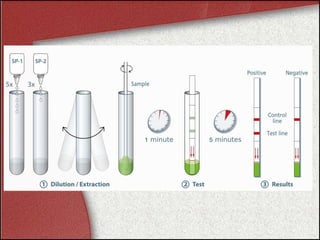
• Rapid immunoassay - can identify the
causative organism as a group A streptococcus
in 10 minutes.
Treatment
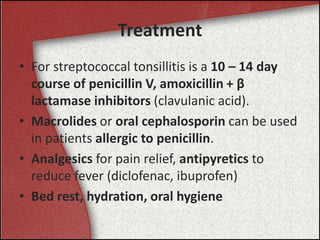
• For streptococcal tonsillitis is a 10 – 14 day
course of penicillin V, amoxicillin + β
lactamase inhibitors (clavulanic acid).
• Macrolides or oral cephalosporin can be used
in patients allergic to penicillin.
• Analgesics for pain relief, antipyretics to
reduce fever (diclofenac, ibuprofen)
• Bed rest, hydration, oral hygiene
Complications
Local/regional
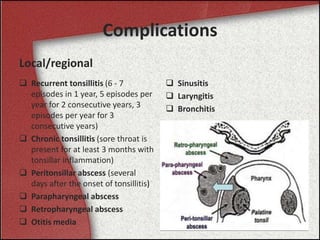
 Recurrent tonsillitis (6 - 7
episodes in 1 year, 5 episodes per
year for 2 consecutive years, 3
episodes per year for 3
consecutive years)
 Chronic tonsillitis (sore throat is
present for at least 3 months with
tonsillar inflammation)
 Peritonsillar abscess (several
days after the onset of tonsillitis)
 Parapharyngeal abscess
 Retropharyngeal abscess
 Otitis media
 Sinusitis
 Laryngitis
 Bronchitis
Complications
Systemic
Sequel of streptococcal tonsillitis – rarely, a delayed type
antigen-antibody reaction can give rise to poststreptococcal
diseases:
 acute glomerulonephritis (1 to 2 weeks after infection)
 acute rheumatic fever (1 to 4 weeks)
 rheumatic endocarditis
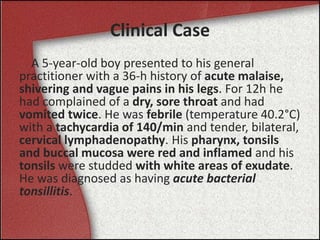
Clinical Case
A 5-year-old boy presented to his general
practitioner with a 36-h history of acute malaise,
shivering and vague pains in his legs. For 12h he
had complained of a dry, sore throat and had
vomited twice. He was febrile (temperature 40.2°C)
with a tachycardia of 140/min and tender, bilateral,
cervical lymphadenopathy. His pharynx, tonsils
and buccal mucosa were red and inflamed and his
tonsils were studded with white areas of exudate.
He was diagnosed as having acute bacterial
tonsillitis.
Clinical case
• He was treated with penicillin for 5 days. A throat
swab taken before starting antibiotics grew beta-
haemolytic streptococci (Group A). After 3 days
of treatment, his temperature had returned to
normal and he made an uneventful recovery.
• Haemolytic streptococcal infections illustrate an
important point about bacterial infection - that
immune defenses together with antibiotics cope
satisfactorily with most bacterial infections in
most people.
1. Which clinical form of an acute tonsillitis is showed in
the picture?
a)Acute catarrhal/superficial
b)Acute follicular
c)Acute membranous
d)Acute parenchymatous
1. Which form of an acute tonsillitis is showed in the
picture?
a)Acute catarrhal/superficial
b)Acute follicular
c)Acute membranous
d)Acute parenchymatous
2. Which is the most common bacterial pathogen
causing tonsillitis?
2. Which is the most common bacterial pathogen
causing tonsillitis?
Answer: group A beta-hemolytic streptococci
3. Which one of these complications isn’t caused by
acute tonsillitis?
a)rheumatic endocarditis
b)laryngitis
c)agranulocytosis
d)retropharyngeal abscess
3. Which one of these complications isn’t caused by
acute tonsillitis?
a)rheumatic endocarditis
b)laryngitis
c)agranulocytosis
d)retropharyngeal abscess
Sources
1. Basic Otorhinolaryngology A Step-by –Step- Learning Guide.
R.Probst, G.Grevers, H.Iro Themie 2006, p. 430
2. Otolaryngology : head & neck surgery : clinical reference guide.
Raza Pasha, Justin S. Golub. — 4th edition, 2014, p. 757
3. Otolaryngology: Basic Science and Clinical Review Authors: Van de
Water, Thomas R., Staecker, Hinrich Publisher: New York: Themie,
2006, eBook
4. http://the-family-doctor.com/the-family-doctor/t/tonsil.htm
5. http://www.uspharmacist.com/continuing_education/ceviewtest/
lessonid/109176/
6. http://epomedicine.com/medical-students/applied-anatomy-of-
palatine-tonsils/
7. http://www.immunologyclinic.com/case.asp?chap=02&case=3
THANK YOU FOR YOUR ATTENTION!

Acute tonsillitis

  • 1.
    Acute Tonsillitis Ieva Muižniece MFIII 1st group Mentor: Dr. Gunta Sumeraga
  • 2.
    Waldeyer’s ring • Thelymphoid tissue surrounding opening into respiratory and digestive systems forms a ring. • The lateral part is formed by palatine tonsils and tubal tonsils (around the auditory tube opening). • The upper part is formed by pharyngeal tonsil (on the roof of the nasopharynx). • The lower part – lingual tonsil (on the posterior 1/3 of tongue)
  • 3.
  • 4.
    Anatomy of PalatineTonsils Situated bilaterally in the lateral wall of the oropharynx in the tonsillar recess bounded by the palatoglossal fold anteriorly and the palatopharyngeal fold posteriorly.
  • 5.
    Anatomy of PalatineTonsils • Size: 10-15 mm transverse diameter, 20-25 mm vertical diameter. • Consists of two surfaces (medial and lateral) and two poles (upper and lower) • Medial surface is covered by non - keratinizing stratified squamous epithelium • There are 12-15 tonsillar crypts on the medial surface that increase the surface area and the efficiency of protection against pathogens • Lateral surface is covered by fibrous capsule
  • 6.
    Anatomy of PalatineTonsils • Upper pole extends into soft palate and lower pole is attached to the tongue • Total surface: 295 cm² • Lymphatic drainage: lack afferent lymphatic vessels, only efferent drainage → upper deep cervical lymph nodes (jugulodigastric group of lymph nodes behind the angle of mandible)
  • 7.
    Functional Importance inthe Immune System • Significant role in the defense against upper respiratory infections. • One of the MALT of the upper respiratory tract, which has the ability to mount specific immune reactions in response to antigens. • Activity is pronounced during childhood, when immunologic challenges from the environment induce hyperplasia. • ‘’Active phase’’ lasts until about 8 – 10 years of age. • The lymphatic tonsillar tissue becomes less important as an immune organ.
  • 8.
    Functional Importance inthe Immune System • While ‘’learning’’ their immune function during childhood, extreme tonsillar hyperplasia may develop (‘’kissing tonsils’’). Can lead to eating difficulties, respiratory dysfunction, apnea and cor pulmonale. Recommendation – tonsillectomy.
  • 9.
    Epidemiology of acutetonsillitis • Affecting children between the ages of 5 and 15 years. • Approximately 30% to 40% of tonsillitis cases in children can be attributed to a bacterial cause. Group A beta-hemolytic streptococcus is the most common bacterial pathogen causing tonsillitis.
  • 10.
    Definition • Synonym: streptococcal angina •Acute tonsillitis is the infectious disease of the whole organism with clinical manifestation in tonsils. The most common place – palatine tonsils, but also lingual, pharyngeal tonsil can be involved.
  • 11.
    Etiology • Generally causedby group A beta - haemolytic streptococci (GABHS) • Moraxella catarrhalis • Haemophilus influenzae • Staphylococcus aureus • S. pneumoniae • Bacteroides • E. Coli • diphtheria, syphilis, Neisseria • viruses (adenovirus, influenza A and B virus, Epstein-Barr virus (EBV), parainfluenza virus, enterovirus, herpes simplex virus)
  • 12.
  • 13.
    Signs and symptoms •high fever (38o – 40o C), may be associated with chills and rigors • severe pain on swallowing, which often radiates to the ear (n.glossopharyngeus) • swollen tonsillar lymph nodes (cervical adenopathy) • muffling of speech due to oropharyngeal swelling • dysphagia • erythematous tonsils with exudates • halitosis
  • 14.
    Signs and symptoms •general – headache, malaise, anorexia, abdominal pain, pain in the back and limbs • viral infections tend to have lower grade fevers and less exudative tonsils • not all signs and symptoms are present in every patient
  • 17.
    Classification of AcuteTonsillitis • Acute catarrhal/superficial • Acute follicular • Acute membranous • Acute parenchymatous • Acute ulcerative
  • 18.
    Classification of AcuteTonsillitis Acute catarrhal/superficial – tonsillitis is a part of generalized infection of the oropharyngeal mucosa, mostly in viral infections.
  • 19.
    Classification of AcuteTonsillitis Acute follicular – infection spreads into the crypts with purulent material, presenting at the opening of crypts as yellow spots.
  • 20.
    Classification of AcuteTonsillitis Acute membranous – follows the stage of an acute follicular tonsillitis where exudates coalesce to form a membrane on the surface.
  • 21.
    Classification of AcuteTonsillitis Acute parenchymatous – the whole tonsil is uniformly congested and swollen.
  • 22.
    Classification of AcuteTonsillitis Acute ulcerative – various subtypes, ulceration can be superficial or deep. Vincent’s angina is a form of ulcerative tonsillitis, ulceration also occurs secondary in syphilis and in diphtheria.
  • 23.
    Diagnosis • Complaints andsymptoms • Examination of the throat • Inflammatory parameters – leukocytosis, ESR and CRP are elevated • Bacteriological testing – rarely taken because it takes 2 – 3 days to obtain a definitive result. • Rapid immunoassay - can identify the causative organism as a group A streptococcus in 10 minutes.
  • 25.
    Treatment • For streptococcaltonsillitis is a 10 – 14 day course of penicillin V, amoxicillin + β lactamase inhibitors (clavulanic acid). • Macrolides or oral cephalosporin can be used in patients allergic to penicillin. • Analgesics for pain relief, antipyretics to reduce fever (diclofenac, ibuprofen) • Bed rest, hydration, oral hygiene
  • 26.
    Complications Local/regional  Recurrent tonsillitis(6 - 7 episodes in 1 year, 5 episodes per year for 2 consecutive years, 3 episodes per year for 3 consecutive years)  Chronic tonsillitis (sore throat is present for at least 3 months with tonsillar inflammation)  Peritonsillar abscess (several days after the onset of tonsillitis)  Parapharyngeal abscess  Retropharyngeal abscess  Otitis media  Sinusitis  Laryngitis  Bronchitis
  • 27.
    Complications Systemic Sequel of streptococcaltonsillitis – rarely, a delayed type antigen-antibody reaction can give rise to poststreptococcal diseases:  acute glomerulonephritis (1 to 2 weeks after infection)  acute rheumatic fever (1 to 4 weeks)  rheumatic endocarditis
  • 28.
    Clinical Case A 5-year-oldboy presented to his general practitioner with a 36-h history of acute malaise, shivering and vague pains in his legs. For 12h he had complained of a dry, sore throat and had vomited twice. He was febrile (temperature 40.2°C) with a tachycardia of 140/min and tender, bilateral, cervical lymphadenopathy. His pharynx, tonsils and buccal mucosa were red and inflamed and his tonsils were studded with white areas of exudate. He was diagnosed as having acute bacterial tonsillitis.
  • 29.
    Clinical case • Hewas treated with penicillin for 5 days. A throat swab taken before starting antibiotics grew beta- haemolytic streptococci (Group A). After 3 days of treatment, his temperature had returned to normal and he made an uneventful recovery. • Haemolytic streptococcal infections illustrate an important point about bacterial infection - that immune defenses together with antibiotics cope satisfactorily with most bacterial infections in most people.
  • 30.
    1. Which clinicalform of an acute tonsillitis is showed in the picture? a)Acute catarrhal/superficial b)Acute follicular c)Acute membranous d)Acute parenchymatous
  • 31.
    1. Which formof an acute tonsillitis is showed in the picture? a)Acute catarrhal/superficial b)Acute follicular c)Acute membranous d)Acute parenchymatous
  • 32.
    2. Which isthe most common bacterial pathogen causing tonsillitis?
  • 33.
    2. Which isthe most common bacterial pathogen causing tonsillitis? Answer: group A beta-hemolytic streptococci
  • 34.
    3. Which oneof these complications isn’t caused by acute tonsillitis? a)rheumatic endocarditis b)laryngitis c)agranulocytosis d)retropharyngeal abscess
  • 35.
    3. Which oneof these complications isn’t caused by acute tonsillitis? a)rheumatic endocarditis b)laryngitis c)agranulocytosis d)retropharyngeal abscess
  • 36.
    Sources 1. Basic OtorhinolaryngologyA Step-by –Step- Learning Guide. R.Probst, G.Grevers, H.Iro Themie 2006, p. 430 2. Otolaryngology : head & neck surgery : clinical reference guide. Raza Pasha, Justin S. Golub. — 4th edition, 2014, p. 757 3. Otolaryngology: Basic Science and Clinical Review Authors: Van de Water, Thomas R., Staecker, Hinrich Publisher: New York: Themie, 2006, eBook 4. http://the-family-doctor.com/the-family-doctor/t/tonsil.htm 5. http://www.uspharmacist.com/continuing_education/ceviewtest/ lessonid/109176/ 6. http://epomedicine.com/medical-students/applied-anatomy-of- palatine-tonsils/ 7. http://www.immunologyclinic.com/case.asp?chap=02&case=3
  • 37.
    THANK YOU FORYOUR ATTENTION!