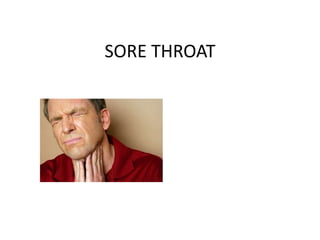
SORE THROAT
Introduction
Sore throat is one of the most common symptoms
encountered
Patients use the term to describe almost any feeling
in the throat, ranging from dryness to actual pain –
important to ascertain the precise nature of sore
throat & severity early in clinical history
Severity – dysphagia for solid?, liquids?, saliva?
Differential Diagnosis
of Sore Throat
1. Tonsillitis
2. Pharyngitis
3. Adenoiditis
4. Peritonsillar abscess
5. Infectious mononucleosis
6. Diphtheria
7. Lymphoma
8. Squamous cell carcinoma of tonsil
9. Trauma/Foreign body
Complication of sore throat
• Tonsilitis, peritonsillar abscess
• Sinusitis
• Mastoiditis
• Ear infection (otitis media)
• Laryngitis
• Rheumatic fever and glomerulonephritis
(GABHS)
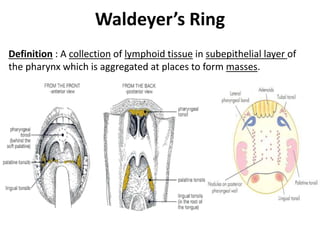
Waldeyer’s Ring
Definition : A collection of lymphoid tissue in subepithelial layer of
the pharynx which is aggregated at places to form masses.
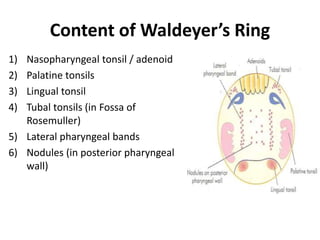
Content of Waldeyer’s Ring
1) Nasopharyngeal tonsil / adenoid
2) Palatine tonsils
3) Lingual tonsil
4) Tubal tonsils (in Fossa of
Rosemuller)
5) Lateral pharyngeal bands
6) Nodules (in posterior pharyngeal
wall)
Content of Waldeyer’s Ring
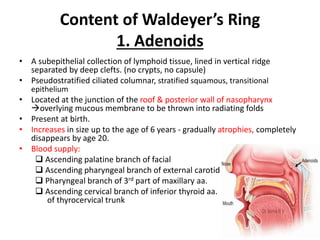
1. Adenoids
• A subepithelial collection of lymphoid tissue, lined in vertical ridge
separated by deep clefts. (no crypts, no capsule)
• Pseudostratified ciliated columnar, stratified squamous, transitional
epithelium
• Located at the junction of the roof & posterior wall of nasopharynx
overlying mucous membrane to be thrown into radiating folds
• Present at birth.
• Increases in size up to the age of 6 years - gradually atrophies, completely
disappears by age 20.
• Blood supply:
 Ascending palatine branch of facial
 Ascending pharyngeal branch of external carotid
 Pharyngeal branch of 3rd part of maxillary aa.
 Ascending cervical branch of inferior thyroid aa.
of thyrocervical trunk
Content of Waldeyer’s Ring
1. Adenoids
• Venous drainage : to pharyngeal plexus, which communicates
with the pterygoid plexus drains into the internal jugular &
facial veins
• Lympathic :
Efferent lympathic of adenoidretropharyngeal &
parapharyngeal LNs  upper jugular nodes
• Innervation : CN IX & CN X
Content of Waldeyer’s Ring
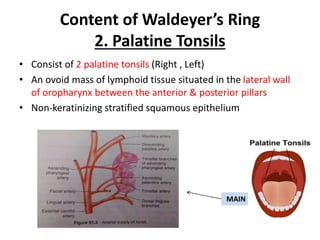
2. Palatine Tonsils
• Consist of 2 palatine tonsils (Right , Left)
• An ovoid mass of lymphoid tissue situated in the lateral wall
of oropharynx between the anterior & posterior pillars
• Non-keratinizing stratified squamous epithelium
MAIN
Content of Waldeyer’s Ring
2. Palatine Tonsils
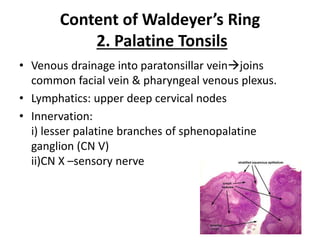
• Venous drainage into paratonsillar veinjoins
common facial vein & pharyngeal venous plexus.
• Lymphatics: upper deep cervical nodes
• Innervation:
i) lesser palatine branches of sphenopalatine
ganglion (CN V)
ii)CN X –sensory nerve
Content of Waldeyer’s Ring
2. Palatine Tonsils
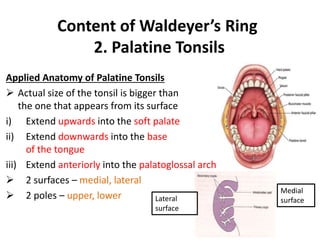
Applied Anatomy of Palatine Tonsils
 Actual size of the tonsil is bigger than
the one that appears from its surface
i) Extend upwards into the soft palate
ii) Extend downwards into the base
of the tongue
iii) Extend anteriorly into the palatoglossal arch
 2 surfaces – medial, lateral
 2 poles – upper, lower
Medial
surfaceLateral
surface
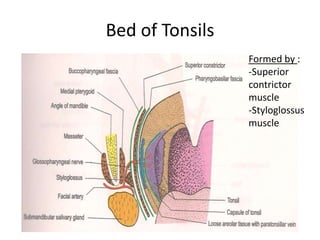
Bed of Tonsils
Formed by :
-Superior
contrictor
muscle
-Styloglossus
muscle
Content of Waldeyer’s Ring
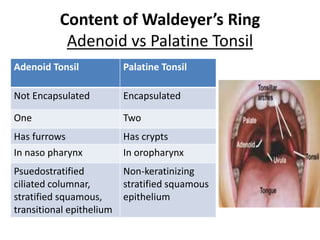
Adenoid vs Palatine Tonsil
Adenoid Tonsil Palatine Tonsil
Not Encapsulated Encapsulated
One Two
Has furrows Has crypts
In naso pharynx In oropharynx
Psuedostratified
ciliated columnar,
stratified squamous,
transitional epithelium
Non-keratinizing
stratified squamous
epithelium
Content of Waldeyer’s Ring
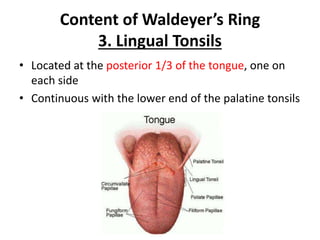
3. Lingual Tonsils
• Located at the posterior 1/3 of the tongue, one on
each side
• Continuous with the lower end of the palatine tonsils
Content of Waldeyer’s Ring
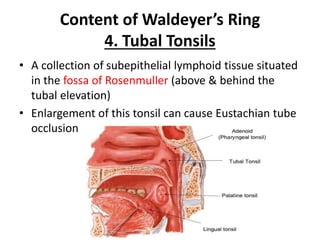
4. Tubal Tonsils
• A collection of subepithelial lymphoid tissue situated
in the fossa of Rosenmuller (above & behind the
tubal elevation)
• Enlargement of this tonsil can cause Eustachian tube
occlusion
Role of Waldeyer’s Ring
in Body Defense Mechanism
 Function as an immunologic surveillance to
allow adaptation to environment esp. in
children.
 Produce lymphocytes and plasma cell
 Protect airway as guarding the entry of air and
food.
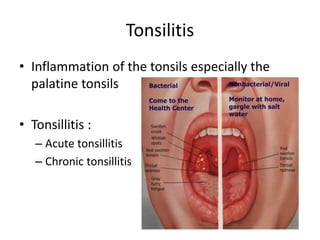
Tonsilitis
• Inflammation of the tonsils especially the
palatine tonsils
• Tonsillitis :
– Acute tonsillitis
– Chronic tonsillitis
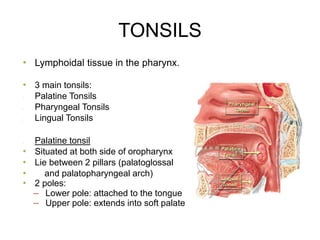
TONSILS
• Lymphoidal tissue in the pharynx.
• 3 main tonsils:
• Palatine Tonsils
• Pharyngeal Tonsils
• Lingual Tonsils
• Palatine tonsil
• Situated at both side of oropharynx
• Lie between 2 pillars (palatoglossal
• and palatopharyngeal arch)
• 2 poles:
– Lower pole: attached to the tongue
– Upper pole: extends into soft palate
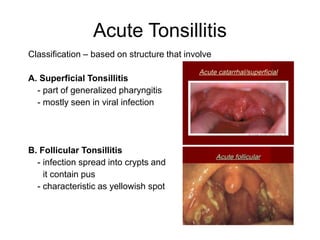
Acute Tonsillitis
Classification – based on structure that involve
A. Superficial Tonsillitis
- part of generalized pharyngitis
- mostly seen in viral infection
B. Follicular Tonsillitis
- infection spread into crypts and
it contain pus
- characteristic as yellowish spot
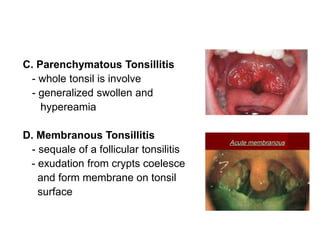
C. Parenchymatous Tonsillitis
- whole tonsil is involve
- generalized swollen and
hypereamia
D. Membranous Tonsillitis
- sequale of a follicular tonsilitis
- exudation from crypts coelesce
and form membrane on tonsil
surface
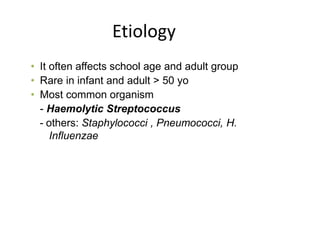
Etiology
• It often affects school age and adult group
• Rare in infant and adult > 50 yo
• Most common organism
- Haemolytic Streptococcus
- others: Staphylococci , Pneumococci, H.
Influenzae
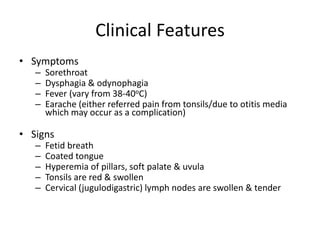
Clinical Features
• Symptoms
– Sorethroat
– Dysphagia & odynophagia
– Fever (vary from 38-40oC)
– Earache (either referred pain from tonsils/due to otitis media
which may occur as a complication)
• Signs
– Fetid breath
– Coated tongue
– Hyperemia of pillars, soft palate & uvula
– Tonsils are red & swollen
– Cervical (jugulodigastric) lymph nodes are swollen & tender
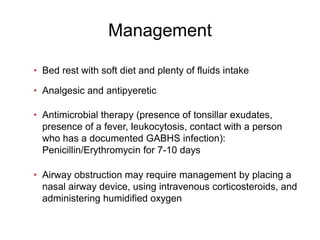
Management
• Bed rest with soft diet and plenty of fluids intake
• Analgesic and antipyeretic
• Antimicrobial therapy (presence of tonsillar exudates,
presence of a fever, leukocytosis, contact with a person
who has a documented GABHS infection):
Penicillin/Erythromycin for 7-10 days
• Airway obstruction may require management by placing a
nasal airway device, using intravenous corticosteroids, and
administering humidified oxygen
Complication
• Chronic tonsillitis with recurrent acute attack
• Peritonsillar abscess (quinsy)
• Parapharyngeal abscess
• Acute otitis media
• Rheumatic fever (GABHS)
• Cervical abscess
• Acute glomerulonephritis
• Subacute bacterial endocarditis
Chronic Tonsilitis
• Usually following acute or subacute tonsillitis
• Mostly affect children and young adult. Rare after 50 yo
• Chronic infection of sinus or teeth as predisposing factor
• Types :
1. Chr. Follicular tonsillitis
– yellowish beads of pus on the medial surface tonsil
2. Chr. Parenchymatous tonsillitis
– hyperplasia of lymphoid tissue
– tonsil very enlarge and can interfere
– speech deglutition and respiration
3. Chr. Fibroid tonsillitis
– infected tonsils are small
– small tonsil but pressure on the anterior pillar expresses frank pus or
cheesy material
– with hx of repeated sore throat
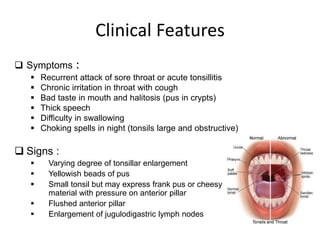
Clinical Features
 Symptoms :
 Recurrent attack of sore throat or acute tonsillitis
 Chronic irritation in throat with cough
 Bad taste in mouth and halitosis (pus in crypts)
 Thick speech
 Difficulty in swallowing
 Choking spells in night (tonsils large and obstructive)
 Signs :
 Varying degree of tonsillar enlargement
 Yellowish beads of pus
 Small tonsil but may express frank pus or cheesy
material with pressure on anterior pillar
 Flushed anterior pillar
 Enlargement of jugulodigastric lymph nodes
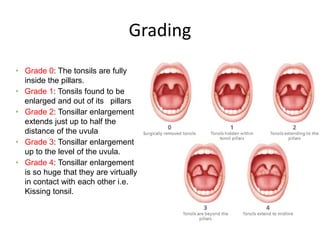
Grading
• Grade 0: The tonsils are fully
inside the pillars.
• Grade 1: Tonsils found to be
enlarged and out of its pillars
• Grade 2: Tonsillar enlargement
extends just up to half the
distance of the uvula
• Grade 3: Tonsillar enlargement
up to the level of the uvula.
• Grade 4: Tonsillar enlargement
is so huge that they are virtually
in contact with each other i.e.
Kissing tonsil.
• Treatment:
– Conservative tx consists of attention to general health, diet, tx of
co-existent infection of teeth, nose and sinuses
– Tonsillectomy
is indicated tonsils interfere with speech, deglutition and respiration
or cause recurrent attacks.
• Complications:
– Peritonsillar abscess
– Parapharyngeal abscess
– Intratonsillar abscess
– Tonsilloliths (calculus of tonsils)
– Tonsillar cyst
– Focus of infection in rheumatic fever, acute glomerulonephritis, eye
and skin disorders
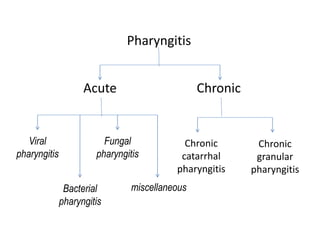
Pharyngitis
Acute Chronic
Viral
pharyngitis
Bacterial
pharyngitis
Fungal
pharyngitis
miscellaneous
Chronic
catarrhal
pharyngitis
Chronic
granular
pharyngitis
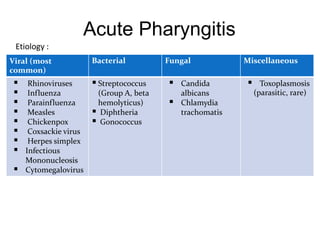
Acute Pharyngitis
Viral (most
common)
Bacterial Fungal Miscellaneous
 Rhinoviruses
 Influenza
 Parainfluenza
 Measles
 Chickenpox
 Coxsackie virus
 Herpes simplex
 Infectious
Mononucleosis
 Cytomegalovirus
 Streptococcus
(Group A, beta
hemolyticus)
 Diphtheria
 Gonococcus
 Candida
albicans
 Chlamydia
trachomatis
 Toxoplasmosis
(parasitic, rare)
Etiology :
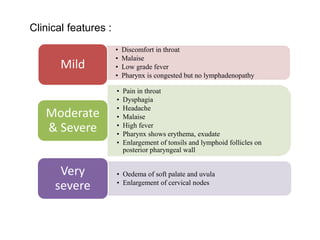
• Discomfort in throat
• Malaise
• Low grade fever
• Pharynx is congested but no lymphadenopathy
Mild
• Pain in throat
• Dysphagia
• Headache
• Malaise
• High fever
• Pharynx shows erythema, exudate
• Enlargement of tonsils and lymphoid follicles on
posterior pharyngeal wall
Moderate
& Severe
• Oedema of soft palate and uvula
• Enlargement of cervical nodes
Very
severe
Clinical features :
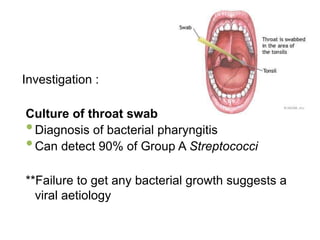
Investigation :
Culture of throat swab
•Diagnosis of bacterial pharyngitis
•Can detect 90% of Group A Streptococci
**Failure to get any bacterial growth suggests a
viral aetiology
Treatment :
General measures
• Bed rest
• Plenty of fluids
• Warm saline gargles or pharyngeal irrigations
• Severe case – lignocaine viscous to relieve local
discomfort in throat and facilitate swallowing
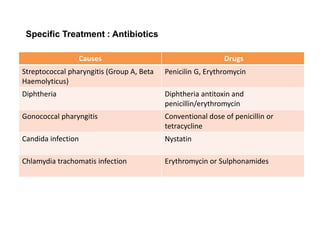
Causes Drugs
Streptococcal pharyngitis (Group A, Beta
Haemolyticus)
Penicilin G, Erythromycin
Diphtheria Diphtheria antitoxin and
penicillin/erythromycin
Gonococcal pharyngitis Conventional dose of penicillin or
tetracycline
Candida infection Nystatin
Chlamydia trachomatis infection Erythromycin or Sulphonamides
Specific Treatment : Antibiotics
Chronic Pharyngitis
• Is a chronic inflammatory condition of the pharynx
• Pathologically:
Hypertrophy of mucosa, seromucinous glands,
subepithelial lymphoid follicles and muscular coat of
pharynx
Two types :
1. Chronic Catarral Pharyngitis
2. Chronic Granular Pharyngitis
AETIOLOGY
Persistent infection in
the neighbourhood
Mouth breathing
Chronic irritants
Environmental
pollution
Faulty voice
production
Ch. Rhinitis , Ch. Sinusitis,
Ch.Tonsillitis & Dental sepsis
 Obstruction in the nose,
nasopharynx
 Protruding teeth which
prevent apposition of lips
 Habitual, without any
organic cause
Excessive smoking, chewing
tobacco, heavy drinking, highly
spiced food
Smoky or dusty
environment or irritant
industrial fumes
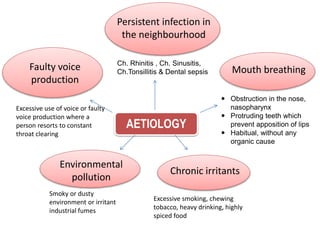
Excessive use of voice or faulty
voice production where a
person resorts to constant
throat clearing
Symptoms :
• Discomfort or pain in the throat
- especially in the morning
• Foreign body sensation in throat
- has constant desire to swallow or clear his throat to get rid of ‘foreign
body’
• Tiredness of voice
- cannot speak for long, voice lose quality and may crack
• Cough
- tendency to cough as throat is irritable
Signs :
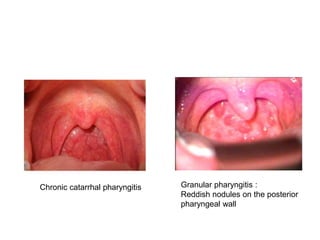
Chronic Catarrhal Pharyngitis Chronic Hypertrophic (Granular)
Pharyngitis
• Congestion of posterior
pharyngeal wall
• Engorgement of vessels
• Thickened faucial pillars
• Increased mucus secretion which
cover pharyngeal mucosa
• Pharyngeal wall appears thick
and oedematous with congested
mucosa and dilated vessels
• Post pharyngeal wall may be
studded with reddish nodules
• Lateral pharyngeal bands
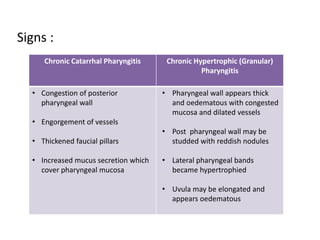
became hypertrophied
• Uvula may be elongated and
appears oedematous
Chronic catarrhal pharyngitis Granular pharyngitis :
Reddish nodules on the posterior
pharyngeal wall
Treatment :
• Aetiological factor should be sought and eradicated
• Voice rest and speech therapy for patients with faulty
voice production
• Hawking, clearing the throat frequently should be
stopped
• Warm saline gargles (especially in the morning) – to
soothe and relieve discomfort
Adenoiditis
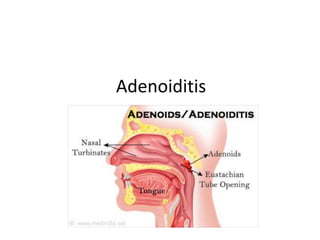
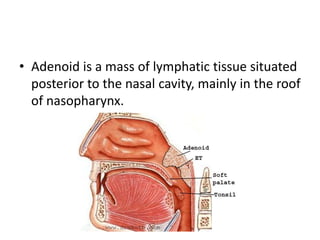
• Adenoid is a mass of lymphatic tissue situated
posterior to the nasal cavity, mainly in the roof
of nasopharynx.
Etiology
• Bacteria or viruses
– Streptococcus, adenovirus, influenza virus, EBV,
enterovirus, HSV
– Group A beta hemolytic Streptococcus pyogenes
(GABHS) is responsible for 30% childhood
adenoiditis and 10% of adult cases
Risk factors
• Children
• Family history of tonsillectomy
• Recurrent infection in the throat, neck or head
• Tonsillitis
Signs and Symptoms
• Nasal symptoms
– Nasal obstruction: snoring, sleep apnea, failure to
thrive in small child due to difficulty in feeding
– Nasal discharge: due to choanal obstruction,
normal nasal secretion unable to drain into
nasopharynx
– Sinustis: due to persistent nasal discharge
– Epistaxis: with nose blowing, in acutely inflamed
adenoids
– Voice change: lose nasal quality in voice due to
nasal obstruction
Signs and Symptoms
• Aural symptoms
– Tubal obstruction: adenoid mass blocks
eustachian tube, leads to retraction of tympanic
membrane and conductive hearing loss
– Recurrent otitis media: due to spread of infection
via eustachian tube
– Unresolved chronic suppurative otitis media due
to presence of infected adenoid
– Serous otitis media
Signs and Symptoms
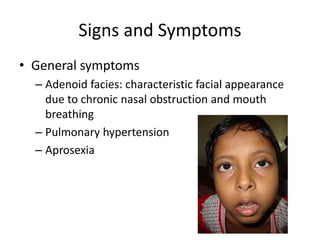
• General symptoms
– Adenoid facies: characteristic facial appearance
due to chronic nasal obstruction and mouth
breathing
– Pulmonary hypertension
– Aprosexia
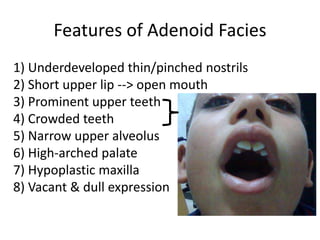
Features of Adenoid Facies
1) Underdeveloped thin/pinched nostrils
2) Short upper lip --> open mouth
3) Prominent upper teeth
4) Crowded teeth
5) Narrow upper alveolus
6) High-arched palate
7) Hypoplastic maxilla
8) Vacant & dull expression
Investigations
• Examination of postnasal space
– Rigid or flexible nasopharyngoscope
• Throat swab
• Soft tissue lateral radiograph
– Adenoid enlargement, size, extent of
nasopharyngeal space compromised.
Treatment
• Viral adenoiditis: analgesic, anti-pyretics
• Bacterial adenoiditis: antibiotics (penicillin)
• Marked symptoms (snoring, mouth breathing,
sleep apnea, speech abnormalities, recurrent
rhinosinusitis, chronic secretory otitis media,
recurrent ear discharge in chronic suppurative
otitis media): do adenoidectomy
Complications
• Otitis media
• Sinusitis
• Chest infection
• Cor-pulmonale
• Obstructive sleep apnea

Sore throat

  • 1.
  • 2.
    Introduction Sore throat isone of the most common symptoms encountered Patients use the term to describe almost any feeling in the throat, ranging from dryness to actual pain – important to ascertain the precise nature of sore throat & severity early in clinical history Severity – dysphagia for solid?, liquids?, saliva?
  • 3.
    Differential Diagnosis of SoreThroat 1. Tonsillitis 2. Pharyngitis 3. Adenoiditis 4. Peritonsillar abscess 5. Infectious mononucleosis 6. Diphtheria 7. Lymphoma 8. Squamous cell carcinoma of tonsil 9. Trauma/Foreign body
  • 4.
    Complication of sorethroat • Tonsilitis, peritonsillar abscess • Sinusitis • Mastoiditis • Ear infection (otitis media) • Laryngitis • Rheumatic fever and glomerulonephritis (GABHS)
  • 5.
    Waldeyer’s Ring Definition :A collection of lymphoid tissue in subepithelial layer of the pharynx which is aggregated at places to form masses.
  • 6.
    Content of Waldeyer’sRing 1) Nasopharyngeal tonsil / adenoid 2) Palatine tonsils 3) Lingual tonsil 4) Tubal tonsils (in Fossa of Rosemuller) 5) Lateral pharyngeal bands 6) Nodules (in posterior pharyngeal wall)
  • 7.
    Content of Waldeyer’sRing 1. Adenoids • A subepithelial collection of lymphoid tissue, lined in vertical ridge separated by deep clefts. (no crypts, no capsule) • Pseudostratified ciliated columnar, stratified squamous, transitional epithelium • Located at the junction of the roof & posterior wall of nasopharynx overlying mucous membrane to be thrown into radiating folds • Present at birth. • Increases in size up to the age of 6 years - gradually atrophies, completely disappears by age 20. • Blood supply:  Ascending palatine branch of facial  Ascending pharyngeal branch of external carotid  Pharyngeal branch of 3rd part of maxillary aa.  Ascending cervical branch of inferior thyroid aa. of thyrocervical trunk
  • 8.
    Content of Waldeyer’sRing 1. Adenoids • Venous drainage : to pharyngeal plexus, which communicates with the pterygoid plexus drains into the internal jugular & facial veins • Lympathic : Efferent lympathic of adenoidretropharyngeal & parapharyngeal LNs  upper jugular nodes • Innervation : CN IX & CN X
  • 9.
    Content of Waldeyer’sRing 2. Palatine Tonsils • Consist of 2 palatine tonsils (Right , Left) • An ovoid mass of lymphoid tissue situated in the lateral wall of oropharynx between the anterior & posterior pillars • Non-keratinizing stratified squamous epithelium MAIN
  • 10.
    Content of Waldeyer’sRing 2. Palatine Tonsils • Venous drainage into paratonsillar veinjoins common facial vein & pharyngeal venous plexus. • Lymphatics: upper deep cervical nodes • Innervation: i) lesser palatine branches of sphenopalatine ganglion (CN V) ii)CN X –sensory nerve
  • 11.
    Content of Waldeyer’sRing 2. Palatine Tonsils Applied Anatomy of Palatine Tonsils  Actual size of the tonsil is bigger than the one that appears from its surface i) Extend upwards into the soft palate ii) Extend downwards into the base of the tongue iii) Extend anteriorly into the palatoglossal arch  2 surfaces – medial, lateral  2 poles – upper, lower Medial surfaceLateral surface
  • 13.
    Bed of Tonsils Formedby : -Superior contrictor muscle -Styloglossus muscle
  • 14.
    Content of Waldeyer’sRing Adenoid vs Palatine Tonsil Adenoid Tonsil Palatine Tonsil Not Encapsulated Encapsulated One Two Has furrows Has crypts In naso pharynx In oropharynx Psuedostratified ciliated columnar, stratified squamous, transitional epithelium Non-keratinizing stratified squamous epithelium
  • 15.
    Content of Waldeyer’sRing 3. Lingual Tonsils • Located at the posterior 1/3 of the tongue, one on each side • Continuous with the lower end of the palatine tonsils
  • 16.
    Content of Waldeyer’sRing 4. Tubal Tonsils • A collection of subepithelial lymphoid tissue situated in the fossa of Rosenmuller (above & behind the tubal elevation) • Enlargement of this tonsil can cause Eustachian tube occlusion
  • 17.
    Role of Waldeyer’sRing in Body Defense Mechanism  Function as an immunologic surveillance to allow adaptation to environment esp. in children.  Produce lymphocytes and plasma cell  Protect airway as guarding the entry of air and food.
  • 18.
    Tonsilitis • Inflammation ofthe tonsils especially the palatine tonsils • Tonsillitis : – Acute tonsillitis – Chronic tonsillitis
  • 19.
    TONSILS • Lymphoidal tissuein the pharynx. • 3 main tonsils: • Palatine Tonsils • Pharyngeal Tonsils • Lingual Tonsils • Palatine tonsil • Situated at both side of oropharynx • Lie between 2 pillars (palatoglossal • and palatopharyngeal arch) • 2 poles: – Lower pole: attached to the tongue – Upper pole: extends into soft palate
  • 20.
    Acute Tonsillitis Classification –based on structure that involve A. Superficial Tonsillitis - part of generalized pharyngitis - mostly seen in viral infection B. Follicular Tonsillitis - infection spread into crypts and it contain pus - characteristic as yellowish spot
  • 21.
    C. Parenchymatous Tonsillitis -whole tonsil is involve - generalized swollen and hypereamia D. Membranous Tonsillitis - sequale of a follicular tonsilitis - exudation from crypts coelesce and form membrane on tonsil surface
  • 22.
    Etiology • It oftenaffects school age and adult group • Rare in infant and adult > 50 yo • Most common organism - Haemolytic Streptococcus - others: Staphylococci , Pneumococci, H. Influenzae
  • 23.
    Clinical Features • Symptoms –Sorethroat – Dysphagia & odynophagia – Fever (vary from 38-40oC) – Earache (either referred pain from tonsils/due to otitis media which may occur as a complication) • Signs – Fetid breath – Coated tongue – Hyperemia of pillars, soft palate & uvula – Tonsils are red & swollen – Cervical (jugulodigastric) lymph nodes are swollen & tender
  • 24.
    Management • Bed restwith soft diet and plenty of fluids intake • Analgesic and antipyeretic • Antimicrobial therapy (presence of tonsillar exudates, presence of a fever, leukocytosis, contact with a person who has a documented GABHS infection): Penicillin/Erythromycin for 7-10 days • Airway obstruction may require management by placing a nasal airway device, using intravenous corticosteroids, and administering humidified oxygen
  • 25.
    Complication • Chronic tonsillitiswith recurrent acute attack • Peritonsillar abscess (quinsy) • Parapharyngeal abscess • Acute otitis media • Rheumatic fever (GABHS) • Cervical abscess • Acute glomerulonephritis • Subacute bacterial endocarditis
  • 26.
    Chronic Tonsilitis • Usuallyfollowing acute or subacute tonsillitis • Mostly affect children and young adult. Rare after 50 yo • Chronic infection of sinus or teeth as predisposing factor • Types : 1. Chr. Follicular tonsillitis – yellowish beads of pus on the medial surface tonsil 2. Chr. Parenchymatous tonsillitis – hyperplasia of lymphoid tissue – tonsil very enlarge and can interfere – speech deglutition and respiration 3. Chr. Fibroid tonsillitis – infected tonsils are small – small tonsil but pressure on the anterior pillar expresses frank pus or cheesy material – with hx of repeated sore throat
  • 27.
    Clinical Features  Symptoms:  Recurrent attack of sore throat or acute tonsillitis  Chronic irritation in throat with cough  Bad taste in mouth and halitosis (pus in crypts)  Thick speech  Difficulty in swallowing  Choking spells in night (tonsils large and obstructive)  Signs :  Varying degree of tonsillar enlargement  Yellowish beads of pus  Small tonsil but may express frank pus or cheesy material with pressure on anterior pillar  Flushed anterior pillar  Enlargement of jugulodigastric lymph nodes
  • 28.
    Grading • Grade 0:The tonsils are fully inside the pillars. • Grade 1: Tonsils found to be enlarged and out of its pillars • Grade 2: Tonsillar enlargement extends just up to half the distance of the uvula • Grade 3: Tonsillar enlargement up to the level of the uvula. • Grade 4: Tonsillar enlargement is so huge that they are virtually in contact with each other i.e. Kissing tonsil.
  • 29.
    • Treatment: – Conservativetx consists of attention to general health, diet, tx of co-existent infection of teeth, nose and sinuses – Tonsillectomy is indicated tonsils interfere with speech, deglutition and respiration or cause recurrent attacks. • Complications: – Peritonsillar abscess – Parapharyngeal abscess – Intratonsillar abscess – Tonsilloliths (calculus of tonsils) – Tonsillar cyst – Focus of infection in rheumatic fever, acute glomerulonephritis, eye and skin disorders
  • 30.
  • 31.
    Acute Pharyngitis Viral (most common) BacterialFungal Miscellaneous  Rhinoviruses  Influenza  Parainfluenza  Measles  Chickenpox  Coxsackie virus  Herpes simplex  Infectious Mononucleosis  Cytomegalovirus  Streptococcus (Group A, beta hemolyticus)  Diphtheria  Gonococcus  Candida albicans  Chlamydia trachomatis  Toxoplasmosis (parasitic, rare) Etiology :
  • 32.
    • Discomfort inthroat • Malaise • Low grade fever • Pharynx is congested but no lymphadenopathy Mild • Pain in throat • Dysphagia • Headache • Malaise • High fever • Pharynx shows erythema, exudate • Enlargement of tonsils and lymphoid follicles on posterior pharyngeal wall Moderate & Severe • Oedema of soft palate and uvula • Enlargement of cervical nodes Very severe Clinical features :
  • 33.
    Investigation : Culture ofthroat swab •Diagnosis of bacterial pharyngitis •Can detect 90% of Group A Streptococci **Failure to get any bacterial growth suggests a viral aetiology
  • 34.
    Treatment : General measures •Bed rest • Plenty of fluids • Warm saline gargles or pharyngeal irrigations • Severe case – lignocaine viscous to relieve local discomfort in throat and facilitate swallowing
  • 35.
    Causes Drugs Streptococcal pharyngitis(Group A, Beta Haemolyticus) Penicilin G, Erythromycin Diphtheria Diphtheria antitoxin and penicillin/erythromycin Gonococcal pharyngitis Conventional dose of penicillin or tetracycline Candida infection Nystatin Chlamydia trachomatis infection Erythromycin or Sulphonamides Specific Treatment : Antibiotics
  • 36.
    Chronic Pharyngitis • Isa chronic inflammatory condition of the pharynx • Pathologically: Hypertrophy of mucosa, seromucinous glands, subepithelial lymphoid follicles and muscular coat of pharynx Two types : 1. Chronic Catarral Pharyngitis 2. Chronic Granular Pharyngitis
  • 37.
    AETIOLOGY Persistent infection in theneighbourhood Mouth breathing Chronic irritants Environmental pollution Faulty voice production Ch. Rhinitis , Ch. Sinusitis, Ch.Tonsillitis & Dental sepsis  Obstruction in the nose, nasopharynx  Protruding teeth which prevent apposition of lips  Habitual, without any organic cause Excessive smoking, chewing tobacco, heavy drinking, highly spiced food Smoky or dusty environment or irritant industrial fumes Excessive use of voice or faulty voice production where a person resorts to constant throat clearing
  • 38.
    Symptoms : • Discomfortor pain in the throat - especially in the morning • Foreign body sensation in throat - has constant desire to swallow or clear his throat to get rid of ‘foreign body’ • Tiredness of voice - cannot speak for long, voice lose quality and may crack • Cough - tendency to cough as throat is irritable
  • 39.
    Signs : Chronic CatarrhalPharyngitis Chronic Hypertrophic (Granular) Pharyngitis • Congestion of posterior pharyngeal wall • Engorgement of vessels • Thickened faucial pillars • Increased mucus secretion which cover pharyngeal mucosa • Pharyngeal wall appears thick and oedematous with congested mucosa and dilated vessels • Post pharyngeal wall may be studded with reddish nodules • Lateral pharyngeal bands became hypertrophied • Uvula may be elongated and appears oedematous
  • 40.
    Chronic catarrhal pharyngitisGranular pharyngitis : Reddish nodules on the posterior pharyngeal wall
  • 41.
    Treatment : • Aetiologicalfactor should be sought and eradicated • Voice rest and speech therapy for patients with faulty voice production • Hawking, clearing the throat frequently should be stopped • Warm saline gargles (especially in the morning) – to soothe and relieve discomfort
  • 42.
  • 43.
    • Adenoid isa mass of lymphatic tissue situated posterior to the nasal cavity, mainly in the roof of nasopharynx.
  • 44.
    Etiology • Bacteria orviruses – Streptococcus, adenovirus, influenza virus, EBV, enterovirus, HSV – Group A beta hemolytic Streptococcus pyogenes (GABHS) is responsible for 30% childhood adenoiditis and 10% of adult cases
  • 45.
    Risk factors • Children •Family history of tonsillectomy • Recurrent infection in the throat, neck or head • Tonsillitis
  • 46.
    Signs and Symptoms •Nasal symptoms – Nasal obstruction: snoring, sleep apnea, failure to thrive in small child due to difficulty in feeding – Nasal discharge: due to choanal obstruction, normal nasal secretion unable to drain into nasopharynx – Sinustis: due to persistent nasal discharge – Epistaxis: with nose blowing, in acutely inflamed adenoids – Voice change: lose nasal quality in voice due to nasal obstruction
  • 47.
    Signs and Symptoms •Aural symptoms – Tubal obstruction: adenoid mass blocks eustachian tube, leads to retraction of tympanic membrane and conductive hearing loss – Recurrent otitis media: due to spread of infection via eustachian tube – Unresolved chronic suppurative otitis media due to presence of infected adenoid – Serous otitis media
  • 48.
    Signs and Symptoms •General symptoms – Adenoid facies: characteristic facial appearance due to chronic nasal obstruction and mouth breathing – Pulmonary hypertension – Aprosexia
  • 49.
    Features of AdenoidFacies 1) Underdeveloped thin/pinched nostrils 2) Short upper lip --> open mouth 3) Prominent upper teeth 4) Crowded teeth 5) Narrow upper alveolus 6) High-arched palate 7) Hypoplastic maxilla 8) Vacant & dull expression
  • 50.
    Investigations • Examination ofpostnasal space – Rigid or flexible nasopharyngoscope • Throat swab • Soft tissue lateral radiograph – Adenoid enlargement, size, extent of nasopharyngeal space compromised.
  • 51.
    Treatment • Viral adenoiditis:analgesic, anti-pyretics • Bacterial adenoiditis: antibiotics (penicillin) • Marked symptoms (snoring, mouth breathing, sleep apnea, speech abnormalities, recurrent rhinosinusitis, chronic secretory otitis media, recurrent ear discharge in chronic suppurative otitis media): do adenoidectomy
  • 52.
    Complications • Otitis media •Sinusitis • Chest infection • Cor-pulmonale • Obstructive sleep apnea