CHRONIC SUPPURATIVE
OTITIS MEDIA
Dept. of ENT
DEFINITION OF CSOM
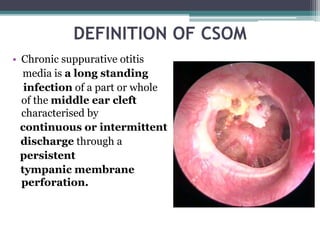
• Chronic suppurative otitis
media is a long standing
infection of a part or whole
of the middle ear cleft
characterised by
continuous or intermittent
discharge through a
persistent
tympanic membrane
perforation.
EPIDEMIOLOGY
• Incidence is higher in developing countries
• Predisposing factors: Poor socio-economic
status, poor nutrition, lack of health education
• Affects both sexes
• All age groups
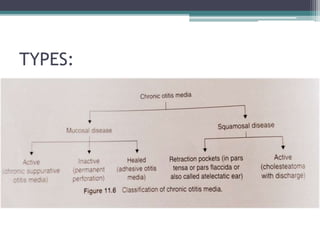
TYPES OF CSOM
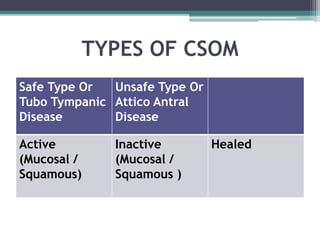
Safe Type Or
Tubo Tympanic
Disease
Unsafe Type Or
Attico Antral
Disease
Active
(Mucosal /
Squamous)
Inactive
(Mucosal /
Squamous )
Healed
TYPES:
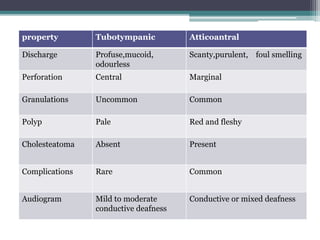
property Tubotympanic Atticoantral
Discharge Profuse,mucoid,
odourless
Scanty,purulent, foul smelling
Perforation Central Marginal
Granulations Uncommon Common
Polyp Pale Red and fleshy
Cholesteatoma Absent Present
Complications Rare Common
Audiogram Mild to moderate
conductive deafness
Conductive or mixed deafness
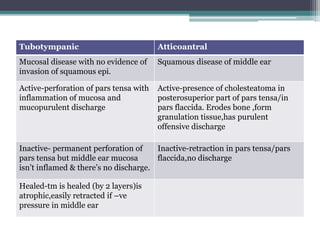
Tubotympanic Atticoantral
Mucosal disease with no evidence of
invasion of squamous epi.
Squamous disease of middle ear
Active-perforation of pars tensa with
inflammation of mucosa and
mucopurulent discharge
Active-presence of cholesteatoma in
posterosuperior part of pars tensa/in
pars flaccida. Erodes bone ,form
granulation tissue,has purulent
offensive discharge
Inactive- permanent perforation of
pars tensa but middle ear mucosa
isn’t inflamed & there’s no discharge.
Inactive-retraction in pars tensa/pars
flaccida,no discharge
Healed-tm is healed (by 2 layers)is
atrophic,easily retracted if –ve
pressure in middle ear
TUBOTYMPANIC DISEASE
• Disease confined to eustachian tube , anterior
and inferior part of mesotympanum and
hypotympanum
• Usually starts in childhood , so safe type is
common in that age group
• Presents with central perforation
• No underlying osteitis or osteomyelitis
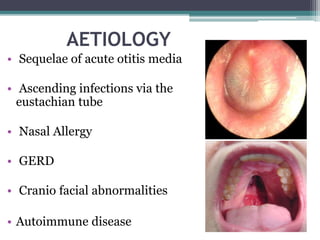
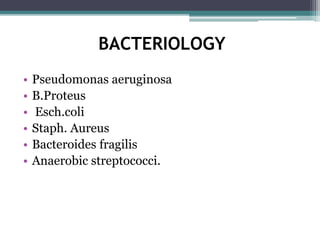
AETIOLOGY
• Sequelae of acute otitis media
• Ascending infections via the
eustachian tube
• Nasal Allergy
• GERD
• Cranio facial abnormalities
• Autoimmune disease
BACTERIOLOGY
• Pseudomonas aeruginosa
• B.Proteus
• Esch.coli
• Staph. Aureus
• Bacteroides fragilis
• Anaerobic streptococci.
SYMPTOMS
• Ear Discharge
• Hearing Loss
• Ear Pain
• Fever
SIGNS
• Profuse mucopurulent discharge, non foul
smelling, not blood stained.
• Hearing loss.
• Central Perforation.
• Middle ear mucosa – congested.
• Polyp
• Ossicular chain – erosion.
• Tympanosclerosis
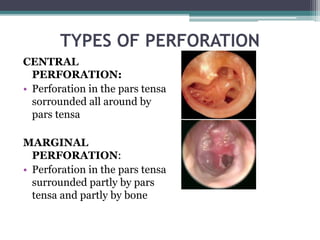
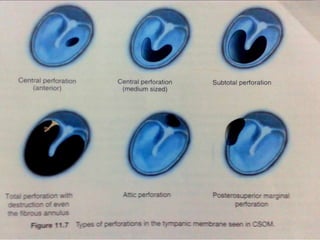
TYPES OF PERFORATION
CENTRAL
PERFORATION:
• Perforation in the pars tensa
sorrounded all around by
pars tensa
MARGINAL
PERFORATION:
• Perforation in the pars tensa
surrounded partly by pars
tensa and partly by bone
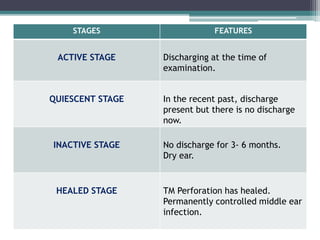
STAGES FEATURES
ACTIVE STAGE Discharging at the time of
examination.
QUIESCENT STAGE In the recent past, discharge
present but there is no discharge
now.
INACTIVE STAGE No discharge for 3- 6 months.
Dry ear.
HEALED STAGE TM Perforation has healed.
Permanently controlled middle ear
infection.
ATTICO ANTRAL DISEASE
• Chronic inflammatory condition of the
middle ear cleft confined to posterior part of
the mesotympanum , attic and antrum
associated with bone eroding disease or
cholesteatoma charactersied by thick,
purulent, scanty, foul smelling, blood stained
persistent discharge and may be associated
with perforation in pars flaccida
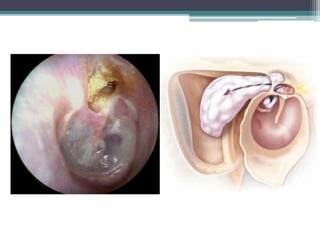
CHOLESTEATOMA
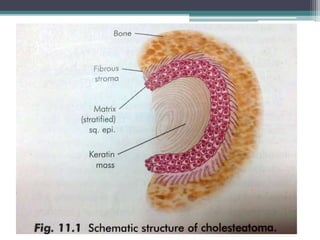
• It is a cystic bag like structure lined by stratified
squamous epithelium containing desquamated
epithelial debris lying on a fibrous tissue stroma
of variable thickness
• Skin in the wrong place
• Synonym: keratoma, epidermosis
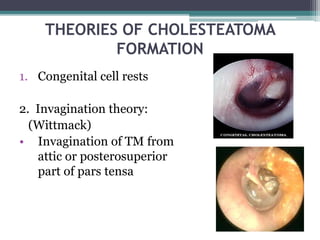
THEORIES OF CHOLESTEATOMA
FORMATION
1. Congenital cell rests
2. Invagination theory:
(Wittmack)
• Invagination of TM from
attic or posterosuperior
part of pars tensa
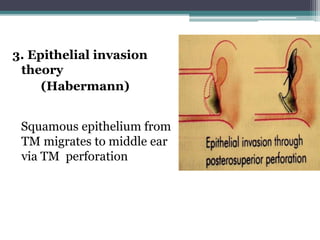
3. Epithelial invasion
theory
(Habermann)
Squamous epithelium from
TM migrates to middle ear
via TM perforation
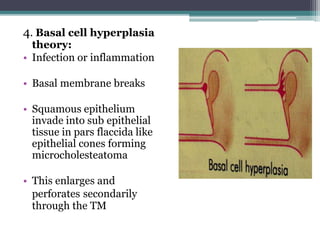
4. Basal cell hyperplasia
theory:
• Infection or inflammation
• Basal membrane breaks
• Squamous epithelium
invade into sub epithelial
tissue in pars flaccida like
epithelial cones forming
microcholesteatoma
• This enlarges and
perforates secondarily
through the TM
5. Squamous metaplasia theory:
• Cuboidal epithelium can undergo metaplasia
to sq.epithelium
• Middle ear cuboidal epithelium is pluripotent
can be stimulated by inflammation to become
keratinising sq.epithelium
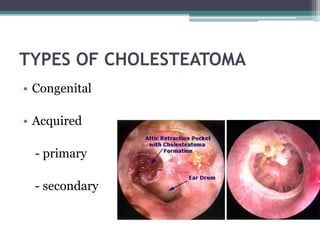
TYPES OF CHOLESTEATOMA
• Congenital
• Acquired
- primary
- secondary
COMMON SITES OF CHOLESTEATOMA
• Most common sites of origin of acquired
cholesteatomas are
1. Posterior epitympanum
2. Posterior mesotympanum
3. Anterior epitympanum
PATHOLOGY
1. Cholesteatoma
2. Osteitis and granulation tisue
3. Ossicular necrosis
4. Cholesterol granuloma
ATTICO ANTRAL DISEASE SYMPTOMS
• Ear Discharge
• Hearing Loss
• Bleeding
• Ear Ache
• Dizziness
• Tinnitus
• Symptoms Of Complications
PARS TENSA CHOLESTEATOMA SIGNS
• Retraction Pockets
• Cholesteatoma Flakes
• Granulation Tissue
• Polyp
• Hearing Loss
INVESTIGATION
• Examination under microscope
• Pus for C/S
• Audiological Assessment
• X-ray both Mastoids
• CT Scan Temporal bone
• Basic Investigations
• X-ray PNS
• Diagnostic Nasal Endoscopy
• Eustachian Tube Function Tests
EXAMINATION UNDER MICROSCOPE
• To confirm Otoscopic findings
• Site & size of perforation
• Margin of perforation
• Appearance of Middle ear
• Presence of Polyp & granulation Tissue and its site
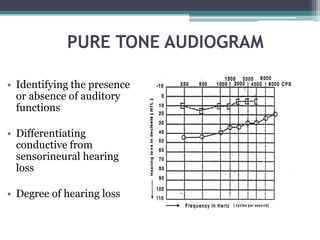
PURE TONE AUDIOGRAM
• Identifying the presence
or absence of auditory
functions
• Differentiating
conductive from
sensorineural hearing
loss
• Degree of hearing loss
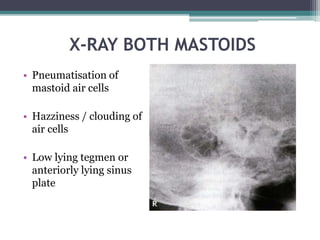
X-RAY BOTH MASTOIDS
• Pneumatisation of
mastoid air cells
• Hazziness / clouding of
air cells
• Low lying tegmen or
anteriorly lying sinus
plate
BASIC INVESTIGATIONS
• Complete hemogram : Hb, TC, DC, BT, CT, ESR
• B. Sugar
• B. Urea, S. Creatinine
• Urine analysis
• ECG
• X-Ray Chest PA view
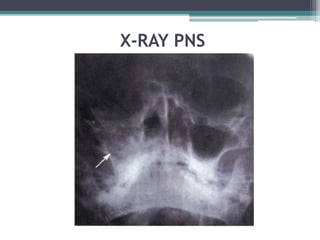
X-RAY PNS
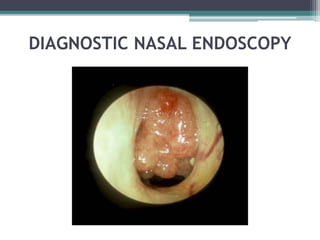
DIAGNOSTIC NASAL ENDOSCOPY
EUSTACHIAN TUBE FUNCTION TESTS
• Valsalva Test
• Politzer Test
• Catheterisation
• Toynbees test
• Tympanometry
• Radiological Test
MEDICAL TREATMENT
• Short term goals :
Elimination of infection
Control of otorrhoea
• Long term goals :-
Improvement of hearing
Eventual healing of TM
• Aural Toileting - Dry Mopping
Wet mopping
Suction irrigation under microscope
• Topical Antibiotics
• Systemic Antibiotics
CAUSES OF FAILURE OF MEDICAL
TREATMENT
• Poor drainage of inflammatory exudate from the middle ear
• Presence of persistent osteitis with mastoid granulation
• Virulent & resistant organisms
• Reinfection via Eustachian tube – adenoid, sinuses
• Allergy
• Mastoid reservoir
CHEMICAL CAUTERIZATION
(MEDICAL MYRINGOPLASTY)
• Trichloroacetic acid
• Principle : The epithelium covering the margin
of the perforation is destroyed and exposing the
fibroblasts
• Mild irritations induces hyperemia and secondary
fibroblast proliferations
• Used in dry small to medium perforations
• Several sittings may be necessary
• Medical Treatment For Cholesteatoma :-
• Topical antibiotics with aural toileting
• Suction clearance
• Application of silver nitrate to granulation
tissue
• Antimetabolite - 5 – fluorouracil
• Reduces the activity of squamous epithelium &
curtail the production of keratin debris
• Ventilation Tubes In Attic Retractions
SURGICAL PROCEDURES
MYRINGOPLASTY
• An operation performed to repair or reconstruct the TM
TYMPANOPLASTY
• An operation performed to eradicate disease in the
middle ear and to reconstruct the hearing mechanisms
with out mastoid surgery, with or without TM grafting.
OSSICULOPLASTY
• An operation performed to repair or reconstruct the
ossicular chain
MYRINGOPLASTY
• Prerequisites
▫ Dry ear
▫ Good cochlear reserve
▫ Normal ET function
▫ Predominantly conductive hearing loss
▫ No cholesteatoma
• Types
▫ Grafting techniques – onlay, underlay
TYMPANOPLASTY
• TYPE I :
-intact ossicular chain.
-sound protection for round window.
• TYPE II:
-slight defect of the ossicles.
-middle ear is of about normal size.
• TYPE III:
- malleus and incus are extremely eroded
- columella effect.
• TYPE IV:
- mobile stapes foot plate.
- sound pressure transformation is given
up.
• TYPE V:
- Fixed stapes foot plate.
- sound pressure through fenestration.

Csom

  • 1.
  • 2.
    DEFINITION OF CSOM •Chronic suppurative otitis media is a long standing infection of a part or whole of the middle ear cleft characterised by continuous or intermittent discharge through a persistent tympanic membrane perforation.
  • 3.
    EPIDEMIOLOGY • Incidence ishigher in developing countries • Predisposing factors: Poor socio-economic status, poor nutrition, lack of health education • Affects both sexes • All age groups
  • 4.
    TYPES OF CSOM SafeType Or Tubo Tympanic Disease Unsafe Type Or Attico Antral Disease Active (Mucosal / Squamous) Inactive (Mucosal / Squamous ) Healed
  • 5.
  • 6.
    property Tubotympanic Atticoantral DischargeProfuse,mucoid, odourless Scanty,purulent, foul smelling Perforation Central Marginal Granulations Uncommon Common Polyp Pale Red and fleshy Cholesteatoma Absent Present Complications Rare Common Audiogram Mild to moderate conductive deafness Conductive or mixed deafness
  • 7.
    Tubotympanic Atticoantral Mucosal diseasewith no evidence of invasion of squamous epi. Squamous disease of middle ear Active-perforation of pars tensa with inflammation of mucosa and mucopurulent discharge Active-presence of cholesteatoma in posterosuperior part of pars tensa/in pars flaccida. Erodes bone ,form granulation tissue,has purulent offensive discharge Inactive- permanent perforation of pars tensa but middle ear mucosa isn’t inflamed & there’s no discharge. Inactive-retraction in pars tensa/pars flaccida,no discharge Healed-tm is healed (by 2 layers)is atrophic,easily retracted if –ve pressure in middle ear
  • 8.
    TUBOTYMPANIC DISEASE • Diseaseconfined to eustachian tube , anterior and inferior part of mesotympanum and hypotympanum • Usually starts in childhood , so safe type is common in that age group • Presents with central perforation • No underlying osteitis or osteomyelitis
  • 9.
    AETIOLOGY • Sequelae ofacute otitis media • Ascending infections via the eustachian tube • Nasal Allergy • GERD • Cranio facial abnormalities • Autoimmune disease
  • 10.
    BACTERIOLOGY • Pseudomonas aeruginosa •B.Proteus • Esch.coli • Staph. Aureus • Bacteroides fragilis • Anaerobic streptococci.
  • 11.
    SYMPTOMS • Ear Discharge •Hearing Loss • Ear Pain • Fever
  • 12.
    SIGNS • Profuse mucopurulentdischarge, non foul smelling, not blood stained. • Hearing loss. • Central Perforation. • Middle ear mucosa – congested. • Polyp • Ossicular chain – erosion. • Tympanosclerosis
  • 13.
    TYPES OF PERFORATION CENTRAL PERFORATION: •Perforation in the pars tensa sorrounded all around by pars tensa MARGINAL PERFORATION: • Perforation in the pars tensa surrounded partly by pars tensa and partly by bone
  • 15.
    STAGES FEATURES ACTIVE STAGEDischarging at the time of examination. QUIESCENT STAGE In the recent past, discharge present but there is no discharge now. INACTIVE STAGE No discharge for 3- 6 months. Dry ear. HEALED STAGE TM Perforation has healed. Permanently controlled middle ear infection.
  • 16.
    ATTICO ANTRAL DISEASE •Chronic inflammatory condition of the middle ear cleft confined to posterior part of the mesotympanum , attic and antrum associated with bone eroding disease or cholesteatoma charactersied by thick, purulent, scanty, foul smelling, blood stained persistent discharge and may be associated with perforation in pars flaccida
  • 18.
    CHOLESTEATOMA • It isa cystic bag like structure lined by stratified squamous epithelium containing desquamated epithelial debris lying on a fibrous tissue stroma of variable thickness • Skin in the wrong place • Synonym: keratoma, epidermosis
  • 20.
    THEORIES OF CHOLESTEATOMA FORMATION 1.Congenital cell rests 2. Invagination theory: (Wittmack) • Invagination of TM from attic or posterosuperior part of pars tensa
  • 21.
    3. Epithelial invasion theory (Habermann) Squamousepithelium from TM migrates to middle ear via TM perforation
  • 22.
    4. Basal cellhyperplasia theory: • Infection or inflammation • Basal membrane breaks • Squamous epithelium invade into sub epithelial tissue in pars flaccida like epithelial cones forming microcholesteatoma • This enlarges and perforates secondarily through the TM
  • 23.
    5. Squamous metaplasiatheory: • Cuboidal epithelium can undergo metaplasia to sq.epithelium • Middle ear cuboidal epithelium is pluripotent can be stimulated by inflammation to become keratinising sq.epithelium
  • 24.
    TYPES OF CHOLESTEATOMA •Congenital • Acquired - primary - secondary
  • 25.
    COMMON SITES OFCHOLESTEATOMA • Most common sites of origin of acquired cholesteatomas are 1. Posterior epitympanum 2. Posterior mesotympanum 3. Anterior epitympanum
  • 26.
    PATHOLOGY 1. Cholesteatoma 2. Osteitisand granulation tisue 3. Ossicular necrosis 4. Cholesterol granuloma
  • 27.
    ATTICO ANTRAL DISEASESYMPTOMS • Ear Discharge • Hearing Loss • Bleeding • Ear Ache • Dizziness • Tinnitus • Symptoms Of Complications
  • 28.
    PARS TENSA CHOLESTEATOMASIGNS • Retraction Pockets • Cholesteatoma Flakes • Granulation Tissue • Polyp • Hearing Loss
  • 29.
    INVESTIGATION • Examination undermicroscope • Pus for C/S • Audiological Assessment • X-ray both Mastoids • CT Scan Temporal bone • Basic Investigations • X-ray PNS • Diagnostic Nasal Endoscopy • Eustachian Tube Function Tests
  • 30.
    EXAMINATION UNDER MICROSCOPE •To confirm Otoscopic findings • Site & size of perforation • Margin of perforation • Appearance of Middle ear • Presence of Polyp & granulation Tissue and its site
  • 31.
    PURE TONE AUDIOGRAM •Identifying the presence or absence of auditory functions • Differentiating conductive from sensorineural hearing loss • Degree of hearing loss
  • 32.
    X-RAY BOTH MASTOIDS •Pneumatisation of mastoid air cells • Hazziness / clouding of air cells • Low lying tegmen or anteriorly lying sinus plate
  • 33.
    BASIC INVESTIGATIONS • Completehemogram : Hb, TC, DC, BT, CT, ESR • B. Sugar • B. Urea, S. Creatinine • Urine analysis • ECG • X-Ray Chest PA view
  • 34.
  • 35.
  • 36.
    EUSTACHIAN TUBE FUNCTIONTESTS • Valsalva Test • Politzer Test • Catheterisation • Toynbees test • Tympanometry • Radiological Test
  • 37.
    MEDICAL TREATMENT • Shortterm goals : Elimination of infection Control of otorrhoea • Long term goals :- Improvement of hearing Eventual healing of TM • Aural Toileting - Dry Mopping Wet mopping Suction irrigation under microscope • Topical Antibiotics • Systemic Antibiotics
  • 38.
    CAUSES OF FAILUREOF MEDICAL TREATMENT • Poor drainage of inflammatory exudate from the middle ear • Presence of persistent osteitis with mastoid granulation • Virulent & resistant organisms • Reinfection via Eustachian tube – adenoid, sinuses • Allergy • Mastoid reservoir
  • 39.
    CHEMICAL CAUTERIZATION (MEDICAL MYRINGOPLASTY) •Trichloroacetic acid • Principle : The epithelium covering the margin of the perforation is destroyed and exposing the fibroblasts • Mild irritations induces hyperemia and secondary fibroblast proliferations • Used in dry small to medium perforations • Several sittings may be necessary
  • 40.
    • Medical TreatmentFor Cholesteatoma :- • Topical antibiotics with aural toileting • Suction clearance • Application of silver nitrate to granulation tissue • Antimetabolite - 5 – fluorouracil • Reduces the activity of squamous epithelium & curtail the production of keratin debris • Ventilation Tubes In Attic Retractions
  • 41.
    SURGICAL PROCEDURES MYRINGOPLASTY • Anoperation performed to repair or reconstruct the TM TYMPANOPLASTY • An operation performed to eradicate disease in the middle ear and to reconstruct the hearing mechanisms with out mastoid surgery, with or without TM grafting. OSSICULOPLASTY • An operation performed to repair or reconstruct the ossicular chain
  • 42.
    MYRINGOPLASTY • Prerequisites ▫ Dryear ▫ Good cochlear reserve ▫ Normal ET function ▫ Predominantly conductive hearing loss ▫ No cholesteatoma • Types ▫ Grafting techniques – onlay, underlay
  • 43.
    TYMPANOPLASTY • TYPE I: -intact ossicular chain. -sound protection for round window. • TYPE II: -slight defect of the ossicles. -middle ear is of about normal size. • TYPE III: - malleus and incus are extremely eroded - columella effect. • TYPE IV: - mobile stapes foot plate. - sound pressure transformation is given up. • TYPE V: - Fixed stapes foot plate. - sound pressure through fenestration.