Tonsillitis
Prepared by: Natalie Marzouqa
Supervised by: Dr Adel Adwan
Pharyngeal Embryology
 At 8 weeks: tonsillar fossa and palatine
tonsils develop from the dorsal wing of the
1st pharyngeal pouch and the ventral wing
of the 2nd pouch; tonsillar pillars originate
from 2nd/3rd arches.
 At 3-6 months: tonsillar crypts form.
 At 5th month: capsule develops from
germinal centers.
Pharyngeal Anatomy
 Tonsils are lymphoid tissue.
 The lymphoid contents are covered by
respiratory epithelium that can invaginate and
cause crypts.
 The common term "tonsils" refers specifically
to the palatine tonsils.
 Palatine tonsils are located between the
palatoglossal fold and the palatopharyngeal
fold
Tonsil function
Prevent infections in two ways:
1. They act like filters to trap bacteria, viruses,
and other materials that enter the body
through the mouth and sinuses.
2. They also produce antibodies to help fight
off infections.
Tonsillitis
 Inflammation of the pharyngeal tonsils.
 Usually extends to the adenoid and the
lingual tonsils.
 Pharyngitis, pharyngotonsillitis, and
adenotonsillitis may be used
interchangeably.
 Lingual tonsillitis refers to isolated
inflammation of the lymphoid tissue at the
tongue base.
Epidemiology
 A common illness.
 Acute tonsillitis can occur at any age but is most
frequent in children under 9 years.
 In infants under 3 years of age with acute
tonsillitis, 15% of cases were found to be
streptococcal; the remainder were probably
viral. In older children, up to 50% of cases are
due to streptococcus pyogenes.
 It is commonest in winter and spring.
 Between 2.5% and 10.9% of children may
be defined as carriers.
Etiology
 Most episodes are caused by viruses:
 Herpes Simplex Virus
 Epstein Barr Virus
 Cytomegalovirus
 Other herpes viruses
 Adenovirus
 Measles virus
 EBV may cause tonsillitis in the absence of
systemic mononucleosis.
Etiology
 Bacteria cause 15-30% of cases.
 Anaerobic bacteria play an important role in
tonsillar disease.
 GABHS causes most bacterial tonsillitis.
 Organisms such as Mycoplasma
pneumoniae, Corynebacterium
diphtheriae, and Chlamydia pneumoniae
are rare causes.
Carrier State
 A "carrier state" is defined by:
 a positive pharyngeal culture of group A
beta hemolytic Streptococcus pyogenes
(GABHS)
 without evidence of an antistreptococcal
immunologic response
Etiology
 Sometimes tonsillitis is caused by a
superinfection of Treponema and
spirocheta
 In this case it’s called Vincent’s
Angina or Plaut-Vincent Angina
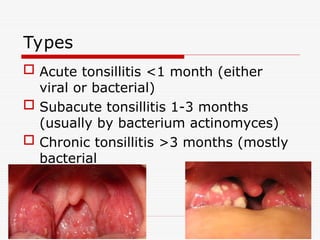
Types
 Acute tonsillitis <1 month (either
viral or bacterial)
 Subacute tonsillitis 1-3 months
(usually by bacterium actinomyces)
 Chronic tonsillitis >3 months (mostly
bacterial
Clinical Symptoms
Dry sore throat
Malaise & Headache
Fever & chills
Odynophagia, dysphagia
Muscular aches
Referred otalgia
Signs
 Dry tongue
 Erythematous enlarged tonsils
 Tonsillar or pharyngeal exudate
 Enlargement and tenderness of cervical
lymph nodes (jugulodigastric lymph
nodes).
Tonsil Hypertrophy
 Tonsil size is based on a grading scale
between 0 to 4:
 Grade 0: entirely within the tonsillar
fossa.
 Grade 1+: Tonsils fill 0% – 25% of the
oropharyngeal diameter
 Grade 2+: Tonsils fill 25% – 50%
 Grade 3+: Tonsils fill 50% – 75%
 Grade 4+: Tonsils fill 75% – 100%
 "Kissing tonsils" fill 100% of the
oropharyngeal diameter and are touching
each other.
Rapid enlargement of one tonsil
is highly suggestive of a tonsillar
malignancy, typically lymphoma
in children.
Chronic Tonsillitis
 Recurrent tonsillitis is diagnosed when an
individual has 6 episodes in 1 year, 5
infections in 2 consecutive years, or 3
infections for 3 years consecutively.
 Individuals with chronic tonsillitis may
present with chronic sore throat, halitosis,
tonsillitis, and persistent tender cervical
nodes.
Clinical: Physical Examination
 Determination of the degree of distress
regarding airway and swallowing function.
 Examination of the pharynx by opening the
mouth without tongue protrusion, followed
by gentle central depression of the tongue.
 Full assessment of oral mucosa, dentition,
and salivary ducts.
 GABSH and EBV can cause tonsillitis that
may be associated with the presence of
palatal petechiae.
 Tender cervical lymph nodes and neck
stiffness are observed in acute tonsillitis.
 Skin and mucosa may have signs of
dehydration.
Laboratory Studies
 Tonsillitis is clinical diagnoses.
 Testing is indicated when GABHS infection
is suspected.
 Throat cultures are the standard criterion
for detecting GABHS.
 A rapid antigen detection test (RADT)
detects the presence of GABHS cell wall
carbohydrate from swabbed material (but is
less sensitive than cultures).
Differential Diagnosis
 Infectious mononucleosis
 Malignancy: lymphoma, leukemia,
carcinoma
 Diptheria
 Scarlet fever
 Agranulocytosis
Management: Medical
 Rest—the patient will usually prefer to be in bed.
 Soluble aspirin or paracetamol held in the mouth and then
swallowed eases the discomfort.
 Remember that aspirin should not be given to children under
the age of 12 years because of the risk of Reye’s syndrome.
 Encourage the patient to drink
 IV corticosteroids may be administered to reduce
pharyngeal edema.
Management: Medical
 Antibiotics in severe cases. Penicillin by injection
followed by oral treatment remains the treatment of
choice.
 It is recommended that treatment be continued for 10
days to reduce the risk of reactivation.
 Macrolides or oral cephalosporins can be used in
patients allergic to penicillin.
Complications of tonsillitis
 Acute otitis media (the most common complication).
 Peritonsillar abscess (quinsy).
 Pulmonary infections (pneumonia, etc.).
 Acute nephritis IgA nephropathy.
 Acute rheumatism.
 Hypertrophy of the tonsils can result in snoring,
mouth breathing, disturbed sleep, and obstructive
sleep apnea .
Management: Surgical
Tonsillectomy indications:
 Absolute indications
 Sleep Apnea
 Suspected Malignancy (for biopsy)
Relative Indications
 Recurrent tonsillitis : > 6 times yearly, 5 times in
2 consecutive years or 3 times in 3 consecutive
years.
 Mild and moderate obstructive sleep apnea.
 2nd attack of peritonsillar abscess (Quinsy).
 2nd attack of febrile convulsions due to acute
otitis media.
 Complicated tonsillitis: Rheumatic fever,
glomerulonephritis.
 As part of some surgery, such as UPPP
(uvulopalatopharyngoplasty)
 Recurrent otitis media
 Chronic tonsillitis
Lingual tonsillitis
 Surgery is rarely required for acute lingual
tonsillitis.
 Surgery is indicated for frequent and
disabling episodes.
Relative contraindication for
tonsillectomy
 Patient's medical condition
 Acute tonsillitis
 Coagulopathy
 Obesity
 Age <3 years
Methods of tonsillectomy
 Dissecting & snare (Galotine method)
 Electrocautery
 CO2 laser tonsillectomy
 Coblation: US+ co2 laser
Complications of tonsillectomy
 Bleeding:
1. Primary: within 24 hours after surgery,
either bad surgeon or bad patient.
2. Reactionary: within 1-5 days
3. Secondary: after the 5th day till day 14,
usually because of infection.
Thank You

Tonsillitis by dr Adel Adwan ptt for all

  • 1.
    Tonsillitis Prepared by: NatalieMarzouqa Supervised by: Dr Adel Adwan
  • 2.
    Pharyngeal Embryology  At8 weeks: tonsillar fossa and palatine tonsils develop from the dorsal wing of the 1st pharyngeal pouch and the ventral wing of the 2nd pouch; tonsillar pillars originate from 2nd/3rd arches.  At 3-6 months: tonsillar crypts form.  At 5th month: capsule develops from germinal centers.
  • 3.
    Pharyngeal Anatomy  Tonsilsare lymphoid tissue.  The lymphoid contents are covered by respiratory epithelium that can invaginate and cause crypts.  The common term "tonsils" refers specifically to the palatine tonsils.  Palatine tonsils are located between the palatoglossal fold and the palatopharyngeal fold
  • 5.
    Tonsil function Prevent infectionsin two ways: 1. They act like filters to trap bacteria, viruses, and other materials that enter the body through the mouth and sinuses. 2. They also produce antibodies to help fight off infections.
  • 6.
    Tonsillitis  Inflammation ofthe pharyngeal tonsils.  Usually extends to the adenoid and the lingual tonsils.  Pharyngitis, pharyngotonsillitis, and adenotonsillitis may be used interchangeably.  Lingual tonsillitis refers to isolated inflammation of the lymphoid tissue at the tongue base.
  • 7.
    Epidemiology  A commonillness.  Acute tonsillitis can occur at any age but is most frequent in children under 9 years.  In infants under 3 years of age with acute tonsillitis, 15% of cases were found to be streptococcal; the remainder were probably viral. In older children, up to 50% of cases are due to streptococcus pyogenes.  It is commonest in winter and spring.  Between 2.5% and 10.9% of children may be defined as carriers.
  • 8.
    Etiology  Most episodesare caused by viruses:  Herpes Simplex Virus  Epstein Barr Virus  Cytomegalovirus  Other herpes viruses  Adenovirus  Measles virus  EBV may cause tonsillitis in the absence of systemic mononucleosis.
  • 9.
    Etiology  Bacteria cause15-30% of cases.  Anaerobic bacteria play an important role in tonsillar disease.  GABHS causes most bacterial tonsillitis.  Organisms such as Mycoplasma pneumoniae, Corynebacterium diphtheriae, and Chlamydia pneumoniae are rare causes.
  • 10.
    Carrier State  A"carrier state" is defined by:  a positive pharyngeal culture of group A beta hemolytic Streptococcus pyogenes (GABHS)  without evidence of an antistreptococcal immunologic response
  • 11.
    Etiology  Sometimes tonsillitisis caused by a superinfection of Treponema and spirocheta  In this case it’s called Vincent’s Angina or Plaut-Vincent Angina
  • 12.
    Types  Acute tonsillitis<1 month (either viral or bacterial)  Subacute tonsillitis 1-3 months (usually by bacterium actinomyces)  Chronic tonsillitis >3 months (mostly bacterial
  • 13.
    Clinical Symptoms Dry sorethroat Malaise & Headache Fever & chills Odynophagia, dysphagia Muscular aches Referred otalgia
  • 14.
    Signs  Dry tongue Erythematous enlarged tonsils  Tonsillar or pharyngeal exudate  Enlargement and tenderness of cervical lymph nodes (jugulodigastric lymph nodes).
  • 15.
    Tonsil Hypertrophy  Tonsilsize is based on a grading scale between 0 to 4:  Grade 0: entirely within the tonsillar fossa.  Grade 1+: Tonsils fill 0% – 25% of the oropharyngeal diameter  Grade 2+: Tonsils fill 25% – 50%  Grade 3+: Tonsils fill 50% – 75%  Grade 4+: Tonsils fill 75% – 100%  "Kissing tonsils" fill 100% of the oropharyngeal diameter and are touching each other.
  • 16.
    Rapid enlargement ofone tonsil is highly suggestive of a tonsillar malignancy, typically lymphoma in children.
  • 17.
    Chronic Tonsillitis  Recurrenttonsillitis is diagnosed when an individual has 6 episodes in 1 year, 5 infections in 2 consecutive years, or 3 infections for 3 years consecutively.  Individuals with chronic tonsillitis may present with chronic sore throat, halitosis, tonsillitis, and persistent tender cervical nodes.
  • 18.
    Clinical: Physical Examination Determination of the degree of distress regarding airway and swallowing function.  Examination of the pharynx by opening the mouth without tongue protrusion, followed by gentle central depression of the tongue.  Full assessment of oral mucosa, dentition, and salivary ducts.
  • 19.
     GABSH andEBV can cause tonsillitis that may be associated with the presence of palatal petechiae.  Tender cervical lymph nodes and neck stiffness are observed in acute tonsillitis.  Skin and mucosa may have signs of dehydration.
  • 20.
    Laboratory Studies  Tonsillitisis clinical diagnoses.  Testing is indicated when GABHS infection is suspected.  Throat cultures are the standard criterion for detecting GABHS.  A rapid antigen detection test (RADT) detects the presence of GABHS cell wall carbohydrate from swabbed material (but is less sensitive than cultures).
  • 21.
    Differential Diagnosis  Infectiousmononucleosis  Malignancy: lymphoma, leukemia, carcinoma  Diptheria  Scarlet fever  Agranulocytosis
  • 22.
    Management: Medical  Rest—thepatient will usually prefer to be in bed.  Soluble aspirin or paracetamol held in the mouth and then swallowed eases the discomfort.  Remember that aspirin should not be given to children under the age of 12 years because of the risk of Reye’s syndrome.  Encourage the patient to drink  IV corticosteroids may be administered to reduce pharyngeal edema.
  • 23.
    Management: Medical  Antibioticsin severe cases. Penicillin by injection followed by oral treatment remains the treatment of choice.  It is recommended that treatment be continued for 10 days to reduce the risk of reactivation.  Macrolides or oral cephalosporins can be used in patients allergic to penicillin.
  • 24.
    Complications of tonsillitis Acute otitis media (the most common complication).  Peritonsillar abscess (quinsy).  Pulmonary infections (pneumonia, etc.).  Acute nephritis IgA nephropathy.  Acute rheumatism.  Hypertrophy of the tonsils can result in snoring, mouth breathing, disturbed sleep, and obstructive sleep apnea .
  • 25.
    Management: Surgical Tonsillectomy indications: Absolute indications  Sleep Apnea  Suspected Malignancy (for biopsy)
  • 26.
    Relative Indications  Recurrenttonsillitis : > 6 times yearly, 5 times in 2 consecutive years or 3 times in 3 consecutive years.  Mild and moderate obstructive sleep apnea.  2nd attack of peritonsillar abscess (Quinsy).  2nd attack of febrile convulsions due to acute otitis media.  Complicated tonsillitis: Rheumatic fever, glomerulonephritis.  As part of some surgery, such as UPPP (uvulopalatopharyngoplasty)  Recurrent otitis media  Chronic tonsillitis
  • 27.
    Lingual tonsillitis  Surgeryis rarely required for acute lingual tonsillitis.  Surgery is indicated for frequent and disabling episodes.
  • 28.
    Relative contraindication for tonsillectomy Patient's medical condition  Acute tonsillitis  Coagulopathy  Obesity  Age <3 years
  • 29.
    Methods of tonsillectomy Dissecting & snare (Galotine method)  Electrocautery  CO2 laser tonsillectomy  Coblation: US+ co2 laser
  • 30.
    Complications of tonsillectomy Bleeding: 1. Primary: within 24 hours after surgery, either bad surgeon or bad patient. 2. Reactionary: within 1-5 days 3. Secondary: after the 5th day till day 14, usually because of infection.
  • 31.