1
CHRONIC OTITIS MEDIA PATIENT
DATABASE DEVELOPMENT AND
APPROBATION
Authors: Liāna Džavadova, Karīna Jelagova
Rīga Stradiņš University, Latvia
Scientific research supervisor: Dr. med. Kitija Daina
Children’s Clinical University Hospital, Latvia
2
 Chronic suppurative otitis media (CSOM) is a
common disease in children, often with recurrent
course and frequent physician visits.
 Currently there is no statistical data on the prevalence
of CSOM in Latvia.
Introduction
3
 In Children's Clinical University Hospital there is no
diagnosis-specific database of patients with chronic
otitis media to monitor and register data.
 As a result, patient follow-up can be challenging.
Introduction
4
 Summarize the latest data of patients with chronic
suppurative otitis media
 Explore the course of the disease
 Assess the prevalence of cholesteatoma among the
patients.
Aim
5
 Retrospective descriptive study
 Children’s Clinical University Hospital
 January 1, 2009 to January 1, 2016
 Hospital archives and patient database Andromeda
 Diagnosis codes and surgical procedures. Patients up to
17 years of age were included.
 Data registration in Microsoft Office Excel
 SPSS Statistics software (Shapiro-Wilk test, Chi-Square
test, Fisher’s exact test, Independent Sample t-test.)
Materials and methods
6
 Diagnosis
 Anamnesis
 Status localis
 Hospitalizations
»CT
»Audiometry
»Culture
 Surgical interventions
 Ambulatory visits
 Associated pathologies (adenoid hypertrophy,
cholesteatoma)
Materials and methods
7
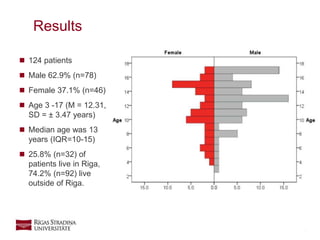
 124 patients
 Male 62.9% (n=78)
 Female 37.1% (n=46)
 Age 3 -17 (M = 12.31,
SD = ± 3.47 years)
 Median age was 13
years (IQR=10-15)
 25.8% (n=32) of
patients live in Riga,
74.2% (n=92) live
outside of Riga.
Results
8
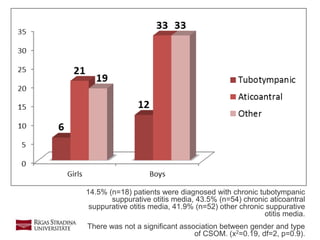
14.5% (n=18) patients were diagnosed with chronic tubotympanic
suppurative otitis media, 43.5% (n=54) chronic aticoantral
suppurative otitis media, 41.9% (n=52) other chronic suppurative
otitis media.
There was not a significant association between gender and type
of CSOM. (x2=0.19, df=2, p=0.9).
9
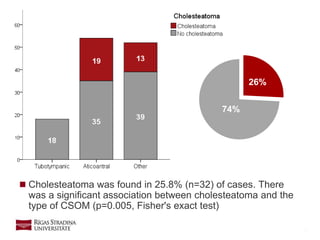
 Cholesteatoma was found in 25.8% (n=32) of cases. There
was a significant association between cholesteatoma and the
type of CSOM (p=0.005, Fisher's exact test)
26%
74%
10
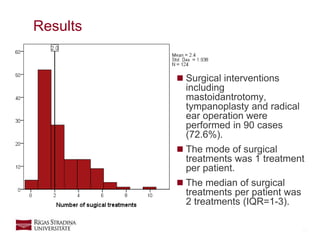
 Surgical interventions
including
mastoidantrotomy,
tympanoplasty and radical
ear operation were
performed in 90 cases
(72.6%).
 The mode of surgical
treatments was 1 treatment
per patient.
 The median of surgical
treatments per patient was
2 treatments (IQR=1-3).
Results
11
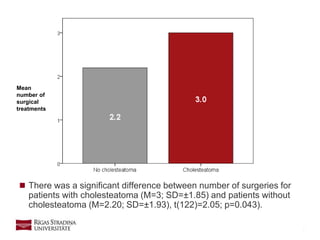
 There was a significant difference between number of surgeries for
patients with cholesteatoma (M=3; SD=±1.85) and patients without
cholesteatoma (M=2.20; SD=±1.93), t(122)=2.05; p=0.043).
Mean
number of
surgical
treatments
12
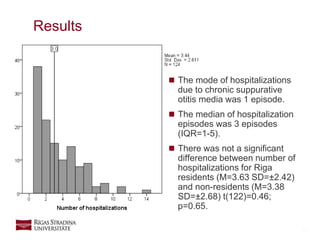
 The mode of hospitalizations
due to chronic suppurative
otitis media was 1 episode.
 The median of hospitalization
episodes was 3 episodes
(IQR=1-5).
 There was not a significant
difference between number of
hospitalizations for Riga
residents (M=3.63 SD=±2.42)
and non-residents (M=3.38
SD=±2.68) t(122)=0.46;
p=0.65.
Results
13
 Chronic suppurative otitis media has a recurrent
course, causing relapses, frequent hospitalizations
and multiple surgical interventions.
 Cholesteatoma is one of the factors contributing to
higher number of surgeries.
 The majority of chronic otitis media patients are young
teenagers, most of them live outside of Riga,
therefore, monitoring and regular follow-ups by
otorhinolaryngologists are necessary.
Conclusion
14
 Rudolf Probst, Gerhard Grevers, Heinrich Iro. Basic Otorhinolaryngology: A Step-by-Step Learning Guide.
Thieme 2006.
 Ralph F. Wetmore, Harlan R. Muntz, Trevor J. McGill. Pediatric otorhinolaryngology. Principles and Practice
Pathways (Wetmore, Pediatric Otolaryngology). Thieme 2012.
 Chronic suppurative otitis media. Burden of Illness and Management Options. World Health Organization
Geneva, Switzerland 2004. http://www.who.int/pbd/publications/Chronicsuppurativeotitis_media.pdf
 D Thornton, T P C Martin, P Amin, S Haque, S Wilson and M C F Smith (2011). Chronic suppurative otitis
media in Nepal: ethnicity does not determine whether disease is associated with cholesteatoma or not. The
Journal of Laryngology & Otology, 125, pp 22-26. doi:10.1017/S0022215110001878.
 Sandhu N, Thomson D, Stang A. In children with chronic suppurative otitis media, should one prescribe
topical or systemic antibiotics? Paediatrics & Child Health. 2012;17(7):385-386.
http://www.ncbi.nlm.nih.gov/pmc/articles/PMC3448540/
 Levi J. Chronic suppurative otitis media (CSOM): Pathogenesis, clinical manifestations, and diagnosis.
UpToDate. Dec 03, 2013. http://www.uptodate.com/contents/chronic-suppurative-otitis-media-csom-
pathogenesis-clinical-manifestations-and-diagnosis#H11720616
 Peter S Roland. Chronic Suppurative Otitis Media. Medscape reference
http://emedicine.medscape.com/article/859501-overview
References
15
Thank you for your attention!

CHRONIC OTITIS MEDIA PATIENT DATABASE DEVELOPMENT AND APPROBATION

  • 1.
    1 CHRONIC OTITIS MEDIAPATIENT DATABASE DEVELOPMENT AND APPROBATION Authors: Liāna Džavadova, Karīna Jelagova Rīga Stradiņš University, Latvia Scientific research supervisor: Dr. med. Kitija Daina Children’s Clinical University Hospital, Latvia
  • 2.
    2  Chronic suppurativeotitis media (CSOM) is a common disease in children, often with recurrent course and frequent physician visits.  Currently there is no statistical data on the prevalence of CSOM in Latvia. Introduction
  • 3.
    3  In Children'sClinical University Hospital there is no diagnosis-specific database of patients with chronic otitis media to monitor and register data.  As a result, patient follow-up can be challenging. Introduction
  • 4.
    4  Summarize thelatest data of patients with chronic suppurative otitis media  Explore the course of the disease  Assess the prevalence of cholesteatoma among the patients. Aim
  • 5.
    5  Retrospective descriptivestudy  Children’s Clinical University Hospital  January 1, 2009 to January 1, 2016  Hospital archives and patient database Andromeda  Diagnosis codes and surgical procedures. Patients up to 17 years of age were included.  Data registration in Microsoft Office Excel  SPSS Statistics software (Shapiro-Wilk test, Chi-Square test, Fisher’s exact test, Independent Sample t-test.) Materials and methods
  • 6.
    6  Diagnosis  Anamnesis Status localis  Hospitalizations »CT »Audiometry »Culture  Surgical interventions  Ambulatory visits  Associated pathologies (adenoid hypertrophy, cholesteatoma) Materials and methods
  • 7.
    7  124 patients Male 62.9% (n=78)  Female 37.1% (n=46)  Age 3 -17 (M = 12.31, SD = ± 3.47 years)  Median age was 13 years (IQR=10-15)  25.8% (n=32) of patients live in Riga, 74.2% (n=92) live outside of Riga. Results
  • 8.
    8 14.5% (n=18) patientswere diagnosed with chronic tubotympanic suppurative otitis media, 43.5% (n=54) chronic aticoantral suppurative otitis media, 41.9% (n=52) other chronic suppurative otitis media. There was not a significant association between gender and type of CSOM. (x2=0.19, df=2, p=0.9).
  • 9.
    9  Cholesteatoma wasfound in 25.8% (n=32) of cases. There was a significant association between cholesteatoma and the type of CSOM (p=0.005, Fisher's exact test) 26% 74%
  • 10.
    10  Surgical interventions including mastoidantrotomy, tympanoplastyand radical ear operation were performed in 90 cases (72.6%).  The mode of surgical treatments was 1 treatment per patient.  The median of surgical treatments per patient was 2 treatments (IQR=1-3). Results
  • 11.
    11  There wasa significant difference between number of surgeries for patients with cholesteatoma (M=3; SD=±1.85) and patients without cholesteatoma (M=2.20; SD=±1.93), t(122)=2.05; p=0.043). Mean number of surgical treatments
  • 12.
    12  The modeof hospitalizations due to chronic suppurative otitis media was 1 episode.  The median of hospitalization episodes was 3 episodes (IQR=1-5).  There was not a significant difference between number of hospitalizations for Riga residents (M=3.63 SD=±2.42) and non-residents (M=3.38 SD=±2.68) t(122)=0.46; p=0.65. Results
  • 13.
    13  Chronic suppurativeotitis media has a recurrent course, causing relapses, frequent hospitalizations and multiple surgical interventions.  Cholesteatoma is one of the factors contributing to higher number of surgeries.  The majority of chronic otitis media patients are young teenagers, most of them live outside of Riga, therefore, monitoring and regular follow-ups by otorhinolaryngologists are necessary. Conclusion
  • 14.
    14  Rudolf Probst,Gerhard Grevers, Heinrich Iro. Basic Otorhinolaryngology: A Step-by-Step Learning Guide. Thieme 2006.  Ralph F. Wetmore, Harlan R. Muntz, Trevor J. McGill. Pediatric otorhinolaryngology. Principles and Practice Pathways (Wetmore, Pediatric Otolaryngology). Thieme 2012.  Chronic suppurative otitis media. Burden of Illness and Management Options. World Health Organization Geneva, Switzerland 2004. http://www.who.int/pbd/publications/Chronicsuppurativeotitis_media.pdf  D Thornton, T P C Martin, P Amin, S Haque, S Wilson and M C F Smith (2011). Chronic suppurative otitis media in Nepal: ethnicity does not determine whether disease is associated with cholesteatoma or not. The Journal of Laryngology & Otology, 125, pp 22-26. doi:10.1017/S0022215110001878.  Sandhu N, Thomson D, Stang A. In children with chronic suppurative otitis media, should one prescribe topical or systemic antibiotics? Paediatrics & Child Health. 2012;17(7):385-386. http://www.ncbi.nlm.nih.gov/pmc/articles/PMC3448540/  Levi J. Chronic suppurative otitis media (CSOM): Pathogenesis, clinical manifestations, and diagnosis. UpToDate. Dec 03, 2013. http://www.uptodate.com/contents/chronic-suppurative-otitis-media-csom- pathogenesis-clinical-manifestations-and-diagnosis#H11720616  Peter S Roland. Chronic Suppurative Otitis Media. Medscape reference http://emedicine.medscape.com/article/859501-overview References
  • 15.
    15 Thank you foryour attention!