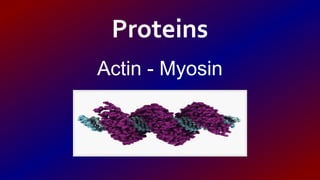
Actin - Myosin
Proteins
The proteins
v
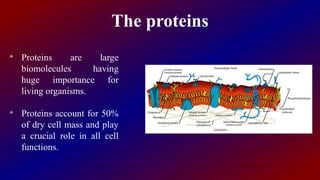
Proteins are large
biomolecules having
huge importance for
living organisms.
v
Proteins account for 50%
of dry cell mass and play
a crucial role in all cell
functions.
The role of proteins
v
Structural elements of cells and tissues
v
Storage of useful substances.
v
They transfer molecules.
v
They take part in cellular communication and signaling.
v
They help in cellular movement.
v
They participate in cell defence.
Myosin
Myosin is a muscle protein constisting of head, neck
and tail domains
The head domain binds the filamentous actin, and
uses ATP hydrolysis to generate force and to "walk"
along the filament towards the barbed (+) .
The neck domain acts as a linker and as a lever
arm for transducing force generated by the catalytic
motor domain. The neck domain can also serve as a
binding site for myosin light chains which are distinct
proteins that form part of a macromolecular complex
and generally have regulatory functions
The tail domain generally mediates interaction with
cargo molecules and/or other myosin subunits. In
some cases, the tail domain may play a role in
regulating
Actin
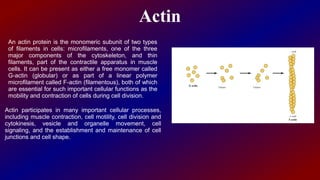
An actin protein is the monomeric subunit of two types
of filaments in cells: microfilaments, one of the three
major components of the cytoskeleton, and thin
filaments, part of the contractile apparatus in muscle
cells. It can be present as either a free monomer called
G-actin (globular) or as part of a linear polymer
microfilament called F-actin (filamentous), both of which
are essential for such important cellular functions as the
mobility and contraction of cells during cell division.
Actin participates in many important cellular processes,
including muscle contraction, cell motility, cell division and
cytokinesis, vesicle and organelle movement, cell
signaling, and the establishment and maintenance of cell
junctions and cell shape.
Actin filaments
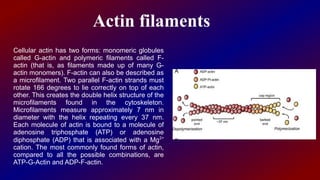
Cellular actin has two forms: monomeric globules
called G-actin and polymeric filaments called F-
actin (that is, as filaments made up of many G-
actin monomers). F-actin can also be described as
a microfilament. Two parallel F-actin strands must
rotate 166 degrees to lie correctly on top of each
other. This creates the double helix structure of the
microfilaments found in the cytoskeleton.
Microfilaments measure approximately 7 nm in
diameter with the helix repeating every 37 nm.
Each molecule of actin is bound to a molecule of
adenosine triphosphate (ATP) or adenosine
diphosphate (ADP) that is associated with a Mg2+
cation. The most commonly found forms of actin,
compared to all the possible combinations, are
ATP-G-Actin and ADP-F-actin.
Muscle contraction
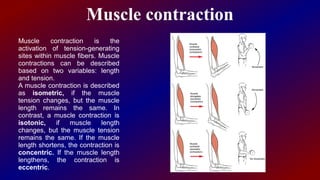
Muscle contraction is the
activation of tension-generating
sites within muscle fibers. Muscle
contractions can be described
based on two variables: length
and tension.
A muscle contraction is described
as isometric, if the muscle
tension changes, but the muscle
length remains the same. In
contrast, a muscle contraction is
isotonic, if muscle length
changes, but the muscle tension
remains the same. If the muscle
length shortens, the contraction is
concentric. If the muscle length
lengthens, the contraction is
eccentric.
The mechanism of muscle contraction
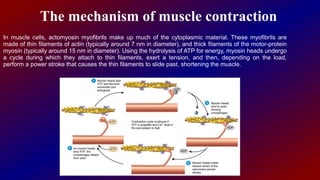
In muscle cells, actomyosin myofibrils make up much of the cytoplasmic material. These myofibrils are
made of thin filaments of actin (typically around 7 nm in diameter), and thick filaments of the motor-protein
myosin (typically around 15 nm in diameter). Using the hydrolysis of ATP for energy, myosin heads undergo
a cycle during which they attach to thin filaments, exert a tension, and then, depending on the load,
perform a power stroke that causes the thin filaments to slide past, shortening the muscle.
Muscular Spasms
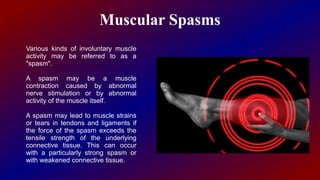
Various kinds of involuntary muscle
activity may be referred to as a
"spasm".
A spasm may be a muscle
contraction caused by abnormal
nerve stimulation or by abnormal
activity of the muscle itself.
A spasm may lead to muscle strains
or tears in tendons and ligaments if
the force of the spasm exceeds the
tensile strength of the underlying
connective tissue. This can occur
with a particularly strong spasm or
with weakened connective tissue.
Thank you for your attention!!!
Work done by the students of C2 Class:
•
Atha Kournouti
•
Alexandros Kostas
•
Giorgos Marmaras
•
Anastasia Michioti
•
Argyris Bazos
•
Panagiotis Babatsias

Actin & Myosin

  • 1.
  • 2.
    The proteins v Proteins arelarge biomolecules having huge importance for living organisms. v Proteins account for 50% of dry cell mass and play a crucial role in all cell functions.
  • 3.
    The role ofproteins v Structural elements of cells and tissues v Storage of useful substances. v They transfer molecules. v They take part in cellular communication and signaling. v They help in cellular movement. v They participate in cell defence.
  • 4.
    Myosin Myosin is amuscle protein constisting of head, neck and tail domains The head domain binds the filamentous actin, and uses ATP hydrolysis to generate force and to "walk" along the filament towards the barbed (+) . The neck domain acts as a linker and as a lever arm for transducing force generated by the catalytic motor domain. The neck domain can also serve as a binding site for myosin light chains which are distinct proteins that form part of a macromolecular complex and generally have regulatory functions The tail domain generally mediates interaction with cargo molecules and/or other myosin subunits. In some cases, the tail domain may play a role in regulating
  • 5.
    Actin An actin proteinis the monomeric subunit of two types of filaments in cells: microfilaments, one of the three major components of the cytoskeleton, and thin filaments, part of the contractile apparatus in muscle cells. It can be present as either a free monomer called G-actin (globular) or as part of a linear polymer microfilament called F-actin (filamentous), both of which are essential for such important cellular functions as the mobility and contraction of cells during cell division. Actin participates in many important cellular processes, including muscle contraction, cell motility, cell division and cytokinesis, vesicle and organelle movement, cell signaling, and the establishment and maintenance of cell junctions and cell shape.
  • 6.
    Actin filaments Cellular actinhas two forms: monomeric globules called G-actin and polymeric filaments called F- actin (that is, as filaments made up of many G- actin monomers). F-actin can also be described as a microfilament. Two parallel F-actin strands must rotate 166 degrees to lie correctly on top of each other. This creates the double helix structure of the microfilaments found in the cytoskeleton. Microfilaments measure approximately 7 nm in diameter with the helix repeating every 37 nm. Each molecule of actin is bound to a molecule of adenosine triphosphate (ATP) or adenosine diphosphate (ADP) that is associated with a Mg2+ cation. The most commonly found forms of actin, compared to all the possible combinations, are ATP-G-Actin and ADP-F-actin.
  • 7.
    Muscle contraction Muscle contractionis the activation of tension-generating sites within muscle fibers. Muscle contractions can be described based on two variables: length and tension. A muscle contraction is described as isometric, if the muscle tension changes, but the muscle length remains the same. In contrast, a muscle contraction is isotonic, if muscle length changes, but the muscle tension remains the same. If the muscle length shortens, the contraction is concentric. If the muscle length lengthens, the contraction is eccentric.
  • 8.
    The mechanism ofmuscle contraction In muscle cells, actomyosin myofibrils make up much of the cytoplasmic material. These myofibrils are made of thin filaments of actin (typically around 7 nm in diameter), and thick filaments of the motor-protein myosin (typically around 15 nm in diameter). Using the hydrolysis of ATP for energy, myosin heads undergo a cycle during which they attach to thin filaments, exert a tension, and then, depending on the load, perform a power stroke that causes the thin filaments to slide past, shortening the muscle.
  • 9.
    Muscular Spasms Various kindsof involuntary muscle activity may be referred to as a "spasm". A spasm may be a muscle contraction caused by abnormal nerve stimulation or by abnormal activity of the muscle itself. A spasm may lead to muscle strains or tears in tendons and ligaments if the force of the spasm exceeds the tensile strength of the underlying connective tissue. This can occur with a particularly strong spasm or with weakened connective tissue.
  • 10.
    Thank you foryour attention!!! Work done by the students of C2 Class: • Atha Kournouti • Alexandros Kostas • Giorgos Marmaras • Anastasia Michioti • Argyris Bazos • Panagiotis Babatsias