SIGNALING MOLECULES
SWATI BAYYANA
M.Sc. LIFE SCIENCES
CELL AND ENVIRONMENT INTERACTION
 All cells are able to sense and respond to
substances present in their external environments.
 The ability to respond to external stimuli enhances
a cell's chance of survival, especially in
multicellular organisms.
 Chemicals that could pass into cells, and bind
directly to proteins inside the cell and modulate
their activities.
In E. coli cells, the uptake of arabinose from
the environment triggers the production of
enzymes necessary for its utilization.
SIGNALLING MOLECULES
 Signaling molecules are the molecules that are
responsible for transmitting information between
cells in your body.
 Most of them have been highly conserved in
evolution.
 Different types of cells respond differently to same
signal molecules
EXTRACELLULAR SIGNAL MOLECULES
  Extracellular signaling molecules are critical
regulators of physiology and development in
organisms.
  There are many different types of signals,
including, peptides, small lipophilic molecules,
small hydrophilic molecules and gases.
 Binding of extracellular signaling molecules to cell-
surface receptors trigger intracellular pathways that
ultimately modulate cellular metabolism, function,
or development.
SIGNALLING PATHWAYS
In animals, signaling by extracellular, secreted
molecules can be classified into three types —
 endocrine, paracrine, or autocrine — based on
the distance over which the signal acts.
 In endocrine signaling, signaling molecules,
called hormones, act on target cells distant from
their site of synthesis by cells of endocrine
organs.
 In paracrine signaling, the signaling molecules
released by a cell only affect target cells in close
proximity to it.
 In autocrine signaling, cells respond to
substances that they themselves release.
 PEPTIDE HORMONES
◦ These are water soluble molecules
◦ They all bind to cell surface receptors
◦ Such as insulin, growth factors,
and glucagon, etc.
 STEROID HORMONES
◦ They are lipid soluble molecules
◦ Interact with receptors in
the cytosol or nucleus.
◦ For example, estrogen and progesterone.
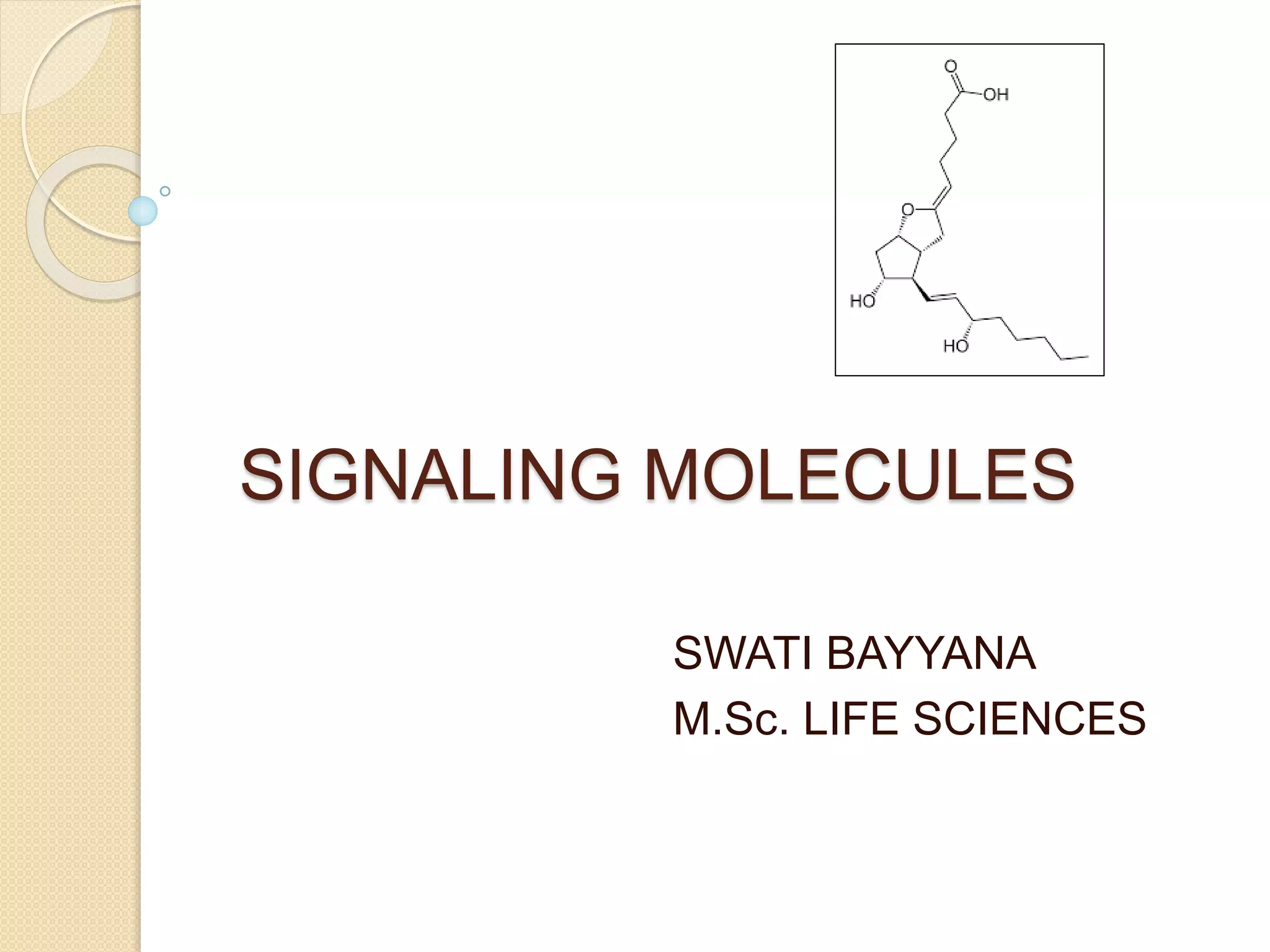
 PROSTAGLANDINS
◦ Prostaglandins are lipid autacoids derived from
arachidonic acid.
◦ Prostaglandins play a key role in the generation of the
inflammatory response.
◦ They act as autocrine or paracrine factors .
 NITRIC OXIDE
◦ NO diffuses freely across cell membranes.
◦ It is quickly consumed close to where it is
synthesized.
◦ Thus NO acts in a paracrine or
even autocrine fashionNobel Prize in Physiology or Medicine in1998 to Robert F
Furchgott, Louis J Ignarro and Ferid Murad for their
discoveries concerning "the nitric oxide as a signalling molecul
in the cardiovascular system"
INTRACELLULAR SIGNAL MOLECULES
 Intracellular signaling molecules relays signals
received at receptors, ultimately results in signaling
cascade.
 It transduce and integrate signals before relaying a
signal forward.
 Intracellular signaling complexes enhance the
speed, efficiency and specificity of the response.
A combination of small and large intracellular
signaling molecules relays signals
 The small intracellular signaling molecules, called
as small intracellular mediators or second
messengers. Examples – cAMP , Ca+2, etc.
 cAMP - It is non-specific and can generate a
variety of responses in the cell.
 Ca++ effects includes exocytosis of secretory
vesicles, muscle contraction or the inducement of
mitosis in fertilized eggs.
cAMP is synthesized by an integral
membrane protein, adenylyl cyclase,
using ATP as a substrate.
A large conformational change in the
protein upon Ca+2 binding.
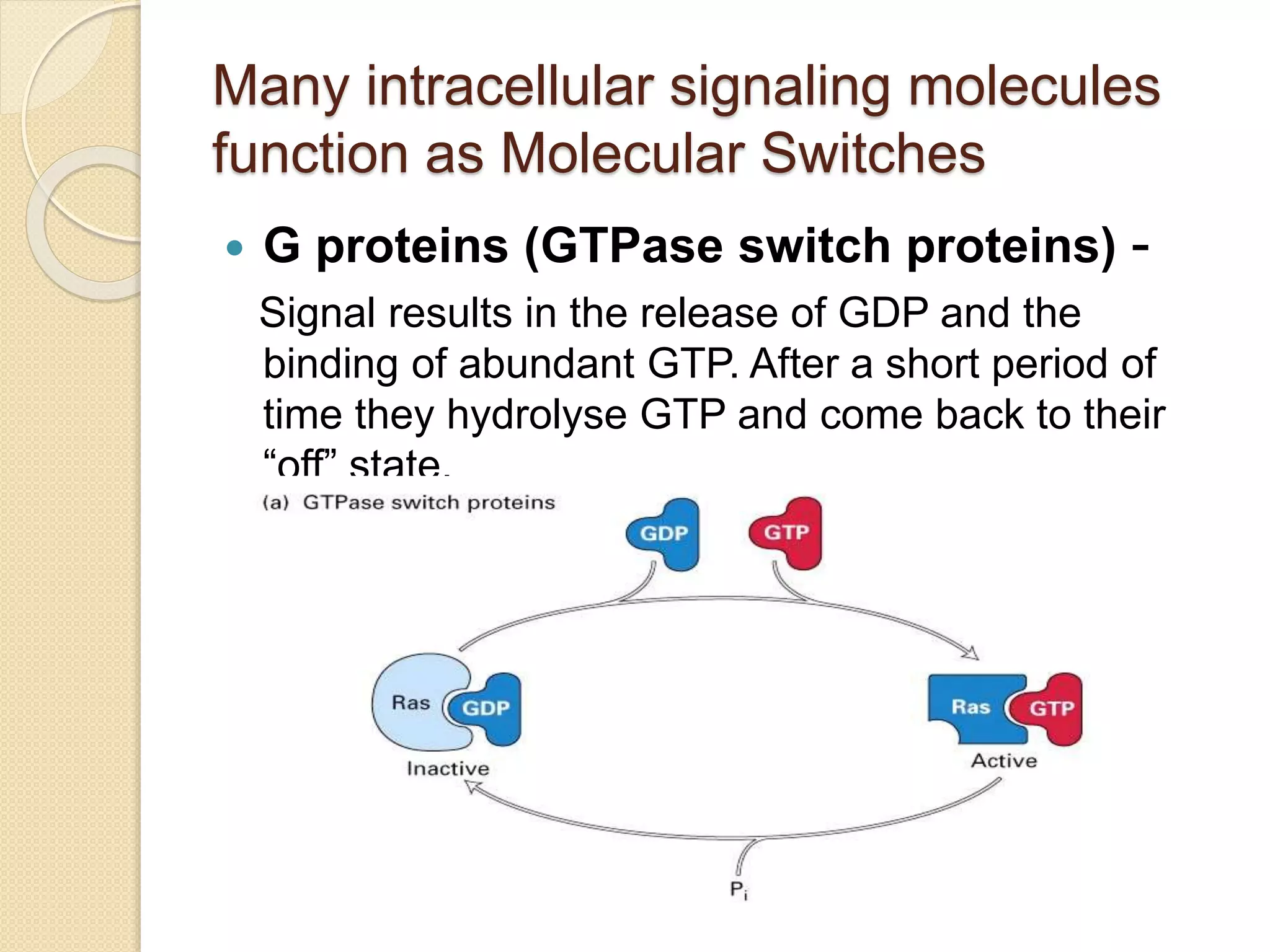
Many intracellular signaling molecules
function as Molecular Switches
 G proteins (GTPase switch proteins) -
Signal results in the release of GDP and the
binding of abundant GTP. After a short period of
time they hydrolyse GTP and come back to their
“off” state.
 Protein Kinases - They add phosphate groups to
themselves and/or other proteins at either
serine/threonine, or at tyrosine residues. Their
activity can be regulated by second messengers,
interaction with other proteins, or by
phosphorylation itself..
REGULATION
 Feedback loops are of great importance as they
regulate many chemical and physical processes in
cells.
 A positive feedback loop can transform the
behavior of the responding cells.
 A negative feedback loop counteracts the effect of
a stimulus, limits the level of response.
When Cell Communication Goes Wrong
 Following are just a few ways in which cell
communication can go wrong, resulting in
disease.
◦ Losing the signal- In type I diabetes, the
pancreatic cells that produce insulin are
lost.
◦ Signal doesn’t reach
its target- Multiple
sclerosis is a disease
in which the protective
wrappings around
nerve cells in the
brain and spinal cord
are destroyed.
◦ Multiple
breakdowns- The
result is uncontrolled
cell growth, often
leading to cancer
Recent advancements…..
 RNA can act as an extracellular signal is
emerging. Studies in plants first showed
that the phenomenon of co-suppression in
response to transgene expression is
mediated by RNA signaling.
 Hydrogen peroxide and Nitric oxide
functions as signaling molecules in plants.
REFERENCES
Lodish –Molecular biology of cell
Albert- Molecular biology of cell
Lehninger –Principles of biochemistry
Stephen Neill; Hydrogen peroxide and Ni
signaling molecules in plants; Journal of
Biology; December 2001; vol 53.
http://www.nature.com/scitable/topicpage
14047077
http://users.rcn.com/jkimball.ma.ultranet/
THANK YOU

Signaling molecules

  • 1.
  • 2.
    CELL AND ENVIRONMENTINTERACTION  All cells are able to sense and respond to substances present in their external environments.  The ability to respond to external stimuli enhances a cell's chance of survival, especially in multicellular organisms.  Chemicals that could pass into cells, and bind directly to proteins inside the cell and modulate their activities.
  • 3.
    In E. colicells, the uptake of arabinose from the environment triggers the production of enzymes necessary for its utilization.
  • 4.
    SIGNALLING MOLECULES  Signalingmolecules are the molecules that are responsible for transmitting information between cells in your body.  Most of them have been highly conserved in evolution.  Different types of cells respond differently to same signal molecules
  • 6.
    EXTRACELLULAR SIGNAL MOLECULES  Extracellular signaling molecules are critical regulators of physiology and development in organisms.   There are many different types of signals, including, peptides, small lipophilic molecules, small hydrophilic molecules and gases.  Binding of extracellular signaling molecules to cell- surface receptors trigger intracellular pathways that ultimately modulate cellular metabolism, function, or development.
  • 7.
    SIGNALLING PATHWAYS In animals,signaling by extracellular, secreted molecules can be classified into three types —  endocrine, paracrine, or autocrine — based on the distance over which the signal acts.  In endocrine signaling, signaling molecules, called hormones, act on target cells distant from their site of synthesis by cells of endocrine organs.  In paracrine signaling, the signaling molecules released by a cell only affect target cells in close proximity to it.  In autocrine signaling, cells respond to substances that they themselves release.
  • 9.
     PEPTIDE HORMONES ◦These are water soluble molecules ◦ They all bind to cell surface receptors ◦ Such as insulin, growth factors, and glucagon, etc.  STEROID HORMONES ◦ They are lipid soluble molecules ◦ Interact with receptors in the cytosol or nucleus. ◦ For example, estrogen and progesterone.
  • 10.
     PROSTAGLANDINS ◦ Prostaglandinsare lipid autacoids derived from arachidonic acid. ◦ Prostaglandins play a key role in the generation of the inflammatory response. ◦ They act as autocrine or paracrine factors .  NITRIC OXIDE ◦ NO diffuses freely across cell membranes. ◦ It is quickly consumed close to where it is synthesized. ◦ Thus NO acts in a paracrine or even autocrine fashionNobel Prize in Physiology or Medicine in1998 to Robert F Furchgott, Louis J Ignarro and Ferid Murad for their discoveries concerning "the nitric oxide as a signalling molecul in the cardiovascular system"
  • 11.
    INTRACELLULAR SIGNAL MOLECULES Intracellular signaling molecules relays signals received at receptors, ultimately results in signaling cascade.  It transduce and integrate signals before relaying a signal forward.  Intracellular signaling complexes enhance the speed, efficiency and specificity of the response.
  • 12.
    A combination ofsmall and large intracellular signaling molecules relays signals  The small intracellular signaling molecules, called as small intracellular mediators or second messengers. Examples – cAMP , Ca+2, etc.  cAMP - It is non-specific and can generate a variety of responses in the cell.  Ca++ effects includes exocytosis of secretory vesicles, muscle contraction or the inducement of mitosis in fertilized eggs.
  • 13.
    cAMP is synthesizedby an integral membrane protein, adenylyl cyclase, using ATP as a substrate. A large conformational change in the protein upon Ca+2 binding.
  • 14.
    Many intracellular signalingmolecules function as Molecular Switches  G proteins (GTPase switch proteins) - Signal results in the release of GDP and the binding of abundant GTP. After a short period of time they hydrolyse GTP and come back to their “off” state.
  • 15.
     Protein Kinases- They add phosphate groups to themselves and/or other proteins at either serine/threonine, or at tyrosine residues. Their activity can be regulated by second messengers, interaction with other proteins, or by phosphorylation itself..
  • 16.
    REGULATION  Feedback loopsare of great importance as they regulate many chemical and physical processes in cells.  A positive feedback loop can transform the behavior of the responding cells.  A negative feedback loop counteracts the effect of a stimulus, limits the level of response.
  • 18.
    When Cell CommunicationGoes Wrong  Following are just a few ways in which cell communication can go wrong, resulting in disease. ◦ Losing the signal- In type I diabetes, the pancreatic cells that produce insulin are lost.
  • 19.
    ◦ Signal doesn’treach its target- Multiple sclerosis is a disease in which the protective wrappings around nerve cells in the brain and spinal cord are destroyed. ◦ Multiple breakdowns- The result is uncontrolled cell growth, often leading to cancer
  • 20.
    Recent advancements…..  RNAcan act as an extracellular signal is emerging. Studies in plants first showed that the phenomenon of co-suppression in response to transgene expression is mediated by RNA signaling.  Hydrogen peroxide and Nitric oxide functions as signaling molecules in plants.
  • 21.
    REFERENCES Lodish –Molecular biologyof cell Albert- Molecular biology of cell Lehninger –Principles of biochemistry Stephen Neill; Hydrogen peroxide and Ni signaling molecules in plants; Journal of Biology; December 2001; vol 53. http://www.nature.com/scitable/topicpage 14047077 http://users.rcn.com/jkimball.ma.ultranet/
  • 22.

Editor's Notes

  • #3 The environments in which cells grow often change rapidly. For example, cells may consume all of a particular food source and must utilize others. To survive in a changing world, cells evolved mechanisms for adjusting their biochemistry in response to signals indicating environmental change. The adjustments can take many forms, including changes in the activities of preexisting enzyme molecules, changes in the rates of synthesis of new enzyme molecules, and changes in membrane-transport processes. either by diffusion through the cell membrane or by the action of transport proteins, Some cells also respond to mechanical stimuli. For example, sensory cells in the skin respond to the pressure of touch, whereas similar cells in the ear react to the movement of sound waves.
  • #4 E. colicells are normally unable to use arabinose efficiently as a source of energy. However, if arabinose is their only source of carbon, E. coli cells synthesize enzymes that catalyze the conversion of this sugar into useful forms. This response is mediated by arabinose itself. If present in sufficient quantity outside the cell, arabinose can enter the cell through transport proteins. Once inside the cell, arabinose binds to a protein called AraC. This binding alters the structure of AraC so that it can now bind to specific sites in the bacterialDNA and increase RNA transcription from genes encoding enzymes that metabolize arabinose.
  • #7  Extracellular signals are often integrated into complex regulatory networks in which the synthesis, release, and degradation of hormones are precisely regulated.
  • #8 PARA- Paracrine signaling is common during development, where a cell's fate is determined by interactions with its neighbors.
  • #11 NO-with their target cells present in the immediate vicinity of the site of their secretion. Binding triggers an allosteric change in the protein which, in turn, triggers the formation of a "second messenger" within the cell. The most common protein target for NO seems to be guanylyl cyclase, the enzyme that generates the second messenger cyclic GMP (cGMP). Nitric Oxide, NO, is a short-lived, endogenously produced gas that acts as a signalling molecule in the body. 
  • #14 To trigger these responses calcium affects a number of cellular effectors. In most cases it does it in conjunction with the calcium-binding protein calmodulin. This protein is found in all eukaryotes and is widely conserved in sequence among species. When the concentration of Ca++ increases calmodulin binds 4 Ca++ ions. This results in a large conformational change in the protein that increases its affinity for a number of effector proteins.
  • #15 These proteins change between an active conformation when bound to GTP, and an inactive conformation when bound to GDP. IN the absence of a signal they are bound to GDP.
  • #16 They are opposed by phosphatases that remove phosphate groups from specific phosphorylated proteins.
  • #19 Normal blood sugar regulation. After food enters the body (1), it is broken down and sugar enters the bloodstream (2). Sugar stimulates cells in the pancreas to release insulin (3). Insulin travels through the blood to other cells in the body and signals them to take up sugar (4).
  • #20 Many mechanisms maintain appropriate cell growth: Cell division occurs in response to external signals (1). Enzymes repair damaged DNA (2). Cells make connections with their neighbors (3). If these connections suddenly change, neighboring cells send out an alert. Cells respect and stay within tissue boundaries (4). If a cell is beyond repair, it initiates its own death (5).
  • #21 Here we review recent evidence that suggests that RNA may supplement endocrine and paracrine signaling by small molecules and proteins, and act as an efficient and evolutionarily flexible source of sequence-specific information transfer between cells, both locally and systemically.