MOTILITY
DR.VAISHALI
POSTGRADUATE
DEPARTMENT OF MICROBIOLOGY
What is motility?
• Motility is the ability of a cell or organism to
move of its own accord by expending energy.
• Means of motility can range from animals' use
of muscles to single cells which may have
microscopic structures that propel the cell
along
Importance of Bacterial Motility
 Chemotactic behavior and survival.
Ability to change direction (moving away or towards
repellants or attractants), avoids unfavorable
conditions of habitat and choose favorable
environment
 Pathogenesis
• For attachment and colonization of cell wall of
host cell
 Microbiology
 Nutrition, Water Expulsion
Types of movement
There are 2 types of movement
 Flagellar movement:
Most motile bacteria
move by use of flagella, threadlike locomotor
appendages extending from the plasma membrane.
and cell wall.
 Gliding movement : movement without any appendages.
Brownian movement: movement exhibited by
particles suspended in liquids due to the
bombardment of water molecules.
example: Saccharomyces cerevisiae,
Staphylococcus aureus
FLAGELLA
• They are slender, thread like appendages
protruding from the cell wall.
• It measures up to 15 or 20 μm in length and
0.01-0.02 μm in thickness.
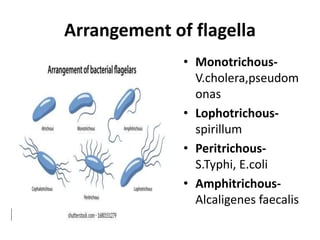
Arrangement of flagella
• Monotrichous-
V.cholera,pseudom
onas
• Lophotrichous-
spirillum
• Peritrichous-
S.Typhi, E.coli
• Amphitrichous-
Alcaligenes faecalis
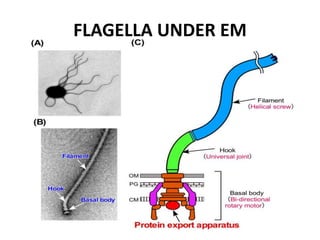
ULTRASTRUCTURE OF FLAGELLA
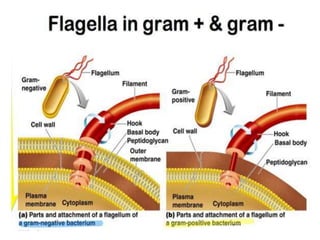
• Filament : The longest and most obvious portion
is the filament, which extend from the cell
surface to the tip. It is made up of a protein called
flagellin.
• Basal body: A basal body is embedded in the cell.
The basal body attaches the flagellum to the cell
wall and plasma membrane. It is composed of a
series of rings connected to a central rod.
• Hook : A short, curved segmented, the hook is
present outside the cell wall and connects
filament to the basal body.
MECHANISM OF FLAGELLAR
MOVEMENT
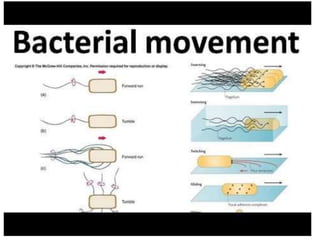
• The filament is in the shape of a rigid helix,
and the bacterium moves when this helix
rotates.
• The basal body act as motor and cause
rotation.
• Flagellar rotation determines the nature of
bacterial movement
MOVEMENT BY OTHER THAN
FLAGELLAR ROTATION
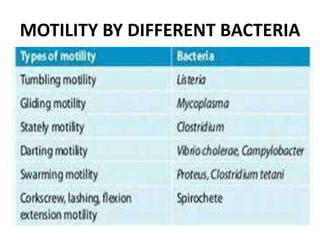
• Spirochetes shows several types of movement such as
flexing, spinning, free swimming and creeping as they are
flexible and helical bacteria and lake flagella.
• Just within the cell envelop they have flagella like
structure which are know as periplasmic flagella or axial
fibrils.
• The axial fibrils are present in the space between inner
and outer membrane of cell envelope
GLIDING MOTILITY
• Some bacteria such as the species of cyanobacteri (eg.
Cytophaga) and mycoplasma show gliding movement when
they come in contact to a solid surface.
• However no organelles are associated with the
movement .
• In the members of cytophagales and cyanobacteria ,
movement helps to find out the substratum eg. Wood,
bark, etc for anchorage and reproduction.
• They secrete slime with the help of which they get
attached to substratum.
MOTILITY BY DIFFERENT BACTERIA
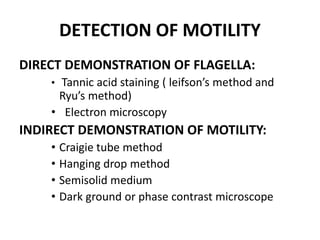
DETECTION OF MOTILITY
DIRECT DEMONSTRATION OF FLAGELLA:
• Tannic acid staining ( leifson’s method and
Ryu’s method)
• Electron microscopy
INDIRECT DEMONSTRATION OF MOTILITY:
• Craigie tube method
• Hanging drop method
• Semisolid medium
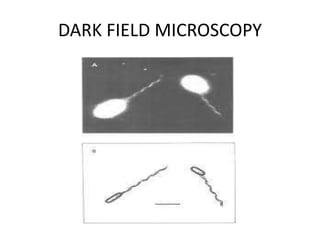
• Dark ground or phase contrast microscope
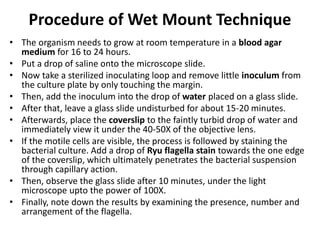
Procedure of Wet Mount Technique
• The organism needs to grow at room temperature in a blood agar
medium for 16 to 24 hours.
• Put a drop of saline onto the microscope slide.
• Now take a sterilized inoculating loop and remove little inoculum from
the culture plate by only touching the margin.
• Then, add the inoculum into the drop of water placed on a glass slide.
• After that, leave a glass slide undisturbed for about 15-20 minutes.
• Afterwards, place the coverslip to the faintly turbid drop of water and
immediately view it under the 40-50X of the objective lens.
• If the motile cells are visible, the process is followed by staining the
bacterial culture. Add a drop of Ryu flagella stain towards the one edge
of the coverslip, which ultimately penetrates the bacterial suspension
through capillary action.
• Then, observe the glass slide after 10 minutes, under the light
microscope upto the power of 100X.
• Finally, note down the results by examining the presence, number and
arrangement of the flagella.
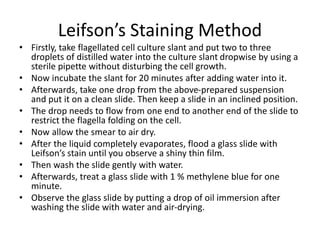
Leifson’s Staining Method
• Firstly, take flagellated cell culture slant and put two to three
droplets of distilled water into the culture slant dropwise by using a
sterile pipette without disturbing the cell growth.
• Now incubate the slant for 20 minutes after adding water into it.
• Afterwards, take one drop from the above-prepared suspension
and put it on a clean slide. Then keep a slide in an inclined position.
• The drop needs to flow from one end to another end of the slide to
restrict the flagella folding on the cell.
• Now allow the smear to air dry.
• After the liquid completely evaporates, flood a glass slide with
Leifson’s stain until you observe a shiny thin film.
• Then wash the slide gently with water.
• Afterwards, treat a glass slide with 1 % methylene blue for one
minute.
• Observe the glass slide by putting a drop of oil immersion after
washing the slide with water and air-drying.
Result Interpretation
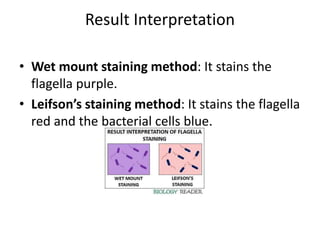
• Wet mount staining method: It stains the
flagella purple.
• Leifson’s staining method: It stains the flagella
red and the bacterial cells blue.
FLAGELLA UNDER EM
CRAIGIE’S TUBE METHOD
HANGING DROP METHOD
DARK FIELD MICROSCOPY
THANK YOU

MOTILITY

  • 1.
  • 2.
    What is motility? •Motility is the ability of a cell or organism to move of its own accord by expending energy. • Means of motility can range from animals' use of muscles to single cells which may have microscopic structures that propel the cell along
  • 3.
    Importance of BacterialMotility  Chemotactic behavior and survival. Ability to change direction (moving away or towards repellants or attractants), avoids unfavorable conditions of habitat and choose favorable environment  Pathogenesis • For attachment and colonization of cell wall of host cell  Microbiology  Nutrition, Water Expulsion
  • 4.
    Types of movement Thereare 2 types of movement  Flagellar movement: Most motile bacteria move by use of flagella, threadlike locomotor appendages extending from the plasma membrane. and cell wall.  Gliding movement : movement without any appendages. Brownian movement: movement exhibited by particles suspended in liquids due to the bombardment of water molecules. example: Saccharomyces cerevisiae, Staphylococcus aureus
  • 5.
    FLAGELLA • They areslender, thread like appendages protruding from the cell wall. • It measures up to 15 or 20 μm in length and 0.01-0.02 μm in thickness.
  • 6.
    Arrangement of flagella •Monotrichous- V.cholera,pseudom onas • Lophotrichous- spirillum • Peritrichous- S.Typhi, E.coli • Amphitrichous- Alcaligenes faecalis
  • 7.
    ULTRASTRUCTURE OF FLAGELLA •Filament : The longest and most obvious portion is the filament, which extend from the cell surface to the tip. It is made up of a protein called flagellin. • Basal body: A basal body is embedded in the cell. The basal body attaches the flagellum to the cell wall and plasma membrane. It is composed of a series of rings connected to a central rod. • Hook : A short, curved segmented, the hook is present outside the cell wall and connects filament to the basal body.
  • 9.
    MECHANISM OF FLAGELLAR MOVEMENT •The filament is in the shape of a rigid helix, and the bacterium moves when this helix rotates. • The basal body act as motor and cause rotation. • Flagellar rotation determines the nature of bacterial movement
  • 11.
    MOVEMENT BY OTHERTHAN FLAGELLAR ROTATION • Spirochetes shows several types of movement such as flexing, spinning, free swimming and creeping as they are flexible and helical bacteria and lake flagella. • Just within the cell envelop they have flagella like structure which are know as periplasmic flagella or axial fibrils. • The axial fibrils are present in the space between inner and outer membrane of cell envelope
  • 12.
    GLIDING MOTILITY • Somebacteria such as the species of cyanobacteri (eg. Cytophaga) and mycoplasma show gliding movement when they come in contact to a solid surface. • However no organelles are associated with the movement . • In the members of cytophagales and cyanobacteria , movement helps to find out the substratum eg. Wood, bark, etc for anchorage and reproduction. • They secrete slime with the help of which they get attached to substratum.
  • 13.
  • 14.
    DETECTION OF MOTILITY DIRECTDEMONSTRATION OF FLAGELLA: • Tannic acid staining ( leifson’s method and Ryu’s method) • Electron microscopy INDIRECT DEMONSTRATION OF MOTILITY: • Craigie tube method • Hanging drop method • Semisolid medium • Dark ground or phase contrast microscope
  • 15.
    Procedure of WetMount Technique • The organism needs to grow at room temperature in a blood agar medium for 16 to 24 hours. • Put a drop of saline onto the microscope slide. • Now take a sterilized inoculating loop and remove little inoculum from the culture plate by only touching the margin. • Then, add the inoculum into the drop of water placed on a glass slide. • After that, leave a glass slide undisturbed for about 15-20 minutes. • Afterwards, place the coverslip to the faintly turbid drop of water and immediately view it under the 40-50X of the objective lens. • If the motile cells are visible, the process is followed by staining the bacterial culture. Add a drop of Ryu flagella stain towards the one edge of the coverslip, which ultimately penetrates the bacterial suspension through capillary action. • Then, observe the glass slide after 10 minutes, under the light microscope upto the power of 100X. • Finally, note down the results by examining the presence, number and arrangement of the flagella.
  • 16.
    Leifson’s Staining Method •Firstly, take flagellated cell culture slant and put two to three droplets of distilled water into the culture slant dropwise by using a sterile pipette without disturbing the cell growth. • Now incubate the slant for 20 minutes after adding water into it. • Afterwards, take one drop from the above-prepared suspension and put it on a clean slide. Then keep a slide in an inclined position. • The drop needs to flow from one end to another end of the slide to restrict the flagella folding on the cell. • Now allow the smear to air dry. • After the liquid completely evaporates, flood a glass slide with Leifson’s stain until you observe a shiny thin film. • Then wash the slide gently with water. • Afterwards, treat a glass slide with 1 % methylene blue for one minute. • Observe the glass slide by putting a drop of oil immersion after washing the slide with water and air-drying.
  • 17.
    Result Interpretation • Wetmount staining method: It stains the flagella purple. • Leifson’s staining method: It stains the flagella red and the bacterial cells blue.
  • 18.
  • 19.
  • 20.
  • 21.
  • 22.