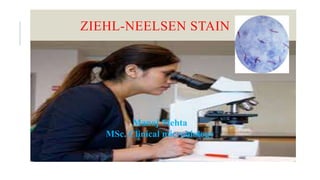
ZIEHL-NEELSEN STAIN
Manoj Mehta
MSc. Clinical microbiology
What is staining?
 Colored compound is used to develop a contrast between the specimen and the
background. This process of imparting colour to the cell is known as staining.
What is the difference between stain and dye?
Dyes are the textile colouring agents that have been prepared with lesser specifications
and they may contain the impurities . Stains are the biological colouring agents that are
more pure and prepared with greater care and specification
 Dye is crude and stain is purified form.
 Cells are stain to reveal the size and shape of microorganisms.
 Cells are stained is to enhance visualization of the cell or certain cellular components
under a microscope.
 Cells may also be stained to highlight metabolic processes.
 To denotiate between live and dead cells in a sample.
 Cells may also be enumerated by staining cells to differetermine biomass in an
environment of interest.
 Cells are stained to demonstrate the presence of internal and external structures.
 Cells are stained to distinguish between different types of organisms.
STAINING METHODS IN MICROBIOLOGY
Simple Stains: only one dye is employed for the colouration of bacterial smear
Ex. Methylene blue
Negative Stains:Negative :staining is a technique by which bacterial cells are not stained, but
are made visible against dark background.
Ex. Eosin,Nigrosin,India Ink etc
Differential Stains: Differential Stains use two or more stains and allow the cells to be
categorized into various groups or types. Other staining techniques allow the observation of cell
morphology, or shape, but differential staining usually provides more information about the
characteristics of the cell wall (Thickness).
Ex. Gram Staini , Acid Fast Stain
ACID-FAST STAIN
Ziehl–Neelsen stain, also known as the acid-fast stain
Ziehl – Neelsen stain was first described by two German doctors; Franz Ziehl (1859 to 1926), a
bacteriologist and Friedrich Neelsen (1854 to 1894) a pathologist.
Principle: When the smear is stained with carbol fuchsin, is lipid-soluble and contains phenol,
which helps the stain penetrate the cell wall. This is further assisted by the addition of heat. The
smear is then rinsed with a very strong decolorizer, which strips the stain from all non-acid-fast
cells but does not permeate the cell wall of acid-fast organisms. The decolorized non-acid-fast
cells then take up the counterstain.. Only decolorized cells absorb the counter stain and take its
color and appears blue while acid-fast cells retain the red color.
Ex. Mycobacteria, Actinomyces in tissue sections, cultures of Nocardia, oocysts of
Cryptosporidium, Isospora and bacterial spores
CHEMICALS USED IN AFB STAIN
Primary stain: Strong carbol fuchsin (consists of basic fuchsin and carbolic acid
phenol)
 Decolourizer: 20% sulfuric acid (H2SO4) or acid alcohol
 Counterstain: methylene blue or malachite green
AFB : Once bacteria are stained with strong carbol fuchsin solution with the
help of heat, those which are not decolorized by acid (20% H2So4), are called
acid fast bacilli (AFB) .
AAFB :those which are not decolorized by acid and alcohol solution
(3%acid/alcohol) are called acid alcohol fast bacilli AAFB
MODIFICATIONS IN THE PERCENTAGE OF SULFURIC ACID
5% H2SO4 for M.leprae
1% H2SO4 for Actinomyces in tissue
0.5% H2SO4 for cultures of Nocardia
0.25-0.5%for spores and for oocysts of Cryptosporidium and Isospora
SAMPLE COLLECTION
Sputum -3 consecutive samples.
Early morning complete sputum.
1st spot sputum,
2nd early morning sputum and
3rd spot sputum (DOTS protocol)
Urine -3 or more consecutive samples or 24 h pooled urine.
PREPARATION OF SMEAR
Thin smear on a clean and grease free slides
DOTS protocol: 3 sputum samples,
1st spot sample,
2nd early morning sample
3rd spot sample
Other specimen included pus, CSF, Urine, endometrial biopsy etc
Smear should be oval, 2.5 cm length and 1.5 cm width in and thin enough to see the printed matters
through it.
Materials required:
Carbol fuchsin stain (filtered)
Acid alcohol, 3% v/v
Malachite green 5 g/l (0.5% w/v) or Methylene blue, 5g/l
ACID FAST REAGENTS
Carbolfuchsin (red)
 Primary stain
 Lipid soluble; phenol
Acid alcohol
 Decolorizer
 Removes carbol fuchsin that has not bound to a mycolic acid.
Methylene blue
 Counterstain
 Cannot penetrate mycolic acid; provides contrast to non acid fast cells.
Fixation
Fixation
may kill some bacilli
makes smear stick to slide
by heat or alcohol
do not overheat
safe smear on
•may kill some bacilli
• makes smear stick to slide
• by heat or alcohol
• do not overheat
• safe smear may kill some bacilli
• makes smear stick to slide
• by heat or alcohol
• do not overheat
• safe smear ?
Cell wall structure of Acid Fast Bacilli
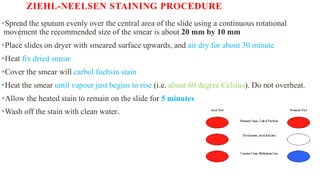
ZIEHL-NEELSEN STAINING PROCEDURE
Spread the sputum evenly over the central area of the slide using a continuous rotational
movement the recommended size of the smear is about 20 mm by 10 mm
Place slides on dryer with smeared surface upwards, and air dry for about 30 minute
Heat fix dried smear
Cover the smear will carbol fuchsin stain
Heat the smear until vapour just begins to rise (i.e. about 60 degree Celsius). Do not overheat.
Allow the heated stain to remain on the slide for 5 minutes.
Wash off the stain with clean water.
Cover the smear with 3% v/v acid alcohol for 2-5 minutes (or 20% sulfuric acid) or until the
smear is sufficiently decolorized, i.e. pale pink.
Wash well with clean water
Cover the stain with malachite green stain for 1-2 minutes
Wash off stain with clean water
Wipe the back of the slide clean, and place it in a draining rack for smear to air dry (do not blot
dry).
Examine the smear microscopically, using the 100x oil immersion objective and scan the smear
systematically.
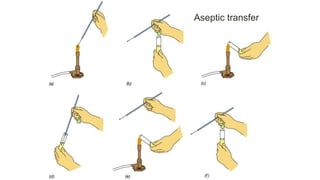
Aseptic transfer
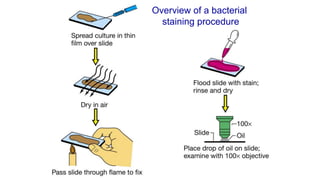
Overview of a bacterial
staining procedure
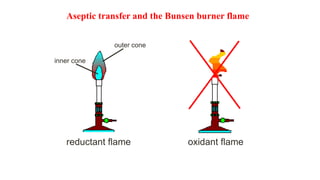
Aseptic transfer and the Bunsen burner flame
reductant flame oxidant flame
inner cone
outer cone
sample1
sample2
Preparation of the heat-fixed smear
RESULTS OF AFB STAIN
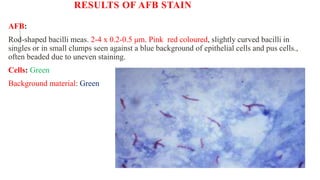
AFB:
Rod-shaped bacilli meas. 2-4 x 0.2-0.5 μm. Pink red coloured, slightly curved bacilli in
singles or in small clumps seen against a blue background of epithelial cells and pus cells.,
often beaded due to uneven staining.
Cells: Green
Background material: Green
REPORTING ON AFB MICROSCOPY
> 10 AFB/high power field –> (+++)
1-10 AFB/high power field –> ( ++)
10-100 AFB/100 high power field –> (+)
1-9 AFB/100 high power fields –> exact number
However if no AFB is seen, write the result as ‘no AFB seen’ and never write negative.
ADVANTAGES OF SPUTUM MICROSCOPY
 More reliable than x-ray for the diagnosis of infectious TB
 Simple to perform
 Easy to read
 Minimal infrastructure required
 Inexpensive
 Quick
 Only tool to monitor and declare patients as “cured’’
AFB MICROSCOPY
Advantages ( continue)
1. Rapid
2. High specificity
-All mycobacterium are acid fast
3. Accurate diagnosis
- Using simple and available equipment
Disadvantage
1. Low sensitivity; Reported sensitivity ranging 25 to 65% when compared to culture (>10,000
bacilli/ml of sputum)
2. Species differentiation impossible. False positive; Saprophytic mycobacteria
FALSE-POSITIVE RESULTS
:
Re-use of containers or positive slides;
Contaminated stain prepared with water containing environmental
mycobacteria;
use of scratched slides;
 AFB floated off one slide and became attached to another during the staining
procedure because there was no space between adjacent slides;
 Inadequate decolourization;
 lack of experience, confusion with artefacts (especially if stains are not or
poorlyfiltered);
 Microscope (lamp) in poor condition or poorly adjusted: interpreting glitter as
AFB;
 Poor quality of staining solutions
FALSE-NEGATIVE RESULTS
 Poor quality of specimen;
 Not taking proper portion of specimen for smear preparation;
 Excessive decolourization;
 Poorly prepared staining solution;
 Too little time staining with carbol fuchsin;
 Over-staining with methylene blue;
 Overheating during fixing
Limitations:
Microscopy for acid-fast bacilli (AFB) cannot distinguish Mycobacterium tuberculosis from
NTM,
Viable from non-viable organisms,
Drug-susceptible from drug-resistant strains.
LIST OF ACID FAST ORGANISMS (OTHER THAN MYCOBACTERIA
Nocardia spp: Partial Acid Fast
Rhodococcus spp: Partial Acid Fast
Legionella micdadei: Partially acid fast in tissue
Cyst of Cryptosporidium: Acid Fast
Cyst of Isospora: Acid Fast
ALTERNATE STAIN FOR AFB
Fluorescent dye (Auramine O and Rhodamine B)
 Good for labs with high workload.
 Auramine O- Bright yellow
 Auramine O-Rhodamine B- Yellow orange.
Afb stain by manoj

Afb stain by manoj

  • 1.
  • 2.
    What is staining? Colored compound is used to develop a contrast between the specimen and the background. This process of imparting colour to the cell is known as staining. What is the difference between stain and dye? Dyes are the textile colouring agents that have been prepared with lesser specifications and they may contain the impurities . Stains are the biological colouring agents that are more pure and prepared with greater care and specification  Dye is crude and stain is purified form.
  • 3.
     Cells arestain to reveal the size and shape of microorganisms.  Cells are stained is to enhance visualization of the cell or certain cellular components under a microscope.  Cells may also be stained to highlight metabolic processes.  To denotiate between live and dead cells in a sample.  Cells may also be enumerated by staining cells to differetermine biomass in an environment of interest.  Cells are stained to demonstrate the presence of internal and external structures.  Cells are stained to distinguish between different types of organisms.
  • 4.
    STAINING METHODS INMICROBIOLOGY Simple Stains: only one dye is employed for the colouration of bacterial smear Ex. Methylene blue Negative Stains:Negative :staining is a technique by which bacterial cells are not stained, but are made visible against dark background. Ex. Eosin,Nigrosin,India Ink etc Differential Stains: Differential Stains use two or more stains and allow the cells to be categorized into various groups or types. Other staining techniques allow the observation of cell morphology, or shape, but differential staining usually provides more information about the characteristics of the cell wall (Thickness). Ex. Gram Staini , Acid Fast Stain
  • 5.
    ACID-FAST STAIN Ziehl–Neelsen stain,also known as the acid-fast stain Ziehl – Neelsen stain was first described by two German doctors; Franz Ziehl (1859 to 1926), a bacteriologist and Friedrich Neelsen (1854 to 1894) a pathologist. Principle: When the smear is stained with carbol fuchsin, is lipid-soluble and contains phenol, which helps the stain penetrate the cell wall. This is further assisted by the addition of heat. The smear is then rinsed with a very strong decolorizer, which strips the stain from all non-acid-fast cells but does not permeate the cell wall of acid-fast organisms. The decolorized non-acid-fast cells then take up the counterstain.. Only decolorized cells absorb the counter stain and take its color and appears blue while acid-fast cells retain the red color. Ex. Mycobacteria, Actinomyces in tissue sections, cultures of Nocardia, oocysts of Cryptosporidium, Isospora and bacterial spores
  • 6.
    CHEMICALS USED INAFB STAIN Primary stain: Strong carbol fuchsin (consists of basic fuchsin and carbolic acid phenol)  Decolourizer: 20% sulfuric acid (H2SO4) or acid alcohol  Counterstain: methylene blue or malachite green AFB : Once bacteria are stained with strong carbol fuchsin solution with the help of heat, those which are not decolorized by acid (20% H2So4), are called acid fast bacilli (AFB) . AAFB :those which are not decolorized by acid and alcohol solution (3%acid/alcohol) are called acid alcohol fast bacilli AAFB
  • 7.
    MODIFICATIONS IN THEPERCENTAGE OF SULFURIC ACID 5% H2SO4 for M.leprae 1% H2SO4 for Actinomyces in tissue 0.5% H2SO4 for cultures of Nocardia 0.25-0.5%for spores and for oocysts of Cryptosporidium and Isospora
  • 8.
    SAMPLE COLLECTION Sputum -3consecutive samples. Early morning complete sputum. 1st spot sputum, 2nd early morning sputum and 3rd spot sputum (DOTS protocol) Urine -3 or more consecutive samples or 24 h pooled urine.
  • 9.
    PREPARATION OF SMEAR Thinsmear on a clean and grease free slides DOTS protocol: 3 sputum samples, 1st spot sample, 2nd early morning sample 3rd spot sample Other specimen included pus, CSF, Urine, endometrial biopsy etc Smear should be oval, 2.5 cm length and 1.5 cm width in and thin enough to see the printed matters through it.
  • 10.
    Materials required: Carbol fuchsinstain (filtered) Acid alcohol, 3% v/v Malachite green 5 g/l (0.5% w/v) or Methylene blue, 5g/l
  • 11.
    ACID FAST REAGENTS Carbolfuchsin(red)  Primary stain  Lipid soluble; phenol Acid alcohol  Decolorizer  Removes carbol fuchsin that has not bound to a mycolic acid. Methylene blue  Counterstain  Cannot penetrate mycolic acid; provides contrast to non acid fast cells.
  • 12.
    Fixation Fixation may kill somebacilli makes smear stick to slide by heat or alcohol do not overheat safe smear on •may kill some bacilli • makes smear stick to slide • by heat or alcohol • do not overheat • safe smear may kill some bacilli • makes smear stick to slide • by heat or alcohol • do not overheat • safe smear ? Cell wall structure of Acid Fast Bacilli
  • 13.
    ZIEHL-NEELSEN STAINING PROCEDURE Spreadthe sputum evenly over the central area of the slide using a continuous rotational movement the recommended size of the smear is about 20 mm by 10 mm Place slides on dryer with smeared surface upwards, and air dry for about 30 minute Heat fix dried smear Cover the smear will carbol fuchsin stain Heat the smear until vapour just begins to rise (i.e. about 60 degree Celsius). Do not overheat. Allow the heated stain to remain on the slide for 5 minutes. Wash off the stain with clean water.
  • 14.
    Cover the smearwith 3% v/v acid alcohol for 2-5 minutes (or 20% sulfuric acid) or until the smear is sufficiently decolorized, i.e. pale pink. Wash well with clean water Cover the stain with malachite green stain for 1-2 minutes Wash off stain with clean water Wipe the back of the slide clean, and place it in a draining rack for smear to air dry (do not blot dry). Examine the smear microscopically, using the 100x oil immersion objective and scan the smear systematically.
  • 15.
  • 16.
    Overview of abacterial staining procedure
  • 17.
    Aseptic transfer andthe Bunsen burner flame reductant flame oxidant flame inner cone outer cone
  • 18.
  • 19.
    RESULTS OF AFBSTAIN AFB: Rod-shaped bacilli meas. 2-4 x 0.2-0.5 μm. Pink red coloured, slightly curved bacilli in singles or in small clumps seen against a blue background of epithelial cells and pus cells., often beaded due to uneven staining. Cells: Green Background material: Green
  • 20.
    REPORTING ON AFBMICROSCOPY > 10 AFB/high power field –> (+++) 1-10 AFB/high power field –> ( ++) 10-100 AFB/100 high power field –> (+) 1-9 AFB/100 high power fields –> exact number However if no AFB is seen, write the result as ‘no AFB seen’ and never write negative.
  • 21.
    ADVANTAGES OF SPUTUMMICROSCOPY  More reliable than x-ray for the diagnosis of infectious TB  Simple to perform  Easy to read  Minimal infrastructure required  Inexpensive  Quick  Only tool to monitor and declare patients as “cured’’
  • 22.
    AFB MICROSCOPY Advantages (continue) 1. Rapid 2. High specificity -All mycobacterium are acid fast 3. Accurate diagnosis - Using simple and available equipment Disadvantage 1. Low sensitivity; Reported sensitivity ranging 25 to 65% when compared to culture (>10,000 bacilli/ml of sputum) 2. Species differentiation impossible. False positive; Saprophytic mycobacteria
  • 23.
    FALSE-POSITIVE RESULTS : Re-use ofcontainers or positive slides; Contaminated stain prepared with water containing environmental mycobacteria; use of scratched slides;  AFB floated off one slide and became attached to another during the staining procedure because there was no space between adjacent slides;  Inadequate decolourization;  lack of experience, confusion with artefacts (especially if stains are not or poorlyfiltered);  Microscope (lamp) in poor condition or poorly adjusted: interpreting glitter as AFB;  Poor quality of staining solutions
  • 24.
    FALSE-NEGATIVE RESULTS  Poorquality of specimen;  Not taking proper portion of specimen for smear preparation;  Excessive decolourization;  Poorly prepared staining solution;  Too little time staining with carbol fuchsin;  Over-staining with methylene blue;  Overheating during fixing
  • 25.
    Limitations: Microscopy for acid-fastbacilli (AFB) cannot distinguish Mycobacterium tuberculosis from NTM, Viable from non-viable organisms, Drug-susceptible from drug-resistant strains.
  • 26.
    LIST OF ACIDFAST ORGANISMS (OTHER THAN MYCOBACTERIA Nocardia spp: Partial Acid Fast Rhodococcus spp: Partial Acid Fast Legionella micdadei: Partially acid fast in tissue Cyst of Cryptosporidium: Acid Fast Cyst of Isospora: Acid Fast
  • 27.
    ALTERNATE STAIN FORAFB Fluorescent dye (Auramine O and Rhodamine B)  Good for labs with high workload.  Auramine O- Bright yellow  Auramine O-Rhodamine B- Yellow orange.