ABG FROM THEORY TO
THERAPY
WHAT IS PH ?
pH=-log[H+] concentration,
which is read:
the pH is equal to minus the log of the H+
concentration.
For example is the H+ concentration is very low, lets say
about 0.0000001M, then the pH is
pH= -log[.0000001] whis is the same as -log[1 X 10⁻⁷]
the term log[1 X 10⁻⁷] = -7
- (-7) = 7
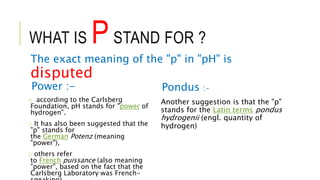
WHAT IS PSTAND FOR ?
The exact meaning of the "p" in "pH" is
disputed
Power :-
o according to the Carlsberg
Foundation, pH stands for "power of
hydrogen".
o It has also been suggested that the
"p" stands for
the German Potenz (meaning
"power"),
o others refer
to French puissance (also meaning
"power", based on the fact that the
Carlsberg Laboratory was French-
Pondus :-
Another suggestion is that the "p"
stands for the Latin terms pondus
hydrogenii (engl. quantity of
hydrogen)
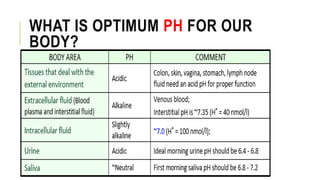
WHAT IS OPTIMUM PH FOR OUR
BODY?
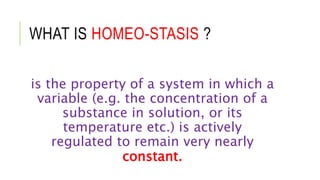
WHAT IS HOMEO-STASIS ?
is the property of a system in which a
variable (e.g. the concentration of a
substance in solution, or its
temperature etc.) is actively
regulated to remain very nearly
constant.
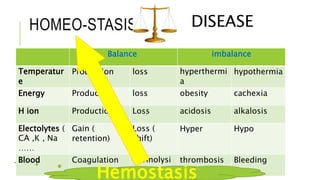
HOMEO-STASIS ….. DISEASE
imbalanceBalance
hypothermiahyperthermi
a
lossProductionTemperatur
e
cachexiaobesitylossProductionEnergy
alkalosisacidosisLossProductionH ion
HypoHyperLoss (
shift)
Gain (
retention)
Electolytes (
CA ,K , Na
……
Bleedingthrombosisfibrinolysi
s
CoagulationBlood
Hemostasis
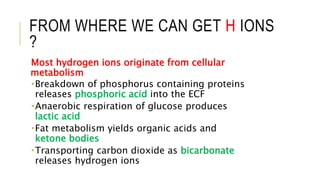
FROM WHERE WE CAN GET H IONS
?
Most hydrogen ions originate from cellular
metabolism
Breakdown of phosphorus containing proteins
releases phosphoric acid into the ECF
Anaerobic respiration of glucose produces
lactic acid
Fat metabolism yields organic acids and
ketone bodies
Transporting carbon dioxide as bicarbonate
releases hydrogen ions
Life is a long
acid trip
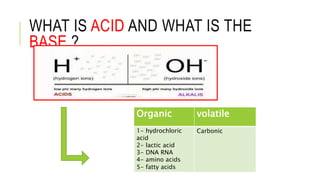
WHAT IS ACID AND WHAT IS THE
BASE ?
volatileOrganic
Carbonic1- hydrochloric
acid
2- lactic acid
3- DNA RNA
4- amino acids
5- fatty acids
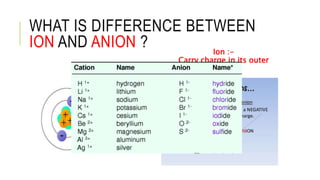
WHAT IS DIFFERENCE BETWEEN
ION AND ANION ? Ion :-
Carry charge in its outer
surface
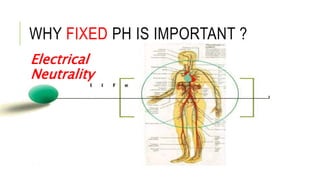
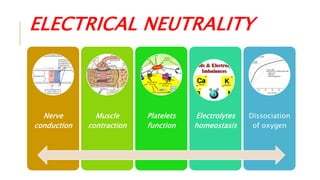
WHY FIXED PH IS IMPORTANT ?
Electrical
Neutrality
ELECTRICAL NEUTRALITY
Nerve
conduction
Muscle
contraction
Platelets
function
Electrolytes
homeostasis
Dissociation
of oxygen
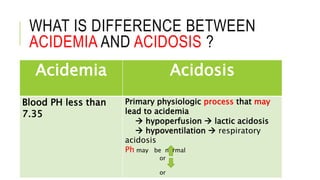
WHAT IS DIFFERENCE BETWEEN
ACIDEMIA AND ACIDOSIS ?
AcidosisAcidemia
Primary physiologic process that may
lead to acidemia
 hypoperfusion  lactic acidosis
 hypoventilation  respiratory
acidosis
Ph may be normal
or
or
Blood PH less than
7.35
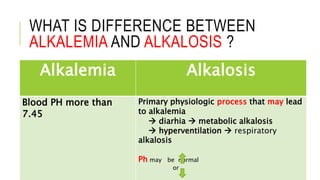
WHAT IS DIFFERENCE BETWEEN
ALKALEMIA AND ALKALOSIS ?
AlkalosisAlkalemia
Primary physiologic process that may lead
to alkalemia
 diarhia  metabolic alkalosis
 hyperventilation  respiratory
alkalosis
Ph may be normal
or
Blood PH more than
7.45
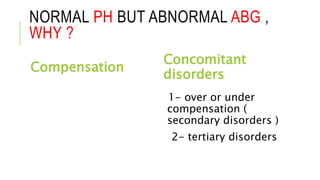
NORMAL PH BUT ABNORMAL ABG ,
WHY ?
Compensation
Concomitant
disorders
1- over or under
compensation (
secondary disorders )
2- tertiary disorders
HYDROGEN ION REGULATION =
COMPENSATION
Concentration of hydrogen ions is regulated
sequentially by:
1. Chemical buffer systems act within seconds
2. The respiratory center in the brain stem acts within
1-3 minutes
3. Renal mechanisms require hours to days to affect pH
changes
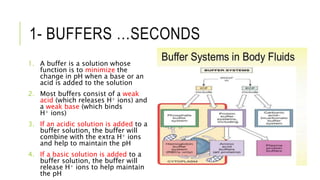
1- BUFFERS …SECONDS
1. A buffer is a solution whose
function is to minimize the
change in pH when a base or an
acid is added to the solution
2. Most buffers consist of a weak
acid (which releases H+ ions) and
a weak base (which binds
H+ ions)
3. If an acidic solution is added to a
buffer solution, the buffer will
combine with the extra H+ ions
and help to maintain the pH
4. If a basic solution is added to a
buffer solution, the buffer will
release H+ ions to help maintain
the pH
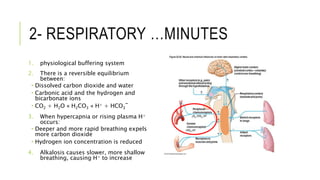
2- RESPIRATORY …MINUTES
1. physiological buffering system
2. There is a reversible equilibrium
between:
 Dissolved carbon dioxide and water
 Carbonic acid and the hydrogen and
bicarbonate ions
 CO2 + H2O « H2CO3 « H+ + HCO3¯
3. When hypercapnia or rising plasma H+
occurs:
 Deeper and more rapid breathing expels
more carbon dioxide
 Hydrogen ion concentration is reduced
4. Alkalosis causes slower, more shallow
breathing, causing H+ to increase
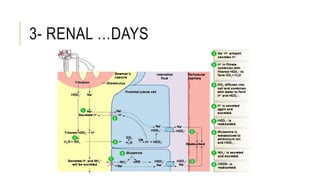
3- RENAL …DAYS
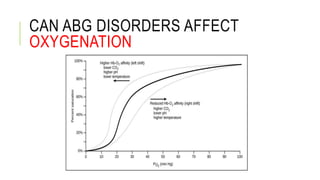
CAN ABG DISORDERS AFFECT
OXYGENATION
INDICATIONS OF ABG TEST
Muakkassa and coworkers
studied the relationship between the presence of an arterial line and
ABG sampling . These authors demonstrated that patients’ with an
arterial line had more ABGs drawn than those who did not regardless
of the value of the PaO2, PaCO2, APACHE II score or the use of a
ventilator. In this study, multivariate analysis demonstrated that
presence of an
arterial line was the most powerful predictor of the number of
ABGs
drawn per patient independent of all other measures of the
patient’s clinical status
WHAT IS YOUR METHOD ?
OUR METHOD WILL BE ……!!!!!!!
P & P ……. !!!!!!!!!!!
Patient Paper
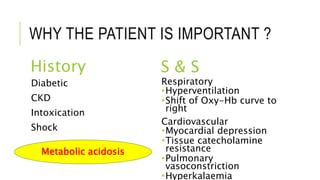
WHY THE PATIENT IS IMPORTANT ?
History S & S
Diabetic
CKD
Intoxication
Shock
Respiratory
Hyperventilation
Shift of Oxy-Hb curve to
right
Cardiovascular
Myocardial depression
Tissue catecholamine
resistance
Pulmonary
vasoconstriction
Hyperkalaemia
Metabolic acidosis
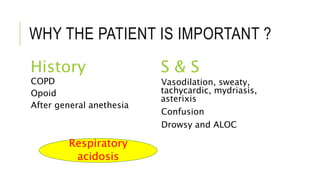
WHY THE PATIENT IS IMPORTANT ?
History S & S
COPD
Opoid
After general anethesia
Vasodilation, sweaty,
tachycardic, mydriasis,
asterixis
Confusion
Drowsy and ALOC
Respiratory
acidosis
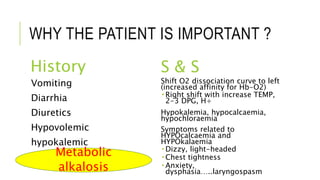
WHY THE PATIENT IS IMPORTANT ?
History S & S
Vomiting
Diarrhia
Diuretics
Hypovolemic
hypokalemic
Shift O2 dissociation curve to left
(increased affinity for Hb-O2)
 Right shift with increase TEMP,
2-3 DPG, H+
Hypokalemia, hypocalcaemia,
hypochloraemia
Symptoms related to
HYPOcalcaemia and
HYPOkalaemia
 Dizzy, light-headed
 Chest tightness
 Anxiety,
dysphasia…..laryngospasm
Metabolic
alkalosis
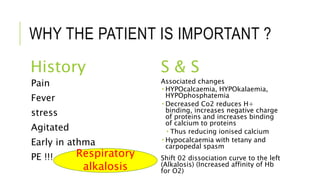
WHY THE PATIENT IS IMPORTANT ?
History S & S
Pain
Fever
stress
Agitated
Early in athma
PE !!!
Associated changes
 HYPOcalcaemia, HYPOkalaemia,
HYPOphosphatemia
 Decreased Co2 reduces H+
binding, increases negative charge
of proteins and increases binding
of calcium to proteins
 Thus reducing ionised calcium
 Hypocalcaemia with tetany and
carpopedal spasm
Shift 02 dissociation curve to the left
(Alkalosis) (Increased affinity of Hb
for O2)
Respiratory
alkalosis
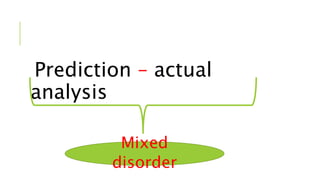
Prediction – actual
analysis
Mixed
disorder
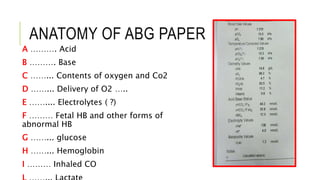
ANATOMY OF ABG PAPER
A ………. Acid
B ………. Base
C ……... Contents of oxygen and Co2
D ……... Delivery of O2 …..
E …….... Electrolytes ( ?)
F ……… Fetal HB and other forms of
abnormal HB
G ……... glucose
H ……... Hemoglobin
I ……… Inhaled CO
5 STEPS
1.Confirm
2.Classify
3.Calculate
4.Causes
5.Correct
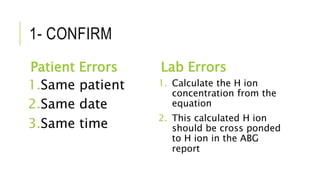
1- CONFIRM
Patient Errors
1.Same patient
2.Same date
3.Same time
Lab Errors
1. Calculate the H ion
concentration from the
equation
2. This calculated H ion
should be cross ponded
to H ion in the ABG
report
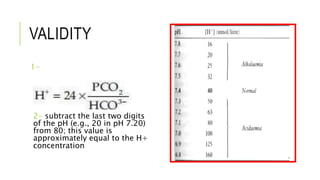
VALIDITY
1-
2- subtract the last two digits
of the pH (e.g., 20 in pH 7.20)
from 80; this value is
approximately equal to the H+
concentration
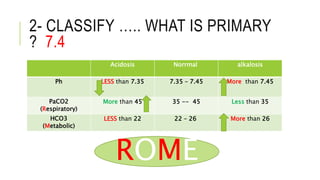
2- CLASSIFY ….. WHAT IS PRIMARY
? 7.4
alkalosisNorrmalAcidosis
More than 7.457.35 – 7.45LESS than 7.35Ph
Less than 3535 -- 45More than 45PaCO2
(Respiratory)
More than 2622 – 26LESS than 22HCO3
(Metabolic)
ROME
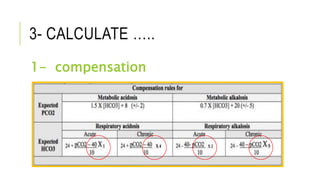
3- CALCULATE …..
1- compensation
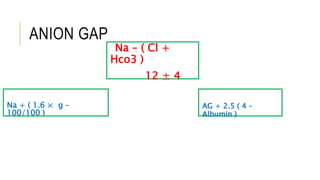
ANION GAP
Na + ( 1.6 × g –
100/100 )
Na – ( Cl +
Hco3 )
12 ± 4
AG + 2.5 ( 4 –
Albumin )
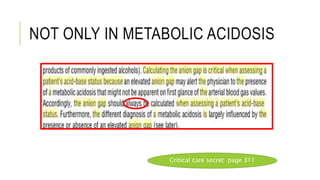
NOT ONLY IN METABOLIC ACIDOSIS
Critical care secret page 311
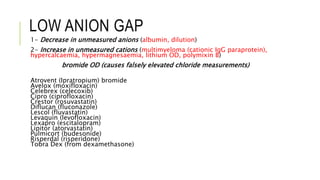
LOW ANION GAP
1- Decrease in unmeasured anions (albumin, dilution)
2- Increase in unmeasured cations (multimyeloma (cationic IgG paraprotein),
hypercalcaemia, hypermagnesaemia, lithium OD, polymixin B)
bromide OD (causes falsely elevated chloride measurements)
Atrovent (Ipratropium) bromide
Avelox (moxifloxacin)
Celebrex (celecoxib)
Cipro (ciprofloxacin)
Crestor (rosuvastatin)
Diflucan (fluconazole)
Lescol (fluvastatin)
Levaquin (levofloxacin)
Lexapro (escitalopram)
Lipitor (atorvastatin)
Pulmicort (budesonide)
Risperdal (risperidone)
Tobra Dex (from dexamethasone)
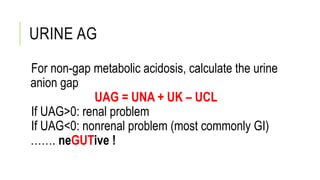
URINE AG
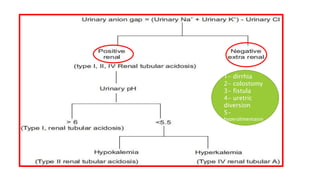
For non-gap metabolic acidosis, calculate the urine
anion gap
UAG = UNA + UK – UCL
If UAG>0: renal problem
If UAG<0: nonrenal problem (most commonly GI)
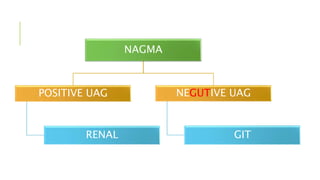
……. neGUTive !
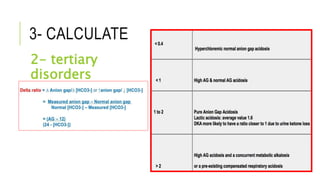
3- CALCULATE
2- tertiary
disorders
4- CAUSES
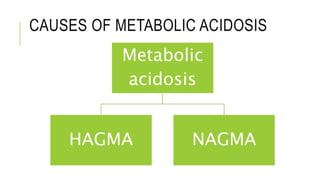
CAUSES OF METABOLIC ACIDOSIS
Metabolic
acidosis
HAGMA NAGMA
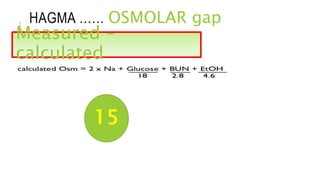
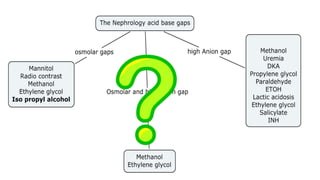
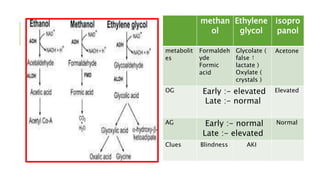
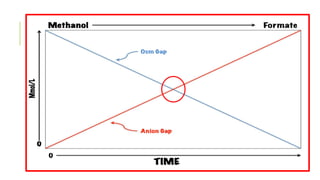
HAGMA …… OSMOLAR gap
Measured –
calculated
15
isopro
panol
Ethylene
glycol
methan
ol
AcetoneGlycolate (
false ↑
lactate )
Oxylate (
crystals )
Formaldeh
yde
Formic
acid
metabolit
es
ElevatedEarly :- elevated
Late :- normal
OG
NormalEarly :- normal
Late :- elevated
AG
AKIBlindnessClues
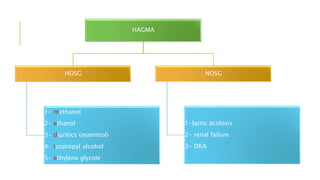
HAGMA
HOSG
1- methanol
2- ethanol
3- diuritics (mannitol)
4- isopropyl alcohol
5- ethylene glycole
NOSG
1-lactic acidosis
2- renal failure
3- DKA
NAGMA
POSITIVE UAG
RENAL
NEGUTIVE UAG
GIT
1- dirrhia
2- colostomy
3- fistula
4- uretric
diversion
5-
hyperalimentaion
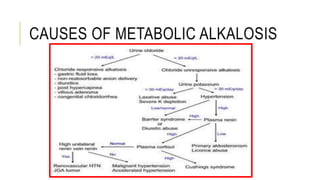
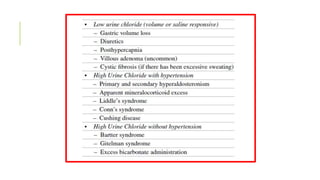
CAUSES OF METABOLIC ALKALOSIS
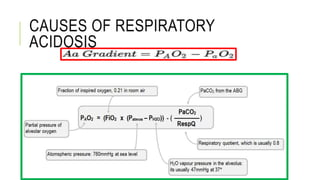
CAUSES OF RESPIRATORY
ACIDOSIS
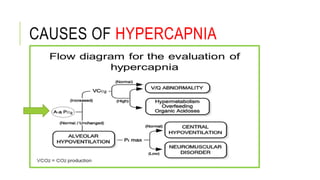
CAUSES OF HYPERCAPNIA
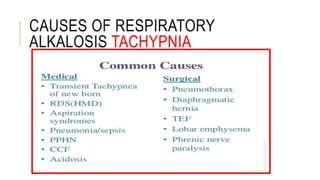
CAUSES OF RESPIRATORY
ALKALOSIS TACHYPNIA
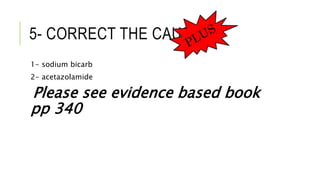
5- CORRECT THE CAUSES
1- sodium bicarb
2- acetazolamide
Please see evidence based book
pp 340
HOW TO
DECREASE THE
ABUSE
SEE PAUL MRIK
PP 330
Thank you

acid base ABG from theory to therapy

  • 1.
    ABG FROM THEORYTO THERAPY
  • 2.
    WHAT IS PH? pH=-log[H+] concentration, which is read: the pH is equal to minus the log of the H+ concentration. For example is the H+ concentration is very low, lets say about 0.0000001M, then the pH is pH= -log[.0000001] whis is the same as -log[1 X 10⁻⁷] the term log[1 X 10⁻⁷] = -7 - (-7) = 7
  • 3.
    WHAT IS PSTANDFOR ? The exact meaning of the "p" in "pH" is disputed Power :- o according to the Carlsberg Foundation, pH stands for "power of hydrogen". o It has also been suggested that the "p" stands for the German Potenz (meaning "power"), o others refer to French puissance (also meaning "power", based on the fact that the Carlsberg Laboratory was French- Pondus :- Another suggestion is that the "p" stands for the Latin terms pondus hydrogenii (engl. quantity of hydrogen)
  • 4.
    WHAT IS OPTIMUMPH FOR OUR BODY?
  • 5.
    WHAT IS HOMEO-STASIS? is the property of a system in which a variable (e.g. the concentration of a substance in solution, or its temperature etc.) is actively regulated to remain very nearly constant.
  • 7.
    HOMEO-STASIS ….. DISEASE imbalanceBalance hypothermiahyperthermi a lossProductionTemperatur e cachexiaobesitylossProductionEnergy alkalosisacidosisLossProductionHion HypoHyperLoss ( shift) Gain ( retention) Electolytes ( CA ,K , Na …… Bleedingthrombosisfibrinolysi s CoagulationBlood Hemostasis
  • 8.
    FROM WHERE WECAN GET H IONS ? Most hydrogen ions originate from cellular metabolism Breakdown of phosphorus containing proteins releases phosphoric acid into the ECF Anaerobic respiration of glucose produces lactic acid Fat metabolism yields organic acids and ketone bodies Transporting carbon dioxide as bicarbonate releases hydrogen ions
  • 9.
    Life is along acid trip
  • 10.
    WHAT IS ACIDAND WHAT IS THE BASE ? volatileOrganic Carbonic1- hydrochloric acid 2- lactic acid 3- DNA RNA 4- amino acids 5- fatty acids
  • 11.
    WHAT IS DIFFERENCEBETWEEN ION AND ANION ? Ion :- Carry charge in its outer surface
  • 12.
    WHY FIXED PHIS IMPORTANT ? Electrical Neutrality
  • 13.
  • 14.
    WHAT IS DIFFERENCEBETWEEN ACIDEMIA AND ACIDOSIS ? AcidosisAcidemia Primary physiologic process that may lead to acidemia  hypoperfusion  lactic acidosis  hypoventilation  respiratory acidosis Ph may be normal or or Blood PH less than 7.35
  • 15.
    WHAT IS DIFFERENCEBETWEEN ALKALEMIA AND ALKALOSIS ? AlkalosisAlkalemia Primary physiologic process that may lead to alkalemia  diarhia  metabolic alkalosis  hyperventilation  respiratory alkalosis Ph may be normal or Blood PH more than 7.45
  • 16.
    NORMAL PH BUTABNORMAL ABG , WHY ? Compensation Concomitant disorders 1- over or under compensation ( secondary disorders ) 2- tertiary disorders
  • 17.
    HYDROGEN ION REGULATION= COMPENSATION Concentration of hydrogen ions is regulated sequentially by: 1. Chemical buffer systems act within seconds 2. The respiratory center in the brain stem acts within 1-3 minutes 3. Renal mechanisms require hours to days to affect pH changes
  • 18.
    1- BUFFERS …SECONDS 1.A buffer is a solution whose function is to minimize the change in pH when a base or an acid is added to the solution 2. Most buffers consist of a weak acid (which releases H+ ions) and a weak base (which binds H+ ions) 3. If an acidic solution is added to a buffer solution, the buffer will combine with the extra H+ ions and help to maintain the pH 4. If a basic solution is added to a buffer solution, the buffer will release H+ ions to help maintain the pH
  • 19.
    2- RESPIRATORY …MINUTES 1.physiological buffering system 2. There is a reversible equilibrium between:  Dissolved carbon dioxide and water  Carbonic acid and the hydrogen and bicarbonate ions  CO2 + H2O « H2CO3 « H+ + HCO3¯ 3. When hypercapnia or rising plasma H+ occurs:  Deeper and more rapid breathing expels more carbon dioxide  Hydrogen ion concentration is reduced 4. Alkalosis causes slower, more shallow breathing, causing H+ to increase
  • 20.
  • 21.
    CAN ABG DISORDERSAFFECT OXYGENATION
  • 22.
    INDICATIONS OF ABGTEST Muakkassa and coworkers studied the relationship between the presence of an arterial line and ABG sampling . These authors demonstrated that patients’ with an arterial line had more ABGs drawn than those who did not regardless of the value of the PaO2, PaCO2, APACHE II score or the use of a ventilator. In this study, multivariate analysis demonstrated that presence of an arterial line was the most powerful predictor of the number of ABGs drawn per patient independent of all other measures of the patient’s clinical status
  • 24.
    WHAT IS YOURMETHOD ?
  • 25.
    OUR METHOD WILLBE ……!!!!!!!
  • 26.
    P & P……. !!!!!!!!!!! Patient Paper
  • 27.
    WHY THE PATIENTIS IMPORTANT ? History S & S Diabetic CKD Intoxication Shock Respiratory Hyperventilation Shift of Oxy-Hb curve to right Cardiovascular Myocardial depression Tissue catecholamine resistance Pulmonary vasoconstriction Hyperkalaemia Metabolic acidosis
  • 28.
    WHY THE PATIENTIS IMPORTANT ? History S & S COPD Opoid After general anethesia Vasodilation, sweaty, tachycardic, mydriasis, asterixis Confusion Drowsy and ALOC Respiratory acidosis
  • 29.
    WHY THE PATIENTIS IMPORTANT ? History S & S Vomiting Diarrhia Diuretics Hypovolemic hypokalemic Shift O2 dissociation curve to left (increased affinity for Hb-O2)  Right shift with increase TEMP, 2-3 DPG, H+ Hypokalemia, hypocalcaemia, hypochloraemia Symptoms related to HYPOcalcaemia and HYPOkalaemia  Dizzy, light-headed  Chest tightness  Anxiety, dysphasia…..laryngospasm Metabolic alkalosis
  • 30.
    WHY THE PATIENTIS IMPORTANT ? History S & S Pain Fever stress Agitated Early in athma PE !!! Associated changes  HYPOcalcaemia, HYPOkalaemia, HYPOphosphatemia  Decreased Co2 reduces H+ binding, increases negative charge of proteins and increases binding of calcium to proteins  Thus reducing ionised calcium  Hypocalcaemia with tetany and carpopedal spasm Shift 02 dissociation curve to the left (Alkalosis) (Increased affinity of Hb for O2) Respiratory alkalosis
  • 31.
  • 33.
    ANATOMY OF ABGPAPER A ………. Acid B ………. Base C ……... Contents of oxygen and Co2 D ……... Delivery of O2 ….. E …….... Electrolytes ( ?) F ……… Fetal HB and other forms of abnormal HB G ……... glucose H ……... Hemoglobin I ……… Inhaled CO
  • 34.
  • 35.
    1- CONFIRM Patient Errors 1.Samepatient 2.Same date 3.Same time Lab Errors 1. Calculate the H ion concentration from the equation 2. This calculated H ion should be cross ponded to H ion in the ABG report
  • 36.
    VALIDITY 1- 2- subtract thelast two digits of the pH (e.g., 20 in pH 7.20) from 80; this value is approximately equal to the H+ concentration
  • 37.
    2- CLASSIFY …..WHAT IS PRIMARY ? 7.4 alkalosisNorrmalAcidosis More than 7.457.35 – 7.45LESS than 7.35Ph Less than 3535 -- 45More than 45PaCO2 (Respiratory) More than 2622 – 26LESS than 22HCO3 (Metabolic) ROME
  • 38.
  • 39.
    ANION GAP Na +( 1.6 × g – 100/100 ) Na – ( Cl + Hco3 ) 12 ± 4 AG + 2.5 ( 4 – Albumin )
  • 40.
    NOT ONLY INMETABOLIC ACIDOSIS Critical care secret page 311
  • 41.
    LOW ANION GAP 1-Decrease in unmeasured anions (albumin, dilution) 2- Increase in unmeasured cations (multimyeloma (cationic IgG paraprotein), hypercalcaemia, hypermagnesaemia, lithium OD, polymixin B) bromide OD (causes falsely elevated chloride measurements) Atrovent (Ipratropium) bromide Avelox (moxifloxacin) Celebrex (celecoxib) Cipro (ciprofloxacin) Crestor (rosuvastatin) Diflucan (fluconazole) Lescol (fluvastatin) Levaquin (levofloxacin) Lexapro (escitalopram) Lipitor (atorvastatin) Pulmicort (budesonide) Risperdal (risperidone) Tobra Dex (from dexamethasone)
  • 42.
    URINE AG For non-gapmetabolic acidosis, calculate the urine anion gap UAG = UNA + UK – UCL If UAG>0: renal problem If UAG<0: nonrenal problem (most commonly GI) ……. neGUTive !
  • 43.
  • 44.
  • 45.
    CAUSES OF METABOLICACIDOSIS Metabolic acidosis HAGMA NAGMA
  • 46.
    HAGMA …… OSMOLARgap Measured – calculated 15
  • 48.
    isopro panol Ethylene glycol methan ol AcetoneGlycolate ( false ↑ lactate) Oxylate ( crystals ) Formaldeh yde Formic acid metabolit es ElevatedEarly :- elevated Late :- normal OG NormalEarly :- normal Late :- elevated AG AKIBlindnessClues
  • 50.
    HAGMA HOSG 1- methanol 2- ethanol 3-diuritics (mannitol) 4- isopropyl alcohol 5- ethylene glycole NOSG 1-lactic acidosis 2- renal failure 3- DKA
  • 52.
  • 53.
    1- dirrhia 2- colostomy 3-fistula 4- uretric diversion 5- hyperalimentaion
  • 54.
  • 56.
  • 57.
  • 58.
  • 59.
    5- CORRECT THECAUSES 1- sodium bicarb 2- acetazolamide Please see evidence based book pp 340
  • 60.
  • 61.

Editor's Notes

  • #11 1- DONATE AND ACCEPT 2- DEOXY RIBO NEUCLIC 3- all acids are organic excpt
  • #13 1- fixed with very narrow range
  • #21 A secretion is a substance that is produced by s cell or a gland or an organ. There are many types of secretions -- hormones, stomach acid, bile, waste, etc. Anexcretion is the secretion of a waste, examples being urine or sweat.
  • #40 شاهد اليوتيوب طارق عبدالحميد
  • #47 What ids the normal and abnormal OSG