Presented by
Abhilasha chaudhary
 Bone is one-third connective tissue.
 It is impregnated with calcium salt.
Bones give shape and support to the body,
and resist any forms of stress.
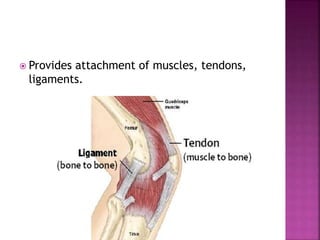
 Provides attachment of muscles, tendons,
ligaments.
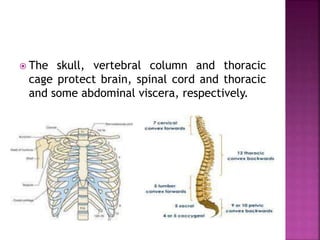
 The skull, vertebral column and thoracic
cage protect brain, spinal cord and thoracic
and some abdominal viscera, respectively.
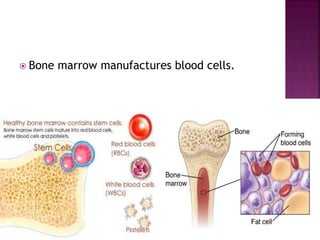
 Bone marrow manufactures blood cells.
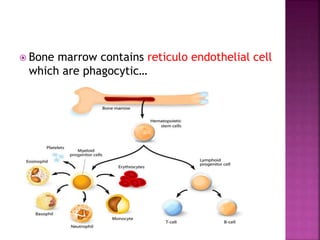
 Bone marrow contains reticulo endothelial cell
which are phagocytic…
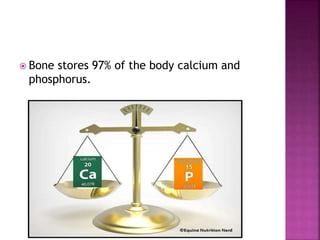
 Bone stores 97% of the body calcium and
phosphorus.
 According to shape
 Developmental bones
 Regional classification
 Structural classification
ACCORDING TO
SHAPE:-
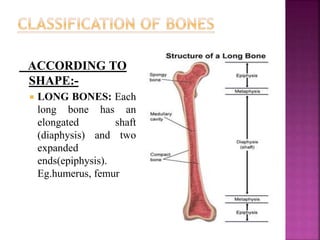
 LONG BONES: Each
long bone has an
elongated shaft
(diaphysis) and two
expanded
ends(epiphysis).
Eg.humerus, femur
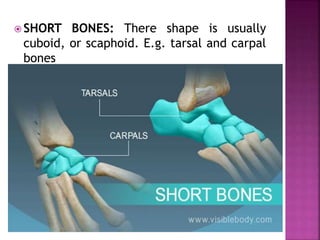
 SHORT BONES: There shape is usually
cuboid, or scaphoid. E.g. tarsal and carpal
bones
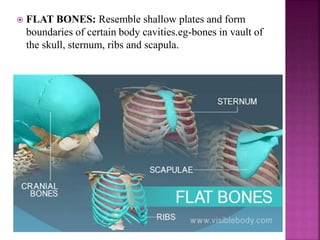
 FLAT BONES: Resemble shallow plates and form
boundaries of certain body cavities.eg-bones in vault of
the skull, sternum, ribs and scapula.
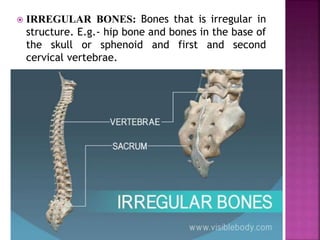
 IRREGULAR BONES: Bones that is irregular in
structure. E.g.- hip bone and bones in the base of
the skull or sphenoid and first and second
cervical vertebrae.
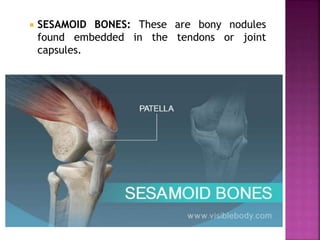
 SESAMOID BONES: These are bony nodules
found embedded in the tendons or joint
capsules.
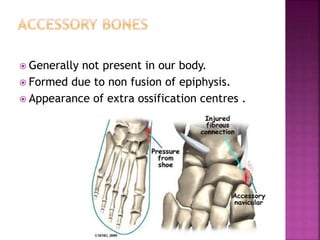
 Generally not present in our body.
 Formed due to non fusion of epiphysis.
 Appearance of extra ossification centres .
 Axial skeleton
 Appendicular skeleton
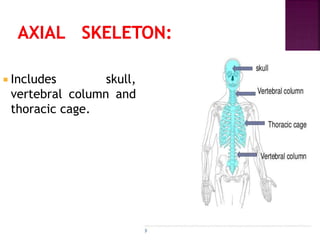
 Includes skull,
vertebral column and
thoracic cage.
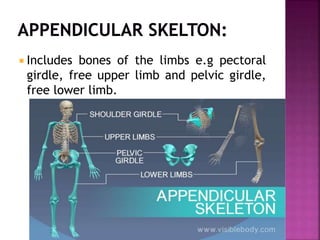
 Includes bones of the limbs e.g pectoral
girdle, free upper limb and pelvic girdle,
free lower limb.
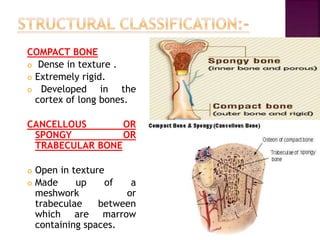
COMPACT BONE
 Dense in texture .
 Extremely rigid.
 Developed in the
cortex of long bones.
CANCELLOUS OR
SPONGY OR
TRABECULAR BONE
 Open in texture
 Made up of a
meshwork or
trabeculae between
which are marrow
containing spaces.
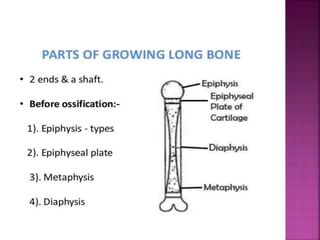
 Epiphysis
 Diaphysis
 Metaphysis
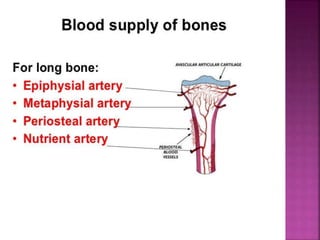
ARTERIAL SUPPLY:
The arterial supply of a long bone is
derived from:
 Nutrient artery:
 Periosteal arteries:
 Epiphyseal arteries:
 Metaphysical arteries:
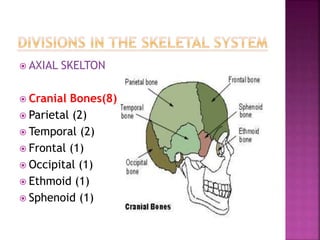
 AXIAL SKELTON
 Cranial Bones(8)
 Parietal (2)
 Temporal (2)
 Frontal (1)
 Occipital (1)
 Ethmoid (1)
 Sphenoid (1)
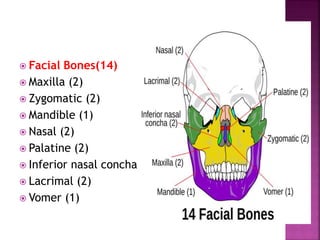
 Facial Bones(14)
 Maxilla (2)
 Zygomatic (2)
 Mandible (1)
 Nasal (2)
 Palatine (2)
 Inferior nasal concha (2)
 Lacrimal (2)
 Vomer (1)
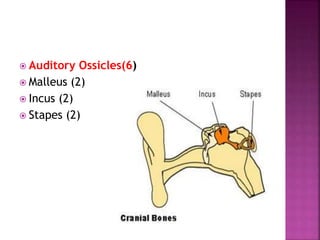
 Auditory Ossicles(6)
 Malleus (2)
 Incus (2)
 Stapes (2)
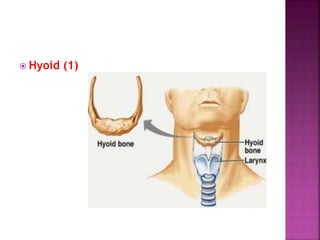
 Hyoid (1)
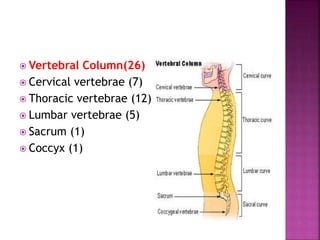
 Vertebral Column(26)
 Cervical vertebrae (7)
 Thoracic vertebrae (12)
 Lumbar vertebrae (5)
 Sacrum (1)
 Coccyx (1)
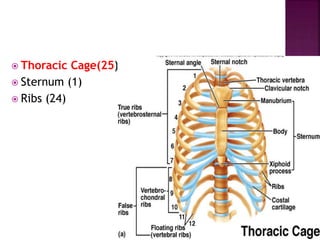
 Thoracic Cage(25)
 Sternum (1)
 Ribs (24)
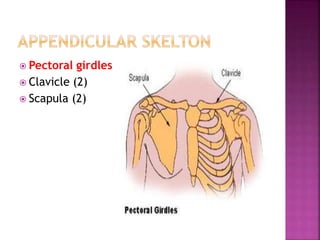
 Pectoral girdles
 Clavicle (2)
 Scapula (2)
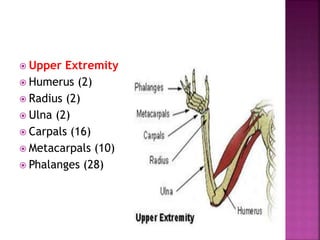
 Upper Extremity
 Humerus (2)
 Radius (2)
 Ulna (2)
 Carpals (16)
 Metacarpals (10)
 Phalanges (28)
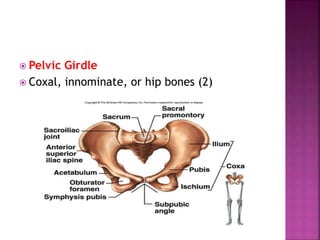
 Pelvic Girdle
 Coxal, innominate, or hip bones (2)
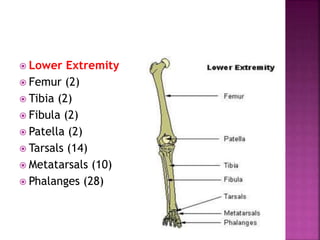
 Lower Extremity
 Femur (2)
 Tibia (2)
 Fibula (2)
 Patella (2)
 Tarsals (14)
 Metatarsals (10)
 Phalanges (28)
JOINTS
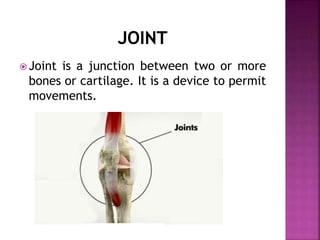
 Joint is a junction between two or more
bones or cartilage. It is a device to permit
movements.
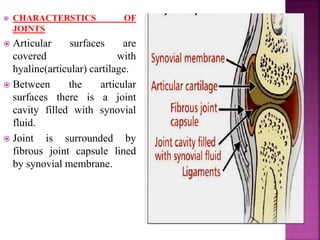
 CHARACTERSTICS OF
JOINTS
 Articular surfaces are
covered with
hyaline(articular) cartilage.
 Between the articular
surfaces there is a joint
cavity filled with synovial
fluid.
 Joint is surrounded by
fibrous joint capsule lined
by synovial membrane.
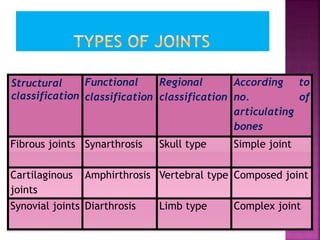
Structural
classification
Functional
classification
Regional
classification
According to
no. of
articulating
bones
Fibrous joints Synarthrosis Skull type Simple joint
Cartilaginous
joints
Amphirthrosis Vertebral type Composed joint
Synovial joints Diarthrosis Limb type Complex joint
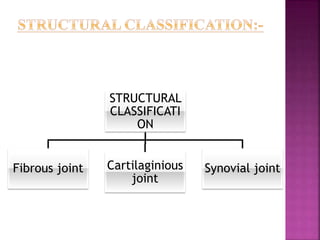
STRUCTURAL
CLASSIFICATI
ON
Fibrous joint Cartilaginious
joint
Synovial joint
FIBROUS JOINTS
 Bones are joined by fibrous tissue.
 Joints are either immovable or permit a slight
degree of movement.
 These can be grouped in the following three
subtypes.
 Sutures
 Syndesmosis
 Gomphosis
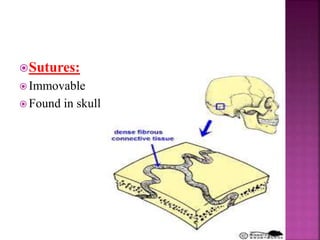
Sutures:
 Immovable
 Found in skull
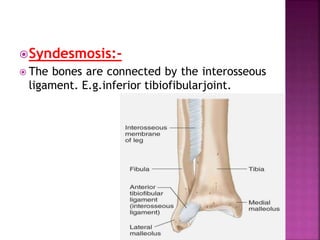
Syndesmosis:-
 The bones are connected by the interosseous
ligament. E.g.inferior tibiofibularjoint.
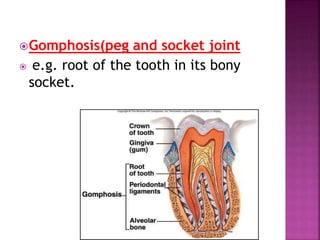
Gomphosis(peg and socket joint
 e.g. root of the tooth in its bony
socket.
CARTILAGINOUS
JOINTS:
CARTILAGINOUS JOINTS:
 In this type of joints the bones are joined by
cartilage.
 These are of the following two types:
 Primary cartilaginous joints (synchondrosis, or
hyaline cartilage joints.
 Secondary cartilaginous joints(Symphyses or
fibrocartilaginous joints):
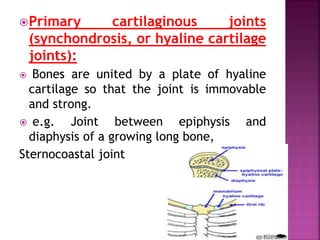
Primary cartilaginous joints
(synchondrosis, or hyaline cartilage
joints):
 Bones are united by a plate of hyaline
cartilage so that the joint is immovable
and strong.
 e.g. Joint between epiphysis and
diaphysis of a growing long bone,
Sternocoastal joint
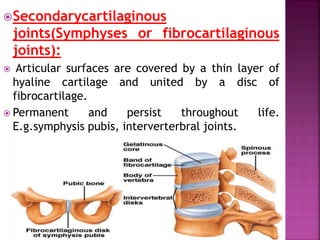
Secondarycartilaginous
joints(Symphyses or fibrocartilaginous
joints):
 Articular surfaces are covered by a thin layer of
hyaline cartilage and united by a disc of
fibrocartilage.
 Permanent and persist throughout life.
E.g.symphysis pubis, interverterbral joints.
SYNOVIAL JOINTS
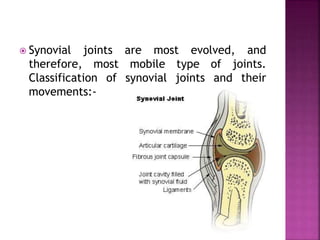
 Synovial joints are most evolved, and
therefore, most mobile type of joints.
Classification of synovial joints and their
movements:-
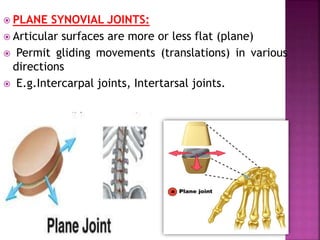
 PLANE SYNOVIAL JOINTS:
 Articular surfaces are more or less flat (plane)
 Permit gliding movements (translations) in various
directions
 E.g.Intercarpal joints, Intertarsal joints.
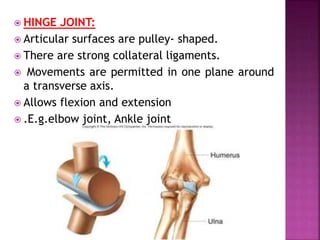
 HINGE JOINT:
 Articular surfaces are pulley- shaped.
 There are strong collateral ligaments.
 Movements are permitted in one plane around
a transverse axis.
 Allows flexion and extension
 .E.g.elbow joint, Ankle joint
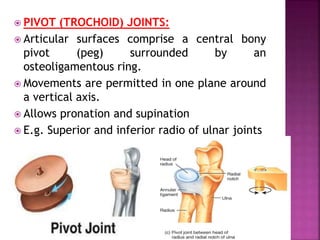
 PIVOT (TROCHOID) JOINTS:
 Articular surfaces comprise a central bony
pivot (peg) surrounded by an
osteoligamentous ring.
 Movements are permitted in one plane around
a vertical axis.
 Allows pronation and supination
 E.g. Superior and inferior radio of ulnar joints
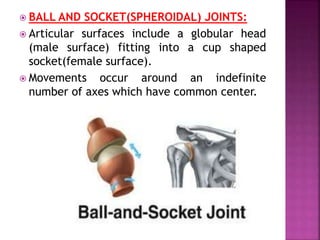
 BALL AND SOCKET(SPHEROIDAL) JOINTS:
 Articular surfaces include a globular head
(male surface) fitting into a cup shaped
socket(female surface).
 Movements occur around an indefinite
number of axes which have common center.
 Flexion, extension, abduction, adduction,
medial rotation, lateral rotation, and
circumduction all occur quite freely. E.g.
Shoulder joint, Hip joint.
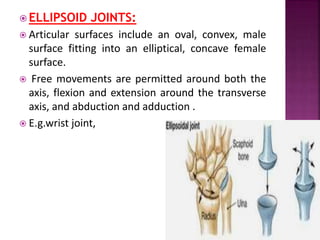
 ELLIPSOID JOINTS:
 Articular surfaces include an oval, convex, male
surface fitting into an elliptical, concave female
surface.
 Free movements are permitted around both the
axis, flexion and extension around the transverse
axis, and abduction and adduction .
 E.g.wrist joint,
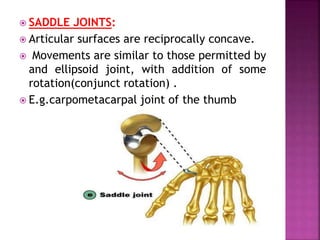
 SADDLE JOINTS:
 Articular surfaces are reciprocally concave.
 Movements are similar to those permitted by
and ellipsoid joint, with addition of some
rotation(conjunct rotation) .
 E.g.carpometacarpal joint of the thumb
FUNCTIONAL
CLASSIFICATION (ACCORDING
TO THE DEGREE OF
MOBILITY)
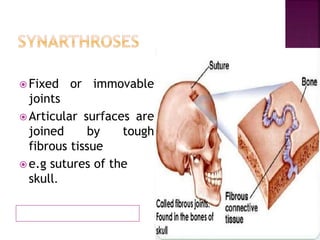
 Fixed or immovable
joints
 Articular surfaces are
joined by tough
fibrous tissue
 e.g sutures of the
skull.
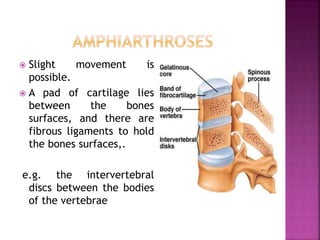
 Slight movement is
possible.
 A pad of cartilage lies
between the bones
surfaces, and there are
fibrous ligaments to hold
the bones surfaces,.
e.g. the intervertebral
discs between the bodies
of the vertebrae
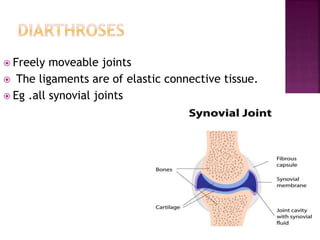
 Freely moveable joints
 The ligaments are of elastic connective tissue.
 Eg .all synovial joints
REGIONAL
CLASSIFICATION
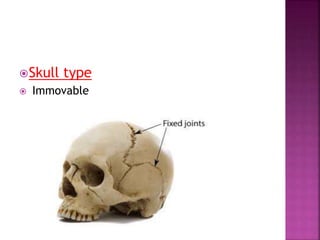
Skull type
 Immovable
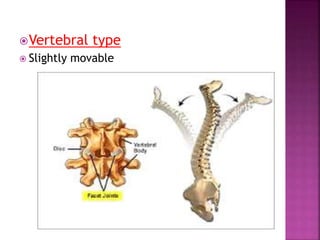
Vertebral type
 Slightly movable
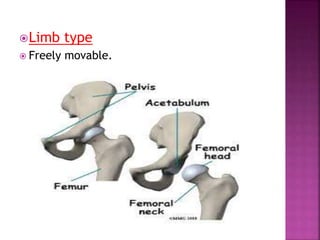
Limb type
 Freely movable.
ACCORDING TO NUMBER
OF ARTICULATING
BONES:-
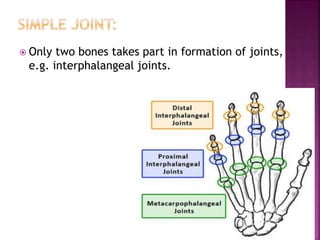
 Only two bones takes part in formation of joints,
e.g. interphalangeal joints.
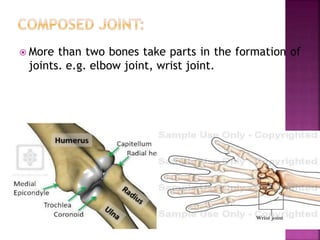
 More than two bones take parts in the formation of
joints. e.g. elbow joint, wrist joint.
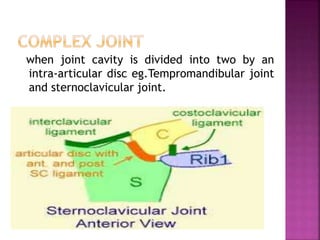
when joint cavity is divided into two by an
intra-articular disc eg.Tempromandibular joint
and sternoclavicular joint.
MUSCLES
 Muscles are group of specialised contractile
cells, also called “FIBRES”. Its function is to
produce force and cause motion, either
locomotion or movement within internal
organs
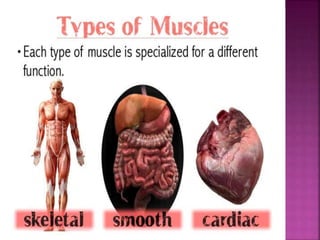
 Skeletal muscle
 Cardiac muscle
 Smooth muscle
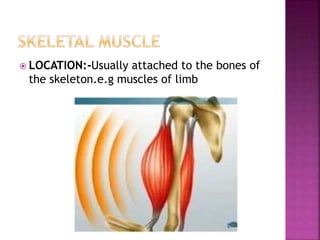
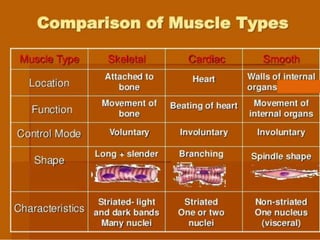
 LOCATION:-Usually attached to the bones of
the skeleton.e.g muscles of limb
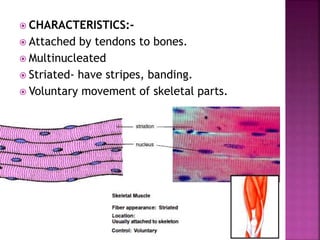
 CHARACTERISTICS:-
 Attached by tendons to bones.
 Multinucleated
 Striated- have stripes, banding.
 Voluntary movement of skeletal parts.
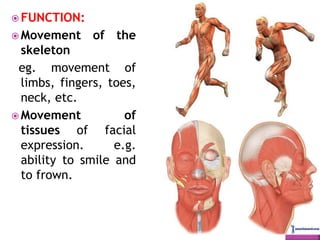
 FUNCTION:
 Movement of the
skeleton
eg. movement of
limbs, fingers, toes,
neck, etc.
 Movement of
tissues of facial
expression. e.g.
ability to smile and
to frown.
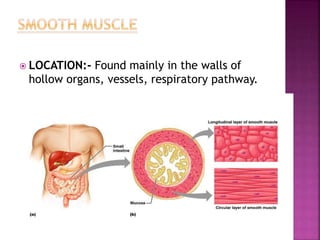
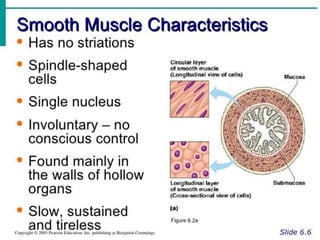
 LOCATION:- Found mainly in the walls of
hollow organs, vessels, respiratory pathway.
 Function:
 Digestive system- to move food along the
gastrointestinal tract .
 Regulating the diameter of blood vessels and parts
of respiratory tract.
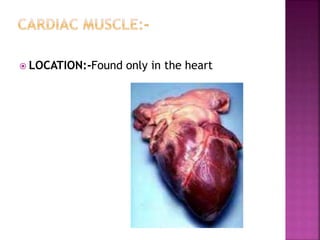
 LOCATION:-Found only in the heart
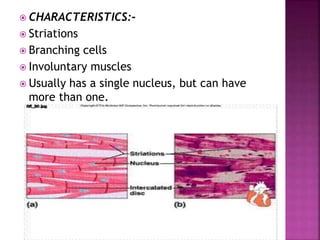
 CHARACTERISTICS:-
 Striations
 Branching cells
 Involuntary muscles
 Usually has a single nucleus, but can have
more than one.
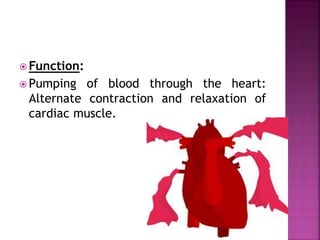
 Function:
 Pumping of blood through the heart:
Alternate contraction and relaxation of
cardiac muscle.
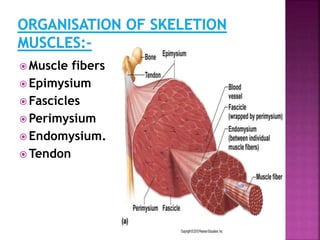
 Muscle fibers
 Epimysium
 Fascicles
 Perimysium
 Endomysium.
 Tendon
Skeletal
muscle
fiber (cell)
endomysium
perimysium
Skeletal
muscle
Surrounded by
epimysium
epimysium
 Muscles are the organs that move body parts.
Your muscular system does lots of important
jobs. It helps you move, pumps your blood,
helps you digest food and even helps you
breathe.
1) Compare different types of muscles.
2)Classify different types of joints.
 Khurana Indu and Arushi. Texbook of Anatomy
and Physiology for Nurses and Allied Health
Sciences. 1 edition. CBC publishers; 121-35.
 Derrickson Bryan H., Tortora Gerard S.
Principles of Anatomy and Physiology. 12
edition; vol-1. Asia 2009; 302-28.
 Wilson and Ross. Anatomy and Physiology in
Health and Illness. 10 editions. Published by
Elsevier.2009; 415-25.

Bones, muscles and joints

  • 1.
  • 2.
     Bone isone-third connective tissue.  It is impregnated with calcium salt.
  • 3.
    Bones give shapeand support to the body, and resist any forms of stress.
  • 4.
     Provides attachmentof muscles, tendons, ligaments.
  • 5.
     The skull,vertebral column and thoracic cage protect brain, spinal cord and thoracic and some abdominal viscera, respectively.
  • 6.
     Bone marrowmanufactures blood cells.
  • 7.
     Bone marrowcontains reticulo endothelial cell which are phagocytic…
  • 8.
     Bone stores97% of the body calcium and phosphorus.
  • 9.
     According toshape  Developmental bones  Regional classification  Structural classification
  • 10.
    ACCORDING TO SHAPE:-  LONGBONES: Each long bone has an elongated shaft (diaphysis) and two expanded ends(epiphysis). Eg.humerus, femur
  • 11.
     SHORT BONES:There shape is usually cuboid, or scaphoid. E.g. tarsal and carpal bones
  • 12.
     FLAT BONES:Resemble shallow plates and form boundaries of certain body cavities.eg-bones in vault of the skull, sternum, ribs and scapula.
  • 13.
     IRREGULAR BONES:Bones that is irregular in structure. E.g.- hip bone and bones in the base of the skull or sphenoid and first and second cervical vertebrae.
  • 15.
     SESAMOID BONES:These are bony nodules found embedded in the tendons or joint capsules.
  • 16.
     Generally notpresent in our body.  Formed due to non fusion of epiphysis.  Appearance of extra ossification centres .
  • 18.
     Axial skeleton Appendicular skeleton
  • 19.
     Includes skull, vertebralcolumn and thoracic cage.
  • 20.
     Includes bonesof the limbs e.g pectoral girdle, free upper limb and pelvic girdle, free lower limb.
  • 21.
    COMPACT BONE  Densein texture .  Extremely rigid.  Developed in the cortex of long bones. CANCELLOUS OR SPONGY OR TRABECULAR BONE  Open in texture  Made up of a meshwork or trabeculae between which are marrow containing spaces.
  • 22.
  • 24.
    ARTERIAL SUPPLY: The arterialsupply of a long bone is derived from:  Nutrient artery:  Periosteal arteries:  Epiphyseal arteries:  Metaphysical arteries:
  • 26.
     AXIAL SKELTON Cranial Bones(8)  Parietal (2)  Temporal (2)  Frontal (1)  Occipital (1)  Ethmoid (1)  Sphenoid (1)
  • 27.
     Facial Bones(14) Maxilla (2)  Zygomatic (2)  Mandible (1)  Nasal (2)  Palatine (2)  Inferior nasal concha (2)  Lacrimal (2)  Vomer (1)
  • 28.
     Auditory Ossicles(6) Malleus (2)  Incus (2)  Stapes (2)
  • 29.
  • 30.
     Vertebral Column(26) Cervical vertebrae (7)  Thoracic vertebrae (12)  Lumbar vertebrae (5)  Sacrum (1)  Coccyx (1)
  • 31.
     Thoracic Cage(25) Sternum (1)  Ribs (24)
  • 32.
     Pectoral girdles Clavicle (2)  Scapula (2)
  • 33.
     Upper Extremity Humerus (2)  Radius (2)  Ulna (2)  Carpals (16)  Metacarpals (10)  Phalanges (28)
  • 34.
     Pelvic Girdle Coxal, innominate, or hip bones (2)
  • 35.
     Lower Extremity Femur (2)  Tibia (2)  Fibula (2)  Patella (2)  Tarsals (14)  Metatarsals (10)  Phalanges (28)
  • 36.
  • 37.
     Joint isa junction between two or more bones or cartilage. It is a device to permit movements.
  • 38.
     CHARACTERSTICS OF JOINTS Articular surfaces are covered with hyaline(articular) cartilage.  Between the articular surfaces there is a joint cavity filled with synovial fluid.  Joint is surrounded by fibrous joint capsule lined by synovial membrane.
  • 39.
    Structural classification Functional classification Regional classification According to no. of articulating bones Fibrousjoints Synarthrosis Skull type Simple joint Cartilaginous joints Amphirthrosis Vertebral type Composed joint Synovial joints Diarthrosis Limb type Complex joint
  • 40.
  • 41.
  • 42.
     Bones arejoined by fibrous tissue.  Joints are either immovable or permit a slight degree of movement.  These can be grouped in the following three subtypes.  Sutures  Syndesmosis  Gomphosis
  • 43.
  • 44.
    Syndesmosis:-  The bonesare connected by the interosseous ligament. E.g.inferior tibiofibularjoint.
  • 45.
    Gomphosis(peg and socketjoint  e.g. root of the tooth in its bony socket.
  • 46.
  • 47.
    CARTILAGINOUS JOINTS:  Inthis type of joints the bones are joined by cartilage.  These are of the following two types:  Primary cartilaginous joints (synchondrosis, or hyaline cartilage joints.  Secondary cartilaginous joints(Symphyses or fibrocartilaginous joints):
  • 48.
    Primary cartilaginous joints (synchondrosis,or hyaline cartilage joints):  Bones are united by a plate of hyaline cartilage so that the joint is immovable and strong.  e.g. Joint between epiphysis and diaphysis of a growing long bone, Sternocoastal joint
  • 49.
    Secondarycartilaginous joints(Symphyses or fibrocartilaginous joints): Articular surfaces are covered by a thin layer of hyaline cartilage and united by a disc of fibrocartilage.  Permanent and persist throughout life. E.g.symphysis pubis, interverterbral joints.
  • 50.
  • 51.
     Synovial jointsare most evolved, and therefore, most mobile type of joints. Classification of synovial joints and their movements:-
  • 52.
     PLANE SYNOVIALJOINTS:  Articular surfaces are more or less flat (plane)  Permit gliding movements (translations) in various directions  E.g.Intercarpal joints, Intertarsal joints.
  • 53.
     HINGE JOINT: Articular surfaces are pulley- shaped.  There are strong collateral ligaments.  Movements are permitted in one plane around a transverse axis.  Allows flexion and extension  .E.g.elbow joint, Ankle joint
  • 54.
     PIVOT (TROCHOID)JOINTS:  Articular surfaces comprise a central bony pivot (peg) surrounded by an osteoligamentous ring.  Movements are permitted in one plane around a vertical axis.  Allows pronation and supination  E.g. Superior and inferior radio of ulnar joints
  • 55.
     BALL ANDSOCKET(SPHEROIDAL) JOINTS:  Articular surfaces include a globular head (male surface) fitting into a cup shaped socket(female surface).  Movements occur around an indefinite number of axes which have common center.
  • 56.
     Flexion, extension,abduction, adduction, medial rotation, lateral rotation, and circumduction all occur quite freely. E.g. Shoulder joint, Hip joint.
  • 57.
     ELLIPSOID JOINTS: Articular surfaces include an oval, convex, male surface fitting into an elliptical, concave female surface.  Free movements are permitted around both the axis, flexion and extension around the transverse axis, and abduction and adduction .  E.g.wrist joint,
  • 58.
     SADDLE JOINTS: Articular surfaces are reciprocally concave.  Movements are similar to those permitted by and ellipsoid joint, with addition of some rotation(conjunct rotation) .  E.g.carpometacarpal joint of the thumb
  • 59.
  • 60.
     Fixed orimmovable joints  Articular surfaces are joined by tough fibrous tissue  e.g sutures of the skull.
  • 61.
     Slight movementis possible.  A pad of cartilage lies between the bones surfaces, and there are fibrous ligaments to hold the bones surfaces,. e.g. the intervertebral discs between the bodies of the vertebrae
  • 62.
     Freely moveablejoints  The ligaments are of elastic connective tissue.  Eg .all synovial joints
  • 63.
  • 64.
  • 65.
  • 66.
  • 67.
    ACCORDING TO NUMBER OFARTICULATING BONES:-
  • 68.
     Only twobones takes part in formation of joints, e.g. interphalangeal joints.
  • 69.
     More thantwo bones take parts in the formation of joints. e.g. elbow joint, wrist joint.
  • 70.
    when joint cavityis divided into two by an intra-articular disc eg.Tempromandibular joint and sternoclavicular joint.
  • 71.
  • 72.
     Muscles aregroup of specialised contractile cells, also called “FIBRES”. Its function is to produce force and cause motion, either locomotion or movement within internal organs
  • 73.
     Skeletal muscle Cardiac muscle  Smooth muscle
  • 75.
     LOCATION:-Usually attachedto the bones of the skeleton.e.g muscles of limb
  • 76.
     CHARACTERISTICS:-  Attachedby tendons to bones.  Multinucleated  Striated- have stripes, banding.  Voluntary movement of skeletal parts.
  • 77.
     FUNCTION:  Movementof the skeleton eg. movement of limbs, fingers, toes, neck, etc.  Movement of tissues of facial expression. e.g. ability to smile and to frown.
  • 78.
     LOCATION:- Foundmainly in the walls of hollow organs, vessels, respiratory pathway.
  • 80.
     Function:  Digestivesystem- to move food along the gastrointestinal tract .  Regulating the diameter of blood vessels and parts of respiratory tract.
  • 81.
  • 82.
     CHARACTERISTICS:-  Striations Branching cells  Involuntary muscles  Usually has a single nucleus, but can have more than one.
  • 83.
     Function:  Pumpingof blood through the heart: Alternate contraction and relaxation of cardiac muscle.
  • 86.
     Muscle fibers Epimysium  Fascicles  Perimysium  Endomysium.  Tendon Skeletal muscle fiber (cell) endomysium perimysium Skeletal muscle Surrounded by epimysium epimysium
  • 96.
     Muscles arethe organs that move body parts. Your muscular system does lots of important jobs. It helps you move, pumps your blood, helps you digest food and even helps you breathe.
  • 97.
    1) Compare differenttypes of muscles. 2)Classify different types of joints.
  • 99.
     Khurana Induand Arushi. Texbook of Anatomy and Physiology for Nurses and Allied Health Sciences. 1 edition. CBC publishers; 121-35.  Derrickson Bryan H., Tortora Gerard S. Principles of Anatomy and Physiology. 12 edition; vol-1. Asia 2009; 302-28.  Wilson and Ross. Anatomy and Physiology in Health and Illness. 10 editions. Published by Elsevier.2009; 415-25.