Arterial Blood Gas  Analysis   …..1 Dr  Satish Deopujari Pediatrician Hon. Prof. ( Pediatrics) JNMC Chairman National Intensive care chapter Indian academy of pediatrics [email_address] Visit us at…. http://rdsoxy.org No click
The Goal : To provide  Bedside  approach to  ABG analysis No click
H  ION  CONC. N.MOLS / L. pH 20  7.70 30  7.52 40  7.40 50  7.30 60  7.22 H  ION OH  ION 0 14 pH stand for "power of hydrogen"  H +  = 80 - last two digits of pH Don’t  click wait …..till  Last message ……..  “H = 80-last two digits of pH”
Bicarbonate: No click  Henderson - Hasselbach equation: pH = pK + Log  HCO3 Dissolved  CO2
Standard Bicarbonate: Plasma HCO 3  after equilibration to a PaCO 2  of 40 mm Hg : Reflects non-respiratory acid base change : No quantification of  the extent of the buffer  base abnormality  Base Excess:     base to normalise HCO 3  (to 24) with PaCO 2  at 40 mm Hg (Sigaard-Andersen) : Reflects metabolic part of acid base   : No info. over that derived from pH,  pCO 2  and HCO 3 : Misinterpreted in chronic or mixed disorders No click
Oxygenation  Indices: O 2  Content of blood: Hb. x O 2  Sat  + Dissolved O 2 (Don’t forget hemoglobin) Oxygen Saturation: reported as ABG report ( Derived from oxygen dis. curve not a measured value ) Alveolar / arterial gradient: ( Useful … to classify respiratory failure ) No click
0  10  20  30  40  50  60  70  80  90  100  PaO 2 20 40 60 80 100 Rt. Shift Normal arterio/venous difference  Shift of the curve ……changes  saturation for a given PaO 2 Normal No click  Oxygen delivered to tissues  with normally placed curve Delivered oxygen  with Rt. Shift curve
Alveolar-arterial Difference Inspired O 2  =  21 %  p i O 2  = (760-45) x . 21  =  150 mmHg O 2 CO 2 p alv O 2 = p i O 2   –  pCO 2  / RQ = 150 – 40 / 0.8 = 150 – 50 =  100 mm Hg PaO 2  = 90 mmHg p alv O 2   –   p art O 2   = 10 mmHg  One click and wait
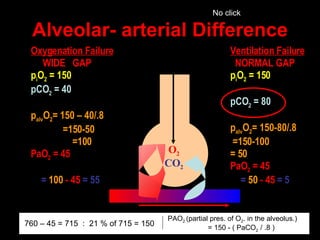
Alveolar- arterial Difference O 2 CO 2 Oxygenation Failure WIDE  GAP p i O 2  = 150 pCO 2  = 40 p alv O 2 = 150 – 40/.8 =150-50   =100 PaO 2  = 45    =   100  - 45   = 55   Ventilation Failure NORMAL GAP p i O 2  = 150 pCO 2  = 80 p alv O 2 = 150-80/.8 =150-100 = 50 PaO 2  = 45    =   50  - 45  = 5 PAO 2  (partial pres. of O 2 . in the alveolus.) = 150 - ( PaCO 2  / .8 ) 760 – 45 = 715  :  21 % of 715 = 150 No click
20  × 5 = 100 Expected  PaO 2   =  FiO 2   × 5 = PaO 2 Normal situation  No click
The Blood Gas Report: normals… pH  7.40  +  0.05 PaCO 2   40  +  5 mm Hg PaO 2   80 - 100 mm Hg HCO 3 24  +  4 mmol/L O2 Sat >95 Always mention and see  FIO2  The essentials HCO3 No click
5 The Steps  for Successful Blood Gas Analysis No click
Step 2  Who is responsible for this change in pH ( culprit )? CO 2  will change pH in opposite direction Bicarb. will change pH in same direction Acidemia:   With HCO 3  < 20 mmol/L = metabolic With PCO 2   >45  mm hg = respiratory Alkalemia: With HCO 3  >28 mmol/L = metabolic With PCO 2  <35 mm Hg  = respiratory Step 1 Look at the pH Is the patient  acidemic  pH < 7.35 or alkalemic pH   > 7.45
Step 3 If there is a primary respiratory disturbance, is it acute ? .08 change in pH ( Acute ) .03 change in pH ( Chronic ) 10 mm  Change  PaCO 2 = No click
Step 4 If the disturbance is metabolic is the respiratory compensation appropriate? For metabolic acidosis: Expected  PaCO 2  = (1.5 x [HCO 3 ]) + 8 )  +  2 or simply… expected PaCO 2  = last two digits of pH For metabolic alkalosis: Expected  PaCO 2  = 6 mm for 10 mEq. rise in Bicarb.  Suspect if ............. actual PaCO 2  is more than expected : additional  … respiratory acidosis actual PaCO 2  is less than expected : additional  … respiratory alkalosis No click
Step 4 cont. If there is metabolic acidosis, is there a wide anion gap ? Na - (Cl - + HCO 3 - ) = Anion Gap usually <12 If >12,  Anion Gap Acidosis :  M  ethanol U  remia D  iabetic Ketoacidosis P  araldehyde I  nfection (lactic acid) E  thylene Glycol S  alicylate Common pediatric causes Lactic acidosis 2)  Metabolic disorders 3)  Renal failure  No click
th step Clinical correlation 5 No click
HCO3  META. pH PaCO 2 pH RESP. Same direction Opposite direction Same direction No click
Remember the format  pH PaCO 2 PaO 2 No click
Primary lesion Primary lesion Compensation pH Bicarbonate  PaCO 2 METABOLIC ACIDOSIS HYPER VENTILATION BICARB  CHANGES  pH in same direction Low  Alkali Three clicks
Primary lesion Compensation pH Bicarbonate PaCO 2 METABOLIC ALKALOSIS HYPO  VENTILATION BICARB  CHANGES  pH in same direction High  Alkali Three clicks
Primary lesion compensation pH PaCO  2 BICARB Respiratory acidosis CO  2   CHANGES  pH in opposite  direction High CO 2 Three clicks Wait for  red  circle
pH CO2+H20=H2CO3 =   H   + HCO3 + HCO3 HCO3 RESP. ACIDOSIS ALKALOSIS  META. PCO2 HIGH H HIGH  HCO3  + four clicks ACUTE  RISE  :  PCO2 10 :  pH  .08 CHRONIC  RISE  :  PCO2 10 :  pH  .03
Primary lesion Primary lesion compensation pH PaCO  2 BICARB Respiratory alkalosis PaCO  2   CHANGES  pH in opposite  direction Low PaCO 2 Three clicks Wait for  red  circle
CO2 + H20 = H2CO3 =   H   +   HCO3 + pH SERUM HCO3 LOW  H  IONS   …LOW  HCO3 RESP. ALK. ACID. META. CO2 + Bicarbonate Six clicks
PaCO 2   of  10 pH Acute change  .08 Chronic change .03 No click
INTERPRETATION  OF  A.B.G. FOUR STEP METHOD OF  DEOSAT LOOK FOR pH WHO IS THE CULPRIT ? IF RESPIRATORY ACUTE / CHRONIC ? IF METABOLIC / COMP. / ANION GAP CLINICAL CORRELATION No click
compensation considered  complete  when the pH returns to  normal  range Clinical blood gases  by  Malley No click
COMPENSION  LIMITS METABLIC  ACIDOSIS PaCO2 = Up to 10 ? METABOLIC  ALKALOSIS PaCO2 = Maximum 6O RESPIRATORY  ACIDOSIS BICARB = Maximum 40 RESPIRATORY  ALKALOSIS BICARB = Up to 10 No click
Blood  Gas  Report Measured 37.0 o   C pH 7.523 PaCO 2 30.1  mm Hg PaO 2 105.3 mm Hg Calculated  Data HCO 3   act 22  mmol / L O 2  Sat 98.3 % PO 2  (A - a) 8 mm Hg   PO 2  (a / A) 0.93 Entered  Data FiO 2 21.0 % Case 1 16 year old female with sudden onset of dyspnea.  No Cough or Chest Pain Vitals normal but RR 56, anxious. One  click  for answer Acute respiratory alkalosis  And why acute ?
Case 2   6 year old male with progressive respiratory distress  Muscular dystrophy . Blood  Gas  Report Measured 37.0 o   C pH 7.301 PaCO 2 76.2  mm Hg PaO 2 45.5 mm Hg Calculated  Data HCO 3   act 35.1  mmol / L O 2  Sat 78 % PO 2  (A - a) 9.5 mm Hg   PO 2  (a / A) 0.83 Entered  Data FiO 2 21 %    CO 2  =76-40=36 Expected    pH for ( Acute ) = .08 for 10 Expected ( Acute ) pH = 7.40 - 0.29=7.11 Chronic resp. acidosis Hypoventilation   Chronic respiratory acidosis With hypoxia due to hypoventilation Five  clicks pH <7.35 :acidemia Res. Acidemia  : High  PaCO 2   and low pH Hypoxemia Normal A-a gradient
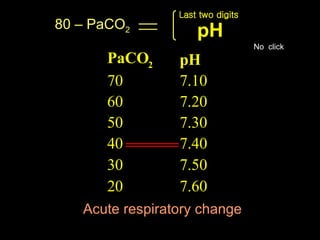
7.60   20   7.50   30   7.40 40 7.30 50 7.20 60 7.10 70 pH PaCO 2 Acute respiratory change No  click Last two digits  pH 80 – PaCO 2
Case 3 8-year-old male asthmatic; 3 days of cough, dyspnea and orthopnea not responding to usual bronchodilators. O/E: Respiratory distress; suprasternal and  intercostal retraction; tired looking; on 4 L NC. p i O 2  = 715x.3=214.5  /  p alv O 2  = 214-49/.8=153  Wide A / a gradient     CO 2  = 49 - 40 = 9 Expected    pH ( Acute ) = 9/10 x 0.08 = 0.072 Expected pH ( Acute ) = 7.40 - 0.072 = 7.328 Acute resp. acidosis 8-year-old male asthmatic with resp. distress Six  clicks Blood  Gas  Report Measured 37.0 o   C pH 7. 24 PaCO 2 49.1  mm Hg PaO 2 66.3 mm Hg Calculated  Data HCO 3   act 18.0  mmol / L O2 Sat 92 % PO 2  (A - a) mm Hg   PO 2  (a / A) Entered  Data FiO 2 30 % 153-66= 87 pH <7.35 ; acidemia PaCO 2  >45; respiratory acidemia Hypoxia WITH INCREASE IN CO2 BICARB  MUST RISE ? Bicarbonate is low………  Metabolic acidosis + respiratory acidosis  30  × 5 = 150
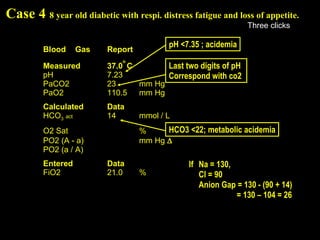
Case 4  8 year old diabetic with respi. distress fatigue and loss of appetite. Blood  Gas  Report Measured 37.0 o   C pH 7.23 PaCO2 23  mm Hg PaO2 110.5 mm Hg Calculated  Data HCO 3   act 14  mmol / L O2 Sat % PO2 (A - a) mm Hg   PO2 (a / A) Entered  Data FiO2 21.0 % If  Na = 130,  Cl = 90 Anion Gap = 130 - (90 + 14) = 130 – 104 = 26 Three clicks pH <7.35 ; acidemia HCO3 <22; metabolic acidemia Last two digits of pH Correspond with co2
Blood  Gas  Report Measured 37.0 o   C pH 7.46 PaCO2 28.1  mm Hg PaO2 55.3 mm Hg Calculated  Data HCO 3   act 19.2  mmol / L O2 Sat % PO2 (A - a) mm Hg   PO2 (a / A) Entered  Data FiO2 24.0 % Case 5 :  10 year old child with encephalitis BICARBINATURIA Four clicks pH almost within normal range Mild alkalosis  PaCO 2  is low  , respiratory low by around 10  ( Acute )  by .08  (Chronic ) by .03 Bicarb  looks low ? Is it expected ?
These findings are most consistent with….    a) Metabolic acidosis with compensatory Hypocapnia.    b) Primary metabolic acidosis with  respiratory alkalosis.    c) Acute respiratory alkalosis fully compensated.    d) Chronic respiratory alkalosis fully compensated.  pH 7.39  PCO 2  l5mmHg  HCO 3  8mmol/L  PaO 2  90 mmHg For metabolic acidosis:  FULL COMPENSATION Expected  PaCO 2  = (1.5 x [HCO3]) + 8 )  +  2 (Winter’s equation) PCO  2  ……SHOULD BE 20 Case  6…………. One click
Adolescent boy with appendicitis , posted for surgery , he is a known  case of SLE. His pre-op ABG shows : Room air  pH 7.39  pCO 2   l5mmHg  paO 2   90 mmHg HCO 3   8mmol/L These findings are most consistent with….    a) Metabolic acidosis with compensatory Hypocapnia.    b) Primary metabolic acidosis with  respiratory alkalosis.  c) Acute respiratory alkalosis fully compensated.  d) Chronic respiratory alkalosis fully compensated.  What is the probable cause for the above findings ? Are they OK  as far as oxygenation is concerned ?  Case 7………. No click
Patient was hypo volumic , received Normal Saline bolus...  Corrected acidosis He was operated ….but post-op became drowsy  His ABG…….. FiO 2 ….30% pH  7.38 PaCO 2  38 PaO 2  60 1) Why hypoxemia ? 2) Were the lungs bad to begin with ? ( Pre OP  PaO 2   90 mmHg ) 3) Micro atelectesis during surgery ? Anesthetist goofed up the case  4) Pure and simple hypoventilation …..Sedation ?  No  click
Why hypoxemia ? Lungs were bad to begin with ? Micro atelectesis during surgery Pure and simple hypoventilation ? sedation  PRE OP ….ABG on room air pH 7.39  PaCO 2  l5mmHg  PaO 2  90 mmHg HCO 3  8mmol/L Pre OP .....A/a gradient  p alv O 2 = P i O 2  – PaCO 2  / RQ = 150 – 15 / 0.8 = 150 – 18 =  132 mm Hg 132 – 90=  42  WIDE  A / a gradient Oxygenation status good …..? One click
Apparently the lungs looked good  with PaO 2  of 90……. But have a good look at the ABG again  With  wash out of CO  2  ………. The expected PaO 2  should have been more than 90 . This coupled with correction of acidosis ( normalizing PaCO 2  ) Lowered the PaO 2  …post operatively. Conclusion ……..  Lungs were not normal to begin with ( SLE )…….. No click
Correlate PaO 2  with FiO 2   But please also correlate with  PaCO 2 Learning point No click
Respiratory  Alkalosis Is it acute ? Case  8,,,,,,,,,,,,,,,,,, pH  7.583 PCO2  19.8 HCO3  18.7 What is the  Diagnosis Click for answer
THANKS Bicarb. pH CO2

Abg Made Easy

  • 1.
    Arterial Blood Gas Analysis …..1 Dr Satish Deopujari Pediatrician Hon. Prof. ( Pediatrics) JNMC Chairman National Intensive care chapter Indian academy of pediatrics [email_address] Visit us at…. http://rdsoxy.org No click
  • 2.
    The Goal :To provide Bedside approach to ABG analysis No click
  • 3.
    H ION CONC. N.MOLS / L. pH 20 7.70 30 7.52 40 7.40 50 7.30 60 7.22 H ION OH ION 0 14 pH stand for &quot;power of hydrogen&quot; H + = 80 - last two digits of pH Don’t click wait …..till Last message …….. “H = 80-last two digits of pH”
  • 4.
    Bicarbonate: No click Henderson - Hasselbach equation: pH = pK + Log HCO3 Dissolved CO2
  • 5.
    Standard Bicarbonate: PlasmaHCO 3 after equilibration to a PaCO 2 of 40 mm Hg : Reflects non-respiratory acid base change : No quantification of the extent of the buffer base abnormality Base Excess:  base to normalise HCO 3 (to 24) with PaCO 2 at 40 mm Hg (Sigaard-Andersen) : Reflects metabolic part of acid base  : No info. over that derived from pH, pCO 2 and HCO 3 : Misinterpreted in chronic or mixed disorders No click
  • 6.
    Oxygenation Indices:O 2 Content of blood: Hb. x O 2 Sat + Dissolved O 2 (Don’t forget hemoglobin) Oxygen Saturation: reported as ABG report ( Derived from oxygen dis. curve not a measured value ) Alveolar / arterial gradient: ( Useful … to classify respiratory failure ) No click
  • 7.
    0 10 20 30 40 50 60 70 80 90 100 PaO 2 20 40 60 80 100 Rt. Shift Normal arterio/venous difference Shift of the curve ……changes saturation for a given PaO 2 Normal No click Oxygen delivered to tissues with normally placed curve Delivered oxygen with Rt. Shift curve
  • 8.
    Alveolar-arterial Difference InspiredO 2 = 21 % p i O 2 = (760-45) x . 21 = 150 mmHg O 2 CO 2 p alv O 2 = p i O 2 – pCO 2 / RQ = 150 – 40 / 0.8 = 150 – 50 = 100 mm Hg PaO 2 = 90 mmHg p alv O 2 – p art O 2 = 10 mmHg One click and wait
  • 9.
    Alveolar- arterial DifferenceO 2 CO 2 Oxygenation Failure WIDE GAP p i O 2 = 150 pCO 2 = 40 p alv O 2 = 150 – 40/.8 =150-50 =100 PaO 2 = 45  = 100 - 45 = 55 Ventilation Failure NORMAL GAP p i O 2 = 150 pCO 2 = 80 p alv O 2 = 150-80/.8 =150-100 = 50 PaO 2 = 45  = 50 - 45 = 5 PAO 2 (partial pres. of O 2 . in the alveolus.) = 150 - ( PaCO 2 / .8 ) 760 – 45 = 715 : 21 % of 715 = 150 No click
  • 10.
    20 ×5 = 100 Expected PaO 2 = FiO 2 × 5 = PaO 2 Normal situation No click
  • 11.
    The Blood GasReport: normals… pH 7.40 + 0.05 PaCO 2 40 + 5 mm Hg PaO 2 80 - 100 mm Hg HCO 3 24 + 4 mmol/L O2 Sat >95 Always mention and see FIO2 The essentials HCO3 No click
  • 12.
    5 The Steps for Successful Blood Gas Analysis No click
  • 13.
    Step 2 Who is responsible for this change in pH ( culprit )? CO 2 will change pH in opposite direction Bicarb. will change pH in same direction Acidemia: With HCO 3 < 20 mmol/L = metabolic With PCO 2 >45 mm hg = respiratory Alkalemia: With HCO 3 >28 mmol/L = metabolic With PCO 2 <35 mm Hg = respiratory Step 1 Look at the pH Is the patient acidemic pH < 7.35 or alkalemic pH > 7.45
  • 14.
    Step 3 Ifthere is a primary respiratory disturbance, is it acute ? .08 change in pH ( Acute ) .03 change in pH ( Chronic ) 10 mm Change PaCO 2 = No click
  • 15.
    Step 4 Ifthe disturbance is metabolic is the respiratory compensation appropriate? For metabolic acidosis: Expected PaCO 2 = (1.5 x [HCO 3 ]) + 8 ) + 2 or simply… expected PaCO 2 = last two digits of pH For metabolic alkalosis: Expected PaCO 2 = 6 mm for 10 mEq. rise in Bicarb. Suspect if ............. actual PaCO 2 is more than expected : additional … respiratory acidosis actual PaCO 2 is less than expected : additional … respiratory alkalosis No click
  • 16.
    Step 4 cont.If there is metabolic acidosis, is there a wide anion gap ? Na - (Cl - + HCO 3 - ) = Anion Gap usually <12 If >12, Anion Gap Acidosis : M ethanol U remia D iabetic Ketoacidosis P araldehyde I nfection (lactic acid) E thylene Glycol S alicylate Common pediatric causes Lactic acidosis 2) Metabolic disorders 3) Renal failure No click
  • 17.
    th step Clinicalcorrelation 5 No click
  • 18.
    HCO3 META.pH PaCO 2 pH RESP. Same direction Opposite direction Same direction No click
  • 19.
    Remember the format pH PaCO 2 PaO 2 No click
  • 20.
    Primary lesion Primarylesion Compensation pH Bicarbonate PaCO 2 METABOLIC ACIDOSIS HYPER VENTILATION BICARB CHANGES pH in same direction Low Alkali Three clicks
  • 21.
    Primary lesion CompensationpH Bicarbonate PaCO 2 METABOLIC ALKALOSIS HYPO VENTILATION BICARB CHANGES pH in same direction High Alkali Three clicks
  • 22.
    Primary lesion compensationpH PaCO 2 BICARB Respiratory acidosis CO 2 CHANGES pH in opposite direction High CO 2 Three clicks Wait for red circle
  • 23.
    pH CO2+H20=H2CO3 = H + HCO3 + HCO3 HCO3 RESP. ACIDOSIS ALKALOSIS META. PCO2 HIGH H HIGH HCO3 + four clicks ACUTE RISE : PCO2 10 : pH .08 CHRONIC RISE : PCO2 10 : pH .03
  • 24.
    Primary lesion Primarylesion compensation pH PaCO 2 BICARB Respiratory alkalosis PaCO 2 CHANGES pH in opposite direction Low PaCO 2 Three clicks Wait for red circle
  • 25.
    CO2 + H20= H2CO3 = H + HCO3 + pH SERUM HCO3 LOW H IONS …LOW HCO3 RESP. ALK. ACID. META. CO2 + Bicarbonate Six clicks
  • 26.
    PaCO 2 of 10 pH Acute change .08 Chronic change .03 No click
  • 27.
    INTERPRETATION OF A.B.G. FOUR STEP METHOD OF DEOSAT LOOK FOR pH WHO IS THE CULPRIT ? IF RESPIRATORY ACUTE / CHRONIC ? IF METABOLIC / COMP. / ANION GAP CLINICAL CORRELATION No click
  • 28.
    compensation considered complete when the pH returns to normal range Clinical blood gases by Malley No click
  • 29.
    COMPENSION LIMITSMETABLIC ACIDOSIS PaCO2 = Up to 10 ? METABOLIC ALKALOSIS PaCO2 = Maximum 6O RESPIRATORY ACIDOSIS BICARB = Maximum 40 RESPIRATORY ALKALOSIS BICARB = Up to 10 No click
  • 30.
    Blood Gas Report Measured 37.0 o C pH 7.523 PaCO 2 30.1 mm Hg PaO 2 105.3 mm Hg Calculated Data HCO 3 act 22 mmol / L O 2 Sat 98.3 % PO 2 (A - a) 8 mm Hg  PO 2 (a / A) 0.93 Entered Data FiO 2 21.0 % Case 1 16 year old female with sudden onset of dyspnea. No Cough or Chest Pain Vitals normal but RR 56, anxious. One click for answer Acute respiratory alkalosis And why acute ?
  • 31.
    Case 2 6 year old male with progressive respiratory distress Muscular dystrophy . Blood Gas Report Measured 37.0 o C pH 7.301 PaCO 2 76.2 mm Hg PaO 2 45.5 mm Hg Calculated Data HCO 3 act 35.1 mmol / L O 2 Sat 78 % PO 2 (A - a) 9.5 mm Hg  PO 2 (a / A) 0.83 Entered Data FiO 2 21 %  CO 2 =76-40=36 Expected  pH for ( Acute ) = .08 for 10 Expected ( Acute ) pH = 7.40 - 0.29=7.11 Chronic resp. acidosis Hypoventilation Chronic respiratory acidosis With hypoxia due to hypoventilation Five clicks pH <7.35 :acidemia Res. Acidemia : High PaCO 2 and low pH Hypoxemia Normal A-a gradient
  • 32.
    7.60 20 7.50 30 7.40 40 7.30 50 7.20 60 7.10 70 pH PaCO 2 Acute respiratory change No click Last two digits pH 80 – PaCO 2
  • 33.
    Case 3 8-year-oldmale asthmatic; 3 days of cough, dyspnea and orthopnea not responding to usual bronchodilators. O/E: Respiratory distress; suprasternal and intercostal retraction; tired looking; on 4 L NC. p i O 2 = 715x.3=214.5 / p alv O 2 = 214-49/.8=153 Wide A / a gradient  CO 2 = 49 - 40 = 9 Expected  pH ( Acute ) = 9/10 x 0.08 = 0.072 Expected pH ( Acute ) = 7.40 - 0.072 = 7.328 Acute resp. acidosis 8-year-old male asthmatic with resp. distress Six clicks Blood Gas Report Measured 37.0 o C pH 7. 24 PaCO 2 49.1 mm Hg PaO 2 66.3 mm Hg Calculated Data HCO 3 act 18.0 mmol / L O2 Sat 92 % PO 2 (A - a) mm Hg  PO 2 (a / A) Entered Data FiO 2 30 % 153-66= 87 pH <7.35 ; acidemia PaCO 2 >45; respiratory acidemia Hypoxia WITH INCREASE IN CO2 BICARB MUST RISE ? Bicarbonate is low……… Metabolic acidosis + respiratory acidosis 30 × 5 = 150
  • 34.
    Case 4 8 year old diabetic with respi. distress fatigue and loss of appetite. Blood Gas Report Measured 37.0 o C pH 7.23 PaCO2 23 mm Hg PaO2 110.5 mm Hg Calculated Data HCO 3 act 14 mmol / L O2 Sat % PO2 (A - a) mm Hg  PO2 (a / A) Entered Data FiO2 21.0 % If Na = 130, Cl = 90 Anion Gap = 130 - (90 + 14) = 130 – 104 = 26 Three clicks pH <7.35 ; acidemia HCO3 <22; metabolic acidemia Last two digits of pH Correspond with co2
  • 35.
    Blood Gas Report Measured 37.0 o C pH 7.46 PaCO2 28.1 mm Hg PaO2 55.3 mm Hg Calculated Data HCO 3 act 19.2 mmol / L O2 Sat % PO2 (A - a) mm Hg  PO2 (a / A) Entered Data FiO2 24.0 % Case 5 : 10 year old child with encephalitis BICARBINATURIA Four clicks pH almost within normal range Mild alkalosis PaCO 2 is low , respiratory low by around 10 ( Acute ) by .08 (Chronic ) by .03 Bicarb looks low ? Is it expected ?
  • 36.
    These findings aremost consistent with…. a) Metabolic acidosis with compensatory Hypocapnia. b) Primary metabolic acidosis with respiratory alkalosis. c) Acute respiratory alkalosis fully compensated. d) Chronic respiratory alkalosis fully compensated. pH 7.39 PCO 2 l5mmHg HCO 3 8mmol/L PaO 2 90 mmHg For metabolic acidosis: FULL COMPENSATION Expected PaCO 2 = (1.5 x [HCO3]) + 8 ) + 2 (Winter’s equation) PCO 2 ……SHOULD BE 20 Case 6…………. One click
  • 37.
    Adolescent boy withappendicitis , posted for surgery , he is a known case of SLE. His pre-op ABG shows : Room air pH 7.39 pCO 2 l5mmHg paO 2 90 mmHg HCO 3 8mmol/L These findings are most consistent with…. a) Metabolic acidosis with compensatory Hypocapnia. b) Primary metabolic acidosis with respiratory alkalosis. c) Acute respiratory alkalosis fully compensated. d) Chronic respiratory alkalosis fully compensated. What is the probable cause for the above findings ? Are they OK as far as oxygenation is concerned ? Case 7………. No click
  • 38.
    Patient was hypovolumic , received Normal Saline bolus... Corrected acidosis He was operated ….but post-op became drowsy His ABG…….. FiO 2 ….30% pH 7.38 PaCO 2 38 PaO 2 60 1) Why hypoxemia ? 2) Were the lungs bad to begin with ? ( Pre OP PaO 2 90 mmHg ) 3) Micro atelectesis during surgery ? Anesthetist goofed up the case 4) Pure and simple hypoventilation …..Sedation ? No click
  • 39.
    Why hypoxemia ?Lungs were bad to begin with ? Micro atelectesis during surgery Pure and simple hypoventilation ? sedation PRE OP ….ABG on room air pH 7.39 PaCO 2 l5mmHg PaO 2 90 mmHg HCO 3 8mmol/L Pre OP .....A/a gradient p alv O 2 = P i O 2 – PaCO 2 / RQ = 150 – 15 / 0.8 = 150 – 18 = 132 mm Hg 132 – 90= 42 WIDE A / a gradient Oxygenation status good …..? One click
  • 40.
    Apparently the lungslooked good with PaO 2 of 90……. But have a good look at the ABG again With wash out of CO 2 ………. The expected PaO 2 should have been more than 90 . This coupled with correction of acidosis ( normalizing PaCO 2 ) Lowered the PaO 2 …post operatively. Conclusion …….. Lungs were not normal to begin with ( SLE )…….. No click
  • 41.
    Correlate PaO 2 with FiO 2 But please also correlate with PaCO 2 Learning point No click
  • 42.
    Respiratory AlkalosisIs it acute ? Case 8,,,,,,,,,,,,,,,,,, pH 7.583 PCO2 19.8 HCO3 18.7 What is the Diagnosis Click for answer
  • 43.