Acid- Base balance &Imbalance
By
Dr.Nahla Shaaban Khalil
Critical Care And Emergency Nursing Department
Faculty of Nursing
Cairo university
2018
Objectives:
At the end of this lecture all students will be able to:
Define PH ,acid and base.
Discuss how the body regulates acid- base balance.
Identify the main diagnostic tests used to assess acid- base
imbalance.
Identify ABG parameters.
Differentiate between the respiratory and metabolic imbalances
regarding their causes, and clinical manifestations.
Outlines:
Definitions of PH,acid and base.
Regulation of acid-base balance.
Diagnosing acid- base imbalance.
-Arterial blood gases interpretation.
-Anion gap.
Acid base imbalance:
-Respiratory acidosis and alkalosis.
- Metabolic acidosis and alkalosis.
Definitions:
Acids:-are substances that dissociate or lose
ions.
Bases:-are substances capable of accepting
ions.
Buffer :-is substance that reacts with acids and
bases to maintain neutral environment of stable
PH.
PH:-represent the free hydrogen ions
concentration.
Acid base balance :
Equilibrium between the acid and base elements of the
blood and body fluids.
Co2+H20  H2CO3  H+HCO3
One
part
acid
20part
base
=
:Regulation of acid-base balance
The body has three mechanisms to maintain
acid-base balance:
1- Buffering mechanism.
2- The respiratory compensation mechanism.
3-The metabolic or renal compensation
mechanism.
Buffering mechanism:
Acid-base buffer is defined as a solution
containing two or more chemical compounds
that prevent marked change in hydrogen ions.
Buffers act immediately to
trap( H+)temporarily until respiratory and renal
mechanism act. they only minimize the change
in(H+)concentration.
Types of buffer system:-
1- Bicarbonate buffer system.
2- Phosphate buffer system.
3- Protein buffer system.
a- Plasma proteins.
b- Hemoglobin.
C -Tissue proteins.
Protein buffer system:
The plasma proteins in general and hemoglobin in
particular constitute an important buffer system.
It plays an important role in buffering co2
There are about 700gm of hemoglobin in the blood of
an adult person.
Deoxy hemoglobin is better buffer than oxy
hemoglobin.
Co2+H20  H2CO3  H+HCO3
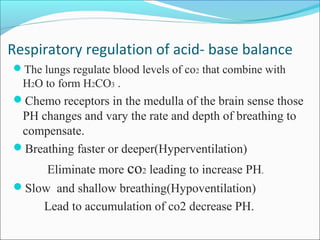
Respiratory regulation of acid- base balance
The lungs regulate blood levels of co2 that combine with
H2O to form H2CO3 .
Chemo receptors in the medulla of the brain sense those
PH changes and vary the rate and depth of breathing to
compensate.
Breathing faster or deeper(Hyperventilation)
Eliminate more co2 leading to increase PH.
Slow and shallow breathing(Hypoventilation)
Lead to accumulation of co2 decrease PH.
Renal regulation of acid-base balance
Kidneys make long- term adjustment to PH.
They reabsorb acids and bases or excrete them into
urine, and can also produce HCO3to replenish lost
supply.
Such adjustment to PH take the kidneys days
to weeks to complete. If the blood contains too
much acids or not enough base, the PH drops
and the kidneys in response reabsorb NaHCO3
and excrete (H+) leading to normalization of PH.
Diagnosis of acid base imbalance:
1-Arterial Blood Gases(ABG).
2-Anion gap estimation.
ABG parameters:
pH [H+
]
PCO2 Partial pressure CO2
PO2 Partial pressure O2
HCO3 Bicarbonate
BE Base excess
SaO2 Oxygen Saturation
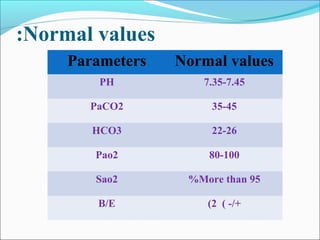
Normal values:
Parameters Normal values
PH 7.35-7.45
PaCO2 35-45
HCO3 22-26
Pao2 80-100
Sao2 %More than 95
B/E ( -/+2(
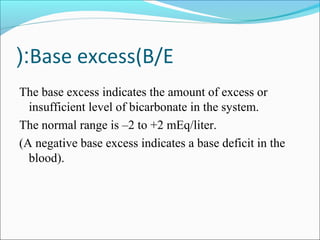
Base excess(B/E(:
The base excess indicates the amount of excess or
insufficient level of bicarbonate in the system.
The normal range is –2 to +2 mEq/liter.
(A negative base excess indicates a base deficit in the
blood).
Arterial Blood Gases Interpretation:.
Anion Gap in Plasma
The difference between measured major positive and negative
charges.
[Na+
] -[Cl-
] - [HCO3-
]
The normal value is (8-14) mEq/L
The sum of measured cations is grater than of measured anions
due to the presence of unmeasured anions (proteins
,phosphates, sulfates, and organic acids as lactic acids, and
ketones acids).
An increased anion gap may be the only clue that metabolic
acidosis is present in a mixed acid-base disorder.
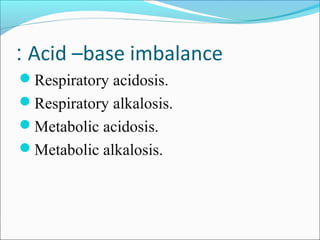
Acid –base imbalance:
Respiratory acidosis.
Respiratory alkalosis.
Metabolic acidosis.
Metabolic alkalosis.
25
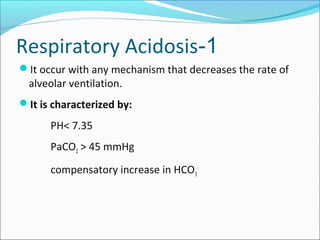
1-Respiratory Acidosis
It occur with any mechanism that decreases the rate of
alveolar ventilation.
It is characterized by:
PH< 7.35
PaCO2 > 45 mmHg
compensatory increase in HCO3
-
Causes of respiratory acidosis:
Depression of respiratory centre:
 Narcotics / over sedation.
 Anesthesia.
 Respiratory arrest.
 Paralysis of respiratory muscles
 Impaired ventilation.
 Airway obstruction:
Foreign body.
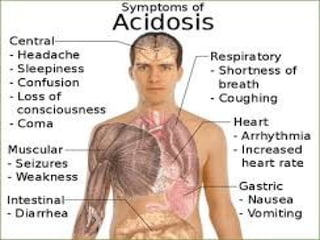
Signs and Symptoms associated with Acidosis:
Decrease excitability of CNS:
 Restlessness,
 Headache,
 Drowsiness,
 Disorientation,
 Coma,
Cardiovascular:
 Dysrhythmias,
 Decreased cardiac contractility
 Hypotension.
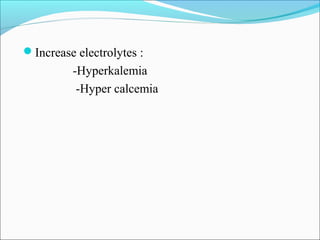
Increase electrolytes :
-Hyperkalemia
-Hyper calcemia
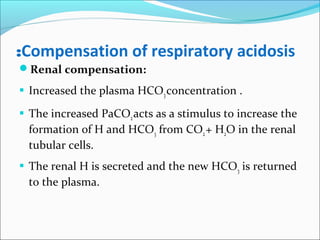
Compensation of respiratory acidosis:
Renal compensation:
 Increased the plasma HCO3concentration .
 The increased PaCO2acts as a stimulus to increase the
formation of H and HCO3 from CO2+ H2O in the renal
tubular cells.
 The renal H is secreted and the new HCO3 is returned
to the plasma.
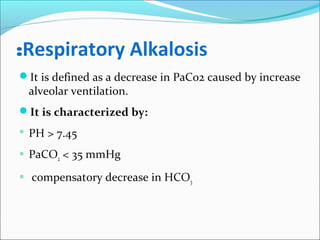
Respiratory Alkalosis:
It is defined as a decrease in PaCo2 caused by increase
alveolar ventilation.
It is characterized by:
 PH > 7.45
 PaCO2 < 35 mmHg
 compensatory decrease in HCO3
Causes of Respiratory Alkalosis:
Hyperventilation:
o Hypoxemia
o Anemia
o Fever
o Psychological dyspnea
o Early in exercises
o Angry
:Signs and Symptoms associated with Alkalosis
Increase excitability of CNS:
o Light headedness,
o Numbness,
o Tingling,
o Confusion,
o Inability to concentrate
o Blurred vision.
• Decrease electrolytes:
Hypokalemia
Hypertension
Compensation of respiratory alkalosis
Renal compensation:
The kidneys decrease plasma [ HCO3 ]:
 Decrease reabsorption of the filtered HCO3.
 The decreased CO2 decreases the generation of H by the
tubular epithelial cells.
Metabolic acidosis:
It is defined as a primary decrease in plasma
bicarbonate concentration(HCO3).
It is characterized by:
 PH < 7.35
 HCO3 < 22 mEq/ L
 Compensatory decrease in PaCO2
Causes of metabolic acidosis:
1)Loss of HCO3:
 Prolonged severe diarrhea
2)Decreased elimination of acids:
 Renal failure
3)Excess production of Acids:
 Starvation - Shock
 Cardiac arrest - Alcoholic Ketoacidosis
 Tissue hypoxia
 Sepsis
 Diabetic Ketoacidosis
Metabolic alkalosis:
It results from an increase in bicarbonate in ECF.
It is characterized by:
 PH > 7.45
 HCO3 > 26 mEq/ L
 Compensatory increase in PaCO2
Causes of metabolic alkalosis:
Excess of base /loss of acid.
Acute H ion loss:
 Vomiting,
 Gastric suction.
 diuretics as: Frusemide.
Excess intake of Alkali
Diet rich H in fruits and vegetables.
IV NaHCO3administration.
Acid  base imbalances 2018

Acid base imbalances 2018

  • 1.
    Acid- Base balance&Imbalance By Dr.Nahla Shaaban Khalil Critical Care And Emergency Nursing Department Faculty of Nursing Cairo university 2018
  • 2.
    Objectives: At the endof this lecture all students will be able to: Define PH ,acid and base. Discuss how the body regulates acid- base balance. Identify the main diagnostic tests used to assess acid- base imbalance. Identify ABG parameters. Differentiate between the respiratory and metabolic imbalances regarding their causes, and clinical manifestations.
  • 3.
    Outlines: Definitions of PH,acidand base. Regulation of acid-base balance. Diagnosing acid- base imbalance. -Arterial blood gases interpretation. -Anion gap. Acid base imbalance: -Respiratory acidosis and alkalosis. - Metabolic acidosis and alkalosis.
  • 4.
    Definitions: Acids:-are substances thatdissociate or lose ions. Bases:-are substances capable of accepting ions. Buffer :-is substance that reacts with acids and bases to maintain neutral environment of stable PH. PH:-represent the free hydrogen ions concentration.
  • 5.
    Acid base balance: Equilibrium between the acid and base elements of the blood and body fluids. Co2+H20  H2CO3  H+HCO3 One part acid 20part base =
  • 7.
    :Regulation of acid-basebalance The body has three mechanisms to maintain acid-base balance: 1- Buffering mechanism. 2- The respiratory compensation mechanism. 3-The metabolic or renal compensation mechanism.
  • 9.
    Buffering mechanism: Acid-base bufferis defined as a solution containing two or more chemical compounds that prevent marked change in hydrogen ions. Buffers act immediately to trap( H+)temporarily until respiratory and renal mechanism act. they only minimize the change in(H+)concentration.
  • 10.
    Types of buffersystem:- 1- Bicarbonate buffer system. 2- Phosphate buffer system. 3- Protein buffer system. a- Plasma proteins. b- Hemoglobin. C -Tissue proteins.
  • 11.
    Protein buffer system: Theplasma proteins in general and hemoglobin in particular constitute an important buffer system. It plays an important role in buffering co2 There are about 700gm of hemoglobin in the blood of an adult person. Deoxy hemoglobin is better buffer than oxy hemoglobin. Co2+H20  H2CO3  H+HCO3
  • 13.
    Respiratory regulation ofacid- base balance The lungs regulate blood levels of co2 that combine with H2O to form H2CO3 . Chemo receptors in the medulla of the brain sense those PH changes and vary the rate and depth of breathing to compensate. Breathing faster or deeper(Hyperventilation) Eliminate more co2 leading to increase PH. Slow and shallow breathing(Hypoventilation) Lead to accumulation of co2 decrease PH.
  • 14.
    Renal regulation ofacid-base balance Kidneys make long- term adjustment to PH. They reabsorb acids and bases or excrete them into urine, and can also produce HCO3to replenish lost supply. Such adjustment to PH take the kidneys days to weeks to complete. If the blood contains too much acids or not enough base, the PH drops and the kidneys in response reabsorb NaHCO3 and excrete (H+) leading to normalization of PH.
  • 16.
    Diagnosis of acidbase imbalance: 1-Arterial Blood Gases(ABG). 2-Anion gap estimation.
  • 17.
    ABG parameters: pH [H+ ] PCO2Partial pressure CO2 PO2 Partial pressure O2 HCO3 Bicarbonate BE Base excess SaO2 Oxygen Saturation
  • 18.
    Normal values: Parameters Normalvalues PH 7.35-7.45 PaCO2 35-45 HCO3 22-26 Pao2 80-100 Sao2 %More than 95 B/E ( -/+2(
  • 19.
    Base excess(B/E(: The baseexcess indicates the amount of excess or insufficient level of bicarbonate in the system. The normal range is –2 to +2 mEq/liter. (A negative base excess indicates a base deficit in the blood).
  • 20.
    Arterial Blood GasesInterpretation:.
  • 22.
    Anion Gap inPlasma The difference between measured major positive and negative charges. [Na+ ] -[Cl- ] - [HCO3- ] The normal value is (8-14) mEq/L The sum of measured cations is grater than of measured anions due to the presence of unmeasured anions (proteins ,phosphates, sulfates, and organic acids as lactic acids, and ketones acids). An increased anion gap may be the only clue that metabolic acidosis is present in a mixed acid-base disorder.
  • 24.
    Acid –base imbalance: Respiratoryacidosis. Respiratory alkalosis. Metabolic acidosis. Metabolic alkalosis.
  • 25.
  • 26.
    1-Respiratory Acidosis It occurwith any mechanism that decreases the rate of alveolar ventilation. It is characterized by: PH< 7.35 PaCO2 > 45 mmHg compensatory increase in HCO3 -
  • 27.
    Causes of respiratoryacidosis: Depression of respiratory centre:  Narcotics / over sedation.  Anesthesia.  Respiratory arrest.  Paralysis of respiratory muscles  Impaired ventilation.  Airway obstruction: Foreign body.
  • 28.
    Signs and Symptomsassociated with Acidosis: Decrease excitability of CNS:  Restlessness,  Headache,  Drowsiness,  Disorientation,  Coma, Cardiovascular:  Dysrhythmias,  Decreased cardiac contractility  Hypotension.
  • 29.
  • 30.
    Compensation of respiratoryacidosis: Renal compensation:  Increased the plasma HCO3concentration .  The increased PaCO2acts as a stimulus to increase the formation of H and HCO3 from CO2+ H2O in the renal tubular cells.  The renal H is secreted and the new HCO3 is returned to the plasma.
  • 31.
    Respiratory Alkalosis: It isdefined as a decrease in PaCo2 caused by increase alveolar ventilation. It is characterized by:  PH > 7.45  PaCO2 < 35 mmHg  compensatory decrease in HCO3
  • 32.
    Causes of RespiratoryAlkalosis: Hyperventilation: o Hypoxemia o Anemia o Fever o Psychological dyspnea o Early in exercises o Angry
  • 33.
    :Signs and Symptomsassociated with Alkalosis Increase excitability of CNS: o Light headedness, o Numbness, o Tingling, o Confusion, o Inability to concentrate o Blurred vision. • Decrease electrolytes: Hypokalemia Hypertension
  • 34.
    Compensation of respiratoryalkalosis Renal compensation: The kidneys decrease plasma [ HCO3 ]:  Decrease reabsorption of the filtered HCO3.  The decreased CO2 decreases the generation of H by the tubular epithelial cells.
  • 37.
    Metabolic acidosis: It isdefined as a primary decrease in plasma bicarbonate concentration(HCO3). It is characterized by:  PH < 7.35  HCO3 < 22 mEq/ L  Compensatory decrease in PaCO2
  • 38.
    Causes of metabolicacidosis: 1)Loss of HCO3:  Prolonged severe diarrhea 2)Decreased elimination of acids:  Renal failure 3)Excess production of Acids:  Starvation - Shock  Cardiac arrest - Alcoholic Ketoacidosis  Tissue hypoxia  Sepsis  Diabetic Ketoacidosis
  • 39.
    Metabolic alkalosis: It resultsfrom an increase in bicarbonate in ECF. It is characterized by:  PH > 7.45  HCO3 > 26 mEq/ L  Compensatory increase in PaCO2
  • 40.
    Causes of metabolicalkalosis: Excess of base /loss of acid. Acute H ion loss:  Vomiting,  Gastric suction.  diuretics as: Frusemide. Excess intake of Alkali Diet rich H in fruits and vegetables. IV NaHCO3administration.