Dr Manisha Sahay

 Currently i/c Professor and HOD, Nephrology Department,
  OMC/OGH

 MBBS Rajasthan
 MD Ped Niloufer
 DNB Neph ,Osmania General Hospital (Gold medal) 2003
 10 gold medals till date
 9 best paper awards at zonal and national conferences
 Best young researcher award –Indian Society of Nephrology
 Executive committee member –Young Nephrologist’s committee
  International Society of nephrology
 Executive committee member Indian society of Nephrology
 Executive member of South Zone –Indian society of Nephrology
 Young Key Opinion leader in Transplantation –India

 Publications in national and international journals
ABC ‘s of ABG


    Dr. Manisha Sahay
  i/c Professor & HOD
  Dept of Nephrology
Osmania General Hospital
        Hyderabad
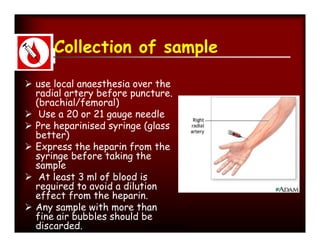
Collection of sample

 use local anaesthesia over the
  radial artery before puncture.
  (brachial/femoral)
 Use a 20 or 21 gauge needle
 Pre heparinised syringe (glass
  better)
 Express the heparin from the
  syringe before taking the
  sample
 At least 3 ml of blood is
  required to avoid a dilution
  effect from the heparin.
 Any sample with more than
  fine air bubbles should be
  discarded.                Manisha Sahay
 Press for 5 minutes

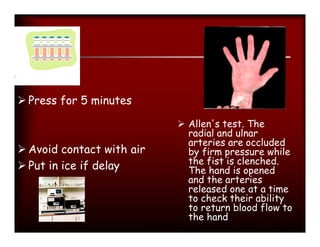
                                      Allen's test. The
                                       radial and ulnar
                                       arteries are occluded
 Avoid contact with air               by firm pressure while
                                       the fist is clenched.
 Put in ice if delay                  The hand is opened
                                       and the arteries
                                       released one at a time
                                       to check their ability
                                       to return blood flow to
                                       the hand
                           Manisha Sahay
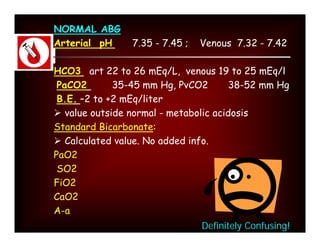
NORMAL ABG
Arterial pH     7.35 - 7.45 ;   Venous 7.32 - 7.42

HCO3 art 22 to 26 mEq/L, venous 19 to 25 mEq/l
 PaCO2       35-45 mm Hg, PvCO2        38-52 mm Hg
 B.E. –2 to +2 mEq/liter
 value outside normal - metabolic acidosis
Standard Bicarbonate:
 Calculated value. No added info.
PaO2
 SO2
FiO2
CaO2
A-a
                                Definitely Confusing!
No click


Steps for
Successful
 Blood Gas
  Analysis
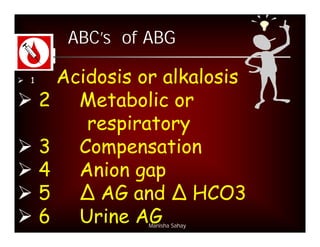
ABC’s of ABG

 1Acidosis or alkalosis
 2 Metabolic or
      respiratory
 3 Compensation
 4 Anion gap
 5 ∆ AG and ∆ HCO3
 6 Urine AG  Manisha Sahay
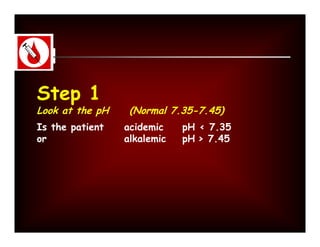
Step 1
Look at the pH    (Normal 7.35-7.45)
Is the patient   acidemic    pH < 7.35
or               alkalemic   pH > 7.45
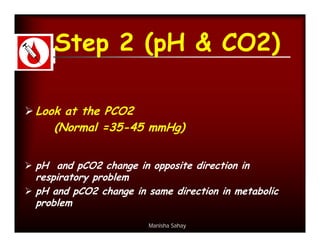
Step 2 (pH & CO2)

 Look at the PCO2
     (Normal =35-45 mmHg)


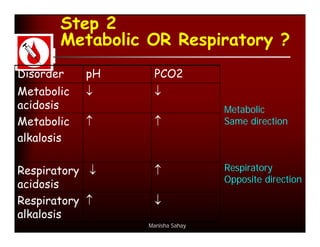
 pH and pCO2 change in opposite direction in
  respiratory problem
 pH and pCO2 change in same direction in metabolic
  problem

                        Manisha Sahay
Step 2
       Metabolic OR Respiratory ?
Disorder    pH    PCO2
Metabolic        
acidosis                         Metabolic
Metabolic                      Same direction
alkalosis

Respiratory                    Respiratory
                                 Opposite direction
acidosis
Respiratory      
alkalosis
                 Manisha Sahay
Step 3
Compensation(CO2 & HCO3)
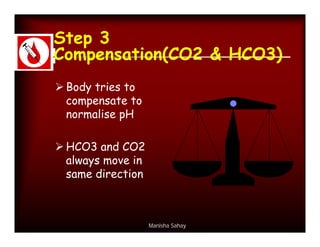
 Body tries to
  compensate to
  normalise pH

 HCO3 and CO2
  always move in                          CO2
                                   HCO3
  same direction


                   Manisha Sahay
Step 3
       Compensation
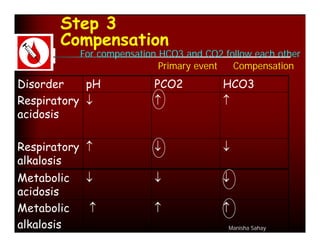
            For compensation HCO3 and CO2 follow each other
                             Primary event  Compensation
Disorder    pH             PCO2           HCO3
Respiratory                             
acidosis

Respiratory                             
alkalosis
Metabolic                               
acidosis
Metabolic                               
alkalosis                                  Manisha Sahay
Step 3:
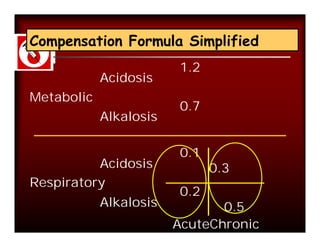
        Calculation of compensation
  Disorder    pH   Primary     Compensatory        Equation
                   change        Response
Metabolic          [HCO3-]       PCO2      ΔPCO2  1.2  ΔHCO3
Acidosis
Metabolic          [HCO3-]       PCO2      ΔPCO2  0.7  ΔHCO3
Alkalosis
Respiratory         PCO2        [HCO3-]           Acute:
Acidosis                                      ΔHCO3-  0.1  ΔPCO2
                                                   Chronic:
                                              ΔHCO3-  0.3  ΔPCO2

Respiratory         PCO2        [HCO3-]           Acute:
Alkalosis                                     ΔHCO3-  0.2  ΔPCO2
                                                   Chronic:
                                              ΔHCO3-  0.5  ΔPCO2
Compensation Formula Simplified
                         1.2
            Acidosis
Metabolic
                         0.7
            Alkalosis

                         0.1
          Acidosis             0.3
Respiratory
                         0.2
            Alkalosis          0.5
                        AcuteChronic
Step 4 Check Anion Gap


          Manisha Sahay
What is anion gap?


 [Na+] – ([HC03-] + [Cl-])

 140 - (24 + 105) = 11

 Normal = 12 + 2


                          Manisha Sahay
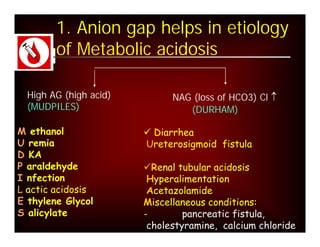
1. Anion gap helps in etiology
        of Metabolic acidosis

  High AG (high acid)         NAG (loss of HCO3) Cl 
  (MUDPILES)                     (DURHAM)

M ethanol                Diarrhea
U remia                 Ureterosigmoid fistula
D KA
P araldehyde            Renal tubular acidosis
I nfection               Hyperalimentation
L actic acidosis         Acetazolamide
E thylene Glycol        Miscellaneous conditions:
S alicylate             -             pancreatic fistula,
                         cholestyramine, calcium chloride
                          Manisha Sahay
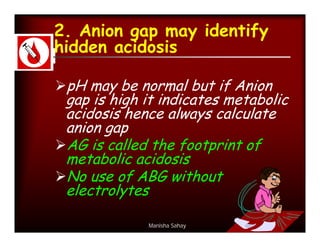
2. Anion gap may identify
hidden acidosis

pH may be normal but if Anion
 gap is high it indicates metabolic
 acidosis hence always calculate
 anion gap
AG is called the footprint of
 metabolic acidosis
No use of ABG without
 electrolytes

              Manisha Sahay
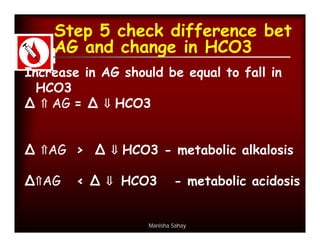
Step 5 check difference bet
    AG and change in HCO3
Increase in AG should be equal to fall in
  HCO3
Δ AG = Δ HCO3


Δ   AG > Δ     HCO3 - metabolic alkalosis

Δ AG    < Δ    HCO3        - metabolic acidosis


                   Manisha Sahay
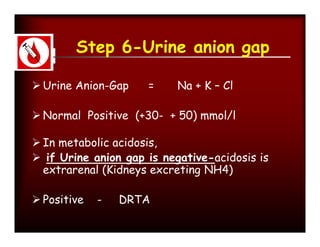
Step 6-Urine anion gap

 Urine Anion-Gap    =     Na + K – Cl

 Normal Positive (+30- + 50) mmol/l

 In metabolic acidosis,
 if Urine anion gap is negative-acidosis is
  extrarenal (Kidneys excreting NH4)

 Positive   -   DRTA
Step 7
Oxygenation and ventilation


           Manisha Sahay
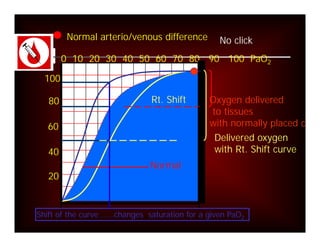
Normal arterio/venous difference        No click
        0 10 20 30 40 50 60 70 80 90 100 PaO2

  100

   80                         Rt. Shift       Oxygen delivered
                                              to tissues
   60                                         with normally placed curve
                                               Delivered oxygen
   40                                          with Rt. Shift curve
                              Normal
   20


Shift of the curve ……changes saturation for a given PaO2
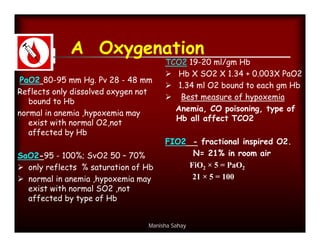
A Oxygenation
                                      TCO2 19-20 ml/gm Hb
                                       Hb X SO2 X 1.34 + 0.003X PaO2
 PaO2 80-95 mm Hg. Pv 28 - 48 mm
                                       1.34 ml O2 bound to each gm Hb
Reflects only dissolved oxygen not
                                       Best measure of hypoxemia
   bound to Hb
                                        Anemia, CO poisoning, type of
normal in anemia ,hypoxemia may
                                        Hb all affect TCO2
   exist with normal O2,not
   affected by Hb
                                      FIO2 - fractional inspired O2.
SaO2-95 - 100%; SvO2 50 – 70%               N= 21% in room air
 only reflects % saturation of Hb         FiO2 × 5 = PaO2
 normal in anemia ,hypoxemia may           21 × 5 = 100
  exist with normal SO2 ,not
  affected by type of Hb


                                 Manisha Sahay
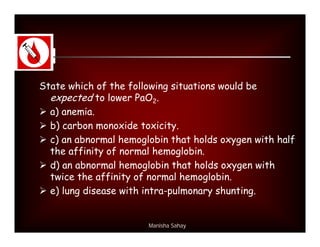
State which of the following situations would be
  expected to lower PaO2.
 a) anemia.
 b) carbon monoxide toxicity.
 c) an abnormal hemoglobin that holds oxygen with half
  the affinity of normal hemoglobin.
 d) an abnormal hemoglobin that holds oxygen with
  twice the affinity of normal hemoglobin.
 e) lung disease with intra-pulmonary shunting.


                       Manisha Sahay
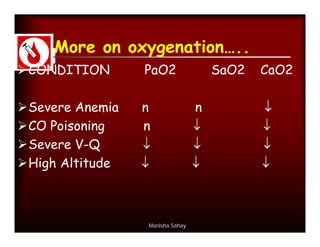
More on oxygenation…..
CONDITION       PaO2                SaO2   CaO2

Severe Anemia   n               n          
CO Poisoning    n                         
Severe V-Q                               
High Altitude                            


                 Manisha Sahay
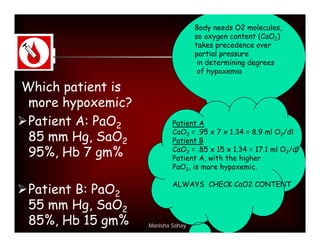
Body needs O2 molecules,
                                   so oxygen content (CaO2)
                                   takes precedence over
                                   partial pressure
                                    in determining degrees
                                    of hypoxemia

Which patient is
 more hypoxemic?
Patient A: PaO2           Patient A
                           CaO2 = .95 x 7 x 1.34 = 8.9 ml O2/dl
 85 mm Hg, SaO2            Patient B
 95%, Hb 7 gm%             CaO2 = .85 x 15 x 1.34 = 17.1 ml O2/dl
                           Patient A, with the higher
                           PaO2, is more hypoxemic.

                           ALWAYS CHECK CaO2 CONTENT
Patient B: PaO2
 55 mm Hg, SaO2
 85%, Hb 15 gm%    Manisha Sahay
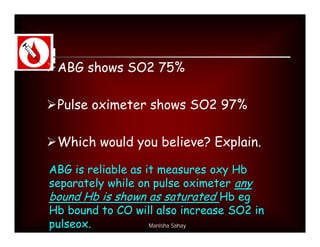
ABG shows SO2 75%

Pulse oximeter shows SO2 97%

Which would you believe? Explain.

ABG is reliable as it measures oxy Hb
separately while on pulse oximeter any
bound Hb is shown as saturated Hb eg
Hb bound to CO will also increase SO2 in
pulseox.            Manisha Sahay
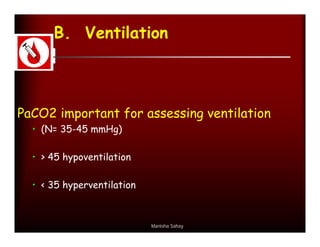
B. Ventilation


PaCO2 important for assessing ventilation
  • (N= 35-45 mmHg)

  • > 45 hypoventilation

  • < 35 hyperventilation


                            Manisha Sahay
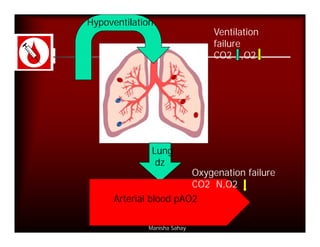
Hypoventilation
                              Ventilation
                              failure
                              CO2 , ,O2


               Lung
                dz
                        Oxygenation failure
                        CO2 N,O2
      Arterial blood pAO2

              Manisha Sahay
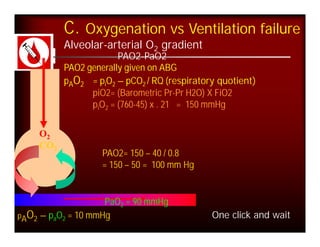
C. Oxygenation vs Ventilation failure
           Alveolar-arterial O2 gradient
                        PAO2-PaO2
           PAO2 generally given on ABG
           pAO2 = piO2 – pCO2 / RQ (respiratory quotient)
                 piO2= (Barometric Pr-Pr H2O) X FiO2
                 piO2 = (760-45) x . 21 = 150 mmHg
       
    O2 
    CO2
                    PAO2= 150 – 40 / 0.8
                    = 150 – 50 = 100 mm Hg


                    PaO2 = 90 mmHg
pAO2 – paO2 = 10 mmHg                         One click and wait
No click

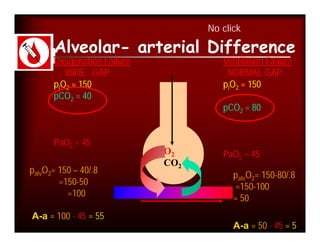
      Alveolar- arterial Difference
      Oxygenation Failure            Ventilation Failure
         WIDE GAP                     NORMAL GAP
      piO2 = 150                     piO2 = 150
      pCO2 = 40
                                     pCO2 = 80


      PaO2 = 45
                            O2       PaO2 = 45
                            CO2
palvO2= 150 – 40/.8                     palvO2= 150-80/.8
        =150-50                         =150-100
          =100                          = 50
A-a = 100 - 45 = 55
                                        A-a = 50 - 45 = 5
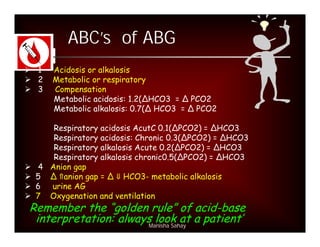
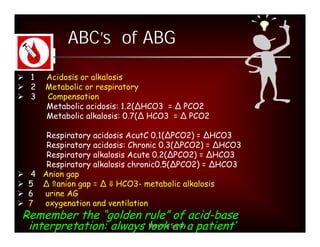
ABC’s of ABG
 1   Acidosis or alkalosis
 2   Metabolic or respiratory
 3   Compensation
      Metabolic acidosis: 1.2(∆HCO3 = ∆ PCO2
      Metabolic alkalosis: 0.7(∆ HCO3 = ∆ PCO2

     Respiratory acidosis AcutC 0.1(ΔPCO2) = ΔHCO3
     Respiratory acidosis: Chronic 0.3(ΔPCO2) = ΔHCO3
     Respiratory alkalosis Acute 0.2(ΔPCO2) = ΔHCO3
     Respiratory alkalosis chronic0.5(ΔPCO2) = ΔHCO3
 4 Anion gap
 5 Δ anion gap = Δ HCO3- metabolic alkalosis
 6 urine AG
 7 Oxygenation and ventilation
 Remember the “golden rule” of acid-base
  interpretation: always look at a patient’
                       Manisha Sahay
HANDS ON ABG


         Manisha Sahay
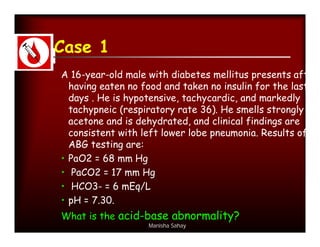
Case 1
A 16-year-old male with diabetes mellitus presents after
  having eaten no food and taken no insulin for the last 3
  days . He is hypotensive, tachycardic, and markedly
  tachypneic (respiratory rate 36). He smells strongly of
  acetone and is dehydrated, and clinical findings are
  consistent with left lower lobe pneumonia. Results of
  ABG testing are:
• PaO2 = 68 mm Hg
• PaCO2 = 17 mm Hg
• HCO3- = 6 mEq/L
• pH = 7.30.
What is the acid-base abnormality?
                   Manisha Sahay
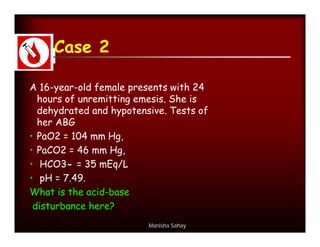
Case 2

A 16-year-old female presents with 24
  hours of unremitting emesis. She is
  dehydrated and hypotensive. Tests of
  her ABG
• PaO2 = 104 mm Hg,
• PaCO2 = 46 mm Hg,
• HCO3- = 35 mEq/L
• pH = 7.49.
What is the acid-base
 disturbance here?
                         Manisha Sahay
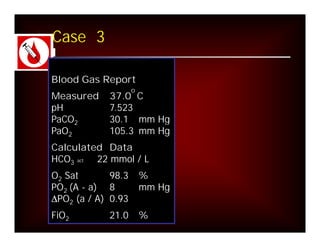
Case 3

Blood Gas Report
                    o
Measured    37.0 C
pH          7.523
PaCO2       30.1 mm Hg
PaO2        105.3 mm Hg
Calculated Data
HCO3 act 22 mmol / L
O2 Sat       98.3       %
PO2 (A - a) 8           mm Hg
DPO2 (a / A) 0.93
FiO2        21.0        %
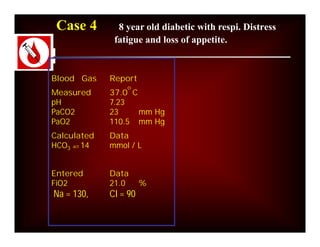
Case 4         8 year old diabetic with respi. Distress
               fatigue and loss of appetite.


Blood Gas     Report
                  o
Measured      37.0 C
pH            7.23
PaCO2         23     mm Hg
PaO2          110.5 mm Hg
Calculated    Data
HCO3 act 14   mmol / L


Entered       Data
FiO2          21.0      %
Na = 130,     Cl = 90
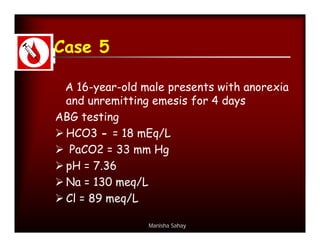
Case 5

  A 16-year-old male presents with anorexia
  and unremitting emesis for 4 days
ABG testing
 HCO3 - = 18 mEq/L
 PaCO2 = 33 mm Hg
 pH = 7.36
 Na = 130 meq/L
 Cl = 89 meq/L

                 Manisha Sahay
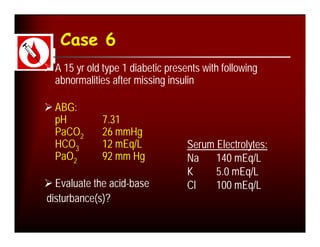
Case 6
 A 15 yr old type 1 diabetic presents with following
  abnormalities after missing insulin

 ABG:
  pH          7.31
  PaCO2       26 mmHg
  HCO3        12 mEq/L             Serum Electrolytes:
  PaO2        92 mm Hg             Na    140 mEq/L
                                   K     5.0 mEq/L
 Evaluate the acid-base           Cl    100 mEq/L
disturbance(s)?
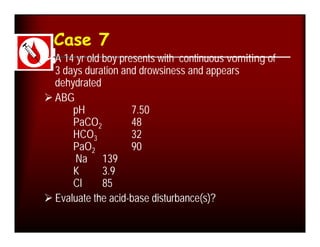
Case 7
 A 14 yr old boy presents with continuous vomiting of
  3 days duration and drowsiness and appears
  dehydrated
 ABG
      pH             7.50
      PaCO2          48
      HCO3           32
      PaO2           90
       Na 139
      K       3.9
      Cl      85
 Evaluate the acid-base disturbance(s)?
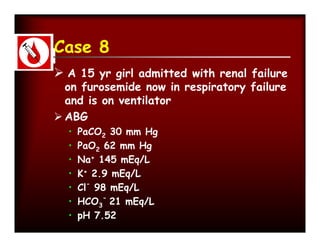
Case 8
 A 15 yr girl admitted with renal failure
  on furosemide now in respiratory failure
  and is on ventilator
 ABG
  •   PaCO2 30 mm Hg
  •   PaO2 62 mm Hg
  •   Na+ 145 mEq/L
  •   K+ 2.9 mEq/L
  •   Cl- 98 mEq/L
  •   HCO3- 21 mEq/L
  •   pH 7.52
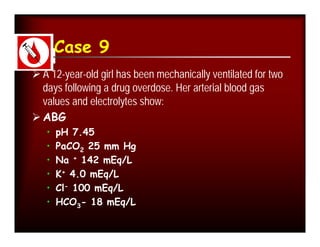
Case 9
 A 12-year-old girl has been mechanically ventilated for two
  days following a drug overdose. Her arterial blood gas
  values and electrolytes show:
 ABG
   •   pH 7.45
   •   PaCO2 25 mm Hg
   •   Na + 142 mEq/L
   •   K+ 4.0 mEq/L
   •   Cl- 100 mEq/L
   •   HCO3- 18 mEq/L
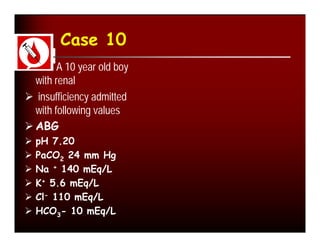
Case 10
       A 10 year old boy
  with renal
 insufficiency admitted
  with following values
 ABG
   pH 7.20
   PaCO2 24 mm Hg
   Na + 140 mEq/L
   K+ 5.6 mEq/L
   Cl- 110 mEq/L
   HCO3- 10 mEq/L
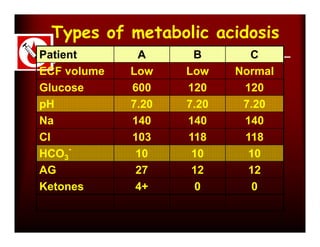
Types of metabolic acidosis
Patient       A      B       C
ECF volume   Low    Low    Normal
Glucose      600    120     120
pH           7.20   7.20    7.20
Na           140    140     140
Cl           103    118     118
     -
HCO3          10     10      10
AG            27     12      12
Ketones       4+      0       0
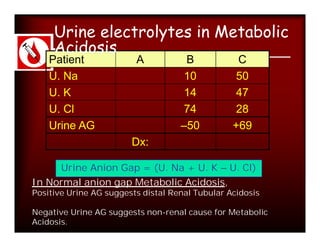
Urine electrolytes in Metabolic
     Acidosis
    Patient              A           B            C
    U. Na                           10           50
    U. K                            14           47
    U. Cl                           74           28
    Urine AG                        –50          +69
                        Dx:

     Urine Anion Gap = (U. Na + U. K – U. Cl)
In Normal anion gap Metabolic Acidosis,
Positive Urine AG suggests distal Renal Tubular Acidosis

Negative Urine AG suggests non-renal cause for Metabolic
Acidosis.
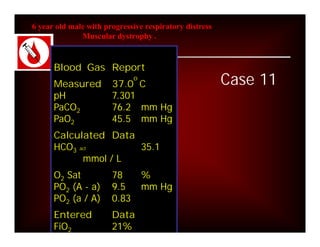
6 year old male with progressive respiratory distress
              Muscular dystrophy .


      Blood Gas Report
      Measured         37.0 C
                              o
                                                        Case 11
      pH               7.301
      PaCO2            76.2 mm Hg
      PaO2             45.5 mm Hg
      Calculated Data
      HCO3 act        35.1
            mmol / L
      O2 Sat           78         %
      PO2 (A - a)      9.5        mm Hg
      PO2 (a / A)      0.83
      Entered          Data
      FiO2             21%
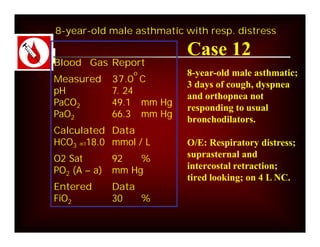
8-year-old male asthmatic with resp. distress

                           Case 12
Blood Gas Report
                 o         8-year-old male asthmatic;
Measured      37.0 C
                           3 days of cough, dyspnea
pH            7. 24
                           and orthopnea not
PaCO2         49.1 mm Hg
                           responding to usual
PaO2          66.3 mm Hg
                           bronchodilators.
Calculated Data
HCO3 act18.0 mmol / L      O/E: Respiratory distress;
O2 Sat        92   %       suprasternal and
PO2 (A – a)   mm Hg        intercostal retraction;
                           tired looking; on 4 L NC.
Entered       Data
FiO2          30   %
ABC’s of ABG

 1   Acidosis or alkalosis
 2   Metabolic or respiratory
 3   Compensation
      Metabolic acidosis: 1.2(∆HCO3 = ∆ PCO2
      Metabolic alkalosis: 0.7(∆ HCO3 = ∆ PCO2

     Respiratory acidosis AcutC 0.1(ΔPCO2) = ΔHCO3
     Respiratory acidosis: Chronic 0.3(ΔPCO2) = ΔHCO3
     Respiratory alkalosis Acute 0.2(ΔPCO2) = ΔHCO3
     Respiratory alkalosis chronic0.5(ΔPCO2) = ΔHCO3
 4 Anion gap
 5 Δ anion gap = Δ HCO3- metabolic alkalosis
 6 urine AG
 7 oxygenation and ventilation
 Remember the “golden rule” of acid-base
  interpretation: always look Sahay a patient’
                         Manisha at
Practice makes a man
 perfect!!


       Manisha Sahay

CME - ABG

  • 1.
    Dr Manisha Sahay Currently i/c Professor and HOD, Nephrology Department, OMC/OGH  MBBS Rajasthan  MD Ped Niloufer  DNB Neph ,Osmania General Hospital (Gold medal) 2003  10 gold medals till date  9 best paper awards at zonal and national conferences  Best young researcher award –Indian Society of Nephrology  Executive committee member –Young Nephrologist’s committee International Society of nephrology  Executive committee member Indian society of Nephrology  Executive member of South Zone –Indian society of Nephrology  Young Key Opinion leader in Transplantation –India  Publications in national and international journals
  • 2.
    ABC ‘s ofABG Dr. Manisha Sahay i/c Professor & HOD Dept of Nephrology Osmania General Hospital Hyderabad
  • 3.
    Collection of sample use local anaesthesia over the radial artery before puncture. (brachial/femoral)  Use a 20 or 21 gauge needle  Pre heparinised syringe (glass better)  Express the heparin from the syringe before taking the sample  At least 3 ml of blood is required to avoid a dilution effect from the heparin.  Any sample with more than fine air bubbles should be discarded. Manisha Sahay
  • 4.
     Press for5 minutes  Allen's test. The radial and ulnar arteries are occluded  Avoid contact with air by firm pressure while the fist is clenched.  Put in ice if delay The hand is opened and the arteries released one at a time to check their ability to return blood flow to the hand Manisha Sahay
  • 5.
    NORMAL ABG Arterial pH 7.35 - 7.45 ; Venous 7.32 - 7.42 HCO3 art 22 to 26 mEq/L, venous 19 to 25 mEq/l PaCO2 35-45 mm Hg, PvCO2 38-52 mm Hg B.E. –2 to +2 mEq/liter  value outside normal - metabolic acidosis Standard Bicarbonate:  Calculated value. No added info. PaO2 SO2 FiO2 CaO2 A-a Definitely Confusing!
  • 6.
  • 7.
    ABC’s of ABG 1Acidosis or alkalosis  2 Metabolic or respiratory  3 Compensation  4 Anion gap  5 ∆ AG and ∆ HCO3  6 Urine AG Manisha Sahay
  • 8.
    Step 1 Look atthe pH (Normal 7.35-7.45) Is the patient acidemic pH < 7.35 or alkalemic pH > 7.45
  • 9.
    Step 2 (pH& CO2)  Look at the PCO2 (Normal =35-45 mmHg)  pH and pCO2 change in opposite direction in respiratory problem  pH and pCO2 change in same direction in metabolic problem Manisha Sahay
  • 10.
    Step 2 Metabolic OR Respiratory ? Disorder pH PCO2 Metabolic   acidosis Metabolic Metabolic   Same direction alkalosis Respiratory   Respiratory Opposite direction acidosis Respiratory   alkalosis Manisha Sahay
  • 11.
    Step 3 Compensation(CO2 &HCO3)  Body tries to compensate to normalise pH  HCO3 and CO2 always move in CO2 HCO3 same direction Manisha Sahay
  • 12.
    Step 3 Compensation For compensation HCO3 and CO2 follow each other Primary event Compensation Disorder pH PCO2 HCO3 Respiratory    acidosis Respiratory    alkalosis Metabolic    acidosis Metabolic    alkalosis Manisha Sahay
  • 13.
    Step 3: Calculation of compensation Disorder pH Primary Compensatory Equation change Response Metabolic   [HCO3-]  PCO2 ΔPCO2  1.2  ΔHCO3 Acidosis Metabolic   [HCO3-]  PCO2 ΔPCO2  0.7  ΔHCO3 Alkalosis Respiratory   PCO2  [HCO3-] Acute: Acidosis ΔHCO3-  0.1  ΔPCO2 Chronic: ΔHCO3-  0.3  ΔPCO2 Respiratory   PCO2  [HCO3-] Acute: Alkalosis ΔHCO3-  0.2  ΔPCO2 Chronic: ΔHCO3-  0.5  ΔPCO2
  • 14.
    Compensation Formula Simplified 1.2 Acidosis Metabolic 0.7 Alkalosis 0.1 Acidosis 0.3 Respiratory 0.2 Alkalosis 0.5 AcuteChronic
  • 15.
    Step 4 CheckAnion Gap Manisha Sahay
  • 16.
    What is aniongap?  [Na+] – ([HC03-] + [Cl-])  140 - (24 + 105) = 11  Normal = 12 + 2 Manisha Sahay
  • 17.
    1. Anion gaphelps in etiology of Metabolic acidosis High AG (high acid) NAG (loss of HCO3) Cl  (MUDPILES) (DURHAM) M ethanol  Diarrhea U remia Ureterosigmoid fistula D KA P araldehyde Renal tubular acidosis I nfection Hyperalimentation L actic acidosis Acetazolamide E thylene Glycol Miscellaneous conditions: S alicylate - pancreatic fistula, cholestyramine, calcium chloride Manisha Sahay
  • 18.
    2. Anion gapmay identify hidden acidosis pH may be normal but if Anion gap is high it indicates metabolic acidosis hence always calculate anion gap AG is called the footprint of metabolic acidosis No use of ABG without electrolytes Manisha Sahay
  • 19.
    Step 5 checkdifference bet AG and change in HCO3 Increase in AG should be equal to fall in HCO3 Δ AG = Δ HCO3 Δ AG > Δ HCO3 - metabolic alkalosis Δ AG < Δ HCO3 - metabolic acidosis Manisha Sahay
  • 20.
    Step 6-Urine aniongap  Urine Anion-Gap = Na + K – Cl  Normal Positive (+30- + 50) mmol/l  In metabolic acidosis,  if Urine anion gap is negative-acidosis is extrarenal (Kidneys excreting NH4)  Positive - DRTA
  • 21.
    Step 7 Oxygenation andventilation Manisha Sahay
  • 22.
    Normal arterio/venous difference No click 0 10 20 30 40 50 60 70 80 90 100 PaO2 100 80 Rt. Shift Oxygen delivered to tissues 60 with normally placed curve Delivered oxygen 40 with Rt. Shift curve Normal 20 Shift of the curve ……changes saturation for a given PaO2
  • 23.
    A Oxygenation TCO2 19-20 ml/gm Hb  Hb X SO2 X 1.34 + 0.003X PaO2 PaO2 80-95 mm Hg. Pv 28 - 48 mm  1.34 ml O2 bound to each gm Hb Reflects only dissolved oxygen not  Best measure of hypoxemia bound to Hb Anemia, CO poisoning, type of normal in anemia ,hypoxemia may Hb all affect TCO2 exist with normal O2,not affected by Hb FIO2 - fractional inspired O2. SaO2-95 - 100%; SvO2 50 – 70% N= 21% in room air  only reflects % saturation of Hb FiO2 × 5 = PaO2  normal in anemia ,hypoxemia may 21 × 5 = 100 exist with normal SO2 ,not affected by type of Hb Manisha Sahay
  • 24.
    State which ofthe following situations would be expected to lower PaO2.  a) anemia.  b) carbon monoxide toxicity.  c) an abnormal hemoglobin that holds oxygen with half the affinity of normal hemoglobin.  d) an abnormal hemoglobin that holds oxygen with twice the affinity of normal hemoglobin.  e) lung disease with intra-pulmonary shunting. Manisha Sahay
  • 25.
    More on oxygenation….. CONDITION PaO2 SaO2 CaO2 Severe Anemia n n  CO Poisoning n   Severe V-Q    High Altitude    Manisha Sahay
  • 26.
    Body needs O2molecules, so oxygen content (CaO2) takes precedence over partial pressure in determining degrees of hypoxemia Which patient is more hypoxemic? Patient A: PaO2 Patient A CaO2 = .95 x 7 x 1.34 = 8.9 ml O2/dl 85 mm Hg, SaO2 Patient B 95%, Hb 7 gm% CaO2 = .85 x 15 x 1.34 = 17.1 ml O2/dl Patient A, with the higher PaO2, is more hypoxemic. ALWAYS CHECK CaO2 CONTENT Patient B: PaO2 55 mm Hg, SaO2 85%, Hb 15 gm% Manisha Sahay
  • 27.
    ABG shows SO275% Pulse oximeter shows SO2 97% Which would you believe? Explain. ABG is reliable as it measures oxy Hb separately while on pulse oximeter any bound Hb is shown as saturated Hb eg Hb bound to CO will also increase SO2 in pulseox. Manisha Sahay
  • 28.
    B. Ventilation PaCO2 importantfor assessing ventilation • (N= 35-45 mmHg) • > 45 hypoventilation • < 35 hyperventilation Manisha Sahay
  • 29.
    Hypoventilation Ventilation failure CO2 , ,O2 Lung dz Oxygenation failure CO2 N,O2 Arterial blood pAO2 Manisha Sahay
  • 30.
    C. Oxygenation vsVentilation failure Alveolar-arterial O2 gradient PAO2-PaO2 PAO2 generally given on ABG pAO2 = piO2 – pCO2 / RQ (respiratory quotient) piO2= (Barometric Pr-Pr H2O) X FiO2 piO2 = (760-45) x . 21 = 150 mmHg  O2  CO2 PAO2= 150 – 40 / 0.8 = 150 – 50 = 100 mm Hg PaO2 = 90 mmHg pAO2 – paO2 = 10 mmHg One click and wait
  • 31.
    No click Alveolar- arterial Difference Oxygenation Failure Ventilation Failure WIDE GAP NORMAL GAP piO2 = 150 piO2 = 150 pCO2 = 40 pCO2 = 80 PaO2 = 45 O2 PaO2 = 45 CO2 palvO2= 150 – 40/.8 palvO2= 150-80/.8 =150-50 =150-100 =100 = 50 A-a = 100 - 45 = 55 A-a = 50 - 45 = 5
  • 32.
    ABC’s of ABG 1 Acidosis or alkalosis  2 Metabolic or respiratory  3 Compensation Metabolic acidosis: 1.2(∆HCO3 = ∆ PCO2 Metabolic alkalosis: 0.7(∆ HCO3 = ∆ PCO2 Respiratory acidosis AcutC 0.1(ΔPCO2) = ΔHCO3 Respiratory acidosis: Chronic 0.3(ΔPCO2) = ΔHCO3 Respiratory alkalosis Acute 0.2(ΔPCO2) = ΔHCO3 Respiratory alkalosis chronic0.5(ΔPCO2) = ΔHCO3  4 Anion gap  5 Δ anion gap = Δ HCO3- metabolic alkalosis  6 urine AG  7 Oxygenation and ventilation Remember the “golden rule” of acid-base interpretation: always look at a patient’ Manisha Sahay
  • 33.
    HANDS ON ABG Manisha Sahay
  • 34.
    Case 1 A 16-year-oldmale with diabetes mellitus presents after having eaten no food and taken no insulin for the last 3 days . He is hypotensive, tachycardic, and markedly tachypneic (respiratory rate 36). He smells strongly of acetone and is dehydrated, and clinical findings are consistent with left lower lobe pneumonia. Results of ABG testing are: • PaO2 = 68 mm Hg • PaCO2 = 17 mm Hg • HCO3- = 6 mEq/L • pH = 7.30. What is the acid-base abnormality? Manisha Sahay
  • 35.
    Case 2 A 16-year-oldfemale presents with 24 hours of unremitting emesis. She is dehydrated and hypotensive. Tests of her ABG • PaO2 = 104 mm Hg, • PaCO2 = 46 mm Hg, • HCO3- = 35 mEq/L • pH = 7.49. What is the acid-base disturbance here? Manisha Sahay
  • 36.
    Case 3 Blood GasReport o Measured 37.0 C pH 7.523 PaCO2 30.1 mm Hg PaO2 105.3 mm Hg Calculated Data HCO3 act 22 mmol / L O2 Sat 98.3 % PO2 (A - a) 8 mm Hg DPO2 (a / A) 0.93 FiO2 21.0 %
  • 37.
    Case 4 8 year old diabetic with respi. Distress fatigue and loss of appetite. Blood Gas Report o Measured 37.0 C pH 7.23 PaCO2 23 mm Hg PaO2 110.5 mm Hg Calculated Data HCO3 act 14 mmol / L Entered Data FiO2 21.0 % Na = 130, Cl = 90
  • 38.
    Case 5 A 16-year-old male presents with anorexia and unremitting emesis for 4 days ABG testing  HCO3 - = 18 mEq/L  PaCO2 = 33 mm Hg  pH = 7.36  Na = 130 meq/L  Cl = 89 meq/L Manisha Sahay
  • 39.
    Case 6  A15 yr old type 1 diabetic presents with following abnormalities after missing insulin  ABG: pH 7.31 PaCO2 26 mmHg HCO3 12 mEq/L Serum Electrolytes: PaO2 92 mm Hg Na 140 mEq/L K 5.0 mEq/L  Evaluate the acid-base Cl 100 mEq/L disturbance(s)?
  • 40.
    Case 7  A14 yr old boy presents with continuous vomiting of 3 days duration and drowsiness and appears dehydrated  ABG pH 7.50 PaCO2 48 HCO3 32 PaO2 90 Na 139 K 3.9 Cl 85  Evaluate the acid-base disturbance(s)?
  • 41.
    Case 8  A15 yr girl admitted with renal failure on furosemide now in respiratory failure and is on ventilator  ABG • PaCO2 30 mm Hg • PaO2 62 mm Hg • Na+ 145 mEq/L • K+ 2.9 mEq/L • Cl- 98 mEq/L • HCO3- 21 mEq/L • pH 7.52
  • 42.
    Case 9  A12-year-old girl has been mechanically ventilated for two days following a drug overdose. Her arterial blood gas values and electrolytes show:  ABG • pH 7.45 • PaCO2 25 mm Hg • Na + 142 mEq/L • K+ 4.0 mEq/L • Cl- 100 mEq/L • HCO3- 18 mEq/L
  • 43.
    Case 10  A 10 year old boy with renal  insufficiency admitted with following values  ABG  pH 7.20  PaCO2 24 mm Hg  Na + 140 mEq/L  K+ 5.6 mEq/L  Cl- 110 mEq/L  HCO3- 10 mEq/L
  • 44.
    Types of metabolicacidosis Patient A B C ECF volume Low Low Normal Glucose 600 120 120 pH 7.20 7.20 7.20 Na 140 140 140 Cl 103 118 118 - HCO3 10 10 10 AG 27 12 12 Ketones 4+ 0 0
  • 45.
    Urine electrolytes inMetabolic Acidosis Patient A B C U. Na 10 50 U. K 14 47 U. Cl 74 28 Urine AG –50 +69 Dx: Urine Anion Gap = (U. Na + U. K – U. Cl) In Normal anion gap Metabolic Acidosis, Positive Urine AG suggests distal Renal Tubular Acidosis Negative Urine AG suggests non-renal cause for Metabolic Acidosis.
  • 46.
    6 year oldmale with progressive respiratory distress Muscular dystrophy . Blood Gas Report Measured 37.0 C o Case 11 pH 7.301 PaCO2 76.2 mm Hg PaO2 45.5 mm Hg Calculated Data HCO3 act 35.1 mmol / L O2 Sat 78 % PO2 (A - a) 9.5 mm Hg PO2 (a / A) 0.83 Entered Data FiO2 21%
  • 47.
    8-year-old male asthmaticwith resp. distress Case 12 Blood Gas Report o 8-year-old male asthmatic; Measured 37.0 C 3 days of cough, dyspnea pH 7. 24 and orthopnea not PaCO2 49.1 mm Hg responding to usual PaO2 66.3 mm Hg bronchodilators. Calculated Data HCO3 act18.0 mmol / L O/E: Respiratory distress; O2 Sat 92 % suprasternal and PO2 (A – a) mm Hg intercostal retraction; tired looking; on 4 L NC. Entered Data FiO2 30 %
  • 48.
    ABC’s of ABG 1 Acidosis or alkalosis  2 Metabolic or respiratory  3 Compensation Metabolic acidosis: 1.2(∆HCO3 = ∆ PCO2 Metabolic alkalosis: 0.7(∆ HCO3 = ∆ PCO2 Respiratory acidosis AcutC 0.1(ΔPCO2) = ΔHCO3 Respiratory acidosis: Chronic 0.3(ΔPCO2) = ΔHCO3 Respiratory alkalosis Acute 0.2(ΔPCO2) = ΔHCO3 Respiratory alkalosis chronic0.5(ΔPCO2) = ΔHCO3  4 Anion gap  5 Δ anion gap = Δ HCO3- metabolic alkalosis  6 urine AG  7 oxygenation and ventilation Remember the “golden rule” of acid-base interpretation: always look Sahay a patient’ Manisha at
  • 49.
    Practice makes aman perfect!! Manisha Sahay