ARTERIAL BLOOD GAS ANALYSIS
S.MEENATCHI SUNDARI,
II YEAR PG.
A.Y.T 1
DEFINITION
It is a diagnostic procedure in which a
blood is obtained from an artery directly
by an arterial puncture or accessed by a
way of indwelling arterial catheter
A.Y.T 2
EQUIPMENT
Blood gas kit OR
• 1ml /2ml syringe
• 23-26 gauge needle
• Stopper or cap
• Alcohol swab
• Disposable gloves
• Plastic bag & crushed ice
• Lidocaine (optional)
• Vial of heparin (1:1000)
• Par code or label A.Y.T 3
Preparatory phase:
• Record patient inspired oxygen concentration
• Check patient temperature
• Explain the procedure to the patient
• Provide privacy for client
• If not using hepranized syringe , hepranize
the needle
• Perform Allen's test
• Wait at least 20 minutes before drawing
blood for ABG after initiating, changing, or
discontinuing oxygen therapy, or settings of
mechanical ventilation, after suctioning the
patient or after extubation.
A.Y.T 4
 EXCESSIVE HEPARIN
Dilutional effect on results ↓ HCO3
-
& PaCO2
Only .05 ml heperin required for 1 ml blood.
So syringe be emptied of heparin after flushing or only dead
space volume is sufficient or dry heperin should be used
ALLEN’S TEST
It is a test done to determine that
collateral circulation is present from the
ulnar artery in case thrombosis occur in
the radial
A.Y.T 6
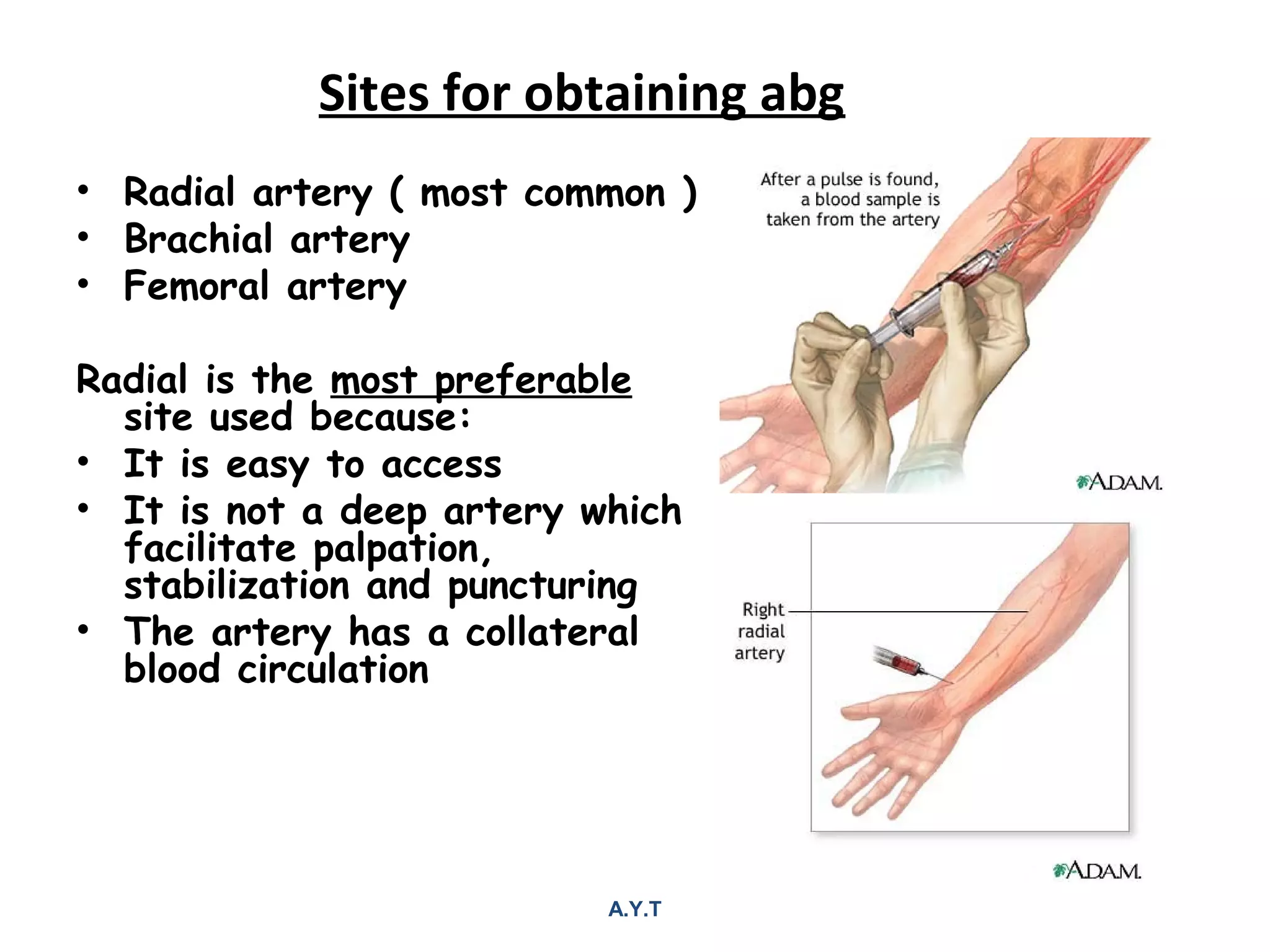
Sites for obtaining abg
• Radial artery ( most common )
• Brachial artery
• Femoral artery
Radial is the most preferable
site used because:
• It is easy to access
• It is not a deep artery which
facilitate palpation,
stabilization and puncturing
• The artery has a collateral
blood circulation
A.Y.T 7
Performance phase:
• Wash hands
• Put on gloves
• Palpate the artery for maximum pulsation
• If radial, perform Allen's test
• Place a small towel roll under the patient
wrist
• Instruct the patient to breath normally
during the test and warn him that he may
feel brief cramping or throbbing pain at the
puncture site
• Clean with alcohol swab in circular motion
• Skin and subcutaneous tissue may be
infiltrated with local anesthetic agent if
needed
A.Y.T 8
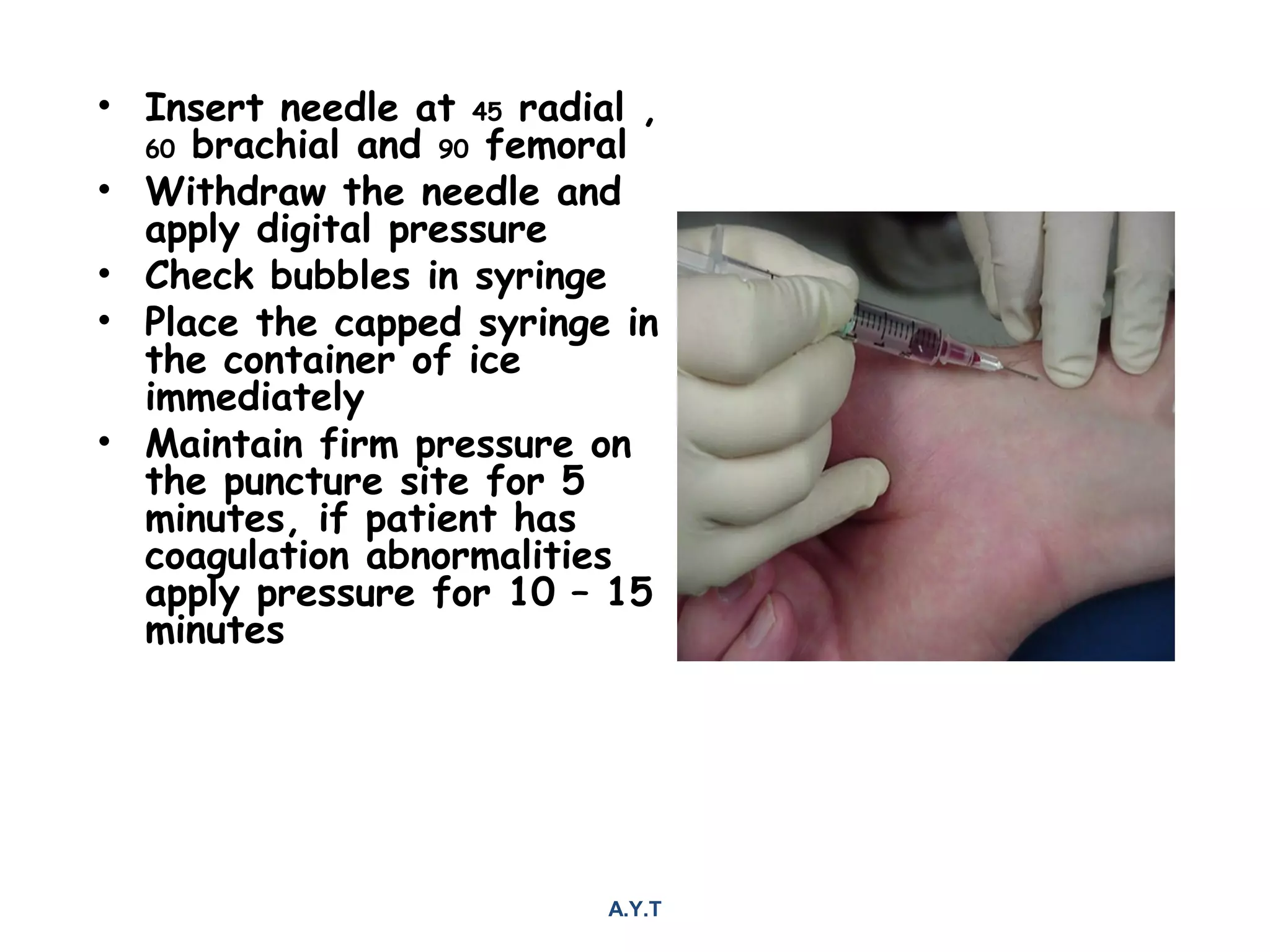
• Insert needle at 45 radial ,
60 brachial and 90 femoral
• Withdraw the needle and
apply digital pressure
• Check bubbles in syringe
• Place the capped syringe in
the container of ice
immediately
• Maintain firm pressure on
the puncture site for 5
minutes, if patient has
coagulation abnormalities
apply pressure for 10 – 15
minutes
A.Y.T 9
AIR BUBBLES
:
1. PO2 ∼150 mmHg & PCO2 ∼0 mm Hg in air bubble(R.A.)
2. Mixing with sample, lead to ↑ PaO2 & ↓ PaCO2
To avoid air bubble, sample drawn very slowly and
preferabily in glass syringe
Steady State:
Sampling should done during steady state after change in
oxygen therepy or ventilator parameter
Steady state is achieved usually within 3-10 minutes
Follow up phase:
• Send labeled, iced specimen to the lab
immediately
• Palpate the pulse distal to the puncture site
• Assess for cold hands, numbness, tingling or
discoloration
• Documentation include: results of Allen's
test, time the sample was drawn,
temperature, puncture site, time pressure
was applied and if O2 therapy is there
• Make sure it’s noted on the slip whether the
patient is breathing room air or oxygen. If
oxygen, document the number of liters . If
the patient is receiving mechanical
ventilation, FIO2 should be documented
A.Y.T 11
complication
• Arteriospasm
• Hematoma
• Hemorrhage
• Distal ischemia
• Infection
• Numbness
A.Y.T 12
ABG component
• PH:
measures hydrogen ion concentration in the
blood, it shows blood’ acidity or alkalinity
• PCO2 :
It is the partial pressure of CO2 that is carried
by the blood for excretion by the lungs, known as
respiratory parameter
• PO2:
It is the partial pressure of O2 that is dissolved in
the blood , it reflects the body ability to pick up
oxygen from the lungs
• HCO3 :
known as the metabolic parameter, it reflects the
kidney’s ability to retain and excrete bicarbonate
A .Y .T 13
Parameter 37 C (Change
every 10 min)
4 C (Change
every 10 min)
↓ pH 0.01 0.001
↑ PCO2 1 mm Hg 0.1 mm Hg
↓ PO2 0.1 vol % 0.01 vol %
Temp Effect On Change of ABG Values
A.Y.T15
Steps for ABG analysis
1. What is the pH? Acidemia or Alkalemia?
2. What is the primary disorder present?
3. Is there appropriate compensation?
4. Is the compensation acute or chronic?
5. Is there an anion gap?
6. If there is a AG check the delta gap?
Normal values:
 PH = 7.35 – 7.45
 PCO2 = 35 – 45 mmhg
 PO2 = 80 – 100 mmhg
 HCO3 = 22 – 28
meq/L
A.Y.T17
Calculation of pH
203.0
log10.6 3
PaCO
HCO
pH
×
+=
−
[ ] −
+
×=
3
2
24
HCO
PaCO
H
Henderson-
Hesselbach
equation
Step 1
 Look at the pH: is the blood acidemic or alkalemic?
pH normal value 7.35-7.45
ACIDIC:below 7.35
ALKALOSIS:above 7.45
Step 2: What is the primary disorder?
What disorder
is present?
pH pCO2 HCO3
Respiratory
Acidosis
pH low high high
Metabolic
Acidosis
pH low low low
Respiratory
Alkalosis
pH high low low
Metabolic
Alkalosis
pH high high high
ROME
Step 4:
Calculation of compensation
Mean "whole body" response equations for simple acid-base disturbances.
Note: The formula calculates the change in the compensatory parameter.
Disorder pH Primary
change
Compensatory
Response
Equation
Metabolic
Acidosis
↓ ↓ [HCO3
-
] ↓ PCO2
ΔPCO2
≈ 1.2 × ΔHCO3
Metabolic
Alkalosis
↑ ↑ [HCO3
-
] ↑ PCO2
ΔPCO2
≈ 0.7 × ΔHCO3
Respiratory
Acidosis
↓ ↑ PCO2
↑ [HCO3
-
] Acute:
ΔHCO3
-
≈ 0.1 × ΔPCO2
Chronic:
ΔHCO3
-
≈ 0.3 × ΔPCO2
Respiratory
Alkalosis
↑ ↓ PCO2
↓ [HCO3
-
] Acute:
ΔHCO3
-
≈ 0.2 × ΔPCO2
Chronic:
ΔHCO3
-
≈ 0.5 × ΔPCO2
1.2
0.7
0.1 0.3
0.2 0.5
Compensation Formula Simplified
Acute Chronic
Metabolic
Respiratory
Acidosis
Alkalosis
Acidosis
Alkalosis
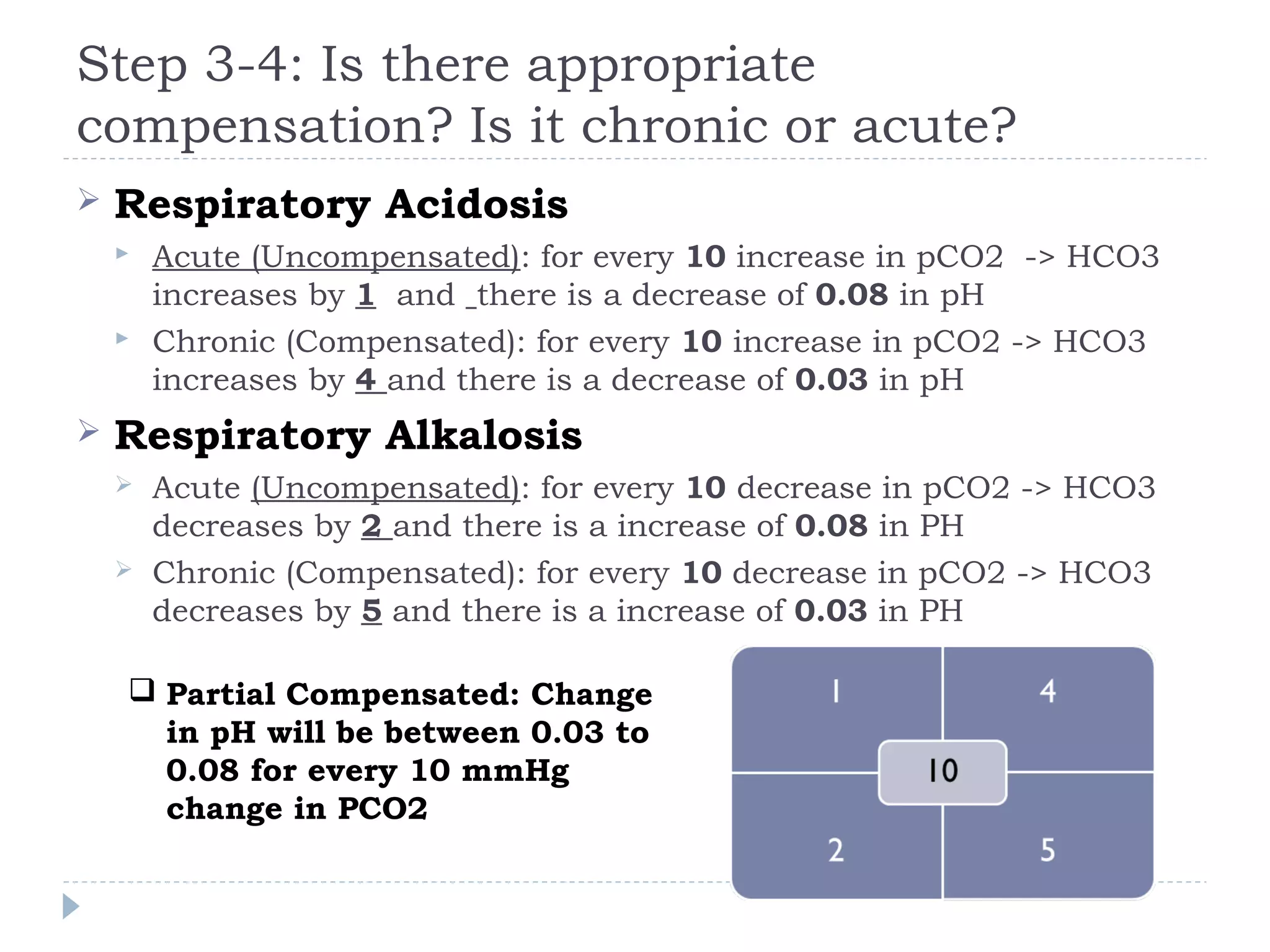
Step 3-4: Is there appropriate
compensation? Is it chronic or acute?
 Respiratory Acidosis
 Acute (Uncompensated): for every 10 increase in pCO2 -> HCO3
increases by 1 and there is a decrease of 0.08 in pH
 Chronic (Compensated): for every 10 increase in pCO2 -> HCO3
increases by 4 and there is a decrease of 0.03 in pH
 Respiratory Alkalosis
 Acute (Uncompensated): for every 10 decrease in pCO2 -> HCO3
decreases by 2 and there is a increase of 0.08 in PH
 Chronic (Compensated): for every 10 decrease in pCO2 -> HCO3
decreases by 5 and there is a increase of 0.03 in PH
 Partial Compensated: Change
in pH will be between 0.03 to
0.08 for every 10 mmHg
change in PCO2
Step 3-4: Is there appropriate
compensation?
 Metabolic Acidosis
 Winter’s formula: Expected pCO2 = 1.5[HCO3] + 8 ± 2
OR
∆ pCO2 = 1.2 (∆ HCO3)
 If serum pCO2 > expected pCO2 -> additional
respiratory acidosis and vice versa
 Metabolic Alkalosis
 Expected PCO2 = 0.7 × HCO3 + (21 ± 2)
OR
∆ pCO2 = 0.7 (∆ HCO3)
 If serum pCO2 < expected pCO2 - additional respiratory
alkalosis and vice versa
Step 5: Calculate the anion gap
 AG used to assess acid-base status esp in D/D of
metabolic acidosis
 ∆ AG & ∆ HCO3
-
used to assess mixed acid-base
disorders
AG based on principle of electroneutrality:
 Total Serum Cations = Total Serum Anions
 Na + (K + Ca + Mg) = HCO3 + Cl + (PO4 + SO4
+ Protein + Organic Acids)
 Na + UC = HCO3 + Cl + UA
 Na – (HCO3 + Cl) = UA – UC

Na – (HCO3 + Cl) = AG
 Normal =12 ± 2
Contd…
 AG corrected = AG + 2.5[4 – albumin]
 If there is an anion Gap then calculate the
Delta/delta gap (step 6) to determine
additional hidden nongap metabolic acidosis
or metabolic alkalosis
 If there is no anion gap then start analyzing
for non-anion gap acidosis
Step 6: Calculate Delta Gap
 Delta gap = (actual AG – 12) + HCO3
 Adjusted HCO3 should be 24 (+_ 6) {18-30}
 If delta gap > 30 -> additional metabolic alkalosis
 If delta gap < 18 -> additional non-gap metabolic
acidosis
 If delta gap 18 – 30 -> no additional metabolic
disorders
Step 5: Calculate the “gaps”
Anion gap = Na+
− [Cl−
+ HCO3
−
]
Δ AG = Anion gap − 12
Δ HCO3 = 24 − HCO3
Δ AG = Δ HCO3
−
, then Pure high AG Met. Acidosis
Δ AG > Δ HCO3
−
, then High AG Met Acidosis + Met. Alkalosis
Δ AG < Δ HCO3
−
, then High AG Met Acidosis + HCMA
Nongap metabolic acidosis
 For non-gap metabolic acidosis, calculate the urine anion
gap
 URINARY AG
Total Urine Cations = Total Urine Anions
Na + K + (NH4 and other UC) = Cl + UA
(Na + K) + UC = Cl + UA
(Na + K) – Cl = UA – UC
(Na + K) – Cl = AG
 Distinguish GI from renal causes of loss of HCO3 by estimating
Urinary NH4+ .
 Hence a -ve UAG (av -20 meq/L) seen in GI, while +ve value (av
+23 meq/L) seen in renal problem.
UAG = UNA + UK – UCL
Metobolic acidosis: Anion gap acidosis
Causes of nongap metabolic acidosis - DURHAM
Diarrhea, ileostomy, colostomy, enteric fistulas
Ureteral diversions or pancreatic fistulas
RTA type I or IV, early renal failure
Hyperailmentation, hydrochloric acid administration
Acetazolamide, Addison’s
Miscellaneous – post-hypocapnia, toulene, sevelamer, cholestyramine ingestion
Dictums in ABG AnalysisDictums in ABG Analysis
1. Primary change & Compensatory change always
occur in the same direction.
2. pH and Primary parameter change in the same
direction suggests a metabolic problem.
pH and Primary parameter change in the opposite
direction suggests a respiratory problem.
3. Renal and pulmonary compensatory mechanisms
return pH toward but rarely to normal.
Corollary:
A normal pH in the presence of changes in PCO2 or
HCO3 suggets a mixed acid-base disorder.
Steps for ABG analysis
1. What is the pH? Acidemia or Alkalemia?
2. What is the primary disorder present?
3. Is there appropriate compensation?
4. Is the compensation acute or chronic?
5. Is there an anion gap?
6. If there is a AG check the delta gap?
ABG

ABG

  • 1.
    ARTERIAL BLOOD GASANALYSIS S.MEENATCHI SUNDARI, II YEAR PG. A.Y.T 1
  • 2.
    DEFINITION It is adiagnostic procedure in which a blood is obtained from an artery directly by an arterial puncture or accessed by a way of indwelling arterial catheter A.Y.T 2
  • 3.
    EQUIPMENT Blood gas kitOR • 1ml /2ml syringe • 23-26 gauge needle • Stopper or cap • Alcohol swab • Disposable gloves • Plastic bag & crushed ice • Lidocaine (optional) • Vial of heparin (1:1000) • Par code or label A.Y.T 3
  • 4.
    Preparatory phase: • Recordpatient inspired oxygen concentration • Check patient temperature • Explain the procedure to the patient • Provide privacy for client • If not using hepranized syringe , hepranize the needle • Perform Allen's test • Wait at least 20 minutes before drawing blood for ABG after initiating, changing, or discontinuing oxygen therapy, or settings of mechanical ventilation, after suctioning the patient or after extubation. A.Y.T 4
  • 5.
     EXCESSIVE HEPARIN Dilutionaleffect on results ↓ HCO3 - & PaCO2 Only .05 ml heperin required for 1 ml blood. So syringe be emptied of heparin after flushing or only dead space volume is sufficient or dry heperin should be used
  • 6.
    ALLEN’S TEST It isa test done to determine that collateral circulation is present from the ulnar artery in case thrombosis occur in the radial A.Y.T 6
  • 7.
    Sites for obtainingabg • Radial artery ( most common ) • Brachial artery • Femoral artery Radial is the most preferable site used because: • It is easy to access • It is not a deep artery which facilitate palpation, stabilization and puncturing • The artery has a collateral blood circulation A.Y.T 7
  • 8.
    Performance phase: • Washhands • Put on gloves • Palpate the artery for maximum pulsation • If radial, perform Allen's test • Place a small towel roll under the patient wrist • Instruct the patient to breath normally during the test and warn him that he may feel brief cramping or throbbing pain at the puncture site • Clean with alcohol swab in circular motion • Skin and subcutaneous tissue may be infiltrated with local anesthetic agent if needed A.Y.T 8
  • 9.
    • Insert needleat 45 radial , 60 brachial and 90 femoral • Withdraw the needle and apply digital pressure • Check bubbles in syringe • Place the capped syringe in the container of ice immediately • Maintain firm pressure on the puncture site for 5 minutes, if patient has coagulation abnormalities apply pressure for 10 – 15 minutes A.Y.T 9
  • 10.
    AIR BUBBLES : 1. PO2∼150 mmHg & PCO2 ∼0 mm Hg in air bubble(R.A.) 2. Mixing with sample, lead to ↑ PaO2 & ↓ PaCO2 To avoid air bubble, sample drawn very slowly and preferabily in glass syringe Steady State: Sampling should done during steady state after change in oxygen therepy or ventilator parameter Steady state is achieved usually within 3-10 minutes
  • 11.
    Follow up phase: •Send labeled, iced specimen to the lab immediately • Palpate the pulse distal to the puncture site • Assess for cold hands, numbness, tingling or discoloration • Documentation include: results of Allen's test, time the sample was drawn, temperature, puncture site, time pressure was applied and if O2 therapy is there • Make sure it’s noted on the slip whether the patient is breathing room air or oxygen. If oxygen, document the number of liters . If the patient is receiving mechanical ventilation, FIO2 should be documented A.Y.T 11
  • 12.
    complication • Arteriospasm • Hematoma •Hemorrhage • Distal ischemia • Infection • Numbness A.Y.T 12
  • 13.
    ABG component • PH: measureshydrogen ion concentration in the blood, it shows blood’ acidity or alkalinity • PCO2 : It is the partial pressure of CO2 that is carried by the blood for excretion by the lungs, known as respiratory parameter • PO2: It is the partial pressure of O2 that is dissolved in the blood , it reflects the body ability to pick up oxygen from the lungs • HCO3 : known as the metabolic parameter, it reflects the kidney’s ability to retain and excrete bicarbonate A .Y .T 13
  • 14.
    Parameter 37 C(Change every 10 min) 4 C (Change every 10 min) ↓ pH 0.01 0.001 ↑ PCO2 1 mm Hg 0.1 mm Hg ↓ PO2 0.1 vol % 0.01 vol % Temp Effect On Change of ABG Values
  • 15.
  • 16.
    Steps for ABGanalysis 1. What is the pH? Acidemia or Alkalemia? 2. What is the primary disorder present? 3. Is there appropriate compensation? 4. Is the compensation acute or chronic? 5. Is there an anion gap? 6. If there is a AG check the delta gap?
  • 17.
    Normal values:  PH= 7.35 – 7.45  PCO2 = 35 – 45 mmhg  PO2 = 80 – 100 mmhg  HCO3 = 22 – 28 meq/L A.Y.T17
  • 18.
    Calculation of pH 203.0 log10.63 PaCO HCO pH × += − [ ] − + ×= 3 2 24 HCO PaCO H Henderson- Hesselbach equation
  • 19.
    Step 1  Lookat the pH: is the blood acidemic or alkalemic? pH normal value 7.35-7.45 ACIDIC:below 7.35 ALKALOSIS:above 7.45
  • 20.
    Step 2: Whatis the primary disorder? What disorder is present? pH pCO2 HCO3 Respiratory Acidosis pH low high high Metabolic Acidosis pH low low low Respiratory Alkalosis pH high low low Metabolic Alkalosis pH high high high ROME
  • 21.
    Step 4: Calculation ofcompensation Mean "whole body" response equations for simple acid-base disturbances. Note: The formula calculates the change in the compensatory parameter. Disorder pH Primary change Compensatory Response Equation Metabolic Acidosis ↓ ↓ [HCO3 - ] ↓ PCO2 ΔPCO2 ≈ 1.2 × ΔHCO3 Metabolic Alkalosis ↑ ↑ [HCO3 - ] ↑ PCO2 ΔPCO2 ≈ 0.7 × ΔHCO3 Respiratory Acidosis ↓ ↑ PCO2 ↑ [HCO3 - ] Acute: ΔHCO3 - ≈ 0.1 × ΔPCO2 Chronic: ΔHCO3 - ≈ 0.3 × ΔPCO2 Respiratory Alkalosis ↑ ↓ PCO2 ↓ [HCO3 - ] Acute: ΔHCO3 - ≈ 0.2 × ΔPCO2 Chronic: ΔHCO3 - ≈ 0.5 × ΔPCO2
  • 22.
    1.2 0.7 0.1 0.3 0.2 0.5 CompensationFormula Simplified Acute Chronic Metabolic Respiratory Acidosis Alkalosis Acidosis Alkalosis
  • 23.
    Step 3-4: Isthere appropriate compensation? Is it chronic or acute?  Respiratory Acidosis  Acute (Uncompensated): for every 10 increase in pCO2 -> HCO3 increases by 1 and there is a decrease of 0.08 in pH  Chronic (Compensated): for every 10 increase in pCO2 -> HCO3 increases by 4 and there is a decrease of 0.03 in pH  Respiratory Alkalosis  Acute (Uncompensated): for every 10 decrease in pCO2 -> HCO3 decreases by 2 and there is a increase of 0.08 in PH  Chronic (Compensated): for every 10 decrease in pCO2 -> HCO3 decreases by 5 and there is a increase of 0.03 in PH  Partial Compensated: Change in pH will be between 0.03 to 0.08 for every 10 mmHg change in PCO2
  • 24.
    Step 3-4: Isthere appropriate compensation?  Metabolic Acidosis  Winter’s formula: Expected pCO2 = 1.5[HCO3] + 8 ± 2 OR ∆ pCO2 = 1.2 (∆ HCO3)  If serum pCO2 > expected pCO2 -> additional respiratory acidosis and vice versa  Metabolic Alkalosis  Expected PCO2 = 0.7 × HCO3 + (21 ± 2) OR ∆ pCO2 = 0.7 (∆ HCO3)  If serum pCO2 < expected pCO2 - additional respiratory alkalosis and vice versa
  • 25.
    Step 5: Calculatethe anion gap  AG used to assess acid-base status esp in D/D of metabolic acidosis  ∆ AG & ∆ HCO3 - used to assess mixed acid-base disorders AG based on principle of electroneutrality:  Total Serum Cations = Total Serum Anions  Na + (K + Ca + Mg) = HCO3 + Cl + (PO4 + SO4 + Protein + Organic Acids)  Na + UC = HCO3 + Cl + UA  Na – (HCO3 + Cl) = UA – UC  Na – (HCO3 + Cl) = AG  Normal =12 ± 2
  • 26.
    Contd…  AG corrected= AG + 2.5[4 – albumin]  If there is an anion Gap then calculate the Delta/delta gap (step 6) to determine additional hidden nongap metabolic acidosis or metabolic alkalosis  If there is no anion gap then start analyzing for non-anion gap acidosis
  • 27.
    Step 6: CalculateDelta Gap  Delta gap = (actual AG – 12) + HCO3  Adjusted HCO3 should be 24 (+_ 6) {18-30}  If delta gap > 30 -> additional metabolic alkalosis  If delta gap < 18 -> additional non-gap metabolic acidosis  If delta gap 18 – 30 -> no additional metabolic disorders
  • 28.
    Step 5: Calculatethe “gaps” Anion gap = Na+ − [Cl− + HCO3 − ] Δ AG = Anion gap − 12 Δ HCO3 = 24 − HCO3 Δ AG = Δ HCO3 − , then Pure high AG Met. Acidosis Δ AG > Δ HCO3 − , then High AG Met Acidosis + Met. Alkalosis Δ AG < Δ HCO3 − , then High AG Met Acidosis + HCMA
  • 29.
    Nongap metabolic acidosis For non-gap metabolic acidosis, calculate the urine anion gap  URINARY AG Total Urine Cations = Total Urine Anions Na + K + (NH4 and other UC) = Cl + UA (Na + K) + UC = Cl + UA (Na + K) – Cl = UA – UC (Na + K) – Cl = AG  Distinguish GI from renal causes of loss of HCO3 by estimating Urinary NH4+ .  Hence a -ve UAG (av -20 meq/L) seen in GI, while +ve value (av +23 meq/L) seen in renal problem. UAG = UNA + UK – UCL
  • 30.
  • 31.
    Causes of nongapmetabolic acidosis - DURHAM Diarrhea, ileostomy, colostomy, enteric fistulas Ureteral diversions or pancreatic fistulas RTA type I or IV, early renal failure Hyperailmentation, hydrochloric acid administration Acetazolamide, Addison’s Miscellaneous – post-hypocapnia, toulene, sevelamer, cholestyramine ingestion
  • 32.
    Dictums in ABGAnalysisDictums in ABG Analysis 1. Primary change & Compensatory change always occur in the same direction. 2. pH and Primary parameter change in the same direction suggests a metabolic problem. pH and Primary parameter change in the opposite direction suggests a respiratory problem. 3. Renal and pulmonary compensatory mechanisms return pH toward but rarely to normal. Corollary: A normal pH in the presence of changes in PCO2 or HCO3 suggets a mixed acid-base disorder.
  • 33.
    Steps for ABGanalysis 1. What is the pH? Acidemia or Alkalemia? 2. What is the primary disorder present? 3. Is there appropriate compensation? 4. Is the compensation acute or chronic? 5. Is there an anion gap? 6. If there is a AG check the delta gap?

Editor's Notes

  • #6 25% lower values if 1ml sample taken in 10 ml syringe (0.25 ml heparin in needle) Syringes must be &amp;gt; 50% full with blood sample
  • #17 Just read the steps off the slides. Quick overview . Determine if you have acidemia or alkalemia based on the PH Here we determine primary disorder is it respiratory or metabolic Check to see if there is appropriate compensation for the primary disorder in order to figure if its simple or mixed disorder Then analyze if this is an acute event or chronic Always look to see if there is an anion gap Due the other calculation depending on the underlying primary source . Such as if AG acidosis check to see if there is also a Delta gap to see if there is also non-anion gap present And lastly then come up with a DDX
  • #21 Just go over the table Then point out the arrows :A quick trick is to determine respiratory versus metabolic is : If PH and PCO2 are going in the opposite direction : then its respiratory, If PH and PCO2 are going in same directions then its metabolic. - Be careful with the mixed disorders using the trick.
  • #24 You need to memorize these and know it by heart . Then quickly go over the changes Then summarize : The easiest one is that for acute situations for every change of 10 in the PCO2 there is should be a change of 0.08 in PH and in chronic situation there should be a change of 0.03 . If there is a different change then know that there is most likely a mixed disorder In ac resp alkalosis, imm response to fall in CO2 (&amp; H2CO3)  release of H+ by blood and tissue buffers  react with HCO3-  fall in HCO3- (usually not less than 18) and fall in pH Cellular uptake of HCO3- in exchange for Cl- Steady state in 15 min - persists for 6 hrs After 6 hrs kidneys increase excretion of HCO3- (usually not less than 12-14) Steady state reached in 11/2 to 3 days. Timing of onset of hypocapnia usually not known except for pts on MV. Hence progression to subac and ch resp alkalosis indistinct in clinical practice Imm response to rise in CO2 (&amp; H2CO3)  blood and tissue buffers take up H+ ions, H2CO3 dissociates and HCO3- increases with rise in pH. Steady state reached in 10 min &amp; lasts for 8 hours. PCO2 of CSF changes rapidly to match PaCO2. Hypercapnia that persists &amp;gt; few hours induces an increase in CSF HCO3- that reaches max by 24 hr and partly restores the CSF pH. After 8 hrs, kidneys generate HCO3- Steady state reached in 3-5 d
  • #25 Metabolic acidosis is the disorder you will mostly encounter in the hospital. You must memorize Winter’s formula Winter’s formula calculates the expected pCO2 in the setting of metabolic acidosis. If the serum pCO2 &amp;gt; expected pCO2 then there is additional respiratory acidosis in which the etiology needs to also be determined.
  • #26 Always calculate the AG . (fyi most BMP ordered calculate the gap for you but need to memorize the formula) Don’t forget to look at albumin and adjust the calculated gap. If albumin is less than 4 then add 2.5 to your gap for every decrease of 1 Delta/Delta gap needs to be calculated to see if there is other underlying acidosis/alkolosis that are present
  • #28 Must memorize how to calculate the delta gap Just read off the slide
  • #30 - Go over the table - Most common cause in the hospital is IV fluids and Diarrhea
  • #31 Go over the table One thing to watch out for is Toluene (initially high gap, subsequent excretion of metabolites normalizes gap) Calculate osmol gap to determine if osmotically active ingestions (methanol, paraldehyde) are the cause of the gap metabolic acidosis. Other ingestions are toluene, isopropyl alcohol.
  • #34 Just read the steps off the slides. Quick overview . Determine if you have acidemia or alkalemia based on the PH Here we determine primary disorder is it respiratory or metabolic Check to see if there is appropriate compensation for the primary disorder in order to figure if its simple or mixed disorder Then analyze if this is an acute event or chronic Always look to see if there is an anion gap Due the other calculation depending on the underlying primary source . Such as if AG acidosis check to see if there is also a Delta gap to see if there is also non-anion gap present And lastly then come up with a DDX