S W A T I L E K H A D A S
M . S C N U R S E
ABG ANALYSIS
INTRODUCTION
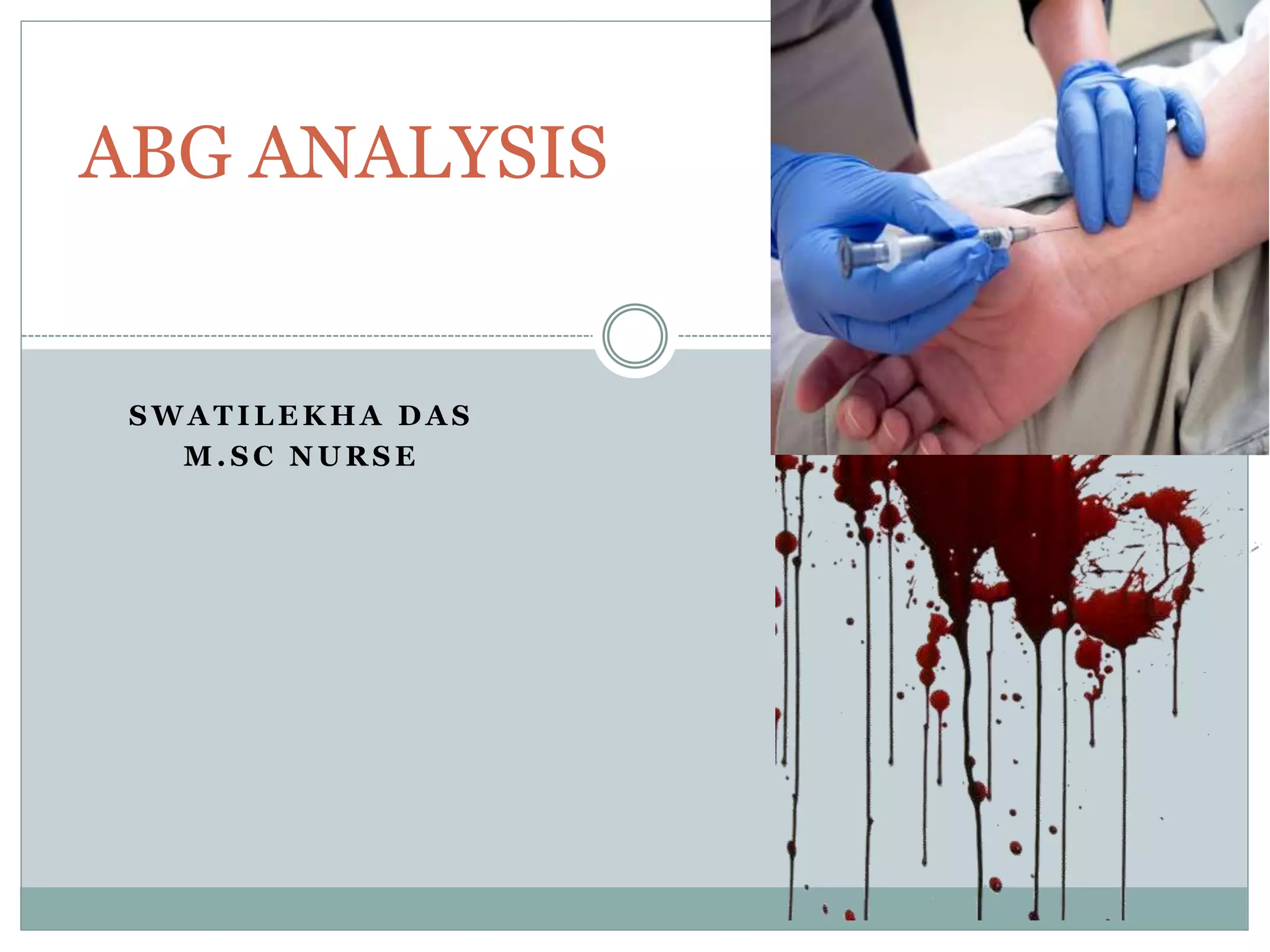
An arterial blood gas (ABG) is a blood test that is
performed using blood from an artery. It involves
puncturing an artery with a thin needle and syringe
and drawing a small volume of blood. The most
common puncture site is the radial artery at the wrist,
but sometimes the femoral artery in the groin or other
sites are used. The blood can also be drawn from
an arterial catheter.
DEFINITION OF ABG TEST
 An ABG is a test that measures the arterial oxyegen
tension (PaO2),carbon dioxide tension (PaCO2), and
acidity (pH). In addition,arterial oxyhemoglobin
saturation (SaO2) can be determined. Such
information is vital when caring for patients with
critical illness or respiratory disease.
 As a result, the ABG is one of the most common tests
performed on patients in intensive care units (ICUs).
PURPOSES OF ABG TEST
 The test is used to determine the pH of the blood, the
partial pressure of carbon dioxide and oxygen , and the
bicarbonate level.
 Many blood gas analyzers will also report concentrations
of lactate, hemoglobin, several electrolytes,
oxyhemoglobin, carboxy-hemoglobin and met-
hemoglobin.
 ABG testing is mainly used in pulmonology and critical
care medicine to determine gas exchange, which reflects
gas exchange across the alveolar-capillary membrane.
ABG testing also has a variety of applications in other
areas of medicine.
SAMPLING AND ANALYSIS
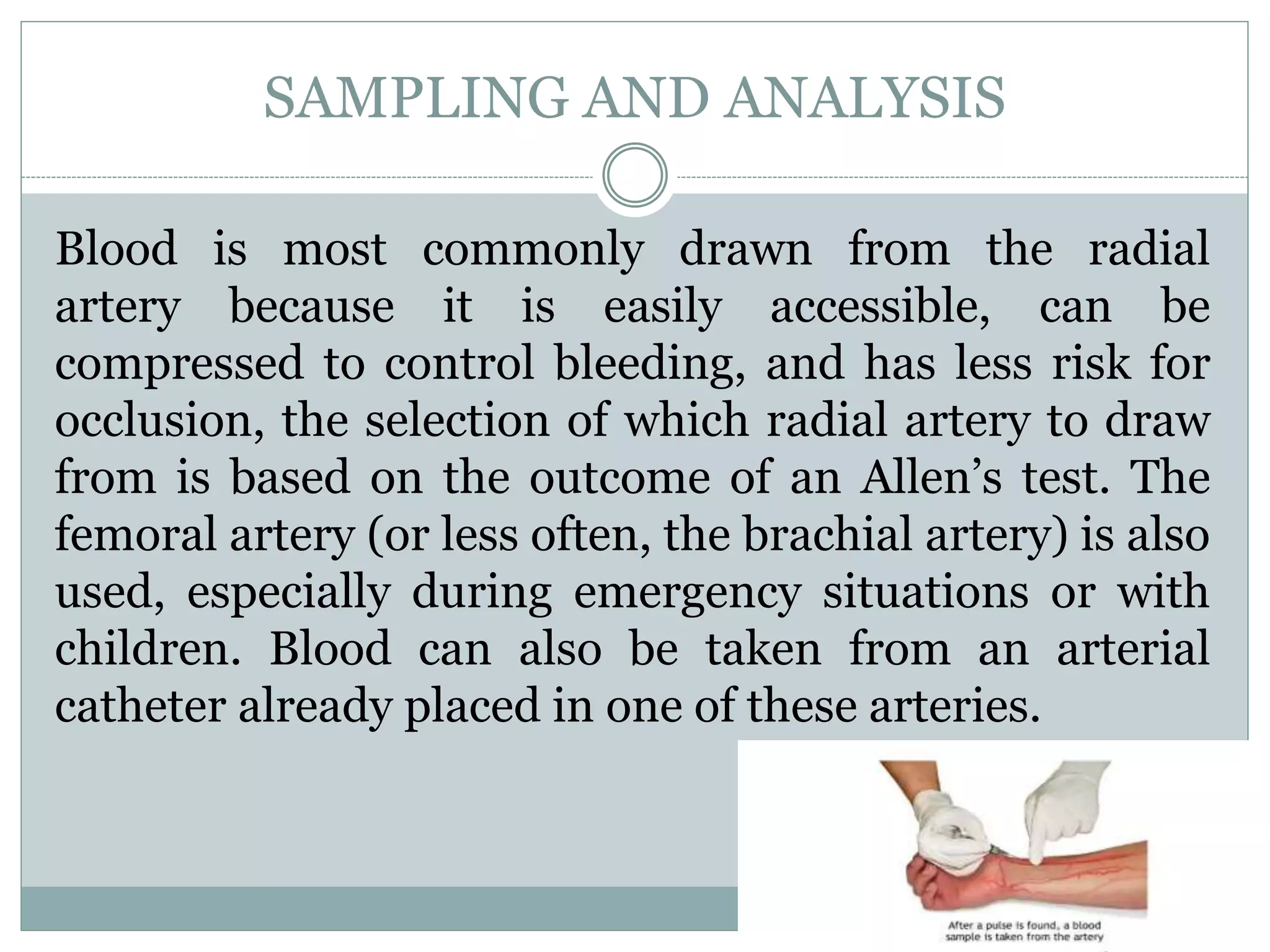
Blood is most commonly drawn from the radial
artery because it is easily accessible, can be
compressed to control bleeding, and has less risk for
occlusion, the selection of which radial artery to draw
from is based on the outcome of an Allen’s test. The
femoral artery (or less often, the brachial artery) is also
used, especially during emergency situations or with
children. Blood can also be taken from an arterial
catheter already placed in one of these arteries.
The syringe is pre-packaged and contains a small
amount of heparin, to prevent coagulation or needs to
be heparinised, by drawing up a small amount of
heparin and squirting it out again. Once the sample is
obtained, care is taken to eliminate visible gas bubbles,
as these bubbles can dissolve into the sample and
cause inaccurate results. The sealed syringe is taken to
a blood gas analyzer. If the sample cannot be analyzed
within 10–15 minutes, it must be placed on ice for
valid results. Even when placed on ice, samples should
still be analyzed within 1 hour.
NORMAL PARAMETERS
Normal values (at"sea"level):
 pH- 7.35-7.45
 pCO2 - 35-45mmHg
 pO2- 80-100mmHg
 O2 Saturation -95- 100%
 HCO3- 22- 26mEq/L
 Base excess : + or – 2 mmole/L
 Sodium – 135 – 145 mmole/L
 Calcium – 1.120 – 1.32 mmole/L
 Chlorine – 98 – 107 mmole/L
 Potassium – 3.5 – 4.5 mmole/L
THE 6 EASY STEPS TO ABG ANALYSIS
 Step 1: Analyze the pH
The first step in analyzing ABGs is to look at the pH. Normal blood pH
is 7.4 plus or minus 0.05, forming the range 7.35 to 7.45. If blood pH
falls below 7.35 it is acidic. If blood pH rises above 7.45, it is alkalotic.
If it falls into the normal range, label what side of 7.4 it falls on. Lower
than 7.4 is normal/acidic, higher than 7.4 is normal/alkalotic.
 Step2: Analyze the CO2
The second step is to examine the pCO2. Normal pCO2 levels are 35-
45mmHg. Below 35 is alkalotic, above 45 is acidic. Label it.
 Step 3: Analyze the HCO3
The third step is to look at the HCO3 level. A normal HCO3 level is 22-
26 mEq/L. If the HCO3 is below 22, the patient is acidotic. If the
HCO3 is above 26, the patient is alkalotic. Label it.
 Step 4: Match the CO2 or the HCO3 with the pH
Next match either the pCO2 or the HCO3 with the pH to determine the acid-base
disorder. For example, if the pH is acidotic, and the CO2 is acidotic, then the acid-
base disturbance is being caused by the respiratory system. Therefore, we call it a
respiratory acidosis. However, if the pH is alkalotic and the HCO3 is alkalotic, the
acid base disturbance is being caused by the metabolic (or renal) system.
Therefore, it will be a metabolic alkalosis.
 Step 5: Does the CO2 or HCO3 go the opposite direction of the pH
Fifth, does either the CO2 or HCO3 go in the opposite direction of the pH. If so,
there is compensation by that system. For example, the pH is acidotic, the CO2 is
acidotic, and the HCO3 is alkalotic. The CO2 matches the pH making the primary
acid-base disorder respiratory acidosis. The HCO3 is opposite of the pH and
would be evidence of compensation from the metabolic system.
 Step 6: Analyze the pO2 and the O2 saturation.
Finally, evaluate the PaO2 and O2 saturation. If they are below normal there is
evidence of hypoxemia.
ANALYSIS OF SAMPLES
SAMPLE 1:
 Patient name: Mrs. Bani Paul
 Age: 53 years, Sex: Female
 ID no: 122768
 Doctor: Dr. S. Mukherjee
 Date of operation: 6.3.2014
 Name of the operation: CABG X 4 – LIMA – LAD, RSVG – OM1, OM2, PDA
 PO2: 220.8 mmHg
 PCO2: 35.7 mmHg
 pH: 7.448
 tHb: 11.8 g/dl
 SO2: 99.5%
 Na: 136mmol/L
 Ca: 0.96mmol/L
 Cl: 98.1mmol/L
 K: 3.57mmol/L
 Hct: 32.6%
 BE: 0.6mmol/L
 BEecf: 0.4mmol/L
 HCO3: 23.7 mmol/L
 P50 : 25.7 mmHg
 Ct02: 14.4 vol %
SAMPLE 1
 From the above sample we can conclude or infer
that the pH is normal, PO2 is normal, PCO2 is
normal and the HCO3 is normal, it can be
concluded that there is no acid – base disturbances
but there is electrolyte disturbances.
 The ABG report signifies: Hypokalemia and
hypocalcimia.
SAMPLE 2
 Patient name: Mr. Bipin Debnath
 Age: 59 years, Sex: Male
 ID no: 122769
 Doctor: Dr. L. Kapoor
 Date of operation: 12.3.2014
 Name of the operation: CABG X 1 – LIMA – LAD
 PO2: 103.2 mmHg
 PCO2: 31.3 mmHg
 pH: 7.520
 tHb: 8.3g/dl
 SO2: 99.2%
 Na: 138.2mmol/L
 Ca: 0.859mmol/L
 Cl: 92.8mmol/L
 K: 3.87mmol/L
 Hct: 33.3%
 BE: 1.7mmol/L
 BEecf:1.2mmol/L
 HCO3: 23.8mmol/L
 P50 : 24.7mmHg
 Ct02: 13.3 vol%
SAMPLE 2
 From the above sample we can conclude or infer that
the pH is high, PO2 is normal, PCO2 is less and the
HCO3 is normal, it can be said that there is
respiratory alkalosis. Sodium and calcium are low.
 The ABG report signifies: Respiratory alkalosis
with hyponatremia and hypocalcimia.
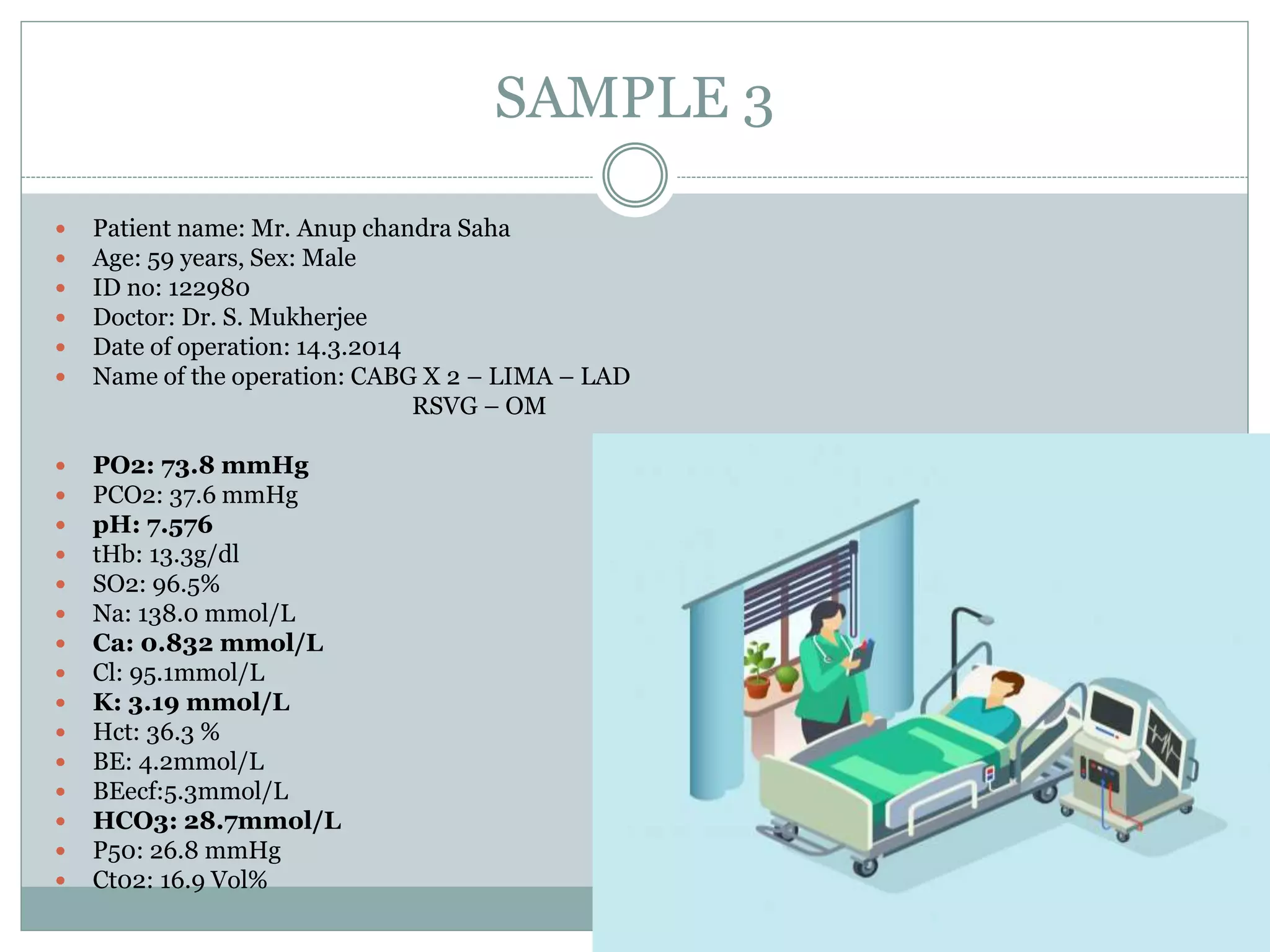
SAMPLE 3
 Patient name: Mr. Anup chandra Saha
 Age: 59 years, Sex: Male
 ID no: 122980
 Doctor: Dr. S. Mukherjee
 Date of operation: 14.3.2014
 Name of the operation: CABG X 2 – LIMA – LAD
RSVG – OM
 PO2: 73.8 mmHg
 PCO2: 37.6 mmHg
 pH: 7.576
 tHb: 13.3g/dl
 SO2: 96.5%
 Na: 138.0 mmol/L
 Ca: 0.832 mmol/L
 Cl: 95.1mmol/L
 K: 3.19 mmol/L
 Hct: 36.3 %
 BE: 4.2mmol/L
 BEecf:5.3mmol/L
 HCO3: 28.7mmol/L
 P50: 26.8 mmHg
 Ct02: 16.9 Vol%
SAMPLE 3
 From the above sample we can conclude or infer that
the pH is high, PO2 is low, PCO2 is normal and the
HCO3 is high. K: low and Ca:low.
 The ABG report signifies: Metabolic alkalosis with
electrolyte imbalance i.e. hypokalemia and
hypocalcemia.
SAMPLE 4
 Patient name: Mrs. Purba Mandal
 Age: 63 years, Sex: Male
 ID no: 122560
 Doctor: Dr. S. Mukherjee
 Date of operation: 20.3.2014
 Name of the operation: CABG X 3 – LIMA – LAD
RSVG – OM1, D1
 PO2: 63.5 mmHg
 PCO2: 32.0 mmHg
 pH: 7.49
 tHb: 13.5g/dl
 SO2: 93.1%
 Na: 133.8mmol/L
 Ca: 1.052mmol/L
 Cl: 95.9 mmol/L
 K: 4.47 mmol/L
 Hct: 43.6 %
 BE: - 4.5mmol/L
 BEecf:- 5.3mmol/L
 HCO3: 19.7 mmol/L
SAMPLE 4
 From the above sample we can conclude or infer that
the pH is high, PO2 is low, PCO2 is low and the
HCO3 is low, it can be said that there is respiratory
alkalosis.
 The ABG report signifies: Compensated respiratory
alkalosis with hypoxemia, hyponatremia and
hypocalcemia.
SAMPLE 5
 Patient name: Mr. Sourin Sahoo
 Age: 60 years, Sex: Male
 ID no: 122348
 Doctor: Dr. L. Kapoor
 Date of operation: 22.3.2014
 Name of the operation: CABG X 3 – LIMA – LAD
RSVG – OM, PDA
 PO2: 236.2 mmHg
 PCO2: 48.8 mmHg
 pH: 7.324
 tHb: 10.7 g/dl
 SO2: 98.7%
 Na: 133.8mmol/L
 Ca: 1.086mmol/L
 Cl: 107.0mmol/L
 K: 3.82mmol/L
 Hct: 31.6%
 BE: -1.0mmol/L
 BEecf: - 0.8mmol/L
 HCO3: 22.3 mmol/L
 P50 : 26.6 mmHg
 Cto2: 14.3 Vol %.
SAMPLE 5
 From the above sample we can conclude or infer that
the pH is low, PO2 is high, PCO2 is high and the
HCO3 is normal, SO2 is normal; it can be said that
there is respiratory acidosis.
 The ABG report signifies: Respiratory acidosis with
hypocalcemia.
CONCLUSION
Due to the increase in patient dependency it is no
longer unusual for nurses to be caring for patients who
need frequent ABG analysis.
Nurses are often the first members of the health care
team to see ABG results and an understanding of their
significance and the ability to decide when medical
staffs need to be informed is important.
ABG analysis(easy interpretation) easy and simple-5 sample analyses are done

ABG analysis(easy interpretation) easy and simple-5 sample analyses are done

  • 1.
    S W AT I L E K H A D A S M . S C N U R S E ABG ANALYSIS
  • 2.
    INTRODUCTION An arterial bloodgas (ABG) is a blood test that is performed using blood from an artery. It involves puncturing an artery with a thin needle and syringe and drawing a small volume of blood. The most common puncture site is the radial artery at the wrist, but sometimes the femoral artery in the groin or other sites are used. The blood can also be drawn from an arterial catheter.
  • 3.
    DEFINITION OF ABGTEST  An ABG is a test that measures the arterial oxyegen tension (PaO2),carbon dioxide tension (PaCO2), and acidity (pH). In addition,arterial oxyhemoglobin saturation (SaO2) can be determined. Such information is vital when caring for patients with critical illness or respiratory disease.  As a result, the ABG is one of the most common tests performed on patients in intensive care units (ICUs).
  • 4.
    PURPOSES OF ABGTEST  The test is used to determine the pH of the blood, the partial pressure of carbon dioxide and oxygen , and the bicarbonate level.  Many blood gas analyzers will also report concentrations of lactate, hemoglobin, several electrolytes, oxyhemoglobin, carboxy-hemoglobin and met- hemoglobin.  ABG testing is mainly used in pulmonology and critical care medicine to determine gas exchange, which reflects gas exchange across the alveolar-capillary membrane. ABG testing also has a variety of applications in other areas of medicine.
  • 5.
    SAMPLING AND ANALYSIS Bloodis most commonly drawn from the radial artery because it is easily accessible, can be compressed to control bleeding, and has less risk for occlusion, the selection of which radial artery to draw from is based on the outcome of an Allen’s test. The femoral artery (or less often, the brachial artery) is also used, especially during emergency situations or with children. Blood can also be taken from an arterial catheter already placed in one of these arteries.
  • 6.
    The syringe ispre-packaged and contains a small amount of heparin, to prevent coagulation or needs to be heparinised, by drawing up a small amount of heparin and squirting it out again. Once the sample is obtained, care is taken to eliminate visible gas bubbles, as these bubbles can dissolve into the sample and cause inaccurate results. The sealed syringe is taken to a blood gas analyzer. If the sample cannot be analyzed within 10–15 minutes, it must be placed on ice for valid results. Even when placed on ice, samples should still be analyzed within 1 hour.
  • 7.
    NORMAL PARAMETERS Normal values(at"sea"level):  pH- 7.35-7.45  pCO2 - 35-45mmHg  pO2- 80-100mmHg  O2 Saturation -95- 100%  HCO3- 22- 26mEq/L  Base excess : + or – 2 mmole/L  Sodium – 135 – 145 mmole/L  Calcium – 1.120 – 1.32 mmole/L  Chlorine – 98 – 107 mmole/L  Potassium – 3.5 – 4.5 mmole/L
  • 8.
    THE 6 EASYSTEPS TO ABG ANALYSIS  Step 1: Analyze the pH The first step in analyzing ABGs is to look at the pH. Normal blood pH is 7.4 plus or minus 0.05, forming the range 7.35 to 7.45. If blood pH falls below 7.35 it is acidic. If blood pH rises above 7.45, it is alkalotic. If it falls into the normal range, label what side of 7.4 it falls on. Lower than 7.4 is normal/acidic, higher than 7.4 is normal/alkalotic.  Step2: Analyze the CO2 The second step is to examine the pCO2. Normal pCO2 levels are 35- 45mmHg. Below 35 is alkalotic, above 45 is acidic. Label it.  Step 3: Analyze the HCO3 The third step is to look at the HCO3 level. A normal HCO3 level is 22- 26 mEq/L. If the HCO3 is below 22, the patient is acidotic. If the HCO3 is above 26, the patient is alkalotic. Label it.
  • 9.
     Step 4:Match the CO2 or the HCO3 with the pH Next match either the pCO2 or the HCO3 with the pH to determine the acid-base disorder. For example, if the pH is acidotic, and the CO2 is acidotic, then the acid- base disturbance is being caused by the respiratory system. Therefore, we call it a respiratory acidosis. However, if the pH is alkalotic and the HCO3 is alkalotic, the acid base disturbance is being caused by the metabolic (or renal) system. Therefore, it will be a metabolic alkalosis.  Step 5: Does the CO2 or HCO3 go the opposite direction of the pH Fifth, does either the CO2 or HCO3 go in the opposite direction of the pH. If so, there is compensation by that system. For example, the pH is acidotic, the CO2 is acidotic, and the HCO3 is alkalotic. The CO2 matches the pH making the primary acid-base disorder respiratory acidosis. The HCO3 is opposite of the pH and would be evidence of compensation from the metabolic system.  Step 6: Analyze the pO2 and the O2 saturation. Finally, evaluate the PaO2 and O2 saturation. If they are below normal there is evidence of hypoxemia.
  • 10.
    ANALYSIS OF SAMPLES SAMPLE1:  Patient name: Mrs. Bani Paul  Age: 53 years, Sex: Female  ID no: 122768  Doctor: Dr. S. Mukherjee  Date of operation: 6.3.2014  Name of the operation: CABG X 4 – LIMA – LAD, RSVG – OM1, OM2, PDA  PO2: 220.8 mmHg  PCO2: 35.7 mmHg  pH: 7.448  tHb: 11.8 g/dl  SO2: 99.5%  Na: 136mmol/L  Ca: 0.96mmol/L  Cl: 98.1mmol/L  K: 3.57mmol/L  Hct: 32.6%  BE: 0.6mmol/L  BEecf: 0.4mmol/L  HCO3: 23.7 mmol/L  P50 : 25.7 mmHg  Ct02: 14.4 vol %
  • 11.
    SAMPLE 1  Fromthe above sample we can conclude or infer that the pH is normal, PO2 is normal, PCO2 is normal and the HCO3 is normal, it can be concluded that there is no acid – base disturbances but there is electrolyte disturbances.  The ABG report signifies: Hypokalemia and hypocalcimia.
  • 12.
    SAMPLE 2  Patientname: Mr. Bipin Debnath  Age: 59 years, Sex: Male  ID no: 122769  Doctor: Dr. L. Kapoor  Date of operation: 12.3.2014  Name of the operation: CABG X 1 – LIMA – LAD  PO2: 103.2 mmHg  PCO2: 31.3 mmHg  pH: 7.520  tHb: 8.3g/dl  SO2: 99.2%  Na: 138.2mmol/L  Ca: 0.859mmol/L  Cl: 92.8mmol/L  K: 3.87mmol/L  Hct: 33.3%  BE: 1.7mmol/L  BEecf:1.2mmol/L  HCO3: 23.8mmol/L  P50 : 24.7mmHg  Ct02: 13.3 vol%
  • 13.
    SAMPLE 2  Fromthe above sample we can conclude or infer that the pH is high, PO2 is normal, PCO2 is less and the HCO3 is normal, it can be said that there is respiratory alkalosis. Sodium and calcium are low.  The ABG report signifies: Respiratory alkalosis with hyponatremia and hypocalcimia.
  • 14.
    SAMPLE 3  Patientname: Mr. Anup chandra Saha  Age: 59 years, Sex: Male  ID no: 122980  Doctor: Dr. S. Mukherjee  Date of operation: 14.3.2014  Name of the operation: CABG X 2 – LIMA – LAD RSVG – OM  PO2: 73.8 mmHg  PCO2: 37.6 mmHg  pH: 7.576  tHb: 13.3g/dl  SO2: 96.5%  Na: 138.0 mmol/L  Ca: 0.832 mmol/L  Cl: 95.1mmol/L  K: 3.19 mmol/L  Hct: 36.3 %  BE: 4.2mmol/L  BEecf:5.3mmol/L  HCO3: 28.7mmol/L  P50: 26.8 mmHg  Ct02: 16.9 Vol%
  • 15.
    SAMPLE 3  Fromthe above sample we can conclude or infer that the pH is high, PO2 is low, PCO2 is normal and the HCO3 is high. K: low and Ca:low.  The ABG report signifies: Metabolic alkalosis with electrolyte imbalance i.e. hypokalemia and hypocalcemia.
  • 16.
    SAMPLE 4  Patientname: Mrs. Purba Mandal  Age: 63 years, Sex: Male  ID no: 122560  Doctor: Dr. S. Mukherjee  Date of operation: 20.3.2014  Name of the operation: CABG X 3 – LIMA – LAD RSVG – OM1, D1  PO2: 63.5 mmHg  PCO2: 32.0 mmHg  pH: 7.49  tHb: 13.5g/dl  SO2: 93.1%  Na: 133.8mmol/L  Ca: 1.052mmol/L  Cl: 95.9 mmol/L  K: 4.47 mmol/L  Hct: 43.6 %  BE: - 4.5mmol/L  BEecf:- 5.3mmol/L  HCO3: 19.7 mmol/L
  • 17.
    SAMPLE 4  Fromthe above sample we can conclude or infer that the pH is high, PO2 is low, PCO2 is low and the HCO3 is low, it can be said that there is respiratory alkalosis.  The ABG report signifies: Compensated respiratory alkalosis with hypoxemia, hyponatremia and hypocalcemia.
  • 18.
    SAMPLE 5  Patientname: Mr. Sourin Sahoo  Age: 60 years, Sex: Male  ID no: 122348  Doctor: Dr. L. Kapoor  Date of operation: 22.3.2014  Name of the operation: CABG X 3 – LIMA – LAD RSVG – OM, PDA  PO2: 236.2 mmHg  PCO2: 48.8 mmHg  pH: 7.324  tHb: 10.7 g/dl  SO2: 98.7%  Na: 133.8mmol/L  Ca: 1.086mmol/L  Cl: 107.0mmol/L  K: 3.82mmol/L  Hct: 31.6%  BE: -1.0mmol/L  BEecf: - 0.8mmol/L  HCO3: 22.3 mmol/L  P50 : 26.6 mmHg  Cto2: 14.3 Vol %.
  • 19.
    SAMPLE 5  Fromthe above sample we can conclude or infer that the pH is low, PO2 is high, PCO2 is high and the HCO3 is normal, SO2 is normal; it can be said that there is respiratory acidosis.  The ABG report signifies: Respiratory acidosis with hypocalcemia.
  • 20.
    CONCLUSION Due to theincrease in patient dependency it is no longer unusual for nurses to be caring for patients who need frequent ABG analysis. Nurses are often the first members of the health care team to see ABG results and an understanding of their significance and the ability to decide when medical staffs need to be informed is important.