
WATER, ELECTROLYTE AND PH
BALANCE
BY
SONI KUMARI SHAH
Electrolytes
Electrolytes are minerals found in bodily fluid that carry an
electric charge.
Electrolytes in living system includes Sodium, Potassium,
Chloride, Bicarbonate, Calcium, Phosphate, Magnesium,
Copper Zinc, Iron, Manganese, Molybdenum And Chromium.
In terms of body function, six electrolytes are most important:
Sodium, Potassium, Chloride, Bicarbonate, Calcium And
Phosphate.
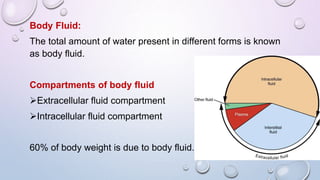
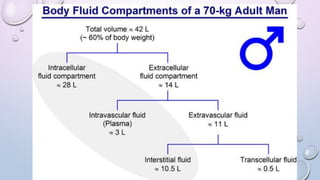
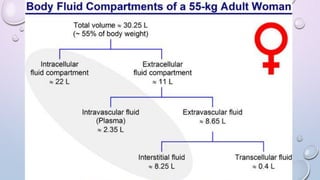
Body Fluid:
The total amount of water present in different forms is known
as body fluid.
Compartments of body fluid
Extracellular fluid compartment
Intracellular fluid compartment
60% of body weight is due to body fluid.
Intracellular Fluid Compartment
The fluid present inside the cells is called intracellular fluid.
It includes water and electrolytes within the cell.
About 40% of total body weight is constitute by intracellular
fluid.
Extracellular Fluid Compartment
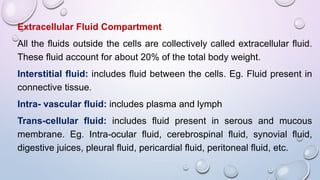
All the fluids outside the cells are collectively called extracellular fluid.
These fluid account for about 20% of the total body weight.
Interstitial fluid: includes fluid between the cells. Eg. Fluid present in
connective tissue.
Intra- vascular fluid: includes plasma and lymph
Trans-cellular fluid: includes fluid present in serous and mucous
membrane. Eg. Intra-ocular fluid, cerebrospinal fluid, synovial fluid,
digestive juices, pleural fluid, pericardial fluid, peritoneal fluid, etc.
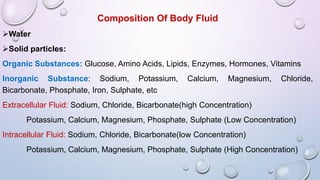
Composition Of Body Fluid
Water
Solid particles:
Organic Substances: Glucose, Amino Acids, Lipids, Enzymes, Hormones, Vitamins
Inorganic Substance: Sodium, Potassium, Calcium, Magnesium, Chloride,
Bicarbonate, Phosphate, Iron, Sulphate, etc
Extracellular Fluid: Sodium, Chloride, Bicarbonate(high Concentration)
Potassium, Calcium, Magnesium, Phosphate, Sulphate (Low Concentration)
Intracellular Fluid: Sodium, Chloride, Bicarbonate(low Concentration)
Potassium, Calcium, Magnesium, Phosphate, Sulphate (High Concentration)
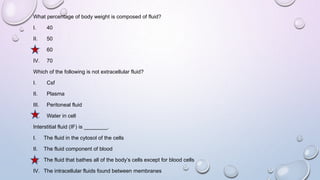
What percentage of body weight is composed of fluid?
I. 40
II. 50
III. 60
IV. 70
Which of the following is not extracellular fluid?
I. Csf
II. Plasma
III. Peritoneal fluid
IV. Water in cell
Interstitial fluid (IF) is ________.
I. The fluid in the cytosol of the cells
II. The fluid component of blood
III. The fluid that bathes all of the body’s cells except for blood cells
IV. The intracellular fluids found between membranes
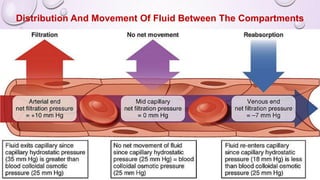
Distribution And Movement Of Fluid Between The Compartments
MECHANISM OF WATER BALANCE AND REGULATION
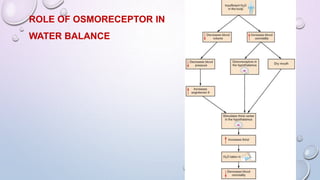
ROLE OF OSMORECEPTOR IN
WATER BALANCE
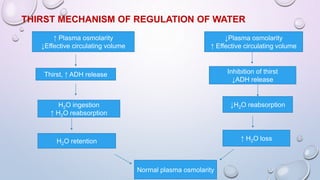
THIRST MECHANISM OF REGULATION OF WATER
↑ Plasma osmolarity
↓Effective circulating volume
Thirst, ↑ ADH release
H2O ingestion
↑ H2O reabsorption
H2O retention
Normal plasma osmolarity
↓Plasma osmolarity
↑ Effective circulating volume
Inhibition of thirst
↓ADH release
↑ H2O loss
↓H2O reabsorption
MECHANISM OF ELECTROLYTE BALANCE AND REGULATION
Electrolytes are in balance when the concentration of individual electrolytes in
the body fluid compartments are normal and remain relatively constant.
The primary regulation of electrolyte balance is through active reabsorption of
positive ions.
Acid and Base:
Any compound which forms hydrogen ion in solution is acid. Also called
proton donor.
The compound which combines with hydrogen ion in solution is base.
Also called proton acceptors.
Buffer:
The solution which have the ability to maintain constant pH despite of
addition of strong acid or strong base is called buffer solutions.
It plays an important role in maintaining acid base balance of our body.
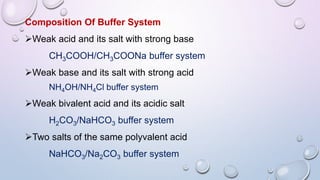
Composition Of Buffer System
Weak acid and its salt with strong base
CH3COOH/CH3COONa buffer system
Weak base and its salt with strong acid
NH4OH/NH4Cl buffer system
Weak bivalent acid and its acidic salt
H2CO3/NaHCO3 buffer system
Two salts of the same polyvalent acid
NaHCO3/Na2CO3 buffer system
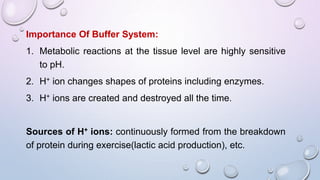
Importance Of Buffer System:
1. Metabolic reactions at the tissue level are highly sensitive
to pH.
2. H+ ion changes shapes of proteins including enzymes.
3. H+ ions are created and destroyed all the time.
Sources of H+ ions: continuously formed from the breakdown
of protein during exercise(lactic acid production), etc.
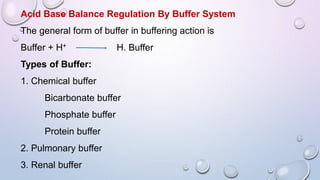
Acid Base Balance Regulation By Buffer System
The general form of buffer in buffering action is
Buffer + H+ H. Buffer
Types of Buffer:
1. Chemical buffer
Bicarbonate buffer
Phosphate buffer
Protein buffer
2. Pulmonary buffer
3. Renal buffer
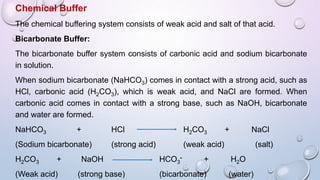
Chemical Buffer
The chemical buffering system consists of weak acid and salt of that acid.
Bicarbonate Buffer:
The bicarbonate buffer system consists of carbonic acid and sodium bicarbonate
in solution.
When sodium bicarbonate (NaHCO3) comes in contact with a strong acid, such as
HCl, carbonic acid (H2CO3), which is weak acid, and NaCl are formed. When
carbonic acid comes in contact with a strong base, such as NaOH, bicarbonate
and water are formed.
NaHCO3 + HCl H2CO3 + NaCl
(Sodium bicarbonate) (strong acid) (weak acid) (salt)
H2CO3 + NaOH HCO3
- + H2O
(Weak acid) (strong base) (bicarbonate) (water)
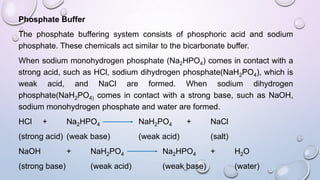
Phosphate Buffer
The phosphate buffering system consists of phosphoric acid and sodium
phosphate. These chemicals act similar to the bicarbonate buffer.
When sodium monohydrogen phosphate (Na2HPO4) comes in contact with a
strong acid, such as HCl, sodium dihydrogen phosphate(NaH2PO4), which is
weak acid, and NaCl are formed. When sodium dihydrogen
phosphate(NaH2PO4) comes in contact with a strong base, such as NaOH,
sodium monohydrogen phosphate and water are formed.
HCl + Na2HPO4 NaH2PO4 + NaCl
(strong acid) (weak base) (weak acid) (salt)
NaOH + NaH2PO4 Na2HPO4 + H2O
(strong base) (weak acid) (weak base) (water)
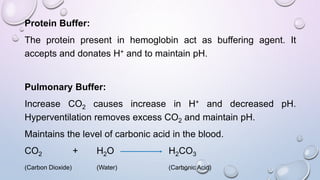
Protein Buffer:
The protein present in hemoglobin act as buffering agent. It
accepts and donates H+ and to maintain pH.
Pulmonary Buffer:
Increase CO2 causes increase in H+ and decreased pH.
Hyperventilation removes excess CO2 and maintain pH.
Maintains the level of carbonic acid in the blood.
CO2 + H2O H2CO3
(Carbon Dioxide) (Water) (Carbonic Acid)
Renal Buffer:
Kidney excretes excess H+ to maintain the pH. It controls plasma bicarbonate
concentrations.
Steps:
1. Sodium ions are reabsorbed from filtrate in exchange for H+ by an antiport
mechanism in the apical membrane of cells lining the renal tubule
2. The cells produces bicarbonate ions that can be shunted to peritubular capillaries.
3. When CO2 is available, the reaction is driven to the formation of carbonic acid,
which dissociates to form a bicarbonate ion and hydrogen ion.
4. The bicarbonate ion passes into the peritubular capillaries and returns to the
blood. The hydrogen ion is secreted into the filtrate, where it can become part of
new water molecules and be reabsorbed as such or removed in the urine.
Disorder Of Hydrogen Ion Balance
Acidosis
The condition when the blood pH is below 7.35 is known as acidosis.
Alkalosis
The condition when the blood pH is above 7.45 is known as alkalosis.
The body has three mechanisms by which it attempts to maintain a
normal blood pH:
Buffers
Removal of CO2 by lungs
Removal of H+ by kidneys.
Respiratory Acidosis
Results when pa CO2 is above the upper limit of normal(45mmHg)
Causes: Inadequate CO2 excretion
Excess CO2 production
Respiratory Alkalosis:
Results when pa CO2 is less than 34mmHg.
Causes: Excess CO2 excretion
Metabolic Acidosis
Causes: Excess H+ production
Ingestion of acid
Inadequate excretion of H+
Excess loss of bicarbonate
Metabolic Alkalosis
Causes: Excess H+ loss
Excessive reabsorption of bicarbonate
Ingestion of alkalis
Regulation Of Acid Base Imbalance
1. Rapid chemical buffering
2. Respiratory compensation
3. Renal compensation
Control of pH:
Lungs: release CO2
Kidney: excretes H+ and reabsorbs bicarbonate
GI tract: release bicarbonate
Acid Base Balance By Respiratory
Compensation
Water electrolyte and ph balance

Water electrolyte and ph balance

  • 1.
    WATER, ELECTROLYTE ANDPH BALANCE BY SONI KUMARI SHAH
  • 2.
    Electrolytes Electrolytes are mineralsfound in bodily fluid that carry an electric charge. Electrolytes in living system includes Sodium, Potassium, Chloride, Bicarbonate, Calcium, Phosphate, Magnesium, Copper Zinc, Iron, Manganese, Molybdenum And Chromium. In terms of body function, six electrolytes are most important: Sodium, Potassium, Chloride, Bicarbonate, Calcium And Phosphate.
  • 3.
    Body Fluid: The totalamount of water present in different forms is known as body fluid. Compartments of body fluid Extracellular fluid compartment Intracellular fluid compartment 60% of body weight is due to body fluid.
  • 4.
    Intracellular Fluid Compartment Thefluid present inside the cells is called intracellular fluid. It includes water and electrolytes within the cell. About 40% of total body weight is constitute by intracellular fluid.
  • 5.
    Extracellular Fluid Compartment Allthe fluids outside the cells are collectively called extracellular fluid. These fluid account for about 20% of the total body weight. Interstitial fluid: includes fluid between the cells. Eg. Fluid present in connective tissue. Intra- vascular fluid: includes plasma and lymph Trans-cellular fluid: includes fluid present in serous and mucous membrane. Eg. Intra-ocular fluid, cerebrospinal fluid, synovial fluid, digestive juices, pleural fluid, pericardial fluid, peritoneal fluid, etc.
  • 6.
    Composition Of BodyFluid Water Solid particles: Organic Substances: Glucose, Amino Acids, Lipids, Enzymes, Hormones, Vitamins Inorganic Substance: Sodium, Potassium, Calcium, Magnesium, Chloride, Bicarbonate, Phosphate, Iron, Sulphate, etc Extracellular Fluid: Sodium, Chloride, Bicarbonate(high Concentration) Potassium, Calcium, Magnesium, Phosphate, Sulphate (Low Concentration) Intracellular Fluid: Sodium, Chloride, Bicarbonate(low Concentration) Potassium, Calcium, Magnesium, Phosphate, Sulphate (High Concentration)
  • 9.
    What percentage ofbody weight is composed of fluid? I. 40 II. 50 III. 60 IV. 70 Which of the following is not extracellular fluid? I. Csf II. Plasma III. Peritoneal fluid IV. Water in cell Interstitial fluid (IF) is ________. I. The fluid in the cytosol of the cells II. The fluid component of blood III. The fluid that bathes all of the body’s cells except for blood cells IV. The intracellular fluids found between membranes
  • 10.
    Distribution And MovementOf Fluid Between The Compartments
  • 11.
    MECHANISM OF WATERBALANCE AND REGULATION
  • 12.
    ROLE OF OSMORECEPTORIN WATER BALANCE
  • 13.
    THIRST MECHANISM OFREGULATION OF WATER ↑ Plasma osmolarity ↓Effective circulating volume Thirst, ↑ ADH release H2O ingestion ↑ H2O reabsorption H2O retention Normal plasma osmolarity ↓Plasma osmolarity ↑ Effective circulating volume Inhibition of thirst ↓ADH release ↑ H2O loss ↓H2O reabsorption
  • 14.
    MECHANISM OF ELECTROLYTEBALANCE AND REGULATION Electrolytes are in balance when the concentration of individual electrolytes in the body fluid compartments are normal and remain relatively constant. The primary regulation of electrolyte balance is through active reabsorption of positive ions.
  • 15.
    Acid and Base: Anycompound which forms hydrogen ion in solution is acid. Also called proton donor. The compound which combines with hydrogen ion in solution is base. Also called proton acceptors. Buffer: The solution which have the ability to maintain constant pH despite of addition of strong acid or strong base is called buffer solutions. It plays an important role in maintaining acid base balance of our body.
  • 16.
    Composition Of BufferSystem Weak acid and its salt with strong base CH3COOH/CH3COONa buffer system Weak base and its salt with strong acid NH4OH/NH4Cl buffer system Weak bivalent acid and its acidic salt H2CO3/NaHCO3 buffer system Two salts of the same polyvalent acid NaHCO3/Na2CO3 buffer system
  • 17.
    Importance Of BufferSystem: 1. Metabolic reactions at the tissue level are highly sensitive to pH. 2. H+ ion changes shapes of proteins including enzymes. 3. H+ ions are created and destroyed all the time. Sources of H+ ions: continuously formed from the breakdown of protein during exercise(lactic acid production), etc.
  • 18.
    Acid Base BalanceRegulation By Buffer System The general form of buffer in buffering action is Buffer + H+ H. Buffer Types of Buffer: 1. Chemical buffer Bicarbonate buffer Phosphate buffer Protein buffer 2. Pulmonary buffer 3. Renal buffer
  • 19.
    Chemical Buffer The chemicalbuffering system consists of weak acid and salt of that acid. Bicarbonate Buffer: The bicarbonate buffer system consists of carbonic acid and sodium bicarbonate in solution. When sodium bicarbonate (NaHCO3) comes in contact with a strong acid, such as HCl, carbonic acid (H2CO3), which is weak acid, and NaCl are formed. When carbonic acid comes in contact with a strong base, such as NaOH, bicarbonate and water are formed. NaHCO3 + HCl H2CO3 + NaCl (Sodium bicarbonate) (strong acid) (weak acid) (salt) H2CO3 + NaOH HCO3 - + H2O (Weak acid) (strong base) (bicarbonate) (water)
  • 20.
    Phosphate Buffer The phosphatebuffering system consists of phosphoric acid and sodium phosphate. These chemicals act similar to the bicarbonate buffer. When sodium monohydrogen phosphate (Na2HPO4) comes in contact with a strong acid, such as HCl, sodium dihydrogen phosphate(NaH2PO4), which is weak acid, and NaCl are formed. When sodium dihydrogen phosphate(NaH2PO4) comes in contact with a strong base, such as NaOH, sodium monohydrogen phosphate and water are formed. HCl + Na2HPO4 NaH2PO4 + NaCl (strong acid) (weak base) (weak acid) (salt) NaOH + NaH2PO4 Na2HPO4 + H2O (strong base) (weak acid) (weak base) (water)
  • 21.
    Protein Buffer: The proteinpresent in hemoglobin act as buffering agent. It accepts and donates H+ and to maintain pH. Pulmonary Buffer: Increase CO2 causes increase in H+ and decreased pH. Hyperventilation removes excess CO2 and maintain pH. Maintains the level of carbonic acid in the blood. CO2 + H2O H2CO3 (Carbon Dioxide) (Water) (Carbonic Acid)
  • 22.
    Renal Buffer: Kidney excretesexcess H+ to maintain the pH. It controls plasma bicarbonate concentrations. Steps: 1. Sodium ions are reabsorbed from filtrate in exchange for H+ by an antiport mechanism in the apical membrane of cells lining the renal tubule 2. The cells produces bicarbonate ions that can be shunted to peritubular capillaries. 3. When CO2 is available, the reaction is driven to the formation of carbonic acid, which dissociates to form a bicarbonate ion and hydrogen ion. 4. The bicarbonate ion passes into the peritubular capillaries and returns to the blood. The hydrogen ion is secreted into the filtrate, where it can become part of new water molecules and be reabsorbed as such or removed in the urine.
  • 23.
    Disorder Of HydrogenIon Balance Acidosis The condition when the blood pH is below 7.35 is known as acidosis. Alkalosis The condition when the blood pH is above 7.45 is known as alkalosis. The body has three mechanisms by which it attempts to maintain a normal blood pH: Buffers Removal of CO2 by lungs Removal of H+ by kidneys.
  • 24.
    Respiratory Acidosis Results whenpa CO2 is above the upper limit of normal(45mmHg) Causes: Inadequate CO2 excretion Excess CO2 production Respiratory Alkalosis: Results when pa CO2 is less than 34mmHg. Causes: Excess CO2 excretion
  • 25.
    Metabolic Acidosis Causes: ExcessH+ production Ingestion of acid Inadequate excretion of H+ Excess loss of bicarbonate Metabolic Alkalosis Causes: Excess H+ loss Excessive reabsorption of bicarbonate Ingestion of alkalis
  • 26.
    Regulation Of AcidBase Imbalance 1. Rapid chemical buffering 2. Respiratory compensation 3. Renal compensation Control of pH: Lungs: release CO2 Kidney: excretes H+ and reabsorbs bicarbonate GI tract: release bicarbonate
  • 27.
    Acid Base BalanceBy Respiratory Compensation