Acid-base balance and disturbance Yu-Hong Jia, Ph.D Department of pathophysiology Dalian medical university
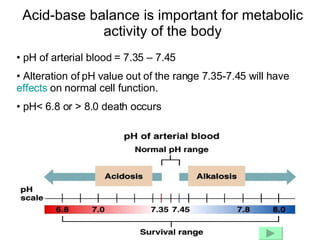
pH of arterial blood = 7.35 – 7.45 Alteration of pH value out of the range 7.35-7.45 will have  effects  on normal cell function. pH< 6.8 or > 8.0 death occurs Acid-base balance is important for metabolic activity of the body
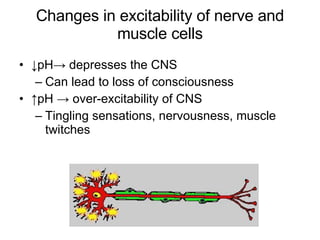
Changes in excitability of nerve and muscle cells ↓ pH-> depresses the CNS Can lead to loss of consciousness ↑ pH -> over-excitability of CNS Tingling sensations, nervousness, muscle twitches
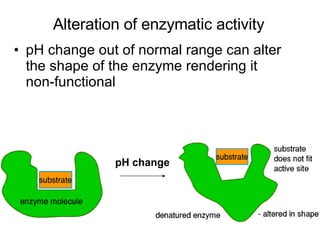
Alteration of enzymatic activity pH change out of normal range can alter the shape of the enzyme rendering it non-functional pH change
Alteration of K +  levels Acid-base state of ECF influence: K +  distribution in ECF and ICF Renal excretion of K +
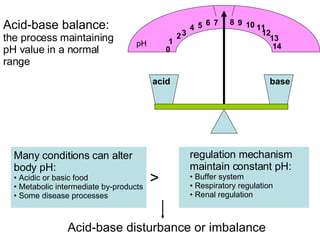
Acid-base balance:  the process maintaining pH value in a normal range  ﹥ Acid-base disturbance or imbalance 7 8 6 5 4 3 2 1 0 9 10 11 12 13 14 acid base pH Many conditions can alter body pH: Acidic or basic food Metabolic intermediate by-products Some disease processes regulation mechanism maintain constant pH: Buffer system Respiratory regulation Renal regulation
Acid-base disturbances Secondary alterations to some diseases or pathologic processes. Can aggravate and complicate the original disease
Ⅰ . Acid-base balance
(Ⅰ). Concept of acids and bases Acids are molecules that can release H +  in solution. (H +  donors) Bases are molecules that can accept H +  or give up OH -  in solution. (H +  acceptors) Acids and bases can be: Strong – dissociate completely in solution  HCl, NaOH Weak – dissociate only partially in solution Lactic acid, carbonic acid
Normal concentration of H +  in body fluid is 4×10 -8 mol/L. pH=- log [H + ] Range of pH is from 0 - 14 Normal pH of blood is 7.35-7.45
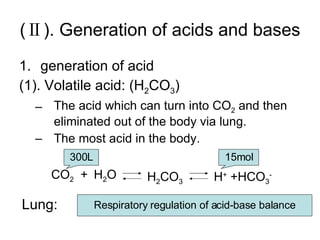
(Ⅱ). Generation of acids and bases generation of acid (1). Volatile acid: (H 2 CO 3 ) The acid which can turn into CO 2  and then eliminated out of the body via lung. The most acid in the body. CO 2 H 2 O H +  +HCO 3 - H 2 CO 3 + Lung: 300L 15mol Respiratory regulation of acid-base balance
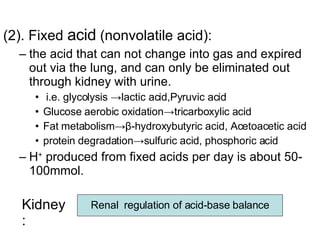
(2). Fixed  acid  (nonvolatile acid):  the acid that can not change into gas and expired out via the lung, and can only be eliminated out through kidney with urine. i.e. glycolysis ->lactic acid,Pyruvic acid Glucose aerobic oxidation->tricarboxylic acid Fat metabolism-> β - hydroxybutyric acid, Acetoacetic acid protein degradation->sulfuric acid, phosphoric acid H +  produced from fixed acids per day is about 50-100mmol. Kidney: Renal  regulation of acid-base balance
2. Generation of base Metabolism of amino acid (e.g. aspartate, glutamate) and organic anions (e.g. citrate, lactate, acetate) Vegetarian diet containing large amounts of organic anions.
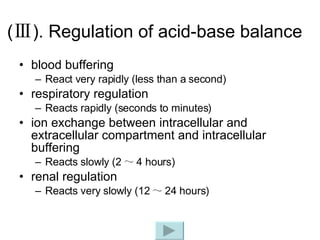
( Ⅲ ). Regulation of acid-base balance blood buffering React very rapidly (less than a second) respiratory regulation Reacts rapidly (seconds to minutes) ion exchange between intracellular and extracellular compartment and intracellular buffering Reacts slowly (2 ~ 4 hours) renal regulation Reacts very slowly (12 ~ 24 hours)
Henderson-Hasselbalch equation pH = pK α + lg =  pK α   + lg = 6.1  + lg = 6.1  + lg = 7.4 dCO 2  =  α × PaCO 2 dissolubility pK α = 6.1 α  = 0.03 [HCO 3 - ]=24mmol/L PaCO 2 =40mmHg [HCO 3 - ] [H 2 CO 3 ] [HCO 3 - ] α · PaCO 2 24 0.03  ×  40 20 1
Buffer system: A - /HA H +  + A -  (weak base) ->HA (weak acid) OH -  + HA -> A -  + H 2 O Main buffer system Bicarbonate buffer system ( HCO 3 - /H 2 CO 3 ) Plasma protein buffer system ( Pr - / HPr ) Phosphate buffer system (HPO 4 2- /H 2 PO 4- ) Hemoglobin (Hb - /HHb) and oxyhemoglobin buffer system (HbO 2 - /HHbO 2 ) 1. Blood buffering  H + OH - H + H + OH - OH - Buffer
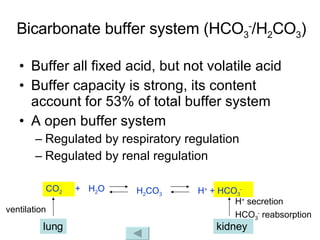
Bicarbonate buffer system (HCO 3 - /H 2 CO 3 )   Buffer all fixed acid, but not volatile acid Buffer capacity is strong, its content account for 53% of total buffer system A open buffer system Regulated by respiratory regulation Regulated by renal regulation CO 2 H 2 O H +  + HCO 3 - H 2 CO 3 + lung kidney ventilation H +  secretion  HCO 3 -  reabsorption
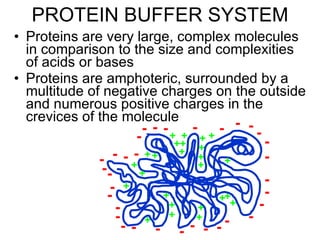
PROTEIN BUFFER SYSTEM Proteins are very large, complex molecules in comparison to the size and complexities of acids or bases Proteins are amphoteric, surrounded by a multitude of negative charges on the outside and numerous positive charges in the crevices of the molecule - - - - - - - - - - - - - - - - - - - - - - - - - - - - - - - - - + + + + + + + + + + + + + + + + + + + + + + + + +
Blood buffering The first defense line against acid-base disturbance. Just temporarily relieve the change of pH in the body fluid. Not eliminate any excessive acid or base loads out of the body.
2. Respiratory regulation The lung regulates the ratio of [HCO 3 - ]/[H 2 CO 3 ] to approach 20/1 by controlling the  alveolar ventilation  and further elimination of CO 2 , so as to maintain constant pH value. pH = pK α + lg =  pK α   + lg [HCO 3 - ] [H 2 CO 3 ] [HCO 3 - ] α · PaCO 2
Regulation of alveolar ventilation (V A ) V A  is controlled by respiratory center (at medulla oblongata). Respiratory center senses stimulus coming from:  Central chemoreceptor ( located at medulla oblongata ) Alteration of [H + ] in Cerebrospinal fluid ↑ [H+] in Cerebrospinal fluid-> respiratory center exciting-> ↑V A   Alteration of PaCO 2 PaCO 2  > 60mmHg-> V A  increase 10 times PaCO 2  > 80mmHg-> respiratory center inhibited.  Peripheral chemoreceptor ( carotid and aortic body ) ↓ PaO 2  or ↑PaCO 2  or ↑[H + ] ↓ PaO 2  < 60mmHg-> respiratory center exciting-> ↑V A   ↓ PaO 2  < 30mmHg-> respiratory center inhibited CO 2  narcosis
How does alteration of alveolar ventilation regulate pH value? ↑ [H + ] in Blood-> rapidly buffered by buffer system such as HCO 3 - /H 2 CO 3 -> ↓ [HCO 3 - ] and ↑ [H 2 CO 3 ] -> [HCO 3 - ]/[H 2 CO 3 ] tend to decrease, while ↑[H + ] can stimulate peripheral chemoreceptor ->respiratory center exciting ->↑alveolar ventilation ->↑CO 2  elimination ->↓PaCO 2  -> [HCO 3 - ] / [H 2 CO 3 ] tends to 20/1 -> pH is maintained. ↓ pH = pK α + lg [HCO 3 - ] [H 2 CO 3 ] ↓ ↑
3. Renal regulation The kidney regulates [HCO 3 - ] through changing  acid excretion  and  bicarbonate conservation , so that the ratio of [HCO 3 - ]/[H 2 CO 3 ] approach 20/1 and pH value is constant. pH = pK α + lg =  pK α   + lg [HCO 3 - ] [H 2 CO 3 ] [HCO 3 - ] α · PaCO 2
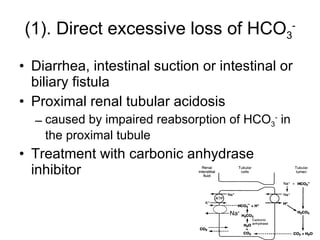
(1). Bicarbonate conservation Bicarbonate reclamation by proximal tubule Bicarbonate regeneration by distal tubule and collecting duct
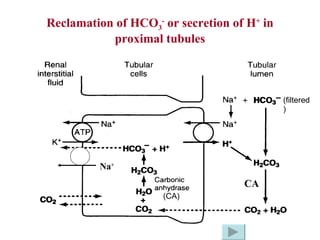
Reclamation of HCO 3 -  or secretion of H +  in proximal tubules CA Na + (filtered) (CA)
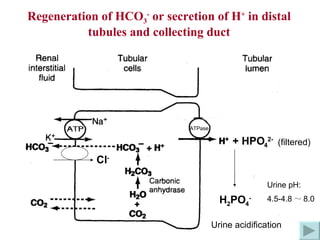
ATPase + HPO 4 2- H 2 PO 4 - Cl - (filtered) Regeneration of HCO 3 -  or secretion of H +  in distal tubules and collecting duct Urine acidification Urine pH: 4.5-4.8 ~ 8.0
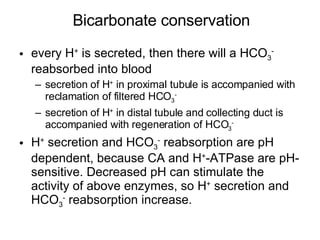
every H +  is secreted, then there will a HCO 3 -  reabsorbed into blood secretion of H +  in proximal tubule is accompanied with reclamation of filtered HCO 3 - secretion of H +  in distal tubule and collecting duct is accompanied with regeneration of HCO 3 -   H +  secretion and HCO 3 -  reabsorption are pH dependent, because CA and H + -ATPase are pH-sensitive. Decreased pH can stimulate the activity of above enzymes, so H +  secretion and HCO 3 -  reabsorption increase. Bicarbonate conservation
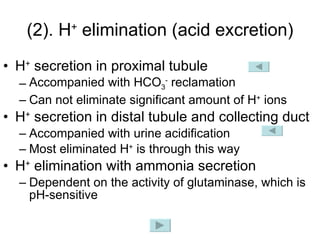
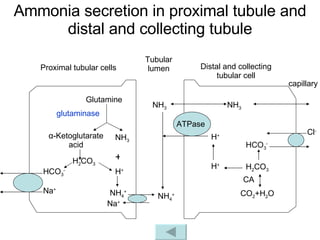
(2). H +  elimination (acid excretion) H +  secretion in proximal tubule Accompanied with HCO 3 -  reclamation Can not eliminate significant amount of H +  ions H +  secretion in distal tubule and collecting duct Accompanied with urine acidification Most eliminated H +  is through this way H +  elimination with ammonia secretion Dependent on the activity of glutaminase, which is pH-sensitive
Glutamine  NH 3  α -Ketoglutarate acid H 2 CO 3 H + HCO 3 - Na + glutaminase + NH 4 + Na + NH 4 + HCO 3 - H 2 CO 3 H + NH 3  H + CO 2 +H 2 O CA ATPase NH 3  Cl - Proximal tubular cells Distal and collecting tubular cell Tubular lumen Ammonia secretion in proximal tubule and distal and collecting tubule capillary
How does the renal regulation maintain the constant pH value? ↑ [H + ] in Blood-> rapidly buffered by buffer system such as HCO 3 - /H 2 CO 3 -> ↓ [HCO 3 - ] and ↑ [H 2 CO 3 ] -> [HCO 3 - ]/[H 2 CO 3 ] tend to decrease, while ↑[H + ] can stimulate the activity of CA, H + -ATPase and glutaminase-> ↑ secretion of H +  and ammonia,  ↑reabsorption of  HCO 3 -  -> [HCO 3 - ] / [H 2 CO 3 ] tends to 20/1 -> pH is maintained. ↑ ↑ pH = pK α + lg [HCO 3 - ] [H 2 CO 3 ] ↓
4. ion exchange between intra- and extracellular compartment & intracellular buffering Intracellular buffer system Phosphate buffer system (HPO 4 2- /H 2 PO 4- ) Hemoglobin (Hb - /HHb) and oxyhemoglobin buffer system (HbO 2 - /HHbO 2 ) Ion exchange between intra- and extracellular compartment  i.e. ↑Extracellular [H + ] -> H +  shift into cells and K +  shift out of cells acidosis-> hyperkalemia alkalosis-> hypokalemia
(Ⅳ). Laboratory tests Essential parameters for acid-base assessment: pH PaCO2 [HCO3-] pH = pK α + lg =  pK α   + lg [HCO 3 - ] [H 2 CO 3 ] [HCO 3 - ] α · PaCO 2
pH pH=- log [H + ] Normal pH of blood is 7.35-7.45 pH﹤7.35 -> acidosis or acidemia pH﹥7.45 -> alkalosis or alkalemia A normal pH may also represent an abnormal acid-base status
2. PaCO 2   (partial pressure of CO 2  in arterial blood) The pressure formed by dissolved CO 2  in arterial blood. PaCO 2  is equilibrium with H 2 CO 3 PaCO 2  is controlled by respiration hypoventilation->↑ PaCO 2 hyperventilation->↓ PaCO 2 Normal PaCO 2  is 33 ~ 46mmHg, average 40mmHg. pH = pK α + lg = pK α   + lg —  Respiratory parameter [CO 2 ] dissolved +H 2 O H 2 CO 3 [HCO 3 - ] [H 2 CO 3 ] [HCO 3 - ] α · PaCO 2
3. [HCO 3 - ] HCO 3 -  is the most abundant buffer base (53%) [HCO 3 - ] reflects the acid-base load of the body, which is controlled by metabolic state. i.e. ↑ H +  load-> HCO 3 -  content will decrease for neutralizing H + ↑ OH -  load-> HCO 3 -  content will increase because combination of H 2 CO 3  with OH -  leads to increased formation of HCO 3 - [HCO 3 - ] also reflects the function of renal tubule(HCO 3 -  reclamation and regeneration), while the renal reabsorption of HCO 3 -  is controlled by pH status Normal arterial blood [HCO 3 - ] is 22-27mmol/L, average 24mmol/L —  metabolic parameter
4. Anion gap (AG) AG= unmeasured anions – unmeasured cations AG=[Na + ] - ([Cl - ] + [HCO 3 - ]) Normal AG is 12±2 mmol/L ↑ AG ↑ unmeasured anions Including phosphates, sulfates,  organic acids, and protein anions Suggest an increased acumulation of metabolic acids in the plasma and metabolic acidosis ↓ AG ↓ unmeasured anions Albumin decrease ↑ unmeasured cations Hyperkalemia, hypercalcemia, and so on Na + Cl - HCO 3 - UA UC Measured cation Measured anion
Ⅱ . Simple acid-base disorders
If [HCO 3 - ] primarily ↓, pH tends to be ↓— metabolic acidosis If [HCO 3 - ] primarily ↑, pH tends to be ↑— metabolic alkalosis If PaCO 2  primarily ↑, pH tends to be ↓— respiratory acidosis If PaCO 2  primarily ↓, pH tends to be ↑— respiratory alkalosis Primary change Secondary change Classification of simple acid-base disorders [HCO 3 - ] Primarily ↓, from 20 to 10 If [H 2 CO 3 ] secondarily↓, from 1 to 0.5-> pH normal If [H 2 CO 3 ] secondarily ↓, from 1 to 0.8-> pH↓ Metabolic parameter pH = pK α + lg [HCO 3 - ] [H 2 CO 3 ] = 6.1  + lg [HCO 3 - ] α · PaCO 2 = 6.1+ lg 20 1 =7.4 respiratory parameter
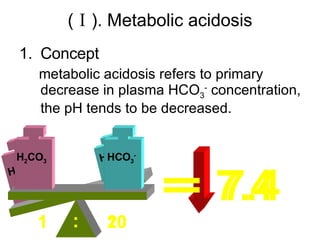
(Ⅰ). Metabolic acidosis Concept metabolic acidosis refers to primary decrease in plasma HCO 3 -  concentration, the pH tends to be decreased. H 2 CO 3 HCO 3 - 1 10 : = 7.4 H 2 CO 3 HCO 3 - 1 20 : = 7.4
2. Primary causes Central change: ↓ [HCO 3 - ]  direct excessive loss of HCO 3 -   indirect loss of HCO 3 -  for buffering increased nonvolatile acid  Excessive intake of nonvolatile acid Excessive production of nonvolatile acid Decreased renal excretion of acid
(1). Direct excessive loss of HCO 3 - Diarrhea, intestinal suction or intestinal or biliary fistula Proximal renal tubular acidosis caused by impaired reabsorption of HCO 3 -  in the proximal tubule Treatment with carbonic anhydrase inhibitor Na +
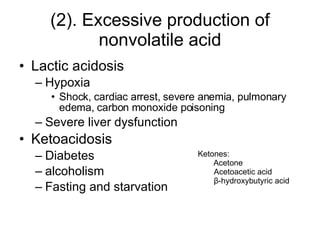
(2). Excessive production of nonvolatile acid Lactic acidosis Hypoxia Shock, cardiac arrest, severe anemia, pulmonary edema, carbon monoxide poisoning Severe liver dysfunction Ketoacidosis Diabetes alcoholism  Fasting and starvation Ketones: Acetone Acetoacetic acid β -hydroxybutyric acid
(3). Excessive intake of nonvolatile acids acetylsalicylic acid (aspirin) Methanol Ammonium chloride
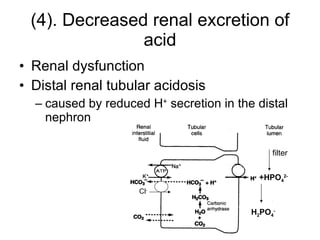
(4). Decreased renal excretion of acid Renal dysfunction Distal renal tubular acidosis caused by reduced H +  secretion in the distal nephron Cl - +HPO 4 2- H 2 PO 4 - filter
3. Classification of metabolic acidosis Increased AG type Caused by increased nonvolatile acids, but the fixed acids containing chloride are excluded. Normal AG type Direct loss of HCO3- Excessive intake of acidic salt containing chloride
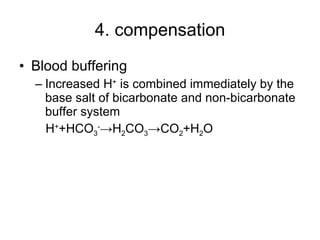
4. compensation Blood buffering Increased H +  is combined immediately by the base salt of bicarbonate and non-bicarbonate buffer system H + +HCO 3 - ->H 2 CO 3 ->CO 2 +H 2 O
Respiratory regulation ↑ [H + ] -> stimulate peripheral chemoreceptor in carotid and aortic body -> respiratory center excitation -> hyperpnea ->↑CO 2  elimination and ↓PaCO 2  -> [HCO 3 - ] /[H 2 CO 3 ] near 20/1 -> pH is maintained i.e. pH 7.4->7.0, alveolar ventilation 4L/min->30L/min
Intracellular buffering ↑  [H + ] in ECF-> H +  move in cells through H + -K +  exchange and K +  move out of cells-> hyperkalemia is resulted in
Renal regulation ↑  [H + ] in ECF-> ↑activity of carbonic anhydrase, H + -ATPase and glutaminase ↑ Renal tubular secretion of H + ↑ Renal tubular reaborption of HCO 3 - ↑ Renal tubular secretion of ammonia (3-5days) ↑ [HCO 3 - ], and [HCO 3 - ] /[H 2 CO 3 ] near 20/1  pH is near to normal
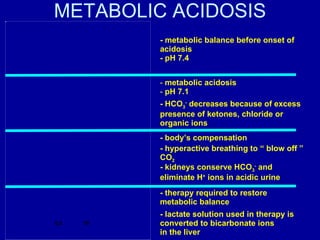
METABOLIC ACIDOSIS - metabolic balance before onset of acidosis - pH 7.4 metabolic acidosis pH 7.1 - HCO 3 -  decreases because of excess presence of ketones, chloride or organic ions - body’s compensation - hyperactive breathing to “ blow off ” CO 2 - kidneys conserve HCO 3 -  and eliminate H +  ions in acidic urine - therapy required to restore metabolic balance - lactate solution used in therapy is converted to bicarbonate ions in the liver 0.5 10
5. Alteration of metabolism and function Cardiovascular system CNS
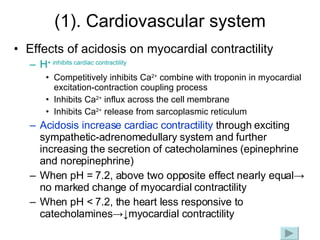
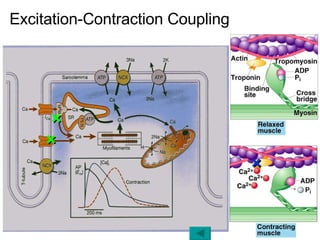
(1). Cardiovascular system Effects of acidosis on myocardial contractility H +  inhibits cardiac contractility Competitively inhibits Ca 2+  combine with troponin in myocardial excitation-contraction coupling process Inhibits Ca 2+  influx across the cell membrane Inhibits Ca 2+  release from sarcoplasmic reticulum Acidosis increase cardiac contractility  through exciting sympathetic-adrenomedullary system and further increasing the secretion of catecholamines (epinephrine and norepinephrine) When pH = 7.2, above two opposite effect nearly equal-> no marked change of myocardial contractility When pH < 7.2, the heart less responsive to catecholamines->↓myocardial contractility
Excitation-Contraction Coupling × × ×
Effect of acidosis on vascular system. H +  dilates both capacitance and resistance vasculature, plus the impaired cardiac contractility, hypotension commonly occurs. Arrhythmia related with hyperkalemia induced by acidosis.
(2). CNS Manifestation: weakness, Conscious disturbance, stupor, lethargy and even coma. Mechanism: Acidosis make elevated activity of glutamate decarboxylase->↑gamma-aminobutyric acid (GABA) production, an inhibitive neurotransmitter Acidosis make decreased activity of biological oxidases in mitochondria->↓ATP production in brain. - depression
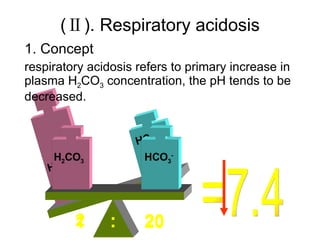
(Ⅱ). Respiratory acidosis 1. Concept respiratory acidosis refers to primary increase in plasma H 2 CO 3  concentration, the pH tends to be decreased. H 2 CO 3 HCO 3 - 2 20 : H 2 CO 3 HCO 3 - 1 20 : =7.4 =7.4
2. Primary causes Decreased alveolar ventilation-> retention of CO 2  (hypercapnia)  Increased CO 2  inhalation
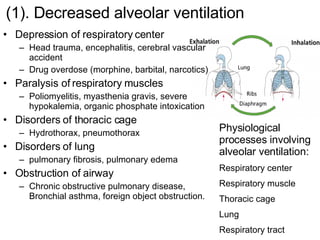
(1). Decreased alveolar ventilation Depression of respiratory center Head trauma, encephalitis, cerebral vascular accident Drug overdose (morphine, barbital, narcotics) Paralysis of respiratory muscles Poliomyelitis, myasthenia gravis, severe hypokalemia, organic phosphate intoxication Disorders of thoracic cage Hydrothorax, pneumothorax Disorders of lung pulmonary fibrosis, pulmonary edema Obstruction of airway Chronic obstructive pulmonary disease, Bronchial asthma, foreign object obstruction.  Physiological processes involving alveolar ventilation: Respiratory center Respiratory muscle Thoracic cage Lung Respiratory tract
(2). Increased CO 2  inhalation Inhaling the air rich in CO 2 Improper adjustment of an artifical ventilator
3. Classification  Acute respiratory acidosis Acute onset Acute airway obstruction, acut cardiac pulmonary edema, apnea Chronic respiratory acidosis Chronic onset, usually CO 2  retention lasts more than 24 hours Chronic obstructive pulmonary disease, extensive pulmonary fibrosis, pulmonary atelectasis
4. compensation Blood buffering HCO 3 -  can not buffer H 2 CO 3 H 2 CO 3  is buffered by non-bicarbonate buffer system weak and insignificant Respiratory regulation ineffective
Intracellular buffering Main compensatory method of acute respiratory acidosis [HCO 3 - ] increase 1mmol/L per increased 10mmHg of PaCO 2 Acute respiratory acidosis is usually decompensated Carbonic anhydrase When PaCO 2  is 60mmHg, then PaCO 2  increase 20mmHg, and through compensation [HCO 3 - ] increase 2mmol/L,  pH=6.1+lg(24+2)/0.03×60=6.1+lg26/1.8 ↑ [H 2 CO 3 ] H 2 CO 3 HCO 3 - H 2 O CO 2 Cl - H + H + CO 2 H 2 O H + HCO 3 - + + + + K + HCO 3 - Buffered by intracellular buffer system ICF ECF
Renal regulation Main compensatory method of chronic respiratory acidosis Detailed process Increased PaCO 2  and [H + ] can elevate the activity of carbonic anhydrase and glutaminase in renal tubular cells->renal tubular secretion of H +  and ammonia increase and renal tubular reabsorption of HCO 3 -  increase, which can compensate the relative deficit of HCO 3 - Through renal compensation, [HCO 3 - ] can increase 3.5-4.5mmol/L per increased 10mmHg of PaCO 2 . Chronic respiratory acidosis is usually compensated
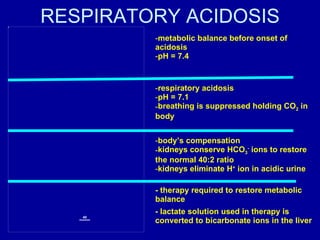
RESPIRATORY ACIDOSIS metabolic balance before onset of acidosis pH = 7.4 respiratory acidosis pH = 7.1 breathing is suppressed holding CO 2  in body body’s compensation kidneys conserve HCO 3 -  ions to restore the normal 40:2 ratio kidneys eliminate H +  ion in acidic urine - therapy required to restore metabolic balance - lactate solution used in therapy is converted to bicarbonate ions in the liver 40
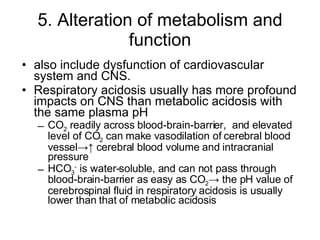
5. Alteration of metabolism and function also include dysfunction of cardiovascular system and CNS. Respiratory acidosis usually has more profound impacts on CNS than metabolic acidosis with the same plasma pH CO 2  readily across blood-brain-barrier,  and elevated level of CO 2  can make vasodilation of cerebral blood vessel->↑ cerebral blood volume and intracranial pressure  HCO 3 -  is water-soluble, and can not pass through blood-brain-barrier as easy as CO 2 -> the pH value of cerebrospinal fluid in respiratory acidosis is usually lower than that of metabolic acidosis
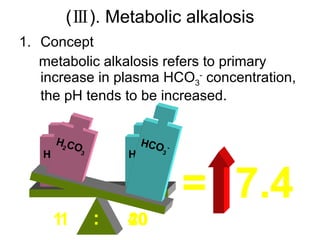
(Ⅲ). Metabolic alkalosis Concept metabolic alkalosis refers to primary increase in plasma HCO 3 -  concentration, the pH tends to be increased. = 7.4 H 2 CO 3 HCO 3 - 1 20 : = 7.4 HCO 3 - 1 40 : H 2 CO 3
Central change: ↑ [HCO 3 - ]  excessive gain of HCO 3 -   excessive loss of H +   Volume contraction 2. Primary causes
(1). Excessive gain of HCO 3 - Excessive ingestion of NaHCO 3 Infusion of large amounts of stocked blood (full of citrate)
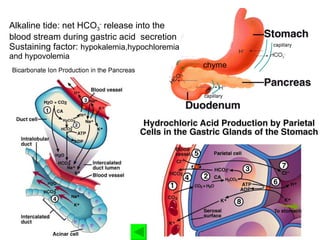
(2). excessive loss of H +   excessive loss of H +  via stomach Vomiting, gastric suction excessive loss of H +  via kidney Aldosteronism ( ↑ADS ), cushing’s syndrome ( ↑glucocorticoid ) Thiazide  and loop diuretics hypokalemia
Alkaline tide: net HCO 3 -  release into the blood stream during gastric acid  secretion Sustaining factor:  hypokalemia,hypochloremia and hypovolemia  chyme
Aldosterone promote renal excretion of H + ADS promote H +  secretion through H + –ATPase in collecting duct->↑HCO 3 -  reabsorption ADS promote sodium retention and potassium excretion->↓ [K + ] in ECF->↑ K +  shift from ICF to ECF and ↑ H +  shift from ECF to ICF through H + -K +  exchange ->↑ [H + ] in ICF -> renal excretion of H +  increase ->↑HCO 3 -  reabsorption
Diuretic promote renal excretion of H + Diuretic inhibit the reabsorption of Na +  and Cl -  in henle’s loop and early distal tublule->↑ [Na + ], [Cl - ] in distal tubule-> promote secretion of H +  and K +  in distal tubule and collecting duct in order to increase Na +  reabsorption->↑HCO 3 -  reabsorption  diuretic->↓ECF volume->↑ADS secretion
(3). Volume contraction Volume contraction ->plasma HCO 3 -  concentrated -> contraction alkalosis Loss of body fluid Diuretic therapy
3. compensation Blood buffering During metabolic alkalosis, ↓[H + ] ECF  and ↑ [OH - ] ECF -> OH -  can be buffered by weak acids, such as H 2 CO 3 ->↑ [HCO 3 - ] Ion exchange between intra- and extra-cell In alkalosis, ↓[H + ] ECF  ->through H + - K +  exchange, H +  shift out of cells and K + shift into cells->hypokalemia
Respiratory regulation ↓ [H + ] ->inhibition of respiratory center ->↓alveolar ventilation-> ↑PaCO 2  or [H 2 CO 3 ] -> [HCO 3 - ]/ [H 2 CO 3 ] approach 20/1 Respiratory regulation is limited and seldom make complete compensation ↓ Alveolar ventilation -> ↑ PaCO 2  ->but when PaCO 2  >60mmHg, respiratory center is excited->respiration deepen and quicken->↑CO2 expiration so compensatory limit of secondary increase of  PaCO 2  is 55mmHg
Renal regulation ↓ [H + ] -> ↓the activity of carbonic anhydrase and glutaminase in renal tubular cell -> ↓ renal secretion of H +  and ammonia, ↓renal reabsorption of HCO3 -  ->↓ [HCO3 -  ] in plasma-> [HCO 3 - ]/ [H 2 CO 3 ] approach 20/1  The increased renal excretion of HCO3 -  peaks at 3-5 days, so this regulation is not useful for acute metabolic alkalosis.
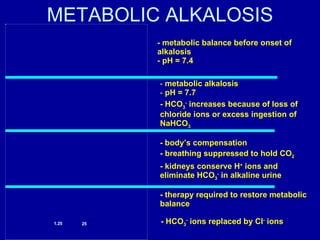
METABOLIC ALKALOSIS - metabolic balance before onset of alkalosis - pH = 7.4 metabolic alkalosis pH = 7.7 - HCO 3 -  increases because of loss of chloride ions or excess ingestion of NaHCO 3 - body’s compensation - breathing suppressed to hold CO 2 - kidneys conserve H +  ions and eliminate HCO 3 -  in alkaline urine - therapy required to restore metabolic balance - HCO 3 -  ions replaced by Cl -  ions 1.25 25
4. Alterations of metabolism and function Mild metabolic alkalosis—asymptomatic or manifestation unrelated with alkalosis Severe metabolic alkalosis—many alterations of metabolism and function Dysfunction of CNS Left-shift of oxygen- Hb  dissociation Hypocalcemia hypokalemia
(1). Dysfunction of CNS— hyperexcitability Manifestation: Dysphoria, mental confusion Mechanism: ↑ pH->↑the activity of gamma -aminobutyric acid  transaminase (↑decomposition of GABA) and ↓the activity of glutamate decarboxylase (↓production of GABA) ->↓ GABA( a inhibitory neurotransmitter)  ->  hyperexcitability of CNS ↑ pH-> left-shift of oxygen-Hb dissociation->cerebral hypoxia
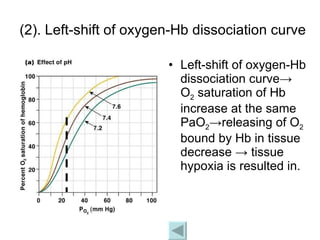
(2). Left-shift of oxygen-Hb dissociation curve Left-shift of oxygen-Hb dissociation curve-> O 2  saturation of Hb increase at the same PaO 2 ->releasing of O 2  bound by Hb in tissue decrease -> tissue hypoxia is resulted in.
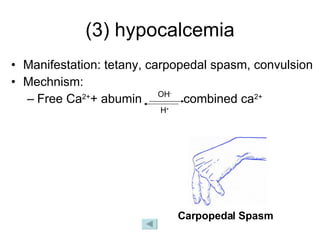
(3) hypocalcemia Manifestation: tetany, carpopedal spasm, convulsion Mechnism: Free Ca 2+ + abumin  combined ca 2+ OH - H + Carpopedal Spasm
(4). hypokalemia Mechanism alkalosis->H +  shift out of cells and K +  shift into cells through H + -K +  exchange alkalosis->↓renal excretion of H +  and ↑renal excretion of K +
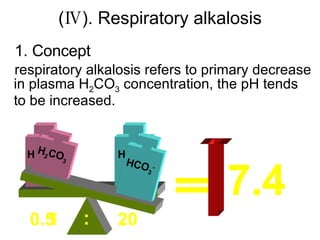
(Ⅳ). Respiratory alkalosis 1. Concept respiratory alkalosis refers to primary decrease in plasma H 2 CO 3  concentration, the pH tends to be increased. = 7.4 0.5 20 : = 7.4 H 2 CO 3 HCO 3 - 1 20 : H 2 CO 3 HCO 3 -
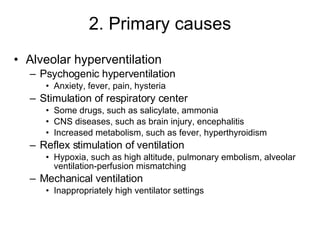
2. Primary causes Alveolar hyperventilation Psychogenic hyperventilation Anxiety, fever, pain, hysteria Stimulation of respiratory center Some drugs, such as salicylate, ammonia  CNS diseases, such as brain injury, encephalitis Increased metabolism, such as fever, hyperthyroidism Reflex stimulation of ventilation Hypoxia, such as high altitude, pulmonary embolism, alveolar ventilation-perfusion mismatching Mechanical ventilation Inappropriately high ventilator settings
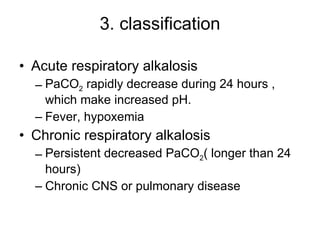
3. classification Acute respiratory alkalosis PaCO 2  rapidly decrease during 24 hours , which make increased pH. Fever, hypoxemia Chronic respiratory alkalosis Persistent decreased PaCO 2 ( longer than 24 hours) Chronic CNS or pulmonary disease
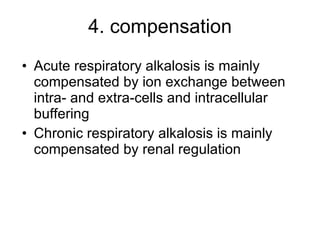
4. compensation Acute respiratory alkalosis is mainly compensated by ion exchange between intra- and extra-cells and intracellular buffering Chronic respiratory alkalosis is mainly compensated by renal regulation
ion exchange between intra- and extra-cells and intracellular buffering Main compensatory method of acute respiratory alkalosis Through above compensation, [HCO 3 - ] decrease 2mmol/L per decreased 10mmHg of PaCO 2 Acute respiratory alkalosis is usually decompensated H 2 CO 3 H 2 CO 3 [HCO 3 - ] relatively increase H 2 O CO 2 Cl - H + CO 2 H 2 O H + HCO 3 - + + + + K + HCO 3 - ICF ECF H 2 CO 3 HCO 3 - H + primary decrease of [H 2 CO 3 ] When PaCO2 is 20mmHg, then PaCO2 decrease 20mmHg, and through compensation [HCO3-] decrease 4mmol/L,  pH=6.1+lg(24-4)/0.03×20=6.1+lg20/0.6=7.63
Renal regulation Main compensatory method of chronic respiratory alkalosis Detailed process Decreased PaCO 2  and [H + ] can decrease the activity of carbonic anhydrase and glutaminase in renal tubular cells->renal tubular secretion of H +  and ammonia decrease and renal tubular reabsorption of HCO 3 -  decrease->↑renal excretion of  HCO 3 - In chronic respiratory alkalosis, through renal regulation and intracellular buffering, [HCO 3 - ] can decrease 5mmol/L per decreased 10mmHg of PaCO 2 . Chronic respiratory alkalosis is usually compensated
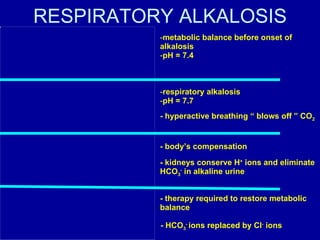
RESPIRATORY ALKALOSIS metabolic balance before onset of alkalosis pH = 7.4 respiratory alkalosis pH = 7.7 - hyperactive breathing “ blows off ” CO 2 - body’s compensation - kidneys conserve H +  ions and eliminate HCO 3 -  in alkaline urine - therapy required to restore metabolic balance - HCO 3 -  ions replaced by Cl -  ions
5. Alterations of metabolism and function Similar to that of metabolic alkalosis Respiratory alkalosis usually has more profound impacts on CNS than metabolic alkalosis with the same plasma pH The decrease in CO 2  content of blood causes constriction of cerebral blood vessel->↓ cerebral blood volume and regional cerebral ischemia
Ⅲ . mixed acid-base disorders
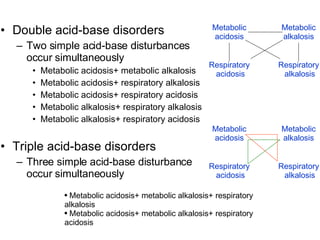
Double acid-base disorders Two simple acid-base disturbances occur simultaneously Metabolic acidosis+ metabolic alkalosis Metabolic acidosis+ respiratory alkalosis Metabolic acidosis+ respiratory acidosis Metabolic alkalosis+ respiratory alkalosis Metabolic alkalosis+ respiratory acidosis Triple acid-base disorders Three simple acid-base disturbance occur simultaneously Metabolic acidosis Metabolic alkalosis Respiratory  acidosis Respiratory  alkalosis Metabolic acidosis Metabolic alkalosis Respiratory  acidosis Respiratory  alkalosis Metabolic acidosis+ metabolic alkalosis+ respiratory alkalosis Metabolic acidosis+ metabolic alkalosis+ respiratory acidosis
1. Metabolic acidosis+ Metabolic alkalosis Causes Diarrhea and vomiting Lactic acidosis and vomiting Ketoacidosis ang hypokalemia Characteristics [HCO 3 - ]: ↑/normal/↓ pH: ↑/normal/↓
2. Metabolic acidosis+ Respiratory alkalosis Causes: Salicylate toxication Diabetes mellitus, renal failure or cardiopulmonary diseases companied with fever Chronic liver disease(with increased blood ammonia) companied with renal failure Characteristics: [HCO 3 - ]: ↓ PaCO 2 : ↓ pH: ↑/normal/↓
3. Metabolic acidosis+ Respiratory acidosis Causes: Cardiopulmonary resuscitation Pulmonary edema Chronic obstructive pulmonary disease Characteristics: [HCO 3 - ]: ↓ PaCO 2 : ↑ pH: ↓
4. Metabolic alkalosis+ Respiratory alkalosis Causes: Fever accompanied with vomiting Hepatic failure(with increased blood ammonia) accompanied with inappropriate use of diuretic Characteristics: [HCO 3 - ]: ↑ PaCO 2 : ↓ pH: ↑
5. Metabolic alkalosis+ Respiratory acidosis Causes: Chronic obstructive pulmonary disease companied with use of diuretics or glucocorticoid Characteristics: [HCO 3 - ]: ↑ PaCO 2 : ↑  pH: ↑/normal/↓

Acid Base Balance And Disturbance

  • 1.
    Acid-base balance anddisturbance Yu-Hong Jia, Ph.D Department of pathophysiology Dalian medical university
  • 2.
    pH of arterialblood = 7.35 – 7.45 Alteration of pH value out of the range 7.35-7.45 will have effects on normal cell function. pH< 6.8 or > 8.0 death occurs Acid-base balance is important for metabolic activity of the body
  • 3.
    Changes in excitabilityof nerve and muscle cells ↓ pH-> depresses the CNS Can lead to loss of consciousness ↑ pH -> over-excitability of CNS Tingling sensations, nervousness, muscle twitches
  • 4.
    Alteration of enzymaticactivity pH change out of normal range can alter the shape of the enzyme rendering it non-functional pH change
  • 5.
    Alteration of K+ levels Acid-base state of ECF influence: K + distribution in ECF and ICF Renal excretion of K +
  • 6.
    Acid-base balance: the process maintaining pH value in a normal range ﹥ Acid-base disturbance or imbalance 7 8 6 5 4 3 2 1 0 9 10 11 12 13 14 acid base pH Many conditions can alter body pH: Acidic or basic food Metabolic intermediate by-products Some disease processes regulation mechanism maintain constant pH: Buffer system Respiratory regulation Renal regulation
  • 7.
    Acid-base disturbances Secondaryalterations to some diseases or pathologic processes. Can aggravate and complicate the original disease
  • 8.
  • 9.
    (Ⅰ). Concept ofacids and bases Acids are molecules that can release H + in solution. (H + donors) Bases are molecules that can accept H + or give up OH - in solution. (H + acceptors) Acids and bases can be: Strong – dissociate completely in solution HCl, NaOH Weak – dissociate only partially in solution Lactic acid, carbonic acid
  • 10.
    Normal concentration ofH + in body fluid is 4×10 -8 mol/L. pH=- log [H + ] Range of pH is from 0 - 14 Normal pH of blood is 7.35-7.45
  • 11.
    (Ⅱ). Generation ofacids and bases generation of acid (1). Volatile acid: (H 2 CO 3 ) The acid which can turn into CO 2 and then eliminated out of the body via lung. The most acid in the body. CO 2 H 2 O H + +HCO 3 - H 2 CO 3 + Lung: 300L 15mol Respiratory regulation of acid-base balance
  • 12.
    (2). Fixed acid (nonvolatile acid): the acid that can not change into gas and expired out via the lung, and can only be eliminated out through kidney with urine. i.e. glycolysis ->lactic acid,Pyruvic acid Glucose aerobic oxidation->tricarboxylic acid Fat metabolism-> β - hydroxybutyric acid, Acetoacetic acid protein degradation->sulfuric acid, phosphoric acid H + produced from fixed acids per day is about 50-100mmol. Kidney: Renal regulation of acid-base balance
  • 13.
    2. Generation ofbase Metabolism of amino acid (e.g. aspartate, glutamate) and organic anions (e.g. citrate, lactate, acetate) Vegetarian diet containing large amounts of organic anions.
  • 14.
    ( Ⅲ ).Regulation of acid-base balance blood buffering React very rapidly (less than a second) respiratory regulation Reacts rapidly (seconds to minutes) ion exchange between intracellular and extracellular compartment and intracellular buffering Reacts slowly (2 ~ 4 hours) renal regulation Reacts very slowly (12 ~ 24 hours)
  • 15.
    Henderson-Hasselbalch equation pH= pK α + lg = pK α + lg = 6.1 + lg = 6.1 + lg = 7.4 dCO 2 = α × PaCO 2 dissolubility pK α = 6.1 α = 0.03 [HCO 3 - ]=24mmol/L PaCO 2 =40mmHg [HCO 3 - ] [H 2 CO 3 ] [HCO 3 - ] α · PaCO 2 24 0.03 × 40 20 1
  • 16.
    Buffer system: A- /HA H + + A - (weak base) ->HA (weak acid) OH - + HA -> A - + H 2 O Main buffer system Bicarbonate buffer system ( HCO 3 - /H 2 CO 3 ) Plasma protein buffer system ( Pr - / HPr ) Phosphate buffer system (HPO 4 2- /H 2 PO 4- ) Hemoglobin (Hb - /HHb) and oxyhemoglobin buffer system (HbO 2 - /HHbO 2 ) 1. Blood buffering H + OH - H + H + OH - OH - Buffer
  • 17.
    Bicarbonate buffer system(HCO 3 - /H 2 CO 3 ) Buffer all fixed acid, but not volatile acid Buffer capacity is strong, its content account for 53% of total buffer system A open buffer system Regulated by respiratory regulation Regulated by renal regulation CO 2 H 2 O H + + HCO 3 - H 2 CO 3 + lung kidney ventilation H + secretion HCO 3 - reabsorption
  • 18.
    PROTEIN BUFFER SYSTEMProteins are very large, complex molecules in comparison to the size and complexities of acids or bases Proteins are amphoteric, surrounded by a multitude of negative charges on the outside and numerous positive charges in the crevices of the molecule - - - - - - - - - - - - - - - - - - - - - - - - - - - - - - - - - + + + + + + + + + + + + + + + + + + + + + + + + +
  • 19.
    Blood buffering Thefirst defense line against acid-base disturbance. Just temporarily relieve the change of pH in the body fluid. Not eliminate any excessive acid or base loads out of the body.
  • 20.
    2. Respiratory regulationThe lung regulates the ratio of [HCO 3 - ]/[H 2 CO 3 ] to approach 20/1 by controlling the alveolar ventilation and further elimination of CO 2 , so as to maintain constant pH value. pH = pK α + lg = pK α + lg [HCO 3 - ] [H 2 CO 3 ] [HCO 3 - ] α · PaCO 2
  • 21.
    Regulation of alveolarventilation (V A ) V A is controlled by respiratory center (at medulla oblongata). Respiratory center senses stimulus coming from: Central chemoreceptor ( located at medulla oblongata ) Alteration of [H + ] in Cerebrospinal fluid ↑ [H+] in Cerebrospinal fluid-> respiratory center exciting-> ↑V A Alteration of PaCO 2 PaCO 2 > 60mmHg-> V A increase 10 times PaCO 2 > 80mmHg-> respiratory center inhibited. Peripheral chemoreceptor ( carotid and aortic body ) ↓ PaO 2 or ↑PaCO 2 or ↑[H + ] ↓ PaO 2 < 60mmHg-> respiratory center exciting-> ↑V A ↓ PaO 2 < 30mmHg-> respiratory center inhibited CO 2 narcosis
  • 22.
    How does alterationof alveolar ventilation regulate pH value? ↑ [H + ] in Blood-> rapidly buffered by buffer system such as HCO 3 - /H 2 CO 3 -> ↓ [HCO 3 - ] and ↑ [H 2 CO 3 ] -> [HCO 3 - ]/[H 2 CO 3 ] tend to decrease, while ↑[H + ] can stimulate peripheral chemoreceptor ->respiratory center exciting ->↑alveolar ventilation ->↑CO 2 elimination ->↓PaCO 2 -> [HCO 3 - ] / [H 2 CO 3 ] tends to 20/1 -> pH is maintained. ↓ pH = pK α + lg [HCO 3 - ] [H 2 CO 3 ] ↓ ↑
  • 23.
    3. Renal regulationThe kidney regulates [HCO 3 - ] through changing acid excretion and bicarbonate conservation , so that the ratio of [HCO 3 - ]/[H 2 CO 3 ] approach 20/1 and pH value is constant. pH = pK α + lg = pK α + lg [HCO 3 - ] [H 2 CO 3 ] [HCO 3 - ] α · PaCO 2
  • 24.
    (1). Bicarbonate conservationBicarbonate reclamation by proximal tubule Bicarbonate regeneration by distal tubule and collecting duct
  • 25.
    Reclamation of HCO3 - or secretion of H + in proximal tubules CA Na + (filtered) (CA)
  • 26.
    ATPase + HPO4 2- H 2 PO 4 - Cl - (filtered) Regeneration of HCO 3 - or secretion of H + in distal tubules and collecting duct Urine acidification Urine pH: 4.5-4.8 ~ 8.0
  • 27.
    every H + is secreted, then there will a HCO 3 - reabsorbed into blood secretion of H + in proximal tubule is accompanied with reclamation of filtered HCO 3 - secretion of H + in distal tubule and collecting duct is accompanied with regeneration of HCO 3 - H + secretion and HCO 3 - reabsorption are pH dependent, because CA and H + -ATPase are pH-sensitive. Decreased pH can stimulate the activity of above enzymes, so H + secretion and HCO 3 - reabsorption increase. Bicarbonate conservation
  • 28.
    (2). H + elimination (acid excretion) H + secretion in proximal tubule Accompanied with HCO 3 - reclamation Can not eliminate significant amount of H + ions H + secretion in distal tubule and collecting duct Accompanied with urine acidification Most eliminated H + is through this way H + elimination with ammonia secretion Dependent on the activity of glutaminase, which is pH-sensitive
  • 29.
    Glutamine NH3 α -Ketoglutarate acid H 2 CO 3 H + HCO 3 - Na + glutaminase + NH 4 + Na + NH 4 + HCO 3 - H 2 CO 3 H + NH 3 H + CO 2 +H 2 O CA ATPase NH 3 Cl - Proximal tubular cells Distal and collecting tubular cell Tubular lumen Ammonia secretion in proximal tubule and distal and collecting tubule capillary
  • 30.
    How does therenal regulation maintain the constant pH value? ↑ [H + ] in Blood-> rapidly buffered by buffer system such as HCO 3 - /H 2 CO 3 -> ↓ [HCO 3 - ] and ↑ [H 2 CO 3 ] -> [HCO 3 - ]/[H 2 CO 3 ] tend to decrease, while ↑[H + ] can stimulate the activity of CA, H + -ATPase and glutaminase-> ↑ secretion of H + and ammonia, ↑reabsorption of HCO 3 - -> [HCO 3 - ] / [H 2 CO 3 ] tends to 20/1 -> pH is maintained. ↑ ↑ pH = pK α + lg [HCO 3 - ] [H 2 CO 3 ] ↓
  • 31.
    4. ion exchangebetween intra- and extracellular compartment & intracellular buffering Intracellular buffer system Phosphate buffer system (HPO 4 2- /H 2 PO 4- ) Hemoglobin (Hb - /HHb) and oxyhemoglobin buffer system (HbO 2 - /HHbO 2 ) Ion exchange between intra- and extracellular compartment i.e. ↑Extracellular [H + ] -> H + shift into cells and K + shift out of cells acidosis-> hyperkalemia alkalosis-> hypokalemia
  • 32.
    (Ⅳ). Laboratory testsEssential parameters for acid-base assessment: pH PaCO2 [HCO3-] pH = pK α + lg = pK α + lg [HCO 3 - ] [H 2 CO 3 ] [HCO 3 - ] α · PaCO 2
  • 33.
    pH pH=- log[H + ] Normal pH of blood is 7.35-7.45 pH﹤7.35 -> acidosis or acidemia pH﹥7.45 -> alkalosis or alkalemia A normal pH may also represent an abnormal acid-base status
  • 34.
    2. PaCO 2 (partial pressure of CO 2 in arterial blood) The pressure formed by dissolved CO 2 in arterial blood. PaCO 2 is equilibrium with H 2 CO 3 PaCO 2 is controlled by respiration hypoventilation->↑ PaCO 2 hyperventilation->↓ PaCO 2 Normal PaCO 2 is 33 ~ 46mmHg, average 40mmHg. pH = pK α + lg = pK α + lg — Respiratory parameter [CO 2 ] dissolved +H 2 O H 2 CO 3 [HCO 3 - ] [H 2 CO 3 ] [HCO 3 - ] α · PaCO 2
  • 35.
    3. [HCO 3- ] HCO 3 - is the most abundant buffer base (53%) [HCO 3 - ] reflects the acid-base load of the body, which is controlled by metabolic state. i.e. ↑ H + load-> HCO 3 - content will decrease for neutralizing H + ↑ OH - load-> HCO 3 - content will increase because combination of H 2 CO 3 with OH - leads to increased formation of HCO 3 - [HCO 3 - ] also reflects the function of renal tubule(HCO 3 - reclamation and regeneration), while the renal reabsorption of HCO 3 - is controlled by pH status Normal arterial blood [HCO 3 - ] is 22-27mmol/L, average 24mmol/L — metabolic parameter
  • 36.
    4. Anion gap(AG) AG= unmeasured anions – unmeasured cations AG=[Na + ] - ([Cl - ] + [HCO 3 - ]) Normal AG is 12±2 mmol/L ↑ AG ↑ unmeasured anions Including phosphates, sulfates, organic acids, and protein anions Suggest an increased acumulation of metabolic acids in the plasma and metabolic acidosis ↓ AG ↓ unmeasured anions Albumin decrease ↑ unmeasured cations Hyperkalemia, hypercalcemia, and so on Na + Cl - HCO 3 - UA UC Measured cation Measured anion
  • 37.
    Ⅱ . Simpleacid-base disorders
  • 38.
    If [HCO 3- ] primarily ↓, pH tends to be ↓— metabolic acidosis If [HCO 3 - ] primarily ↑, pH tends to be ↑— metabolic alkalosis If PaCO 2 primarily ↑, pH tends to be ↓— respiratory acidosis If PaCO 2 primarily ↓, pH tends to be ↑— respiratory alkalosis Primary change Secondary change Classification of simple acid-base disorders [HCO 3 - ] Primarily ↓, from 20 to 10 If [H 2 CO 3 ] secondarily↓, from 1 to 0.5-> pH normal If [H 2 CO 3 ] secondarily ↓, from 1 to 0.8-> pH↓ Metabolic parameter pH = pK α + lg [HCO 3 - ] [H 2 CO 3 ] = 6.1 + lg [HCO 3 - ] α · PaCO 2 = 6.1+ lg 20 1 =7.4 respiratory parameter
  • 39.
    (Ⅰ). Metabolic acidosisConcept metabolic acidosis refers to primary decrease in plasma HCO 3 - concentration, the pH tends to be decreased. H 2 CO 3 HCO 3 - 1 10 : = 7.4 H 2 CO 3 HCO 3 - 1 20 : = 7.4
  • 40.
    2. Primary causesCentral change: ↓ [HCO 3 - ] direct excessive loss of HCO 3 - indirect loss of HCO 3 - for buffering increased nonvolatile acid Excessive intake of nonvolatile acid Excessive production of nonvolatile acid Decreased renal excretion of acid
  • 41.
    (1). Direct excessiveloss of HCO 3 - Diarrhea, intestinal suction or intestinal or biliary fistula Proximal renal tubular acidosis caused by impaired reabsorption of HCO 3 - in the proximal tubule Treatment with carbonic anhydrase inhibitor Na +
  • 42.
    (2). Excessive productionof nonvolatile acid Lactic acidosis Hypoxia Shock, cardiac arrest, severe anemia, pulmonary edema, carbon monoxide poisoning Severe liver dysfunction Ketoacidosis Diabetes alcoholism Fasting and starvation Ketones: Acetone Acetoacetic acid β -hydroxybutyric acid
  • 43.
    (3). Excessive intakeof nonvolatile acids acetylsalicylic acid (aspirin) Methanol Ammonium chloride
  • 44.
    (4). Decreased renalexcretion of acid Renal dysfunction Distal renal tubular acidosis caused by reduced H + secretion in the distal nephron Cl - +HPO 4 2- H 2 PO 4 - filter
  • 45.
    3. Classification ofmetabolic acidosis Increased AG type Caused by increased nonvolatile acids, but the fixed acids containing chloride are excluded. Normal AG type Direct loss of HCO3- Excessive intake of acidic salt containing chloride
  • 46.
    4. compensation Bloodbuffering Increased H + is combined immediately by the base salt of bicarbonate and non-bicarbonate buffer system H + +HCO 3 - ->H 2 CO 3 ->CO 2 +H 2 O
  • 47.
    Respiratory regulation ↑[H + ] -> stimulate peripheral chemoreceptor in carotid and aortic body -> respiratory center excitation -> hyperpnea ->↑CO 2 elimination and ↓PaCO 2 -> [HCO 3 - ] /[H 2 CO 3 ] near 20/1 -> pH is maintained i.e. pH 7.4->7.0, alveolar ventilation 4L/min->30L/min
  • 48.
    Intracellular buffering ↑ [H + ] in ECF-> H + move in cells through H + -K + exchange and K + move out of cells-> hyperkalemia is resulted in
  • 49.
    Renal regulation ↑ [H + ] in ECF-> ↑activity of carbonic anhydrase, H + -ATPase and glutaminase ↑ Renal tubular secretion of H + ↑ Renal tubular reaborption of HCO 3 - ↑ Renal tubular secretion of ammonia (3-5days) ↑ [HCO 3 - ], and [HCO 3 - ] /[H 2 CO 3 ] near 20/1 pH is near to normal
  • 50.
    METABOLIC ACIDOSIS -metabolic balance before onset of acidosis - pH 7.4 metabolic acidosis pH 7.1 - HCO 3 - decreases because of excess presence of ketones, chloride or organic ions - body’s compensation - hyperactive breathing to “ blow off ” CO 2 - kidneys conserve HCO 3 - and eliminate H + ions in acidic urine - therapy required to restore metabolic balance - lactate solution used in therapy is converted to bicarbonate ions in the liver 0.5 10
  • 51.
    5. Alteration ofmetabolism and function Cardiovascular system CNS
  • 52.
    (1). Cardiovascular systemEffects of acidosis on myocardial contractility H + inhibits cardiac contractility Competitively inhibits Ca 2+ combine with troponin in myocardial excitation-contraction coupling process Inhibits Ca 2+ influx across the cell membrane Inhibits Ca 2+ release from sarcoplasmic reticulum Acidosis increase cardiac contractility through exciting sympathetic-adrenomedullary system and further increasing the secretion of catecholamines (epinephrine and norepinephrine) When pH = 7.2, above two opposite effect nearly equal-> no marked change of myocardial contractility When pH < 7.2, the heart less responsive to catecholamines->↓myocardial contractility
  • 53.
  • 54.
    Effect of acidosison vascular system. H + dilates both capacitance and resistance vasculature, plus the impaired cardiac contractility, hypotension commonly occurs. Arrhythmia related with hyperkalemia induced by acidosis.
  • 55.
    (2). CNS Manifestation:weakness, Conscious disturbance, stupor, lethargy and even coma. Mechanism: Acidosis make elevated activity of glutamate decarboxylase->↑gamma-aminobutyric acid (GABA) production, an inhibitive neurotransmitter Acidosis make decreased activity of biological oxidases in mitochondria->↓ATP production in brain. - depression
  • 56.
    (Ⅱ). Respiratory acidosis1. Concept respiratory acidosis refers to primary increase in plasma H 2 CO 3 concentration, the pH tends to be decreased. H 2 CO 3 HCO 3 - 2 20 : H 2 CO 3 HCO 3 - 1 20 : =7.4 =7.4
  • 57.
    2. Primary causesDecreased alveolar ventilation-> retention of CO 2 (hypercapnia) Increased CO 2 inhalation
  • 58.
    (1). Decreased alveolarventilation Depression of respiratory center Head trauma, encephalitis, cerebral vascular accident Drug overdose (morphine, barbital, narcotics) Paralysis of respiratory muscles Poliomyelitis, myasthenia gravis, severe hypokalemia, organic phosphate intoxication Disorders of thoracic cage Hydrothorax, pneumothorax Disorders of lung pulmonary fibrosis, pulmonary edema Obstruction of airway Chronic obstructive pulmonary disease, Bronchial asthma, foreign object obstruction. Physiological processes involving alveolar ventilation: Respiratory center Respiratory muscle Thoracic cage Lung Respiratory tract
  • 59.
    (2). Increased CO2 inhalation Inhaling the air rich in CO 2 Improper adjustment of an artifical ventilator
  • 60.
    3. Classification Acute respiratory acidosis Acute onset Acute airway obstruction, acut cardiac pulmonary edema, apnea Chronic respiratory acidosis Chronic onset, usually CO 2 retention lasts more than 24 hours Chronic obstructive pulmonary disease, extensive pulmonary fibrosis, pulmonary atelectasis
  • 61.
    4. compensation Bloodbuffering HCO 3 - can not buffer H 2 CO 3 H 2 CO 3 is buffered by non-bicarbonate buffer system weak and insignificant Respiratory regulation ineffective
  • 62.
    Intracellular buffering Maincompensatory method of acute respiratory acidosis [HCO 3 - ] increase 1mmol/L per increased 10mmHg of PaCO 2 Acute respiratory acidosis is usually decompensated Carbonic anhydrase When PaCO 2 is 60mmHg, then PaCO 2 increase 20mmHg, and through compensation [HCO 3 - ] increase 2mmol/L, pH=6.1+lg(24+2)/0.03×60=6.1+lg26/1.8 ↑ [H 2 CO 3 ] H 2 CO 3 HCO 3 - H 2 O CO 2 Cl - H + H + CO 2 H 2 O H + HCO 3 - + + + + K + HCO 3 - Buffered by intracellular buffer system ICF ECF
  • 63.
    Renal regulation Maincompensatory method of chronic respiratory acidosis Detailed process Increased PaCO 2 and [H + ] can elevate the activity of carbonic anhydrase and glutaminase in renal tubular cells->renal tubular secretion of H + and ammonia increase and renal tubular reabsorption of HCO 3 - increase, which can compensate the relative deficit of HCO 3 - Through renal compensation, [HCO 3 - ] can increase 3.5-4.5mmol/L per increased 10mmHg of PaCO 2 . Chronic respiratory acidosis is usually compensated
  • 64.
    RESPIRATORY ACIDOSIS metabolicbalance before onset of acidosis pH = 7.4 respiratory acidosis pH = 7.1 breathing is suppressed holding CO 2 in body body’s compensation kidneys conserve HCO 3 - ions to restore the normal 40:2 ratio kidneys eliminate H + ion in acidic urine - therapy required to restore metabolic balance - lactate solution used in therapy is converted to bicarbonate ions in the liver 40
  • 65.
    5. Alteration ofmetabolism and function also include dysfunction of cardiovascular system and CNS. Respiratory acidosis usually has more profound impacts on CNS than metabolic acidosis with the same plasma pH CO 2 readily across blood-brain-barrier, and elevated level of CO 2 can make vasodilation of cerebral blood vessel->↑ cerebral blood volume and intracranial pressure HCO 3 - is water-soluble, and can not pass through blood-brain-barrier as easy as CO 2 -> the pH value of cerebrospinal fluid in respiratory acidosis is usually lower than that of metabolic acidosis
  • 66.
    (Ⅲ). Metabolic alkalosisConcept metabolic alkalosis refers to primary increase in plasma HCO 3 - concentration, the pH tends to be increased. = 7.4 H 2 CO 3 HCO 3 - 1 20 : = 7.4 HCO 3 - 1 40 : H 2 CO 3
  • 67.
    Central change: ↑[HCO 3 - ] excessive gain of HCO 3 - excessive loss of H + Volume contraction 2. Primary causes
  • 68.
    (1). Excessive gainof HCO 3 - Excessive ingestion of NaHCO 3 Infusion of large amounts of stocked blood (full of citrate)
  • 69.
    (2). excessive lossof H + excessive loss of H + via stomach Vomiting, gastric suction excessive loss of H + via kidney Aldosteronism ( ↑ADS ), cushing’s syndrome ( ↑glucocorticoid ) Thiazide and loop diuretics hypokalemia
  • 70.
    Alkaline tide: netHCO 3 - release into the blood stream during gastric acid secretion Sustaining factor: hypokalemia,hypochloremia and hypovolemia chyme
  • 71.
    Aldosterone promote renalexcretion of H + ADS promote H + secretion through H + –ATPase in collecting duct->↑HCO 3 - reabsorption ADS promote sodium retention and potassium excretion->↓ [K + ] in ECF->↑ K + shift from ICF to ECF and ↑ H + shift from ECF to ICF through H + -K + exchange ->↑ [H + ] in ICF -> renal excretion of H + increase ->↑HCO 3 - reabsorption
  • 72.
    Diuretic promote renalexcretion of H + Diuretic inhibit the reabsorption of Na + and Cl - in henle’s loop and early distal tublule->↑ [Na + ], [Cl - ] in distal tubule-> promote secretion of H + and K + in distal tubule and collecting duct in order to increase Na + reabsorption->↑HCO 3 - reabsorption diuretic->↓ECF volume->↑ADS secretion
  • 73.
    (3). Volume contractionVolume contraction ->plasma HCO 3 - concentrated -> contraction alkalosis Loss of body fluid Diuretic therapy
  • 74.
    3. compensation Bloodbuffering During metabolic alkalosis, ↓[H + ] ECF and ↑ [OH - ] ECF -> OH - can be buffered by weak acids, such as H 2 CO 3 ->↑ [HCO 3 - ] Ion exchange between intra- and extra-cell In alkalosis, ↓[H + ] ECF ->through H + - K + exchange, H + shift out of cells and K + shift into cells->hypokalemia
  • 75.
    Respiratory regulation ↓[H + ] ->inhibition of respiratory center ->↓alveolar ventilation-> ↑PaCO 2 or [H 2 CO 3 ] -> [HCO 3 - ]/ [H 2 CO 3 ] approach 20/1 Respiratory regulation is limited and seldom make complete compensation ↓ Alveolar ventilation -> ↑ PaCO 2 ->but when PaCO 2 >60mmHg, respiratory center is excited->respiration deepen and quicken->↑CO2 expiration so compensatory limit of secondary increase of PaCO 2 is 55mmHg
  • 76.
    Renal regulation ↓[H + ] -> ↓the activity of carbonic anhydrase and glutaminase in renal tubular cell -> ↓ renal secretion of H + and ammonia, ↓renal reabsorption of HCO3 - ->↓ [HCO3 - ] in plasma-> [HCO 3 - ]/ [H 2 CO 3 ] approach 20/1 The increased renal excretion of HCO3 - peaks at 3-5 days, so this regulation is not useful for acute metabolic alkalosis.
  • 77.
    METABOLIC ALKALOSIS -metabolic balance before onset of alkalosis - pH = 7.4 metabolic alkalosis pH = 7.7 - HCO 3 - increases because of loss of chloride ions or excess ingestion of NaHCO 3 - body’s compensation - breathing suppressed to hold CO 2 - kidneys conserve H + ions and eliminate HCO 3 - in alkaline urine - therapy required to restore metabolic balance - HCO 3 - ions replaced by Cl - ions 1.25 25
  • 78.
    4. Alterations ofmetabolism and function Mild metabolic alkalosis—asymptomatic or manifestation unrelated with alkalosis Severe metabolic alkalosis—many alterations of metabolism and function Dysfunction of CNS Left-shift of oxygen- Hb dissociation Hypocalcemia hypokalemia
  • 79.
    (1). Dysfunction ofCNS— hyperexcitability Manifestation: Dysphoria, mental confusion Mechanism: ↑ pH->↑the activity of gamma -aminobutyric acid transaminase (↑decomposition of GABA) and ↓the activity of glutamate decarboxylase (↓production of GABA) ->↓ GABA( a inhibitory neurotransmitter) -> hyperexcitability of CNS ↑ pH-> left-shift of oxygen-Hb dissociation->cerebral hypoxia
  • 80.
    (2). Left-shift ofoxygen-Hb dissociation curve Left-shift of oxygen-Hb dissociation curve-> O 2 saturation of Hb increase at the same PaO 2 ->releasing of O 2 bound by Hb in tissue decrease -> tissue hypoxia is resulted in.
  • 81.
    (3) hypocalcemia Manifestation:tetany, carpopedal spasm, convulsion Mechnism: Free Ca 2+ + abumin combined ca 2+ OH - H + Carpopedal Spasm
  • 82.
    (4). hypokalemia Mechanismalkalosis->H + shift out of cells and K + shift into cells through H + -K + exchange alkalosis->↓renal excretion of H + and ↑renal excretion of K +
  • 83.
    (Ⅳ). Respiratory alkalosis1. Concept respiratory alkalosis refers to primary decrease in plasma H 2 CO 3 concentration, the pH tends to be increased. = 7.4 0.5 20 : = 7.4 H 2 CO 3 HCO 3 - 1 20 : H 2 CO 3 HCO 3 -
  • 84.
    2. Primary causesAlveolar hyperventilation Psychogenic hyperventilation Anxiety, fever, pain, hysteria Stimulation of respiratory center Some drugs, such as salicylate, ammonia CNS diseases, such as brain injury, encephalitis Increased metabolism, such as fever, hyperthyroidism Reflex stimulation of ventilation Hypoxia, such as high altitude, pulmonary embolism, alveolar ventilation-perfusion mismatching Mechanical ventilation Inappropriately high ventilator settings
  • 85.
    3. classification Acuterespiratory alkalosis PaCO 2 rapidly decrease during 24 hours , which make increased pH. Fever, hypoxemia Chronic respiratory alkalosis Persistent decreased PaCO 2 ( longer than 24 hours) Chronic CNS or pulmonary disease
  • 86.
    4. compensation Acuterespiratory alkalosis is mainly compensated by ion exchange between intra- and extra-cells and intracellular buffering Chronic respiratory alkalosis is mainly compensated by renal regulation
  • 87.
    ion exchange betweenintra- and extra-cells and intracellular buffering Main compensatory method of acute respiratory alkalosis Through above compensation, [HCO 3 - ] decrease 2mmol/L per decreased 10mmHg of PaCO 2 Acute respiratory alkalosis is usually decompensated H 2 CO 3 H 2 CO 3 [HCO 3 - ] relatively increase H 2 O CO 2 Cl - H + CO 2 H 2 O H + HCO 3 - + + + + K + HCO 3 - ICF ECF H 2 CO 3 HCO 3 - H + primary decrease of [H 2 CO 3 ] When PaCO2 is 20mmHg, then PaCO2 decrease 20mmHg, and through compensation [HCO3-] decrease 4mmol/L, pH=6.1+lg(24-4)/0.03×20=6.1+lg20/0.6=7.63
  • 88.
    Renal regulation Maincompensatory method of chronic respiratory alkalosis Detailed process Decreased PaCO 2 and [H + ] can decrease the activity of carbonic anhydrase and glutaminase in renal tubular cells->renal tubular secretion of H + and ammonia decrease and renal tubular reabsorption of HCO 3 - decrease->↑renal excretion of HCO 3 - In chronic respiratory alkalosis, through renal regulation and intracellular buffering, [HCO 3 - ] can decrease 5mmol/L per decreased 10mmHg of PaCO 2 . Chronic respiratory alkalosis is usually compensated
  • 89.
    RESPIRATORY ALKALOSIS metabolicbalance before onset of alkalosis pH = 7.4 respiratory alkalosis pH = 7.7 - hyperactive breathing “ blows off ” CO 2 - body’s compensation - kidneys conserve H + ions and eliminate HCO 3 - in alkaline urine - therapy required to restore metabolic balance - HCO 3 - ions replaced by Cl - ions
  • 90.
    5. Alterations ofmetabolism and function Similar to that of metabolic alkalosis Respiratory alkalosis usually has more profound impacts on CNS than metabolic alkalosis with the same plasma pH The decrease in CO 2 content of blood causes constriction of cerebral blood vessel->↓ cerebral blood volume and regional cerebral ischemia
  • 91.
    Ⅲ . mixedacid-base disorders
  • 92.
    Double acid-base disordersTwo simple acid-base disturbances occur simultaneously Metabolic acidosis+ metabolic alkalosis Metabolic acidosis+ respiratory alkalosis Metabolic acidosis+ respiratory acidosis Metabolic alkalosis+ respiratory alkalosis Metabolic alkalosis+ respiratory acidosis Triple acid-base disorders Three simple acid-base disturbance occur simultaneously Metabolic acidosis Metabolic alkalosis Respiratory acidosis Respiratory alkalosis Metabolic acidosis Metabolic alkalosis Respiratory acidosis Respiratory alkalosis Metabolic acidosis+ metabolic alkalosis+ respiratory alkalosis Metabolic acidosis+ metabolic alkalosis+ respiratory acidosis
  • 93.
    1. Metabolic acidosis+Metabolic alkalosis Causes Diarrhea and vomiting Lactic acidosis and vomiting Ketoacidosis ang hypokalemia Characteristics [HCO 3 - ]: ↑/normal/↓ pH: ↑/normal/↓
  • 94.
    2. Metabolic acidosis+Respiratory alkalosis Causes: Salicylate toxication Diabetes mellitus, renal failure or cardiopulmonary diseases companied with fever Chronic liver disease(with increased blood ammonia) companied with renal failure Characteristics: [HCO 3 - ]: ↓ PaCO 2 : ↓ pH: ↑/normal/↓
  • 95.
    3. Metabolic acidosis+Respiratory acidosis Causes: Cardiopulmonary resuscitation Pulmonary edema Chronic obstructive pulmonary disease Characteristics: [HCO 3 - ]: ↓ PaCO 2 : ↑ pH: ↓
  • 96.
    4. Metabolic alkalosis+Respiratory alkalosis Causes: Fever accompanied with vomiting Hepatic failure(with increased blood ammonia) accompanied with inappropriate use of diuretic Characteristics: [HCO 3 - ]: ↑ PaCO 2 : ↓ pH: ↑
  • 97.
    5. Metabolic alkalosis+Respiratory acidosis Causes: Chronic obstructive pulmonary disease companied with use of diuretics or glucocorticoid Characteristics: [HCO 3 - ]: ↑ PaCO 2 : ↑ pH: ↑/normal/↓