Life is a struggle,
not against sin,
not against
Money Power . .
But against
hydrogen ions.
Dr. Mamta
Khandelwal

                      1
 Why acid base homeostasis is essential?
 hoW it is achieved ?


                                            2
 The  need for the existence of multiple
 mechanisms, involved in Acid-Base
 homeostasis is important for the hydrogen
 ion (H + ) concentration which is essential
 for the operation of many cellular enzymes
 and function of vital organs, most
 prominently the brain and the heart


                                               3
 Acid-Base  homeostasis involves chemical
 and physiologic processes responsible for
 the maintenance of the acidity of body fluids
 at levels that allow optimal function of the
 whole individual


                                                 4
 The chemical processes represent the
  first line of defense to an acid or base load
  and include the extracellular and
  intracellular buffers.
 The physiologic processes modulate
  acid-base composition by changes in cellular
  metabolism and by adaptive responses in the
  excretion of volatile acids by the lungs and
  fixed acids by the kidneys


                                                  3
 The task imposed on the mechanisms that
 maintain Acid-Base homeostasis is large.
 ◦ Metabolic pathways are continuously
   consuming or producing H +
 ◦ The daily load of waste products for
   excretion in the form of volatile and fixed
   acids is substantial.


                                                 6
 Acid- Base balance is primarily
 concerned with two ions:
 ◦ Hydrogen (H + )
 ◦ Bicarbonate (HCO 3 - )


H   +
                    HCO 3           7
 H+ ion has special
 significance
 because of the
 narrow ranges that
 it must be
 maintained in order
 to be compatible
 with living systems


                       8
9
 Maintenance   of an acceptable pH range in
 the extracellular fluids is accomplished by
 three mechanisms:
 ◦ 1) Chemical Buffers
    React very rapidly
     (less than a second)
 ◦ 2) Respiratory Regulation
    Reacts rapidly (seconds to minutes)
 ◦ 3) Renal Regulation
    Reacts slowly (minutes to hours)
                                               10
 What is acid ?
 What are physiologically

  important acids?
 What is base?
 What are physiologically

  important bases?


                             11
 Acids can be defined as a proton (H + ) donor
 Many other substance (carbohydrates) also

  contain hydrogen but they are not acids
  because the hydrogen is tightly bound and it is
  never liberated as free H +
   Physiologically important acids include:
    ◦ Carbonic acid (H 2 CO 3 )
    ◦ Phosphoric acid (H 3 PO 4 )
    ◦ Pyruvic acid (C 3 H 4 O 3 )
    ◦ Lactic acid (C 3 H 6 O 3 )


                                                    12
 Bases can be defined as:
 ◦ A proton (H + ) acceptor
 ◦ Give up OH- in solution.
 ◦ Physiologically important bases include:
 ◦ Bicarbonate (HCO 3 - )
 ◦ Biphosphate (HPO 4 -2 )


                                              13
14
 What is ph?
 What is normal blood ph ?
 What is the ph range
  compatible With life?


                              15
   pH refers to P otential H ydrogen
   Expresses hydrogen ion concentration in water
    solutions.
   Water ionizes to form equal amounts of H + ions and
    OH - ions

    ◦ H 2O              H + + OH -
   Pure water is Neutral ( H + = OH - )
       pH = 7
   Acid ( H + > OH - )
       pH < 7
   Base ( H + < OH - )
       pH > 7
   Normal blood pH is 7.35 - 7.45
   pH range compatible with life is 6.8 - 8.0
    ◦
                                                          16
 ThepH of the solution is defined as the
 negative logarithm ( base 10 )of the
 hydrogen ion (H + ) concentration
        pH = log 1 / H + concentration
 H+
   concentration in extracellular fluid
 (ECF)
           4 X 10 -8 (0.00000004)

                                            17
 Low  pH values = high H + concentrations
 ◦ H + concentration in denominator of formula


        pH = log 1 / H + concentration
 Unit changes in pH represent a tenfold

  change in H + concentrations


                                                 18
 pH = 4 is more acidic than pH = 6
   pH = 4 has 10 times more free H +
    concentration than pH = 5 and 100 times
    more free H + concentration than pH = 6


         ACIDOSIS       NORMAL              ALKALOSIS

DEATH                                                   DEATH

  6.8                7.3    7.4      7.5                 8.0
                    Venou         Arteria
                      s           l Blood
                    Blood                                      19
What is normal ratio o f HCO 3 -
to H 2 CO 3 ?
What is acidosis ?
What is alkalosis?
What is compensation ?
What are the effects of ph
change on cell functions?


                                   20
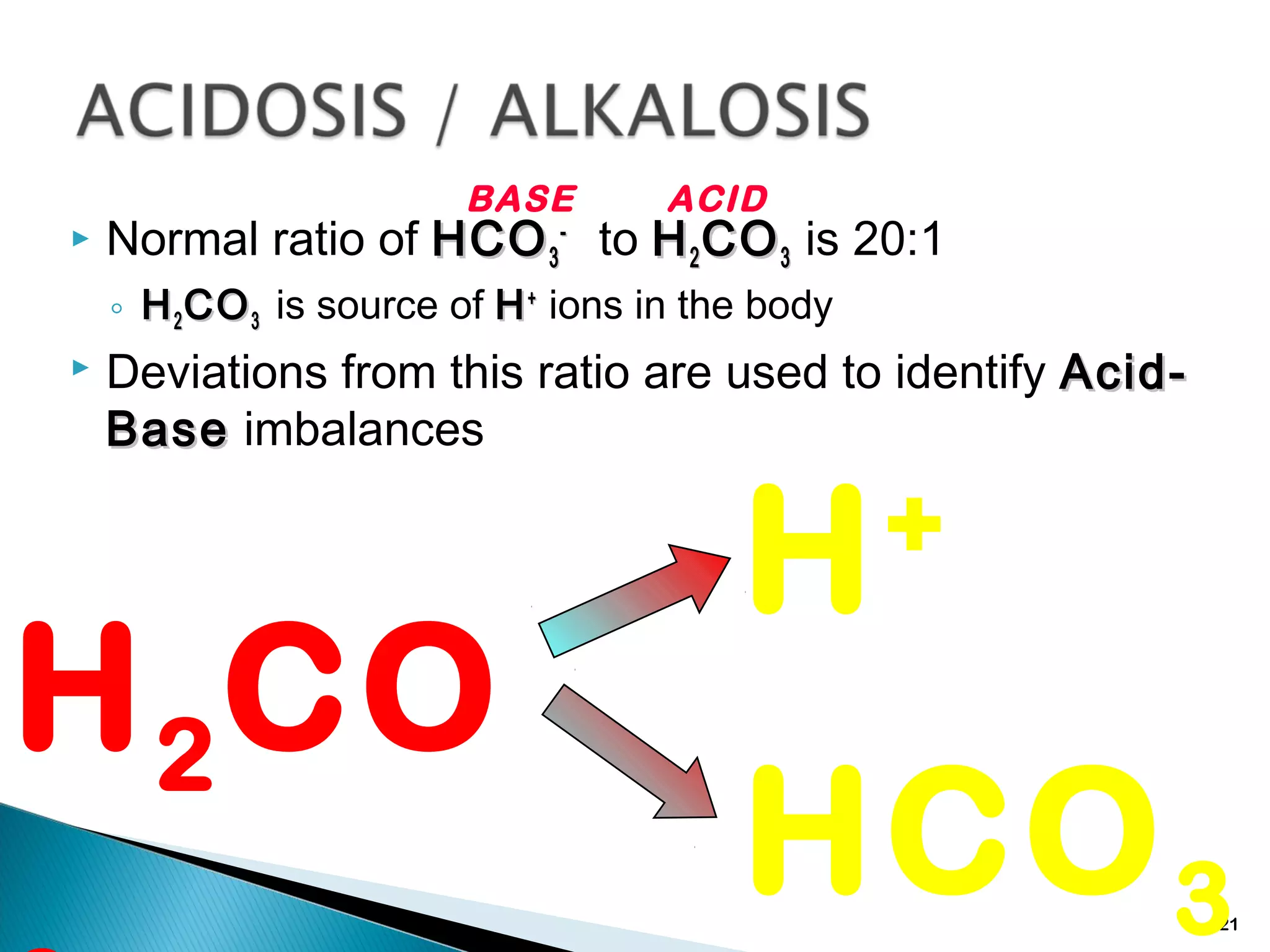
BASE        ACID
   Normal ratio of HCO 3 - to H 2 CO 3 is 20:1
    ◦ H 2 CO 3 is source of H + ions in the body
   Deviations from this ratio are used to identify Acid-
    Base imbalances


                                          H        +
H 2 CO
                                          HCO 3             21
 An  increase in the normal 20:1 base to
  acid ratio so there is
  ◦ A decrease in the number of hydrogen
    ions(ex: ratio of 20:0.5)
    An increase in the number of bicarbonate
    ions (ex: ratio of 40:1)
 Caused by base excess or acid deficit


 ACI                     BAS
                                               22
 Acidosis  is a decrease in pH below 7.35
 ◦ Which means a relative increase of H +
   ions.
 ◦ A relative decrease in HCO 3 -
 ◦ Both lead to a decrease in the ratio of
   20:1


H    +
                  =       p
                                             23
 The   body response to acid-base
  imbalance is called compensation
 May be complete if brought back

  within normal limits
 Partial compensation if range is

  still outside norms.


                                     24
 If underlying problem is metabolic,
  hyperventilation or hypoventilation
  can help by respiratory
  compensation.
 If problem is respiratory, renal

  mechanisms can bring about normal
  pH--- metabolic compensation .


                                        25
 pH changes have dramatic effects on
 normal cell function
 ◦ 1) Changes in excitability of nerve and
   muscle cells
 ◦ 2) Influences enzyme activity
 ◦ 3) Influences K + levels


                                             26
 pH  decrease (more acidic) depresses the
  central nervous system
  ◦ Can lead to loss of consciousness
 pH increase (more basic) can cause over-

  excitability
  ◦ Tingling sensations, nervousness,
    muscle twitches


                                             27
 pH  increases or decreases can alter the
  shape of the enzyme rendering it non-
  functional
 Changes in enzyme structure can result in

  accelerated or depressed metabolic actions
  within the cell


                                               28
 When   reabsorbing Na + from the filtrate of
  the renal tubules K + or H + is secreted
  (exchanged)
 Normally K + is

  secreted in much
  greater amounts
  than H +

K+                                               Na +

H+


             K+
                                                    29
 IfH + concentrations are high (acidosis) than
  H + is secreted in greater amounts
 This leaves less K + than usual excreted
 The resultant K + retention can affect cardiac

  function and other systems


K+                                             Na +

H+


                                                   30
 What are the different types
 of acidosis & alkalosis?


                                 31
 Deviations from normal Acid-Base status are
 divided into four general categories,
 depending on the source and direction of
 the abnormal change in H + concentrations
 ◦ Respiratory Acidosis
 ◦ Respiratory Alkalosis
 ◦ Metabolic Acidosis
 ◦ Metabolic Alkalosis


                                            32
◦ Respiratory Acidosis and Respiratory
  Alkalosis
◦ caused primarily by lung or breathing
  disorders.
◦ Metabolic Acidosis and Metabolic
  Alkalosis
   caused by an imbalance in the production
    and excretion of acids or bases by the
    kidneys.


                                               33
34
What is
respiratory
acidosis?
What are the
different causes
of rac ?
What is the
treatment of rac?

                    35
 Caused by hypercapnia( CO2) due to
 Hypoventilation
 Or Increased CO2 production
 Characterized by a decrease pH and an

  increase in CO2
 High levels of CO in the blood stimulate the
                      2
  parts of the brain that regulate breathing, which
  leads to faster and deeper breathing.


                                                      36
   Decreased CO 2 removal can be the result
    of:
    1) Obstruction of air passages
    2) Decreased respiration (depression of
        respiratory centers)
    3) Decreased gas exchange between
        pulmonary capillaries and air sacs of
        lungs (emphycema,bronchitis)
    4) Collapse of lung


                                                37
   Etiology :1) Alveolar hypoventilation
   Emphysema,
   Chronic bronchitis,
   Severe pneumonia
   Pulmonary edema
   Asthma
   Flail chest
   Diseases of the nerves or muscles of the chest .
   Over sedation from narcotics and strong sleeping
    medications .


                                                       38
 2) Increased CO2 production
 Malignant hyperthermia
 Thyroid storm
 Intensive shivering
 Prolonged seijures


                                39
 Breathlessness
 Restlessness

 Lethargy and disorientation

 Tremors, convulsions, coma

 Respiratory rate rapid, then gradually depressed

 Skin warm and flushed due to vasodilation caused

  by excess CO2


                                                     40
 Treat the under lying cause
 The treatment of respiratory acidosis aims to
  improve the function of the lungs.
 Drugs to improve breathing may help people who
  have lung diseases such as asthma and
  emphysema.
 Ventilatory support.


                                                   41
-metabolic balance before onset
     of acidosis
     -pH = 7.4


     -respiratory acidosis
     -pH = 7.1
     -breathing is suppressed holding
     CO 2 in body

     -body’s compensation
     -kidneys conserve HCO 3 - ions to
     restore the normal 40:2 ratio
     -kidneys eliminate H + ion in acidic
     urine
     - therapy required to restore
     metabolic balance
40
     - lactate solution used in therapy
     is converted to bicarbonate ions in
     the liver           42
What is
respiratory
alkalosis?
What are the
different causes
of ral ?
What is the
treatment of ral?

                    43
 Cause  is Hyperventilation leads to
 elimination of excessive amounts of CO 2.
 ◦ Increased loss of CO 2 from the lungs at
   a rate faster than it is produced.
 ◦ There is increase in pH and decrease in
   H+


                                              44
 Can be the result of:
 ◦ 1) pain,anxiety, emotional
   disturbances
 ◦ 2) Respiratory center lesions
 ◦ 3) Fever
 ◦ 4) Salicylate poisoning (overdose)
 ◦ 5) Assisted respiration
 ◦ 6) High altitude (low P O 2 )


                                        45
 Kidneys compensate by:
  Retaining hydrogen ions
   Increasing bicarbonate excretion
 Respiratory system
   Decreased CO 2 in the lungs will
  eventually slow the rate of
  breathing
   Will permit a normal amount of CO 2
    to be retained in theHHCO
                            H
                          lung
                             +   +

                                      -
                                  3

                    HCO 3 - H
                              +


                        H + HCO 3
                                  -

                HCO 3 -       H+
                        HCO 3 -
               H +

                   HCO - H
                            +
                        3

                   H+
                                          46
 Usually the only treatment needed is to slow
  down the rate of breathing
 Breathing into a paper bag or holding the

  breath as long as possible may help raise
  the blood CO 2 content as the person
  breathes carbon dioxide
  back in after breathing it out


                                                 47
-metabolic balance before
  onset of alkalosis
  -pH = 7.4


-respiratory alkalosis
-pH = 7.7
  - hyperactive breathing “ blows
  off ” CO 2

- body’s compensation

  - kidneys conserve H + ions and
  eliminate HCO 3 - in alkaline urine


  - therapy required to restore
  metabolic balance

- HCO 3 - ions replaced by Cl - ions
                      48
What is metabolic
acidosis (mac) ?
What are the different
causes of mac ?
What is the treatment of
mac ?


                           49
 Decrease in blood pH and bicarbonate level
      (below 22mEq/L)
     Excessive H + or decreased HCO -
                                     3


 H 2 CO           CO 3
                 HHCO 3
     O
H32C

                          = 7.4
                           = 7.4
                 --


3


       1    :     10
                  20                               50
 The causes of metabolic acidosis can be
 grouped into five major categories
 ◦ 1) Ingesting an acid (acetylsalicylic acid)
 ◦ 2) Abnormal Metabolism (type I
   DM,shock)
 ◦ 3) Kidney Insufficiencies(renal tubular
   acidosis or uremic acidosis )
 ◦ 4) Strenuous Exercise
 ◦ 5) Severe Diarrhea


                                                 51
 Unregulated  diabetes
 mellitus causes
 ketoacidosis
 ◦ Body metabolizes fat
   rather than glucose
 ◦ Accumulations of
   metabolic acids
   (Keto Acids) cause
   an increase in plasma
   H+


                           52
 This leads to excessive production of
   ketones:
   ◦ Acetone
   ◦ Acetoacetic acid
   ◦ B-hydroxybutyric acid
  Contribute excessive numbers of hydrogen
   ions to body fluids

Acetone
  H +     H+
 Acetoacetic
  H+ H+ H+
 acid
Hydroxybutyric
 H
acid+      +                                  53
   As the blood pH drops,
    breathing becomes
    deeper and faster as the
    body attempts to rid the
    blood of excess acid by
    decreasing the amount
    of carbon dioxide


                               54
 Eventually, the kidneys
  also try to compensate by
  excreting more acid in the
  urine
 However, both

  mechanisms can be
  overwhelmed if the body
  continues to produce too
  much acid, leading to
  severe acidosis and
  eventually a coma

                               55
◦ If the acidosis is mild, intravenous fluids and
    treatment for the underlying disorder may be all
    that's needed.
  ◦ control diabetes with insulin or treat poisoning by
    removing the toxic substance.
 When acidosis is severe, bicarbonate may be

  given
 (NaHCO3=BD X 30% X BODY WEIGHT

  ◦ Bicarbonate provides only temporary relief and
    may cause harm.


                                                          56
- metabolic balance before
            onset of acidosis
            - pH 7.4

           - metabolic acidosis
           - pH 7.1
             - HCO 3 - decreases because of
             excess presence of ketones,
             chloride or organic ions
           - body’s compensation
             - hyperactive breathing to “
             blow off ” CO 2
             - kidneys conserve HCO 3 - and
             eliminate H + ions in acidic urine
            - therapy required to restore
            metabolic balance
            - lactate solution used in therapy
0.5   10    is
            converted to bicarbonate ions
                               57
 What is anion gap ?
 What is the normal value?
 What is the effect of albumin?


                                   58
 To achieve electrochemical balance, the concentration
  of negatively-charged anions must equal the
  concentration of positively-charged cations.
 Na+UC=(Cl+HCO3)+UA

 Rearranging: Na-(Cl+HCO3)=UA-UC

 The difference (UA - UC) is a measure of the relative

  abundance of unmeasured anions
  and is called the anion gap (AG).
The normal value of the AG was originally set at 12 ± 4
  mEq/L (range = 8 to 16 mEq/L)


                                                          59
   Unmeasured Anions                  Unmeasured
    Cations
   Albumin (15 mEq/L)*         Calcium (5 mEq/L)
   Organic Acids (5 mEq/L)     Potassium (4.5 mEq/L)
   Phosphate (2 mEq/L)         Magnesium (1.5 mEq/L)
   Sulfate (1 mEq/L)
   Total UA: (23 mEq/L) Total UC: (11 mEq/L)
   Anion Gap = UA - UC = 12 mEq/L
   *If albumin is reduced by 50%, anion gap = 4 mEq/L


                                                         60
Increased anion gap                       Normal anion gap
                                          (hyperchloremic)

Renal failure                             Increased HCO3 loss by GIT
Ketoacdosis (DM,starvation)               Diarrhea, fistula,
                                          ureterosigmoidostomy
Lactic acidosis                           Increased loss of HCO3 by kidneys
Ingestion of toxin-salicylate methanol,   Renal tubular
ethylene glycol                           acidosis,hypoaldosteronism
rabdomyolysis                             Dilutional –large amt of HCO3 free
                                          fluids


                                                                               61
What is metabolic
alkalosis (mal) ?
What are the different
causes of mal ?
What is the treatment of
mal ?


                           62
 Elevation   of pH due to an increased 20:1
 ratio
 ◦ May be caused by:
    An increase of bicarbonate
    A decrease in hydrogen ions
 ◦ Imbalance again cannot be due to CO 2
 ◦ Increase in pH which has a non-respiratory
   origin

                                                63
   Can be the result of:
   1) Ingestion of Alkaline Substances (NaHCO 3 ) often used as a
    remedy for gastric hyperacidity.

    ◦ 2)Vomiting ,gastric drainage( loss of HCl )

    ◦ 3)certain diuretics

    ◦ 4)endocrine disorders:
    ◦ prim. hyperaldosteronism, cushing synd.

    ◦ 5)massive blood transfusion

    ◦ 6)severe dehydration


                                                                64
 Reaction   of the body to alkalosis is to lower
 pH by:
 ◦ Retain CO 2 by decreasing breathing rate.
 ◦ Kidneys increase the retention of H +


                                        H+
                                        H+
  CO                                     H+
         CO 2                           H+
  2


                                                    65
 Treatment   of metabolic alkalosis is most
  often accomplished by replacing water and
  electrolytes (sodium and potassium)
                              potassium
  while treating the underlying cause
 Occasionally when metabolic alkalosis is

  very severe, dilute acid in the form of
  ammonium chloride is given by IV


                                               66
- metabolic balance before onset
            of alkalosis
            - pH = 7.4

           - metabolic alkalosis
           - pH = 7.7
             - HCO 3 - increases because of
             loss of chloride ions or excess
             ingestion of NaHCO 3

           - body’s compensation
             - breathing suppressed to hold
             CO 2
             - kidneys conserve H + ions and
             eliminate HCO 3 - in alkaline urine

             - therapy required to restore
             metabolic balance

1.2   25   - HCO 3 - ions replaced by Cl - ions
5
                                                   67
http://umed.med.utah.edu/MS2/renal/AcidBaseTables/img001.JP
RESP           RESP           METAB              METAB
            ACIDOSIS       ALKALOSI       ACIDOSIS           ALKALOSIS
                           S
COMPENSAT Kidneys          Kidneys        Increased          Alkalosis
ION       eliminate        conserve       ventilation        commonly
          hydrogen ion     hydrogen ion   Renal              occurs with
          and retain       Excrete        excretion of H     renal
          bicarbonate      bicarbonate    ions.              dysfunction,
          ion              ion            K+ exchanges       so can’t count
                                          with excess H+     on kidneys.
                                          in ECF             Respiratory
                                          ( H+ into cells,   compensation
                                          K+ out of cells)   difficult –
                                                             hypoventilatio
                                                             n limited by
                                                             hypoxia
TREATMENT   Restore        Breathe into   IV lactate         Electrolytes to
            ventilation,   a paper bag    solution           replace those
            IV lactate     IV Chloride                       lost,
            solution       containing                        IV chloride       69
disturbance             response   Expected changes
Respiratory acidosis
acute                   HCO3       1mEq/L/10 mm of Hg inc
                                   .in Paco2
chronic                 HCO3       4mEq/L/10 mm of Hg inc
                                   .in Paco2
Respiratory alkalosis
acute                   HCO3       2mEq/L/10 mm of Hg
                                   dec .in Paco2
chronic                 HCO3       4mEq/L/10 mm of Hg
                                   dec .in Paco2

Metabolic acidosis      PPaco2     1.2 x the decrease in
                                   HCO3
Metabolic alkalosis     Paco2      0.7 x the increase in
                                   HCO3                     70
 Mechanisms  protect the body against life-
 threatening changes in hydrogen ion
 concentration
 ◦ 1) Buffering Systems in Body
   Fluids
 ◦ 2) Respiratory Responses
 ◦ 3) Renal Responses
 ◦ 4) Intracellular Shifts of Ions
                                           71
 Buffering  systems provide an immediate
  response to fluctuations in pH
  ◦ 1) Phosphate
  ◦ 2) Protein
  ◦ 3) Bicarbonate Buffer System
 A buffer is a combination of chemicals in

  solution that resists any significant change
  in pH
 Able to bind or release free H + ions


                                                 72
 1)   Phosphate buffer system
Na 2 HPO 4 + H +          NaH 2 PO 4 + Na +

 Most  important in the intracellular system.
 Phosphate concentrations are higher

  intracellularly and within the kidney tubules.


                                                   73
 2) Protein Buffer System
 ◦ Behaves as a buffer in both plasma and
   cells.
 ◦ Hemoglobin is by far the most important
   protein buffer.

 Proteinsare excellent buffers because they
 contain both acid and base groups that can
 give up or take up H +


                                               74
 As H + Hb picks up O 2 from the lungs the Hb
  which has a higher affinity for O 2 releases H +
  and picks up O 2
 Liberated H + combines with HCO -
                                       3


HCO 3 -         H 2 CO 3        CO 2 (exhaled)
   O2            H+


          H
   O2            O2
          b                                      75
 Protein
        buffer system works instantaneously
 making it the most powerful in the body.
 75% of the body’s buffer capacity is
 controlled by protein.
 ◦ Bicarbonate and phosphate buffer systems
   require several hours to be effective


                                              76
   3) Bicarbonate Buffer System
    ◦ Predominates in extracellular fluid (ECF)
                                           ECF
    HCO 3 - + H +                     H 2 CO 3

      This system is most important
       because the concentration of
       both components can be
       regulated:
        ◦Carbonic acid by the
        respiratory system
        ◦Bicarbonate by the renal
        system
                                                  77
 Neurons   in the medulla oblongata and pons
  constitute the Respiratory Center
 Increases in CO and H +
                     2

 stimulate the
 respiratory center.
  ◦ The effect is to
   raise respiration
   rates, but the effect
    diminishes in           Respiratory
    1 - 2 minutes.          centers


                                                78
 Chemoreceptors    are also present in the
  carotid and aortic arteries which respond to
  changes in partial pressures of O 2 and CO 2
  or pH
 Increased levels of

  CO 2 (low pH) or
             pH
  decreased levels of
  O 2 stimulate
  respiration rates
  to increase
                                                 79
 Overallcompensatory response is:
 ◦ Hyperventilation in response to
   increased CO 2 or H + (low pH)
                              pH
 ◦ Hypoventilation in response to
   decreased CO 2 or H + (high pH)
                               pH


                                     80
cell production of CO 2 increases


             CO 2 + H 2 O      H 2 CO 3


           H 2 CO 3       H + + HCO 3 -
           H+         acidosis; pH drops

H + stimulates respiratory center in medulla oblongata


       rate and depth of breathing increase


            CO 2 eliminated in lungs


           pH rises toward normal
                                                         81
 The   kidney compensates for Acid - Base
  imbalance within 24 hours and is
  responsible for long term control
 The kidney in response:

  ◦ To Acidosis
     Retains bicarbonate ions and eliminates
      hydrogen ions
  ◦ To Alkalosis
     Eliminates bicarbonate ions and retains
      hydrogen ions
                                                82
CO 2 + H 2 O           H 2 CO 3          H + + HCO 3


yperventilation removes    Kidneys eliminate or retai
 H + ion concentrations      H + or bicarbonate ions

ypoventilation increases
 H + ion concentrations
                                                  83
 Hyperkalemia    is generally associated with
 acidosis
 ◦ Accompanied by a shift of H + ions into cells
   and K + ions out of the cell to maintain
   electrical neutrality.
 ◦ Acidosis may cause Hyperkalemia and
   Hyperkalemia may cause Acidosis


      H      +
                               K      +
                                                 84
 Hypokalemia     is generally associated with
 reciprocal exchanges of H + and K + in the
 opposite direction
 ◦ Associated with alkalosis


       H      +
                                K      +
                                                 85
THANKS


     86

Acid base balance

  • 1.
    Life is astruggle, not against sin, not against Money Power . . But against hydrogen ions. Dr. Mamta Khandelwal 1
  • 2.
     Why acidbase homeostasis is essential?  hoW it is achieved ? 2
  • 3.
     The need for the existence of multiple mechanisms, involved in Acid-Base homeostasis is important for the hydrogen ion (H + ) concentration which is essential for the operation of many cellular enzymes and function of vital organs, most prominently the brain and the heart 3
  • 4.
     Acid-Base homeostasis involves chemical and physiologic processes responsible for the maintenance of the acidity of body fluids at levels that allow optimal function of the whole individual 4
  • 5.
     The chemicalprocesses represent the first line of defense to an acid or base load and include the extracellular and intracellular buffers.  The physiologic processes modulate acid-base composition by changes in cellular metabolism and by adaptive responses in the excretion of volatile acids by the lungs and fixed acids by the kidneys 3
  • 6.
     The taskimposed on the mechanisms that maintain Acid-Base homeostasis is large. ◦ Metabolic pathways are continuously consuming or producing H + ◦ The daily load of waste products for excretion in the form of volatile and fixed acids is substantial. 6
  • 7.
     Acid- Basebalance is primarily concerned with two ions: ◦ Hydrogen (H + ) ◦ Bicarbonate (HCO 3 - ) H + HCO 3 7
  • 8.
     H+ ionhas special significance because of the narrow ranges that it must be maintained in order to be compatible with living systems 8
  • 9.
  • 10.
     Maintenance of an acceptable pH range in the extracellular fluids is accomplished by three mechanisms: ◦ 1) Chemical Buffers  React very rapidly (less than a second) ◦ 2) Respiratory Regulation  Reacts rapidly (seconds to minutes) ◦ 3) Renal Regulation  Reacts slowly (minutes to hours) 10
  • 11.
     What isacid ?  What are physiologically important acids?  What is base?  What are physiologically important bases? 11
  • 12.
     Acids canbe defined as a proton (H + ) donor  Many other substance (carbohydrates) also contain hydrogen but they are not acids because the hydrogen is tightly bound and it is never liberated as free H +  Physiologically important acids include: ◦ Carbonic acid (H 2 CO 3 ) ◦ Phosphoric acid (H 3 PO 4 ) ◦ Pyruvic acid (C 3 H 4 O 3 ) ◦ Lactic acid (C 3 H 6 O 3 ) 12
  • 13.
     Bases canbe defined as: ◦ A proton (H + ) acceptor ◦ Give up OH- in solution. ◦ Physiologically important bases include: ◦ Bicarbonate (HCO 3 - ) ◦ Biphosphate (HPO 4 -2 ) 13
  • 14.
  • 15.
     What isph?  What is normal blood ph ?  What is the ph range compatible With life? 15
  • 16.
    pH refers to P otential H ydrogen  Expresses hydrogen ion concentration in water solutions.  Water ionizes to form equal amounts of H + ions and OH - ions ◦ H 2O H + + OH -  Pure water is Neutral ( H + = OH - )  pH = 7  Acid ( H + > OH - )  pH < 7  Base ( H + < OH - )  pH > 7  Normal blood pH is 7.35 - 7.45  pH range compatible with life is 6.8 - 8.0 ◦ 16
  • 17.
     ThepH ofthe solution is defined as the negative logarithm ( base 10 )of the hydrogen ion (H + ) concentration pH = log 1 / H + concentration  H+ concentration in extracellular fluid (ECF) 4 X 10 -8 (0.00000004) 17
  • 18.
     Low pH values = high H + concentrations ◦ H + concentration in denominator of formula pH = log 1 / H + concentration  Unit changes in pH represent a tenfold change in H + concentrations 18
  • 19.
     pH =4 is more acidic than pH = 6  pH = 4 has 10 times more free H + concentration than pH = 5 and 100 times more free H + concentration than pH = 6 ACIDOSIS NORMAL ALKALOSIS DEATH DEATH 6.8 7.3 7.4 7.5 8.0 Venou Arteria s l Blood Blood 19
  • 20.
    What is normalratio o f HCO 3 - to H 2 CO 3 ? What is acidosis ? What is alkalosis? What is compensation ? What are the effects of ph change on cell functions? 20
  • 21.
    BASE ACID  Normal ratio of HCO 3 - to H 2 CO 3 is 20:1 ◦ H 2 CO 3 is source of H + ions in the body  Deviations from this ratio are used to identify Acid- Base imbalances H + H 2 CO HCO 3 21
  • 22.
     An increase in the normal 20:1 base to acid ratio so there is ◦ A decrease in the number of hydrogen ions(ex: ratio of 20:0.5) An increase in the number of bicarbonate ions (ex: ratio of 40:1)  Caused by base excess or acid deficit ACI BAS 22
  • 23.
     Acidosis is a decrease in pH below 7.35 ◦ Which means a relative increase of H + ions. ◦ A relative decrease in HCO 3 - ◦ Both lead to a decrease in the ratio of 20:1 H + = p 23
  • 24.
     The body response to acid-base imbalance is called compensation  May be complete if brought back within normal limits  Partial compensation if range is still outside norms. 24
  • 25.
     If underlyingproblem is metabolic, hyperventilation or hypoventilation can help by respiratory compensation.  If problem is respiratory, renal mechanisms can bring about normal pH--- metabolic compensation . 25
  • 26.
     pH changeshave dramatic effects on normal cell function ◦ 1) Changes in excitability of nerve and muscle cells ◦ 2) Influences enzyme activity ◦ 3) Influences K + levels 26
  • 27.
     pH decrease (more acidic) depresses the central nervous system ◦ Can lead to loss of consciousness  pH increase (more basic) can cause over- excitability ◦ Tingling sensations, nervousness, muscle twitches 27
  • 28.
     pH increases or decreases can alter the shape of the enzyme rendering it non- functional  Changes in enzyme structure can result in accelerated or depressed metabolic actions within the cell 28
  • 29.
     When reabsorbing Na + from the filtrate of the renal tubules K + or H + is secreted (exchanged)  Normally K + is secreted in much greater amounts than H + K+ Na + H+ K+ 29
  • 30.
     IfH +concentrations are high (acidosis) than H + is secreted in greater amounts  This leaves less K + than usual excreted  The resultant K + retention can affect cardiac function and other systems K+ Na + H+ 30
  • 31.
     What arethe different types of acidosis & alkalosis? 31
  • 32.
     Deviations fromnormal Acid-Base status are divided into four general categories, depending on the source and direction of the abnormal change in H + concentrations ◦ Respiratory Acidosis ◦ Respiratory Alkalosis ◦ Metabolic Acidosis ◦ Metabolic Alkalosis 32
  • 33.
    ◦ Respiratory Acidosisand Respiratory Alkalosis ◦ caused primarily by lung or breathing disorders. ◦ Metabolic Acidosis and Metabolic Alkalosis  caused by an imbalance in the production and excretion of acids or bases by the kidneys. 33
  • 34.
  • 35.
    What is respiratory acidosis? What arethe different causes of rac ? What is the treatment of rac? 35
  • 36.
     Caused byhypercapnia( CO2) due to  Hypoventilation  Or Increased CO2 production  Characterized by a decrease pH and an increase in CO2  High levels of CO in the blood stimulate the 2 parts of the brain that regulate breathing, which leads to faster and deeper breathing. 36
  • 37.
    Decreased CO 2 removal can be the result of: 1) Obstruction of air passages 2) Decreased respiration (depression of respiratory centers) 3) Decreased gas exchange between pulmonary capillaries and air sacs of lungs (emphycema,bronchitis) 4) Collapse of lung 37
  • 38.
    Etiology :1) Alveolar hypoventilation  Emphysema,  Chronic bronchitis,  Severe pneumonia  Pulmonary edema  Asthma  Flail chest  Diseases of the nerves or muscles of the chest .  Over sedation from narcotics and strong sleeping medications . 38
  • 39.
     2) IncreasedCO2 production  Malignant hyperthermia  Thyroid storm  Intensive shivering  Prolonged seijures 39
  • 40.
     Breathlessness  Restlessness Lethargy and disorientation  Tremors, convulsions, coma  Respiratory rate rapid, then gradually depressed  Skin warm and flushed due to vasodilation caused by excess CO2 40
  • 41.
     Treat theunder lying cause  The treatment of respiratory acidosis aims to improve the function of the lungs.  Drugs to improve breathing may help people who have lung diseases such as asthma and emphysema.  Ventilatory support. 41
  • 42.
    -metabolic balance beforeonset of acidosis -pH = 7.4 -respiratory acidosis -pH = 7.1 -breathing is suppressed holding CO 2 in body -body’s compensation -kidneys conserve HCO 3 - ions to restore the normal 40:2 ratio -kidneys eliminate H + ion in acidic urine - therapy required to restore metabolic balance 40 - lactate solution used in therapy is converted to bicarbonate ions in the liver 42
  • 43.
    What is respiratory alkalosis? What arethe different causes of ral ? What is the treatment of ral? 43
  • 44.
     Cause is Hyperventilation leads to elimination of excessive amounts of CO 2. ◦ Increased loss of CO 2 from the lungs at a rate faster than it is produced. ◦ There is increase in pH and decrease in H+ 44
  • 45.
     Can bethe result of: ◦ 1) pain,anxiety, emotional disturbances ◦ 2) Respiratory center lesions ◦ 3) Fever ◦ 4) Salicylate poisoning (overdose) ◦ 5) Assisted respiration ◦ 6) High altitude (low P O 2 ) 45
  • 46.
     Kidneys compensateby: Retaining hydrogen ions Increasing bicarbonate excretion  Respiratory system Decreased CO 2 in the lungs will eventually slow the rate of breathing Will permit a normal amount of CO 2 to be retained in theHHCO H lung + + - 3 HCO 3 - H + H + HCO 3 - HCO 3 - H+ HCO 3 - H + HCO - H + 3 H+ 46
  • 47.
     Usually theonly treatment needed is to slow down the rate of breathing  Breathing into a paper bag or holding the breath as long as possible may help raise the blood CO 2 content as the person breathes carbon dioxide back in after breathing it out 47
  • 48.
    -metabolic balance before onset of alkalosis -pH = 7.4 -respiratory alkalosis -pH = 7.7 - hyperactive breathing “ blows off ” CO 2 - body’s compensation - kidneys conserve H + ions and eliminate HCO 3 - in alkaline urine - therapy required to restore metabolic balance - HCO 3 - ions replaced by Cl - ions 48
  • 49.
    What is metabolic acidosis(mac) ? What are the different causes of mac ? What is the treatment of mac ? 49
  • 50.
     Decrease inblood pH and bicarbonate level (below 22mEq/L)  Excessive H + or decreased HCO - 3 H 2 CO CO 3 HHCO 3 O H32C = 7.4 = 7.4 -- 3 1 : 10 20 50
  • 51.
     The causesof metabolic acidosis can be grouped into five major categories ◦ 1) Ingesting an acid (acetylsalicylic acid) ◦ 2) Abnormal Metabolism (type I DM,shock) ◦ 3) Kidney Insufficiencies(renal tubular acidosis or uremic acidosis ) ◦ 4) Strenuous Exercise ◦ 5) Severe Diarrhea 51
  • 52.
     Unregulated diabetes mellitus causes ketoacidosis ◦ Body metabolizes fat rather than glucose ◦ Accumulations of metabolic acids (Keto Acids) cause an increase in plasma H+ 52
  • 53.
     This leadsto excessive production of ketones: ◦ Acetone ◦ Acetoacetic acid ◦ B-hydroxybutyric acid  Contribute excessive numbers of hydrogen ions to body fluids Acetone H + H+ Acetoacetic H+ H+ H+ acid Hydroxybutyric H acid+ + 53
  • 54.
    As the blood pH drops, breathing becomes deeper and faster as the body attempts to rid the blood of excess acid by decreasing the amount of carbon dioxide 54
  • 55.
     Eventually, thekidneys also try to compensate by excreting more acid in the urine  However, both mechanisms can be overwhelmed if the body continues to produce too much acid, leading to severe acidosis and eventually a coma 55
  • 56.
    ◦ If theacidosis is mild, intravenous fluids and treatment for the underlying disorder may be all that's needed. ◦ control diabetes with insulin or treat poisoning by removing the toxic substance.  When acidosis is severe, bicarbonate may be given  (NaHCO3=BD X 30% X BODY WEIGHT ◦ Bicarbonate provides only temporary relief and may cause harm. 56
  • 57.
    - metabolic balancebefore onset of acidosis - pH 7.4 - metabolic acidosis - pH 7.1 - HCO 3 - decreases because of excess presence of ketones, chloride or organic ions - body’s compensation - hyperactive breathing to “ blow off ” CO 2 - kidneys conserve HCO 3 - and eliminate H + ions in acidic urine - therapy required to restore metabolic balance - lactate solution used in therapy 0.5 10 is converted to bicarbonate ions 57
  • 58.
     What isanion gap ?  What is the normal value?  What is the effect of albumin? 58
  • 59.
     To achieveelectrochemical balance, the concentration of negatively-charged anions must equal the concentration of positively-charged cations.  Na+UC=(Cl+HCO3)+UA  Rearranging: Na-(Cl+HCO3)=UA-UC  The difference (UA - UC) is a measure of the relative abundance of unmeasured anions and is called the anion gap (AG). The normal value of the AG was originally set at 12 ± 4 mEq/L (range = 8 to 16 mEq/L) 59
  • 60.
    Unmeasured Anions Unmeasured Cations  Albumin (15 mEq/L)* Calcium (5 mEq/L)  Organic Acids (5 mEq/L) Potassium (4.5 mEq/L)  Phosphate (2 mEq/L) Magnesium (1.5 mEq/L)  Sulfate (1 mEq/L)  Total UA: (23 mEq/L) Total UC: (11 mEq/L)  Anion Gap = UA - UC = 12 mEq/L  *If albumin is reduced by 50%, anion gap = 4 mEq/L 60
  • 61.
    Increased anion gap Normal anion gap (hyperchloremic) Renal failure Increased HCO3 loss by GIT Ketoacdosis (DM,starvation) Diarrhea, fistula, ureterosigmoidostomy Lactic acidosis Increased loss of HCO3 by kidneys Ingestion of toxin-salicylate methanol, Renal tubular ethylene glycol acidosis,hypoaldosteronism rabdomyolysis Dilutional –large amt of HCO3 free fluids 61
  • 62.
    What is metabolic alkalosis(mal) ? What are the different causes of mal ? What is the treatment of mal ? 62
  • 63.
     Elevation of pH due to an increased 20:1 ratio ◦ May be caused by:  An increase of bicarbonate  A decrease in hydrogen ions ◦ Imbalance again cannot be due to CO 2 ◦ Increase in pH which has a non-respiratory origin 63
  • 64.
    Can be the result of:  1) Ingestion of Alkaline Substances (NaHCO 3 ) often used as a remedy for gastric hyperacidity. ◦ 2)Vomiting ,gastric drainage( loss of HCl ) ◦ 3)certain diuretics ◦ 4)endocrine disorders: ◦ prim. hyperaldosteronism, cushing synd. ◦ 5)massive blood transfusion ◦ 6)severe dehydration 64
  • 65.
     Reaction of the body to alkalosis is to lower pH by: ◦ Retain CO 2 by decreasing breathing rate. ◦ Kidneys increase the retention of H + H+ H+ CO H+ CO 2 H+ 2 65
  • 66.
     Treatment of metabolic alkalosis is most often accomplished by replacing water and electrolytes (sodium and potassium) potassium while treating the underlying cause  Occasionally when metabolic alkalosis is very severe, dilute acid in the form of ammonium chloride is given by IV 66
  • 67.
    - metabolic balancebefore onset of alkalosis - pH = 7.4 - metabolic alkalosis - pH = 7.7 - HCO 3 - increases because of loss of chloride ions or excess ingestion of NaHCO 3 - body’s compensation - breathing suppressed to hold CO 2 - kidneys conserve H + ions and eliminate HCO 3 - in alkaline urine - therapy required to restore metabolic balance 1.2 25 - HCO 3 - ions replaced by Cl - ions 5 67
  • 68.
  • 69.
    RESP RESP METAB METAB ACIDOSIS ALKALOSI ACIDOSIS ALKALOSIS S COMPENSAT Kidneys Kidneys Increased Alkalosis ION eliminate conserve ventilation commonly hydrogen ion hydrogen ion Renal occurs with and retain Excrete excretion of H renal bicarbonate bicarbonate ions. dysfunction, ion ion K+ exchanges so can’t count with excess H+ on kidneys. in ECF Respiratory ( H+ into cells, compensation K+ out of cells) difficult – hypoventilatio n limited by hypoxia TREATMENT Restore Breathe into IV lactate Electrolytes to ventilation, a paper bag solution replace those IV lactate IV Chloride lost, solution containing IV chloride 69
  • 70.
    disturbance response Expected changes Respiratory acidosis acute HCO3 1mEq/L/10 mm of Hg inc .in Paco2 chronic HCO3 4mEq/L/10 mm of Hg inc .in Paco2 Respiratory alkalosis acute HCO3 2mEq/L/10 mm of Hg dec .in Paco2 chronic HCO3 4mEq/L/10 mm of Hg dec .in Paco2 Metabolic acidosis PPaco2 1.2 x the decrease in HCO3 Metabolic alkalosis Paco2 0.7 x the increase in HCO3 70
  • 71.
     Mechanisms protect the body against life- threatening changes in hydrogen ion concentration ◦ 1) Buffering Systems in Body Fluids ◦ 2) Respiratory Responses ◦ 3) Renal Responses ◦ 4) Intracellular Shifts of Ions 71
  • 72.
     Buffering systems provide an immediate response to fluctuations in pH ◦ 1) Phosphate ◦ 2) Protein ◦ 3) Bicarbonate Buffer System  A buffer is a combination of chemicals in solution that resists any significant change in pH  Able to bind or release free H + ions 72
  • 73.
     1) Phosphate buffer system Na 2 HPO 4 + H + NaH 2 PO 4 + Na +  Most important in the intracellular system.  Phosphate concentrations are higher intracellularly and within the kidney tubules. 73
  • 74.
     2) ProteinBuffer System ◦ Behaves as a buffer in both plasma and cells. ◦ Hemoglobin is by far the most important protein buffer.  Proteinsare excellent buffers because they contain both acid and base groups that can give up or take up H + 74
  • 75.
     As H+ Hb picks up O 2 from the lungs the Hb which has a higher affinity for O 2 releases H + and picks up O 2  Liberated H + combines with HCO - 3 HCO 3 - H 2 CO 3 CO 2 (exhaled) O2 H+ H O2 O2 b 75
  • 76.
     Protein buffer system works instantaneously making it the most powerful in the body.  75% of the body’s buffer capacity is controlled by protein. ◦ Bicarbonate and phosphate buffer systems require several hours to be effective 76
  • 77.
    3) Bicarbonate Buffer System ◦ Predominates in extracellular fluid (ECF) ECF HCO 3 - + H + H 2 CO 3 This system is most important because the concentration of both components can be regulated: ◦Carbonic acid by the respiratory system ◦Bicarbonate by the renal system 77
  • 78.
     Neurons in the medulla oblongata and pons constitute the Respiratory Center  Increases in CO and H + 2 stimulate the respiratory center. ◦ The effect is to raise respiration rates, but the effect diminishes in Respiratory 1 - 2 minutes. centers 78
  • 79.
     Chemoreceptors are also present in the carotid and aortic arteries which respond to changes in partial pressures of O 2 and CO 2 or pH  Increased levels of CO 2 (low pH) or pH decreased levels of O 2 stimulate respiration rates to increase 79
  • 80.
     Overallcompensatory responseis: ◦ Hyperventilation in response to increased CO 2 or H + (low pH) pH ◦ Hypoventilation in response to decreased CO 2 or H + (high pH) pH 80
  • 81.
    cell production ofCO 2 increases CO 2 + H 2 O H 2 CO 3 H 2 CO 3 H + + HCO 3 - H+ acidosis; pH drops H + stimulates respiratory center in medulla oblongata rate and depth of breathing increase CO 2 eliminated in lungs pH rises toward normal 81
  • 82.
     The kidney compensates for Acid - Base imbalance within 24 hours and is responsible for long term control  The kidney in response: ◦ To Acidosis  Retains bicarbonate ions and eliminates hydrogen ions ◦ To Alkalosis  Eliminates bicarbonate ions and retains hydrogen ions 82
  • 83.
    CO 2 +H 2 O H 2 CO 3 H + + HCO 3 yperventilation removes Kidneys eliminate or retai H + ion concentrations H + or bicarbonate ions ypoventilation increases H + ion concentrations 83
  • 84.
     Hyperkalemia is generally associated with acidosis ◦ Accompanied by a shift of H + ions into cells and K + ions out of the cell to maintain electrical neutrality. ◦ Acidosis may cause Hyperkalemia and Hyperkalemia may cause Acidosis H + K + 84
  • 85.
     Hypokalemia is generally associated with reciprocal exchanges of H + and K + in the opposite direction ◦ Associated with alkalosis H + K + 85
  • 86.