Dr. Urfeya Mirza
Vet Surgeon
(MVSc VSR)
2
pH Review
 pH = - log [H+]
 H+ is really a proton
 Range is from 0 - 14
 If [H+] is high, the solution is acidic; pH < 7
 If [H+] is low, the solution is basic or alkaline ; pH > 7
3
4
5
 Acids are H+ donors
 Bases are H+ acceptors, or give up OH- in solution
 Acids and bases can be:
Strong – dissociate completely in solution
HCl, NaOH
Weak – dissociate only partially in
solution
Lactic acid, carbonic acid
6
The Body and pH
 Homeostasis of pH is tightly controlled
 Extracellular fluid = 7.4
 Blood = 7.35 – 7.45
 < 6.8 or > 8.0 death occurs
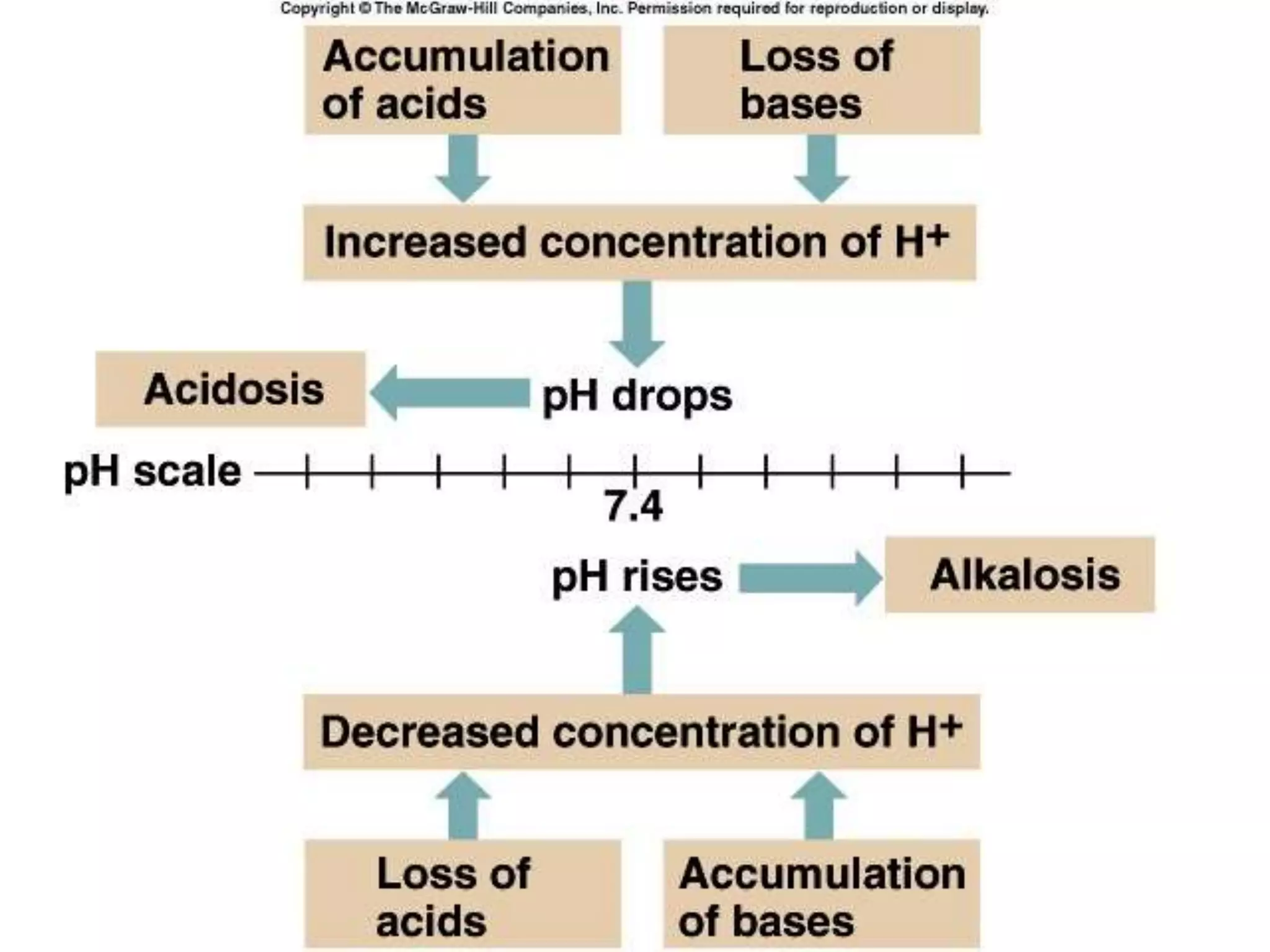
 Acidosis (acidemia) below 7.35
 Alkalosis (alkalemia) above 7.45
7
8
 Small changes in pH can produce major disturbances
 Most enzymes function only with narrow pH ranges
 Acid-base balance can also affect electrolytes (Na+, K+,
Cl-)
 Can also affect hormones
 The body produces more acids than bases
 Acids take in with foods
 Acids produced by metabolism of lipids and proteins
 Cellular metabolism produces CO2
CO2 + H20 ↔ H2CO3 ↔ H+ + HCO3
-
Henderson-Hasselbach equation
 pH = pKa + log([HCO3
-]/[H2CO3])
 CO2 dissolved in plasma potentially can form H2CO3 so:
pH = pKa + log([HCO3
-]/[dissolved CO2 + H2CO3])
 At the temperature and ionic strength of ECF there are 6,800
HCO3
- ions and 340 molecules of dissolved CO2 for each
molecule of H2CO3. Therefore, H2CO3 can be neglected
 Dissolved CO2 is related to pCO2 by its solubility coefficient:
Dissolved CO2 = 0.03 X pCO2
Henderson-Hasselbach equation (clinically
relevant form)
pH = pKa + log([HCO3
-]/.03xpCO2)
pH = 6.1 + log([HCO3
-]/.03xpCO2)
 Shows that pH is a function of the RATIO
between bicarbonate and pCO2
11
Control of Acids
1. Buffer systems
 Take up H+ or release H+ as conditions change
 Buffer pairs – weak acid and a base
 Exchange a strong acid or base for a weak one
 Results in a much smaller pH change
12
Bicarbonate buffer
 Sodium Bicarbonate (NaHCO3) and carbonic acid (H2CO3)
 Maintain a 20:1 ratio : HCO3
- : H2CO3
HCl + NaHCO3 ↔ H2CO3 + NaCl
NaOH + H2CO3 ↔ NaHCO3 + H2O
Phosphate buffer
 Major intracellular buffer
H+ + HPO4
2- ↔ H2PO4-
OH- + H2PO4
- ↔ H2O + H2PO4
2-
Protein Buffers
Includes hemoglobin, work in blood and ISF
Carboxyl group gives up H+
Amino Group accepts H+
Side chains that can buffer H+ are present on 27 amino acids
13
2. Respiratory mechanisms
 Exhalation of carbon dioxide
 Powerful, but only works with volatile acids
 Doesn’t affect fixed acids like lactic acid
 CO2 + H20 ↔ H2CO3 ↔ H+ + HCO3
-
 Body pH can be adjusted by changing rate and depth of breathing
3. Kidney excretion
 Can eliminate large amounts of acid
 Can also excrete base
 Can conserve and produce bicarb ions
 Most effective regulator of pH
 If kidneys fail, pH balance fails
14
Rates of correction
 Buffers function almost instantaneously
 Respiratory mechanisms take several minutes to hours
 Renal mechanisms may take several hours to days
15
16
17
Acid-Base Imbalances
 Metabolic disturbances
 Metabolic acidosis
 Metabolic alkalosis
 Respiratory disturbances
 Respiratory acidosis
 Respiratory alkalosis
18
Acid-Base Imbalances
 pH< 7.35 acidosis
 pH > 7.45 alkalosis
 The body response to acid-base imbalance is called
compensation
 May be complete if brought back within normal
limits
 Partial compensation if range is still outside norms
19
Compensation
 If underlying problem is metabolic, hyperventilation
or hypoventilation can help : respiratory
compensation
 If problem is respiratory, renal mechanisms can bring
about metabolic compensation
20
Acidosis
 Principal effect of acidosis is depression of the CNS
through ↓ in synaptic transmission
 Generalized weakness
 Deranged CNS function the greatest threat
 Severe acidosis causes
 Disorientation
 Coma
 Death
21
Alkalosis
 Alkalosis causes over excitability of the central and
peripheral nervous systems
 Numbness
 Lightheadedness
 It can cause :
 Nervousness
 Muscle spasms or tetany
 Convulsions
 Loss of consciousness
 Death
22
23
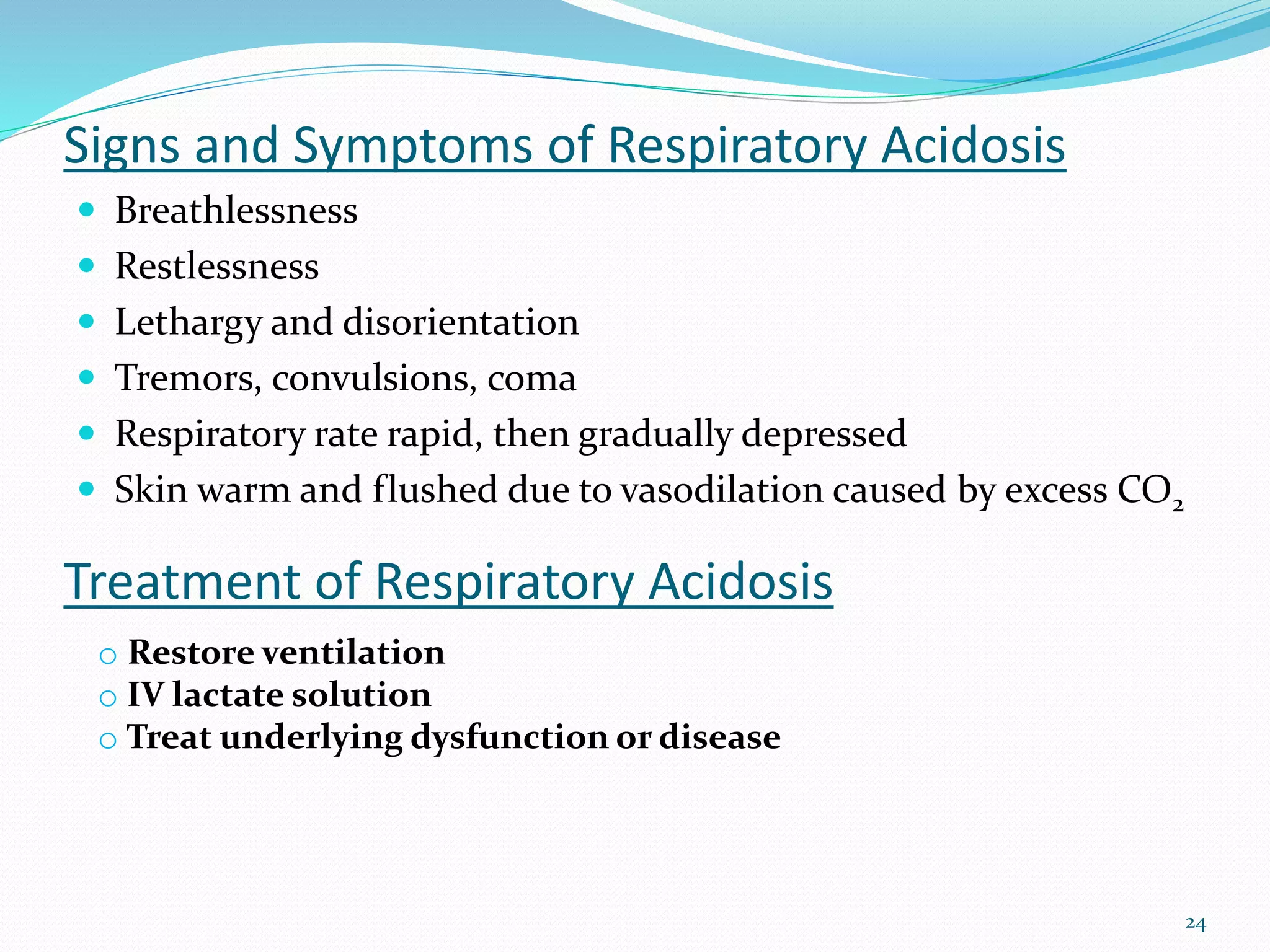
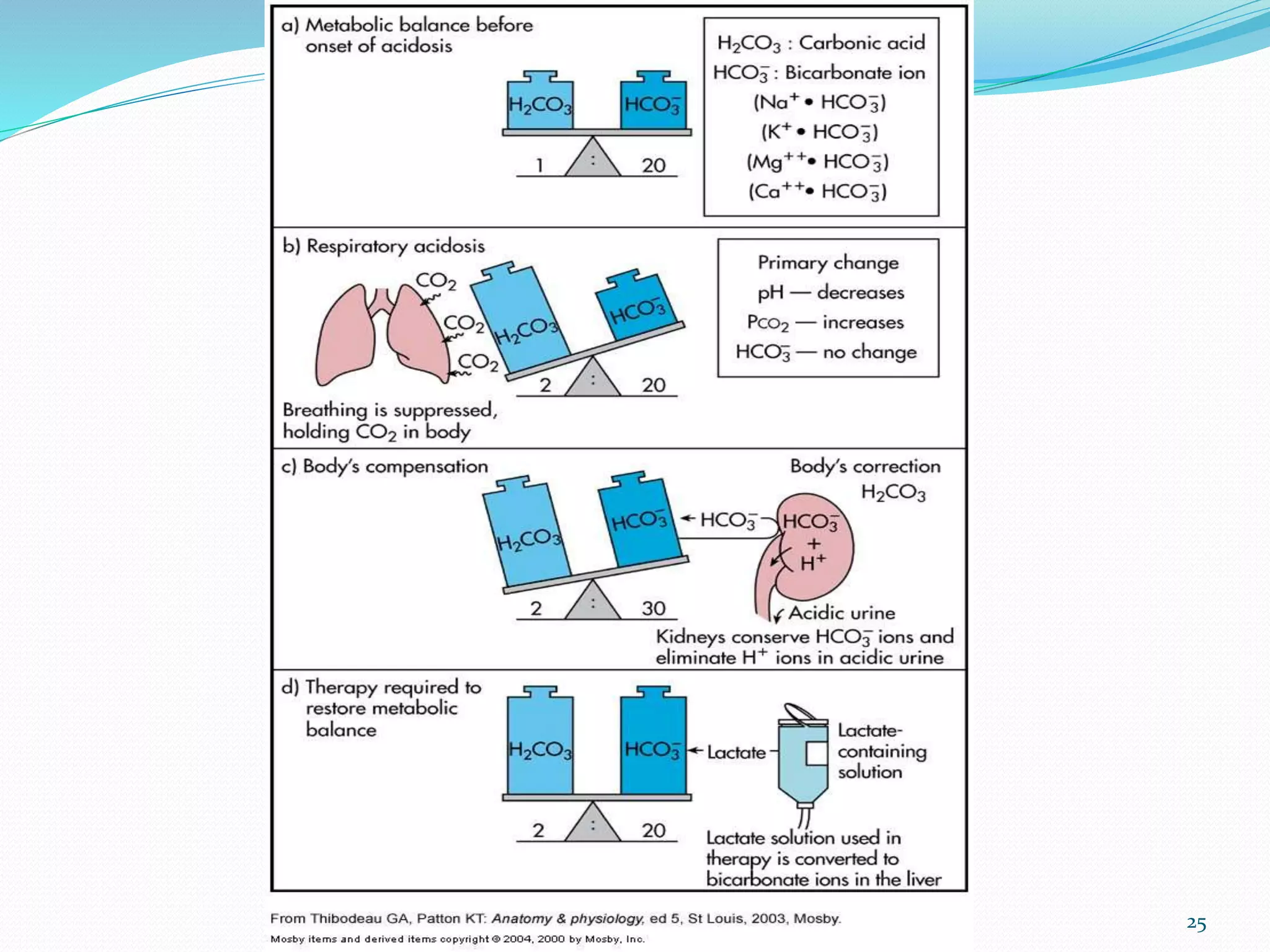
Respiratory Acidosis
 Carbonic acid excess caused by blood levels of CO2 above 45
mm Hg
 Hypercapnia – high levels of CO2 in blood
 Chronic conditions:
 Depression of respiratory center in brain that controls breathing rate –
drugs or head trauma
 Paralysis of respiratory or chest muscles
 Acute conditons:
 Adult Respiratory Distress Syndrome
 Pulmonary edema
 Pneumothorax
 Emphysema
Compensation for Respiratory Acidosis
• Kidneys eliminate hydrogen ion and retain bicarbonate ion
24
Signs and Symptoms of Respiratory Acidosis
 Breathlessness
 Restlessness
 Lethargy and disorientation
 Tremors, convulsions, coma
 Respiratory rate rapid, then gradually depressed
 Skin warm and flushed due to vasodilation caused by excess CO2
Treatment of Respiratory Acidosis
o Restore ventilation
o IV lactate solution
o Treat underlying dysfunction or disease
25
26
Respiratory Alkalosis
 Carbonic acid deficit
 pCO2 less than 35 mm Hg (hypocapnea)
 Most common acid-base imbalance
 Primary cause is hyperventilation
 Conditions that stimulate respiratory center:
 Oxygen deficiency at high altitudes
 Pulmonary disease and Congestive heart failure – caused by
hypoxia
 Acute anxiety
 Fever, anemia
 Early salicylate intoxication
 Cirrhosis
 Gram-negative sepsis
27
Compensation of Respiratory Alkalosis
 Kidneys conserve hydrogen ion
 Excrete bicarbonate ion
Treatment of Respiratory Alkalosis
o Treat underlying cause
o Breathe into a paper bag
o IV Chloride containing solution – Cl- ions replace lost
bicarbonate ions
28
29
Metabolic Acidosis
 Bicarbonate deficit - blood concentrations of bicarb drop below
22mEq/L
 Causes:
 Loss of bicarbonate through diarrhea or renal dysfunction
 Accumulation of acids (lactic acid or ketones)
 Failure of kidneys to excrete H+
Symptoms of Metabolic Acidosis
o Headache, lethargy
o Nausea, vomiting, diarrhea
o Coma
o Death
30
Compensation for Metabolic Acidosis
 Increased ventilation
 Renal excretion of hydrogen ions if possible
 K+ exchanges with excess H+ in ECF
 ( H+ into cells, K+ out of cells)
Treatment of Metabolic Acidosis
o IV lactate solution
31
32
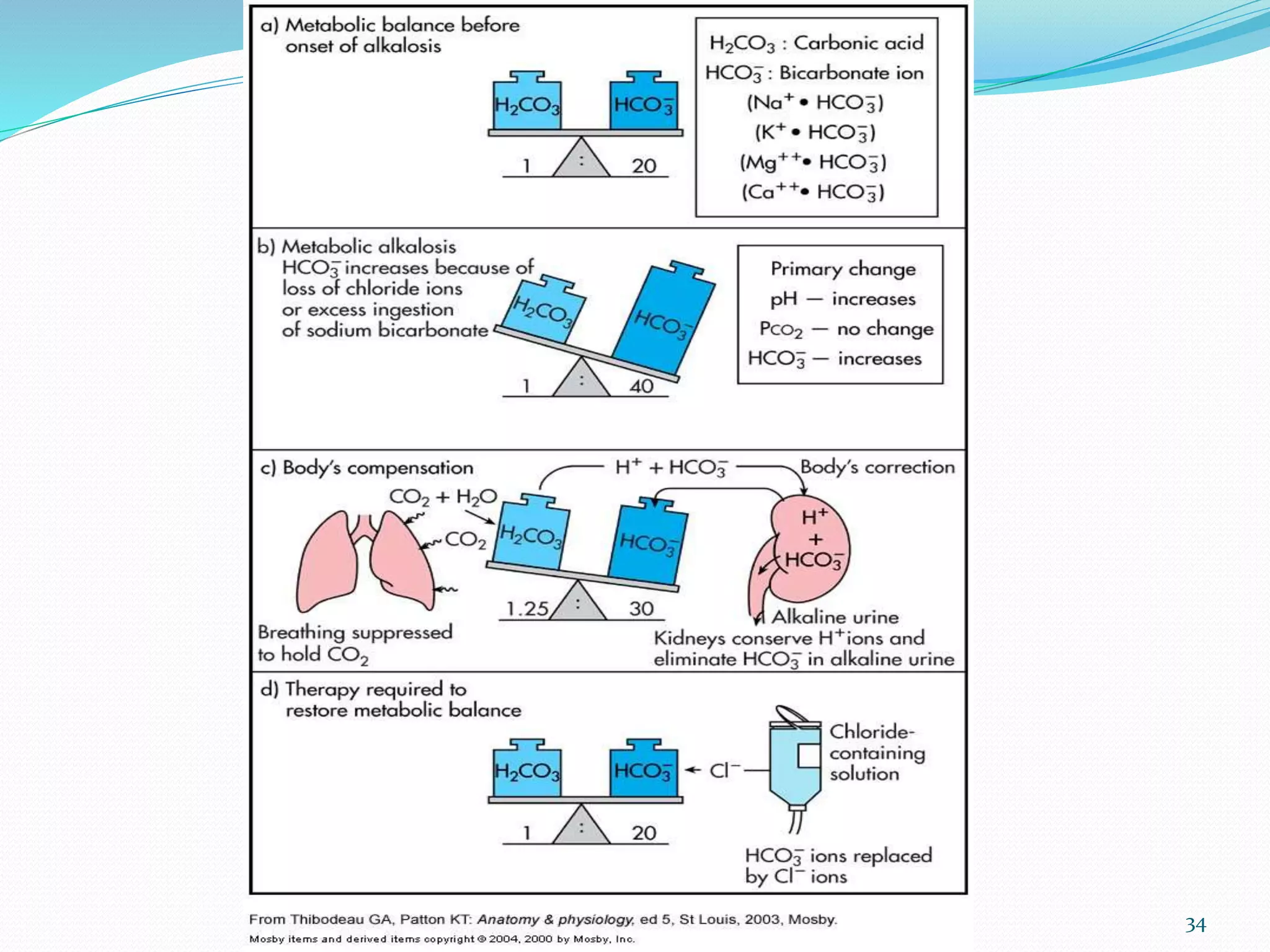
Metabolic Alkalosis
 Bicarbonate excess - concentration in blood is greater than 26
mEq/L
 Causes:
 Excess vomiting = loss of stomach acid
 Excessive use of alkaline drugs
 Certain diuretics
 Endocrine disorders
 Heavy ingestion of antacids
 Severe dehydration
Compensation for Metabolic Alkalosis
 Alkalosis most commonly occurs with renal dysfunction, so can’t
count on kidneys
 Respiratory compensation difficult – hypoventilation limited by
hypoxia
33
Symptoms of Metabolic Alkalosis
 Respiration slow and shallow
 Hyperactive reflexes ; tetany
 Often related to depletion of electrolytes
 Atrial tachycardia
 Dysrhythmias
Treatment of Metabolic Alkalosis
 Electrolytes to replace those lost
 IV chloride containing solution
 Treat underlying disorder
34
35
Diagnosis of Acid-Base Imbalances
1. Note whether the pH is low (acidosis) or high (alkalosis)
2. Decide which value, pCO2 or HCO3
- , is outside the
normal range and could be the cause of the problem. If
the cause is a change in pCO2, the problem is respiratory.
If the cause is HCO3
- the problem is metabolic
3. Look at the value that doesn’t correspond to the
observed pH change. If it is inside the normal range,
there is no compensation occurring. If it is outside the
normal range, the body is partially compensating for the
problem
36
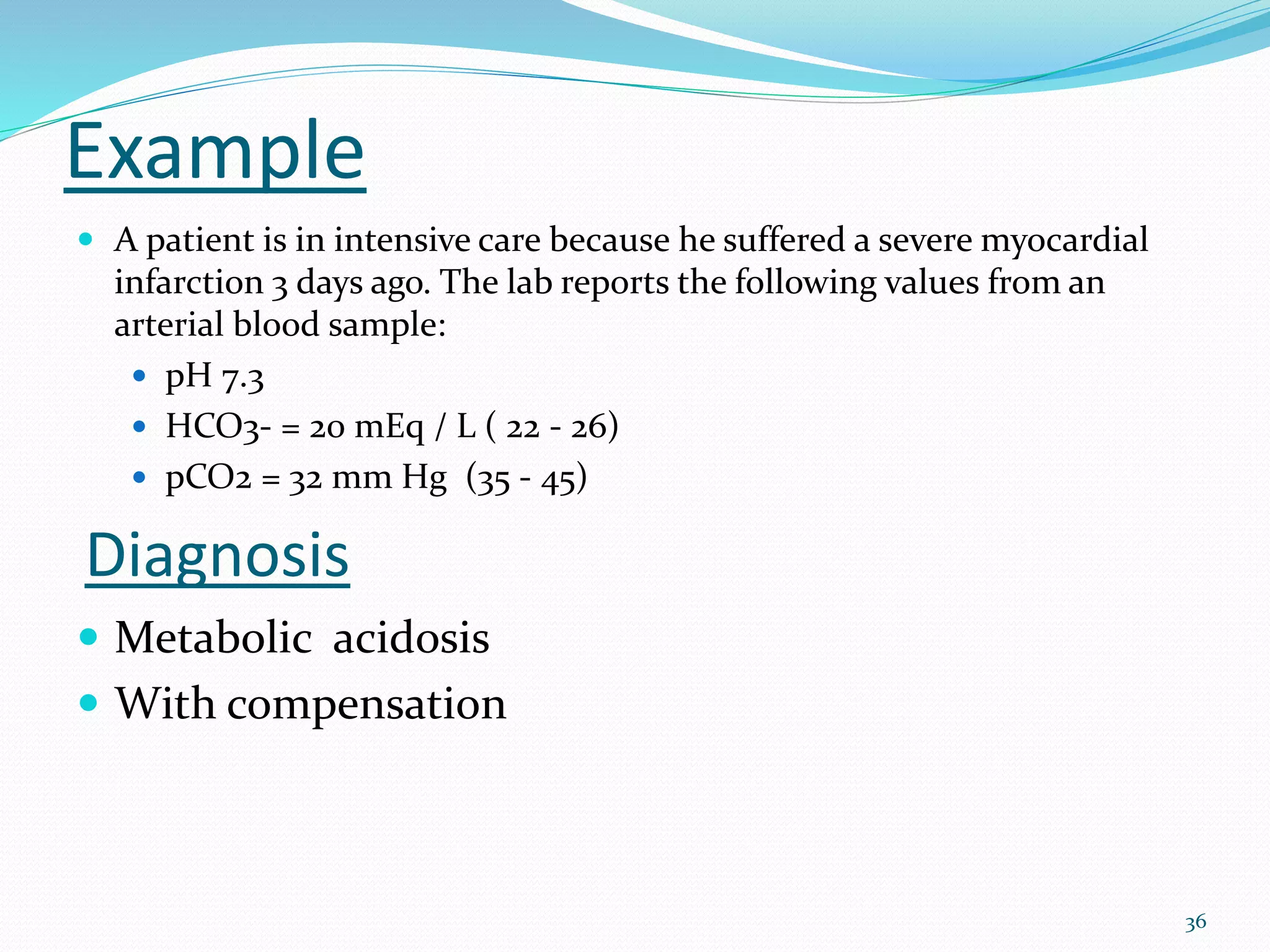
Example
 A patient is in intensive care because he suffered a severe myocardial
infarction 3 days ago. The lab reports the following values from an
arterial blood sample:
 pH 7.3
 HCO3- = 20 mEq / L ( 22 - 26)
 pCO2 = 32 mm Hg (35 - 45)
Diagnosis
 Metabolic acidosis
 With compensation
37
References
 Introduction to Fluid Therapy. In Di Bartola SP ed
Fluid, Electrolyte and Acid Base Disorders, 4th edn.
 Acid Base Balance- Stephen P. Di Bartola, DVM
Department of Veterinary Clinical Sciences College of
Veterinary Medicine Ohio State University Columbus
 ACID-BASE PHYSIOLOGY & ANESTHESIA Lyon Lee
DVM PhD DACVA
Acid and Base Balance and Imbalance

Acid and Base Balance and Imbalance

  • 1.
    Dr. Urfeya Mirza VetSurgeon (MVSc VSR)
  • 2.
    2 pH Review  pH= - log [H+]  H+ is really a proton  Range is from 0 - 14  If [H+] is high, the solution is acidic; pH < 7  If [H+] is low, the solution is basic or alkaline ; pH > 7
  • 3.
  • 4.
  • 5.
    5  Acids areH+ donors  Bases are H+ acceptors, or give up OH- in solution  Acids and bases can be: Strong – dissociate completely in solution HCl, NaOH Weak – dissociate only partially in solution Lactic acid, carbonic acid
  • 6.
    6 The Body andpH  Homeostasis of pH is tightly controlled  Extracellular fluid = 7.4  Blood = 7.35 – 7.45  < 6.8 or > 8.0 death occurs  Acidosis (acidemia) below 7.35  Alkalosis (alkalemia) above 7.45
  • 7.
  • 8.
    8  Small changesin pH can produce major disturbances  Most enzymes function only with narrow pH ranges  Acid-base balance can also affect electrolytes (Na+, K+, Cl-)  Can also affect hormones  The body produces more acids than bases  Acids take in with foods  Acids produced by metabolism of lipids and proteins  Cellular metabolism produces CO2 CO2 + H20 ↔ H2CO3 ↔ H+ + HCO3 -
  • 9.
    Henderson-Hasselbach equation  pH= pKa + log([HCO3 -]/[H2CO3])  CO2 dissolved in plasma potentially can form H2CO3 so: pH = pKa + log([HCO3 -]/[dissolved CO2 + H2CO3])  At the temperature and ionic strength of ECF there are 6,800 HCO3 - ions and 340 molecules of dissolved CO2 for each molecule of H2CO3. Therefore, H2CO3 can be neglected  Dissolved CO2 is related to pCO2 by its solubility coefficient: Dissolved CO2 = 0.03 X pCO2
  • 10.
    Henderson-Hasselbach equation (clinically relevantform) pH = pKa + log([HCO3 -]/.03xpCO2) pH = 6.1 + log([HCO3 -]/.03xpCO2)  Shows that pH is a function of the RATIO between bicarbonate and pCO2
  • 11.
    11 Control of Acids 1.Buffer systems  Take up H+ or release H+ as conditions change  Buffer pairs – weak acid and a base  Exchange a strong acid or base for a weak one  Results in a much smaller pH change
  • 12.
    12 Bicarbonate buffer  SodiumBicarbonate (NaHCO3) and carbonic acid (H2CO3)  Maintain a 20:1 ratio : HCO3 - : H2CO3 HCl + NaHCO3 ↔ H2CO3 + NaCl NaOH + H2CO3 ↔ NaHCO3 + H2O Phosphate buffer  Major intracellular buffer H+ + HPO4 2- ↔ H2PO4- OH- + H2PO4 - ↔ H2O + H2PO4 2- Protein Buffers Includes hemoglobin, work in blood and ISF Carboxyl group gives up H+ Amino Group accepts H+ Side chains that can buffer H+ are present on 27 amino acids
  • 13.
    13 2. Respiratory mechanisms Exhalation of carbon dioxide  Powerful, but only works with volatile acids  Doesn’t affect fixed acids like lactic acid  CO2 + H20 ↔ H2CO3 ↔ H+ + HCO3 -  Body pH can be adjusted by changing rate and depth of breathing 3. Kidney excretion  Can eliminate large amounts of acid  Can also excrete base  Can conserve and produce bicarb ions  Most effective regulator of pH  If kidneys fail, pH balance fails
  • 14.
    14 Rates of correction Buffers function almost instantaneously  Respiratory mechanisms take several minutes to hours  Renal mechanisms may take several hours to days
  • 15.
  • 16.
  • 17.
    17 Acid-Base Imbalances  Metabolicdisturbances  Metabolic acidosis  Metabolic alkalosis  Respiratory disturbances  Respiratory acidosis  Respiratory alkalosis
  • 18.
    18 Acid-Base Imbalances  pH<7.35 acidosis  pH > 7.45 alkalosis  The body response to acid-base imbalance is called compensation  May be complete if brought back within normal limits  Partial compensation if range is still outside norms
  • 19.
    19 Compensation  If underlyingproblem is metabolic, hyperventilation or hypoventilation can help : respiratory compensation  If problem is respiratory, renal mechanisms can bring about metabolic compensation
  • 20.
    20 Acidosis  Principal effectof acidosis is depression of the CNS through ↓ in synaptic transmission  Generalized weakness  Deranged CNS function the greatest threat  Severe acidosis causes  Disorientation  Coma  Death
  • 21.
    21 Alkalosis  Alkalosis causesover excitability of the central and peripheral nervous systems  Numbness  Lightheadedness  It can cause :  Nervousness  Muscle spasms or tetany  Convulsions  Loss of consciousness  Death
  • 22.
  • 23.
    23 Respiratory Acidosis  Carbonicacid excess caused by blood levels of CO2 above 45 mm Hg  Hypercapnia – high levels of CO2 in blood  Chronic conditions:  Depression of respiratory center in brain that controls breathing rate – drugs or head trauma  Paralysis of respiratory or chest muscles  Acute conditons:  Adult Respiratory Distress Syndrome  Pulmonary edema  Pneumothorax  Emphysema Compensation for Respiratory Acidosis • Kidneys eliminate hydrogen ion and retain bicarbonate ion
  • 24.
    24 Signs and Symptomsof Respiratory Acidosis  Breathlessness  Restlessness  Lethargy and disorientation  Tremors, convulsions, coma  Respiratory rate rapid, then gradually depressed  Skin warm and flushed due to vasodilation caused by excess CO2 Treatment of Respiratory Acidosis o Restore ventilation o IV lactate solution o Treat underlying dysfunction or disease
  • 25.
  • 26.
    26 Respiratory Alkalosis  Carbonicacid deficit  pCO2 less than 35 mm Hg (hypocapnea)  Most common acid-base imbalance  Primary cause is hyperventilation  Conditions that stimulate respiratory center:  Oxygen deficiency at high altitudes  Pulmonary disease and Congestive heart failure – caused by hypoxia  Acute anxiety  Fever, anemia  Early salicylate intoxication  Cirrhosis  Gram-negative sepsis
  • 27.
    27 Compensation of RespiratoryAlkalosis  Kidneys conserve hydrogen ion  Excrete bicarbonate ion Treatment of Respiratory Alkalosis o Treat underlying cause o Breathe into a paper bag o IV Chloride containing solution – Cl- ions replace lost bicarbonate ions
  • 28.
  • 29.
    29 Metabolic Acidosis  Bicarbonatedeficit - blood concentrations of bicarb drop below 22mEq/L  Causes:  Loss of bicarbonate through diarrhea or renal dysfunction  Accumulation of acids (lactic acid or ketones)  Failure of kidneys to excrete H+ Symptoms of Metabolic Acidosis o Headache, lethargy o Nausea, vomiting, diarrhea o Coma o Death
  • 30.
    30 Compensation for MetabolicAcidosis  Increased ventilation  Renal excretion of hydrogen ions if possible  K+ exchanges with excess H+ in ECF  ( H+ into cells, K+ out of cells) Treatment of Metabolic Acidosis o IV lactate solution
  • 31.
  • 32.
    32 Metabolic Alkalosis  Bicarbonateexcess - concentration in blood is greater than 26 mEq/L  Causes:  Excess vomiting = loss of stomach acid  Excessive use of alkaline drugs  Certain diuretics  Endocrine disorders  Heavy ingestion of antacids  Severe dehydration Compensation for Metabolic Alkalosis  Alkalosis most commonly occurs with renal dysfunction, so can’t count on kidneys  Respiratory compensation difficult – hypoventilation limited by hypoxia
  • 33.
    33 Symptoms of MetabolicAlkalosis  Respiration slow and shallow  Hyperactive reflexes ; tetany  Often related to depletion of electrolytes  Atrial tachycardia  Dysrhythmias Treatment of Metabolic Alkalosis  Electrolytes to replace those lost  IV chloride containing solution  Treat underlying disorder
  • 34.
  • 35.
    35 Diagnosis of Acid-BaseImbalances 1. Note whether the pH is low (acidosis) or high (alkalosis) 2. Decide which value, pCO2 or HCO3 - , is outside the normal range and could be the cause of the problem. If the cause is a change in pCO2, the problem is respiratory. If the cause is HCO3 - the problem is metabolic 3. Look at the value that doesn’t correspond to the observed pH change. If it is inside the normal range, there is no compensation occurring. If it is outside the normal range, the body is partially compensating for the problem
  • 36.
    36 Example  A patientis in intensive care because he suffered a severe myocardial infarction 3 days ago. The lab reports the following values from an arterial blood sample:  pH 7.3  HCO3- = 20 mEq / L ( 22 - 26)  pCO2 = 32 mm Hg (35 - 45) Diagnosis  Metabolic acidosis  With compensation
  • 37.
  • 38.
    References  Introduction toFluid Therapy. In Di Bartola SP ed Fluid, Electrolyte and Acid Base Disorders, 4th edn.  Acid Base Balance- Stephen P. Di Bartola, DVM Department of Veterinary Clinical Sciences College of Veterinary Medicine Ohio State University Columbus  ACID-BASE PHYSIOLOGY & ANESTHESIA Lyon Lee DVM PhD DACVA