ACID BASE
HOMEOSTASIS
DR. FARHANA ATIA
Associate Professor
Department of Biochemistry
Nilphamari Medical College, Nilphamari
Acid-Base Balance
• Normal pH: 7.4 [ H⁺ : 40 nmol/L]
• Body fluids maintained pH between 7.35-7.45
• Clinically safe: 7.3-7.5
• Compatible to life: 6.8-7.8
• Recovery unusual: <6.8 & >7.8
• Low pH: Acidic
• High pH: Alkaline
Origin of acid
Volatile acid [H₂CO₃]
• Aerobic metabolism of carbohydrate & lipid
Non volatile acid [all except H₂CO₃]
• Anaerobic metabolism of carbohydrate: lactic acid
• Insulin lack: Ketoacids
• Diet (protein)
HCl
Phosphoric acid- arginine, histidine
Sulfuric acid- cystine, methionine
Origin of base
Base originates by metabolism of some food stuff
• Vegetables
• Fruits
• Vegetarian: ↑ base production
• Non-vegetarian: ↑ acid production
Our body is net acid producer
• Volatile acid
Basal CO₂ production 12000-15000
mmoles/day
Disposed by respiratory system
• Net production of non-volatile/ fixed production
70-100 mmoles of H⁺/day
Non volatile acids are disposed by kidney
3 Systems that maintain pH
First line defense: Buffers
Moves or release hydrogen ions
Act within seconds
Second line defense: Respiratory system
Regulate volatile acid by eliminating or retaining CO2
Act within minutes
Third line defense: Renal system
Long term regulation of acid-base in body
Act within hours to days
Buffers
• Very rapid but temporary
• Can not remove H⁺ from body
• Act as shock absorbent to reduce free H⁺ ion
• Blood buffers are-
1. Bicarbonate buffer: Most predominant buffer
2. Phosphate buffer: Mainly intracellular
3. Protein buffer: Buffer capacity is only 2% of total
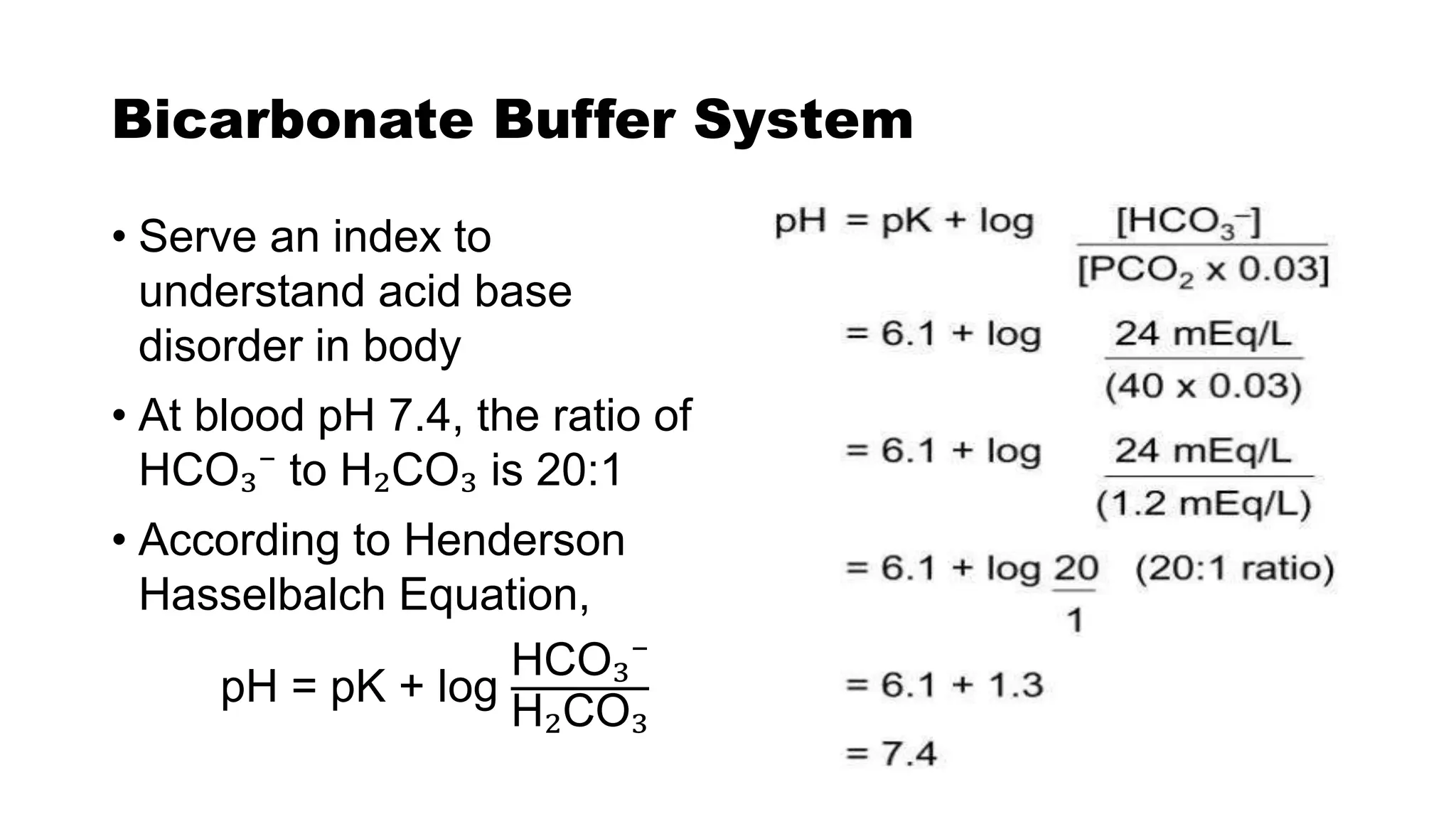
Bicarbonate Buffer System
• Serve an index to
understand acid base
disorder in body
• At blood pH 7.4, the ratio of
HCO₃⁻ to H₂CO₃ is 20:1
• According to Henderson
Hasselbalch Equation,
pH = pK + log
HCO₃⁻
H₂CO₃
Compensation & Correction of ABD
• How this ratio is maintained?
1.By increasing/decreasing
plasma [HCO₃⁻]
2.By reducing/increasing PCO₂
• Normal [HCO₃⁻]:[H₂CO₃] =
20:1
• Compensation:
Maintaining the ratio of
[HCO₃⁻]:[H₂CO₃] towards
normal, so pH become
normal
• Correction: Concentration
of [HCO₃⁻] & [H₂CO₃]
become normal.
Respiratory Mechanism for pH Regulation
• Rapid but short term regulation
• Regulate [H₂CO₃] concentration in blood
H₂CO₃ CO₂ + H₂O
• All CO₂ is eliminated via the lungs
Carbonic Anhydrase
Renal Mechanism for pH Regulation
• Permanent solution of ABD
• Kidney is the only route to eliminate H⁺
ions from the body
• By two mechanisms
1. HCO₃⁻ reabsorption mechanism -
PCT (90%)
2. HCO₃⁻ generation mechanism -
DCT (where there is no filtered
HCO₃⁻)
Lumen PCT cell Capillary
HCO₃⁻ reabsorption mechanism
HCO₃⁻ Generation Mechanism
Acid Base Disorders
Arterial blood pH is closely regulated to 7.4 ±0.05
Simple ABD: pH change occurs due to change of either PCO₂
or HCO₃⁻
• Respiratory acidosis: ↑ PCO₂
• Metabolic acidosis: ↓ HCO₃⁻
• Respiratory alkalosis: ↓ PCO₂
• Metabolic alkalosis: ↑ HCO₃⁻
Complex ABD
• Combination of 2-3 simple type
• Both HCO₃⁻ & CO₂ get abnormal value
Simple Method to Diagnose ABD
Look at the pH
• pH <7.35 (acidosis); pH >7.45 (alkalosis)
Is the CO₂ abnormal?
• CO₂ is an acidic gas; raised with acidosis, lowered with
alkalosis  Respiratory problem
• No change; or an opposite one ↑↑↓↓  compensatory change
Is the HCO₃⁻ abnormal? [Normal: 22-28mmol/L]
• Is the change in keeping with pH?
• HCO₃⁻ is alkaline; raised with alkalosis, lowered with
acidosis Metabolic problem
State of
ABD
Primary
defect
Consequ
ence
Compensation by Correction by
Metabolic
acidosis
↓ HCO₃⁻ ↓ pH Hyperventilation
(↓PCO₂)
Kidney
Treatment of cause
(↑ HCO₃)
Metabolic
alkalosis
↑ HCO₃⁻ ↑ pH Hypoventilation
(↑PCO₂)
Kidney
Treatment of cause
(↓ HCO₃)
Respiratory
acidosis
↑ PCO₂ ↓ pH Renal HCO₃⁻
retention (↑HCO₃⁻)
Hyperventilation
Treatment of cause
Respiratory
alkalosis
↓ PCO₂ ↑ pH Renal HCO₃⁻
excretion (↓ HCO₃⁻)
Hypoventilation
Treatment of cause
Causes of ABD
Metabolic acidosis
[↑ production /↓ removal of
fixed or organic acid]
Metabolic alkalosis
[Accumulation of base/ loss of
acid other than H₂CO₃]
• Diabetic ketoacidosis
• Acute MI
• Lactic acidosis
• CRF
• Renal tubular acidosis
• Watery diarrhea
• Intestinal fistula
• Vomiting
• K depletion (diuretics)
• Burns
• Ingestion of base
• Excessive infusion of NaHCO₃
Causes of ABD
Respiratory acidosis
[Impaired excretion of CO₂]
Respiratory alkalosis
[excessive ventilation]
• COPD
• Chronic bronchitis
• Pulmonary fibrosis
• Acute bronchial asthma
• Narcotic overdose
• Anesthesia
• Stroke
• SAH
• Meningitis
• High altitude
• Hysteria
• Fever
• Pulmonary emboli
• Salicylate poisoning
• Pregnancy
Acid base parameters
Blood gas analysis of
arterial blood
• pH: 7.35-7.45
• HCO₃⁻: 24-30 meq/L
• PCO₂ : 40 mm of Hg
Additional parameters
• Actual HCO₃⁻: HHE from pH &
PCO₂.
• Standard HCO₃⁻: 24 meq/L
Measured under standard
condition
T: 37-38⁰ c
Hb: full saturated
PCO₂: 40 mm of Hg
• Base excess: ±2
• Total CO₂: 24-30 mmol/L
• Buffer base: Anti acid component of buffer pair
HCO₃⁻, pr⁻, H₂PO₄⁻, Hb⁻, HbO₂⁻
• Base excess: Changes in the concentration of buffer
base from its normal value. It refers to the HCO₃⁻
BE = Measured HCO₃⁻- Standard HCO₃⁻
Metabolic acidosis <-2
Metabolic alkalosis >+2
• Alkali reserve: Sum of all buffer base present in blood
 48 mEq/L.
The anion gap
• Estimates unmeasured plasma anions (fixed or organic
acids such as phosphate, ketone and lactate- hard to
measure directly)
• Importance:
1. Determine the cause of metabolic acidosis
2. Reflect those anion actually present but routinely
unmeasured
The anion gap
• Difference between plasma anion
& cation. In Plasma,
Cation = Anion
Na⁺+ K ⁺ = HCO₃⁻+ Cl
Na⁺+K⁺ = HCO₃⁻+Cl⁻
136+4 = 100+25
• This difference is anion gap
• 12±4meq/L= 8-16meq/L
Causes of Metabolic Acidosis
 MA with high AG (HCO₃⁻ & unmeasured anions
associated with the acids accumulates)
• Urate (RF)
• Lactic acid (shock, infection, tissue ischemia)
• Ketone (DM, alcohol)
• Drugs, toxins (Salisylate poisoning)
Causes of Metabolic Acidosis
 MA with normal AG (loss of HCO₃⁻/ ingestion of H⁺)
• Diarrhea
• Pancreatic fistula
• Renal tubular acidosis
• Addison’s disease
• NH₄Cl ingestion
Acid base homeostasis

Acid base homeostasis

  • 1.
    ACID BASE HOMEOSTASIS DR. FARHANAATIA Associate Professor Department of Biochemistry Nilphamari Medical College, Nilphamari
  • 2.
    Acid-Base Balance • NormalpH: 7.4 [ H⁺ : 40 nmol/L] • Body fluids maintained pH between 7.35-7.45 • Clinically safe: 7.3-7.5 • Compatible to life: 6.8-7.8 • Recovery unusual: <6.8 & >7.8 • Low pH: Acidic • High pH: Alkaline
  • 3.
    Origin of acid Volatileacid [H₂CO₃] • Aerobic metabolism of carbohydrate & lipid Non volatile acid [all except H₂CO₃] • Anaerobic metabolism of carbohydrate: lactic acid • Insulin lack: Ketoacids • Diet (protein) HCl Phosphoric acid- arginine, histidine Sulfuric acid- cystine, methionine
  • 4.
    Origin of base Baseoriginates by metabolism of some food stuff • Vegetables • Fruits • Vegetarian: ↑ base production • Non-vegetarian: ↑ acid production
  • 5.
    Our body isnet acid producer • Volatile acid Basal CO₂ production 12000-15000 mmoles/day Disposed by respiratory system • Net production of non-volatile/ fixed production 70-100 mmoles of H⁺/day Non volatile acids are disposed by kidney
  • 6.
    3 Systems thatmaintain pH First line defense: Buffers Moves or release hydrogen ions Act within seconds Second line defense: Respiratory system Regulate volatile acid by eliminating or retaining CO2 Act within minutes Third line defense: Renal system Long term regulation of acid-base in body Act within hours to days
  • 7.
    Buffers • Very rapidbut temporary • Can not remove H⁺ from body • Act as shock absorbent to reduce free H⁺ ion • Blood buffers are- 1. Bicarbonate buffer: Most predominant buffer 2. Phosphate buffer: Mainly intracellular 3. Protein buffer: Buffer capacity is only 2% of total
  • 8.
    Bicarbonate Buffer System •Serve an index to understand acid base disorder in body • At blood pH 7.4, the ratio of HCO₃⁻ to H₂CO₃ is 20:1 • According to Henderson Hasselbalch Equation, pH = pK + log HCO₃⁻ H₂CO₃
  • 9.
    Compensation & Correctionof ABD • How this ratio is maintained? 1.By increasing/decreasing plasma [HCO₃⁻] 2.By reducing/increasing PCO₂ • Normal [HCO₃⁻]:[H₂CO₃] = 20:1 • Compensation: Maintaining the ratio of [HCO₃⁻]:[H₂CO₃] towards normal, so pH become normal • Correction: Concentration of [HCO₃⁻] & [H₂CO₃] become normal.
  • 10.
    Respiratory Mechanism forpH Regulation • Rapid but short term regulation • Regulate [H₂CO₃] concentration in blood H₂CO₃ CO₂ + H₂O • All CO₂ is eliminated via the lungs Carbonic Anhydrase
  • 11.
    Renal Mechanism forpH Regulation • Permanent solution of ABD • Kidney is the only route to eliminate H⁺ ions from the body • By two mechanisms 1. HCO₃⁻ reabsorption mechanism - PCT (90%) 2. HCO₃⁻ generation mechanism - DCT (where there is no filtered HCO₃⁻)
  • 12.
    Lumen PCT cellCapillary HCO₃⁻ reabsorption mechanism
  • 13.
  • 14.
    Acid Base Disorders Arterialblood pH is closely regulated to 7.4 ±0.05 Simple ABD: pH change occurs due to change of either PCO₂ or HCO₃⁻ • Respiratory acidosis: ↑ PCO₂ • Metabolic acidosis: ↓ HCO₃⁻ • Respiratory alkalosis: ↓ PCO₂ • Metabolic alkalosis: ↑ HCO₃⁻ Complex ABD • Combination of 2-3 simple type • Both HCO₃⁻ & CO₂ get abnormal value
  • 15.
    Simple Method toDiagnose ABD Look at the pH • pH <7.35 (acidosis); pH >7.45 (alkalosis) Is the CO₂ abnormal? • CO₂ is an acidic gas; raised with acidosis, lowered with alkalosis  Respiratory problem • No change; or an opposite one ↑↑↓↓  compensatory change Is the HCO₃⁻ abnormal? [Normal: 22-28mmol/L] • Is the change in keeping with pH? • HCO₃⁻ is alkaline; raised with alkalosis, lowered with acidosis Metabolic problem
  • 16.
    State of ABD Primary defect Consequ ence Compensation byCorrection by Metabolic acidosis ↓ HCO₃⁻ ↓ pH Hyperventilation (↓PCO₂) Kidney Treatment of cause (↑ HCO₃) Metabolic alkalosis ↑ HCO₃⁻ ↑ pH Hypoventilation (↑PCO₂) Kidney Treatment of cause (↓ HCO₃) Respiratory acidosis ↑ PCO₂ ↓ pH Renal HCO₃⁻ retention (↑HCO₃⁻) Hyperventilation Treatment of cause Respiratory alkalosis ↓ PCO₂ ↑ pH Renal HCO₃⁻ excretion (↓ HCO₃⁻) Hypoventilation Treatment of cause
  • 17.
    Causes of ABD Metabolicacidosis [↑ production /↓ removal of fixed or organic acid] Metabolic alkalosis [Accumulation of base/ loss of acid other than H₂CO₃] • Diabetic ketoacidosis • Acute MI • Lactic acidosis • CRF • Renal tubular acidosis • Watery diarrhea • Intestinal fistula • Vomiting • K depletion (diuretics) • Burns • Ingestion of base • Excessive infusion of NaHCO₃
  • 18.
    Causes of ABD Respiratoryacidosis [Impaired excretion of CO₂] Respiratory alkalosis [excessive ventilation] • COPD • Chronic bronchitis • Pulmonary fibrosis • Acute bronchial asthma • Narcotic overdose • Anesthesia • Stroke • SAH • Meningitis • High altitude • Hysteria • Fever • Pulmonary emboli • Salicylate poisoning • Pregnancy
  • 19.
    Acid base parameters Bloodgas analysis of arterial blood • pH: 7.35-7.45 • HCO₃⁻: 24-30 meq/L • PCO₂ : 40 mm of Hg Additional parameters • Actual HCO₃⁻: HHE from pH & PCO₂. • Standard HCO₃⁻: 24 meq/L Measured under standard condition T: 37-38⁰ c Hb: full saturated PCO₂: 40 mm of Hg • Base excess: ±2 • Total CO₂: 24-30 mmol/L
  • 20.
    • Buffer base:Anti acid component of buffer pair HCO₃⁻, pr⁻, H₂PO₄⁻, Hb⁻, HbO₂⁻ • Base excess: Changes in the concentration of buffer base from its normal value. It refers to the HCO₃⁻ BE = Measured HCO₃⁻- Standard HCO₃⁻ Metabolic acidosis <-2 Metabolic alkalosis >+2 • Alkali reserve: Sum of all buffer base present in blood  48 mEq/L.
  • 21.
    The anion gap •Estimates unmeasured plasma anions (fixed or organic acids such as phosphate, ketone and lactate- hard to measure directly) • Importance: 1. Determine the cause of metabolic acidosis 2. Reflect those anion actually present but routinely unmeasured
  • 22.
    The anion gap •Difference between plasma anion & cation. In Plasma, Cation = Anion Na⁺+ K ⁺ = HCO₃⁻+ Cl Na⁺+K⁺ = HCO₃⁻+Cl⁻ 136+4 = 100+25 • This difference is anion gap • 12±4meq/L= 8-16meq/L
  • 23.
    Causes of MetabolicAcidosis  MA with high AG (HCO₃⁻ & unmeasured anions associated with the acids accumulates) • Urate (RF) • Lactic acid (shock, infection, tissue ischemia) • Ketone (DM, alcohol) • Drugs, toxins (Salisylate poisoning)
  • 24.
    Causes of MetabolicAcidosis  MA with normal AG (loss of HCO₃⁻/ ingestion of H⁺) • Diarrhea • Pancreatic fistula • Renal tubular acidosis • Addison’s disease • NH₄Cl ingestion