Airway Evaluation and Management
Indications of intubation Resuscitation (CPR) Prevention of lung soiling Positive pressure ventilation (GA) Pulmonary toilet Patent airway (coma or near coma) Respiratory failure(CO2 retention )
Requirement of successful intbatin 1-Normal roomy mandible 2-Normal T-M, A-O , and C-spine
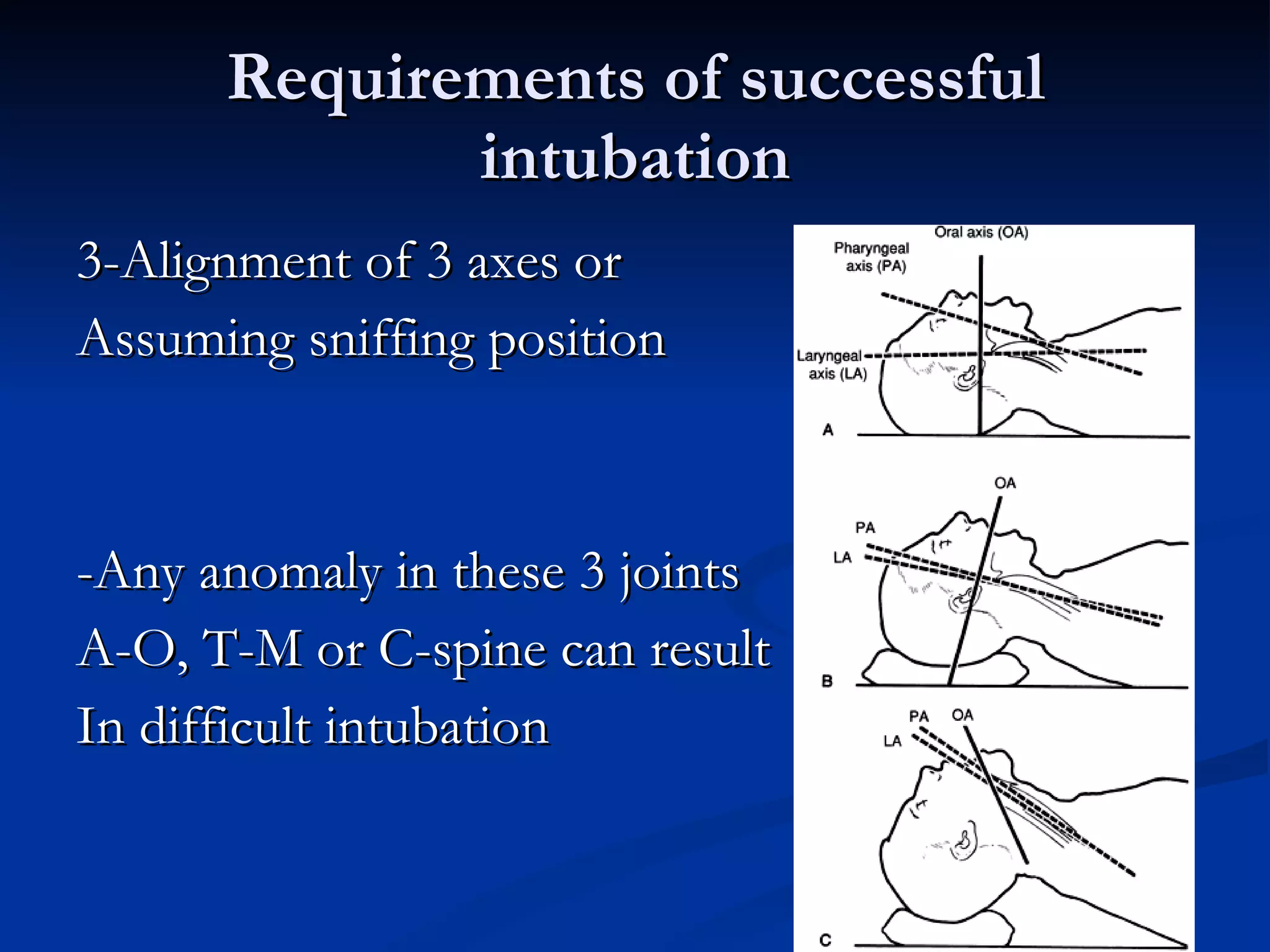
Requirements of successful intubation 3-Alignment of 3 axes or Assuming sniffing position -Any anomaly in these 3 joints A-O, T-M or C-spine can result In difficult intubation
Requirement of successful intubation Proper equipment -Bag and mask,oxygen source -Airways oro and nasopharyngeal -Laryngosopes different blades -ETT different sizes -suction on
Airway gadgets
Management  I-History: previous history of difficulty is the best predictor Inquire about:-Nature of difficulty -No of trials -Ability to ventilate bet trials -Maneuver used -Complications II-Snoring and sleep apnea( prdictors of DMV)
Examination -Look for any obvious anomaly  Morbid obesity(BMI) Skull Face Jaw Mouth,teeth Neck
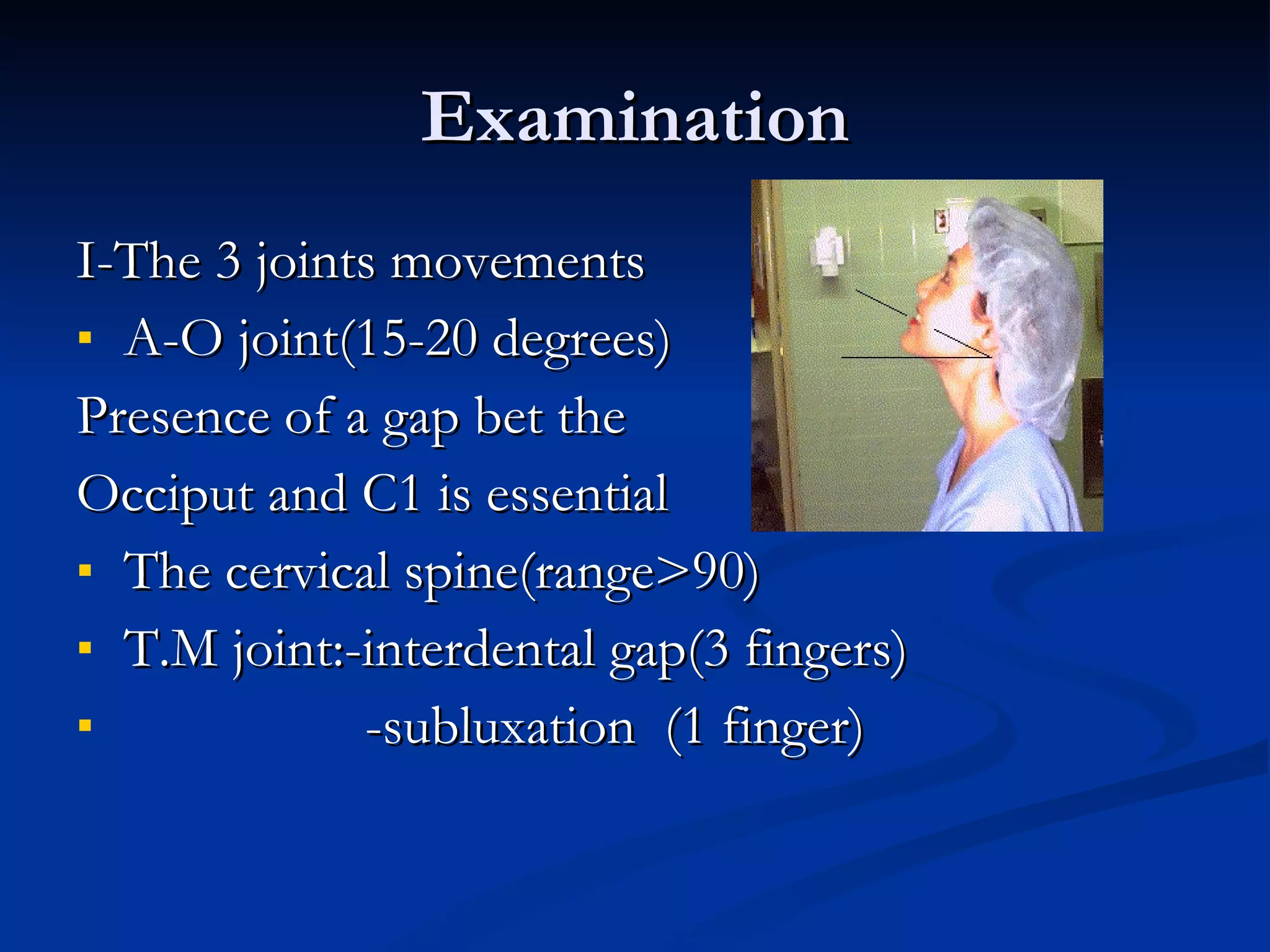
Examination I-The 3 joints movements A-O joint(15-20 degrees) Presence of a gap bet the  Occiput and C1 is essential The cervical spine(range>90) T.M joint:-interdental gap(3 fingers) -subluxation  (1 finger)
Examination II-Measurements of the mandible -Thyro-mental distance (head extended) Normally 6.5 cm Less than 6 cm=expect difficulty
Tests to predict difficulty Mallampatti test: Based on the hypothesis That when the base of the Tongue is disproportionally Large it will overshadow the larynx
-Simple easy test,correlates with what is seen during laryngoscopy or Cormack-Lehene grades ,but 1-moderate sensitivity and specificity(12% false +ve) 2-Inter observer variation 3-Phonation increases false negative view
II-Wilson test -Consists of 5 easily assessed factors Body wight(n=0 ,>90=1,>110=2) Head and neck movement Jaw movement Receding jaw Buck teeth Each factor assigned as o ,1 ,2 max is 10
Difficult airway Expected from history,examination Secure airway while awake under LA Unexpected  different options Priority for maintenance of patent airway and oxygenation
Airway gadgets
 
Needle cricothyroidotomy
Confirm tube position Direct visualization of ETT between cords Bronchoscopy ;carina seen Continuous trace of capnography 3 point auscultation Esophageal detector device Other as bilateral chest movement,mist in the tube,CXR
Rapid sequence induction Indications Technique:  -Preoxygenation -IV induction with sux -Cricoid pressure -Intubate, inflate the cuff ,confirm position -Release cricoid and fix the tube
Complications of intubation 1-Inadequate ventilation 2-Esophageal intubation 3-Airway obstruction 4-Bronchospasm 5-Aspiration 6- Trauma 7-Stress response
Recommendations Adequate airway assessment to pick up expected D.A to be secured awake Difficult intubation cart always ready Pre oxygenation as a routine Maintenance of oxygenation not the intubation should be your aim Use the technique you are familiar with Always have plan B,C,D in unexpected D.A

Airway Evaluation and Management

  • 1.
  • 2.
    Indications of intubationResuscitation (CPR) Prevention of lung soiling Positive pressure ventilation (GA) Pulmonary toilet Patent airway (coma or near coma) Respiratory failure(CO2 retention )
  • 3.
    Requirement of successfulintbatin 1-Normal roomy mandible 2-Normal T-M, A-O , and C-spine
  • 4.
    Requirements of successfulintubation 3-Alignment of 3 axes or Assuming sniffing position -Any anomaly in these 3 joints A-O, T-M or C-spine can result In difficult intubation
  • 5.
    Requirement of successfulintubation Proper equipment -Bag and mask,oxygen source -Airways oro and nasopharyngeal -Laryngosopes different blades -ETT different sizes -suction on
  • 6.
  • 7.
    Management I-History:previous history of difficulty is the best predictor Inquire about:-Nature of difficulty -No of trials -Ability to ventilate bet trials -Maneuver used -Complications II-Snoring and sleep apnea( prdictors of DMV)
  • 8.
    Examination -Look forany obvious anomaly Morbid obesity(BMI) Skull Face Jaw Mouth,teeth Neck
  • 9.
    Examination I-The 3joints movements A-O joint(15-20 degrees) Presence of a gap bet the Occiput and C1 is essential The cervical spine(range>90) T.M joint:-interdental gap(3 fingers) -subluxation (1 finger)
  • 10.
    Examination II-Measurements ofthe mandible -Thyro-mental distance (head extended) Normally 6.5 cm Less than 6 cm=expect difficulty
  • 11.
    Tests to predictdifficulty Mallampatti test: Based on the hypothesis That when the base of the Tongue is disproportionally Large it will overshadow the larynx
  • 12.
    -Simple easy test,correlateswith what is seen during laryngoscopy or Cormack-Lehene grades ,but 1-moderate sensitivity and specificity(12% false +ve) 2-Inter observer variation 3-Phonation increases false negative view
  • 13.
    II-Wilson test -Consistsof 5 easily assessed factors Body wight(n=0 ,>90=1,>110=2) Head and neck movement Jaw movement Receding jaw Buck teeth Each factor assigned as o ,1 ,2 max is 10
  • 14.
    Difficult airway Expectedfrom history,examination Secure airway while awake under LA Unexpected different options Priority for maintenance of patent airway and oxygenation
  • 15.
  • 16.
  • 17.
  • 18.
    Confirm tube positionDirect visualization of ETT between cords Bronchoscopy ;carina seen Continuous trace of capnography 3 point auscultation Esophageal detector device Other as bilateral chest movement,mist in the tube,CXR
  • 19.
    Rapid sequence inductionIndications Technique: -Preoxygenation -IV induction with sux -Cricoid pressure -Intubate, inflate the cuff ,confirm position -Release cricoid and fix the tube
  • 20.
    Complications of intubation1-Inadequate ventilation 2-Esophageal intubation 3-Airway obstruction 4-Bronchospasm 5-Aspiration 6- Trauma 7-Stress response
  • 21.
    Recommendations Adequate airwayassessment to pick up expected D.A to be secured awake Difficult intubation cart always ready Pre oxygenation as a routine Maintenance of oxygenation not the intubation should be your aim Use the technique you are familiar with Always have plan B,C,D in unexpected D.A