A SEMINAR ON
QUANTITAVE
DATA ANALYSIS
INTRODUCTION
DEFINITION
Analysis is the process of organizing and
synthesizing the data so as to answer
research questions and test hypothesis.
 Analysis referred as a method of organizing
data in such a way that research questions
can be answered and hypothesis can be
tested.
 Analysis is the process of breaking a
complex topic into smaller parts to gain
better understanding of it.

STEPS OF QUANTITATIVE DATA
ANALYSIS


1.

Data preparation
STEPS IN DATA
PREPARATION
Compilation:
 Editing:
 Coding:
 Classification:
 Tabulation:

2. Describing the data
Drawing the inferences of data
Interpretation of the data:
STRATEGIES FOR EFFECTIVE
INTERPRETATIONS
Interpretations must be made in light of
research problem.
 Critical examination of the each element of
study
 Careful consideration and recognition of the
limitations of the research study
 Interpretations must be only based on the
study results.
 Each part, aspect, and segment of the
analyzed result must receive close attentions

DESCRIPTIVE STATISTICS
Measures to condense data (frequency and
percentage distribution through tabulation
and graphic presentations)
 Measures of central tendency
 Measures of dispersion
 Measures of relationship (correlation
coefficient)

MEASURES TO CONDENSE
DATA
tables
 charts
 graphs
 diagram

TABLES
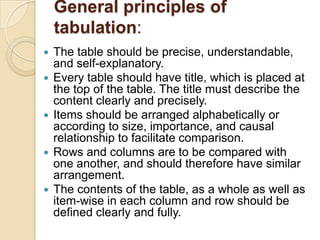
General principles of
tabulation:









The table should be precise, understandable,
and self-explanatory.
Every table should have title, which is placed at
the top of the table. The title must describe the
content clearly and precisely.
Items should be arranged alphabetically or
according to size, importance, and causal
relationship to facilitate comparison.
Rows and columns are to be compared with
one another, and should therefore have similar
arrangement.
The contents of the table, as a whole as well as
item-wise in each column and row should be
defined clearly and fully.









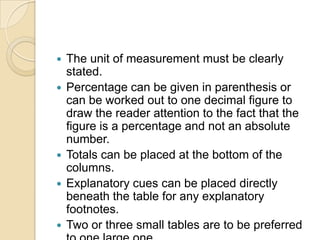
The unit of measurement must be clearly
stated.
Percentage can be given in parenthesis or
can be worked out to one decimal figure to
draw the reader attention to the fact that the
figure is a percentage and not an absolute
number.
Totals can be placed at the bottom of the
columns.
Explanatory cues can be placed directly
beneath the table for any explanatory
footnotes.
Two or three small tables are to be preferred
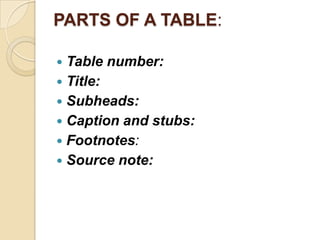
PARTS OF A TABLE:
Table number:
 Title:
 Subheads:
 Caption and stubs:
 Footnotes:
 Source note:

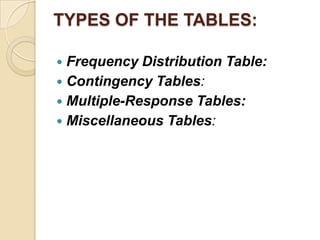
TYPES OF THE TABLES:
Frequency Distribution Table:
 Contingency Tables:
 Multiple-Response Tables:
 Miscellaneous Tables:

GRAPHS AND DIAGRAMS
The main uses
It is one of the most systematic and concise
ways in which statistical results may be
presented.
 They give overall view of entire data.
 The tabular appearance is easy to
assimilate and more appealing than the
same data presented in text.
 The data becomes much more easy to
understand and memorize.
 It facilitates comparison of data represented
in different columns and rows.

Types of diagram and graphs:
bar diagram,
 pie chart,
 histogram,
 frequency polygon,
 line graphs,
 cumulative frequency curve
 scattered diagrams,
 pictograms,
 map diagrams,.

Bar diagram
simple
 multiple
 proportional bar diagram

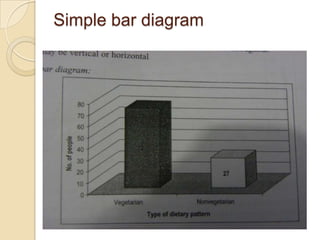
Simple bar diagram
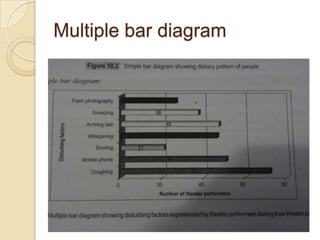
Multiple bar diagram
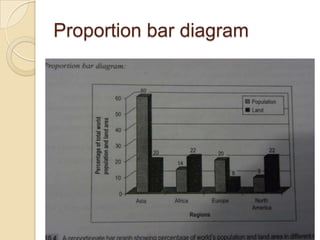
Proportion bar diagram
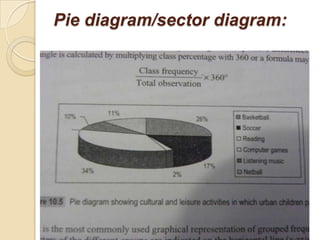
Pie diagram/sector diagram:
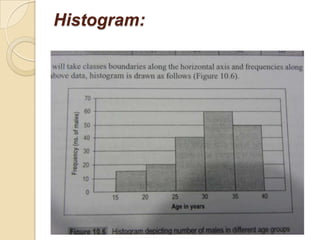
Histogram:
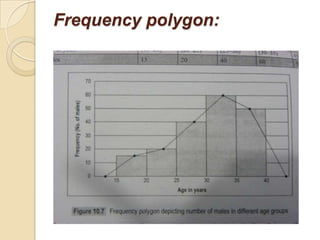
Frequency polygon:
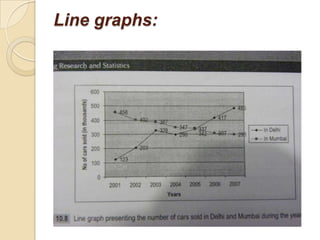
Line graphs:
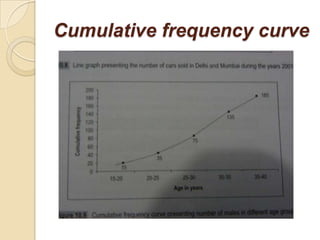
Cumulative frequency curve
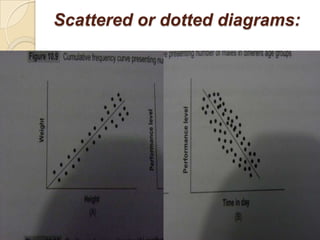
Scattered or dotted diagrams:
Pictograms or picture
diagram:
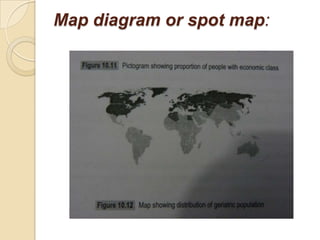
Map diagram or spot map:
A seminar on quantitave data analysis

A seminar on quantitave data analysis

  • 1.
  • 2.
  • 3.
    DEFINITION Analysis is theprocess of organizing and synthesizing the data so as to answer research questions and test hypothesis.  Analysis referred as a method of organizing data in such a way that research questions can be answered and hypothesis can be tested.  Analysis is the process of breaking a complex topic into smaller parts to gain better understanding of it. 
  • 4.
    STEPS OF QUANTITATIVEDATA ANALYSIS  1. Data preparation
  • 5.
    STEPS IN DATA PREPARATION Compilation: Editing:  Coding:  Classification:  Tabulation: 
  • 6.
  • 7.
  • 8.
  • 9.
    STRATEGIES FOR EFFECTIVE INTERPRETATIONS Interpretationsmust be made in light of research problem.  Critical examination of the each element of study  Careful consideration and recognition of the limitations of the research study  Interpretations must be only based on the study results.  Each part, aspect, and segment of the analyzed result must receive close attentions 
  • 10.
  • 11.
    Measures to condensedata (frequency and percentage distribution through tabulation and graphic presentations)  Measures of central tendency  Measures of dispersion  Measures of relationship (correlation coefficient) 
  • 12.
    MEASURES TO CONDENSE DATA tables charts  graphs  diagram 
  • 14.
  • 15.
    General principles of tabulation:      Thetable should be precise, understandable, and self-explanatory. Every table should have title, which is placed at the top of the table. The title must describe the content clearly and precisely. Items should be arranged alphabetically or according to size, importance, and causal relationship to facilitate comparison. Rows and columns are to be compared with one another, and should therefore have similar arrangement. The contents of the table, as a whole as well as item-wise in each column and row should be defined clearly and fully.
  • 16.
         The unit ofmeasurement must be clearly stated. Percentage can be given in parenthesis or can be worked out to one decimal figure to draw the reader attention to the fact that the figure is a percentage and not an absolute number. Totals can be placed at the bottom of the columns. Explanatory cues can be placed directly beneath the table for any explanatory footnotes. Two or three small tables are to be preferred
  • 17.
    PARTS OF ATABLE: Table number:  Title:  Subheads:  Caption and stubs:  Footnotes:  Source note: 
  • 18.
    TYPES OF THETABLES: Frequency Distribution Table:  Contingency Tables:  Multiple-Response Tables:  Miscellaneous Tables: 
  • 19.
    GRAPHS AND DIAGRAMS Themain uses It is one of the most systematic and concise ways in which statistical results may be presented.  They give overall view of entire data.  The tabular appearance is easy to assimilate and more appealing than the same data presented in text.  The data becomes much more easy to understand and memorize.  It facilitates comparison of data represented in different columns and rows. 
  • 20.
    Types of diagramand graphs: bar diagram,  pie chart,  histogram,  frequency polygon,  line graphs,  cumulative frequency curve  scattered diagrams,  pictograms,  map diagrams,. 
  • 21.
    Bar diagram simple  multiple proportional bar diagram 
  • 22.
  • 23.
  • 24.
  • 25.
  • 26.
  • 27.
  • 28.
  • 29.
  • 30.
  • 31.
  • 32.
    Map diagram orspot map: