






Dr. Mrs. Mary Sulakshini Immanuel
CONTENTS
•Objectives
•Five key words
•Definition
•Place of Evaluation in
educational cycle
•Historical overview
• Purpose of Evaluation
• Role of Evaluation in
educational cycle
• Student Evaluation – What
for
• Characteristics of evaluation
• Process of Evaluation
• Common defects of
examinations
• Selecting evaluation
instruments
• Test Blue Print Design
• Evaluation Tools – Methods
• Trends concerning the
Evaluation of clinical skills
• Characteristics of constructive
feedback
• Facilitating behavior of an
Instructor
• Interference behavior
• Problems of Evaluation
• Helping students of learn from
the Test
• Helping yourself learn from the
test
• Returning test papers
• Dealing with an agrieved student
• What do you do with student
who missed the test
• Notice to all teachers
OBJECTIVES
• Update knowledge regarding
various evaluation strategies
• Understand different tools and
techniques used in evaluation
• Identify different evaluation
strategies and their application in
different settings
• Discuss basic item analysis and
sociometry
FIVE KEY QUESTIONS
•What
•Why
•How
•When
•Who
DEFINITIONS
E – Value
It is a systematic process of
determining the extent to which
instructional objectives and
qualitative descriptions of
learners and value judgment
concerning the desirability of
that behavior
Evaluation is a process of
determining the extent
to which instructional
objectives are achieved
by learner.
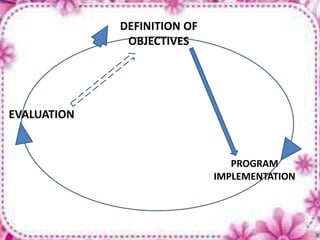
PLACE OF
EVALUATION
IN
EDUCATIONAL
CYCLE
DEFINITION OF
OBJECTIVES
PROGRAM
IMPLEMENTATION
EVALUATION
HISTORICAL OVER
VIEW
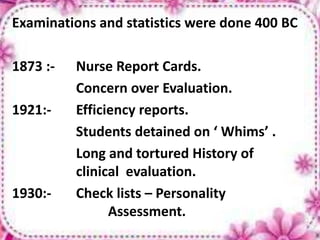
Examinations and statistics were done 400 BC
1873 :- Nurse Report Cards.
Concern over Evaluation.
1921:- Efficiency reports.
Students detained on ‘ Whims’ .
Long and tortured History of
clinical evaluation.
1930:- Check lists – Personality
Assessment.
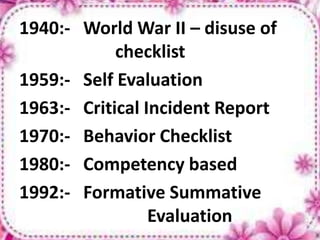
1940:- World War II – disuse of
checklist
1959:- Self Evaluation
1963:- Critical Incident Report
1970:- Behavior Checklist
1980:- Competency based
1992:- Formative Summative
Evaluation
WHY!
THE PURPOSE
OF
EVALUATION
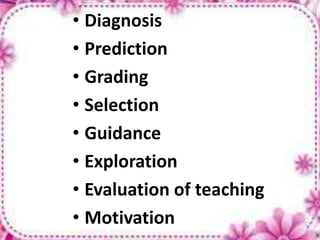
• Diagnosis
• Prediction
• Grading
• Selection
• Guidance
• Exploration
• Evaluation of teaching
• Motivation
ROLE OF
EVALUATION IN
TEACHING
1.Contributes directly to teaching
2.Pre assess the Learners needs
3.Provide Relevant teaching
4.Evaluate the Intended outcome
5.Progress of the student
6.To improve future learning
experience
STUDENT
EVALUATION
-
WHAT FOR
1.Incentive to learn, motivation
2.Feedback to students
3.Modification of learning activities
4.Selection of students
5.Success or failure
6.Feedback to teacher
7.School – Public relations
8.Protection of society
CHARACTERIS
TICS
OF
EVALUATION
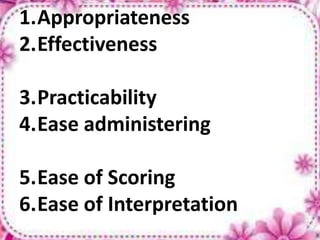
1.Appropriateness
2.Effectiveness
3.Practicability
4.Ease administering
5.Ease of Scoring
6.Ease of Interpretation
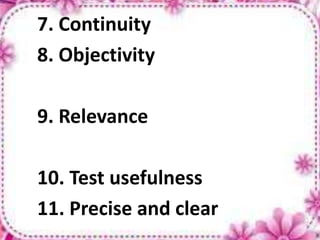
7. Continuity
8. Objectivity
9. Relevance
10. Test usefulness
11. Precise and clear
12.Adequacy and balanced
13. Utility
14. Comparability
15. Validity
16. Reliability
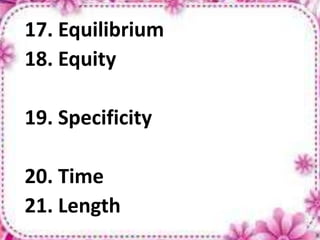
17. Equilibrium
18. Equity
19. Specificity
20. Time
21. Length
PROCESS
OF
EVALUATION
• Identify the purpose of Evaluation
• Identify the time frame
• Determining when to Evaluate
• Select the Evaluators
• Choose an Evaluation design/
model
• Select the Evaluation instruments
• Collect data
• Interpret data
• Report the findings
• Consider the cost of evaluation
COMMON DEFECTS
OF
EXAMINATIONS
• Triviality
• Outright error
• Ambiguity
• Obsolescence
• Bias
• Complexity
• Unintended clues
• Conservatism
SELECTING EVALUATION
INSTRUMENTS
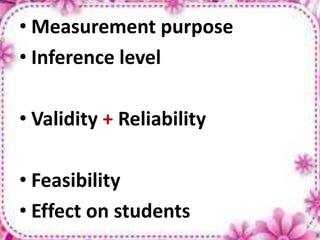
• Measurement purpose
• Inference level
• Validity + Reliability
• Feasibility
• Effect on students
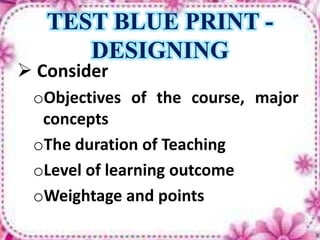
TEST BLUE PRINT -
DESIGNING
 Consider
oObjectives of the course, major
concepts
oThe duration of Teaching
oLevel of learning outcome
oWeightage and points
TEST
CONSTRUCTION
SPECIFICATION
TABLE
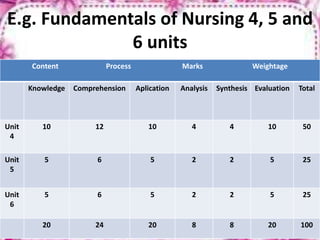
E.g. Fundamentals of Nursing 4, 5 and
6 units
Content Process Marks Weightage
Knowledge Comprehension Aplication Analysis Synthesis Evaluation Total
Unit
4
10 12 10 4 4 10 50
Unit
5
5 6 5 2 2 5 25
Unit
6
5 6 5 2 2 5 25
20 24 20 8 8 20 100
Decide:- How many questions,
weightage, to be given, how
much time for each questions in
one hour paper.
Teacher should take the test and
allow three times more time to
the students
EVALUATION TOOLS /
METHODS OF EVALUATION
Categorized into
Knowledge
Attitude
Skills
COGNITIVE/KNOWLEDGE
SUBJECTIVE TESTS
oEssay Type
oDescriptive or Narrative Type
OBJECTIVE TYPE
oMultiple choice question
oSingle choice question
oMatching
oTrue – False
oFill in the blanks
COGNITIVE/KNOWLEDGE
Problem Solving Type
oAssignment
oAnecdotal Records
oAchievement tests
oTeacher made tests
oStandardized tests
oSimulation
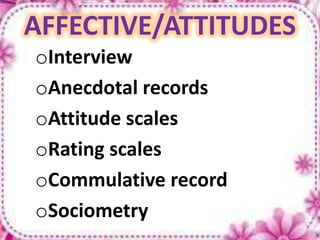
AFFECTIVE/ATTITUDES
oInterview
oAnecdotal records
oAttitude scales
oRating scales
oCommulative record
oSociometry
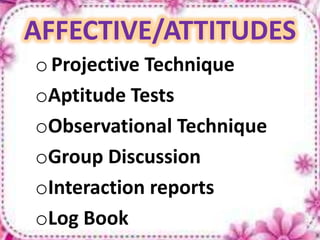
AFFECTIVE/ATTITUDES
o Projective Technique
oAptitude Tests
oObservational Technique
oGroup Discussion
oInteraction reports
oLog Book
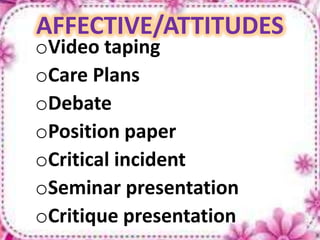
AFFECTIVE/ATTITUDES
oVideo taping
oCare Plans
oDebate
oPosition paper
oCritical incident
oSeminar presentation
oCritique presentation
PSYCHO MOTOR/SKILLS
• Performance Appraisal
• Critical incident Technique
• Cumulative record
• OSCE or OSPE Methods
• Observational Technique
• Self Report
• Anecdotal notes
STUDENT EVALUATION
TRENDS
CONCERNING
THE EVALUATION
OF
CLINICAL SKILLS
Greater emphasis on
relating objectives to
evaluation.
More focus on student
learning as the function of
clinical evaluation.
Increased attention to the
clinical evaluation process
as a vehicle for
instructional improvement
More involvement of the
students in clinical
evaluation
Provision for observers
training to improve reliability
among faculty evaluation
Increased use of stimulation
techniques
Use of patients records as
instrument for clinical
evaluation
Renewed efforts towards dealing
effectively with the issue of
grades and clinical evaluation
Combined clinical evaluation
methods for more comprehensive
evaluation
CHARACTERISTIC
S OF
CONSTRUCTIVE
FEEDBACK
Feedback should be descriptive
rather than evaluative
Specific rather than general
Focus on behavior rather than on
personality
Feedback involves sharing of
information rather than giving
advice
Well timed
Amount of information is limited
to what recipient can use
Feedback be solicited rather than
imposed
Feedback can be verified or
checked to determine degree of
agreement from others
Avoid collusion
FACILITATING
BEHAVIOR
OF AN
INSTRUCTOR
Positive feedback
Honest feedback
Constructive criticism
Clearly defined expectations
INTERFERENCE
BEHAVIORInsufficient feedback
Only negative feedback
Lack of clearly defined expectations
Late returning papers
PROBLEMS
OF
EVALUATION
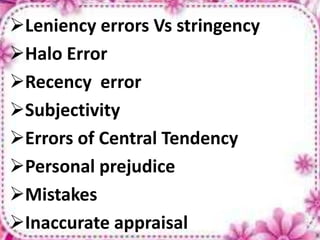
Leniency errors Vs stringency
Halo Error
Recency error
Subjectivity
Errors of Central Tendency
Personal prejudice
Mistakes
Inaccurate appraisal
HELPING STUDENTS
TO
LEARN FROM THE
TEST
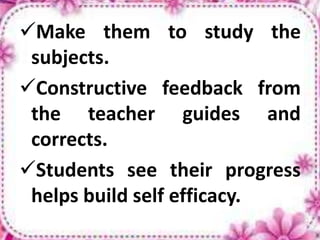
Make them to study the
subjects.
Constructive feedback from
the teacher guides and
corrects.
Students see their progress
helps build self efficacy.
HELPING
YOURSELF
LEARN
FROM THE TEST
Helps to diagnose student
weakness
Reveal areas of teaching failed to
achieve its purposes
Recognize students problems in
understanding
Improve the test
RETURNING TEST
PAPERS
Discussion the test in worthwhile
use of time
Help students to assess their own
learning
Discuss common errors and suggest
strategies to avoid such problems
Explain what answers are expected
DEALING WITH
AN AGGRIEVED
STUDENT
Be calm
Listen to the complaints
If grade to be changed, do it
If not, help the student to find
alternative models of study
Ask them to write the complaint
in a paragraph to be considered
What do you do about
the student who missed
the test?
Only take the average of the
test she has done..
ITEM ANALYSIS
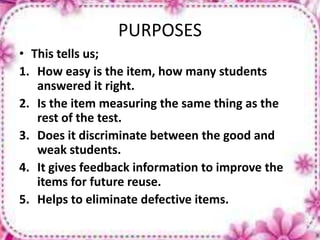
PURPOSES
• This tells us;
1. How easy is the item, how many students
answered it right.
2. Is the item measuring the same thing as the
rest of the test.
3. Does it discriminate between the good and
weak students.
4. It gives feedback information to improve the
items for future reuse.
5. Helps to eliminate defective items.
NOTICE TO ALL
TEACHERS
You are reminded that
evaluation of education
must begin with a clear
and meaningful definition
of its objectives
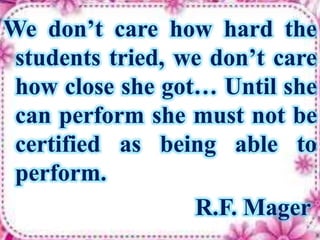
We don’t care how hard the
students tried, we don’t care
how close she got… Until she
can perform she must not be
certified as being able to
perform.
R.F. Mager
THANK YOU

Evaluation strategies conference final