ITEM ANALYSIS
Dr. Rajasree
Lecturer in General Education
K.U.C.T.E,Aryad,Alappuzha
ITEM ANALYSIS
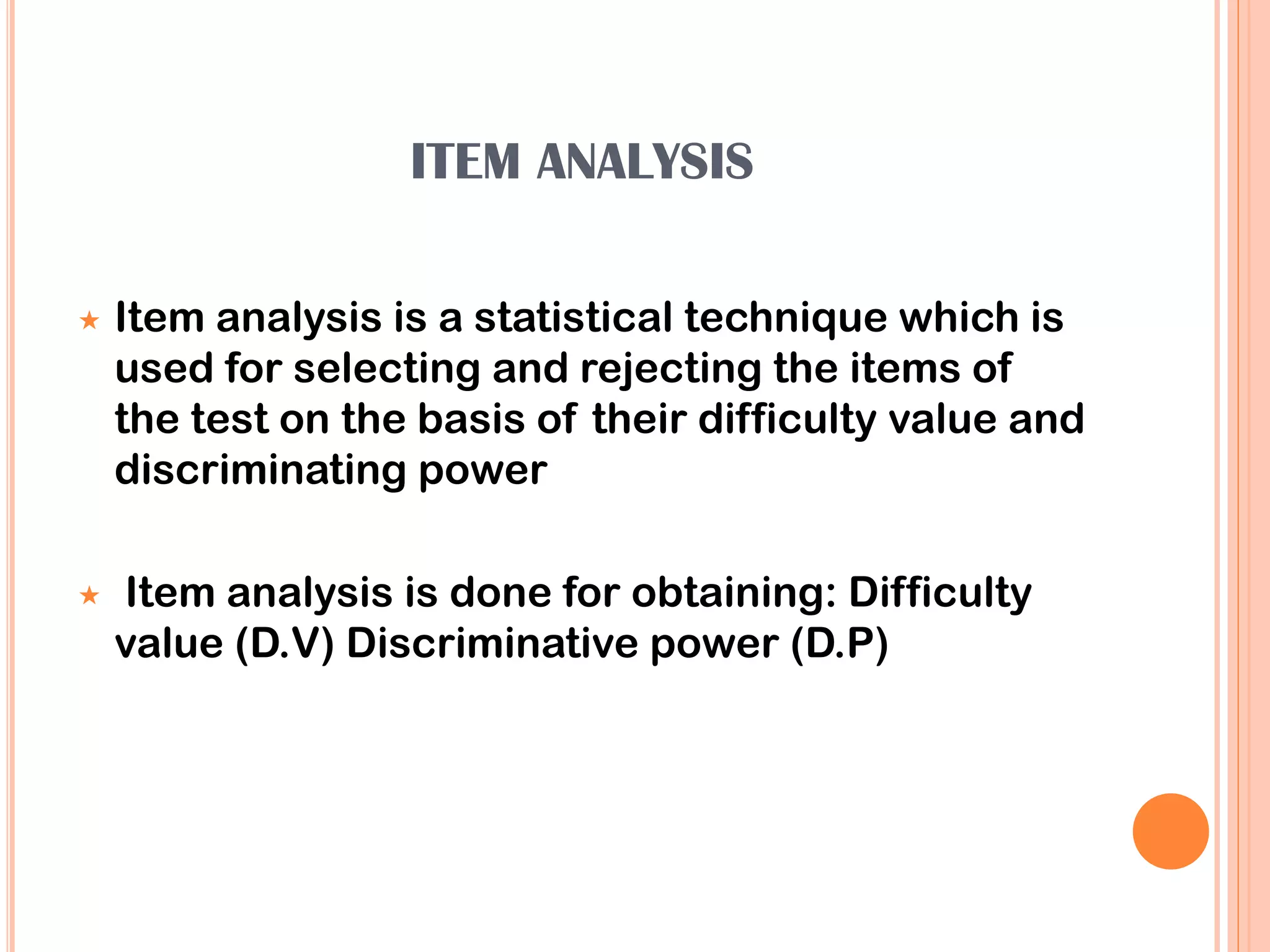
 Item analysis is a statistical technique which is
used for selecting and rejecting the items of
the test on the basis of their difficulty value and
discriminating power
 Item analysis is done for obtaining: Difficulty
value (D.V) Discriminative power (D.P)
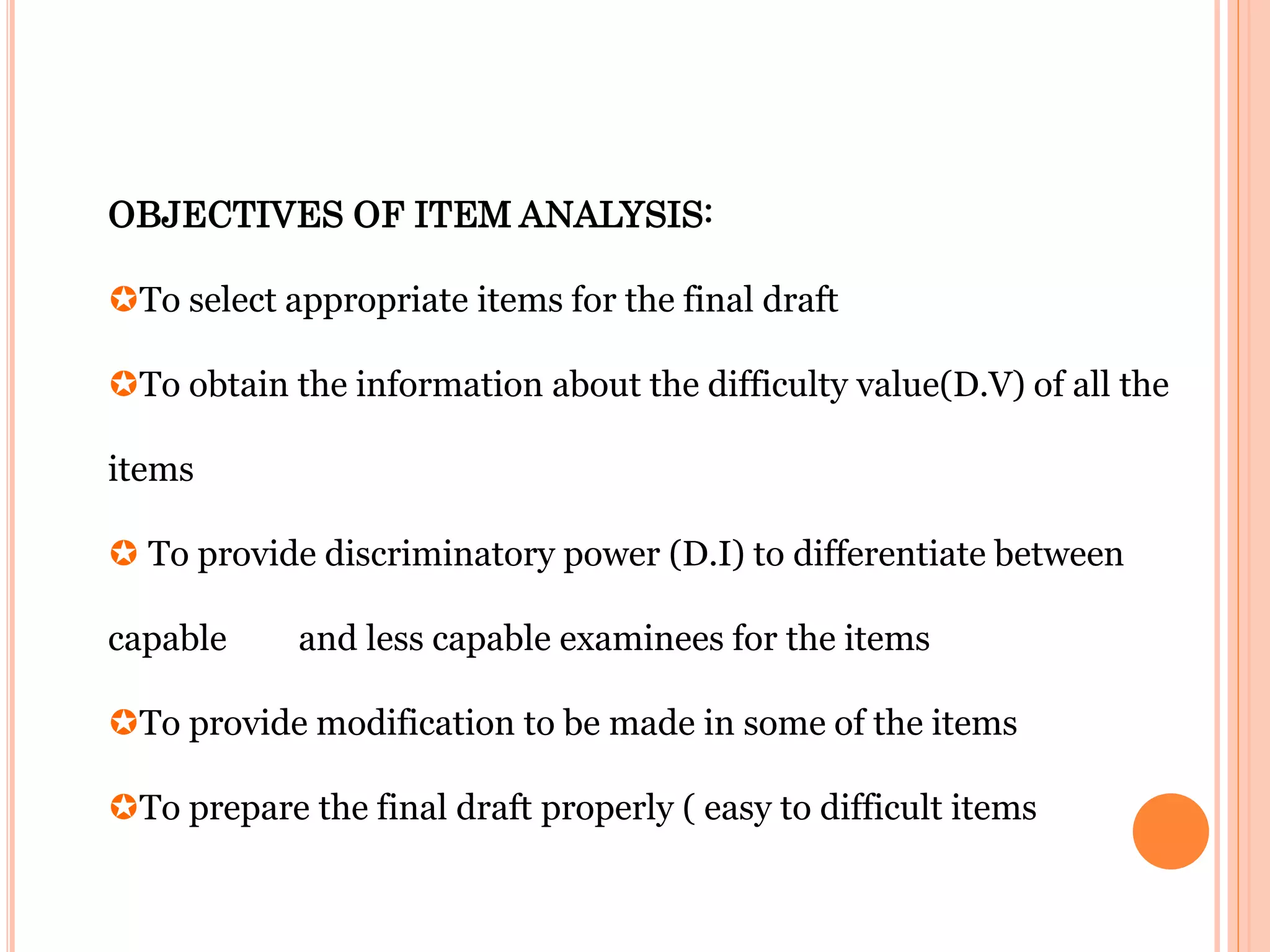
OBJECTIVES OF ITEM ANALYSIS:
To select appropriate items for the final draft
To obtain the information about the difficulty value(D.V) of all the
items
 To provide discriminatory power (D.I) to differentiate between
capable and less capable examinees for the items
To provide modification to be made in some of the items
To prepare the final draft properly ( easy to difficult items
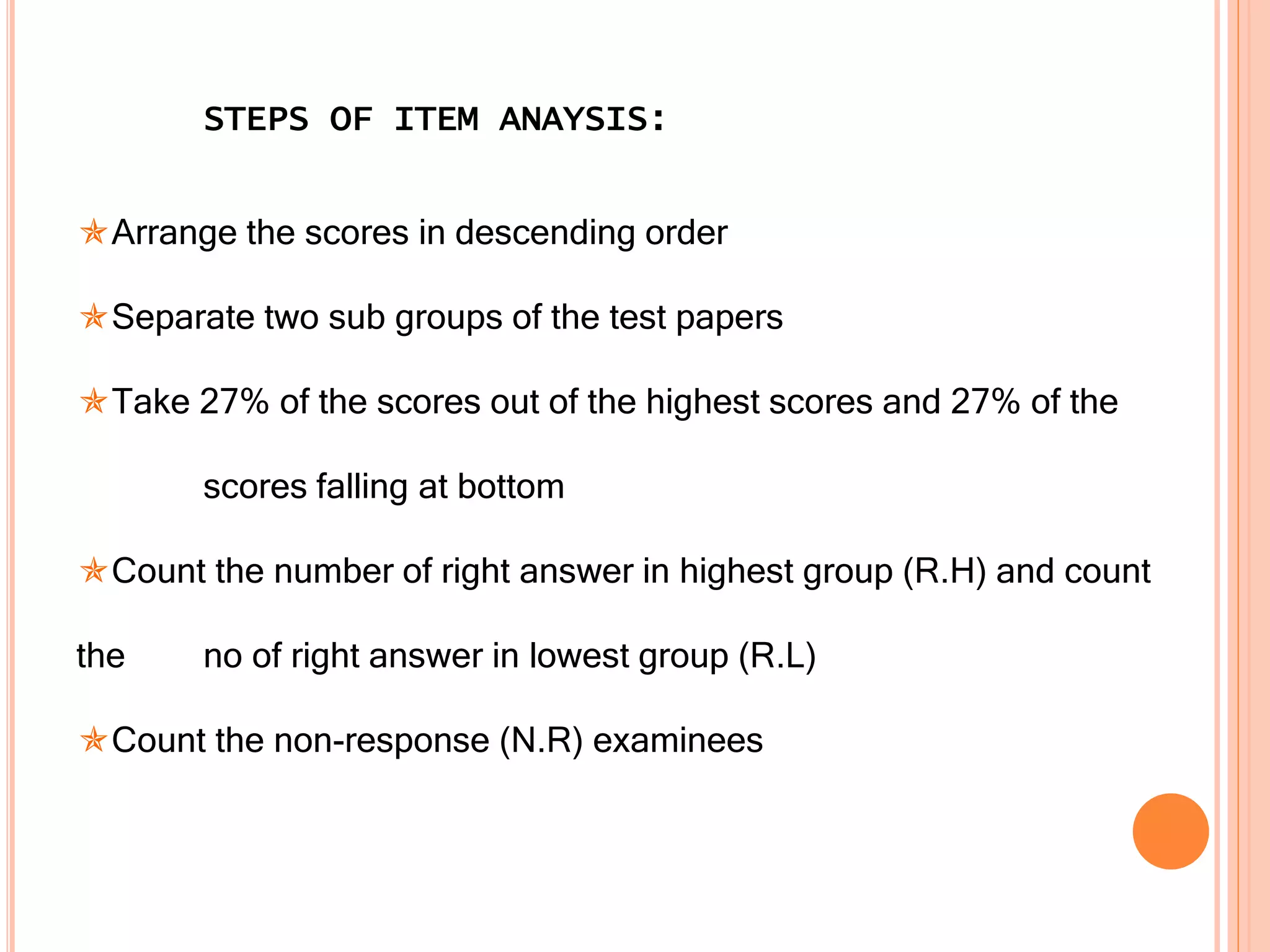
STEPS OF ITEM ANAYSIS:
Arrange the scores in descending order
Separate two sub groups of the test papers
Take 27% of the scores out of the highest scores and 27% of the
scores falling at bottom
Count the number of right answer in highest group (R.H) and count
the no of right answer in lowest group (R.L)
Count the non-response (N.R) examinees
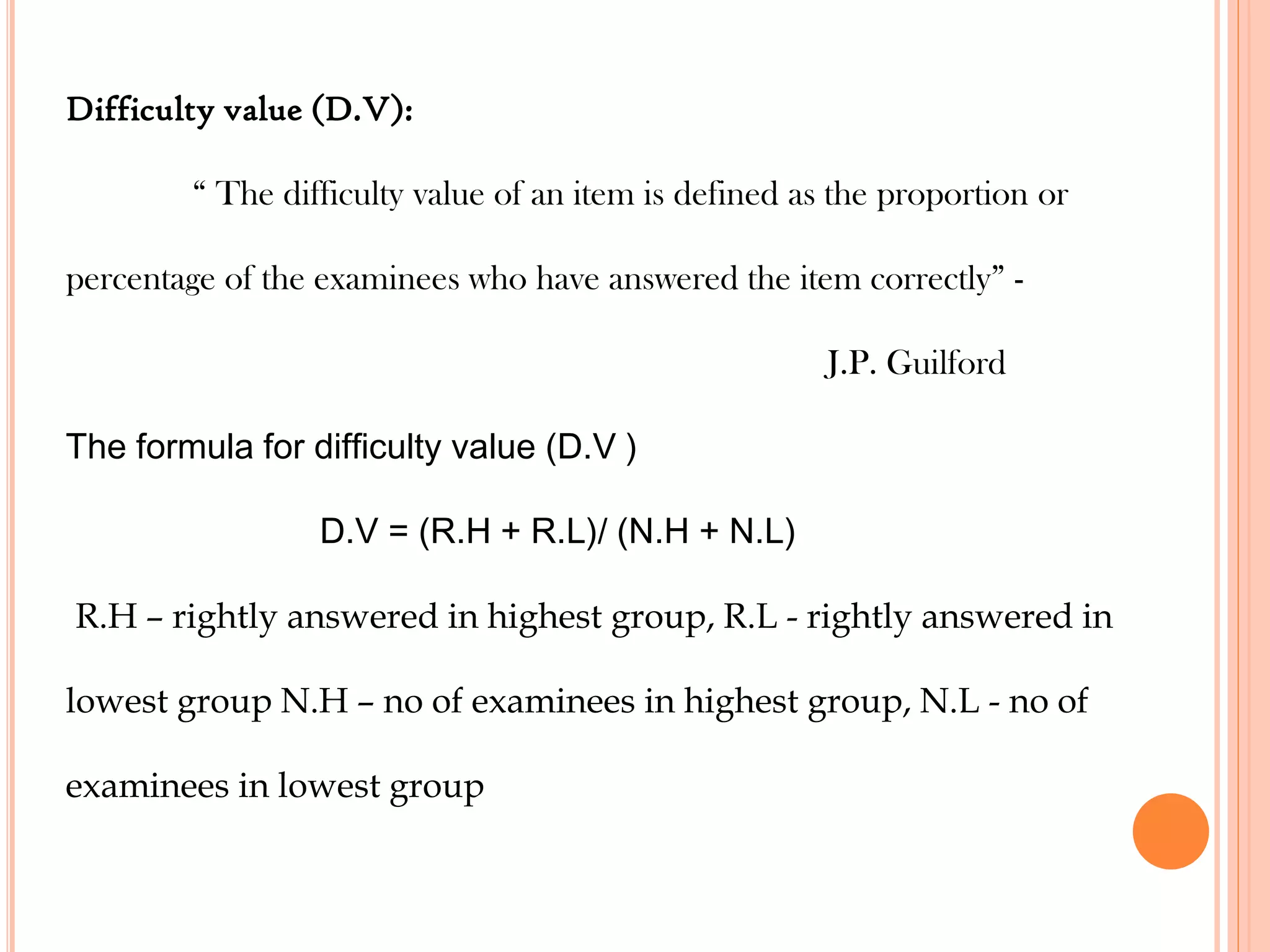
Difficulty value (D.V):
“ The difficulty value of an item is defined as the proportion or
percentage of the examinees who have answered the item correctly” -
J.P. Guilford
The formula for difficulty value (D.V )
D.V = (R.H + R.L)/ (N.H + N.L)
R.H – rightly answered in highest group, R.L - rightly answered in
lowest group N.H – no of examinees in highest group, N.L - no of
examinees in lowest group
In case non-response examinees available means, The formula for
difficulty value (D.V)
D.V = (R.H + R.L)/ [(N.H + N.L)- N.R]
R.H – rightly answered in highest group
R.L - rightly answered in lowest group
N.H – no of examinees in highest group
N.L - no of examinees in lowest group
N.R – no of non-response examinees
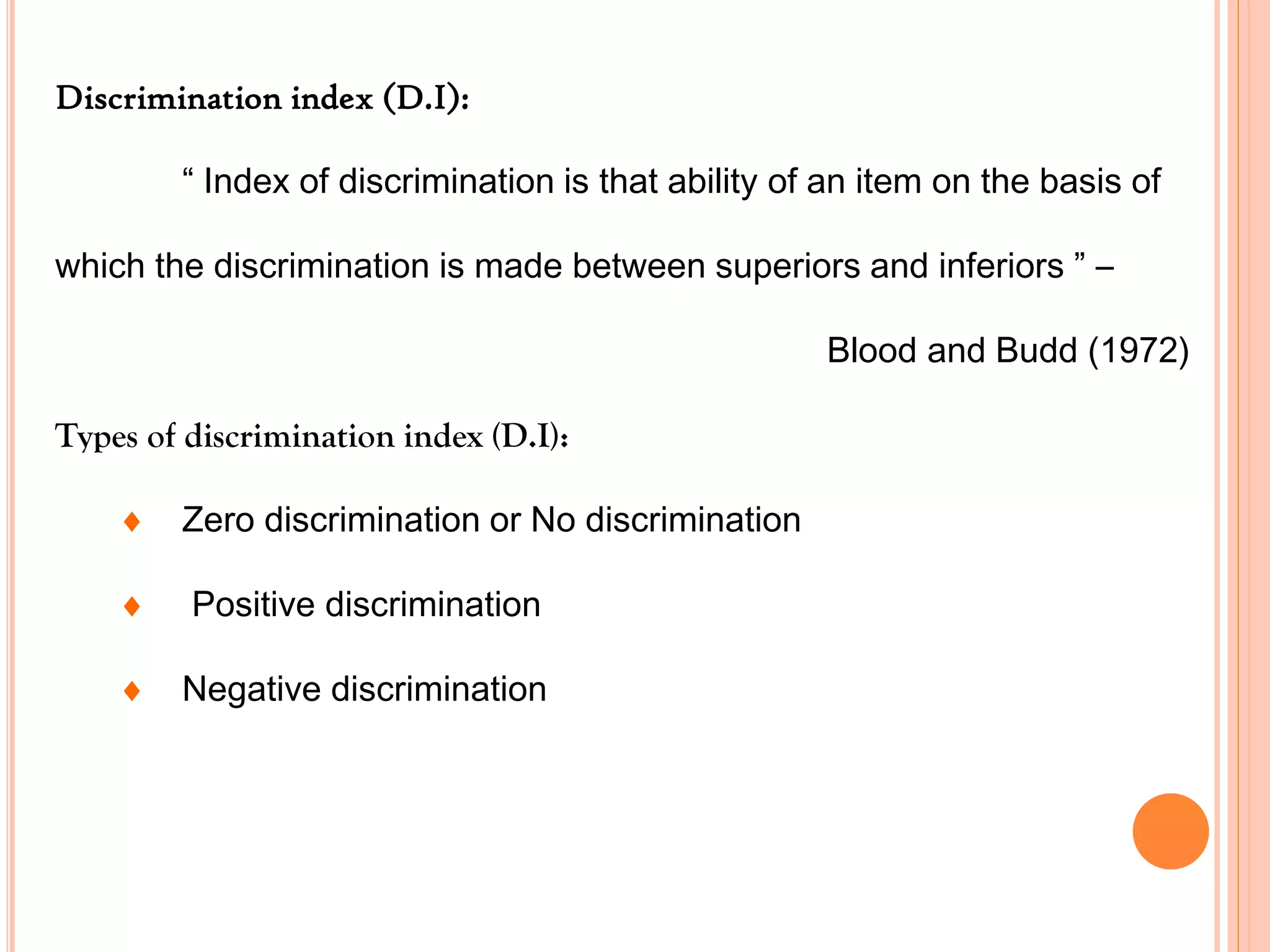
Discrimination index (D.I):
“ Index of discrimination is that ability of an item on the basis of
which the discrimination is made between superiors and inferiors ” –
Blood and Budd (1972)
Types of discrimination index (D.I):
 Zero discrimination or No discrimination
 Positive discrimination
 Negative discrimination
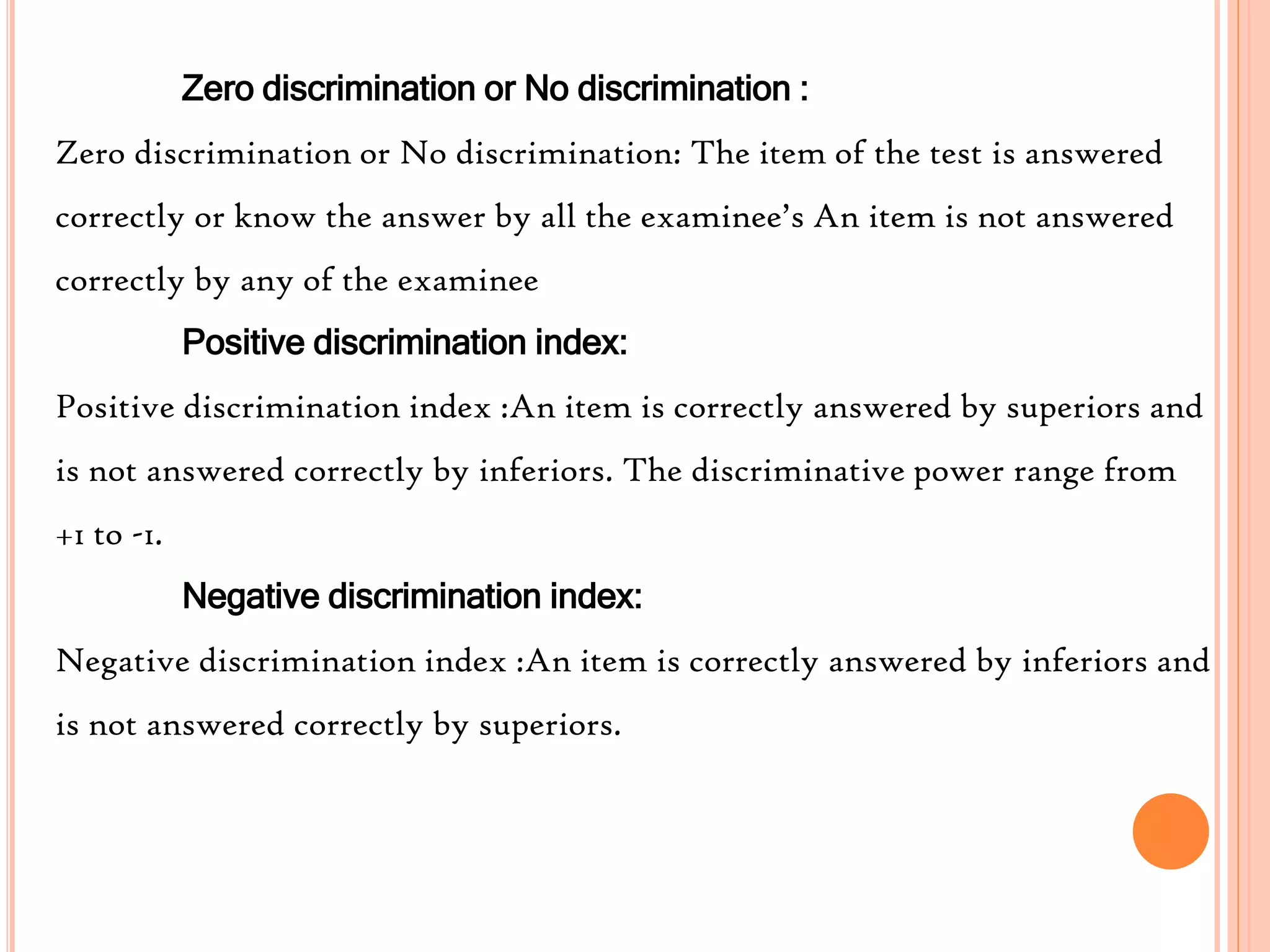
Zero discrimination or No discrimination :
Zero discrimination or No discrimination: The item of the test is answered
correctly or know the answer by all the examinee’s An item is not answered
correctly by any of the examinee
Positive discrimination index:
Positive discrimination index :An item is correctly answered by superiors and
is not answered correctly by inferiors. The discriminative power range from
+1 to -1.
Negative discrimination index:
Negative discrimination index :An item is correctly answered by inferiors and
is not answered correctly by superiors.
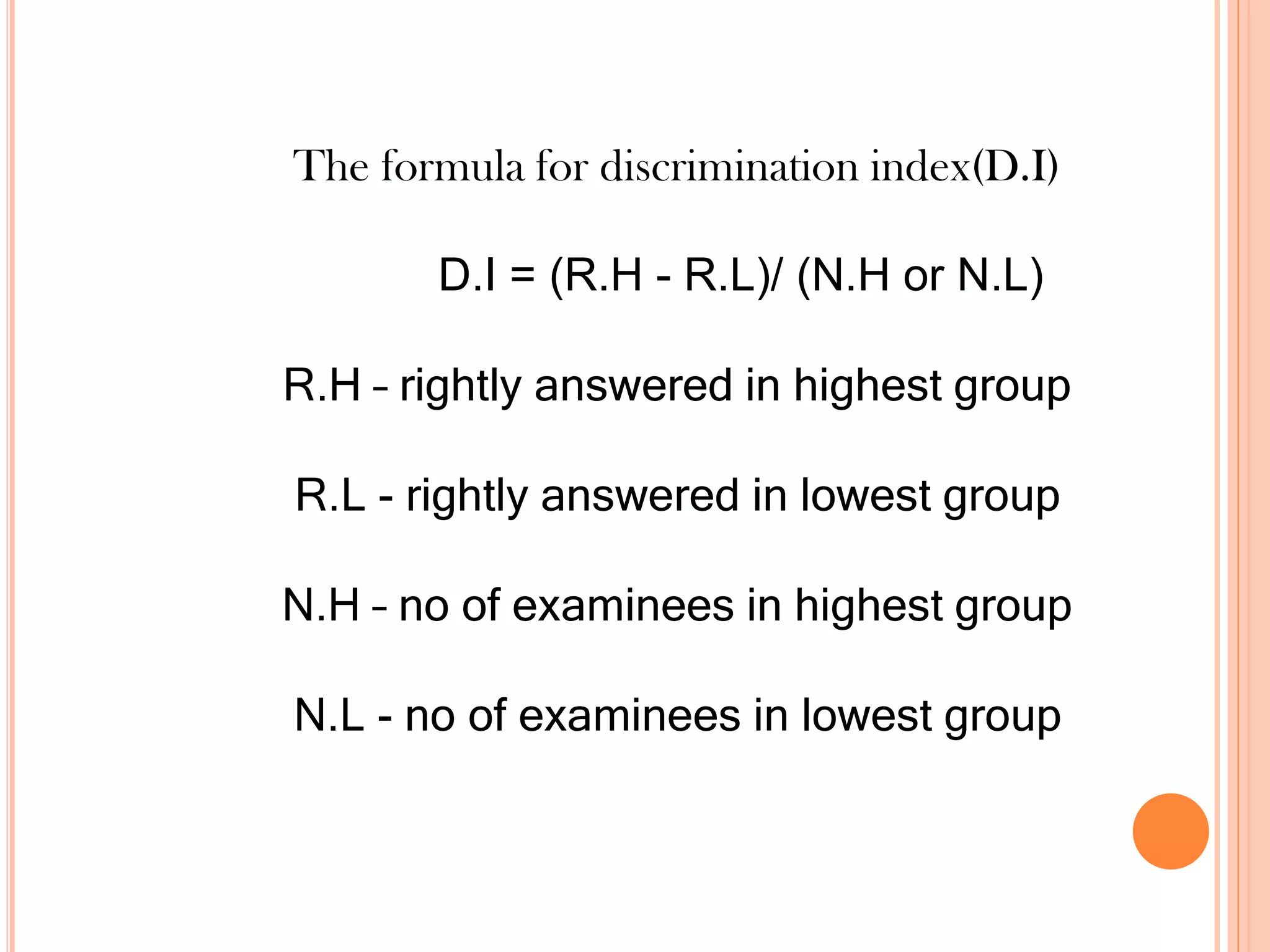
The formula for discrimination index(D.I)
D.I = (R.H - R.L)/ (N.H or N.L)
R.H – rightly answered in highest group
R.L - rightly answered in lowest group
N.H – no of examinees in highest group
N.L - no of examinees in lowest group
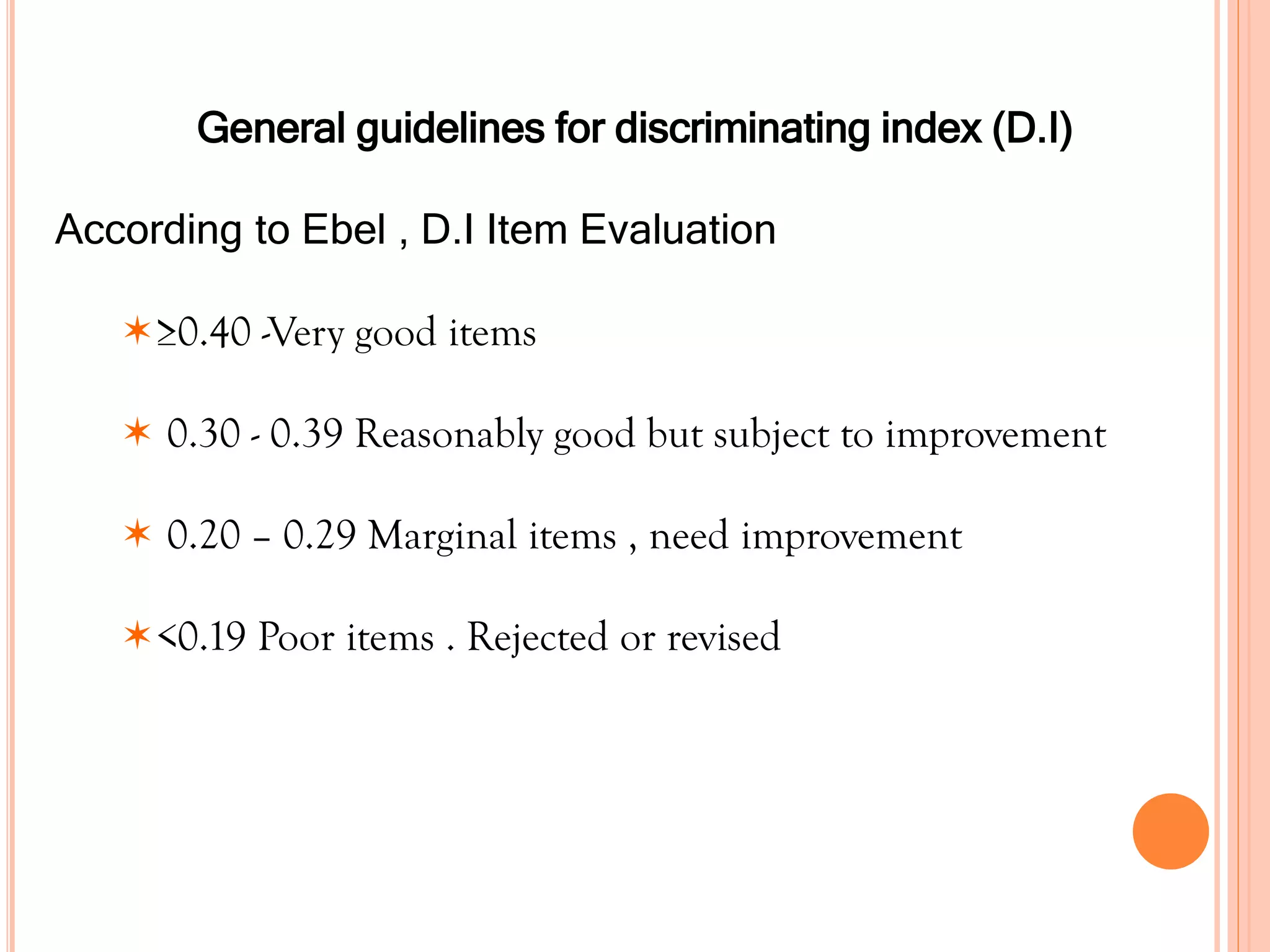
General guidelines for discriminating index (D.I)
According to Ebel , D.I Item Evaluation
≥0.40 -Very good items
 0.30 - 0.39 Reasonably good but subject to improvement
 0.20 – 0.29 Marginal items , need improvement
<0.19 Poor items . Rejected or revised
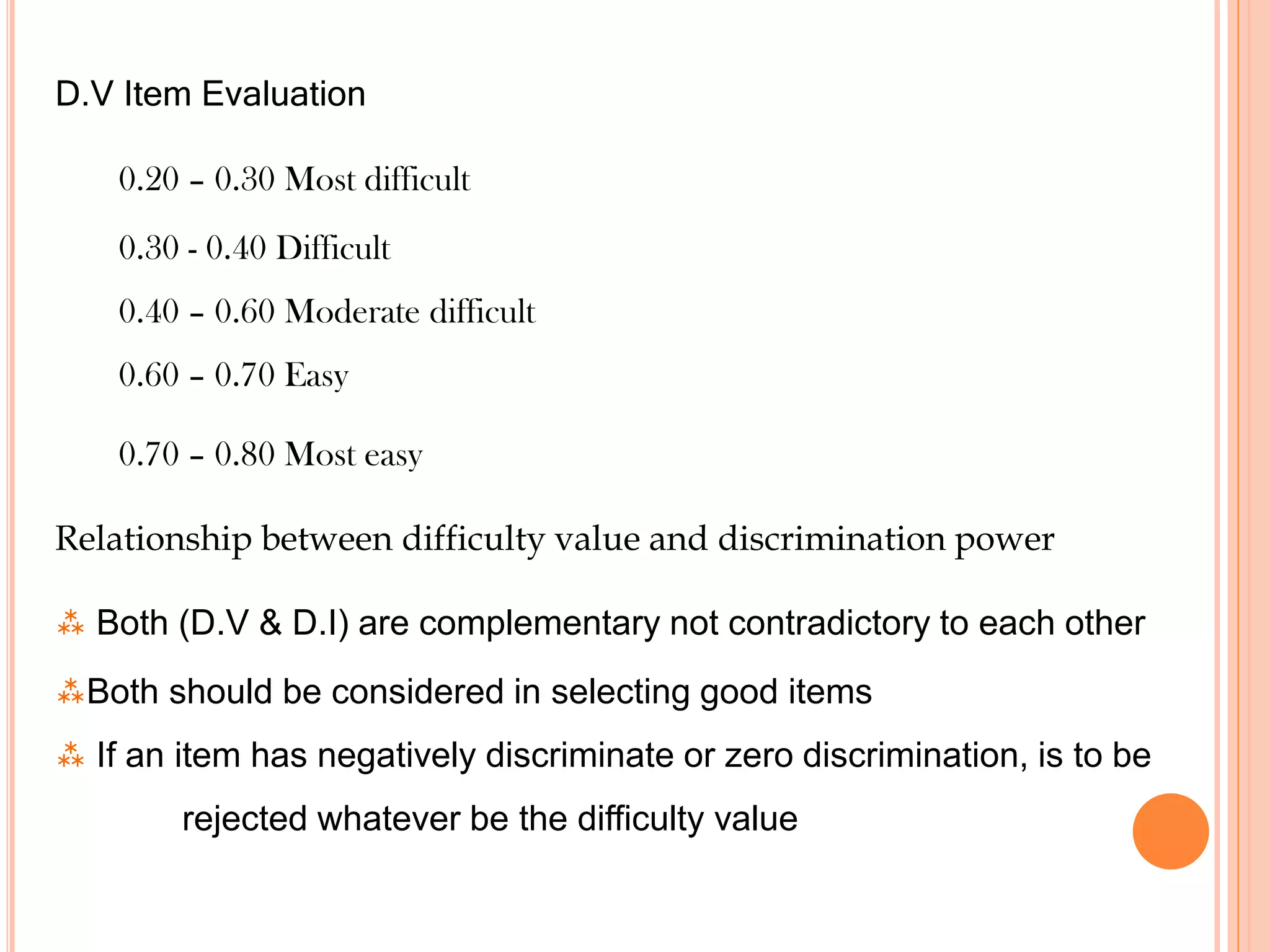
D.V Item Evaluation
0.20 – 0.30 Most difficult
0.30 - 0.40 Difficult
0.40 – 0.60 Moderate difficult
0.60 – 0.70 Easy
0.70 – 0.80 Most easy
Relationship between difficulty value and discrimination power
 Both (D.V & D.I) are complementary not contradictory to each other
Both should be considered in selecting good items
 If an item has negatively discriminate or zero discrimination, is to be
rejected whatever be the difficulty value
THANK YOU

Item analysis

  • 1.
    ITEM ANALYSIS Dr. Rajasree Lecturerin General Education K.U.C.T.E,Aryad,Alappuzha
  • 2.
    ITEM ANALYSIS  Itemanalysis is a statistical technique which is used for selecting and rejecting the items of the test on the basis of their difficulty value and discriminating power  Item analysis is done for obtaining: Difficulty value (D.V) Discriminative power (D.P)
  • 3.
    OBJECTIVES OF ITEMANALYSIS: To select appropriate items for the final draft To obtain the information about the difficulty value(D.V) of all the items  To provide discriminatory power (D.I) to differentiate between capable and less capable examinees for the items To provide modification to be made in some of the items To prepare the final draft properly ( easy to difficult items
  • 4.
    STEPS OF ITEMANAYSIS: Arrange the scores in descending order Separate two sub groups of the test papers Take 27% of the scores out of the highest scores and 27% of the scores falling at bottom Count the number of right answer in highest group (R.H) and count the no of right answer in lowest group (R.L) Count the non-response (N.R) examinees
  • 5.
    Difficulty value (D.V): “The difficulty value of an item is defined as the proportion or percentage of the examinees who have answered the item correctly” - J.P. Guilford The formula for difficulty value (D.V ) D.V = (R.H + R.L)/ (N.H + N.L) R.H – rightly answered in highest group, R.L - rightly answered in lowest group N.H – no of examinees in highest group, N.L - no of examinees in lowest group
  • 6.
    In case non-responseexaminees available means, The formula for difficulty value (D.V) D.V = (R.H + R.L)/ [(N.H + N.L)- N.R] R.H – rightly answered in highest group R.L - rightly answered in lowest group N.H – no of examinees in highest group N.L - no of examinees in lowest group N.R – no of non-response examinees
  • 7.
    Discrimination index (D.I): “Index of discrimination is that ability of an item on the basis of which the discrimination is made between superiors and inferiors ” – Blood and Budd (1972) Types of discrimination index (D.I):  Zero discrimination or No discrimination  Positive discrimination  Negative discrimination
  • 8.
    Zero discrimination orNo discrimination : Zero discrimination or No discrimination: The item of the test is answered correctly or know the answer by all the examinee’s An item is not answered correctly by any of the examinee Positive discrimination index: Positive discrimination index :An item is correctly answered by superiors and is not answered correctly by inferiors. The discriminative power range from +1 to -1. Negative discrimination index: Negative discrimination index :An item is correctly answered by inferiors and is not answered correctly by superiors.
  • 9.
    The formula fordiscrimination index(D.I) D.I = (R.H - R.L)/ (N.H or N.L) R.H – rightly answered in highest group R.L - rightly answered in lowest group N.H – no of examinees in highest group N.L - no of examinees in lowest group
  • 10.
    General guidelines fordiscriminating index (D.I) According to Ebel , D.I Item Evaluation ≥0.40 -Very good items  0.30 - 0.39 Reasonably good but subject to improvement  0.20 – 0.29 Marginal items , need improvement <0.19 Poor items . Rejected or revised
  • 11.
    D.V Item Evaluation 0.20– 0.30 Most difficult 0.30 - 0.40 Difficult 0.40 – 0.60 Moderate difficult 0.60 – 0.70 Easy 0.70 – 0.80 Most easy Relationship between difficulty value and discrimination power  Both (D.V & D.I) are complementary not contradictory to each other Both should be considered in selecting good items  If an item has negatively discriminate or zero discrimination, is to be rejected whatever be the difficulty value
  • 12.