Frequency distribution
DATA
The main sources for collection of medical statistics
are:
1. Experiments
2. Surveys
3. Records.
Nos. 1 and 2 are specially applied to generate data
needed for specific purposes while the records
provide ready-made data for routine and
continuous information.
Experiments
• Experiments are performed in the laboratories of
physiology, biochemistry, pharmacology and
clinical pathology or in the hospital wards for
investigations and fundamental research.
• The data collected with specific objective by one
or more workers are compiled and analyzed.
• The results are made use of in preparation of
dissertations, theses and scientific papers of
publication in scientific journals and books.
Surveys-definition
Surveys are carried out for
epidemiological studies in the field by
trained teams to find the incidence or
prevalence of health or disease
situations in a community such as
incidence of malaria or prevalence of
leprosy.
Records
Records are maintained as a routine in registers or
books over a long period of time for various
purposes such as for vital statistics— births,
marriages and deaths and for illnesses in hospitals.
• Data thus collected, are made use of in
demography (population studies) and public
health practice.
• Regular administrative machinery is necessary to
record or register the different events.
Statistical data -Qualitative and
quantitative
-
Qualitative (or Discrete) Data
In such data there is no notion of magnitude or
size of the characteristic or attribute as the
same cannot be measured.
They are classified by counting the individuals
having the same characteristic or attribute and
not by measurement.
There is only one variable, i.e. the number of
persons and not the characteristic.
Qualitative (or Discrete) Data
Persons with the same characteristic are counted to
form specific groups or classes such as attacked,
escaped, died, cured, relieved, vaccinated, males,
young, old, treated, not treated, on drug, on
placebo, etc.
Qualitative data are discrete in nature such as
number of deaths in different years,
population of different towns,
persons with different blood groups in a population
and so on.
Quantitative (or Continuous) Data
In statistical language any character,
characteristic or quality that varies is called
variable.
The quantitative data have a magnitude.
The characteristics is measured either on an
interval or on a ratio scale.
There are two variables—the characteristics
such as height and the frequency.
Height varies from person to person, it may be 150
cm in one and 160 cm in another person of the
same age and sex.
The quantitative data obtained from characteristic
variable are also called continuous data
Some of the statistical methods employed in
analysis of such data are mean, range, standard
deviation, coefficient of variation and correlation
coefficient.
Class limit, class interval and class
frequency
• Class limit are the lowest and highest values that
can be included in the class.
• Class intervals – the differences between the
upper and lower limit of a class is known as class
interval of that class.
• In the class 100-200 the class interval is 100 i.e
200 minus 100
• Class frequency
• The number of observation correspond to a
particular class is known as class frequency
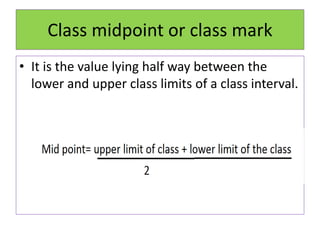
Class midpoint or class mark
• It is the value lying half way between the
lower and upper class limits of a class interval.
Data collected and compiled from
experimental work, records and
surveys should be accurate and
complete. They must be checked
for accuracy and adequacy before
processing further.
METHODS OF PRESENTATION
There are two main methods of presenting
frequencies of a variable. character or a
variable.
• Tabulation
• Drawing
Tabulation
• A table is a systematic arrangement of
statistical data in the columns and rows.
• Rows are horizontal arrangement
• Columns are vertical arrangement.
• Tables make it possible for the analyst to
present a huge mass of data in a detailed
orderly manner within a minimum of space
Significance of tabulation
• It simplifies the complex data
• It facilitates comparison
• It gives identity to data
• It reveals pattern
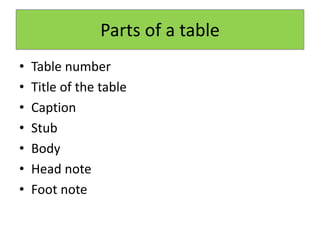
Parts of a table
• Table number
• Title of the table
• Caption
• Stub
• Body
• Head note
• Foot note
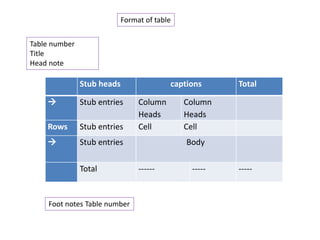
Format of table
Table number
Title
Head note
Stub heads captions Total
 Stub entries Column
Heads
Column
Heads
Rows Stub entries Cell Cell
 Stub entries Body
Total ------ ----- -----
Foot notes Table number
Table number
• Each table must be numbered.
• Different practice with regard to place where
the number is to be given.
• It can be in centre, at the top above the title,
inside of the title, or in the bottom of the
table on the left hand side.
• If space permits the table number must be
centered
Title of the table
• Every table must be given suitable title.
• The title is the description of the content of
the table.
• Title should be precise clear and self
explanatory.
• It should be in the form of a series of phrases
rather than complete sentences.
• Lettering must be prominent of any letter on
the table
caption
• Caption refers to the column heading.
• Under a column heading there may be sub
heads.
• If the different columns are mentioned with
different unit, the units must be mentioned
with the caption.
• Caption must be shown in small letters. This
helps in saving space
Stub
• It is designation of the rows or rows heading.
• They are at the extreme left.
• Stubs are usually wider than column heading.
• It should be kept as narrow as possible
Body
• The body of the table contains the numerical
information.
• This is the most vital part of the table.
• Datas are arranged according to description of
caption and stubs.
Head note
• It is a brief explanatory statement applying to
all or a major part of the material in the table.
• It is placed below the point centred and
enclosed in brackets.
• It is used to explain certain points which is
not mentioned in the caption and stubs.
Foot note
• Anything in the table which the reader may
find difficult to understand from the title,
caption and stubs should be explained in the
foot notes.
• If it is needed they are placed directly below
the body of the table.
• To clarify anything in the table.
Various system of identifying the
footnotes
• Numbering them consecutively with small
numbers 1,2,3,4 or letters a,b,c,d
• Another system identifies the first note with
one star *
• Second footnote with two stars**
• Third foot notes with three stars and so on.
• Sometimes instead of star another sign dagger
is used ϯ. Better to use small letters.
General rules of tabulation
• The table should suit the size of the paper usually
with more rows than columns.
• In all tables the caption and stubs are arranged in
the systematic order.
• Alphabetical –arrangements according to
alphabet.
• Chronological- arrangement according to time
[historical data] [ review of literature ]
• Geographical- arrangement of data in certain
territorial units such as countries, cities and
districts.
• Conventional or arrangement in customary
order.
• Items arranged according to size, the largest
item given first and smallest in the last.
• This arrangement may be reversed , if
necessary.
• The point of measurement should be clearly
defined eg income in rupees.
General rules of tabulation
• Figures should be rounded off to avoid
unnecessary details in the table and a foot
note to this effect should be given.
• Figures taken to nearest rupees and paise are
eliminated.
• Table should not be overloaded with details.
• Percentages and ratio are sometimes called
derived statistics.
General rules of tabulation
• Indicate a zero quantity by zero and not by 0
to indicate the information which is not
available. [ not available or by - ]
• Abbreviations should be avoided especially in
titles and headings.
• Do not use ditto mark. If figure is repeated
show it each time. A ditto mark can be
mistaken as number 11.
General rules of tabulation
Types of tables
i]Simple or one way table
ii] Two way table
iii]Higher order table
• When three or more characteristics are
represented in the same table, such table is
called a high order table.
• Number of characteristics represented
increases the table become more and more
confusing.
2. General and special purpose table
• It is also known as reference table or
repository tables.
• Tables published by government belongs to it.
• Special purpose table are also known as
summary table provide information for
particular discussion.
• They are also called derivative tables because
they derive from general table.
Rules for making a frequency
distribution table
• The class or group interval between the
groups should not be too broad or too narrow,
e.g. grouping of age should not be yearly or 20
yearly, but 5 yearly.
• Too large a group will omit the details and too
small will defeat the purpose of making the
date concise.
• The number of groups or classes should not
be too many or too few but be ordinarily
between 6 and 16 depending on the details
necessary and the size of sample.
• The class interval should be same throughout
such as 10 mm in observations of the systolic
blood pressure from 80–160 mmHg, the
groups in ascending order will be 80–89, 90–
99, …, 150–159.
• The headings must be clear such as “height” in
inches or in centimeters,“age” in years or months,
etc. If the data are expressed as rates, mention
per cent or per thousand.
• The rates and proportions, if given the actual
number in the group must also be noted, which
may be done in parenthesis.
• Groups should be tabulated in ascending or
descending order, from the lowest value in the
range to the highest such as pulse rate 61–65,
66–70, …, 106–110.
• If certain data are omitted or excluded
deliberately, the reasons for the same should
be given.
• After classwise or groupwise tabulation, the
frequencies of a characteristic can be
presented by two kinds of drawings: Graphs
and diagrams. They may be shown either by
lines and dots or by figures.
The drawings are meant for the nonstatistical
minded people who want to study the relative
values or frequencies of persons or events. For
the statistical-mined persons, they are for quick
eye readings.
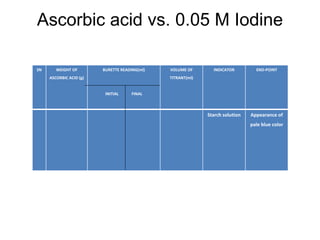
Ascorbic acid vs. 0.05 M Iodine
SN WEIGHT OF
ASCORBIC ACID (g)
BURETTE READING(ml)
INITIAL FINAL
VOLUME OF
TITRANT(ml)
INDICATOR END-POINT
Starch solution Appearance of
pale blue color
• EXPLAIN IN DETAIL ABOUT THE
SCOPE OF STATISTICS.
• DRAW A TABLE FOR TITRATION OF
0.1 M SODIUM HYDROXIDE VS HCL 4

Frequency distribution432021

  • 1.
  • 2.
    DATA The main sourcesfor collection of medical statistics are: 1. Experiments 2. Surveys 3. Records. Nos. 1 and 2 are specially applied to generate data needed for specific purposes while the records provide ready-made data for routine and continuous information.
  • 3.
    Experiments • Experiments areperformed in the laboratories of physiology, biochemistry, pharmacology and clinical pathology or in the hospital wards for investigations and fundamental research. • The data collected with specific objective by one or more workers are compiled and analyzed. • The results are made use of in preparation of dissertations, theses and scientific papers of publication in scientific journals and books.
  • 4.
    Surveys-definition Surveys are carriedout for epidemiological studies in the field by trained teams to find the incidence or prevalence of health or disease situations in a community such as incidence of malaria or prevalence of leprosy.
  • 5.
    Records Records are maintainedas a routine in registers or books over a long period of time for various purposes such as for vital statistics— births, marriages and deaths and for illnesses in hospitals. • Data thus collected, are made use of in demography (population studies) and public health practice. • Regular administrative machinery is necessary to record or register the different events.
  • 6.
    Statistical data -Qualitativeand quantitative - Qualitative (or Discrete) Data In such data there is no notion of magnitude or size of the characteristic or attribute as the same cannot be measured. They are classified by counting the individuals having the same characteristic or attribute and not by measurement. There is only one variable, i.e. the number of persons and not the characteristic.
  • 7.
    Qualitative (or Discrete)Data Persons with the same characteristic are counted to form specific groups or classes such as attacked, escaped, died, cured, relieved, vaccinated, males, young, old, treated, not treated, on drug, on placebo, etc. Qualitative data are discrete in nature such as number of deaths in different years, population of different towns, persons with different blood groups in a population and so on.
  • 8.
    Quantitative (or Continuous)Data In statistical language any character, characteristic or quality that varies is called variable. The quantitative data have a magnitude. The characteristics is measured either on an interval or on a ratio scale. There are two variables—the characteristics such as height and the frequency.
  • 9.
    Height varies fromperson to person, it may be 150 cm in one and 160 cm in another person of the same age and sex. The quantitative data obtained from characteristic variable are also called continuous data Some of the statistical methods employed in analysis of such data are mean, range, standard deviation, coefficient of variation and correlation coefficient.
  • 10.
    Class limit, classinterval and class frequency • Class limit are the lowest and highest values that can be included in the class. • Class intervals – the differences between the upper and lower limit of a class is known as class interval of that class. • In the class 100-200 the class interval is 100 i.e 200 minus 100 • Class frequency • The number of observation correspond to a particular class is known as class frequency
  • 11.
    Class midpoint orclass mark • It is the value lying half way between the lower and upper class limits of a class interval.
  • 12.
    Data collected andcompiled from experimental work, records and surveys should be accurate and complete. They must be checked for accuracy and adequacy before processing further.
  • 13.
    METHODS OF PRESENTATION Thereare two main methods of presenting frequencies of a variable. character or a variable. • Tabulation • Drawing
  • 14.
    Tabulation • A tableis a systematic arrangement of statistical data in the columns and rows. • Rows are horizontal arrangement • Columns are vertical arrangement. • Tables make it possible for the analyst to present a huge mass of data in a detailed orderly manner within a minimum of space
  • 15.
    Significance of tabulation •It simplifies the complex data • It facilitates comparison • It gives identity to data • It reveals pattern
  • 16.
    Parts of atable • Table number • Title of the table • Caption • Stub • Body • Head note • Foot note
  • 17.
    Format of table Tablenumber Title Head note Stub heads captions Total  Stub entries Column Heads Column Heads Rows Stub entries Cell Cell  Stub entries Body Total ------ ----- ----- Foot notes Table number
  • 18.
    Table number • Eachtable must be numbered. • Different practice with regard to place where the number is to be given. • It can be in centre, at the top above the title, inside of the title, or in the bottom of the table on the left hand side. • If space permits the table number must be centered
  • 19.
    Title of thetable • Every table must be given suitable title. • The title is the description of the content of the table. • Title should be precise clear and self explanatory. • It should be in the form of a series of phrases rather than complete sentences. • Lettering must be prominent of any letter on the table
  • 20.
    caption • Caption refersto the column heading. • Under a column heading there may be sub heads. • If the different columns are mentioned with different unit, the units must be mentioned with the caption. • Caption must be shown in small letters. This helps in saving space
  • 21.
    Stub • It isdesignation of the rows or rows heading. • They are at the extreme left. • Stubs are usually wider than column heading. • It should be kept as narrow as possible
  • 22.
    Body • The bodyof the table contains the numerical information. • This is the most vital part of the table. • Datas are arranged according to description of caption and stubs.
  • 23.
    Head note • Itis a brief explanatory statement applying to all or a major part of the material in the table. • It is placed below the point centred and enclosed in brackets. • It is used to explain certain points which is not mentioned in the caption and stubs.
  • 24.
    Foot note • Anythingin the table which the reader may find difficult to understand from the title, caption and stubs should be explained in the foot notes. • If it is needed they are placed directly below the body of the table. • To clarify anything in the table.
  • 25.
    Various system ofidentifying the footnotes • Numbering them consecutively with small numbers 1,2,3,4 or letters a,b,c,d • Another system identifies the first note with one star * • Second footnote with two stars** • Third foot notes with three stars and so on. • Sometimes instead of star another sign dagger is used ϯ. Better to use small letters.
  • 26.
    General rules oftabulation • The table should suit the size of the paper usually with more rows than columns. • In all tables the caption and stubs are arranged in the systematic order. • Alphabetical –arrangements according to alphabet. • Chronological- arrangement according to time [historical data] [ review of literature ] • Geographical- arrangement of data in certain territorial units such as countries, cities and districts.
  • 27.
    • Conventional orarrangement in customary order. • Items arranged according to size, the largest item given first and smallest in the last. • This arrangement may be reversed , if necessary. • The point of measurement should be clearly defined eg income in rupees. General rules of tabulation
  • 28.
    • Figures shouldbe rounded off to avoid unnecessary details in the table and a foot note to this effect should be given. • Figures taken to nearest rupees and paise are eliminated. • Table should not be overloaded with details. • Percentages and ratio are sometimes called derived statistics. General rules of tabulation
  • 29.
    • Indicate azero quantity by zero and not by 0 to indicate the information which is not available. [ not available or by - ] • Abbreviations should be avoided especially in titles and headings. • Do not use ditto mark. If figure is repeated show it each time. A ditto mark can be mistaken as number 11. General rules of tabulation
  • 30.
  • 31.
    i]Simple or oneway table
  • 32.
  • 33.
    iii]Higher order table •When three or more characteristics are represented in the same table, such table is called a high order table. • Number of characteristics represented increases the table become more and more confusing.
  • 34.
    2. General andspecial purpose table • It is also known as reference table or repository tables. • Tables published by government belongs to it. • Special purpose table are also known as summary table provide information for particular discussion. • They are also called derivative tables because they derive from general table.
  • 35.
    Rules for makinga frequency distribution table • The class or group interval between the groups should not be too broad or too narrow, e.g. grouping of age should not be yearly or 20 yearly, but 5 yearly. • Too large a group will omit the details and too small will defeat the purpose of making the date concise.
  • 36.
    • The numberof groups or classes should not be too many or too few but be ordinarily between 6 and 16 depending on the details necessary and the size of sample. • The class interval should be same throughout such as 10 mm in observations of the systolic blood pressure from 80–160 mmHg, the groups in ascending order will be 80–89, 90– 99, …, 150–159.
  • 37.
    • The headingsmust be clear such as “height” in inches or in centimeters,“age” in years or months, etc. If the data are expressed as rates, mention per cent or per thousand. • The rates and proportions, if given the actual number in the group must also be noted, which may be done in parenthesis. • Groups should be tabulated in ascending or descending order, from the lowest value in the range to the highest such as pulse rate 61–65, 66–70, …, 106–110.
  • 38.
    • If certaindata are omitted or excluded deliberately, the reasons for the same should be given. • After classwise or groupwise tabulation, the frequencies of a characteristic can be presented by two kinds of drawings: Graphs and diagrams. They may be shown either by lines and dots or by figures.
  • 39.
    The drawings aremeant for the nonstatistical minded people who want to study the relative values or frequencies of persons or events. For the statistical-mined persons, they are for quick eye readings.
  • 40.
    Ascorbic acid vs.0.05 M Iodine SN WEIGHT OF ASCORBIC ACID (g) BURETTE READING(ml) INITIAL FINAL VOLUME OF TITRANT(ml) INDICATOR END-POINT Starch solution Appearance of pale blue color
  • 42.
    • EXPLAIN INDETAIL ABOUT THE SCOPE OF STATISTICS. • DRAW A TABLE FOR TITRATION OF 0.1 M SODIUM HYDROXIDE VS HCL 4