GlaucomaGlaucoma
Dr Lee Ming YuehDr Lee Ming Yueh
Ophthalmology UnitOphthalmology Unit
Penang HospitalPenang Hospital
Glaucoma is a sight threatening diseaseGlaucoma is a sight threatening disease
which can cause irreversible visual losswhich can cause irreversible visual loss
Baltimore Eye Survey:Baltimore Eye Survey:
-- by the year 2000by the year 2000 > 66.8 million primary glaucoma> 66.8 million primary glaucoma
> 6.7 million bilateral blindness> 6.7 million bilateral blindness
DefinitionDefinition
A spectrum of disease characterized byA spectrum of disease characterized by
- progressive optic neuropathy- progressive optic neuropathy
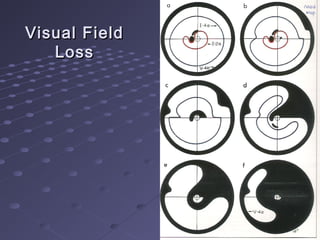
- visual field loss- visual field loss
** IOP is an important risk factor.IOP is an important risk factor.
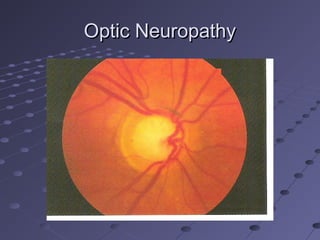
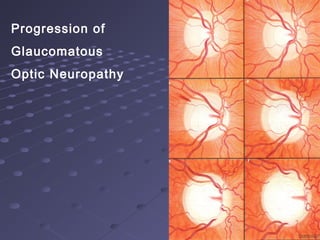
Optic NeuropathyOptic Neuropathy
Progression of
Glaucomatous
Optic Neuropathy
Visual FieldVisual Field
LossLoss
Classification:Classification:
Open Angle GlaucomaOpen Angle Glaucoma
Close Angle GlaucomaClose Angle Glaucoma
Congenital GlaucomaCongenital Glaucoma
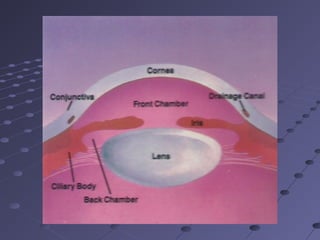
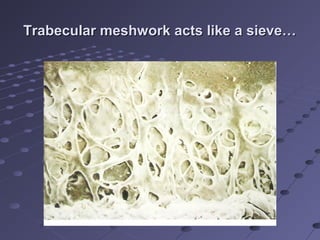
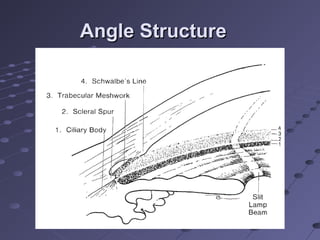
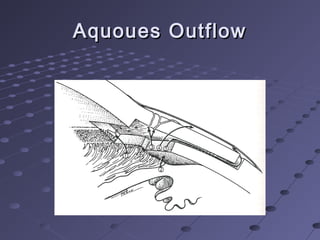
Trabecular meshwork acts like a sieve…Trabecular meshwork acts like a sieve…
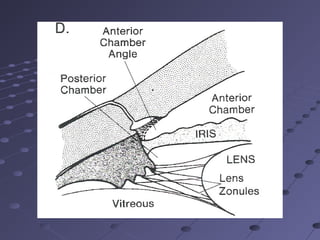
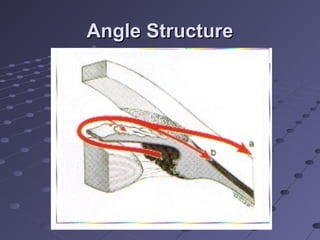
Angle StructureAngle Structure
Open Angle GlaucomaOpen Angle Glaucoma
PrimaryPrimary
Risk factors :Risk factors : Age > 60Age > 60
Race – negro, darkRace – negro, dark
Family history – siblings 4xFamily history – siblings 4x
- parents 2x- parents 2x
Ocular ds – myopia, Retinitis PigmentosaOcular ds – myopia, Retinitis Pigmentosa
Cardiovascular ds, DM, SAS, migraine ?Cardiovascular ds, DM, SAS, migraine ?
SecondarySecondary
a.a. Pretrabecular – neovascular/inflammatory membranePretrabecular – neovascular/inflammatory membrane
b.b. Trabecular- RBC, pseudoexfoliation, pigmentTrabecular- RBC, pseudoexfoliation, pigment
c.c. Post Trabecular- TED, Carotid-cavernous fistulaPost Trabecular- TED, Carotid-cavernous fistula
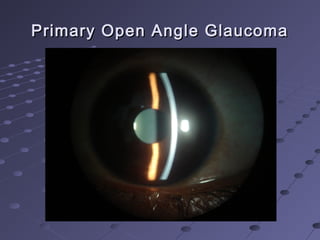
Primary Open Angle GlaucomaPrimary Open Angle Glaucoma
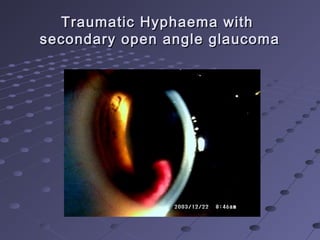
Traumatic Hyphaema withTraumatic Hyphaema with
secondary open angle glaucomasecondary open angle glaucoma
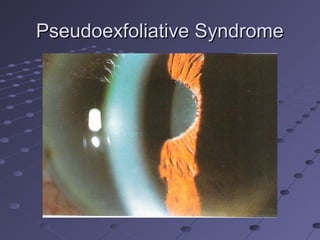
Pseudoexfoliative SyndromePseudoexfoliative Syndrome
Open Angle GlaucomaOpen Angle Glaucoma
Clinical features:Clinical features:
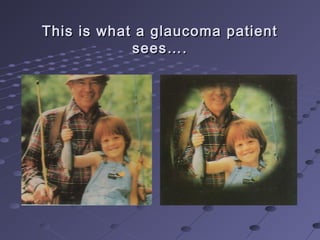
- ‘silent thief of sight’- ‘silent thief of sight’
- Painless gradual loss of vision; loss of- Painless gradual loss of vision; loss of
visual field follows by impairment of visualvisual field follows by impairment of visual
acuity.acuity.
- Intraocular pressure (IOP) rise gradually,- Intraocular pressure (IOP) rise gradually,
usually asymptomatic, till significant visualusually asymptomatic, till significant visual
impairment occurs.impairment occurs.
This is what a glaucoma patientThis is what a glaucoma patient
sees….sees….
ExaminationExamination
1.1. Visual acuityVisual acuity
2.2. Pupil – afferent pupillary defectPupil – afferent pupillary defect
3.3. Intra-ocular Pressure (IOP)Intra-ocular Pressure (IOP)
- IOP > 21 mmHg- IOP > 21 mmHg
- IOP asymmetry > 3 mmHg- IOP asymmetry > 3 mmHg
4.4. Optic nerve head & retinal nerve fibre layerOptic nerve head & retinal nerve fibre layer
assessmentassessment
- vertical cup-disc ratio (CDR) > 0.7- vertical cup-disc ratio (CDR) > 0.7
- Asymmetry of CDR > 0.2- Asymmetry of CDR > 0.2
- thinning & notching of neuroretinal rim,- thinning & notching of neuroretinal rim,
nasalization & bayonetting of retinal vessels..nasalization & bayonetting of retinal vessels..
(Normal NRR follow ‘ISNT rule’).(Normal NRR follow ‘ISNT rule’).
- Laminar dots sign- Laminar dots sign
- optic disc haemorrhage- optic disc haemorrhage
5. Evaluation of the angle5. Evaluation of the angle
GonioscopyGonioscopy
- open or close ?- open or close ?
- to exclude secondary cause of glaucoma- to exclude secondary cause of glaucoma
Angle StructureAngle Structure
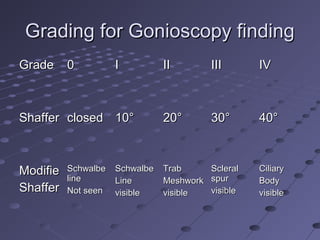
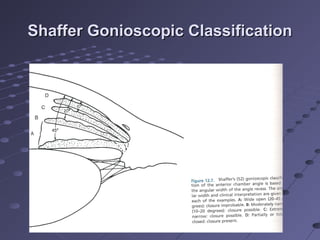
Grading for Gonioscopy findingGrading for Gonioscopy finding
GradeGrade 00 II IIII IIIIII IVIV
ShafferShaffer closedclosed 1010°° 2020°° 3030°° 4040°°
ModifieModifie
ShafferShaffer
SchwalbeSchwalbe
lineline
Not seenNot seen
SchwalbeSchwalbe
LineLine
visiblevisible
TrabTrab
MeshworkMeshwork
visiblevisible
ScleralScleral
spurspur
visiblevisible
CiliaryCiliary
BodyBody
visiblevisible
Shaffer Gonioscopic ClassificationShaffer Gonioscopic Classification
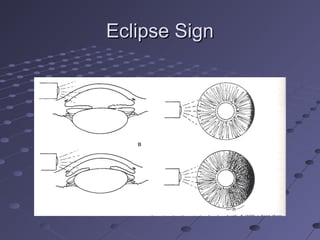
Eclipse SignEclipse Sign
6.6. Visual Field TestVisual Field Test
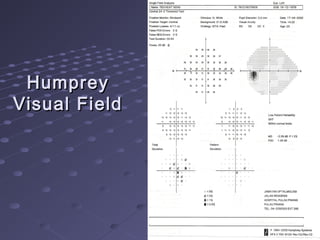
- Humphrey visual field is gold standard- Humphrey visual field is gold standard
- classical VF defects are- classical VF defects are
:: paracentral scotomaparacentral scotoma
nasal stepnasal step
Arcuate scotomaArcuate scotoma
Temporal wedgeTemporal wedge
HumpreyHumprey
Visual FieldVisual Field
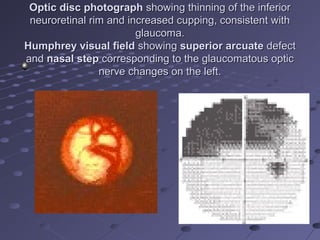
Optic disc photographOptic disc photograph showing thinning of the inferiorshowing thinning of the inferior
neuroretinal rim and increased cupping, consistent withneuroretinal rim and increased cupping, consistent with
glaucoma.glaucoma.
Humphrey visual fieldHumphrey visual field showingshowing superior arcuatesuperior arcuate defectdefect
andand nasal stepnasal step corresponding to the glaucomatous opticcorresponding to the glaucomatous optic
nerve changes on the left.nerve changes on the left.
Management:Management:
MedicalMedical
topical anti-glaucomatopical anti-glaucoma
- B-blocker eg Timolol, Betoptic- B-blocker eg Timolol, Betoptic
- prostaglandin analog- prostaglandin analog
- carbonic anhydrace inhibitor- carbonic anhydrace inhibitor
-- αα agonistagonist
Laser TreatmentLaser Treatment
- Argon laser trabeculoplasty /Selective LT- Argon laser trabeculoplasty /Selective LT
SurgicalSurgical
- Trabeculectomy/augmented trabeculectomy- Trabeculectomy/augmented trabeculectomy
- Shunt/valve surgery- Shunt/valve surgery
ConservativeConservative
- asymptomatic poor visual prognosis- asymptomatic poor visual prognosis
Indications for surgery:Indications for surgery:
1.1. Failed medical therapyFailed medical therapy
2.2. Disease progression despite maximunDisease progression despite maximun
medical therapymedical therapy
3.3. Anticipated fast progressionAnticipated fast progression
4.4. Combined cataract & trabeculectomyCombined cataract & trabeculectomy
surgerysurgery
Primary Angle Closure GlaucomaPrimary Angle Closure Glaucoma
Risk Factors:Risk Factors:
-- age, average 60 y-oldage, average 60 y-old
- female more common 4:1- female more common 4:1
- race: more common in SEA, Chinese,- race: more common in SEA, Chinese,
Eskimos.Eskimos.
- Family: 1- Family: 1stst
degree relatives increased risk .degree relatives increased risk .
Anatomical predisposing factorsAnatomical predisposing factors
1.1. Relatively anterior location of iris-lensRelatively anterior location of iris-lens
diaphragm.diaphragm.
2.2. Shallow anterior chamberShallow anterior chamber
3.3. Narrow entrance to the chamber angleNarrow entrance to the chamber angle
Eyes with PACGEyes with PACG havehave
-corneal diameter 0.25mm smaller than normal-corneal diameter 0.25mm smaller than normal
eyeseyes
- shallower anterior chamber (1.8mm)- shallower anterior chamber (1.8mm)
- hypermetropic eyes- hypermetropic eyes
Secondary- Pupillary Block GlaucomaSecondary- Pupillary Block Glaucoma
Inflammatory with occlusio or seclusioInflammatory with occlusio or seclusio
pupillaepupillae
PhacomorphicPhacomorphic
Vitreous blocVitreous bloc
Silicone oilSilicone oil
Secondary-NonPupillary BlockSecondary-NonPupillary Block
GlaucomaGlaucoma
NeovascularNeovascular
Iridocorneal endothelial syndromIridocorneal endothelial syndrom
Ciliary tumour, iris cystCiliary tumour, iris cyst
Suprachoroidal haemorrhageSuprachoroidal haemorrhage
Iatrogenic- tight scleral buckling, post PRPIatrogenic- tight scleral buckling, post PRP
Clinical Features:Clinical Features:
Rapidly progressive blurring of visionRapidly progressive blurring of vision
Periocular pain and congestionPeriocular pain and congestion
Nausea and vomiting in severe cases.Nausea and vomiting in severe cases.
Slit-lamp exam:Slit-lamp exam:
- ciliary flush/circumcornea injection- ciliary flush/circumcornea injection
- high IOP (50 -100mmHg)- high IOP (50 -100mmHg)
- cornea oedema w epithelial cysts- cornea oedema w epithelial cysts
- shallow anterior chamber.- shallow anterior chamber.
Acute Management ofAcute Management of
Angle Closure GlaucomaAngle Closure Glaucoma
To lower the IOP fastTo lower the IOP fast
- IV Diamox 500mg /IV Mannitol- IV Diamox 500mg /IV Mannitol
- Topical antiglaucoma- Topical antiglaucoma > pilocarpine 2%> pilocarpine 2%
> timolol 0.5%> timolol 0.5%
> prostaglandin analog> prostaglandin analog
Definitive treatmentDefinitive treatment
- laser peripheral iridectomy/ surgical- laser peripheral iridectomy/ surgical
Further managementFurther management
ToTo control IOPcontrol IOP toto stop disease progressionstop disease progression
- IOP, optic nerve changes, visual field- IOP, optic nerve changes, visual field
MedicalMedical
-- ββ blocker, prostaglandin analog carbonicblocker, prostaglandin analog carbonic
anhydrace inhibitor,anhydrace inhibitor, αα agonistagonist
SurgicalSurgical
- Trabeculectomy- Trabeculectomy
- Shunt/valve surgery- Shunt/valve surgery
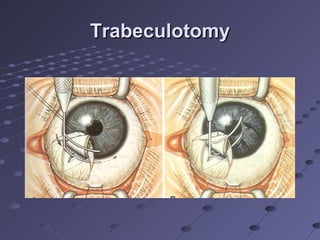
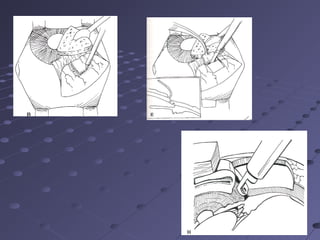
TrabeculotomyTrabeculotomy
Aquoues OutflowAquoues Outflow
Congenital GlaucomaCongenital Glaucoma
PrimaryPrimary
SecondarySecondary
- Anterior segment dysgenesis- Anterior segment dysgenesis
- Ocular ds- Ocular ds
- Phakomatoses eg. Neurofibromatosis- Phakomatoses eg. Neurofibromatosis
- Metabolic ds eg. Lowe’s, Homocysteinuria- Metabolic ds eg. Lowe’s, Homocysteinuria
- Congenital rubella- Congenital rubella
- chromosomal abn eg. Down’s- chromosomal abn eg. Down’s
- Ocular tumour- Ocular tumour
- inflammatory eg. Seronegative arthritis- inflammatory eg. Seronegative arthritis
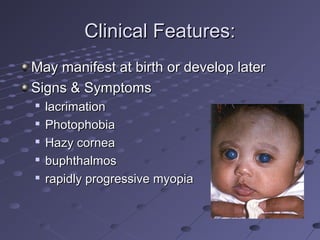
Clinical Features:Clinical Features:
May manifest at birth or develop laterMay manifest at birth or develop later
Signs & SymptomsSigns & Symptoms

lacrimationlacrimation

PhotophobiaPhotophobia

Hazy corneaHazy cornea

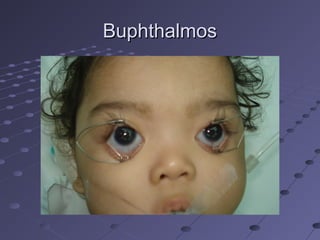
buphthalmosbuphthalmos

rapidly progressive myopiarapidly progressive myopia
BuphthalmosBuphthalmos
Examination under anaesthesiaExamination under anaesthesia
Intraocular pressureIntraocular pressure
Anterior segment examinationAnterior segment examination
- cornea opacity, Haab’s striae- cornea opacity, Haab’s striae
- anterior segment dysgenesis- anterior segment dysgenesis
GonioscopyGonioscopy
- Thicken trabecular meshwork, Barkhan’s- Thicken trabecular meshwork, Barkhan’s
membranemembrane
Fundus examinationFundus examination
- optic cup-disc ratio- optic cup-disc ratio
Management of Congenital GlaucomaManagement of Congenital Glaucoma
Congenital glaucoma is a surgical disease!Congenital glaucoma is a surgical disease!
SurgerySurgery

goniotomygoniotomy

trabeculotomytrabeculotomy

trabeculectomytrabeculectomy
MedicalMedical

topical eye drops ie.topical eye drops ie. ΒΒ-blocker, carbonic anhydrace-blocker, carbonic anhydrace
inhibitor, prostaglandin analoginhibitor, prostaglandin analog

Alfa-2 agonist contraindicated due to sedative effectAlfa-2 agonist contraindicated due to sedative effect
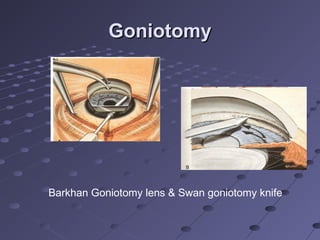
GoniotomyGoniotomy
Barkhan Goniotomy lens & Swan goniotomy knife
Thank YouThank You

Glaucoma

  • 1.
    GlaucomaGlaucoma Dr Lee MingYuehDr Lee Ming Yueh Ophthalmology UnitOphthalmology Unit Penang HospitalPenang Hospital
  • 2.
    Glaucoma is asight threatening diseaseGlaucoma is a sight threatening disease which can cause irreversible visual losswhich can cause irreversible visual loss Baltimore Eye Survey:Baltimore Eye Survey: -- by the year 2000by the year 2000 > 66.8 million primary glaucoma> 66.8 million primary glaucoma > 6.7 million bilateral blindness> 6.7 million bilateral blindness
  • 3.
    DefinitionDefinition A spectrum ofdisease characterized byA spectrum of disease characterized by - progressive optic neuropathy- progressive optic neuropathy - visual field loss- visual field loss ** IOP is an important risk factor.IOP is an important risk factor.
  • 4.
  • 5.
  • 6.
  • 7.
    Classification:Classification: Open Angle GlaucomaOpenAngle Glaucoma Close Angle GlaucomaClose Angle Glaucoma Congenital GlaucomaCongenital Glaucoma
  • 10.
    Trabecular meshwork actslike a sieve…Trabecular meshwork acts like a sieve…
  • 11.
  • 12.
    Open Angle GlaucomaOpenAngle Glaucoma PrimaryPrimary Risk factors :Risk factors : Age > 60Age > 60 Race – negro, darkRace – negro, dark Family history – siblings 4xFamily history – siblings 4x - parents 2x- parents 2x Ocular ds – myopia, Retinitis PigmentosaOcular ds – myopia, Retinitis Pigmentosa Cardiovascular ds, DM, SAS, migraine ?Cardiovascular ds, DM, SAS, migraine ? SecondarySecondary a.a. Pretrabecular – neovascular/inflammatory membranePretrabecular – neovascular/inflammatory membrane b.b. Trabecular- RBC, pseudoexfoliation, pigmentTrabecular- RBC, pseudoexfoliation, pigment c.c. Post Trabecular- TED, Carotid-cavernous fistulaPost Trabecular- TED, Carotid-cavernous fistula
  • 13.
    Primary Open AngleGlaucomaPrimary Open Angle Glaucoma
  • 14.
    Traumatic Hyphaema withTraumaticHyphaema with secondary open angle glaucomasecondary open angle glaucoma
  • 15.
  • 16.
    Open Angle GlaucomaOpenAngle Glaucoma Clinical features:Clinical features: - ‘silent thief of sight’- ‘silent thief of sight’ - Painless gradual loss of vision; loss of- Painless gradual loss of vision; loss of visual field follows by impairment of visualvisual field follows by impairment of visual acuity.acuity. - Intraocular pressure (IOP) rise gradually,- Intraocular pressure (IOP) rise gradually, usually asymptomatic, till significant visualusually asymptomatic, till significant visual impairment occurs.impairment occurs.
  • 17.
    This is whata glaucoma patientThis is what a glaucoma patient sees….sees….
  • 18.
    ExaminationExamination 1.1. Visual acuityVisualacuity 2.2. Pupil – afferent pupillary defectPupil – afferent pupillary defect 3.3. Intra-ocular Pressure (IOP)Intra-ocular Pressure (IOP) - IOP > 21 mmHg- IOP > 21 mmHg - IOP asymmetry > 3 mmHg- IOP asymmetry > 3 mmHg
  • 19.
    4.4. Optic nervehead & retinal nerve fibre layerOptic nerve head & retinal nerve fibre layer assessmentassessment - vertical cup-disc ratio (CDR) > 0.7- vertical cup-disc ratio (CDR) > 0.7 - Asymmetry of CDR > 0.2- Asymmetry of CDR > 0.2 - thinning & notching of neuroretinal rim,- thinning & notching of neuroretinal rim, nasalization & bayonetting of retinal vessels..nasalization & bayonetting of retinal vessels.. (Normal NRR follow ‘ISNT rule’).(Normal NRR follow ‘ISNT rule’). - Laminar dots sign- Laminar dots sign - optic disc haemorrhage- optic disc haemorrhage
  • 20.
    5. Evaluation ofthe angle5. Evaluation of the angle GonioscopyGonioscopy - open or close ?- open or close ? - to exclude secondary cause of glaucoma- to exclude secondary cause of glaucoma
  • 21.
  • 22.
    Grading for GonioscopyfindingGrading for Gonioscopy finding GradeGrade 00 II IIII IIIIII IVIV ShafferShaffer closedclosed 1010°° 2020°° 3030°° 4040°° ModifieModifie ShafferShaffer SchwalbeSchwalbe lineline Not seenNot seen SchwalbeSchwalbe LineLine visiblevisible TrabTrab MeshworkMeshwork visiblevisible ScleralScleral spurspur visiblevisible CiliaryCiliary BodyBody visiblevisible
  • 23.
  • 24.
  • 25.
    6.6. Visual FieldTestVisual Field Test - Humphrey visual field is gold standard- Humphrey visual field is gold standard - classical VF defects are- classical VF defects are :: paracentral scotomaparacentral scotoma nasal stepnasal step Arcuate scotomaArcuate scotoma Temporal wedgeTemporal wedge
  • 26.
  • 27.
    Optic disc photographOpticdisc photograph showing thinning of the inferiorshowing thinning of the inferior neuroretinal rim and increased cupping, consistent withneuroretinal rim and increased cupping, consistent with glaucoma.glaucoma. Humphrey visual fieldHumphrey visual field showingshowing superior arcuatesuperior arcuate defectdefect andand nasal stepnasal step corresponding to the glaucomatous opticcorresponding to the glaucomatous optic nerve changes on the left.nerve changes on the left.
  • 28.
    Management:Management: MedicalMedical topical anti-glaucomatopical anti-glaucoma -B-blocker eg Timolol, Betoptic- B-blocker eg Timolol, Betoptic - prostaglandin analog- prostaglandin analog - carbonic anhydrace inhibitor- carbonic anhydrace inhibitor -- αα agonistagonist Laser TreatmentLaser Treatment - Argon laser trabeculoplasty /Selective LT- Argon laser trabeculoplasty /Selective LT SurgicalSurgical - Trabeculectomy/augmented trabeculectomy- Trabeculectomy/augmented trabeculectomy - Shunt/valve surgery- Shunt/valve surgery ConservativeConservative - asymptomatic poor visual prognosis- asymptomatic poor visual prognosis
  • 29.
    Indications for surgery:Indicationsfor surgery: 1.1. Failed medical therapyFailed medical therapy 2.2. Disease progression despite maximunDisease progression despite maximun medical therapymedical therapy 3.3. Anticipated fast progressionAnticipated fast progression 4.4. Combined cataract & trabeculectomyCombined cataract & trabeculectomy surgerysurgery
  • 30.
    Primary Angle ClosureGlaucomaPrimary Angle Closure Glaucoma Risk Factors:Risk Factors: -- age, average 60 y-oldage, average 60 y-old - female more common 4:1- female more common 4:1 - race: more common in SEA, Chinese,- race: more common in SEA, Chinese, Eskimos.Eskimos. - Family: 1- Family: 1stst degree relatives increased risk .degree relatives increased risk .
  • 31.
    Anatomical predisposing factorsAnatomicalpredisposing factors 1.1. Relatively anterior location of iris-lensRelatively anterior location of iris-lens diaphragm.diaphragm. 2.2. Shallow anterior chamberShallow anterior chamber 3.3. Narrow entrance to the chamber angleNarrow entrance to the chamber angle Eyes with PACGEyes with PACG havehave -corneal diameter 0.25mm smaller than normal-corneal diameter 0.25mm smaller than normal eyeseyes - shallower anterior chamber (1.8mm)- shallower anterior chamber (1.8mm) - hypermetropic eyes- hypermetropic eyes
  • 32.
    Secondary- Pupillary BlockGlaucomaSecondary- Pupillary Block Glaucoma Inflammatory with occlusio or seclusioInflammatory with occlusio or seclusio pupillaepupillae PhacomorphicPhacomorphic Vitreous blocVitreous bloc Silicone oilSilicone oil
  • 33.
    Secondary-NonPupillary BlockSecondary-NonPupillary Block GlaucomaGlaucoma NeovascularNeovascular Iridocornealendothelial syndromIridocorneal endothelial syndrom Ciliary tumour, iris cystCiliary tumour, iris cyst Suprachoroidal haemorrhageSuprachoroidal haemorrhage Iatrogenic- tight scleral buckling, post PRPIatrogenic- tight scleral buckling, post PRP
  • 34.
    Clinical Features:Clinical Features: Rapidlyprogressive blurring of visionRapidly progressive blurring of vision Periocular pain and congestionPeriocular pain and congestion Nausea and vomiting in severe cases.Nausea and vomiting in severe cases. Slit-lamp exam:Slit-lamp exam: - ciliary flush/circumcornea injection- ciliary flush/circumcornea injection - high IOP (50 -100mmHg)- high IOP (50 -100mmHg) - cornea oedema w epithelial cysts- cornea oedema w epithelial cysts - shallow anterior chamber.- shallow anterior chamber.
  • 35.
    Acute Management ofAcuteManagement of Angle Closure GlaucomaAngle Closure Glaucoma To lower the IOP fastTo lower the IOP fast - IV Diamox 500mg /IV Mannitol- IV Diamox 500mg /IV Mannitol - Topical antiglaucoma- Topical antiglaucoma > pilocarpine 2%> pilocarpine 2% > timolol 0.5%> timolol 0.5% > prostaglandin analog> prostaglandin analog Definitive treatmentDefinitive treatment - laser peripheral iridectomy/ surgical- laser peripheral iridectomy/ surgical
  • 36.
    Further managementFurther management ToTocontrol IOPcontrol IOP toto stop disease progressionstop disease progression - IOP, optic nerve changes, visual field- IOP, optic nerve changes, visual field MedicalMedical -- ββ blocker, prostaglandin analog carbonicblocker, prostaglandin analog carbonic anhydrace inhibitor,anhydrace inhibitor, αα agonistagonist SurgicalSurgical - Trabeculectomy- Trabeculectomy - Shunt/valve surgery- Shunt/valve surgery
  • 37.
  • 39.
  • 40.
  • 41.
    Congenital GlaucomaCongenital Glaucoma PrimaryPrimary SecondarySecondary -Anterior segment dysgenesis- Anterior segment dysgenesis - Ocular ds- Ocular ds - Phakomatoses eg. Neurofibromatosis- Phakomatoses eg. Neurofibromatosis - Metabolic ds eg. Lowe’s, Homocysteinuria- Metabolic ds eg. Lowe’s, Homocysteinuria - Congenital rubella- Congenital rubella - chromosomal abn eg. Down’s- chromosomal abn eg. Down’s - Ocular tumour- Ocular tumour - inflammatory eg. Seronegative arthritis- inflammatory eg. Seronegative arthritis
  • 42.
    Clinical Features:Clinical Features: Maymanifest at birth or develop laterMay manifest at birth or develop later Signs & SymptomsSigns & Symptoms  lacrimationlacrimation  PhotophobiaPhotophobia  Hazy corneaHazy cornea  buphthalmosbuphthalmos  rapidly progressive myopiarapidly progressive myopia
  • 43.
  • 44.
    Examination under anaesthesiaExaminationunder anaesthesia Intraocular pressureIntraocular pressure Anterior segment examinationAnterior segment examination - cornea opacity, Haab’s striae- cornea opacity, Haab’s striae - anterior segment dysgenesis- anterior segment dysgenesis GonioscopyGonioscopy - Thicken trabecular meshwork, Barkhan’s- Thicken trabecular meshwork, Barkhan’s membranemembrane Fundus examinationFundus examination - optic cup-disc ratio- optic cup-disc ratio
  • 45.
    Management of CongenitalGlaucomaManagement of Congenital Glaucoma Congenital glaucoma is a surgical disease!Congenital glaucoma is a surgical disease! SurgerySurgery  goniotomygoniotomy  trabeculotomytrabeculotomy  trabeculectomytrabeculectomy MedicalMedical  topical eye drops ie.topical eye drops ie. ΒΒ-blocker, carbonic anhydrace-blocker, carbonic anhydrace inhibitor, prostaglandin analoginhibitor, prostaglandin analog  Alfa-2 agonist contraindicated due to sedative effectAlfa-2 agonist contraindicated due to sedative effect
  • 46.
  • 47.