
Secondary
Glaucoma
Subtitle
By
Dr. Amr Mounir
Lecturer of Ophthalmology
Sohag University
Background
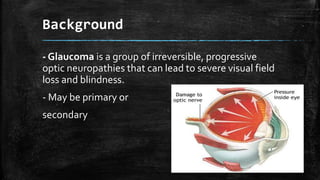
- Glaucoma is a group of irreversible, progressive
optic neuropathies that can lead to severe visual field
loss and blindness.
- May be primary or
secondary
Background
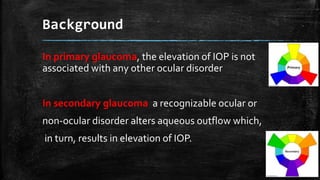
In primary glaucoma, the elevation of IOP is not
associated with any other ocular disorder
In secondary glaucoma a recognizable ocular or
non-ocular disorder alters aqueous outflow which,
in turn, results in elevation of IOP.
Secondary
glaucoma
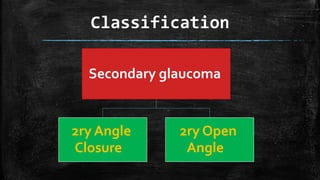
Classification
Secondary glaucoma
2ry Angle
Closure
2ry Open
Angle
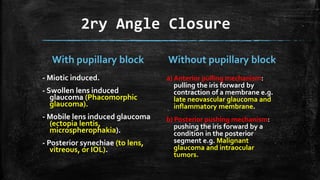
2ry Angle Closure
With pupillary block
- Miotic induced.
- Swollen lens induced
glaucoma (Phacomorphic
glaucoma).
- Mobile lens induced glaucoma
(ectopia lentis,
microspherophakia).
- Posterior synechiae (to lens,
vitreous, or IOL).
Without pupillary block
a) Anterior pulling mechanism:
pulling the iris forward by
contraction of a membrane e.g.
late neovascular glaucoma and
inflammatory membrane.
b) Posterior pushing mechanism:
pushing the iris forward by a
condition in the posterior
segment e.g. Malignant
glaucoma and intraocular
tumors.
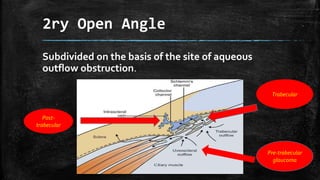
2ry Open Angle
Subdivided on the basis of the site of aqueous
outflow obstruction.
Pre-trabecular
glaucoma
Trabecular
Post-
trabecular
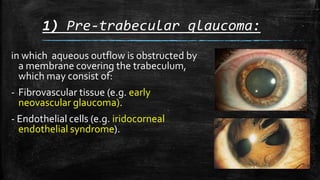
1) Pre-trabecular glaucoma:
in which aqueous outflow is obstructed by
a membrane covering the trabeculum,
which may consist of:
- Fibrovascular tissue (e.g. early
neovascular glaucoma).
- Endothelial cells (e.g. iridocorneal
endothelial syndrome).
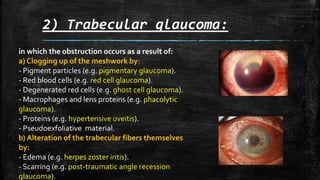
2) Trabecular glaucoma:
in which the obstruction occurs as a result of:
a) Clogging up of the meshwork by:
- Pigment particles (e.g. pigmentary glaucoma).
- Red blood cells (e.g. red cell glaucoma).
- Degenerated red cells (e.g. ghost cell glaucoma).
- Macrophages and lens proteins (e.g. phacolytic
glaucoma).
- Proteins (e.g. hypertensive uveitis).
- Pseudoexfoliative material.
b) Alteration of the trabecular fibers themselves
by:
- Edema (e.g. herpes zoster iritis).
- Scarring (e.g. post-traumatic angle recession
glaucoma).
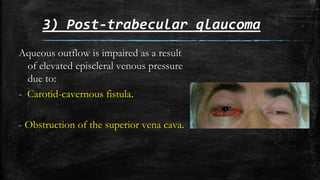
3) Post-trabecular glaucoma
Aqueous outflow is impaired as a result
of elevated episcleral venous pressure
due to:
- Carotid-cavernous fistula.
- Obstruction of the superior vena cava.
Important types
of
Secondary
Glaucoma
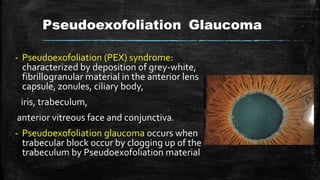
Pseudoexofoliation Glaucoma
- Pseudoexofoliation (PEX) syndrome:
characterized by deposition of grey-white,
fibrillogranular material in the anterior lens
capsule, zonules, ciliary body,
iris, trabeculum,
anterior vitreous face and conjunctiva.
- Pseudoexofoliation glaucoma occurs when
trabecular block occur by clogging up of the
trabeculum by Pseudoexofoliation material
Pseudoexofoliation Glaucoma
Clinical picture:
1) Cornea: PEX materials on the posterior
surface.
2) Iris: Atrophy – PEX material.
3) Lens: PEX materials forming central disc and
peripheral band – cataract – subluxation.
4) Gonioscopy:Trabecular hyperpigmentation
and PEX materials.
Treatment: as POAG.
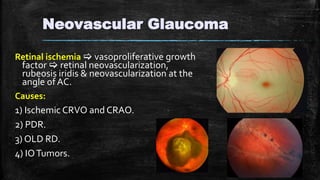
Neovascular Glaucoma
Retinal ischemia  vasoproliferative growth
factor  retinal neovascularization,
rubeosis iridis & neovascularization at the
angle of AC.
Causes:
1) Ischemic CRVO and CRAO.
2) PDR.
3) OLD RD.
4) IOTumors.
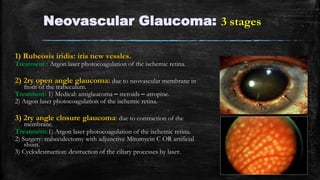
Neovascular Glaucoma: 3 stages
1) Rubeosis iridis: iris new vessles.
Treatment : Argon laser photocoagulation of the ischemic retina.
2) 2ry open angle glaucoma: due to neovascular membrane in
front of the trabeculum.
Treatment: 1) Medical: antiglaucoma – steroids – atropine.
2) Argon laser photocoagulation of the ischemic retina.
3) 2ry angle closure glaucoma: due to contraction of the
membrane.
Treatment:1) Argon laser photocoagulation of the ischemic retina.
2) Surgery: trabeculectomy with adjunctive Mitomycin C OR artificial
shunt.
3) Cyclodestruction: destruction of the ciliary processes by laser.
Lens induced
Glaucoma
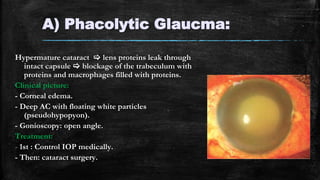
A) Phacolytic Glaucma:
Hypermature cataract  lens proteins leak through
intact capsule  blockage of the trabeculum with
proteins and macrophages filled with proteins.
Clinical picture:
- Corneal edema.
- Deep AC with floating white particles
(pseudohypopyon).
- Gonioscopy: open angle.
Treatment:
- 1st : Control IOP medically.
- Then: cataract surgery.
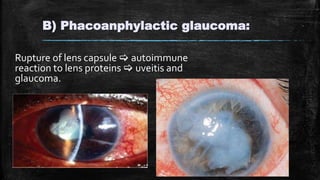
B) Phacoanphylactic glaucoma:
Rupture of lens capsule  autoimmune
reaction to lens proteins  uveitis and
glaucoma.
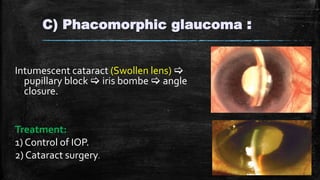
C) Phacomorphic glaucoma :
Intumescent cataract (Swollen lens) 
pupillary block  iris bombe  angle
closure.
Treatment:
1) Control of IOP.
2) Cataract surgery.
Thank You
Hussein Bicar (1913-2002)

Secondary glaucoma

  • 1.
  • 2.
    Background - Glaucoma isa group of irreversible, progressive optic neuropathies that can lead to severe visual field loss and blindness. - May be primary or secondary
  • 3.
    Background In primary glaucoma,the elevation of IOP is not associated with any other ocular disorder In secondary glaucoma a recognizable ocular or non-ocular disorder alters aqueous outflow which, in turn, results in elevation of IOP.
  • 4.
  • 5.
  • 6.
    2ry Angle Closure Withpupillary block - Miotic induced. - Swollen lens induced glaucoma (Phacomorphic glaucoma). - Mobile lens induced glaucoma (ectopia lentis, microspherophakia). - Posterior synechiae (to lens, vitreous, or IOL). Without pupillary block a) Anterior pulling mechanism: pulling the iris forward by contraction of a membrane e.g. late neovascular glaucoma and inflammatory membrane. b) Posterior pushing mechanism: pushing the iris forward by a condition in the posterior segment e.g. Malignant glaucoma and intraocular tumors.
  • 7.
    2ry Open Angle Subdividedon the basis of the site of aqueous outflow obstruction. Pre-trabecular glaucoma Trabecular Post- trabecular
  • 8.
    1) Pre-trabecular glaucoma: inwhich aqueous outflow is obstructed by a membrane covering the trabeculum, which may consist of: - Fibrovascular tissue (e.g. early neovascular glaucoma). - Endothelial cells (e.g. iridocorneal endothelial syndrome).
  • 9.
    2) Trabecular glaucoma: inwhich the obstruction occurs as a result of: a) Clogging up of the meshwork by: - Pigment particles (e.g. pigmentary glaucoma). - Red blood cells (e.g. red cell glaucoma). - Degenerated red cells (e.g. ghost cell glaucoma). - Macrophages and lens proteins (e.g. phacolytic glaucoma). - Proteins (e.g. hypertensive uveitis). - Pseudoexfoliative material. b) Alteration of the trabecular fibers themselves by: - Edema (e.g. herpes zoster iritis). - Scarring (e.g. post-traumatic angle recession glaucoma).
  • 10.
    3) Post-trabecular glaucoma Aqueousoutflow is impaired as a result of elevated episcleral venous pressure due to: - Carotid-cavernous fistula. - Obstruction of the superior vena cava.
  • 11.
  • 12.
    Pseudoexofoliation Glaucoma - Pseudoexofoliation(PEX) syndrome: characterized by deposition of grey-white, fibrillogranular material in the anterior lens capsule, zonules, ciliary body, iris, trabeculum, anterior vitreous face and conjunctiva. - Pseudoexofoliation glaucoma occurs when trabecular block occur by clogging up of the trabeculum by Pseudoexofoliation material
  • 13.
    Pseudoexofoliation Glaucoma Clinical picture: 1)Cornea: PEX materials on the posterior surface. 2) Iris: Atrophy – PEX material. 3) Lens: PEX materials forming central disc and peripheral band – cataract – subluxation. 4) Gonioscopy:Trabecular hyperpigmentation and PEX materials. Treatment: as POAG.
  • 14.
    Neovascular Glaucoma Retinal ischemia vasoproliferative growth factor  retinal neovascularization, rubeosis iridis & neovascularization at the angle of AC. Causes: 1) Ischemic CRVO and CRAO. 2) PDR. 3) OLD RD. 4) IOTumors.
  • 15.
    Neovascular Glaucoma: 3stages 1) Rubeosis iridis: iris new vessles. Treatment : Argon laser photocoagulation of the ischemic retina. 2) 2ry open angle glaucoma: due to neovascular membrane in front of the trabeculum. Treatment: 1) Medical: antiglaucoma – steroids – atropine. 2) Argon laser photocoagulation of the ischemic retina. 3) 2ry angle closure glaucoma: due to contraction of the membrane. Treatment:1) Argon laser photocoagulation of the ischemic retina. 2) Surgery: trabeculectomy with adjunctive Mitomycin C OR artificial shunt. 3) Cyclodestruction: destruction of the ciliary processes by laser.
  • 16.
  • 17.
    A) Phacolytic Glaucma: Hypermaturecataract  lens proteins leak through intact capsule  blockage of the trabeculum with proteins and macrophages filled with proteins. Clinical picture: - Corneal edema. - Deep AC with floating white particles (pseudohypopyon). - Gonioscopy: open angle. Treatment: - 1st : Control IOP medically. - Then: cataract surgery.
  • 18.
    B) Phacoanphylactic glaucoma: Ruptureof lens capsule  autoimmune reaction to lens proteins  uveitis and glaucoma.
  • 19.
    C) Phacomorphic glaucoma: Intumescent cataract (Swollen lens)  pupillary block  iris bombe  angle closure. Treatment: 1) Control of IOP. 2) Cataract surgery.
  • 20.