INTRODUCTION
 Usually with a charecteristics loss of visual function.
 Damage to a optic nerve is irreversible prosses
 Usually caused by raised IOP acting on the nerve head
 Normal IOP is -15-21 mnn of hg
 It is a heterogenous group of diseases in whitch optic nerve
is damage.
 IOP is the most common risk factor for development of
glaucoma
 Vission loss is irreversible
 It is the secound leading causes of BLINDNESS.
 In its early stages it affects peripheral visual field only
but as it advances it affects central vision and results in
loss of visual acuity,
Intraocular pressure is not the only factor
responsible for glaucoma!
 95% of people with elevated IOP will never have the
damage associated with glaucoma.
 One-third of patients with glaucoma do not have
elevated IOP.
 Most of the ocular findings that occur in people
with glaucoma also occur in people without
glaucoma.
EPIDEMIOLOGY
 Globally estimated 8.4 million people who are blind on
the result of glaucoma
 These number are set to increases to 11.2 million by
2020
 It is the secound leading causes of BLINDNESS globally
 The highest prevelance of open angle glaucoma occures
in AFRICA.(WWW.SCIENCEDIRECT.COM)
 Global prevelance of glaucoma -2%of those over the age
of 40 years and 10% of those over 80 years of age
 Glaucoma blindness-
- global 8.0%
-india 12.8%
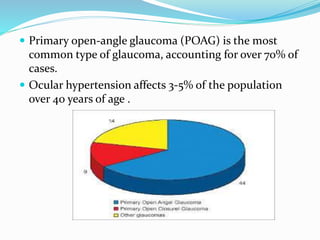
 Primary open-angle glaucoma (POAG) is the most
common type of glaucoma, accounting for over 70% of
cases.
 Ocular hypertension affects 3-5% of the population
over 40 years of age .
from google
Population distribution of IOP
AQUEOUS PRODUCTION AND DRAINAGE
 SECRATION OF AQUEOUS HUMOR:-
cilliary body
 ROUTE OF DRAINAGES-
-TRABECULAR OUTFLOW(90%)
-UVEAL-SCLERAL OUTFLOW(10%)
TRABECULAROUTFLOW:-
CILLIARY BODY
POSTERIOR CHAMBER
ANTERIOR CHAMBER
TRABECULAR MESHWORK
SCLEMNS CANEL
COLLECTOR CHANELS
EPISCLERAL VEIN
UVEOLSCLERALOUTFLOW
CILLIARY BODY
POST. CHAMBER
ANT. CHAMBER
CILLIARY BODY
SUPRA CHOROIDAL SPACE
VENOUS CIRCULATION OF CILLIARY BODY
 (The normal level of IOP is essentially maintained bye the formation and outflow
of the aqueous humour )
CLASSIFICATION of glaucoma
 (A)Congenital/Developmental glaucoma
1)primary congenital glaucoma
(without associated anomalies)
2)developmental glaucoma
(with associated anomalies)
 (B)PRIMARY GLAUCOMA
1)POAG
2)PACG
3)Primary mixed
mechanism glaucoma
(C) SECONDARY GLAUCOMA
Phacomorphic glaucoma
Phacolytic glaucoma
Pigmentary glaucoma
Traumatic glaucoma
Cilliary block glaucoma
Neovascular glaucoma
Glaucoma in aphakia
Absolute glaucoma
• The end stage of glaucoma is referred to as absolute
glaucoma.
• There is no functioning vision, the pupillary reflex is
lost and the eye has a stony appearance.
• The condition is very painful and is treated by
destructive processes.
CONGENITAL/DEVELOPMENTAL
GLAUCOMA
 A rare condition
 Manifest without associated anomalies
Bupthalmhos and cloudy cornea
Congenital Glaucoma
Buphthalmos,
glaucomatous
cupping, and
cloudy cornea
OD
Normal OS
Haa’s bstriae
PATHOGENESIS
 Maldevelopmental of the angle structures
 Impaired aqueous outflow
 Raised IOP
 Damage optic nerve
CLASSIFICATION
I. Primary developmental/congenital glaucoma
II. Developmental glaucoma with associated congenital
ocular anomalies
III. Developmental glaucoma with associated systemic
anomalies
IV. ISOLATED CONGENITAL
GLAUCOMA:-
ISOLATED CONGENITAL GLAUCOMA
V. INFANTILE CONGENITAL GLAUCOMA:-
-synonymous with congenital glaucoma
-1 months to 3 years
VI. JUVENILE GLAUCOMA:-
-Primary glaucoma occuring latter in
childhood
-3years to 18years
EPIDEMIOLOGY
-1 in 10,000 births
-65% of patients are boys
CLINICALFEATURES
SYMPTOMS:-
-Photophobia
-Lacrimation
-Blepharspasm
-Irritation
-Cloudy cornea
-Red eye
-Poor vission and pain
CLINICALFEATURES
SIGNS:-
Corneal oedema
Corneal enlargement
Haab’s straie
Sclera thin and blue
A.chamber deep
Iridodonesis
Optic disc-variable cupping & atrophy
INVESTIGATION
a) IOP measurement
b) Corneal diameter measurement
c) Slit lamp examination
d) Ophthalmoscopy
e) Gonioscopy
TREATMENT
A. MEDICAL TREATMENT :-
-Not very effective.
-It is a surgical diseases .
-Acetazolamide & beta-blockers use till
surgery is taken
TREATMENT
B.SURGICAL TRATMENT:-
-Goniotomy
-Trabeculectomy
-Filteration surgery
-Glaucoma drainage devices
tr T TRABECULECTOMY
Images of surgical treatment
 GONIOTOMY
POAG
(PRIMARY OPEN ANGLE GLAUCOMA)
 POAG is a commonly disease of a adult onset
 It is a charecterized by
-IOP >21 mm of hg
-open anterior chamber
angle
-optic dics cupping
-optic dics damages
-specific visual field damages
 POAG is a bilateral disease
 IOP is the major risk factor
 Also known as chronic simple glaucoma
 Most prevalence of all glaucoma
 Most common glaucoma
PREDISPOSING&RISKFACTORS
 IOP –most common risk factors
 Age-most case >40 years
 BP-Diastolic pressure <55 mm of hg
 Retinal diseases-CRVO,RD,RP
 Diabetes melitus
 Central corneal thickness
PATHOGENESIS OF RISE IN IOP
 Certain rise of IOP that occures due to decrease of
aqueous outflow.
 Aqueous outflow reduce due to
-thickening of trabecular meshwork
-sclerosis of trabecular meshwork
-narrowing of intertrabecular spaces
-trabecular meshwork stiffening
EPIDEMIOLOGY
 POAG affects about 1 in 100 of general population
 Forms about one third cases of all glaucoma
CLINICALFEATURES
-SYMPTOMS
-Asymptomatic diseases
-Gradual painless loss of vision
-Mild headache
-Visual field defect
-Changes in presbyopic glasses
-Delayed dark adaptation
SIGNS
 Ant.segment signs:-
-normal
-corneal haze
-lazy pupil reflex
 Iop changes:-
-Initial stages IOP normal
-Doing DIURNAL variation test
-In later stages,IOP is permanently raised
-Range of IOP between 30 to 45 mm of hg
ONH evaluation:-
 Early glaucomatouas changes
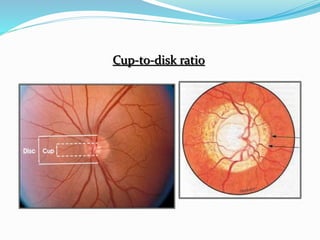
-Large cup
-Asymetry of >0.2 between two eyes
-Cup ratio 0.6 or more
-pallor disc
-vertical oval cup
-splinter haemmorages
 Advavce glaucomatous chamges:-
-Cup size 0.7 to 0.9
-Neuroretinal rim thinning
-Nasal siftting of retinal vessels
-Lamellar dot signs
Visual field deffects:-
 In glaucoma ,visual field defects observed in
BJERRUM’S area ....
-Retinal paracentral scotoma
-Roenn’s nasal steep
-Seidel scotoma
-Arcuate scotoma
INVESTIGATIONOFPOAG
 1)GONIOSCOPY:-
-Wide open angle of ant.chamber
-structure seen ROI,SS,SL,CBB,TM
 TONOMETRY :-
-Tonometry shoul be preferred over
Schitze tonometry
-IOP <21 mm of hg
PROGRESSIVE CUPPING:-
CD=0.3 to 0.4
normal fundus
 CD=0.5 CD=0.5 to 0.7
optic dics margine
NRR
 CD=0.9 CD=1.0
0.9
CD=1.0
Cup-to-disk ratio
MANAGEMENT
 Aim of treatment to prevent impairment of vision
 Require careful & regular periodic supervision by
ophthalmologist
 Theraputic choices:-
-Medical therapy:-
-Parasympathomimetic drugs
-Prostaglandine
-Topical beta blockers
-Carbonic anhydrase inhibitors
• Argon or diode laser trabeculoplasty :-
Action:- outflow by causing shrinkage
of TM
Technique:-40-50 spots on the anterior half of TM
over 180 using a Goniolens
SURGERYFORPOAG
 Fileration surgery
 Trabeculectomy
 Trabeculectomy
PACG
PRIMARY ANGLE CLOSURE GLAUCOMA
 It refers to occlusion of the TM by the peripheral iris
abstructing aqueous outflow
 Narrow angle/acute glaucoma
 Much more rare
 IOP is ries very queckly
 It is caused by a rapid or sudden increase in eye
pressure
CLASSIFICATION
 (1)Primary angle closure suspect:-
-Normal IOP,optic disc & visual field
-No peripheral anterior synechiae
 (2)Primary angle closure:-
-Optic nerve damage from an
episode of severe IOP elevation
-ITC in three or more quadrants
 (3)Primary angle closure glaucoma:-
-Shows three or more quadrents of
ITC with rised IOP.
-Normal disc & field
RISK FACTORS
 Age:- -60 years- pupillary block
 -young non pupillary block
 Gender:-Female > Male
 Family history:-Genetic factors
 Race:-Asians
 Refraction:-Typically hypermetropic
CAUSES
 Angle beteween iris and cornea is closed
 Increase IOP suddenly
 Completely block the canals,which stops fluid flowing
 Some health condition can also cause ACG:-
-Cataract
-Ectopic lens
-Diabetic retinopathy
-Tumors
MECHANISMOF ACG
 1)Relative pupil block:-70% of case
-Iris hase large arc of contact
with anterior surface of lens
 2)Iris bombe formation:-Responsible for few atypical
case
 3)Appositional angle closure:-mechanism along with
pupillary block with iris bombe.
Relative pupilary blok:-
IRIS BOMB
Iris
bombe
CLINICALFEATURES
Symptoms:-
-Rapidly progressive impairement of vision
-Painful eye
-Red eye
-Nausea
-Vomitting
-photophobia
-Haloes
Signs:-
-Reduce visual acuity
-Cornea cloudy,& oedemotous
-Pupil oval,fixed,modaretly dilated
-Eye feels hard on palpation
-Elevated IOP 50-100 mm of Hg
-Aqueous flare & cells
-Optic disc oedema & hyperaema
MANAGEMENT
 1)Medicine:-
-Acetazolamide
-Topical steroids
-Topical beta blockers
 2)Surgical management:-
-Peripheral laser iridotomy
-Peripheral iridotomy
 INITIAL MANAGEMENT :-
-Immediately on attack:
-Pilocarpine
-beta blockers
-Topical corticosteroid
-If patient in pain:-
-Topical ketorolac
-Systemic pain medication
-If patient in vomitting:-
-Intramascular metoclopromide
-If patient in comfortable:-
-Laser iridoctomy in fellow eye
SECONDARYGLAUCOA
 Group of disorder in which the raised IOP is assosiated
with a primary ocular or systemic diseases.
CLASSIFICATION
 (A)Depending on the mechanism of rise in
IOP:-
i)Secondary open angle glaucoma:-
-In which aqueous outflow
may be blocked by
pretrabucular membrane or
trabecular closing.
ii)Secondary angle closure:-
which may be or may not be
assosiated with pupil block
 (B)Depending on the cavsative primary
diseases:-
-Lens induced glaucoma
-Inflamatory glaucoma
-Neuvascular glaucoma
-Cilliary block glaucoma
-Traumatic glaucoma
-Glaucoma in aphakia
-glaucoma with assosiated with intra ocular
haemorrhage
LENSINDUCED(phacogenic)
 Pacomorphic –(due to swollen lens)
 Phacotopic-(anterior lens displacement)
 Phacolytic
 Lens partical glacucoma
 Phacoanaphylactic glaucoma
Figure 1: (a) Traumatic anterior dislocation of lens with pupillary block glaucoma; (b)
lens particle glaucoma; (c) phacomorphic glaucoma; (d) phacolytic
PHACOMORPHICGLAUCOMA
 Causes:-
-Intumesent lens
-ant.subluxation of lens & spherophakia
 Pathogenosis:-
-swollen lens pushes iris forward
 Treatment:-
-Medical:-control of IOP by-
- iv mannitol
-acetazolamide
-topical beta blockers
-LASER iridotomy
PHACOLYTIC GLAOCOMA
 Pathogenesis:-
-T.M is clogged by the lens
proteins,macrophages .
-Deep anterior chamber and aqueous may
contain fine white protein particles.
 Clinical features:-
-Symptoms:-
-pain,nausea,vomitting
-rapidly progressive
impairement of vision
 Signs:-
-Lid oedematous
-Congunctiva-chemosed & congested
-Cilliary vessel congested
-A.C very shallow
-Iris may be discolored
-Optic disc oedematous & hyperaemic
 Management:-
-Medical therapy to lower the IOP
-Extraction of the hypermature
catarctous lens with PCIOL
implantation
Phacolytic glaucoma
NEUVASCULAR GLAUCOMA
 Result due to formation of neuvascular membrane
involving the angle of anterior chamber
 Etiology:-
Neuvascularization of iris following retina
isvhaemia features of –
-PDR
-CRVO
-Sickle-cell retinoparhy
 Clinical Profile:-
- Pre-glaucomotous stage
-Open angle glaucoma stage
-Secondary angle closure glaucoma
 Treatment:-
-Panretinal photocoagulation
-Medical therapy not affective
-Arteficial filtration shunt.
Neuvascular glaucoma
TRAUMATIC GLAUCOMA
 Mechanism:-
-Inflammatory glaucoma due to iridocyclitis
-Due to intra ocular haemorrhage
-Lens-induced glaucoma due to shollen lens
-Epithelial grouth
-Angle recession glaucoma
-Angle-closure glaucoma due to anterior
synechia
Management:-
 Medical therapy with topical 0.5% timolol and oral
acetazolamide and surgical intervention according to
situation.
 Image of traumatic glaucoma:-
GLAUCOMA INVESTIGATION
 Instrument which are use in glaucoma
investigation are:-
-OCT (Disc profile):
-To measure the thickness of RNFL
-VFA:- for visual field test
-Perimetry:-visual field test
-Tonometry:-measure the inner eye pressur
-Opthalmoscopy:-for shape & color of optic nerve
-Gonioscopy:-to see the iridocorneal angler
-Pachymetry:- to measure thickness of cornea
Tonometry
Applanation Schiotz Gonioscopy
THE VISUAL FIELD
Humphrey automated perimetry
PATIENTS
RECORDS
CASE:-01
 PT’S NAME:-Vishwanath thakur DATE:-09/10/2018
 REG NO.:-1819-011510 AGE:-55 year
 OCCUPATION:-farmer SEX:-Male
 ADRESS:-west bengal
 C/O:-RE-Trauma by hand
 FINDING:-
Fundus-RE-Total cup,LE-c/d=0:5
V/A:-RE-6/60p ,LE:-6/24p
IOP:-RE-54,LE:-15
 INVESTIGATION:-
VFA
APLANATION TONOMETRY
INDIRECT OPHTHALMOSCOPY
 REPORTS:-VFA:-RE-Trabeular vision
LE-generalized depression
A.T:-RE-55,LE-14
I.O:-RE-Total cupping,LE:-c/d=0:5
 CONCLUSIONS:-
CASE:-02
 PT’S NAME:- Hiralal manjhi DATE:-12/10/2018
 REG NO.:-1718-017579 AGE:-52y
 OCCUPATION:-bussinessman SEX:-male
 ADRESS:-Purulia,W.B
 C/O:-low vision,headache,
 FINDING:-
Fundus-LE-cupping undialated
V/A:-RE-NOPL ,LE:-6/18P
CORNEA:-RE-Total corneal opacity
 INVESTIGATION:-
VFA
OCT (DISC PROFILE)
APLANATION TONOMETRY
INDIRECT OPHTHALMOSCOPY
 REPORTS:-VFA:-LE-advanced field loss
A.T:-RE-18,LE-27
OCT:-LE significant development seen of
inferior quadrent
(LE-vertical C/D=1.00)
 CONCLUSIONS:-
CASE:-03
 PT’S NAME:- DATE:-
 ID NO.:- AGE:-
 OCCUPATION:- SEX:-
 ADRESS:-
 C/O:-
 FINDING:-
Fundus
V/A:-RE- ,LE:-
 INVESTIGATION:-
VFA
OCT (DISC PROFILE)
APLANATION TONOMETRY
INDIRECT OPHTHALMOSCOPY
 REPORTS:-
 CONCLUSIONS:-
CASE:-04
 PT’S NAME:- DATE:-
 ID NO.:- AGE:-
 OCCUPATION:- SEX:-
 ADRESS:-
 C/O:-
 FINDING:-
Fundus
V/A:-RE- ,LE:-
 INVESTIGATION:-
VFA
OCT (DISC PROFILE)
APLANATION TONOMETRY
INDIRECT OPHTHALMOSCOPY
 REPORTS:-
 CONCLUSIONS:-
CASE:-05
 PT’S NAME:-REENA DEVI DATE:-04/09/2018
 REG NO.:-Reg1819-011281 AGE:-30 years
SEX:-female
 OCCUPATION:-House wife ADRESS:-Ranchi
 C/O:- -painless loss of vision,-Mild headache
-Changes in presbyopic glasses
 FINDING:-
Fudus-Cupping
V/A-RE-6/6P,LE-6/6P
NCT-RE-22,LE-10
• INVESTIGATION:- -VFA
-OCT (DISC PROFILE)
-INDIRECT OPHTHALMOSCOPY
-APLANATION TONOMETRY
 REPORTS:-
VFA:-Normal
OCT:-Vertical C/D=RE-0.71,LE-0.72
I.O:-Cupping
A.T:-RE-23,LE-13 (mm of Hg)
 CONCLUSIONS:-
Glaucoma
Glaucoma
Glaucoma
Glaucoma

Glaucoma

  • 2.
    INTRODUCTION  Usually witha charecteristics loss of visual function.  Damage to a optic nerve is irreversible prosses  Usually caused by raised IOP acting on the nerve head  Normal IOP is -15-21 mnn of hg  It is a heterogenous group of diseases in whitch optic nerve is damage.  IOP is the most common risk factor for development of glaucoma  Vission loss is irreversible  It is the secound leading causes of BLINDNESS.  In its early stages it affects peripheral visual field only but as it advances it affects central vision and results in loss of visual acuity,
  • 3.
    Intraocular pressure isnot the only factor responsible for glaucoma!  95% of people with elevated IOP will never have the damage associated with glaucoma.  One-third of patients with glaucoma do not have elevated IOP.  Most of the ocular findings that occur in people with glaucoma also occur in people without glaucoma.
  • 4.
    EPIDEMIOLOGY  Globally estimated8.4 million people who are blind on the result of glaucoma  These number are set to increases to 11.2 million by 2020  It is the secound leading causes of BLINDNESS globally  The highest prevelance of open angle glaucoma occures in AFRICA.(WWW.SCIENCEDIRECT.COM)  Global prevelance of glaucoma -2%of those over the age of 40 years and 10% of those over 80 years of age  Glaucoma blindness- - global 8.0% -india 12.8%
  • 5.
     Primary open-angleglaucoma (POAG) is the most common type of glaucoma, accounting for over 70% of cases.  Ocular hypertension affects 3-5% of the population over 40 years of age .
  • 6.
  • 7.
  • 8.
    AQUEOUS PRODUCTION ANDDRAINAGE  SECRATION OF AQUEOUS HUMOR:- cilliary body  ROUTE OF DRAINAGES- -TRABECULAR OUTFLOW(90%) -UVEAL-SCLERAL OUTFLOW(10%)
  • 9.
    TRABECULAROUTFLOW:- CILLIARY BODY POSTERIOR CHAMBER ANTERIORCHAMBER TRABECULAR MESHWORK SCLEMNS CANEL COLLECTOR CHANELS EPISCLERAL VEIN
  • 10.
    UVEOLSCLERALOUTFLOW CILLIARY BODY POST. CHAMBER ANT.CHAMBER CILLIARY BODY SUPRA CHOROIDAL SPACE VENOUS CIRCULATION OF CILLIARY BODY  (The normal level of IOP is essentially maintained bye the formation and outflow of the aqueous humour )
  • 11.
    CLASSIFICATION of glaucoma (A)Congenital/Developmental glaucoma 1)primary congenital glaucoma (without associated anomalies) 2)developmental glaucoma (with associated anomalies)
  • 12.
     (B)PRIMARY GLAUCOMA 1)POAG 2)PACG 3)Primarymixed mechanism glaucoma (C) SECONDARY GLAUCOMA Phacomorphic glaucoma Phacolytic glaucoma Pigmentary glaucoma Traumatic glaucoma Cilliary block glaucoma Neovascular glaucoma Glaucoma in aphakia
  • 13.
    Absolute glaucoma • Theend stage of glaucoma is referred to as absolute glaucoma. • There is no functioning vision, the pupillary reflex is lost and the eye has a stony appearance. • The condition is very painful and is treated by destructive processes.
  • 14.
    CONGENITAL/DEVELOPMENTAL GLAUCOMA  A rarecondition  Manifest without associated anomalies Bupthalmhos and cloudy cornea
  • 15.
  • 16.
    PATHOGENESIS  Maldevelopmental ofthe angle structures  Impaired aqueous outflow  Raised IOP  Damage optic nerve
  • 17.
    CLASSIFICATION I. Primary developmental/congenitalglaucoma II. Developmental glaucoma with associated congenital ocular anomalies III. Developmental glaucoma with associated systemic anomalies IV. ISOLATED CONGENITAL GLAUCOMA:- ISOLATED CONGENITAL GLAUCOMA
  • 18.
    V. INFANTILE CONGENITALGLAUCOMA:- -synonymous with congenital glaucoma -1 months to 3 years VI. JUVENILE GLAUCOMA:- -Primary glaucoma occuring latter in childhood -3years to 18years
  • 19.
    EPIDEMIOLOGY -1 in 10,000births -65% of patients are boys
  • 20.
  • 21.
    CLINICALFEATURES SIGNS:- Corneal oedema Corneal enlargement Haab’sstraie Sclera thin and blue A.chamber deep Iridodonesis Optic disc-variable cupping & atrophy
  • 22.
    INVESTIGATION a) IOP measurement b)Corneal diameter measurement c) Slit lamp examination d) Ophthalmoscopy e) Gonioscopy
  • 23.
    TREATMENT A. MEDICAL TREATMENT:- -Not very effective. -It is a surgical diseases . -Acetazolamide & beta-blockers use till surgery is taken
  • 24.
  • 25.
    Images of surgicaltreatment  GONIOTOMY
  • 26.
    POAG (PRIMARY OPEN ANGLEGLAUCOMA)  POAG is a commonly disease of a adult onset  It is a charecterized by -IOP >21 mm of hg -open anterior chamber angle -optic dics cupping -optic dics damages -specific visual field damages
  • 27.
     POAG isa bilateral disease  IOP is the major risk factor  Also known as chronic simple glaucoma  Most prevalence of all glaucoma  Most common glaucoma
  • 28.
    PREDISPOSING&RISKFACTORS  IOP –mostcommon risk factors  Age-most case >40 years  BP-Diastolic pressure <55 mm of hg  Retinal diseases-CRVO,RD,RP  Diabetes melitus  Central corneal thickness
  • 29.
    PATHOGENESIS OF RISEIN IOP  Certain rise of IOP that occures due to decrease of aqueous outflow.  Aqueous outflow reduce due to -thickening of trabecular meshwork -sclerosis of trabecular meshwork -narrowing of intertrabecular spaces -trabecular meshwork stiffening
  • 30.
    EPIDEMIOLOGY  POAG affectsabout 1 in 100 of general population  Forms about one third cases of all glaucoma
  • 31.
    CLINICALFEATURES -SYMPTOMS -Asymptomatic diseases -Gradual painlessloss of vision -Mild headache -Visual field defect -Changes in presbyopic glasses -Delayed dark adaptation
  • 32.
    SIGNS  Ant.segment signs:- -normal -cornealhaze -lazy pupil reflex  Iop changes:- -Initial stages IOP normal -Doing DIURNAL variation test -In later stages,IOP is permanently raised -Range of IOP between 30 to 45 mm of hg
  • 33.
    ONH evaluation:-  Earlyglaucomatouas changes -Large cup -Asymetry of >0.2 between two eyes -Cup ratio 0.6 or more -pallor disc -vertical oval cup -splinter haemmorages  Advavce glaucomatous chamges:- -Cup size 0.7 to 0.9 -Neuroretinal rim thinning -Nasal siftting of retinal vessels -Lamellar dot signs
  • 34.
    Visual field deffects:- In glaucoma ,visual field defects observed in BJERRUM’S area .... -Retinal paracentral scotoma -Roenn’s nasal steep -Seidel scotoma -Arcuate scotoma
  • 35.
    INVESTIGATIONOFPOAG  1)GONIOSCOPY:- -Wide openangle of ant.chamber -structure seen ROI,SS,SL,CBB,TM  TONOMETRY :- -Tonometry shoul be preferred over Schitze tonometry -IOP <21 mm of hg PROGRESSIVE CUPPING:- CD=0.3 to 0.4 normal fundus
  • 36.
     CD=0.5 CD=0.5to 0.7 optic dics margine NRR  CD=0.9 CD=1.0 0.9 CD=1.0
  • 37.
  • 38.
    MANAGEMENT  Aim oftreatment to prevent impairment of vision  Require careful & regular periodic supervision by ophthalmologist  Theraputic choices:- -Medical therapy:- -Parasympathomimetic drugs -Prostaglandine -Topical beta blockers -Carbonic anhydrase inhibitors • Argon or diode laser trabeculoplasty :- Action:- outflow by causing shrinkage of TM Technique:-40-50 spots on the anterior half of TM over 180 using a Goniolens
  • 39.
    SURGERYFORPOAG  Fileration surgery Trabeculectomy  Trabeculectomy
  • 40.
    PACG PRIMARY ANGLE CLOSUREGLAUCOMA  It refers to occlusion of the TM by the peripheral iris abstructing aqueous outflow  Narrow angle/acute glaucoma  Much more rare  IOP is ries very queckly  It is caused by a rapid or sudden increase in eye pressure
  • 41.
    CLASSIFICATION  (1)Primary angleclosure suspect:- -Normal IOP,optic disc & visual field -No peripheral anterior synechiae  (2)Primary angle closure:- -Optic nerve damage from an episode of severe IOP elevation -ITC in three or more quadrants  (3)Primary angle closure glaucoma:- -Shows three or more quadrents of ITC with rised IOP. -Normal disc & field
  • 42.
    RISK FACTORS  Age:--60 years- pupillary block  -young non pupillary block  Gender:-Female > Male  Family history:-Genetic factors  Race:-Asians  Refraction:-Typically hypermetropic
  • 43.
    CAUSES  Angle beteweeniris and cornea is closed  Increase IOP suddenly  Completely block the canals,which stops fluid flowing  Some health condition can also cause ACG:- -Cataract -Ectopic lens -Diabetic retinopathy -Tumors
  • 44.
    MECHANISMOF ACG  1)Relativepupil block:-70% of case -Iris hase large arc of contact with anterior surface of lens  2)Iris bombe formation:-Responsible for few atypical case  3)Appositional angle closure:-mechanism along with pupillary block with iris bombe. Relative pupilary blok:-
  • 45.
  • 46.
  • 47.
    CLINICALFEATURES Symptoms:- -Rapidly progressive impairementof vision -Painful eye -Red eye -Nausea -Vomitting -photophobia -Haloes
  • 48.
    Signs:- -Reduce visual acuity -Corneacloudy,& oedemotous -Pupil oval,fixed,modaretly dilated -Eye feels hard on palpation -Elevated IOP 50-100 mm of Hg -Aqueous flare & cells -Optic disc oedema & hyperaema
  • 49.
    MANAGEMENT  1)Medicine:- -Acetazolamide -Topical steroids -Topicalbeta blockers  2)Surgical management:- -Peripheral laser iridotomy -Peripheral iridotomy  INITIAL MANAGEMENT :- -Immediately on attack: -Pilocarpine -beta blockers -Topical corticosteroid
  • 50.
    -If patient inpain:- -Topical ketorolac -Systemic pain medication -If patient in vomitting:- -Intramascular metoclopromide -If patient in comfortable:- -Laser iridoctomy in fellow eye
  • 51.
    SECONDARYGLAUCOA  Group ofdisorder in which the raised IOP is assosiated with a primary ocular or systemic diseases.
  • 52.
    CLASSIFICATION  (A)Depending onthe mechanism of rise in IOP:- i)Secondary open angle glaucoma:- -In which aqueous outflow may be blocked by pretrabucular membrane or trabecular closing. ii)Secondary angle closure:- which may be or may not be assosiated with pupil block
  • 53.
     (B)Depending onthe cavsative primary diseases:- -Lens induced glaucoma -Inflamatory glaucoma -Neuvascular glaucoma -Cilliary block glaucoma -Traumatic glaucoma -Glaucoma in aphakia -glaucoma with assosiated with intra ocular haemorrhage
  • 54.
    LENSINDUCED(phacogenic)  Pacomorphic –(dueto swollen lens)  Phacotopic-(anterior lens displacement)  Phacolytic  Lens partical glacucoma  Phacoanaphylactic glaucoma
  • 55.
    Figure 1: (a)Traumatic anterior dislocation of lens with pupillary block glaucoma; (b) lens particle glaucoma; (c) phacomorphic glaucoma; (d) phacolytic
  • 56.
    PHACOMORPHICGLAUCOMA  Causes:- -Intumesent lens -ant.subluxationof lens & spherophakia  Pathogenosis:- -swollen lens pushes iris forward  Treatment:- -Medical:-control of IOP by- - iv mannitol -acetazolamide -topical beta blockers -LASER iridotomy
  • 58.
    PHACOLYTIC GLAOCOMA  Pathogenesis:- -T.Mis clogged by the lens proteins,macrophages . -Deep anterior chamber and aqueous may contain fine white protein particles.  Clinical features:- -Symptoms:- -pain,nausea,vomitting -rapidly progressive impairement of vision
  • 59.
     Signs:- -Lid oedematous -Congunctiva-chemosed& congested -Cilliary vessel congested -A.C very shallow -Iris may be discolored -Optic disc oedematous & hyperaemic  Management:- -Medical therapy to lower the IOP -Extraction of the hypermature catarctous lens with PCIOL implantation
  • 60.
  • 61.
    NEUVASCULAR GLAUCOMA  Resultdue to formation of neuvascular membrane involving the angle of anterior chamber  Etiology:- Neuvascularization of iris following retina isvhaemia features of – -PDR -CRVO -Sickle-cell retinoparhy
  • 62.
     Clinical Profile:- -Pre-glaucomotous stage -Open angle glaucoma stage -Secondary angle closure glaucoma  Treatment:- -Panretinal photocoagulation -Medical therapy not affective -Arteficial filtration shunt.
  • 63.
  • 64.
    TRAUMATIC GLAUCOMA  Mechanism:- -Inflammatoryglaucoma due to iridocyclitis -Due to intra ocular haemorrhage -Lens-induced glaucoma due to shollen lens -Epithelial grouth -Angle recession glaucoma -Angle-closure glaucoma due to anterior synechia
  • 65.
    Management:-  Medical therapywith topical 0.5% timolol and oral acetazolamide and surgical intervention according to situation.  Image of traumatic glaucoma:-
  • 66.
    GLAUCOMA INVESTIGATION  Instrumentwhich are use in glaucoma investigation are:- -OCT (Disc profile): -To measure the thickness of RNFL -VFA:- for visual field test -Perimetry:-visual field test -Tonometry:-measure the inner eye pressur -Opthalmoscopy:-for shape & color of optic nerve -Gonioscopy:-to see the iridocorneal angler -Pachymetry:- to measure thickness of cornea
  • 67.
  • 68.
    THE VISUAL FIELD Humphreyautomated perimetry
  • 70.
  • 71.
    CASE:-01  PT’S NAME:-Vishwanaththakur DATE:-09/10/2018  REG NO.:-1819-011510 AGE:-55 year  OCCUPATION:-farmer SEX:-Male  ADRESS:-west bengal  C/O:-RE-Trauma by hand  FINDING:- Fundus-RE-Total cup,LE-c/d=0:5 V/A:-RE-6/60p ,LE:-6/24p IOP:-RE-54,LE:-15
  • 72.
     INVESTIGATION:- VFA APLANATION TONOMETRY INDIRECTOPHTHALMOSCOPY  REPORTS:-VFA:-RE-Trabeular vision LE-generalized depression A.T:-RE-55,LE-14 I.O:-RE-Total cupping,LE:-c/d=0:5  CONCLUSIONS:-
  • 73.
    CASE:-02  PT’S NAME:-Hiralal manjhi DATE:-12/10/2018  REG NO.:-1718-017579 AGE:-52y  OCCUPATION:-bussinessman SEX:-male  ADRESS:-Purulia,W.B  C/O:-low vision,headache,  FINDING:- Fundus-LE-cupping undialated V/A:-RE-NOPL ,LE:-6/18P CORNEA:-RE-Total corneal opacity
  • 74.
     INVESTIGATION:- VFA OCT (DISCPROFILE) APLANATION TONOMETRY INDIRECT OPHTHALMOSCOPY  REPORTS:-VFA:-LE-advanced field loss A.T:-RE-18,LE-27 OCT:-LE significant development seen of inferior quadrent (LE-vertical C/D=1.00)  CONCLUSIONS:-
  • 75.
    CASE:-03  PT’S NAME:-DATE:-  ID NO.:- AGE:-  OCCUPATION:- SEX:-  ADRESS:-  C/O:-  FINDING:- Fundus V/A:-RE- ,LE:-
  • 76.
     INVESTIGATION:- VFA OCT (DISCPROFILE) APLANATION TONOMETRY INDIRECT OPHTHALMOSCOPY  REPORTS:-  CONCLUSIONS:-
  • 77.
    CASE:-04  PT’S NAME:-DATE:-  ID NO.:- AGE:-  OCCUPATION:- SEX:-  ADRESS:-  C/O:-  FINDING:- Fundus V/A:-RE- ,LE:-
  • 78.
     INVESTIGATION:- VFA OCT (DISCPROFILE) APLANATION TONOMETRY INDIRECT OPHTHALMOSCOPY  REPORTS:-  CONCLUSIONS:-
  • 79.
    CASE:-05  PT’S NAME:-REENADEVI DATE:-04/09/2018  REG NO.:-Reg1819-011281 AGE:-30 years SEX:-female  OCCUPATION:-House wife ADRESS:-Ranchi  C/O:- -painless loss of vision,-Mild headache -Changes in presbyopic glasses  FINDING:- Fudus-Cupping V/A-RE-6/6P,LE-6/6P NCT-RE-22,LE-10
  • 80.
    • INVESTIGATION:- -VFA -OCT(DISC PROFILE) -INDIRECT OPHTHALMOSCOPY -APLANATION TONOMETRY  REPORTS:- VFA:-Normal OCT:-Vertical C/D=RE-0.71,LE-0.72 I.O:-Cupping A.T:-RE-23,LE-13 (mm of Hg)  CONCLUSIONS:-