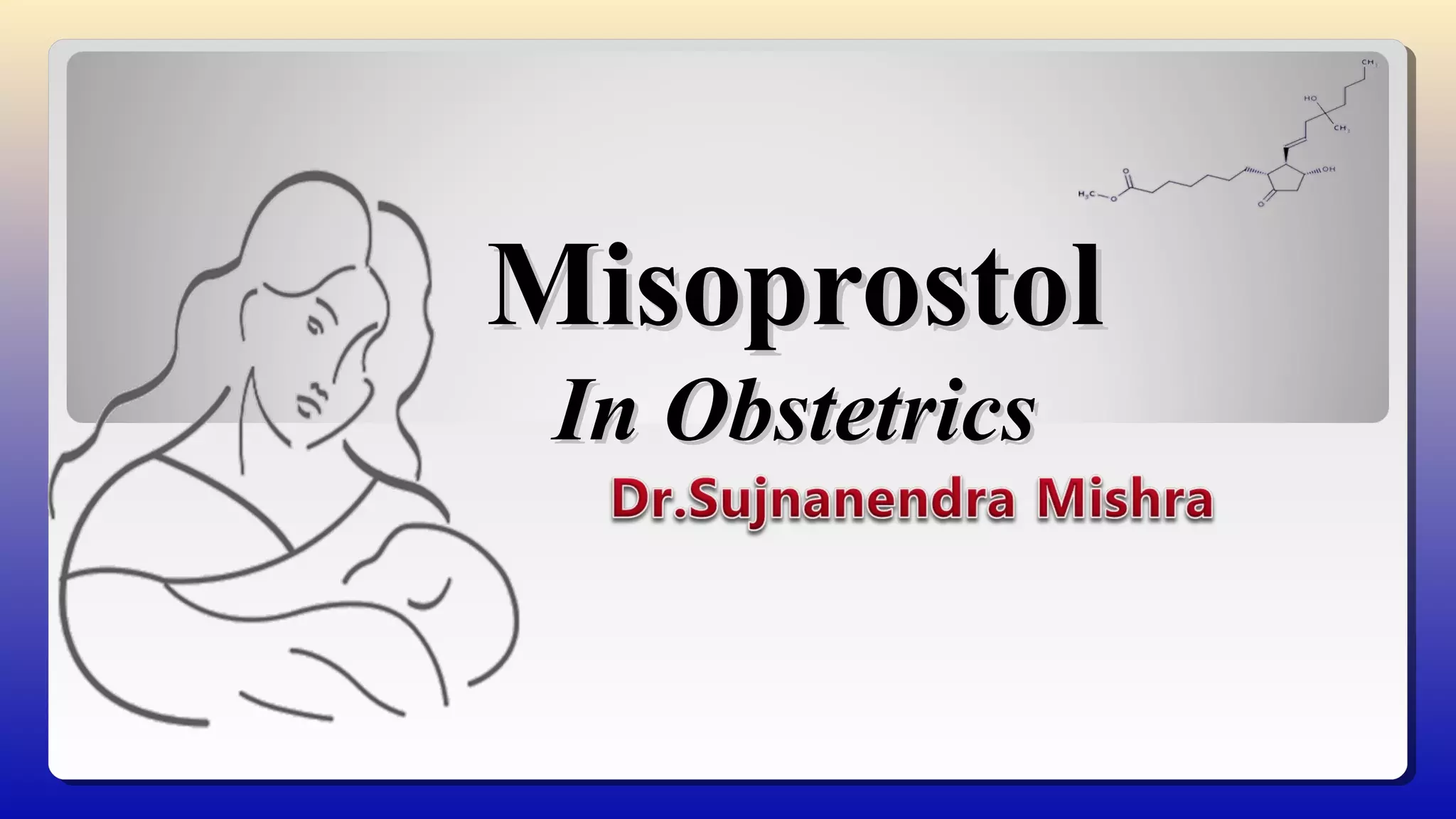











MisoprostolMisoprostol
In ObstetricsIn Obstetrics
HISTORYHISTORY
 The first prostaglandin effects were discovered in 1930.
 During artificial insemination, in a many cases, semen injected into the uterine
cavity was promptly expelled. (Kurzrok and Lieb, 1930)
 A powerful vasodilator substance with ability to stimulate muscle activity was
discovered from seminal fluid (Goldblatt, 1935)
 This lipid-soluble, smooth-muscle-stimulating and blood-pressure-lowering
agent was named prostaglandin (v. Euler, 1935) as it was found in seminal fluid
from the prostate gland.
 It was shown to consist of highly active, lipid-soluble, unsaturated hydroxy acids
(Bergström, 1949).
 Almost 10 years later, the chemical structure was elucidated and named
prostaglandin E (Bergström and Sjövall, 1960)
 Other prostaglandins, such asPGE2, PGF2, etc., were identified somewhat later.
 Karim A. worked extensively on use of prostaglandins to induce labour.
 It is turned into a common method of the induction of labour and abortion.
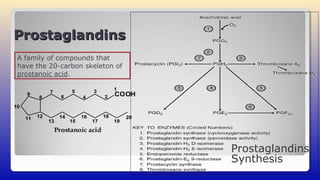
A family of compounds that
have the 20-carbon skeleton of
prostanoic acid.
Prostaglandins
Synthesis
ProstaglandinsProstaglandins
2
3
4
5
6
7
8
9
20
10
11 12
13
14
15
16
17
18
19
1
Prostanoic acid
COOH
PGE1 analog - MisoprostolPGE1 analog - Misoprostol
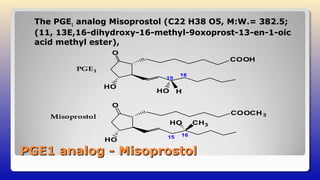
The PGE1 analog Misoprostol (C22 H38 O5, M:W.= 382.5;
(11, 13E,16-dihydroxy-16-methyl-9oxoprost-13-en-1-oic
acid methyl ester),
1615
Misoprostol
PGE1
15
16
COOCH3
HO
O
HO
CH3
HO H
HO
O
COOH
Misoprostol ChemistryMisoprostol Chemistry
Discovered in 1973
Prostaglandin E1 analogue
Slight structural modifications leads to:
◦ increase anti-secretory potency
◦ increase duration of action (half life of naturally occurring
prostaglandins seconds)
◦ improve oral bioavailability
◦ improve safety profile
Misoprostol was registered in 1986 for the prevention and
treatment of peptic ulcers resulted from NSAID.
It is safe and well tolerated within the recommended dose of
800 µ g/day.
Distribution & MetabolismDistribution & Metabolism
High variability of plasma levels between and within studies
Mean plasma levels after single oral doses show a linear
relationship with dose over the range of 200-400 mcg
No accumulation of misoprostol noted in multiple dose studies
Serum protein binding less than 90%, concentration-
independent in the therapeutic range
Undergoes rapid de-esterification to produce clinically active
misoprostol acid.
Misoprostol acid further metabolized by oxidation, primarily in
the liver
ExcretionExcretion
 Mainly urinary excretion- 80% in urine
 Plasma elimination half-life reported to be between 20 and 40 minutes
 Misoprostol acid is secreted into breast milk
 Studies in patients with varying degrees of renal impairment have shown:
◦ approximate doubling of T1/2, C max, and AUC compared to normal controls
◦ no clear correlation between the degree of impairment and AUC.
 No routine dosage adjustment recommended in patients with renal
impairment, but dosage may need to be reduced if the usual dose is not
tolerated
 Does not affect the hepatic mixed function oxidase (cytochrome P-450)
enzyme systems in animals-
 No known drug interactions
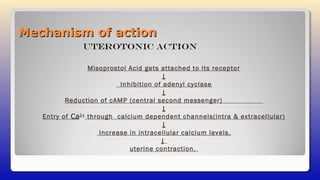
Mechanism of actionMechanism of action
Misoprostol Acid gets attached to its receptor
↓
Inhibition of adenyl cyclase
↓
Reduction of cAMP (central second messenger)
↓
Entry of Ca2+
through calcium dependent channels(intra & extracellular)
↓
Increase in intracellular calcium levels.
↓
uterine contraction.
Uterotonic Action
ROUTE OF ADMINSTRATION
Misoprostol: an old drug, new indications.
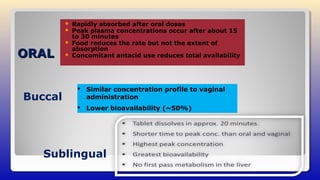
ORALORAL
 Rapidly absorbed after oral doses
 Peak plasma concentrations occur after about 15
to 30 minutes
 Food reduces the rate but not the extent of
absorption
 Concomitant antacid use reduces total availability
Buccal
 Similar concentration profile to vaginal
administration
 Lower bioavailability (~50%)
Sublingual
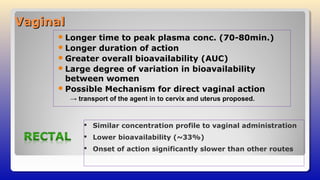
VaginalVaginal
Longer time to peak plasma conc. (70-80min.)
Longer duration of action
Greater overall bioavailability (AUC)
Large degree of variation in bioavailability
between women
Possible Mechanism for direct vaginal action
→ transport of the agent in to cervix and uterus proposed.
 Similar concentration profile to vaginal administration
 Lower bioavailability (~33%)
 Onset of action significantly slower than other routes
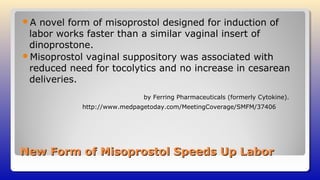
New Form of Misoprostol Speeds Up LaborNew Form of Misoprostol Speeds Up Labor
A novel form of misoprostol designed for induction of
labor works faster than a similar vaginal insert of
dinoprostone.
Misoprostol vaginal suppository was associated with
reduced need for tocolytics and no increase in cesarean
deliveries.
by Ferring Pharmaceuticals (formerly Cytokine).
http://www.medpagetoday.com/MeetingCoverage/SMFM/37406
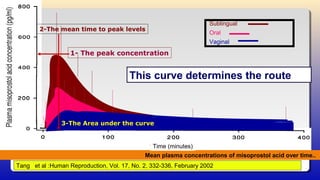
Pharmacokinetics
Sublingual
Oral
Vaginal
Mean plasma concentrations of misoprostol acid over time..
Time (minutes)
Tang et al :Human Reproduction, Vol. 17, No. 2, 332-336, February 2002
1- The peak concentration
2-The mean time to peak levels
3-The Area under the curve
This curve determines the route
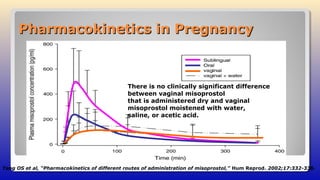
Pharmacokinetics in PregnancyPharmacokinetics in Pregnancy
Tang OS et al, “Pharmacokinetics of different routes of administration of misoprostol,” Hum Reprod. 2002;17:332-336.
There is no clinically significant difference
between vaginal misoprostol
that is administered dry and vaginal
misoprostol moistened with water,
saline, or acetic acid.
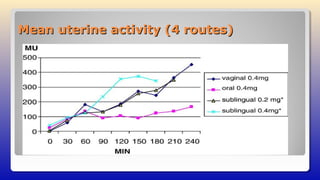
Mean uterine activity (4 routes)Mean uterine activity (4 routes)
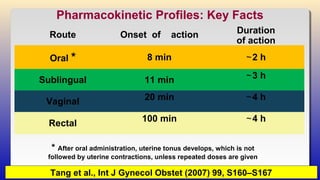
Route Onset of action Duration
of action
Oral * 8 min ∼2 h
Sublingual 11 min ∼3 h
Vaginal 20 min ∼4 h
Rectal 100 min ∼4 h
* After oral administration, uterine tonus develops, which is not
followed by uterine contractions, unless repeated doses are given
Pharmacokinetic Profiles: Key Facts
Tang et al., Int J Gynecol Obstet (2007) 99, S160–S167
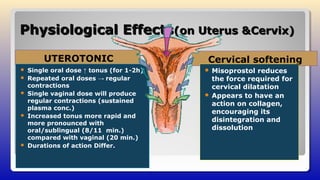
Physiological EffectsPhysiological Effects(on Uterus &Cervix)(on Uterus &Cervix)
UTEROTONIC Cervical softening
 Single oral dose ↑ tonus (for 1-2h)
 Repeated oral doses → regular
contractions
 Single vaginal dose will produce
regular contractions (sustained
plasma conc.)
 Increased tonus more rapid and
more pronounced with
oral/sublingual (8/11 min.)
compared with vaginal (20 min.)
 Durations of action Differ.
 Misoprostol reduces
the force required for
cervical dilatation
 Appears to have an
action on collagen,
encouraging its
disintegration and
dissolution
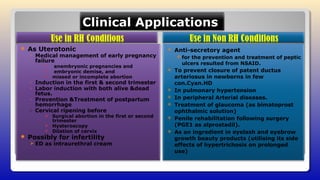
Clinical Applications
Clinical ApplicationsClinical Applications
 As Uterotonic
◦ Medical management of early pregnancy
failure
 anembryonic pregnancies and
 embryonic demise, and
 missed or incomplete abortion
◦ Induction in the first & second trimester
◦ Labor induction with both alive &dead
fetus.
◦ Prevention &Treatment of postpartum
hemorrhage
◦ Cervical ripening before
 Surgical abortion in the first or second
trimester
 Hysteroscopy
 Dilation of cervix
 Possibly for infertility
 ED as intraurethral cream
 Anti-secretory agent
for the prevention and treatment of peptic
ulcers resulted from NSAID.
 To prevent closure of patent ductus
arteriosus in newborns in few
con.Cyan.HD
 In pulmonary hypertension
 In peripheral Arterial diseases.
 Treatment of glaucoma (as bimatoprost
ophthalmic solution)
 Penile rehabilitation following surgery
(PGE1 as alprostadil).
 As an ingredient in eyelash and eyebrow
growth beauty products (utilising its side
effects of hypertrichosis on prolonged
use)
Adverse reactions
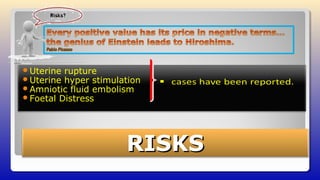
RISKSRISKS
Uterine rupture
Uterine hyper stimulation
Amniotic fluid embolism
Foetal Distress
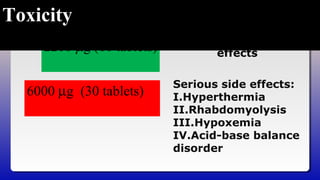
2200 µg (11 tablets)
No serious side
effects
Toxicity
Serious side effects:
I.Hyperthermia
II.Rhabdomyolysis
III.Hypoxemia
IV.Acid-base balance
disorder
6000 µg (30 tablets)
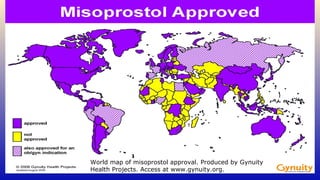
World map of misoprostol approval. Produced by Gynuity
Health Projects. Access at www.gynuity.org.
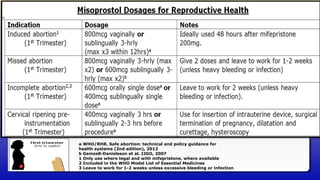
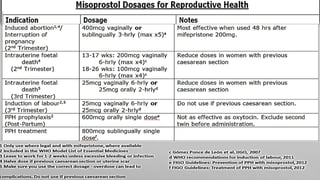
FIGO/WHO - MISOPROSTOL Dosage
recommendation
The International Federation of Gynecology and Obstetrics (FIGO) is an umbrella organization for 124 national
professional associations of obstetrics and gynecology around the world.
International Federation of Gynecology and Obstetrics
a WHO/RHR. Safe abortion: technical and policy guidance for
health systems (2nd edition), 2012
b Gemzell-Danielsson et al. IJGO, 2007
1 Only use where legal and with mifepristone, where available
2 Included in the WHO Model List of Essential Medicines
3 Leave to work for 1-2 weeks unless excessive bleeding or infection
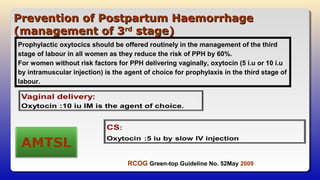
Prevention of Postpartum HaemorrhagePrevention of Postpartum Haemorrhage
(management of 3(management of 3rdrd
stage)stage)
RCOG Green-top Guideline No. 52May 2009
Prophylactic oxytocics should be offered routinely in the management of the third
stage of labour in all women as they reduce the risk of PPH by 60%.
For women without risk factors for PPH delivering vaginally, oxytocin (5 i.u or 10 i.u
by intramuscular injection) is the agent of choice for prophylaxis in the third stage of
labour.
AMTSL
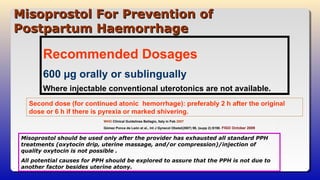
Misoprostol For Prevention ofMisoprostol For Prevention of
Postpartum HaemorrhagePostpartum Haemorrhage
WHO Clinical Guidelines Bellagio, Italy in Feb 2007
Gómez Ponce de León et al., Int J Gynecol Obstet(2007) 99, (supp 2):S190. FIGO October 2009
Recommended Dosages
600 µg orally or sublingually
Where injectable conventional uterotonics are not available.
Second dose (for continued atonic hemorrhage): preferably 2 h after the original
dose or 6 h if there is pyrexia or marked shivering.
Misoprostol should be used only after the provider has exhausted all standard PPH
treatments (oxytocin drip, uterine massage, and/or compression)/injection of
quality oxytocin is not possible .
All potential causes for PPH should be explored to assure that the PPH is not due to
another factor besides uterine atony.
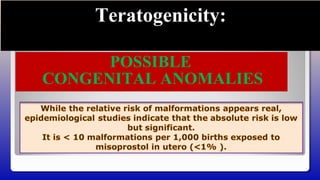
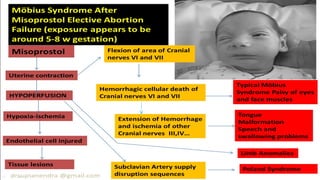
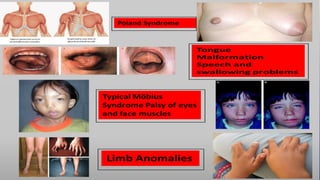
POSSIBLE
CONGENITAL ANOMALIES
Teratogenicity:
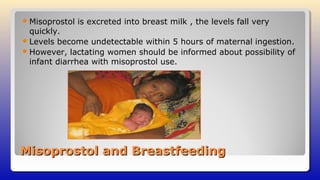
Misoprostol and BreastfeedingMisoprostol and Breastfeeding
Misoprostol is excreted into breast milk , the levels fall very
quickly.
Levels become undetectable within 5 hours of maternal ingestion.
However, lactating women should be informed about possibility of
infant diarrhea with misoprostol use.
Key points to remember !Key points to remember !
Misoprostol is a prostaglandin E1 analogue that causes uterine contractions,
cervical softening and dilation.
Routes of administration include oral, vaginal, rectal, buccal, and sublingual.
Medication abortion with 200 mg of mifepristone and 800 g of buccal or
vaginal misoprostol is 95% to 98% effective with evidence-based regimens.
It is an effective cervical ripening agent priorto first-trimestersurgical
abortion.
Misoprostol forcervical ripening as a substitute for/adjuvant to laminaria prior
to second trimesterdilation and evacuation.
Misoprostol is an effective cervical ripening agent in premenopausal women
priorto hysteroscopy. The greatest benefit is seen in nulliparous women and
foroperative hysteroscopy. Whetherthe routine use of misoprostol priorto
hysteroscopy is beneficial is still unknown.
Key points to remember !Key points to remember !
Misoprostol forcervical ripening priorto gynecologic procedures in
postmenopausal women has not been found to be effective.
Misoprostol is an option forthe management of early pregnancy failure and
incomplete abortion in women who are hemodynamically stable without
signs of infection. A single dose of 800 g vaginally is typically used.
Misoprostol is a proven induction agent in the second trimesterfor
termination of pregnancy orfetal death. One regimen is 400 g vaginally
every 6 hours up to 48 hours.
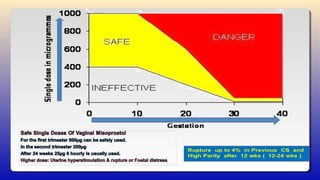
Forcervical ripening and induction of laborfora viable fetus, 25 g of
vaginal misoprostol every 4 to 6 hours is recommended.
Misoprostol has not been shown to be as effective as injectable uterotonics
(oxytocin and methylergotomine) forthe prevention and treatment of
postpartumhemorrhage. However, it is a valid option when these are not
available orfail.
Special challenges related to prevention ofSpecial challenges related to prevention of
PPH in low-resource areas:PPH in low-resource areas:
 Many births in the rural setting are attended by
Unskilled/minimally trained health providers
◦ Lack in skills for administration of injectable or
◦ Local laws may prohibit their use
◦ In spite of best effort mother may not reach institution
◦ Births may be attended by family/community members and not by SBA.
 AMTSL not practiced at all or not practiced properly by SBA
 Availability of injectable uterotonics may not be ensured.
 Refrigerated storage not possible in remote regions.
 Importance of proper storage of uterotonics is ignored by CARE
PROVIDERS instead use to cool portable water in the fridge if
available.
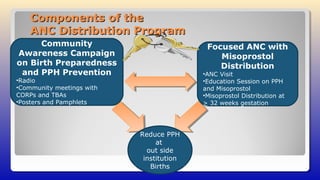
Components of theComponents of the
ANC Distribution ProgramANC Distribution Program
Community
Awareness Campaign
on Birth Preparedness
and PPH Prevention
•Radio
•Community meetings with
CORPs and TBAs
•Posters and Pamphlets
Focused ANC with
Misoprostol
Distribution
•ANC Visit
•Education Session on PPH
and Misoprostol
•Misoprostol Distribution at
> 32 weeks gestation
Reduce PPH
at
out side
institution
Births
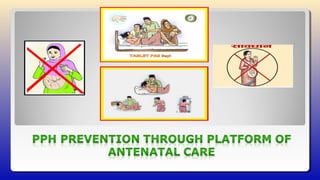
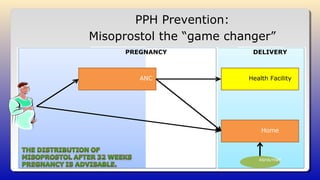
PPH Prevention:
Misoprostol the “game changer”
PREGNANCY
ANC
DELIVERY
Health Facility
Home
ASHA/HWF
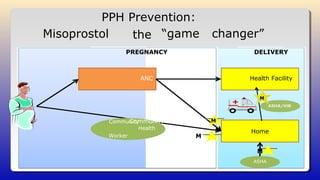
PPH Prevention:
Misoprostol the “game changer”
MCommunity
PREGNANCY
ANC
Community
Health
Worker M
DELIVERY
Health Facility
Home
M
ASHA
ASHA/HW
M
MISOPROSTOL AT GRASSROOTS
Examples from Uruguay, Bangladesh and Indian trials
Community-Based Distribution of Misoprostol
for Prevention of Postpartum Hemorrhage:
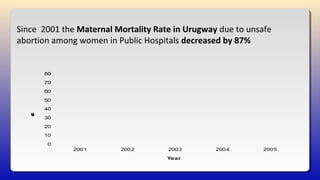
Since 2001 the Maternal Mortality Rate in Urugway due to unsafe
abortion among women in Public Hospitals decreased by 87%
0
10
20
30
40
50
60
70
80
2001 2002 2003 2004 2005
Cases
Year
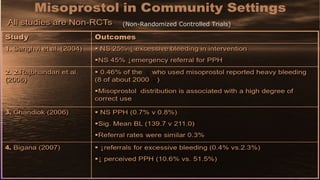
(Non-Randomized Controlled Trials)
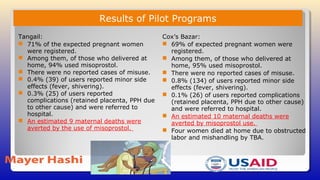
Tangail:
 71% of the expected pregnant women
were registered.
 Among them, of those who delivered at
home, 94% used misoprostol.
 There were no reported cases of misuse.
 0.4% (39) of users reported minor side
effects (fever, shivering).
 0.3% (25) of users reported
complications (retained placenta, PPH due
to other cause) and were referred to
hospital.
 An estimated 9 maternal deaths were
averted by the use of misoprostol.
Cox’s Bazar:
 69% of expected pregnant women were
registered.
 Among them, of those who delivered at
home, 95% used misoprostol.
 There were no reported cases of misuse.
 0.8% (134) of users reported minor side
effects (fever, shivering).
 0.1% (26) of users reported complications
(retained placenta, PPH due to other cause)
and were referred to hospital.
 An estimated 10 maternal deaths were
averted by misoprostol use.
 Four women died at home due to obstructed
labor and mishandling by TBA.
Results of Pilot Programs
Leaflet on use of Misoprostol
Bangladesh
Misoprostol Information,Misoprostol Information,
Education and Communication:Education and Communication:
For Community
For SBA
Misoprostol Information,Misoprostol Information,
Education and Communication:Education and Communication:
NIGERIA
PAKISTAN
ConclusionConclusion
 New information adds valuable evidence, obstetric use of misoprostol is useful .
 Misoprostol side effects tolerable, and less prevalent with prescribed doses.‐
 Misoprostol can treat the two largest causes of maternal mortality worldwide,
 postpartum hemorrhage and
unsafe abortion
 It is cheap and readily available, easy to store and, doesn't need skill to use.
 Information given to women by pharmacy workers needs to be accurate.
 Wrong advise on usage of the drug is worrying.
 Effectiveness of obstetric use of misoprostol in low resource settings,‐
a real need under a social perspective.
 The distribution of misoprostol after 32 weeks pregnancy is advisable.
Misoprostol in obstetrics

Misoprostol in obstetrics

  • 1.
  • 2.
    HISTORYHISTORY  The firstprostaglandin effects were discovered in 1930.  During artificial insemination, in a many cases, semen injected into the uterine cavity was promptly expelled. (Kurzrok and Lieb, 1930)  A powerful vasodilator substance with ability to stimulate muscle activity was discovered from seminal fluid (Goldblatt, 1935)  This lipid-soluble, smooth-muscle-stimulating and blood-pressure-lowering agent was named prostaglandin (v. Euler, 1935) as it was found in seminal fluid from the prostate gland.  It was shown to consist of highly active, lipid-soluble, unsaturated hydroxy acids (Bergström, 1949).  Almost 10 years later, the chemical structure was elucidated and named prostaglandin E (Bergström and Sjövall, 1960)  Other prostaglandins, such asPGE2, PGF2, etc., were identified somewhat later.  Karim A. worked extensively on use of prostaglandins to induce labour.  It is turned into a common method of the induction of labour and abortion.
  • 4.
    A family ofcompounds that have the 20-carbon skeleton of prostanoic acid. Prostaglandins Synthesis ProstaglandinsProstaglandins 2 3 4 5 6 7 8 9 20 10 11 12 13 14 15 16 17 18 19 1 Prostanoic acid COOH
  • 5.
    PGE1 analog -MisoprostolPGE1 analog - Misoprostol The PGE1 analog Misoprostol (C22 H38 O5, M:W.= 382.5; (11, 13E,16-dihydroxy-16-methyl-9oxoprost-13-en-1-oic acid methyl ester), 1615 Misoprostol PGE1 15 16 COOCH3 HO O HO CH3 HO H HO O COOH
  • 6.
    Misoprostol ChemistryMisoprostol Chemistry Discoveredin 1973 Prostaglandin E1 analogue Slight structural modifications leads to: ◦ increase anti-secretory potency ◦ increase duration of action (half life of naturally occurring prostaglandins seconds) ◦ improve oral bioavailability ◦ improve safety profile Misoprostol was registered in 1986 for the prevention and treatment of peptic ulcers resulted from NSAID. It is safe and well tolerated within the recommended dose of 800 µ g/day.
  • 7.
    Distribution & MetabolismDistribution& Metabolism High variability of plasma levels between and within studies Mean plasma levels after single oral doses show a linear relationship with dose over the range of 200-400 mcg No accumulation of misoprostol noted in multiple dose studies Serum protein binding less than 90%, concentration- independent in the therapeutic range Undergoes rapid de-esterification to produce clinically active misoprostol acid. Misoprostol acid further metabolized by oxidation, primarily in the liver
  • 8.
    ExcretionExcretion  Mainly urinaryexcretion- 80% in urine  Plasma elimination half-life reported to be between 20 and 40 minutes  Misoprostol acid is secreted into breast milk  Studies in patients with varying degrees of renal impairment have shown: ◦ approximate doubling of T1/2, C max, and AUC compared to normal controls ◦ no clear correlation between the degree of impairment and AUC.  No routine dosage adjustment recommended in patients with renal impairment, but dosage may need to be reduced if the usual dose is not tolerated  Does not affect the hepatic mixed function oxidase (cytochrome P-450) enzyme systems in animals-  No known drug interactions
  • 9.
    Mechanism of actionMechanismof action Misoprostol Acid gets attached to its receptor ↓ Inhibition of adenyl cyclase ↓ Reduction of cAMP (central second messenger) ↓ Entry of Ca2+ through calcium dependent channels(intra & extracellular) ↓ Increase in intracellular calcium levels. ↓ uterine contraction. Uterotonic Action
  • 10.
    ROUTE OF ADMINSTRATION Misoprostol:an old drug, new indications.
  • 11.
    ORALORAL  Rapidly absorbedafter oral doses  Peak plasma concentrations occur after about 15 to 30 minutes  Food reduces the rate but not the extent of absorption  Concomitant antacid use reduces total availability Buccal  Similar concentration profile to vaginal administration  Lower bioavailability (~50%) Sublingual
  • 12.
    VaginalVaginal Longer time topeak plasma conc. (70-80min.) Longer duration of action Greater overall bioavailability (AUC) Large degree of variation in bioavailability between women Possible Mechanism for direct vaginal action → transport of the agent in to cervix and uterus proposed.  Similar concentration profile to vaginal administration  Lower bioavailability (~33%)  Onset of action significantly slower than other routes
  • 13.
    New Form ofMisoprostol Speeds Up LaborNew Form of Misoprostol Speeds Up Labor A novel form of misoprostol designed for induction of labor works faster than a similar vaginal insert of dinoprostone. Misoprostol vaginal suppository was associated with reduced need for tocolytics and no increase in cesarean deliveries. by Ferring Pharmaceuticals (formerly Cytokine). http://www.medpagetoday.com/MeetingCoverage/SMFM/37406
  • 14.
  • 15.
    Sublingual Oral Vaginal Mean plasma concentrationsof misoprostol acid over time.. Time (minutes) Tang et al :Human Reproduction, Vol. 17, No. 2, 332-336, February 2002 1- The peak concentration 2-The mean time to peak levels 3-The Area under the curve This curve determines the route
  • 16.
    Pharmacokinetics in PregnancyPharmacokineticsin Pregnancy Tang OS et al, “Pharmacokinetics of different routes of administration of misoprostol,” Hum Reprod. 2002;17:332-336. There is no clinically significant difference between vaginal misoprostol that is administered dry and vaginal misoprostol moistened with water, saline, or acetic acid.
  • 17.
    Mean uterine activity(4 routes)Mean uterine activity (4 routes)
  • 18.
    Route Onset ofaction Duration of action Oral * 8 min ∼2 h Sublingual 11 min ∼3 h Vaginal 20 min ∼4 h Rectal 100 min ∼4 h * After oral administration, uterine tonus develops, which is not followed by uterine contractions, unless repeated doses are given Pharmacokinetic Profiles: Key Facts Tang et al., Int J Gynecol Obstet (2007) 99, S160–S167
  • 19.
    Physiological EffectsPhysiological Effects(onUterus &Cervix)(on Uterus &Cervix) UTEROTONIC Cervical softening  Single oral dose ↑ tonus (for 1-2h)  Repeated oral doses → regular contractions  Single vaginal dose will produce regular contractions (sustained plasma conc.)  Increased tonus more rapid and more pronounced with oral/sublingual (8/11 min.) compared with vaginal (20 min.)  Durations of action Differ.  Misoprostol reduces the force required for cervical dilatation  Appears to have an action on collagen, encouraging its disintegration and dissolution
  • 20.
  • 21.
    Clinical ApplicationsClinical Applications As Uterotonic ◦ Medical management of early pregnancy failure  anembryonic pregnancies and  embryonic demise, and  missed or incomplete abortion ◦ Induction in the first & second trimester ◦ Labor induction with both alive &dead fetus. ◦ Prevention &Treatment of postpartum hemorrhage ◦ Cervical ripening before  Surgical abortion in the first or second trimester  Hysteroscopy  Dilation of cervix  Possibly for infertility  ED as intraurethral cream  Anti-secretory agent for the prevention and treatment of peptic ulcers resulted from NSAID.  To prevent closure of patent ductus arteriosus in newborns in few con.Cyan.HD  In pulmonary hypertension  In peripheral Arterial diseases.  Treatment of glaucoma (as bimatoprost ophthalmic solution)  Penile rehabilitation following surgery (PGE1 as alprostadil).  As an ingredient in eyelash and eyebrow growth beauty products (utilising its side effects of hypertrichosis on prolonged use)
  • 22.
  • 23.
    RISKSRISKS Uterine rupture Uterine hyperstimulation Amniotic fluid embolism Foetal Distress
  • 24.
    2200 µg (11tablets) No serious side effects Toxicity Serious side effects: I.Hyperthermia II.Rhabdomyolysis III.Hypoxemia IV.Acid-base balance disorder 6000 µg (30 tablets)
  • 26.
    World map ofmisoprostol approval. Produced by Gynuity Health Projects. Access at www.gynuity.org.
  • 27.
    FIGO/WHO - MISOPROSTOLDosage recommendation The International Federation of Gynecology and Obstetrics (FIGO) is an umbrella organization for 124 national professional associations of obstetrics and gynecology around the world. International Federation of Gynecology and Obstetrics
  • 30.
    a WHO/RHR. Safeabortion: technical and policy guidance for health systems (2nd edition), 2012 b Gemzell-Danielsson et al. IJGO, 2007 1 Only use where legal and with mifepristone, where available 2 Included in the WHO Model List of Essential Medicines 3 Leave to work for 1-2 weeks unless excessive bleeding or infection
  • 32.
    Prevention of PostpartumHaemorrhagePrevention of Postpartum Haemorrhage (management of 3(management of 3rdrd stage)stage) RCOG Green-top Guideline No. 52May 2009 Prophylactic oxytocics should be offered routinely in the management of the third stage of labour in all women as they reduce the risk of PPH by 60%. For women without risk factors for PPH delivering vaginally, oxytocin (5 i.u or 10 i.u by intramuscular injection) is the agent of choice for prophylaxis in the third stage of labour. AMTSL
  • 33.
    Misoprostol For PreventionofMisoprostol For Prevention of Postpartum HaemorrhagePostpartum Haemorrhage WHO Clinical Guidelines Bellagio, Italy in Feb 2007 Gómez Ponce de León et al., Int J Gynecol Obstet(2007) 99, (supp 2):S190. FIGO October 2009 Recommended Dosages 600 µg orally or sublingually Where injectable conventional uterotonics are not available. Second dose (for continued atonic hemorrhage): preferably 2 h after the original dose or 6 h if there is pyrexia or marked shivering. Misoprostol should be used only after the provider has exhausted all standard PPH treatments (oxytocin drip, uterine massage, and/or compression)/injection of quality oxytocin is not possible . All potential causes for PPH should be explored to assure that the PPH is not due to another factor besides uterine atony.
  • 34.
  • 37.
    Misoprostol and BreastfeedingMisoprostoland Breastfeeding Misoprostol is excreted into breast milk , the levels fall very quickly. Levels become undetectable within 5 hours of maternal ingestion. However, lactating women should be informed about possibility of infant diarrhea with misoprostol use.
  • 38.
    Key points toremember !Key points to remember ! Misoprostol is a prostaglandin E1 analogue that causes uterine contractions, cervical softening and dilation. Routes of administration include oral, vaginal, rectal, buccal, and sublingual. Medication abortion with 200 mg of mifepristone and 800 g of buccal or vaginal misoprostol is 95% to 98% effective with evidence-based regimens. It is an effective cervical ripening agent priorto first-trimestersurgical abortion. Misoprostol forcervical ripening as a substitute for/adjuvant to laminaria prior to second trimesterdilation and evacuation. Misoprostol is an effective cervical ripening agent in premenopausal women priorto hysteroscopy. The greatest benefit is seen in nulliparous women and foroperative hysteroscopy. Whetherthe routine use of misoprostol priorto hysteroscopy is beneficial is still unknown.
  • 39.
    Key points toremember !Key points to remember ! Misoprostol forcervical ripening priorto gynecologic procedures in postmenopausal women has not been found to be effective. Misoprostol is an option forthe management of early pregnancy failure and incomplete abortion in women who are hemodynamically stable without signs of infection. A single dose of 800 g vaginally is typically used. Misoprostol is a proven induction agent in the second trimesterfor termination of pregnancy orfetal death. One regimen is 400 g vaginally every 6 hours up to 48 hours. Forcervical ripening and induction of laborfora viable fetus, 25 g of vaginal misoprostol every 4 to 6 hours is recommended. Misoprostol has not been shown to be as effective as injectable uterotonics (oxytocin and methylergotomine) forthe prevention and treatment of postpartumhemorrhage. However, it is a valid option when these are not available orfail.
  • 41.
    Special challenges relatedto prevention ofSpecial challenges related to prevention of PPH in low-resource areas:PPH in low-resource areas:  Many births in the rural setting are attended by Unskilled/minimally trained health providers ◦ Lack in skills for administration of injectable or ◦ Local laws may prohibit their use ◦ In spite of best effort mother may not reach institution ◦ Births may be attended by family/community members and not by SBA.  AMTSL not practiced at all or not practiced properly by SBA  Availability of injectable uterotonics may not be ensured.  Refrigerated storage not possible in remote regions.  Importance of proper storage of uterotonics is ignored by CARE PROVIDERS instead use to cool portable water in the fridge if available.
  • 42.
    Components of theComponentsof the ANC Distribution ProgramANC Distribution Program Community Awareness Campaign on Birth Preparedness and PPH Prevention •Radio •Community meetings with CORPs and TBAs •Posters and Pamphlets Focused ANC with Misoprostol Distribution •ANC Visit •Education Session on PPH and Misoprostol •Misoprostol Distribution at > 32 weeks gestation Reduce PPH at out side institution Births
  • 43.
    PPH Prevention: Misoprostol the“game changer” PREGNANCY ANC DELIVERY Health Facility Home ASHA/HWF
  • 44.
    PPH Prevention: Misoprostol the“game changer” MCommunity PREGNANCY ANC Community Health Worker M DELIVERY Health Facility Home M ASHA ASHA/HW M
  • 45.
    MISOPROSTOL AT GRASSROOTS Examplesfrom Uruguay, Bangladesh and Indian trials Community-Based Distribution of Misoprostol for Prevention of Postpartum Hemorrhage:
  • 46.
    Since 2001 theMaternal Mortality Rate in Urugway due to unsafe abortion among women in Public Hospitals decreased by 87% 0 10 20 30 40 50 60 70 80 2001 2002 2003 2004 2005 Cases Year
  • 47.
  • 48.
    Tangail:  71% ofthe expected pregnant women were registered.  Among them, of those who delivered at home, 94% used misoprostol.  There were no reported cases of misuse.  0.4% (39) of users reported minor side effects (fever, shivering).  0.3% (25) of users reported complications (retained placenta, PPH due to other cause) and were referred to hospital.  An estimated 9 maternal deaths were averted by the use of misoprostol. Cox’s Bazar:  69% of expected pregnant women were registered.  Among them, of those who delivered at home, 95% used misoprostol.  There were no reported cases of misuse.  0.8% (134) of users reported minor side effects (fever, shivering).  0.1% (26) of users reported complications (retained placenta, PPH due to other cause) and were referred to hospital.  An estimated 10 maternal deaths were averted by misoprostol use.  Four women died at home due to obstructed labor and mishandling by TBA. Results of Pilot Programs
  • 49.
    Leaflet on useof Misoprostol Bangladesh
  • 50.
    Misoprostol Information,Misoprostol Information, Educationand Communication:Education and Communication: For Community For SBA
  • 51.
    Misoprostol Information,Misoprostol Information, Educationand Communication:Education and Communication: NIGERIA PAKISTAN
  • 52.
    ConclusionConclusion  New informationadds valuable evidence, obstetric use of misoprostol is useful .  Misoprostol side effects tolerable, and less prevalent with prescribed doses.‐  Misoprostol can treat the two largest causes of maternal mortality worldwide,  postpartum hemorrhage and unsafe abortion  It is cheap and readily available, easy to store and, doesn't need skill to use.  Information given to women by pharmacy workers needs to be accurate.  Wrong advise on usage of the drug is worrying.  Effectiveness of obstetric use of misoprostol in low resource settings,‐ a real need under a social perspective.  The distribution of misoprostol after 32 weeks pregnancy is advisable.