Hyperlipidemia
• Lipids of human plasma are transported as
complexes with proteins, such macromolecular
complexes are termed lipoproteins; except fatty
acids which are bound to albumin.
• Any metabolic disorders involving the elevations
in plasma concentrations of any lipoprotein
species known as hyperlipoproteinemias or
hyperlipidemias.
• Hyperlipidemia is generally restricted to
conditions that involve increased level of
triglycerides in plasma.
• The major complications are acute
pancreatitis and atherosclerosis
• Those which contain apolipoprotein (apo)
B100 act as vehicles by which cholesterol are
transported into artery wall.
• Those are low-density (LDL), intermediate
density (IDL), very low density (VLDL) and
Lp(a) lipoproteins.
• Cellular components in atherosclerotic plaque
are foam cells, derived form macrophages and
smooth muscle cells filled with cholesteryl
esters.
• The atheromatous plaque grows over time
with the accumulation of increased no. of
foam cells and of collagen and fibrin.
• High-density lipoproteins (HDL) exert antiatherogenic effects.
RISK FACTORS
1) Cigarette is a major risk factor for coronary disease
– Associated with reduced HDL levels
– Impaired cholesterol level
– Cytotoxic effects on endothelium
– Increased oxidation of atherogenic lipoproteins
– Stimulates thrombogenesis
2) Hypertension
3) Diabetes
4) LDL levels
• Normally EDRF, nitric oxide are responsible for
vessels regulation but it is impaired in
hyperlipidemia.
• So natural antioxidants such as tocopherol and
ascorbic acid can reduce such impairment.
Pathophysiology of
hyperlipoproteinemia
•
1.
2.
•

Major lipoproteins are:
Cholesteryl esters and
Triglycerides
A monolayer of unesterified cholesterol and phospholipids
surrounds the hydrophobic core of above lipoproteins.
• Specific proteins (apolipoproteins) are located on the
surface.
• Also certain lipoproteins contain large mol. wt
apolipoproteins(B lipoproteins) which don’t migrate like
smaller ones.
• Subtypes of B apolipoproteins:
–
–

B-48 formed in intestine with chylomicrons
B100 synthesized in liver and found in VLDL, VLDL
remnants,LDL and the Lp(a) lipoproteins.
• Chylomicrons:
– Lagest type;formed in intestine and carry dietary lipids
–triglycerides
– Responsible for transport of lipids

• Very low density lipoproteins (VLDL) :
– Secreted by liver; means for transporting triglycerides
to peripheral tissues
– Hydrolyzed by lipoprotein lipase yielding free fatty
acids for oxidation and storage.
– Intermediate particles called IDL are formed after the
VLDL is depleted of triglycerides.
• Low density lipoproteins:
– Further removal of triglycerides by hepatic
lipaseresults in its formation.
– Hepatocytes play a major role for its catabolic
activity.

• Lp(a) lipoprotein:
– Formed form an LDL-like moiety
– The Lp(a) lipoprotein complex can be found in
atherosclerotic plaques and contribute to
coronary disease by inhibiting thrombolysis.
• High density lipoproteins:
– Secreted by the liver and intestine
– Comes from surface of chylomicrons and VLDL
during lipolysis.
• Atherosclerosis: It is a disease which affects large and
medium size arteries, and a leading cause of death.
• consists of localized plaque in the intima, and is
composed of cholesterol esters, proliferation of
smooth muscle, deposition of fibrous proteins and
calcifications.
• Effects:
– Narrowing of the arterial lumen
– Ulceration of arterial lumen and thrombosis of artery and
embolization.
– Weakens arterial wall and formation of aneurysms.
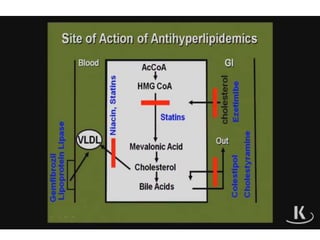
Classification of anti-hyperlipidemics:
• HMG-CoA reductase inhibitors ( statins)
– Lovastatin
– Atorvastatin
– Simvastatin
– Pravastatin
– Rosuvastatin
• Bile acid sequestrants (resins):
– Cholestyramine
– Colestipol
• lipoprotein lipase inducers (fibric acid derivative)
– Clofibrate
– Gemfibrozil
– Benzafibrate
• Inhibit lipolysis and triglycerides synthesis
– Nicotinic acid ( niacin)
• Inhibit intestinal cholesterol absorption
– Ezetimibe
• Others
– Probucol
– gugulipid
HMG-CoA reductase inhibitors
• Mechanism of action
The de novo synthesis of cholesterol involves a
pathway in which mevalonic acid is formed and by the
enzyme hydroxymethylglutaryl co-enzyme reductase
(HMG-Co A reductase); the statins inhibits this step
resulting in decrease hepatic cholesterol synthesis.
Resultantly synthesis of high affinity LDL receptors on
the liver occurs and increased clearance of plasma LDL.
• Decrease liver cholesterol
• Increase LDL gene expression
• Decrease plasma LDL
• Decrease VLDL synthesis
• Decrease TGLs
• Pharmacokinetics:
– Given orally except fluvastatin
– Upto 90% available
– Undergoes first pass metabolism and secreted in
bile
– 5-10% excreted in urine
• Adverse effects:
–
–
–
–
–
–

Headache, nausea, bowel upsets, rashes
Sleep disturbances
Rhabdomyolysis
Myalgia , myopathy
Rise in LFTs particularly serum transaminases
Muscle weakness

• Indications:
– Hyperlipidemia with raised LDL and Cholesterol level
– Progression of atherosclerotic lesion
– Ischemic heart disease of elderly
• Drug interactions :
– Gemfibrogil
– Cyt P450 enzymes
Cholestyramine
• Also known as bile acid binding resin.
• Bile acid binding resins are cholesterol lowering
drugs that are man made resins. They are gritty,
insoluble granules which are available in the form
of a bar that has to be chewed thoroughly or
comes in the form of a powder and needs to be
mixed with a liquid.
• These prevent re-absorption of cholesterol into
the body when they bind with the cholesterolrich bile acids secreted by the liver.
• Resulting in decreased enterohepatic
circulation of causing the liver to increase
production of bile acids utilizing cholesterol
• Decrease LDL levels
• Increase LDL receptor gene expression.
• It significant effect on LDL levels by utilizing
the LDL receptors but no effect on the HDL
levels.
• Pharmacokinetics:
– Orally (chewed)
– No systemic effects as it is retained in the GI tract
– Usual dose of 12-36g of resin per day in divided
doses with meals.
• Side-effects:
– Increased VLDL and triglycerides
– Usually causes GI symptoms like constipation and
flatulence.
– May interfere with the absorption of fat-soluble
vitamins and may bind with other drugs if taken
concurrently.
Drug interactions
– Orally administered drugs
Contraindication:
– Hypertriglyceridemia
Nicotinic acid
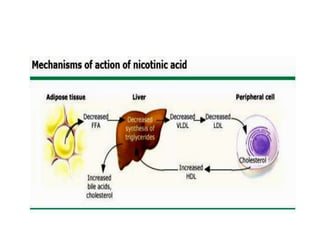
• Inhibition of VLDL synthesis( inhibiting
ApoB100 gene expression and resulting in:
– Decreased plasma VLDL
– Decreased plasma LDL
– Increased plasma HDL
Side effects :
– Flushing , pruritus , rashes
– hepatotoxicity
Fibric acid derivatives
• Prototype: Gemfibrozil
• Others : clofibrate , benzafibrate
• Mechanism of action:
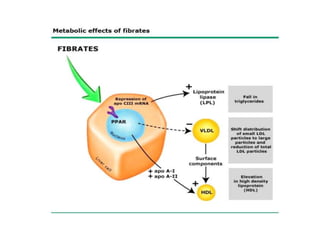
– Induction of lipoprotein lipase
– Activation of the nuclear transcription receptor
“peroxisome proliferator - activated receptor alpha” (PPARα). –mediate effects of insulin
– class of intracellular receptors that modulate carbohydrate
and fat metabolism and adipose tissue differentiation.
– PPAR-α activation by fibrates results in numerous changes
in lipid metabolism that act together to decrease plasma
triglyceride levels & increase plasma HDL.
– Decrease VLDL and IDL
• Indications:
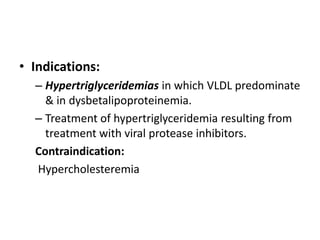
– Hypertriglyceridemias in which VLDL predominate
& in dysbetalipoproteinemia.
– Treatment of hypertriglyceridemia resulting from
treatment with viral protease inhibitors.
Contraindication:
Hypercholesteremia
• Pharmacokinetics:
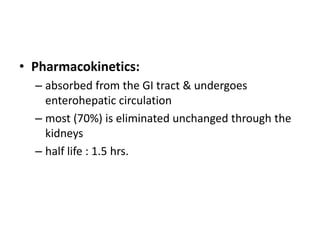
– absorbed from the GI tract & undergoes
enterohepatic circulation
– most (70%) is eliminated unchanged through the
kidneys
– half life : 1.5 hrs.
• Side Effects:
–
–
–
–
–
–
–
–

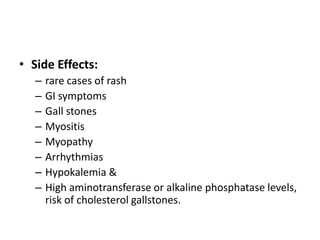
rare cases of rash
GI symptoms
Gall stones
Myositis
Myopathy
Arrhythmias
Hypokalemia &
High aminotransferase or alkaline phosphatase levels,
risk of cholesterol gallstones.
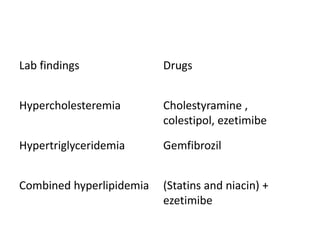
Lab findings

Drugs

Hypercholesteremia

Cholestyramine ,
colestipol, ezetimibe

Hypertriglyceridemia

Gemfibrozil

Combined hyperlipidemia

(Statins and niacin) +
ezetimibe

6anti hyperlipidemic drugs

  • 1.
    Hyperlipidemia • Lipids ofhuman plasma are transported as complexes with proteins, such macromolecular complexes are termed lipoproteins; except fatty acids which are bound to albumin. • Any metabolic disorders involving the elevations in plasma concentrations of any lipoprotein species known as hyperlipoproteinemias or hyperlipidemias. • Hyperlipidemia is generally restricted to conditions that involve increased level of triglycerides in plasma.
  • 2.
    • The majorcomplications are acute pancreatitis and atherosclerosis • Those which contain apolipoprotein (apo) B100 act as vehicles by which cholesterol are transported into artery wall. • Those are low-density (LDL), intermediate density (IDL), very low density (VLDL) and Lp(a) lipoproteins.
  • 3.
    • Cellular componentsin atherosclerotic plaque are foam cells, derived form macrophages and smooth muscle cells filled with cholesteryl esters. • The atheromatous plaque grows over time with the accumulation of increased no. of foam cells and of collagen and fibrin. • High-density lipoproteins (HDL) exert antiatherogenic effects.
  • 4.
    RISK FACTORS 1) Cigaretteis a major risk factor for coronary disease – Associated with reduced HDL levels – Impaired cholesterol level – Cytotoxic effects on endothelium – Increased oxidation of atherogenic lipoproteins – Stimulates thrombogenesis 2) Hypertension 3) Diabetes 4) LDL levels
  • 5.
    • Normally EDRF,nitric oxide are responsible for vessels regulation but it is impaired in hyperlipidemia. • So natural antioxidants such as tocopherol and ascorbic acid can reduce such impairment.
  • 6.
    Pathophysiology of hyperlipoproteinemia • 1. 2. • Major lipoproteinsare: Cholesteryl esters and Triglycerides A monolayer of unesterified cholesterol and phospholipids surrounds the hydrophobic core of above lipoproteins. • Specific proteins (apolipoproteins) are located on the surface. • Also certain lipoproteins contain large mol. wt apolipoproteins(B lipoproteins) which don’t migrate like smaller ones. • Subtypes of B apolipoproteins: – – B-48 formed in intestine with chylomicrons B100 synthesized in liver and found in VLDL, VLDL remnants,LDL and the Lp(a) lipoproteins.
  • 7.
    • Chylomicrons: – Lagesttype;formed in intestine and carry dietary lipids –triglycerides – Responsible for transport of lipids • Very low density lipoproteins (VLDL) : – Secreted by liver; means for transporting triglycerides to peripheral tissues – Hydrolyzed by lipoprotein lipase yielding free fatty acids for oxidation and storage. – Intermediate particles called IDL are formed after the VLDL is depleted of triglycerides.
  • 8.
    • Low densitylipoproteins: – Further removal of triglycerides by hepatic lipaseresults in its formation. – Hepatocytes play a major role for its catabolic activity. • Lp(a) lipoprotein: – Formed form an LDL-like moiety – The Lp(a) lipoprotein complex can be found in atherosclerotic plaques and contribute to coronary disease by inhibiting thrombolysis.
  • 9.
    • High densitylipoproteins: – Secreted by the liver and intestine – Comes from surface of chylomicrons and VLDL during lipolysis.
  • 10.
    • Atherosclerosis: Itis a disease which affects large and medium size arteries, and a leading cause of death. • consists of localized plaque in the intima, and is composed of cholesterol esters, proliferation of smooth muscle, deposition of fibrous proteins and calcifications. • Effects: – Narrowing of the arterial lumen – Ulceration of arterial lumen and thrombosis of artery and embolization. – Weakens arterial wall and formation of aneurysms.
  • 12.
    Classification of anti-hyperlipidemics: •HMG-CoA reductase inhibitors ( statins) – Lovastatin – Atorvastatin – Simvastatin – Pravastatin – Rosuvastatin
  • 13.
    • Bile acidsequestrants (resins): – Cholestyramine – Colestipol • lipoprotein lipase inducers (fibric acid derivative) – Clofibrate – Gemfibrozil – Benzafibrate • Inhibit lipolysis and triglycerides synthesis – Nicotinic acid ( niacin) • Inhibit intestinal cholesterol absorption – Ezetimibe • Others – Probucol – gugulipid
  • 14.
    HMG-CoA reductase inhibitors •Mechanism of action The de novo synthesis of cholesterol involves a pathway in which mevalonic acid is formed and by the enzyme hydroxymethylglutaryl co-enzyme reductase (HMG-Co A reductase); the statins inhibits this step resulting in decrease hepatic cholesterol synthesis. Resultantly synthesis of high affinity LDL receptors on the liver occurs and increased clearance of plasma LDL. • Decrease liver cholesterol • Increase LDL gene expression • Decrease plasma LDL • Decrease VLDL synthesis • Decrease TGLs
  • 15.
    • Pharmacokinetics: – Givenorally except fluvastatin – Upto 90% available – Undergoes first pass metabolism and secreted in bile – 5-10% excreted in urine
  • 16.
    • Adverse effects: – – – – – – Headache,nausea, bowel upsets, rashes Sleep disturbances Rhabdomyolysis Myalgia , myopathy Rise in LFTs particularly serum transaminases Muscle weakness • Indications: – Hyperlipidemia with raised LDL and Cholesterol level – Progression of atherosclerotic lesion – Ischemic heart disease of elderly
  • 17.
    • Drug interactions: – Gemfibrogil – Cyt P450 enzymes
  • 18.
    Cholestyramine • Also knownas bile acid binding resin. • Bile acid binding resins are cholesterol lowering drugs that are man made resins. They are gritty, insoluble granules which are available in the form of a bar that has to be chewed thoroughly or comes in the form of a powder and needs to be mixed with a liquid. • These prevent re-absorption of cholesterol into the body when they bind with the cholesterolrich bile acids secreted by the liver.
  • 19.
    • Resulting indecreased enterohepatic circulation of causing the liver to increase production of bile acids utilizing cholesterol • Decrease LDL levels • Increase LDL receptor gene expression. • It significant effect on LDL levels by utilizing the LDL receptors but no effect on the HDL levels.
  • 20.
    • Pharmacokinetics: – Orally(chewed) – No systemic effects as it is retained in the GI tract – Usual dose of 12-36g of resin per day in divided doses with meals.
  • 21.
    • Side-effects: – IncreasedVLDL and triglycerides – Usually causes GI symptoms like constipation and flatulence. – May interfere with the absorption of fat-soluble vitamins and may bind with other drugs if taken concurrently. Drug interactions – Orally administered drugs Contraindication: – Hypertriglyceridemia
  • 22.
    Nicotinic acid • Inhibitionof VLDL synthesis( inhibiting ApoB100 gene expression and resulting in: – Decreased plasma VLDL – Decreased plasma LDL – Increased plasma HDL Side effects : – Flushing , pruritus , rashes – hepatotoxicity
  • 24.
    Fibric acid derivatives •Prototype: Gemfibrozil • Others : clofibrate , benzafibrate • Mechanism of action: – Induction of lipoprotein lipase – Activation of the nuclear transcription receptor “peroxisome proliferator - activated receptor alpha” (PPARα). –mediate effects of insulin – class of intracellular receptors that modulate carbohydrate and fat metabolism and adipose tissue differentiation. – PPAR-α activation by fibrates results in numerous changes in lipid metabolism that act together to decrease plasma triglyceride levels & increase plasma HDL. – Decrease VLDL and IDL
  • 26.
    • Indications: – Hypertriglyceridemiasin which VLDL predominate & in dysbetalipoproteinemia. – Treatment of hypertriglyceridemia resulting from treatment with viral protease inhibitors. Contraindication: Hypercholesteremia
  • 27.
    • Pharmacokinetics: – absorbedfrom the GI tract & undergoes enterohepatic circulation – most (70%) is eliminated unchanged through the kidneys – half life : 1.5 hrs.
  • 28.
    • Side Effects: – – – – – – – – rarecases of rash GI symptoms Gall stones Myositis Myopathy Arrhythmias Hypokalemia & High aminotransferase or alkaline phosphatase levels, risk of cholesterol gallstones.
  • 29.
    Lab findings Drugs Hypercholesteremia Cholestyramine , colestipol,ezetimibe Hypertriglyceridemia Gemfibrozil Combined hyperlipidemia (Statins and niacin) + ezetimibe