Hypoglycemic agentsHypoglycemic agents
Ashwini P. Shewale Pradnya N. Jagtap
M.Pharm M.Pharm
Pharmaceutical Chemistry Pharmacology
Hypoglycemic agentsHypoglycemic agents
The normal blood sugar level is 70-80 mg/100ml.
In persons without diabetes, normal 'fasting' blood sugar
levels are below 100 mg/dL; levels just prior to meals and
snacks should be less than 110 mg/dL. Optimal levels are
below 140 mg/dL two hours after meals and below 120
mg/dL before bed, 
HYPERGLYCEMIA
HYPOGLYCEMIA
DIABETIES Mellitus is the condition arising due to
abnormal metabolism of carbohydrate , fats and proteins .
It is characterized by Hyperglycemia & glucosouria.
Diabetes means large urine volume.
Mellitus means Honey
 The drugs which are used to lower blood sugar are called
hypoglycemic agents. They are used to treat diabetes mellitus.
(Latin word mellitus means honey)
 Diabetes mellitus is characterised by persistant hyperglycaemia,
usually with glucosuria.
 The different factors involved in its origin are hereditary,
 immunological, age, stress etc. during which either endogenous
insulin secretion is reduced or action of insulin is opposed.
 The lack or deficiency of insulin affects carbohydrate, protein
and lipid metabolism. As a result the different symptoms
(manifestations) observed are hyperglycaemia, glucosuria,
ketonaemia, ketonura, hyperlipidaemia, polyuria, polydipsia
(increased thirst) etc.
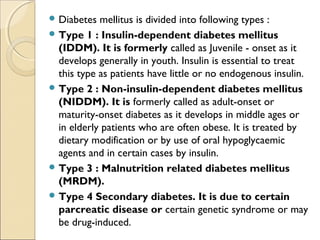
 Diabetes mellitus is divided into following types :
 Type 1 : Insulin-dependent diabetes mellitus
(IDDM). It is formerly called as Juvenile - onset as it
develops generally in youth. Insulin is essential to treat
this type as patients have little or no endogenous insulin.
 Type 2 : Non-insulin-dependent diabetes mellitus
(NIDDM). It is formerly called as adult-onset or
maturity-onset diabetes as it develops in middle ages or
in elderly patients who are often obese. It is treated by
dietary modification or by use of oral hypoglycaemic
agents and in certain cases by insulin.
 Type 3 : Malnutrition related diabetes mellitus
(MRDM).
 Type 4 Secondary diabetes. It is due to certain
parcreatic disease or certain genetic syndrome or may
be drug-induced.
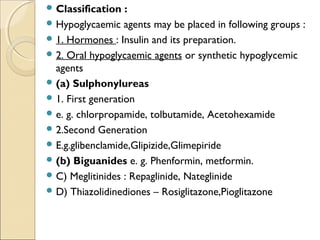
 Classification :
 Hypoglycaemic agents may be placed in following groups :
 1. Hormones : Insulin and its preparation.
 2. Oral hypoglycaemic agents or synthetic hypoglycemic
agents
 (a) Sulphonylureas
 1. First generation
 e. g. chlorpropamide, tolbutamide, Acetohexamide
 2.Second Generation
 E.g.glibenclamide,Glipizide,Glimepiride
 (b) Biguanides e. g. Phenformin, metformin.
 C) Meglitinides : Repaglinide, Nateglinide
 D) Thiazolidinediones – Rosiglitazone,Pioglitazone
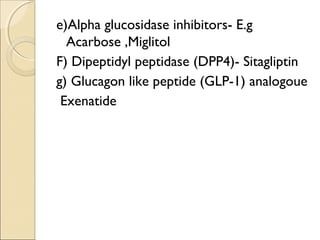
e)Alpha glucosidase inhibitors- E.g
Acarbose ,Miglitol
F) Dipeptidyl peptidase (DPP4)- Sitagliptin
g) Glucagon like peptide (GLP-1) analogoue
Exenatide
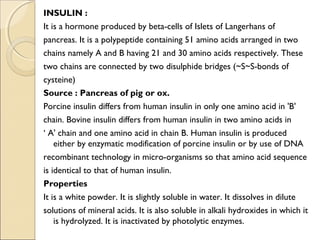
INSULIN :
It is a hormone produced by beta-cells of Islets of Langerhans of
pancreas. It is a polypeptide containing 51 amino acids arranged in two
chains namely A and B having 21 and 30 amino acids respectively. These
two chains are connected by two disulphide bridges (~S~S-bonds of
cysteine)
Source : Pancreas of pig or ox.
Porcine insulin differs from human insulin in only one amino acid in 'B'
chain. Bovine insulin differs from human insulin in two amino acids in
‘ A' chain and one amino acid in chain B. Human insulin is produced
either by enzymatic modification of porcine insulin or by use of DNA
recombinant technology in micro-organisms so that amino acid sequence
is identical to that of human insulin.
Properties
It is a white powder. It is slightly soluble in water. It dissolves in dilute
solutions of mineral acids. It is also soluble in alkali hydroxides in which it
is hydrolyzed. It is inactivated by photolytic enzymes.
 Stability & Storage
 It is sensitive to heat and light and hence it is stored in well-closed
 containers at a temperature below 8° C.
 Insulin injection is stored in multidose containers at a temperature
 between 2° and 8° C and should not be allowed to freeze. The label on
container should bear
 1. Number of units per ml.
 2. The animal source of insulin.
 3. Expiry date.
 4. Storage condition with precautions that
 (i) it should not be allowed to freeze.
 (ii) the container should be shaken gently before withdrawal of dose.
 Uses : It is used
 1. to control diabetes mellitus (which is uncontrollable by diet alone)
 or to treat Insulin dependent diabetes mellitus.2. to regulate
carbohydrate metabolism. 3. to treat hyperkalaemia.
 4. to treat severe ketoacidosis or diabetic coma
Insulin exerts following action:-
Decrease blood sugar level
Increase oxidation of glucose
Increase muscle glycogen
Decreased Gluconeogenesis
Decreased ketogenesis
Increase Lipogenesis
Increased protein synthesis
The actions of insulin (indirect and direct) on cells include:
Stimulates the uptake of glucose - Insulin decreases blood
glucose concentration by inducing intake of glucose by the cell. This
is possible because Insulin causes the insertion of the GLUT4
transporter in the cell membranes of muscle and fat tissues which
allows glucose to enter the cell. [51]
Effect of insulin on glucose uptake and metabolism. Insulin binds
to its receptor (1), which starts many protein activation cascades (2).
These include translocation of Glut-4 transporter to the plasma
membrane and influx of glucose (3), glycogen synthesis (4), glycolysis
(5) and triglyceride synthesis (6).
Induce glycogen synthesis - When glucose levels are high, insulin
induces the formation of glycogen by the activation of the hexokinase
enzyme, which adds a phosphates group in glucose, thus resulting in a
molecule that cannot exit the cell. At the same time, insulin inhibits the
enzyme glucose-6-phosphatase, which removes the phosphate group.
These two enzymes are key for the formation of glycogen. Also, insulin
activates the enzymes phosphofructokinase and glycogen synthase
which are responsible of glycogen synthesis.[57]
Increased potassium uptake – forces cells synthesizing glycogen
(a very spongy, "wet" substance, that
increases the content of intracellular water, and its accompanying K+
ions
)[58]
to absorb potassium from the extracellular fluids; lack of insulin
inhibits absorption. Insulin's increase in cellular potassium uptake
lowers potassium levels in blood plasma. This possibly occurs via
insulin-induced translocation of the Na+/K+-ATPase to the surface of
skeletal muscle cells.[59][60]
Decreased gluconeogenesis and glycogenolysis – decreases
production of glucose from noncarbohydrate substrates, primarily in the
liver (the vast majority of endogenous insulin arriving at the liver never
leaves the liver); increase of insulin causes glucose production by the
liver from assorted substrates.[56]
Increased lipid synthesis – insulin forces fat cells to take in blood
glucose, which is converted into triglycerides; decrease of insulin causes
the reverse.[56]
Increased esterification of fatty acids – forces adipose tissue to make
neutral fats (i.e., triglycerides) from fatty acids; decrease of insulin
causes the reverse.[56]
Decreased lipolysis – forces reduction in conversion of fat cell lipid
stores into blood fatty acids and glycerol; decrease of insulin causes the
reverse.[56]
Decreased proteolysis – decreasing the breakdown of protein[56]
Increased amino acid uptake – forces cells to absorb circulating amino acids
decrease of insulin inhibits absorption.[56]
Arterial muscle tone – forces arterial wall muscle to relax, increasing blood
flow, especially in microarteries; decrease of insulin reduces flow by allowing
these muscles to contract.[citation needed]
Increase in the secretion of hydrochloric acid by parietal cells in the
stomach.[citation needed]
Decreased renal sodium excretion.
Ketoacidosis-The absence of insulin also leads to the release of
free fatty acids from adipose tissue (lipolysis), which are converted
through a process called beta oxidation, again in the liver, into
ketone bodies (acetoacetate and β-hydroxybutyrate). Ketonemia,
Ketouria
Pharmaceutical formulations:
1. Insulin injection.
2. Neutral insulin injection.
3. Biphasic insulin injection.
4. Globin zinc insulin injection.
5. Isophane insulin injection.
6. Protamine zinc insulin injection.
7. Insulin zinc suspension (mixed or
amorphous or crystalline).
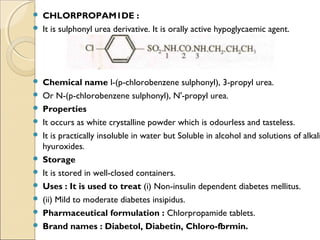
 CHLORPROPAM1DE :
 It is sulphonyl urea derivative. It is orally active hypoglycaemic agent.
 Chemical name l-(p-chlorobenzene sulphonyl), 3-propyl urea.
 Or N-(p-chlorobenzene sulphonyl), N'-propyl urea.
 Properties
 It occurs as white crystalline powder which is odourless and tasteless.
 It is practically insoluble in water but Soluble in alcohol and solutions of alkali
hyuroxides.
 Storage
 It is stored in well-closed containers.
 Uses : It is used to treat (i) Non-insulin dependent diabetes mellitus.
 (ii) Mild to moderate diabetes insipidus.
 Pharmaceutical formulation : Chlorpropamide tablets.
 Brand names : Diabetol, Diabetin, Chloro-fbrmin.
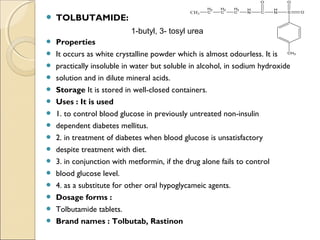
 TOLBUTAMIDE:
 Properties
 It occurs as white crystalline powder which is almost odourless. It is
 practically insoluble in water but soluble in alcohol, in sodium hydroxide
 solution and in dilute mineral acids.
 Storage It is stored in well-closed containers.
 Uses : It is used
 1. to control blood glucose in previously untreated non-insulin
 dependent diabetes mellitus.
 2. in treatment of diabetes when blood glucose is unsatisfactory
 despite treatment with diet.
 3. in conjunction with metformin, if the drug alone fails to control
 blood glucose level.
 4. as a substitute for other oral hypoglycameic agents.
 Dosage forms :
 Tolbutamide tablets.
 Brand names : Tolbutab, Rastinon
CH3
H2
C
H2
C
H2
C
H
N C
H
N
O
S
O
O
CH3
1-butyl, 3- tosyl urea
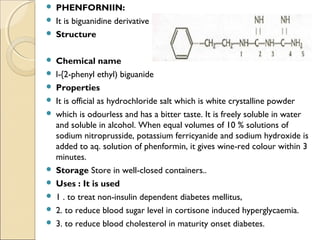
 PHENFORNIIN:
 It is biguanidine derivative
 Structure
 Chemical name
 l-{2-phenyl ethyl) biguanide
 Properties
 It is official as hydrochloride salt which is white crystalline powder
 which is odourless and has a bitter taste. It is freely soluble in water
and soluble in alcohol. When equal volumes of 10 % solutions of
sodium nitroprusside, potassium ferricyanide and sodium hydroxide is
added to aq. solution of phenformin, it gives wine-red colour within 3
minutes.
 Storage Store in well-closed containers..
 Uses : It is used
 1 . to treat non-insulin dependent diabetes mellitus,
 2. to reduce blood sugar level in cortisone induced hyperglycaemia.
 3. to reduce blood cholesterol in maturity onset diabetes.
 Dosage forms :
 Phenfbrmin tablets
 Brand names : Sucronase, Bislim.
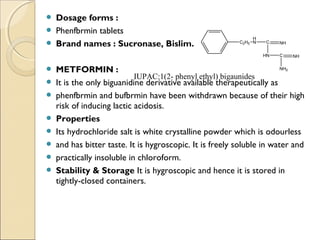
 METFORMIN :
 It is the only biguanidine derivative available therapeutically as
 phenfbrmin and bufbrmin have been withdrawn because of their high
risk of inducing lactic acidosis.
 Properties
 Its hydrochloride salt is white crystalline powder which is odourless
 and has bitter taste. It is hygroscopic. It is freely soluble in water and
 practically insoluble in chloroform.
 Stability & Storage It is hygroscopic and hence it is stored in
tightly-closed containers.
C2H5
H
N C
HN
NH
C NH
NH2
IUPAC:1(2- phenyl ethyl) bigaunides
 Uses : It is used to treat
 1. non-insulin dependent diabetes mellitus.
 2. insulin dependent diabetes mellitus in combination with insulin.
 3. diabetes associated with hyperlipoproteinaemia.
 I 4. obesity.
 Dosage forms :
 Metormin tablets
 Brand names : Diabex, Diafbrmin
 GLIBENCLAMIDE : (GLYBURIDE)
 It is a second generation drug which was introduced in early 1980 and
 probably the most potent on weight basis.,
 Properties
 It is white crystalline powder and is odourless. It is very slightly soluble
 in water and sparingly soluble in chloroform.
 Storage
 It is stored in well-closed containers.
 Uses : It is used
 1. To treat non-insulin dependent diabetes mellitus, either
alone with
 controlled diet or in combination with biguanides.
 2. As a substitute for other hypoglycaemic agents which
cause
 undesirable side effects.
 3. As a possible substitute for insulin in non-insulin
dependent diabetes mellitus.
 Dosage forms :
 Glibenclamide tablet.
 Brand names : Daonil, Euglucon.
O
NH
NHS
O
OH2
C
H2
CHN
C
O
Cl
O
H3C
IUPAC: 5-chloro-N-[2-[4-(cyclohexylcarbamoylsulfamoyl) phenyl]ethyl]-2-
methoxybenzamide

Hypoglycemic agents

  • 1.
    Hypoglycemic agentsHypoglycemic agents AshwiniP. Shewale Pradnya N. Jagtap M.Pharm M.Pharm Pharmaceutical Chemistry Pharmacology
  • 2.
    Hypoglycemic agentsHypoglycemic agents Thenormal blood sugar level is 70-80 mg/100ml. In persons without diabetes, normal 'fasting' blood sugar levels are below 100 mg/dL; levels just prior to meals and snacks should be less than 110 mg/dL. Optimal levels are below 140 mg/dL two hours after meals and below 120 mg/dL before bed,  HYPERGLYCEMIA HYPOGLYCEMIA DIABETIES Mellitus is the condition arising due to abnormal metabolism of carbohydrate , fats and proteins . It is characterized by Hyperglycemia & glucosouria. Diabetes means large urine volume. Mellitus means Honey
  • 3.
     The drugswhich are used to lower blood sugar are called hypoglycemic agents. They are used to treat diabetes mellitus. (Latin word mellitus means honey)  Diabetes mellitus is characterised by persistant hyperglycaemia, usually with glucosuria.  The different factors involved in its origin are hereditary,  immunological, age, stress etc. during which either endogenous insulin secretion is reduced or action of insulin is opposed.  The lack or deficiency of insulin affects carbohydrate, protein and lipid metabolism. As a result the different symptoms (manifestations) observed are hyperglycaemia, glucosuria, ketonaemia, ketonura, hyperlipidaemia, polyuria, polydipsia (increased thirst) etc.
  • 4.
     Diabetes mellitusis divided into following types :  Type 1 : Insulin-dependent diabetes mellitus (IDDM). It is formerly called as Juvenile - onset as it develops generally in youth. Insulin is essential to treat this type as patients have little or no endogenous insulin.  Type 2 : Non-insulin-dependent diabetes mellitus (NIDDM). It is formerly called as adult-onset or maturity-onset diabetes as it develops in middle ages or in elderly patients who are often obese. It is treated by dietary modification or by use of oral hypoglycaemic agents and in certain cases by insulin.  Type 3 : Malnutrition related diabetes mellitus (MRDM).  Type 4 Secondary diabetes. It is due to certain parcreatic disease or certain genetic syndrome or may be drug-induced.
  • 5.
     Classification : Hypoglycaemic agents may be placed in following groups :  1. Hormones : Insulin and its preparation.  2. Oral hypoglycaemic agents or synthetic hypoglycemic agents  (a) Sulphonylureas  1. First generation  e. g. chlorpropamide, tolbutamide, Acetohexamide  2.Second Generation  E.g.glibenclamide,Glipizide,Glimepiride  (b) Biguanides e. g. Phenformin, metformin.  C) Meglitinides : Repaglinide, Nateglinide  D) Thiazolidinediones – Rosiglitazone,Pioglitazone
  • 6.
    e)Alpha glucosidase inhibitors-E.g Acarbose ,Miglitol F) Dipeptidyl peptidase (DPP4)- Sitagliptin g) Glucagon like peptide (GLP-1) analogoue Exenatide
  • 7.
    INSULIN : It isa hormone produced by beta-cells of Islets of Langerhans of pancreas. It is a polypeptide containing 51 amino acids arranged in two chains namely A and B having 21 and 30 amino acids respectively. These two chains are connected by two disulphide bridges (~S~S-bonds of cysteine) Source : Pancreas of pig or ox. Porcine insulin differs from human insulin in only one amino acid in 'B' chain. Bovine insulin differs from human insulin in two amino acids in ‘ A' chain and one amino acid in chain B. Human insulin is produced either by enzymatic modification of porcine insulin or by use of DNA recombinant technology in micro-organisms so that amino acid sequence is identical to that of human insulin. Properties It is a white powder. It is slightly soluble in water. It dissolves in dilute solutions of mineral acids. It is also soluble in alkali hydroxides in which it is hydrolyzed. It is inactivated by photolytic enzymes.
  • 8.
     Stability &Storage  It is sensitive to heat and light and hence it is stored in well-closed  containers at a temperature below 8° C.  Insulin injection is stored in multidose containers at a temperature  between 2° and 8° C and should not be allowed to freeze. The label on container should bear  1. Number of units per ml.  2. The animal source of insulin.  3. Expiry date.  4. Storage condition with precautions that  (i) it should not be allowed to freeze.  (ii) the container should be shaken gently before withdrawal of dose.  Uses : It is used  1. to control diabetes mellitus (which is uncontrollable by diet alone)  or to treat Insulin dependent diabetes mellitus.2. to regulate carbohydrate metabolism. 3. to treat hyperkalaemia.  4. to treat severe ketoacidosis or diabetic coma
  • 9.
    Insulin exerts followingaction:- Decrease blood sugar level Increase oxidation of glucose Increase muscle glycogen Decreased Gluconeogenesis Decreased ketogenesis Increase Lipogenesis Increased protein synthesis
  • 10.
    The actions ofinsulin (indirect and direct) on cells include: Stimulates the uptake of glucose - Insulin decreases blood glucose concentration by inducing intake of glucose by the cell. This is possible because Insulin causes the insertion of the GLUT4 transporter in the cell membranes of muscle and fat tissues which allows glucose to enter the cell. [51] Effect of insulin on glucose uptake and metabolism. Insulin binds to its receptor (1), which starts many protein activation cascades (2). These include translocation of Glut-4 transporter to the plasma membrane and influx of glucose (3), glycogen synthesis (4), glycolysis (5) and triglyceride synthesis (6).
  • 11.
    Induce glycogen synthesis- When glucose levels are high, insulin induces the formation of glycogen by the activation of the hexokinase enzyme, which adds a phosphates group in glucose, thus resulting in a molecule that cannot exit the cell. At the same time, insulin inhibits the enzyme glucose-6-phosphatase, which removes the phosphate group. These two enzymes are key for the formation of glycogen. Also, insulin activates the enzymes phosphofructokinase and glycogen synthase which are responsible of glycogen synthesis.[57] Increased potassium uptake – forces cells synthesizing glycogen (a very spongy, "wet" substance, that increases the content of intracellular water, and its accompanying K+ ions )[58] to absorb potassium from the extracellular fluids; lack of insulin inhibits absorption. Insulin's increase in cellular potassium uptake lowers potassium levels in blood plasma. This possibly occurs via insulin-induced translocation of the Na+/K+-ATPase to the surface of skeletal muscle cells.[59][60]
  • 12.
    Decreased gluconeogenesis andglycogenolysis – decreases production of glucose from noncarbohydrate substrates, primarily in the liver (the vast majority of endogenous insulin arriving at the liver never leaves the liver); increase of insulin causes glucose production by the liver from assorted substrates.[56] Increased lipid synthesis – insulin forces fat cells to take in blood glucose, which is converted into triglycerides; decrease of insulin causes the reverse.[56] Increased esterification of fatty acids – forces adipose tissue to make neutral fats (i.e., triglycerides) from fatty acids; decrease of insulin causes the reverse.[56] Decreased lipolysis – forces reduction in conversion of fat cell lipid stores into blood fatty acids and glycerol; decrease of insulin causes the reverse.[56] Decreased proteolysis – decreasing the breakdown of protein[56] Increased amino acid uptake – forces cells to absorb circulating amino acids decrease of insulin inhibits absorption.[56] Arterial muscle tone – forces arterial wall muscle to relax, increasing blood flow, especially in microarteries; decrease of insulin reduces flow by allowing these muscles to contract.[citation needed] Increase in the secretion of hydrochloric acid by parietal cells in the stomach.[citation needed] Decreased renal sodium excretion.
  • 13.
    Ketoacidosis-The absence ofinsulin also leads to the release of free fatty acids from adipose tissue (lipolysis), which are converted through a process called beta oxidation, again in the liver, into ketone bodies (acetoacetate and β-hydroxybutyrate). Ketonemia, Ketouria
  • 14.
    Pharmaceutical formulations: 1. Insulininjection. 2. Neutral insulin injection. 3. Biphasic insulin injection. 4. Globin zinc insulin injection. 5. Isophane insulin injection. 6. Protamine zinc insulin injection. 7. Insulin zinc suspension (mixed or amorphous or crystalline).
  • 15.
     CHLORPROPAM1DE : It is sulphonyl urea derivative. It is orally active hypoglycaemic agent.  Chemical name l-(p-chlorobenzene sulphonyl), 3-propyl urea.  Or N-(p-chlorobenzene sulphonyl), N'-propyl urea.  Properties  It occurs as white crystalline powder which is odourless and tasteless.  It is practically insoluble in water but Soluble in alcohol and solutions of alkali hyuroxides.  Storage  It is stored in well-closed containers.  Uses : It is used to treat (i) Non-insulin dependent diabetes mellitus.  (ii) Mild to moderate diabetes insipidus.  Pharmaceutical formulation : Chlorpropamide tablets.  Brand names : Diabetol, Diabetin, Chloro-fbrmin.
  • 16.
     TOLBUTAMIDE:  Properties It occurs as white crystalline powder which is almost odourless. It is  practically insoluble in water but soluble in alcohol, in sodium hydroxide  solution and in dilute mineral acids.  Storage It is stored in well-closed containers.  Uses : It is used  1. to control blood glucose in previously untreated non-insulin  dependent diabetes mellitus.  2. in treatment of diabetes when blood glucose is unsatisfactory  despite treatment with diet.  3. in conjunction with metformin, if the drug alone fails to control  blood glucose level.  4. as a substitute for other oral hypoglycameic agents.  Dosage forms :  Tolbutamide tablets.  Brand names : Tolbutab, Rastinon CH3 H2 C H2 C H2 C H N C H N O S O O CH3 1-butyl, 3- tosyl urea
  • 17.
     PHENFORNIIN:  Itis biguanidine derivative  Structure  Chemical name  l-{2-phenyl ethyl) biguanide  Properties  It is official as hydrochloride salt which is white crystalline powder  which is odourless and has a bitter taste. It is freely soluble in water and soluble in alcohol. When equal volumes of 10 % solutions of sodium nitroprusside, potassium ferricyanide and sodium hydroxide is added to aq. solution of phenformin, it gives wine-red colour within 3 minutes.  Storage Store in well-closed containers..  Uses : It is used  1 . to treat non-insulin dependent diabetes mellitus,  2. to reduce blood sugar level in cortisone induced hyperglycaemia.  3. to reduce blood cholesterol in maturity onset diabetes.
  • 18.
     Dosage forms:  Phenfbrmin tablets  Brand names : Sucronase, Bislim.  METFORMIN :  It is the only biguanidine derivative available therapeutically as  phenfbrmin and bufbrmin have been withdrawn because of their high risk of inducing lactic acidosis.  Properties  Its hydrochloride salt is white crystalline powder which is odourless  and has bitter taste. It is hygroscopic. It is freely soluble in water and  practically insoluble in chloroform.  Stability & Storage It is hygroscopic and hence it is stored in tightly-closed containers. C2H5 H N C HN NH C NH NH2 IUPAC:1(2- phenyl ethyl) bigaunides
  • 19.
     Uses :It is used to treat  1. non-insulin dependent diabetes mellitus.  2. insulin dependent diabetes mellitus in combination with insulin.  3. diabetes associated with hyperlipoproteinaemia.  I 4. obesity.  Dosage forms :  Metormin tablets  Brand names : Diabex, Diafbrmin  GLIBENCLAMIDE : (GLYBURIDE)  It is a second generation drug which was introduced in early 1980 and  probably the most potent on weight basis.,  Properties  It is white crystalline powder and is odourless. It is very slightly soluble  in water and sparingly soluble in chloroform.  Storage  It is stored in well-closed containers.
  • 20.
     Uses :It is used  1. To treat non-insulin dependent diabetes mellitus, either alone with  controlled diet or in combination with biguanides.  2. As a substitute for other hypoglycaemic agents which cause  undesirable side effects.  3. As a possible substitute for insulin in non-insulin dependent diabetes mellitus.  Dosage forms :  Glibenclamide tablet.  Brand names : Daonil, Euglucon.
  • 21.