Dyslipidemia
pharmacotherapy
Dr Mahesh B Mudhol
Assistant Professor
September 2024
Plasma lipoproteins
Size , composition -7 types
Chylomicrons
Chylomicron remnants:
VLDL, IDL, LDL, and Lp (a)
HDL is non atherogeic
Cholesterol synthesis occurs in both
peroxisomes and endoplasmic reticulum (ER)
(Fig. 1) and shows a diurnal rhythm peaking at
0300–0500 Rusnak & Krisans, 1987, Krisans,
1996, Wanders & Tager, 1998, Aboushadi et al.,
1999, Hogenboom et al., 2002, Kovacs et al.,
Apolipoproteins have four major functions
1) serving a structural role,
2) acting as ligands for lipoprotein receptors,
3) guiding the formation of lipoproteins, and
4) serving as activators or inhibitors of
enzymes involved in the metabolism of
lipoproteins
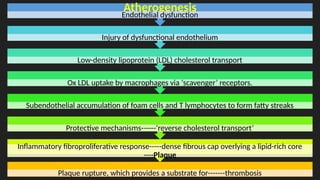
Plaque rupture, which provides a substrate for-------thrombosis
Inflammatory fibroproliferative response-----dense fibrous cap overlying a lipid-rich core
----Plaque
Protective mechanisms------‘reverse cholesterol transport’
Subendothelial accumulation of foam cells and T lymphocytes to form fatty streaks
Ox LDL uptake by macrophages via ‘scavenger’ receptors.
Low-density lipoprotein (LDL) cholesterol transport
Injury of dysfunctional endothelium
Atherogenesis
Endothelial dysfunction
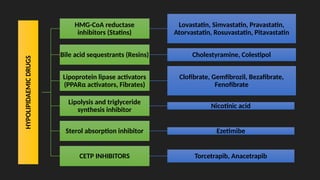
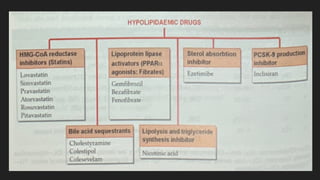
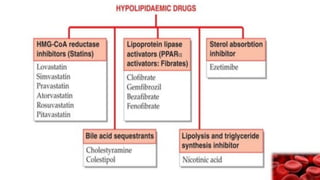
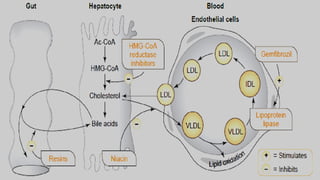
HYPOLIPIDAEMIC
DRUGS HMG-CoA reductase
inhibitors (Statins)
Lovastatin, Simvastatin, Pravastatin,
Atorvastatin, Rosuvastatin, Pitavastatin
Bile acid sequestrants (Resins) Cholestyramine, Colestipol
Lipoprotein lipase activators
(PPARα activators, Fibrates)
Clofibrate, Gemfibrozil, Bezafibrate,
Fenofibrate
Lipolysis and triglyceride
synthesis inhibitor
Nicotinic acid
Sterol absorption inhibitor Ezetimibe
CETP INHIBITORS Torcetrapib, Anacetrapib
Cholesterol,Chylomicron
familial
hyperlipoproteinemia type
2A or Fredrickson type 2A
hyperlipidemia
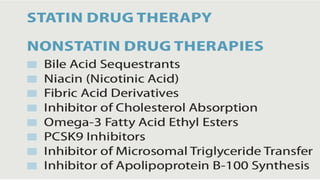
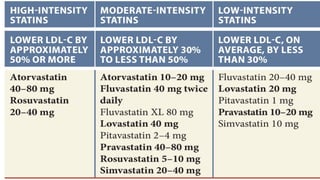
Statins
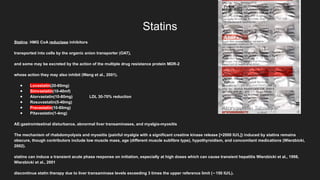
Statins: HMG CoA reductase inhibitors
transported into cells by the organic anion transporter (OAT),
and some may be excreted by the action of the multiple drug resistance protein MDR-2
whose action they may also inhibit (Wang et al., 2001).
● Lovastatin(20-80mg)
● Simvastatin(10-40mf)
● Atorvastatin(10-80mg) LDL 30-70% reduction
● Rosuvastatin(5-40mg)
● Pravastatin(10-80mg)
● Pitavastatin(1-4mg)
AE:gastrointestinal disturbance, abnormal liver transaminases, and myalgia-myositis
The mechanism of rhabdomyolysis and myositis (painful myalgia with a significant creatine kinase release [>2000 IU/L]) induced by statins remains
obscure, though contributors include low muscle mass, age (different muscle subfibre type), hypothyroidism, and concomitant medications (Wierzbicki,
2002).
statins can induce a transient acute phase response on initiation, especially at high doses which can cause transient hepatitis Wierzbicki et al., 1998,
Wierzbicki et al., 2001
discontinue statin therapy due to liver transaminase levels exceeding 3 times the upper reference limit ( 150 IU/L).
∼
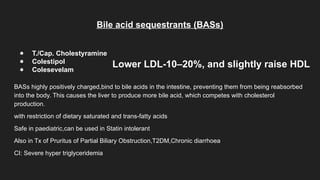
Bile acid sequestrants (BASs)
● T./Cap. Cholestyramine
● Colestipol
● Colesevelam
BASs highly positively charged,bind to bile acids in the intestine, preventing them from being reabsorbed
into the body. This causes the liver to produce more bile acid, which competes with cholesterol
production.
with restriction of dietary saturated and trans-fatty acids
Safe in paediatric,can be used in Statin intolerant
Also in Tx of Pruritus of Partial Biliary Obstruction,T2DM,Chronic diarrhoea
CI: Severe hyper triglyceridemia
Lower LDL-10–20%, and slightly raise HDL
Nicotinic acid /Niacin / Vitamin B3
● Recommended Daily Allowance (RDA) for
adults ranges between 16 and 18 mg daily
● anti-inflammatory effects, inhibition of free
oxygen radical,
● increase of serum adiponectin levels
● In adipose tissue, inhibits the lipolysis of
triglycerides by hormone sensitive lipase,
thereby reducing transport of free fatty acids to
the liver and decreasing hepatic triglyceride
synthesis.
● raises HDL-C levels by decreasing the
fractional clearance of apo A-I in HDL
AE: Flushing,Niacin also elevates uric acid levels and
may reactivate gout.
35-50% reduction in TG
4-7days to be effective
Niacin is the most effective agent available for
increasing HDL-C (30%–40%)
Concurrent use of niacin and a statin can cause
myopathy.
Fibrates
activates lipoprotein lypase through
nuclear peroxisome proliferator activated
receptor alpha.
TGs are reduced
● 1st generation
○ Gemfibrozil
○ Bezafibrate
● 2nd Generation
○ Fenofibrate 200mg OD č meals
Elevated triglycerides are an important
risk factor for pancreatitis.
with type III hyperlipoproteinemia
(dysbetalipoproteinemia) are better
responders
T.Gemfibrogyl600-mg dose taken twice
daily, 30 min before the morning and
evening meals.
AE: increased risk of gallstone formation
CI: children & pregnancy
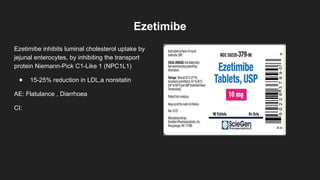
Ezetimibe
Ezetimibe inhibits luminal cholesterol uptake by
jejunal enterocytes, by inhibiting the transport
protein Niemann-Pick C1-Like 1 (NPC1L1)
● 15-25% reduction in LDL,a nonstatin
AE: Flatulance , Diarrhoea
CI:
Omega-3 fatty acids
Omega-3 fatty acids, commonly Eicosapentaenoic acid (EHA)and DHA
docosahexaenoic acid ethyl esters, reduce VLDL triglycerides and are used as an
adjunct to diet for treatment of adult patients with severe hypertriglyceridemia.
1-2grans OTC
arthralgia, nausea, fishy burps, dyspepsia
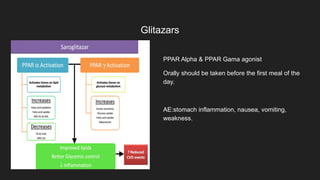
Glitazars
PPAR Alpha & PPAR Gama agonist
Orally should be taken before the first meal of the
day.
AE:stomach inflammation, nausea, vomiting,
weakness,
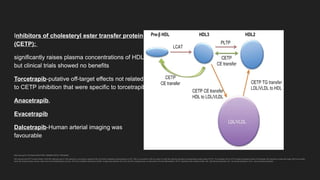
Inhibitors of cholesteryl ester transfer protein
(CETP):
significantly raises plasma concentrations of HDL
but clinical trials showed no benefits
Torcetrapib-putative off-target effects not related
to CETP inhibition that were specific to torcetrapib.
Anacetrapib,
Evacetrapib
Dalcetrapib-Human arterial imaging was
favourable
https://doi.org/10.2147/dddt.s34976 PMID: 23055695 PMCID: PMC346067
HDL lifecycle and CETP function.Notes: Pre-β HDL (lipid-poor apo A-I HDL particles) is converted to spherical HDL3 by lecithin-cholesterol acyltransferase (LCAT). HDL3 is converted to HDL2 by fusion of small HDL particles activated by phospholipid transfer protein (PLTP). The modulator role of CETP transfers cholesteryl esters (CE) between HDL particles to create both larger HDL2 and smaller
pre-β HDL particles (green arrows), which may be an antiatherogenic process. CETP also mediates heterotropic transfer of triglyceride between LDL/VLDL and HDL (orange arrows), as discussed in the text.Abbreviations: CETP, cholesteryl ester transfer protein; HDL, high-density lipoprotein; LDL, low density lipoprotein; VLDL, very low density lipoprotein.
PCSK9 inhibitors
Proprotein convertase subtilisin/kexin type 9 is a protease that binds to the
LDL receptor on the surface of hepatocytes and enhances lysosomal
degradation of the LDL receptor, resulting in higher plasma LDL
concentrations.
siRNA that targets PCSK9 mRNA
Inj.Evolocumab is administered as a 140-mg injection every 2 weeks or 420
mg once monthly.
S/C Inj Inclisiran
Lomitapide
Inhibitor of Microsomal Triglyceride Transfer Lomitapide,reduces VLDL
Metabolism: metabolized by CYP3A4
Indicated for lowering LDL as adjuvant
CI : with inhibitors of CYP3A4
5mg/d before meal
Inhibitor of apolipoprotein B-100 synthesis -Mipomersen
first antisense oligonucleotide inhibitor of apo B-100
synthesis acts on mRNA and inhibits apo B in a sequence
manner
S/C Inj 1ml of 200mg/ml once weekly
Maximal LDL reduction can be achieved after 1-2 months
Drug interactions
● Statin interactions occur with fibrates,
especially Gemfibrozil (38%), and with
Cyclosporine (4%), Digoxin (5%), Warfarin
(4%), macrolide antibiotics (3%), and azole
antifungals (1%).
● Ledipasvir(LDV) NS5A inhibitor inhibits
BCRP and Rosuvastatin levels will increase
● Gemfibrozil and higher doses of statins.
Gemfibrozil inhibits hepatic uptake of
statins by OATP1B1 and competes for the
same glucuronosyl transferases that
metabolize most statins.
● Itraconazole is a strong
CYP3A4 inhibitor and increases
the AUC of Lovastatin acid and
Simvastatin acid by 15-20 times
and 19 times their original
values, respectively.
● According to a 2012 FDA
warning, Simvastatin should not
be used in combination with
cyclosporine, HIV protease
inhibitors, erythromycin, or
gemfibrozil
Thank you 🙏