B Y : M U H A M M A D H A L M I I
F B : M U H A M M A D H E L M I
W H A T S A P P : 0 1 6 3 6 2 6 4 7 0
T W I T T E R : @ C H A L D E A P R I N C E
Hyperlipidemia
TEAM GENESIS
 DEFINE
 CAUSE
 DIAGNOSIS
 TYPES
 PATHOGENESIS
 EFFECT
 CLINICAL MENIFESTATIONS (SIGNS & SYMPTOMS)
A Glimpse Through Foundation/Matrix
TG
Phospholipid
Cholesterol
Lipoprotein Types
Lipoprotein
Chylomicron
LDL
VLDLIDL
HDL
Lipid Metabolism
 Endogenous = Liver {De Novo Synthesis}
(VLDL→IDL→LDL) [Apo B 100]
 Exogenous= Intestine {From Diet}
(Chylomicron→Chylomicron Remnants) [Apo B 48]
HDL
[Apo C II ’Activate
Lipoproten Lipase’
, Apo E ’Liver
Recognition’ ]
 Apolipoprotein (Apo
B48) organizes assembly
in enterocyte’s golgi/ER
 Picks up apo A,C and E
in plasma (HDL)
 Circulating chylomicrons
interact at the capillaries
of adipose tissue and
muscle cells releasing TG
to the adipose tissue to
be stored and available
for the body's energy
needs.
 The enzyme LPL
hydrolyzes the TG and
free-fatty acids are
released.
 TG and cholesterol ester are generated by
the liver and packaged into VLDL particles
and then released into the circulation
 VLDL is then processed by LPL in tissues to
release fatty acids and glycerol.
 The majority of the VLDL remnants are
taken up by the liver via the LDL
receptor, and the remaining remnant
particles become IDL, a smaller, denser
lipoprotein than VLDL.
 The fate of some of the IDL particles
requires them to be reabsorbed by the liver
(again by the LDL receptor)
 However, other IDL particles are hydrolyzed
in the liver by hepatic-triglyceride lipase to
form LDL
VIDEO
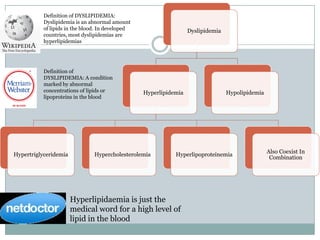
Dyslipidemia
Hyperlipidemia
Hypertriglyceridemia Hypercholesterolemia Hyperlipoproteinemia
Also Coexist In
Combination
Hypolipidemia
Definition of
DYSLIPIDEMIA: A condition
marked by abnormal
concentrations of lipids or
lipoproteins in the blood
Definition of DYSLIPIDEMIA:
Dyslipidemia is an abnormal amount
of lipids in the blood. In developed
countries, most dyslipidemias are
hyperlipidemias
Hyperlipidaemia is just the
medical word for a high level of
lipid in the blood
Risk Factors

 Creamy Top (Supernatant)
{Indicative Of Chylomicron
(Low Density, Tends To
Float)}
 Clear {Either Normal Or
Indicative Of High
Cholesterol Content (Why
Is It Clear ?)}
 Turbid/Milky/Cloudy
{Indicative Of High TG But
Specifically Refers To
VLDL (Density
Factors, Molecular
Factors)}
Lipoprotein Electrophoresis
I. Chylomicron
II. LDL
IIa LDL
IIb LDL + VLDL
III. IDL
IV. VLDL
V. Chylomicron
& VLDL
Types
Hyperlipidemia
Primary
Secondary
{Common}
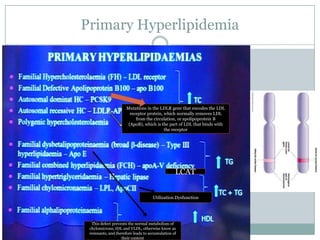
Primary Hyperlipidemia
LCAT
Mutations in the LDLR gene that encodes the LDL
receptor protein, which normally removes LDL
from the circulation, or apolipoprotein B
(ApoB), which is the part of LDL that binds with
the receptor
This defect prevents the normal metabolism of
chylomicrons, IDL and VLDL, otherwise know as
remnants, and therefore leads to accumulation of
their content
Utilization Dysfunction
Secondary
Hypothyroidism
 When the thyroid slows down (hypothyroidism), it
also slows down the body's ability to process
cholesterol.
 This processing lag is largely explained by a
reduction in the number and activity of what are
known as LDL receptors. LDL receptors help remove
bad cholesterol from the body
 When the number of receptors decreases, LDL
accumulates in the bloodstream, acting to increase
both LDL and total cholesterol levels.
Normal
Hypo
Nephrotic Syndrome/Renal Failure
 Nephrotic syndrome is a nonspecific kidney disorder characterized by a number of signs
of disease: proteinuria, hypoalbuminemia and edema. It is characterized by an increase
in permeability of the capillary walls of the glomerulus leading to the presence of
proteinuria
 The increased loss of proteins in urine stimulates the liver to increase synthesis of
proteins
 Apolipoporteins are synthesised in increased quantities – especially apo B, apo C-II, and
apo E which are used VLDL and LDL formation
 Apoproteins associated with HDL synthesis – apo A-I and apo A-II usually remains
normal
 In addition to this, there is decreased lipid catabolism due to decreased activity of
lipoprotein lipase
 Underlying mechanisms probably include overproduction by the liver, which
concurrently increases albumin synthesis to compensate for renal protein wasting.
Cholestasis
 In medicine, cholestasis is a condition where bile
cannot flow from the liver to the duodenum. The two
basic distinctions are an obstructive type of
cholestasis where there is a mechanical blockage in
the duct system such as can occur from a gallstone or
malignancy, and metabolic types of cholestasis which
are disturbances in bile formation.
 Decreased cholesterol excretion (NB: Normally, 20%
of secreted bile is excreted, most significant route of
cholesterol excretion)---> Hypercholesterolemia
Obesity
 People with excess visceral adipose tissue often have
elevated triglyceride and low HDL-C levels.
 Supply exceeds demand
Diabetes
 Diabetes is due to either the pancreas not produce enough insulin, or because cells
of the body do not respond properly to the insulin that is produced.
 Diabetic ketoacidosis (DKA) is a potentially life-threatening complication in
patients with diabetes mellitus. It happens predominantly in those with type 1
diabetes, but it can occur in those with type 2 diabetes under certain circumstances.
DKA results from a shortage of insulin; in response the body switches to burning
fatty acids and producing acidic ketone bodies that cause most of the symptoms and
complications.
 Increased Lipolysis
SIDE INFO:
 Diabetes insipidus (DI) is a condition characterized by excessive thirst and excretion
of large amounts of severely diluted urine, with reduction of fluid intake having no
effect on the concentration of the urine.
Alcoholism
 Hypertriglyceridemia associated with alcohol intake also mainly results
from increased plasma VLDL. In some alcohol users, plasma triglyceride
measurements can remain within the normal range because of an adaptive
increase in lipolytic activity.
 However, alcohol can also impair lipolysis, especially when a patient has a
pre-existing functional deficiency of lipoprotein lipase, which leads to
markedly increased plasma triglycerides
 Alcohol has a significant additive effect on the triglyceride peak when it
accompanies a meal containing fat, especially saturated fat. This results
from a decrease in the breakdown of chylomicrons and VLDL remnants due
to an acute inhibitory effect of alcohol on lipoprotein lipase activity.
 Furthermore, alcohol increases the synthesis of large VLDL particles in the
liver, which is the main source of triglycerides in the hypertriglyceridemia
associated with chronic excessive alcohol intake.
Drugs
 MoA Of Certain Drugs
Myeloma
 In multiple myeloma, collections of
abnormal plasma cells accumulate in the
bone marrow, where they interfere with
the production of normal blood cells.
Most cases of myeloma also feature the
production of a paraprotein—an
abnormal antibody which can cause
kidney problems. Bone lesions and
hypercalcemia (high blood calcium
levels) are also often encountered.
 Distorts the normal plasma environment
(Proteins are –vely charged)
Anorexia
 Mean serum levels of total cholesterol (TC), low-density
lipoprotein cholesterol (LDL-C), high-density lipoprotein
cholesterol (HDL-C), ketone bodies, apolipoprotein
(apo)-A1, B, C2, C3, E, and cholesterol ester transfer
protein (CETP) activity were significantly higher in
patients with Anorexia than in controls.
 Serum levels of cholesterol, CETP, and apolipoproteins
decreased after weight gain, indicating that cholesterol
metabolism is accelerated in patients with Anorexia.
 ―Quoted from Dallas University Research‖
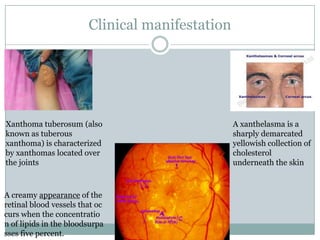
Clinical manifestation
A xanthelasma is a
sharply demarcated
yellowish collection of
cholesterol
underneath the skin
Xanthoma tuberosum (also
known as tuberous
xanthoma) is characterized
by xanthomas located over
the joints
A creamy appearance of the
retinal blood vessels that oc
curs when the concentratio
n of lipids in the bloodsurpa
sses five percent.
 Palmar xanthoma is clinically characterized by
yellowish plaques that involve the palms and
flexural surfaces of the fingers.[1]:531 Plane
xanthomas are characterised by yellowish to
orange, flat macules or slightly elevated
plaques, often with a central white area which may
be localised or generalised. They often arise in the
skin folds, especially the palmar creases. They
occur in hyperlipoproteinaemia type III and type
IIA, and in association with biliary cirrhosis. The
presence of palmar xanthomata, like the presence
of tendinous xanthomata, is indicative of
hypercholesterolaemia.
Eruptive xanthoma is
clinically characterized by
small, yellowish-orange to
reddish-brown papules
that appear all over the
body.It tends to be
associated with elevated
triglycerides
Effects & Complications

Hyperlipidimea

  • 1.
    B Y :M U H A M M A D H A L M I I F B : M U H A M M A D H E L M I W H A T S A P P : 0 1 6 3 6 2 6 4 7 0 T W I T T E R : @ C H A L D E A P R I N C E Hyperlipidemia
  • 2.
    TEAM GENESIS  DEFINE CAUSE  DIAGNOSIS  TYPES  PATHOGENESIS  EFFECT  CLINICAL MENIFESTATIONS (SIGNS & SYMPTOMS)
  • 3.
    A Glimpse ThroughFoundation/Matrix TG Phospholipid Cholesterol
  • 4.
  • 5.
    Lipid Metabolism  Endogenous= Liver {De Novo Synthesis} (VLDL→IDL→LDL) [Apo B 100]  Exogenous= Intestine {From Diet} (Chylomicron→Chylomicron Remnants) [Apo B 48] HDL [Apo C II ’Activate Lipoproten Lipase’ , Apo E ’Liver Recognition’ ]
  • 6.
     Apolipoprotein (Apo B48)organizes assembly in enterocyte’s golgi/ER  Picks up apo A,C and E in plasma (HDL)  Circulating chylomicrons interact at the capillaries of adipose tissue and muscle cells releasing TG to the adipose tissue to be stored and available for the body's energy needs.  The enzyme LPL hydrolyzes the TG and free-fatty acids are released.
  • 7.
     TG andcholesterol ester are generated by the liver and packaged into VLDL particles and then released into the circulation  VLDL is then processed by LPL in tissues to release fatty acids and glycerol.  The majority of the VLDL remnants are taken up by the liver via the LDL receptor, and the remaining remnant particles become IDL, a smaller, denser lipoprotein than VLDL.  The fate of some of the IDL particles requires them to be reabsorbed by the liver (again by the LDL receptor)  However, other IDL particles are hydrolyzed in the liver by hepatic-triglyceride lipase to form LDL
  • 9.
  • 10.
    Dyslipidemia Hyperlipidemia Hypertriglyceridemia Hypercholesterolemia Hyperlipoproteinemia AlsoCoexist In Combination Hypolipidemia Definition of DYSLIPIDEMIA: A condition marked by abnormal concentrations of lipids or lipoproteins in the blood Definition of DYSLIPIDEMIA: Dyslipidemia is an abnormal amount of lipids in the blood. In developed countries, most dyslipidemias are hyperlipidemias Hyperlipidaemia is just the medical word for a high level of lipid in the blood
  • 11.
  • 12.
     Creamy Top(Supernatant) {Indicative Of Chylomicron (Low Density, Tends To Float)}  Clear {Either Normal Or Indicative Of High Cholesterol Content (Why Is It Clear ?)}  Turbid/Milky/Cloudy {Indicative Of High TG But Specifically Refers To VLDL (Density Factors, Molecular Factors)}
  • 13.
    Lipoprotein Electrophoresis I. Chylomicron II.LDL IIa LDL IIb LDL + VLDL III. IDL IV. VLDL V. Chylomicron & VLDL
  • 14.
  • 15.
    Primary Hyperlipidemia LCAT Mutations inthe LDLR gene that encodes the LDL receptor protein, which normally removes LDL from the circulation, or apolipoprotein B (ApoB), which is the part of LDL that binds with the receptor This defect prevents the normal metabolism of chylomicrons, IDL and VLDL, otherwise know as remnants, and therefore leads to accumulation of their content Utilization Dysfunction
  • 16.
  • 17.
    Hypothyroidism  When thethyroid slows down (hypothyroidism), it also slows down the body's ability to process cholesterol.  This processing lag is largely explained by a reduction in the number and activity of what are known as LDL receptors. LDL receptors help remove bad cholesterol from the body  When the number of receptors decreases, LDL accumulates in the bloodstream, acting to increase both LDL and total cholesterol levels.
  • 18.
  • 19.
    Nephrotic Syndrome/Renal Failure Nephrotic syndrome is a nonspecific kidney disorder characterized by a number of signs of disease: proteinuria, hypoalbuminemia and edema. It is characterized by an increase in permeability of the capillary walls of the glomerulus leading to the presence of proteinuria  The increased loss of proteins in urine stimulates the liver to increase synthesis of proteins  Apolipoporteins are synthesised in increased quantities – especially apo B, apo C-II, and apo E which are used VLDL and LDL formation  Apoproteins associated with HDL synthesis – apo A-I and apo A-II usually remains normal  In addition to this, there is decreased lipid catabolism due to decreased activity of lipoprotein lipase  Underlying mechanisms probably include overproduction by the liver, which concurrently increases albumin synthesis to compensate for renal protein wasting.
  • 20.
    Cholestasis  In medicine,cholestasis is a condition where bile cannot flow from the liver to the duodenum. The two basic distinctions are an obstructive type of cholestasis where there is a mechanical blockage in the duct system such as can occur from a gallstone or malignancy, and metabolic types of cholestasis which are disturbances in bile formation.  Decreased cholesterol excretion (NB: Normally, 20% of secreted bile is excreted, most significant route of cholesterol excretion)---> Hypercholesterolemia
  • 21.
    Obesity  People withexcess visceral adipose tissue often have elevated triglyceride and low HDL-C levels.  Supply exceeds demand
  • 22.
    Diabetes  Diabetes isdue to either the pancreas not produce enough insulin, or because cells of the body do not respond properly to the insulin that is produced.  Diabetic ketoacidosis (DKA) is a potentially life-threatening complication in patients with diabetes mellitus. It happens predominantly in those with type 1 diabetes, but it can occur in those with type 2 diabetes under certain circumstances. DKA results from a shortage of insulin; in response the body switches to burning fatty acids and producing acidic ketone bodies that cause most of the symptoms and complications.  Increased Lipolysis SIDE INFO:  Diabetes insipidus (DI) is a condition characterized by excessive thirst and excretion of large amounts of severely diluted urine, with reduction of fluid intake having no effect on the concentration of the urine.
  • 23.
    Alcoholism  Hypertriglyceridemia associatedwith alcohol intake also mainly results from increased plasma VLDL. In some alcohol users, plasma triglyceride measurements can remain within the normal range because of an adaptive increase in lipolytic activity.  However, alcohol can also impair lipolysis, especially when a patient has a pre-existing functional deficiency of lipoprotein lipase, which leads to markedly increased plasma triglycerides  Alcohol has a significant additive effect on the triglyceride peak when it accompanies a meal containing fat, especially saturated fat. This results from a decrease in the breakdown of chylomicrons and VLDL remnants due to an acute inhibitory effect of alcohol on lipoprotein lipase activity.  Furthermore, alcohol increases the synthesis of large VLDL particles in the liver, which is the main source of triglycerides in the hypertriglyceridemia associated with chronic excessive alcohol intake.
  • 24.
    Drugs  MoA OfCertain Drugs
  • 25.
    Myeloma  In multiplemyeloma, collections of abnormal plasma cells accumulate in the bone marrow, where they interfere with the production of normal blood cells. Most cases of myeloma also feature the production of a paraprotein—an abnormal antibody which can cause kidney problems. Bone lesions and hypercalcemia (high blood calcium levels) are also often encountered.  Distorts the normal plasma environment (Proteins are –vely charged)
  • 26.
    Anorexia  Mean serumlevels of total cholesterol (TC), low-density lipoprotein cholesterol (LDL-C), high-density lipoprotein cholesterol (HDL-C), ketone bodies, apolipoprotein (apo)-A1, B, C2, C3, E, and cholesterol ester transfer protein (CETP) activity were significantly higher in patients with Anorexia than in controls.  Serum levels of cholesterol, CETP, and apolipoproteins decreased after weight gain, indicating that cholesterol metabolism is accelerated in patients with Anorexia.  ―Quoted from Dallas University Research‖
  • 27.
    Clinical manifestation A xanthelasmais a sharply demarcated yellowish collection of cholesterol underneath the skin Xanthoma tuberosum (also known as tuberous xanthoma) is characterized by xanthomas located over the joints A creamy appearance of the retinal blood vessels that oc curs when the concentratio n of lipids in the bloodsurpa sses five percent.
  • 28.
     Palmar xanthomais clinically characterized by yellowish plaques that involve the palms and flexural surfaces of the fingers.[1]:531 Plane xanthomas are characterised by yellowish to orange, flat macules or slightly elevated plaques, often with a central white area which may be localised or generalised. They often arise in the skin folds, especially the palmar creases. They occur in hyperlipoproteinaemia type III and type IIA, and in association with biliary cirrhosis. The presence of palmar xanthomata, like the presence of tendinous xanthomata, is indicative of hypercholesterolaemia. Eruptive xanthoma is clinically characterized by small, yellowish-orange to reddish-brown papules that appear all over the body.It tends to be associated with elevated triglycerides
  • 29.