ANTIVIRAL

DRUGS

Dr. Gyanendra Raj Joshi
PharmD, RPh

1
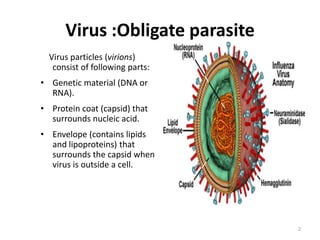
Virus :Obligate parasite
Virus particles (virions)
consist of following parts:
• Genetic material (DNA or
RNA).
• Protein coat (capsid) that
surrounds nucleic acid.
• Envelope (contains lipids
and lipoproteins) that
surrounds the capsid when
virus is outside a cell.

2
DNA Virus:
Pox virus( small pox)
Herpes virus
Adeno virus ( conjunctivitis ,
sore throat)
Hepadna virus ( HBV)
Papilloma virus ( warts )

RNA virus
Rubella virus ( German
Measles)
Rhabdo virus ( rabies)
Picorna virus ( polio,
meningitis, cold , Hepatitis
A)
Arena virus (lassa fever)
Flavi virus (yellow fever , HCV)
Orthomyxo virus (Influenza)
Paramyxo virus (mumps ,
measles)
Corona virus (cold , SARS)
3
Viral infections

4
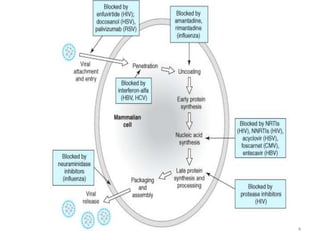
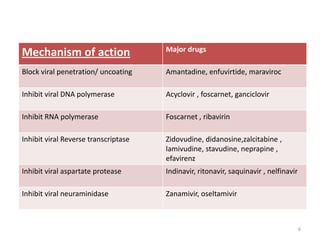
Mechanism of action

Major drugs

Block viral penetration/ uncoating

Amantadine, enfuvirtide, maraviroc

Inhibit viral DNA polymerase

Acyclovir , foscarnet, ganciclovir

Inhibit RNA polymerase

Foscarnet , ribavirin

Inhibit viral Reverse transcriptase

Zidovudine, didanosine,zalcitabine ,
lamivudine, stavudine, neprapine ,
efavirenz

Inhibit viral aspartate protease

Indinavir, ritonavir, saquinavir , nelfinavir

Inhibit viral neuraminidase

Zanamivir, oseltamivir

6
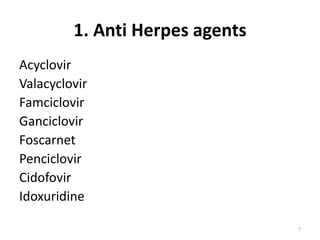
1. Anti Herpes agents
Acyclovir
Valacyclovir
Famciclovir
Ganciclovir
Foscarnet
Penciclovir
Cidofovir
Idoxuridine
7
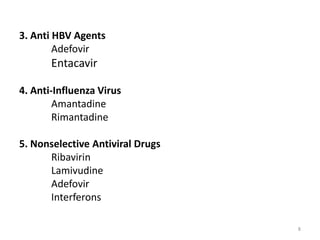
3. Anti HBV Agents
Adefovir

Entacavir
4. Anti-Influenza Virus
Amantadine
Rimantadine
5. Nonselective Antiviral Drugs
Ribavirin
Lamivudine
Adefovir
Interferons
8
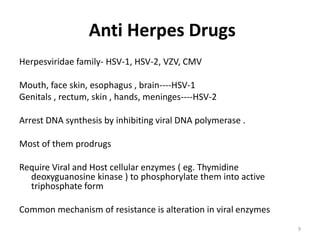
Anti Herpes Drugs
Herpesviridae family- HSV-1, HSV-2, VZV, CMV

Mouth, face skin, esophagus , brain----HSV-1
Genitals , rectum, skin , hands, meninges----HSV-2
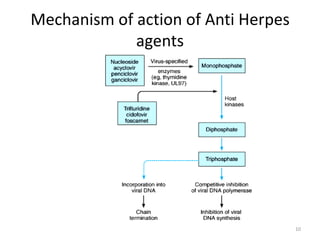
Arrest DNA synthesis by inhibiting viral DNA polymerase .
Most of them prodrugs
Require Viral and Host cellular enzymes ( eg. Thymidine
deoxyguanosine kinase ) to phosphorylate them into active
triphosphate form
Common mechanism of resistance is alteration in viral enzymes
9
Mechanism of action of Anti Herpes
agents

10
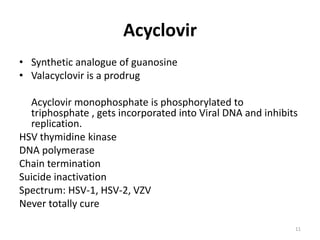
Acyclovir
• Synthetic analogue of guanosine
• Valacyclovir is a prodrug
Acyclovir monophosphate is phosphorylated to
triphosphate , gets incorporated into Viral DNA and inhibits
replication.
HSV thymidine kinase
DNA polymerase
Chain termination
Suicide inactivation
Spectrum: HSV-1, HSV-2, VZV
Never totally cure
11
• Advantage:
– No hematotoxicity, no myelosupression
– Treatment of herpes encephalitis

• Resistance :
– Absence or partial production of TK
– Altered TK specificity
– Altered viral DNA polymerase

• Adverse effects :
–
–
–
–
–

PEG base topical effects
Oral- nausea , vomiting , diarrhoea and headache
Dose dependent renal impairment , crystallie nephropathy
Neurological – lethargy , confusion , tremors
Rash , itching and phlebitis at injection site
12
Ganciclovir
• Similar to acyclovir
• First phosphorylation viral specific, TK in HSV,
Phosphotransferase (UL97) in CMV
• Triphosphate form inhibits viral DNA polymerase
and causes chain termination
• HSV, VZV, CMV reitinitis in HIV patients
• Dose limiting hematotoxicity, mucositis , fever,
rash , crystalluria
• Seizures in overdose
13
Foscarnet
Inorganic pyrophosphate analog inhibitory for
herpes and HIV
• Not an antimetabolite
• Interacts directly with Viral DNA polymerase
or HIV reverse transcriptase
• Blocks binding site of pyrophosphate and
inhibits cleavage
• IV
14
•
•
•
•
•
•
•
•
•
•

Nephrotoxicity
Hypocalcemia
Acute tubular necrosis
Crystalluria
CNS – tremor, irritabilty, seizure , halluccination,
Rash, fever,nausea, vomiting
Anemia, LFT,ECG
Avoid pentamidine iv
CMV retinitis
Ganciclovir resistant infections in AIDS
15
Anti-influenza agents

• Amantadine/ rimantadine
–
–
–
–
–
–
–
–
–
–
–
–

Tricyclic amines
Low concentration inhibits replication
Rimantadine more active , also for Trypanosoma brucei
Inhibit attachment, penetration and viral uncoating
M2 protein inhibition
Potentiate acid pH induced changes in hemaggluttin during
intracellular transfer
Minor Dose related GIT and CNS effects
Atropine like
Livedo reticularis
Insomnia
Loss of appetite
Teratogenic
16
Oseltamivir/zanamivir
– Absorbed rapidly and cleaved to active
carboxylate
– Selective inhibitor of vial neuraminidase and leads
to viral aggregation and reduced spread
– Nausea , abdominal discomfort—given with food
– Nasal and throat irritation
– Flu like
– Influenza A and B
17
Ribavirin
• Monophosphorylated form inhibits IMP
dehydrogenase and as a result depletes intracellular
nucleotide reserves.
• Triphosphate inhibits viral RNA polymerase and end
capping of viral RNA
• Used as an adjunct to IFN in HCV infection
• Management of respiratory syncytial virus
• Lassa fever
• Hematotoxic
• Upper airway irritation
• Teratogenic
18
Anti hepatitis agents
• Adefovir dipivoxil
– Acyclic phosphonate
nucleotide of adenosine
monophosphate
– Adefovir diphosphate is
competitive inhibitor of
DNA polymerase and
reverse transcriptase
– Chain terminator
– Chronic HBV
– Lamivudine resistant
HBV strains

– Reduced carnitine
– Dose related
nephrotoxicity/tubular
dysfunction
– Headache , abdominal
discomfort, diarrhoea ,
asthenia
– Hepatotoxicity ,lymphoid
toxicity

19
Interferons
• Potent cytokines
• Antiviral, immunomodulating and
antiproliferative
• Synthesised by host cells
• Types –
– α, β- all cells, stimulate MHC antigen
– γ - T lymphocytes / NK cells

• Pegylated interferon
• Inhibit protein synthesis , activate
endoribonuclease
20
• Acute influenza like
syndrome – fever , chills,
headache, myalgia ,
arthralgia, nausea ,
vomiting and diarrhorea
• Tolerance
• Dose limiting –
myleosuppression
• Neurotoxicity- confusion
• Hepatotoxicity

• Condyloma acuminata(
genital warts )
• Chronic HCV, HBV
• Kaposi Sarcoma in HIV
• Multiple sclerosis

21
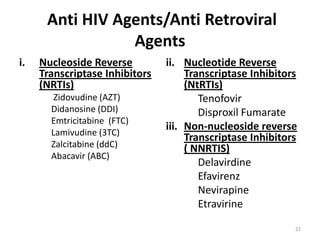
Anti HIV Agents/Anti Retroviral
Agents
i.

Nucleoside Reverse
Transcriptase Inhibitors
(NRTIs)
Zidovudine (AZT)
Didanosine (DDI)
Emtricitabine (FTC)
Lamivudine (3TC)
Zalcitabine (ddC)
Abacavir (ABC)

ii. Nucleotide Reverse
Transcriptase Inhibitors
(NtRTIs)
Tenofovir
Disproxil Fumarate
iii. Non-nucleoside reverse
Transcriptase Inhibitors
( NNRTIS)
Delavirdine
Efavirenz
Nevirapine
Etravirine
22
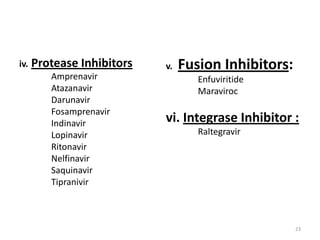
iv.

Protease Inhibitors
Amprenavir
Atazanavir
Darunavir
Fosamprenavir
Indinavir
Lopinavir
Ritonavir
Nelfinavir
Saquinavir
Tipranivir

v.

Fusion Inhibitors:
Enfuviritide
Maraviroc

vi. Integrase Inhibitor :
Raltegravir

23
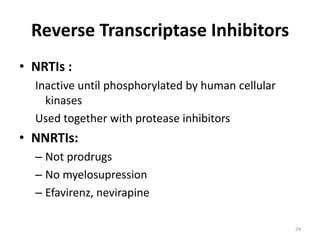
Reverse Transcriptase Inhibitors
• NRTIs :
Inactive until phosphorylated by human cellular
kinases
Used together with protease inhibitors

• NNRTIs:
– Not prodrugs
– No myelosupression
– Efavirenz, nevirapine
24
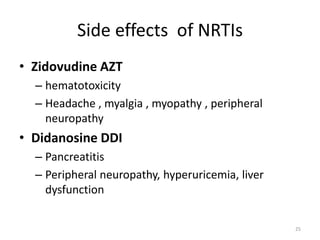
Side effects of NRTIs
• Zidovudine AZT
– hematotoxicity
– Headache , myalgia , myopathy , peripheral
neuropathy

• Didanosine DDI
– Pancreatitis
– Peripheral neuropathy, hyperuricemia, liver
dysfunction
25
• Zalcitabine DDC
– Peripheral neuropathy
– GI distress, pancreatitis, neutropenia, rash

• Stavudine D4T
– Peripheral neuropathy
– Myelosupression

• Lamivudine 3TC
– GI effects and neutropenia
26
• ADRs of Efavirenz (a NNRTI)
– Not during pregnancy
– Dizziness
– Vivid dreams

27
Protease inhibitors
• Aspartate protease (pol gene encoded)
cleaves precursor polypeptides to form the
proteins of mature virion core
• Selective to dipeptide structure of viral
proteins
• Combined with NRTIs
• Indinavir , ritonavir
28
Adverse effects of PI
•
•
•
•
•
•

Paresthesia
Diarrhoea
Nausea and vomiting
Hypertriglyceridemia
Hyperglycemia
Hypercholesterolemia

29
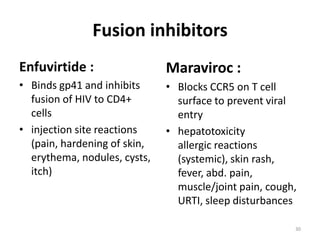
Fusion inhibitors
Enfuvirtide :

Maraviroc :

• Binds gp41 and inhibits
fusion of HIV to CD4+
cells
• injection site reactions
(pain, hardening of skin,
erythema, nodules, cysts,
itch)

• Blocks CCR5 on T cell
surface to prevent viral
entry
• hepatotoxicity
allergic reactions
(systemic), skin rash,
fever, abd. pain,
muscle/joint pain, cough,
URTI, sleep disturbances
30
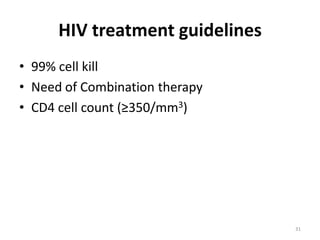
HIV treatment guidelines
• 99% cell kill
• Need of Combination therapy
• CD4 cell count (≥350/mm3)

31
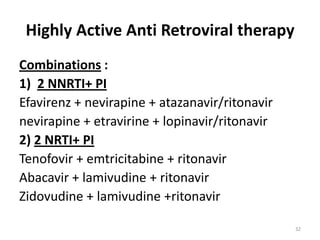
Highly Active Anti Retroviral therapy
Combinations :
1) 2 NNRTI+ PI
Efavirenz + nevirapine + atazanavir/ritonavir
nevirapine + etravirine + lopinavir/ritonavir
2) 2 NRTI+ PI
Tenofovir + emtricitabine + ritonavir
Abacavir + lamivudine + ritonavir
Zidovudine + lamivudine +ritonavir
32
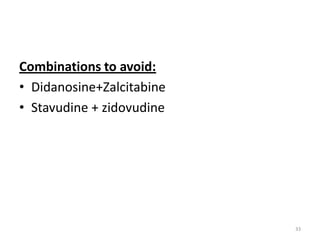
Combinations to avoid:
• Didanosine+Zalcitabine
• Stavudine + zidovudine

33
HIV Postexposure Prophylaxis (PEP)
Contact with blood /fluid or blood transfusion
Sharp injury or needle stick of HIV infected
NRTIs for 28 days/ with triple therapy (dual
NRTIs plus a boosted PI)

34
Prevention of mother-to-childtransmission
• Start Zidovudine (AZT) from 28 weeks or as
soon as possible thereafter, be provided with
single-dose Nevirapine (NVP) when entering
labour, and be given AZT+3TC for one week
following delivery

35
Quick Review of Antiviral Agents
•
•
•
•

Anti herpetics
Anti influenza agents
Anti hepatitis viral infections
Anti retroviral drugs

36

Lecture 1 anti viral agents

  • 1.
  • 2.
    Virus :Obligate parasite Virusparticles (virions) consist of following parts: • Genetic material (DNA or RNA). • Protein coat (capsid) that surrounds nucleic acid. • Envelope (contains lipids and lipoproteins) that surrounds the capsid when virus is outside a cell. 2
  • 3.
    DNA Virus: Pox virus(small pox) Herpes virus Adeno virus ( conjunctivitis , sore throat) Hepadna virus ( HBV) Papilloma virus ( warts ) RNA virus Rubella virus ( German Measles) Rhabdo virus ( rabies) Picorna virus ( polio, meningitis, cold , Hepatitis A) Arena virus (lassa fever) Flavi virus (yellow fever , HCV) Orthomyxo virus (Influenza) Paramyxo virus (mumps , measles) Corona virus (cold , SARS) 3
  • 4.
  • 5.
    Mechanism of action Majordrugs Block viral penetration/ uncoating Amantadine, enfuvirtide, maraviroc Inhibit viral DNA polymerase Acyclovir , foscarnet, ganciclovir Inhibit RNA polymerase Foscarnet , ribavirin Inhibit viral Reverse transcriptase Zidovudine, didanosine,zalcitabine , lamivudine, stavudine, neprapine , efavirenz Inhibit viral aspartate protease Indinavir, ritonavir, saquinavir , nelfinavir Inhibit viral neuraminidase Zanamivir, oseltamivir 6
  • 6.
    1. Anti Herpesagents Acyclovir Valacyclovir Famciclovir Ganciclovir Foscarnet Penciclovir Cidofovir Idoxuridine 7
  • 7.
    3. Anti HBVAgents Adefovir Entacavir 4. Anti-Influenza Virus Amantadine Rimantadine 5. Nonselective Antiviral Drugs Ribavirin Lamivudine Adefovir Interferons 8
  • 8.
    Anti Herpes Drugs Herpesviridaefamily- HSV-1, HSV-2, VZV, CMV Mouth, face skin, esophagus , brain----HSV-1 Genitals , rectum, skin , hands, meninges----HSV-2 Arrest DNA synthesis by inhibiting viral DNA polymerase . Most of them prodrugs Require Viral and Host cellular enzymes ( eg. Thymidine deoxyguanosine kinase ) to phosphorylate them into active triphosphate form Common mechanism of resistance is alteration in viral enzymes 9
  • 9.
    Mechanism of actionof Anti Herpes agents 10
  • 10.
    Acyclovir • Synthetic analogueof guanosine • Valacyclovir is a prodrug Acyclovir monophosphate is phosphorylated to triphosphate , gets incorporated into Viral DNA and inhibits replication. HSV thymidine kinase DNA polymerase Chain termination Suicide inactivation Spectrum: HSV-1, HSV-2, VZV Never totally cure 11
  • 11.
    • Advantage: – Nohematotoxicity, no myelosupression – Treatment of herpes encephalitis • Resistance : – Absence or partial production of TK – Altered TK specificity – Altered viral DNA polymerase • Adverse effects : – – – – – PEG base topical effects Oral- nausea , vomiting , diarrhoea and headache Dose dependent renal impairment , crystallie nephropathy Neurological – lethargy , confusion , tremors Rash , itching and phlebitis at injection site 12
  • 12.
    Ganciclovir • Similar toacyclovir • First phosphorylation viral specific, TK in HSV, Phosphotransferase (UL97) in CMV • Triphosphate form inhibits viral DNA polymerase and causes chain termination • HSV, VZV, CMV reitinitis in HIV patients • Dose limiting hematotoxicity, mucositis , fever, rash , crystalluria • Seizures in overdose 13
  • 13.
    Foscarnet Inorganic pyrophosphate analoginhibitory for herpes and HIV • Not an antimetabolite • Interacts directly with Viral DNA polymerase or HIV reverse transcriptase • Blocks binding site of pyrophosphate and inhibits cleavage • IV 14
  • 14.
    • • • • • • • • • • Nephrotoxicity Hypocalcemia Acute tubular necrosis Crystalluria CNS– tremor, irritabilty, seizure , halluccination, Rash, fever,nausea, vomiting Anemia, LFT,ECG Avoid pentamidine iv CMV retinitis Ganciclovir resistant infections in AIDS 15
  • 15.
    Anti-influenza agents • Amantadine/rimantadine – – – – – – – – – – – – Tricyclic amines Low concentration inhibits replication Rimantadine more active , also for Trypanosoma brucei Inhibit attachment, penetration and viral uncoating M2 protein inhibition Potentiate acid pH induced changes in hemaggluttin during intracellular transfer Minor Dose related GIT and CNS effects Atropine like Livedo reticularis Insomnia Loss of appetite Teratogenic 16
  • 16.
    Oseltamivir/zanamivir – Absorbed rapidlyand cleaved to active carboxylate – Selective inhibitor of vial neuraminidase and leads to viral aggregation and reduced spread – Nausea , abdominal discomfort—given with food – Nasal and throat irritation – Flu like – Influenza A and B 17
  • 17.
    Ribavirin • Monophosphorylated forminhibits IMP dehydrogenase and as a result depletes intracellular nucleotide reserves. • Triphosphate inhibits viral RNA polymerase and end capping of viral RNA • Used as an adjunct to IFN in HCV infection • Management of respiratory syncytial virus • Lassa fever • Hematotoxic • Upper airway irritation • Teratogenic 18
  • 18.
    Anti hepatitis agents •Adefovir dipivoxil – Acyclic phosphonate nucleotide of adenosine monophosphate – Adefovir diphosphate is competitive inhibitor of DNA polymerase and reverse transcriptase – Chain terminator – Chronic HBV – Lamivudine resistant HBV strains – Reduced carnitine – Dose related nephrotoxicity/tubular dysfunction – Headache , abdominal discomfort, diarrhoea , asthenia – Hepatotoxicity ,lymphoid toxicity 19
  • 19.
    Interferons • Potent cytokines •Antiviral, immunomodulating and antiproliferative • Synthesised by host cells • Types – – α, β- all cells, stimulate MHC antigen – γ - T lymphocytes / NK cells • Pegylated interferon • Inhibit protein synthesis , activate endoribonuclease 20
  • 20.
    • Acute influenzalike syndrome – fever , chills, headache, myalgia , arthralgia, nausea , vomiting and diarrhorea • Tolerance • Dose limiting – myleosuppression • Neurotoxicity- confusion • Hepatotoxicity • Condyloma acuminata( genital warts ) • Chronic HCV, HBV • Kaposi Sarcoma in HIV • Multiple sclerosis 21
  • 21.
    Anti HIV Agents/AntiRetroviral Agents i. Nucleoside Reverse Transcriptase Inhibitors (NRTIs) Zidovudine (AZT) Didanosine (DDI) Emtricitabine (FTC) Lamivudine (3TC) Zalcitabine (ddC) Abacavir (ABC) ii. Nucleotide Reverse Transcriptase Inhibitors (NtRTIs) Tenofovir Disproxil Fumarate iii. Non-nucleoside reverse Transcriptase Inhibitors ( NNRTIS) Delavirdine Efavirenz Nevirapine Etravirine 22
  • 22.
  • 23.
    Reverse Transcriptase Inhibitors •NRTIs : Inactive until phosphorylated by human cellular kinases Used together with protease inhibitors • NNRTIs: – Not prodrugs – No myelosupression – Efavirenz, nevirapine 24
  • 24.
    Side effects ofNRTIs • Zidovudine AZT – hematotoxicity – Headache , myalgia , myopathy , peripheral neuropathy • Didanosine DDI – Pancreatitis – Peripheral neuropathy, hyperuricemia, liver dysfunction 25
  • 25.
    • Zalcitabine DDC –Peripheral neuropathy – GI distress, pancreatitis, neutropenia, rash • Stavudine D4T – Peripheral neuropathy – Myelosupression • Lamivudine 3TC – GI effects and neutropenia 26
  • 26.
    • ADRs ofEfavirenz (a NNRTI) – Not during pregnancy – Dizziness – Vivid dreams 27
  • 27.
    Protease inhibitors • Aspartateprotease (pol gene encoded) cleaves precursor polypeptides to form the proteins of mature virion core • Selective to dipeptide structure of viral proteins • Combined with NRTIs • Indinavir , ritonavir 28
  • 28.
    Adverse effects ofPI • • • • • • Paresthesia Diarrhoea Nausea and vomiting Hypertriglyceridemia Hyperglycemia Hypercholesterolemia 29
  • 29.
    Fusion inhibitors Enfuvirtide : Maraviroc: • Binds gp41 and inhibits fusion of HIV to CD4+ cells • injection site reactions (pain, hardening of skin, erythema, nodules, cysts, itch) • Blocks CCR5 on T cell surface to prevent viral entry • hepatotoxicity allergic reactions (systemic), skin rash, fever, abd. pain, muscle/joint pain, cough, URTI, sleep disturbances 30
  • 30.
    HIV treatment guidelines •99% cell kill • Need of Combination therapy • CD4 cell count (≥350/mm3) 31
  • 31.
    Highly Active AntiRetroviral therapy Combinations : 1) 2 NNRTI+ PI Efavirenz + nevirapine + atazanavir/ritonavir nevirapine + etravirine + lopinavir/ritonavir 2) 2 NRTI+ PI Tenofovir + emtricitabine + ritonavir Abacavir + lamivudine + ritonavir Zidovudine + lamivudine +ritonavir 32
  • 32.
    Combinations to avoid: •Didanosine+Zalcitabine • Stavudine + zidovudine 33
  • 33.
    HIV Postexposure Prophylaxis(PEP) Contact with blood /fluid or blood transfusion Sharp injury or needle stick of HIV infected NRTIs for 28 days/ with triple therapy (dual NRTIs plus a boosted PI) 34
  • 34.
    Prevention of mother-to-childtransmission •Start Zidovudine (AZT) from 28 weeks or as soon as possible thereafter, be provided with single-dose Nevirapine (NVP) when entering labour, and be given AZT+3TC for one week following delivery 35
  • 35.
    Quick Review ofAntiviral Agents • • • • Anti herpetics Anti influenza agents Anti hepatitis viral infections Anti retroviral drugs 36