

Cardiac arrhythmia


Abnormal cardiac rhythm usually
involving a change in rate or regularity.



Synonym: dysrhythmia
Etiology
Physiological:
-sympathetic or parasympathetic control changes
eg. Stress , anxiety, exercise , smoking.
 Hypothyroidism, hyperthyroidism, hypoadrenalism,
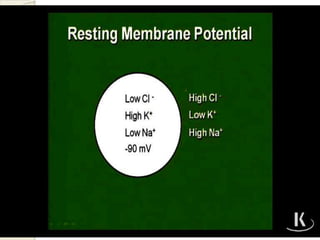
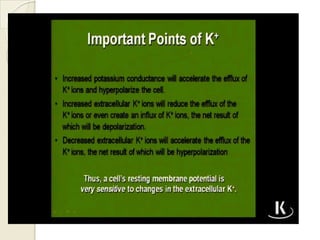
hyperkalemia, hypokalemia and other electrolyte changes.
Pathological:
 Valvular heart disease.
 Ischemic heart disease.----------MI causing death of
pacemaker cells or conducting tissue.
 Hypertensive heart diseases.
 Congenital heart disease.
 Cardiomyopathies.
 Carditis.
 RV dysplasia.
 Drug related.
 Pericarditis.
 Pulmonary diseases.
 Others.
CLINICAL EVALUATION
I. PHYSICAL FINDINGS
Palpitation.
Dizziness.
Chest Pain.
Abnormal pulse rate , rhythm or amplitude
Dyspnea.
Anxiety and confusion (from reduced brain perfusion)
Fainting (syncope)
Skin pallor or cyanosis
Reduced blood pressure
Weakness
Convulsions
Decreased urinary output
Sudden cardiac death.
II. DIAGNOSTIC TEST RESULTS
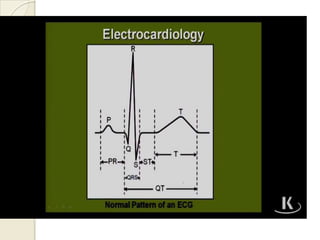
ECG
electrophysiological (EP)
testing
His bundle study
III. LAB FINDINGS:
hyperkalemia (>5mEq/L)
Hypocalcemia (<4.5mEq/L)
hypomagnesemia(<2.5mEq/L)
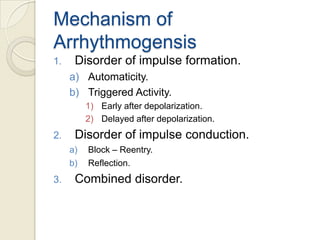
Mechanism of
Arrhythmogensis
1.

Disorder of impulse formation.
a) Automaticity.
b) Triggered Activity.
1) Early after depolarization.
2) Delayed after depolarization.

2.

Disorder of impulse conduction.
a)
b)

3.

Block – Reentry.
Reflection.

Combined disorder.
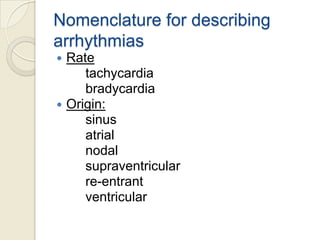
Nomenclature for describing
arrhythmias




Rate
tachycardia
bradycardia
Origin:
sinus
atrial
nodal
supraventricular
re-entrant
ventricular


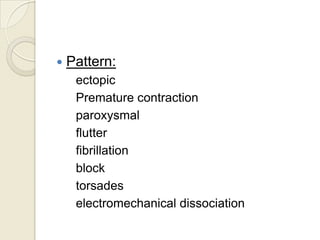
Pattern:
ectopic
Premature contraction
paroxysmal
flutter
fibrillation
block
torsades
electromechanical dissociation
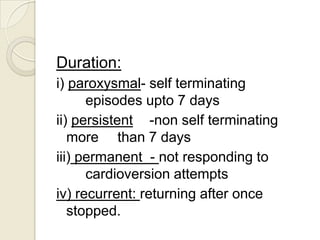
Duration:
i) paroxysmal- self terminating
episodes upto 7 days
ii) persistent -non self terminating
more than 7 days
iii) permanent - not responding to
cardioversion attempts
iv) recurrent: returning after once
stopped.
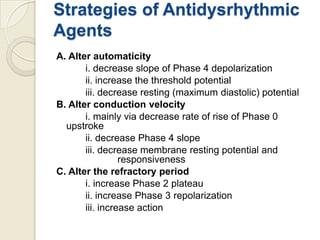
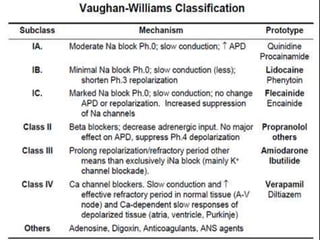
Strategies of Antidysrhythmic
Agents
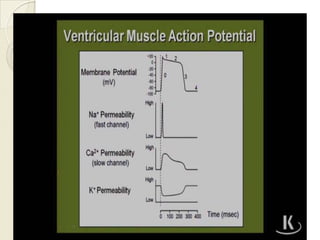
A. Alter automaticity
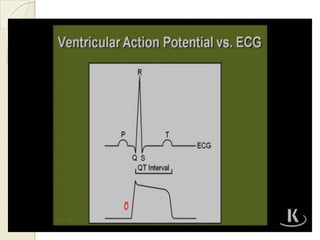
i. decrease slope of Phase 4 depolarization
ii. increase the threshold potential
iii. decrease resting (maximum diastolic) potential
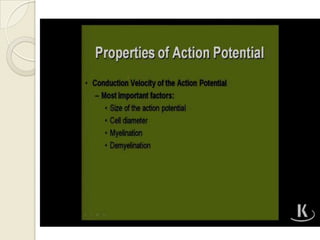
B. Alter conduction velocity
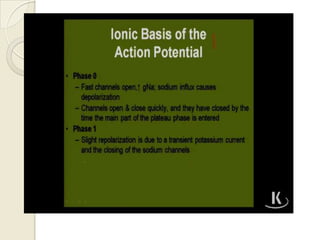
i. mainly via decrease rate of rise of Phase 0
upstroke
ii. decrease Phase 4 slope
iii. decrease membrane resting potential and
responsiveness
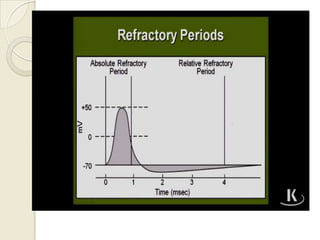
C. Alter the refractory period
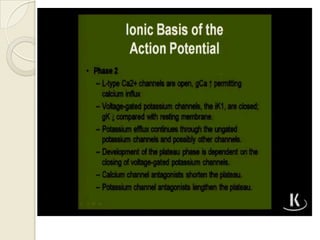
i. increase Phase 2 plateau
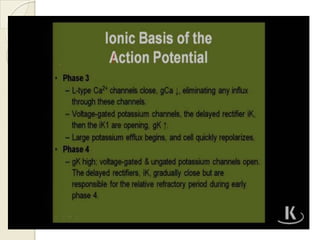
ii. increase Phase 3 repolarization
iii. increase action
2cardiac arrhytmia
2cardiac arrhytmia
2cardiac arrhytmia
2cardiac arrhytmia
2cardiac arrhytmia
2cardiac arrhytmia
2cardiac arrhytmia
2cardiac arrhytmia
2cardiac arrhytmia
2cardiac arrhytmia
2cardiac arrhytmia
2cardiac arrhytmia
2cardiac arrhytmia

2cardiac arrhytmia