Introduction
• Drugs having the cardiac Inotropic property – increase in
force of contraction and cardiac output in a failing
(hypodynamic) heart.
• They increase the myocardial contractility and improves
cardiac output without proportionate increase in Oxygen
consumption - Cardio-tonic.
• Do not increase the heart rate.
• Present in several plants and in toad skin.
What is a failing Heart ???
Inability of the heart to pump sufficient blood to meet the
metabolic demands of the body.
 Systolic - In IHD, Valve incompetence,
cardiomyopathy and myocarditis etc.
 Diastolic - In Hypertension, aortic stenosis,
congenital heart disease and hypertrophic
cardiomyopathy
Reduced efficiency of the heart as a pump – reduced
Cardiac Output
Pharmacological actions
HEART:
• Direct effects - Myocardial contractility
• Vagomimetic effect
• CNS effects – altering sympathetic activity
Force of Contraction:
• Positive inotropic effect
• Systole is shortened and prolonged diastole
• In Normal Heart – what happens ??
Normal
Digitalis
Heart failure
Stroke
volume
Arterial impedance
Tone:
• Maximum length of fibre in a given filling pressure
(Resting tension)
• Not affected by digitalis
• Decreasing end diastolic size of failing ventricle
Rate:
• Rate decreased because of improved circulation, restored
vagal tone and abolished sympathetic over activity.
• Additionally decreases heart rate by vagal and extravagal
action.
Electrophysiological Properties:
• Action Potential: Excitability enhanced - RMP
progressively decreased, shifted towards isoelectric.
• SAN and AVN automaticity – reduced
• Conductivity: Slowed in AVN and Bundle of His fibres
• ECG:
 Increased PR interval
 Decreased QT (shortening of systole)
 Decreased - T wave
BP:
 No prominent action in Systolic and diastolic BP
KIDNEY:
 Diuresis due to the improvement of circulation in CHF
OTHER SMOOTH MUSCLES:
 Na+/K+ ATPase inhibition: increased spontaneous activity
CNS:
 Therapeutic doses: No major visible action
 High doses – stimulation of CTZ - nausea and vomiting
 Toxic doses – central sympathetic stimulation, mental
confusion, disorientation and visual disturbance
Mechanism of action
Inhibition of Na+K+- ATPase (the “sodium pump”)
Digoxin
Pharmacokinetics
Absorption and Distribution:
• Vary in their ADME
• Presence of food in stomach delays absorption
• Digitoxin is the most lipid soluble
Metabolism:
• Digitoxin is metabolized in liver partly to Digoxin and
excreted in bile.
• Enterohepatic circulation – long half life
• Digoxine primarily excreted unchanged in urine and rate
of excretion parallels creatinine clearance.
• All CGs are cumulative – steady state after 4 half lives.
Adverse effects
Extracardiac:
• GIT: nausea, vomiting and anorexia etc.
• CNS: Headache, blurring of vision, mental confusion etc.
• Fatigue, malaise
• Serum Electrolyte-
K+ : Digitalis competes for K+ binding at Na/K ATPase
 Hypokalemia: increase toxicity
 Hyperkalemia: decrease toxicity
Mg2+: Hypomagnesaemia: increases toxicity
Ca2+: Hypercalcaemia: increases toxicity
Cardiac: All Arrhythmias
• Tachyarrythmias
• Ventricular arrhythmia
• PSVT
• AV block
DIGOXIN ANTIBODY: DIGIBIND
Contraindications
• Hypokalemia: Toxicity
• Myocardial Infarction
• WPW syndrome: VF may occur (due to reduced ERP of
bypass)
• Elderly, renal or severe hepatic disease: more sensitive
• Ventricular tachyarrhythmias
• Partial AV block: Complete block
• Thyrotoxicosis
Common Drug interactions
• Diuretics: Hypokalaemia (K+ supplementation required)
• Calcium: synergizes with digitalis
• Adrenergic drugs: arrhythmia
• Propranolol and Ca++ channel blockers: depress
AV conduction and oppose positive ionotropic effects
• Metoclopramide, sucralfate and antacids –reduced
absorption
Therapeutic Uses
1. Congestive Heart Failure &
2. Cardiac Arrhythmias
Digitalization
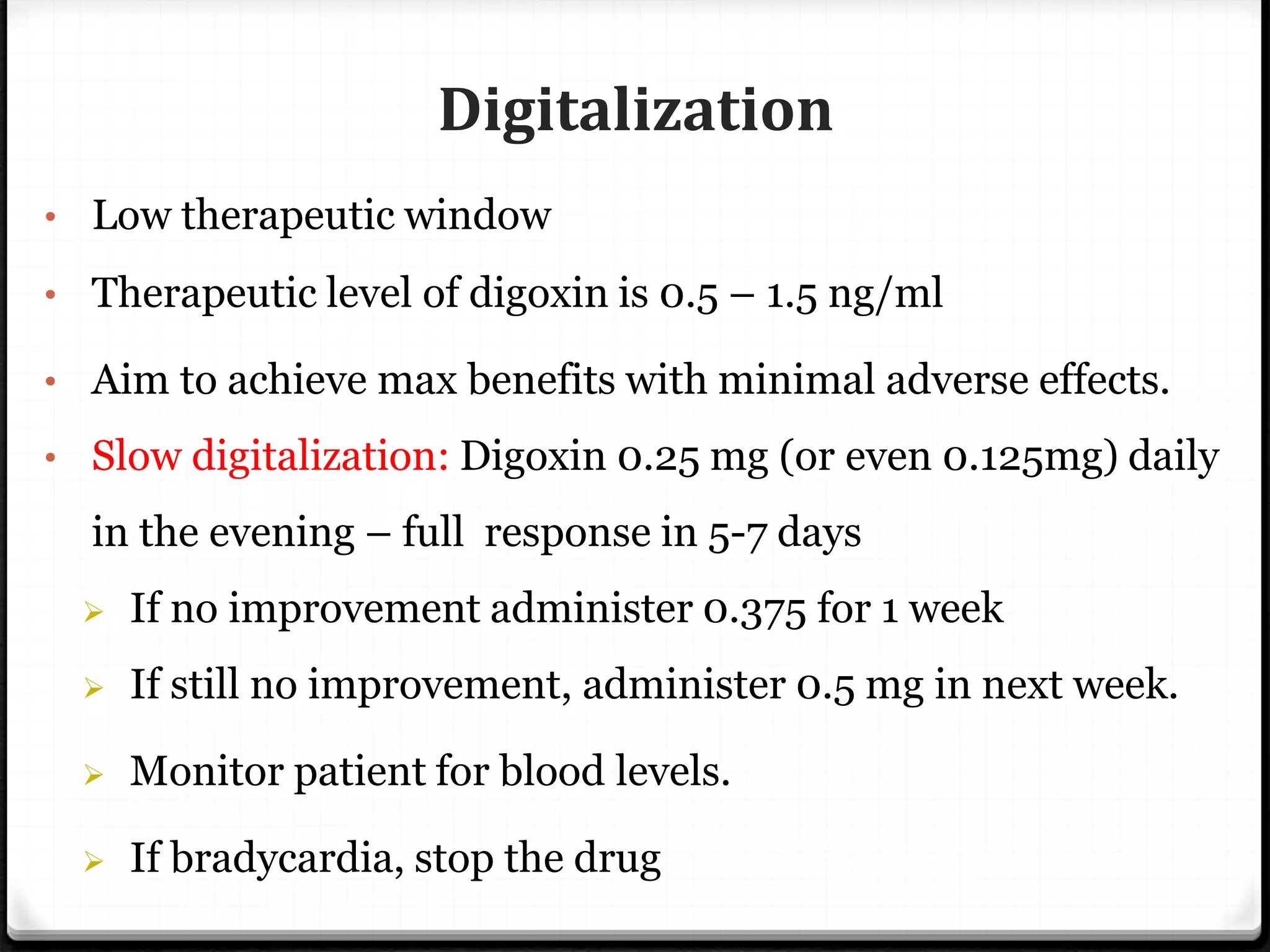
• Low therapeutic window
• Therapeutic level of digoxin is 0.5 – 1.5 ng/ml
• Aim to achieve max benefits with minimal adverse effects.
• Slow digitalization: Digoxin 0.25 mg (or even 0.125mg) daily
in the evening – full response in 5-7 days
 If no improvement administer 0.375 for 1 week
 If still no improvement, administer 0.5 mg in next week.
 Monitor patient for blood levels.
 If bradycardia, stop the drug
• Rapid IV: Seldom used now: As desperate measure in
CHF and atrial fibrillation - 0.25 mg slow IV stat
followed by 0.1 mg every Hrly
• Rapid digitalization (oral): 0.5 to 1 mg stat then 0.25 mg
every 6 Hrly
- Monitor for toxicity - Patient is digitalized within 24 Hrs
Goals and Drugs of Therapy for CHF
• Relief of congestive/Low output symptoms and
restoration of Cardiac performance:
 Inotropic: Digoxin, Dopamine, Dobutamine,
Amrinone/Milrinone
 Diuretics: Furosemide, thiazides
 Vasodilators: ACE inhibitors/ARBs, Hydralazine,
Nitroprusside and Nitrates
 Beta-blockers: Metoprolol, Bisoprolol, Carvedilol
• Arrest/Reversal of disease progression and
prolongation of survival
 ACE inhibitors/ARBs, Beta-blockers
 Aldosterone antgonist: Spironolactone
• Non-pharmacological measures: Rest and salt
restriction (for all grades of CHF)
Diuretics
• Almost all cases of CHF are treated with diuretics
• High ceiling diuretics (furosemide, bumetanide) are
preferred –
• IV diuretics – rapid symptomatic relief
• Chronic cases – resistance to furosemide -
combination with thiazides/spironolactone
Benefits:
• Decrease in preload – Improved ventricular efficiency
• Relief from Oedema and pulmonary congestion
• Increases venous capacitance – relief of LVF
Drawbacks:
• No influence in disease process
• No Role in asymptomatic heart failure
• Activation of RAS
• Chronic therapy: hypokalaemia, alkalosis,
RAS Inhibitors
• ACE Inhibitors and ARBs
• Mainstay in treatment – orally effective, medium efficacy
• Symptomatic as well as disease modifying benefits:
 Vasodilatation – arterio-venous
 Retardation/Prevention of ventricular hypertrophy -
myocardial cell apoptosis, fibrosis and intercellular matrix
changes and remodeling.
• Starts with low dose and gradual increase
• Used in all grades of CHF– including asymptomatic cases
Vasodilators
• Used IV to treat acute CHF cases
• Preload reduction: Nitrates –controlled IV – rapid
relief of ALVF
• Afterload reduction: Hydralazine – dilate resistance
vessels – reduce aortic impedance
• Pre-and after load reduction: ACEIs/ARBs – medium
efficacy and Nitroprusside – high efficacy IV
• Used with loop diuretics + IV inotropics to tide over
crisis in severely decompensated patients
Beta-blockers
• Selective β1- receptor blockers – metoprolol and
bisoprolol in mild to moderate cases
• Mechanism: antagonism of sympathetic over activity –
ventricular wall stretching, remodeling, apoptosis etc.
prevented, also decreases RAS
Aldosterone antagonists - Spironolactone
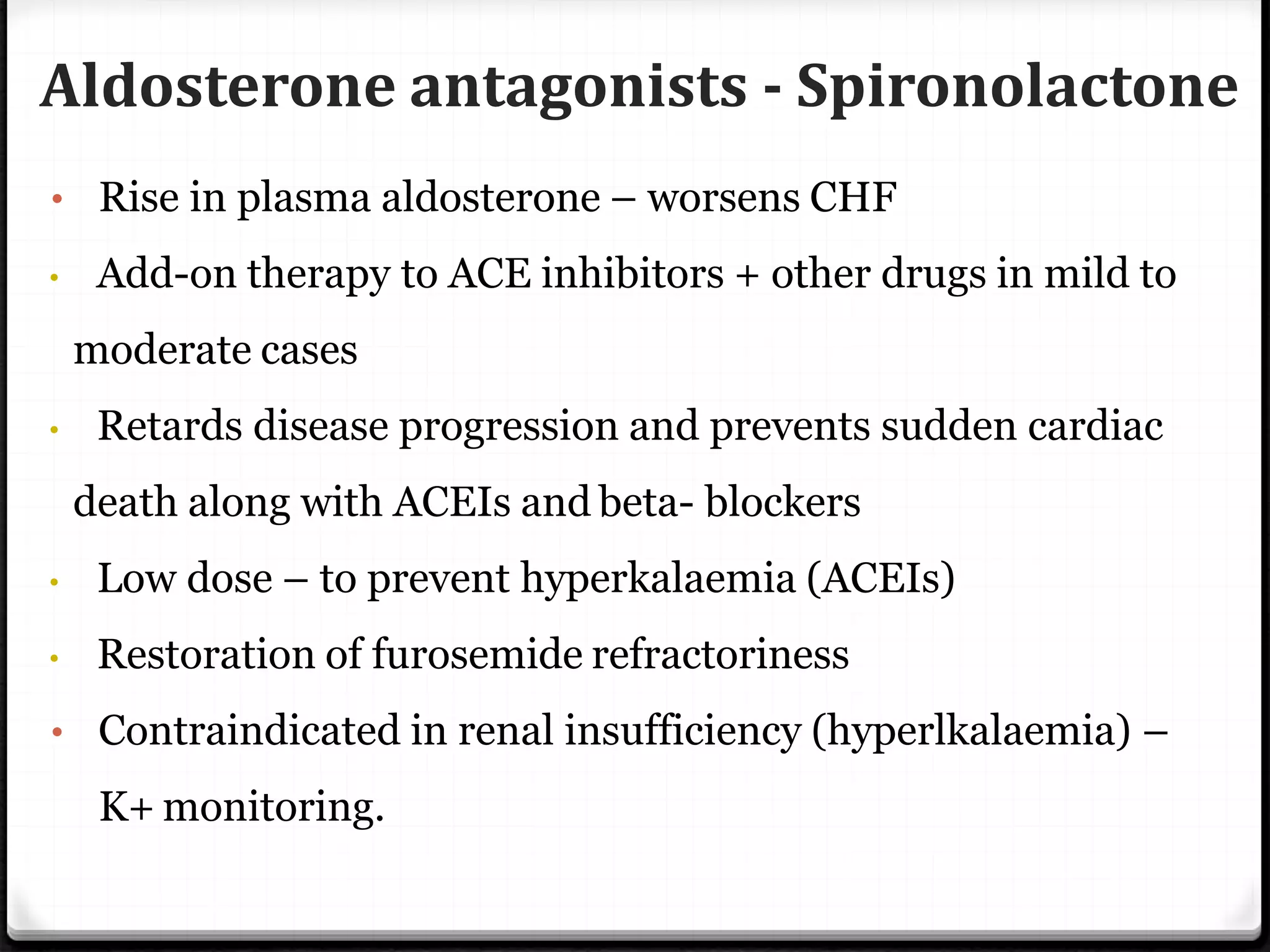
• Rise in plasma aldosterone – worsens CHF
• Add-on therapy to ACE inhibitors + other drugs in mild to
moderate cases
• Retards disease progression and prevents sudden cardiac
death along with ACEIs and beta- blockers
• Low dose – to prevent hyperkalaemia (ACEIs)
• Restoration of furosemide refractoriness
• Contraindicated in renal insufficiency (hyperlkalaemia) –
K+ monitoring.
Phosphodiesterase (PDE III)
Inhibitors
• Inamrinone, Milrinone – positive inotropy and
vasodilataion (INODILATOR)
• PDE III is specific for degradation of intracellular cAMP and
cGMP
 Indicated only in short-term IV therapy in severe and
refractory cases and as an add-on drug.
 Oral maintenance therapy – NOT USED
• ADR: Thrombocytopenia, nausea, diarrhoea, abdominal
pain, liver damage and arrhythmia etc.
THANK YOU

Congestive Heart Failure- Part II

  • 2.
    Introduction • Drugs havingthe cardiac Inotropic property – increase in force of contraction and cardiac output in a failing (hypodynamic) heart. • They increase the myocardial contractility and improves cardiac output without proportionate increase in Oxygen consumption - Cardio-tonic. • Do not increase the heart rate. • Present in several plants and in toad skin.
  • 3.
    What is afailing Heart ??? Inability of the heart to pump sufficient blood to meet the metabolic demands of the body.  Systolic - In IHD, Valve incompetence, cardiomyopathy and myocarditis etc.  Diastolic - In Hypertension, aortic stenosis, congenital heart disease and hypertrophic cardiomyopathy Reduced efficiency of the heart as a pump – reduced Cardiac Output
  • 4.
    Pharmacological actions HEART: • Directeffects - Myocardial contractility • Vagomimetic effect • CNS effects – altering sympathetic activity Force of Contraction: • Positive inotropic effect • Systole is shortened and prolonged diastole • In Normal Heart – what happens ??
  • 5.
  • 6.
    Tone: • Maximum lengthof fibre in a given filling pressure (Resting tension) • Not affected by digitalis • Decreasing end diastolic size of failing ventricle Rate: • Rate decreased because of improved circulation, restored vagal tone and abolished sympathetic over activity. • Additionally decreases heart rate by vagal and extravagal action.
  • 7.
    Electrophysiological Properties: • ActionPotential: Excitability enhanced - RMP progressively decreased, shifted towards isoelectric. • SAN and AVN automaticity – reduced • Conductivity: Slowed in AVN and Bundle of His fibres • ECG:  Increased PR interval  Decreased QT (shortening of systole)  Decreased - T wave
  • 9.
    BP:  No prominentaction in Systolic and diastolic BP KIDNEY:  Diuresis due to the improvement of circulation in CHF OTHER SMOOTH MUSCLES:  Na+/K+ ATPase inhibition: increased spontaneous activity CNS:  Therapeutic doses: No major visible action  High doses – stimulation of CTZ - nausea and vomiting  Toxic doses – central sympathetic stimulation, mental confusion, disorientation and visual disturbance
  • 10.
    Mechanism of action Inhibitionof Na+K+- ATPase (the “sodium pump”) Digoxin
  • 12.
    Pharmacokinetics Absorption and Distribution: •Vary in their ADME • Presence of food in stomach delays absorption • Digitoxin is the most lipid soluble Metabolism: • Digitoxin is metabolized in liver partly to Digoxin and excreted in bile. • Enterohepatic circulation – long half life • Digoxine primarily excreted unchanged in urine and rate of excretion parallels creatinine clearance. • All CGs are cumulative – steady state after 4 half lives.
  • 13.
    Adverse effects Extracardiac: • GIT:nausea, vomiting and anorexia etc. • CNS: Headache, blurring of vision, mental confusion etc. • Fatigue, malaise • Serum Electrolyte- K+ : Digitalis competes for K+ binding at Na/K ATPase  Hypokalemia: increase toxicity  Hyperkalemia: decrease toxicity Mg2+: Hypomagnesaemia: increases toxicity Ca2+: Hypercalcaemia: increases toxicity
  • 14.
    Cardiac: All Arrhythmias •Tachyarrythmias • Ventricular arrhythmia • PSVT • AV block DIGOXIN ANTIBODY: DIGIBIND
  • 15.
    Contraindications • Hypokalemia: Toxicity •Myocardial Infarction • WPW syndrome: VF may occur (due to reduced ERP of bypass) • Elderly, renal or severe hepatic disease: more sensitive • Ventricular tachyarrhythmias • Partial AV block: Complete block • Thyrotoxicosis
  • 16.
    Common Drug interactions •Diuretics: Hypokalaemia (K+ supplementation required) • Calcium: synergizes with digitalis • Adrenergic drugs: arrhythmia • Propranolol and Ca++ channel blockers: depress AV conduction and oppose positive ionotropic effects • Metoclopramide, sucralfate and antacids –reduced absorption
  • 17.
    Therapeutic Uses 1. CongestiveHeart Failure & 2. Cardiac Arrhythmias
  • 18.
    Digitalization • Low therapeuticwindow • Therapeutic level of digoxin is 0.5 – 1.5 ng/ml • Aim to achieve max benefits with minimal adverse effects. • Slow digitalization: Digoxin 0.25 mg (or even 0.125mg) daily in the evening – full response in 5-7 days  If no improvement administer 0.375 for 1 week  If still no improvement, administer 0.5 mg in next week.  Monitor patient for blood levels.  If bradycardia, stop the drug
  • 19.
    • Rapid IV:Seldom used now: As desperate measure in CHF and atrial fibrillation - 0.25 mg slow IV stat followed by 0.1 mg every Hrly • Rapid digitalization (oral): 0.5 to 1 mg stat then 0.25 mg every 6 Hrly - Monitor for toxicity - Patient is digitalized within 24 Hrs
  • 20.
    Goals and Drugsof Therapy for CHF • Relief of congestive/Low output symptoms and restoration of Cardiac performance:  Inotropic: Digoxin, Dopamine, Dobutamine, Amrinone/Milrinone  Diuretics: Furosemide, thiazides  Vasodilators: ACE inhibitors/ARBs, Hydralazine, Nitroprusside and Nitrates  Beta-blockers: Metoprolol, Bisoprolol, Carvedilol
  • 21.
    • Arrest/Reversal ofdisease progression and prolongation of survival  ACE inhibitors/ARBs, Beta-blockers  Aldosterone antgonist: Spironolactone • Non-pharmacological measures: Rest and salt restriction (for all grades of CHF)
  • 22.
    Diuretics • Almost allcases of CHF are treated with diuretics • High ceiling diuretics (furosemide, bumetanide) are preferred – • IV diuretics – rapid symptomatic relief • Chronic cases – resistance to furosemide - combination with thiazides/spironolactone
  • 23.
    Benefits: • Decrease inpreload – Improved ventricular efficiency • Relief from Oedema and pulmonary congestion • Increases venous capacitance – relief of LVF Drawbacks: • No influence in disease process • No Role in asymptomatic heart failure • Activation of RAS • Chronic therapy: hypokalaemia, alkalosis,
  • 24.
    RAS Inhibitors • ACEInhibitors and ARBs • Mainstay in treatment – orally effective, medium efficacy • Symptomatic as well as disease modifying benefits:  Vasodilatation – arterio-venous  Retardation/Prevention of ventricular hypertrophy - myocardial cell apoptosis, fibrosis and intercellular matrix changes and remodeling. • Starts with low dose and gradual increase • Used in all grades of CHF– including asymptomatic cases
  • 25.
    Vasodilators • Used IVto treat acute CHF cases • Preload reduction: Nitrates –controlled IV – rapid relief of ALVF • Afterload reduction: Hydralazine – dilate resistance vessels – reduce aortic impedance • Pre-and after load reduction: ACEIs/ARBs – medium efficacy and Nitroprusside – high efficacy IV • Used with loop diuretics + IV inotropics to tide over crisis in severely decompensated patients
  • 26.
    Beta-blockers • Selective β1-receptor blockers – metoprolol and bisoprolol in mild to moderate cases • Mechanism: antagonism of sympathetic over activity – ventricular wall stretching, remodeling, apoptosis etc. prevented, also decreases RAS
  • 27.
    Aldosterone antagonists -Spironolactone • Rise in plasma aldosterone – worsens CHF • Add-on therapy to ACE inhibitors + other drugs in mild to moderate cases • Retards disease progression and prevents sudden cardiac death along with ACEIs and beta- blockers • Low dose – to prevent hyperkalaemia (ACEIs) • Restoration of furosemide refractoriness • Contraindicated in renal insufficiency (hyperlkalaemia) – K+ monitoring.
  • 28.
    Phosphodiesterase (PDE III) Inhibitors •Inamrinone, Milrinone – positive inotropy and vasodilataion (INODILATOR) • PDE III is specific for degradation of intracellular cAMP and cGMP  Indicated only in short-term IV therapy in severe and refractory cases and as an add-on drug.  Oral maintenance therapy – NOT USED • ADR: Thrombocytopenia, nausea, diarrhoea, abdominal pain, liver damage and arrhythmia etc.
  • 29.