Riccardo Rigon
IlSole,F.Lelong,2008,ValdiSella
Solar Radiation
The Stefan-Boltzmann law
R. Rigon
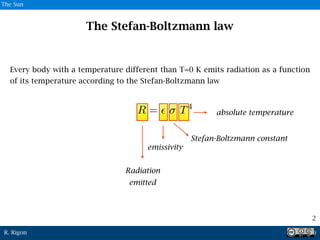
Radiation
emitted
emissivity
Stefan-Boltzmann constant
absolute temperatureR = ✏ T4
Every body with a temperature different than T=0 K emits radiation as a function
of its temperature according to the Stefan-Boltzmann law
The Stefan-Boltzmann law
10
2
The Sun
R. Rigon
RSun = ✏ T4
= 1 ⇤ 5.67 ⇤ 10 8
⇤ 60004
⇡ 25.12 ⇤ 109
J m 2
s 1
The physics of Radiation
On the basis of the temperature of the Sun photosphere (~6000 K), and the
Stephan-Boltzmann law, the total energy emitted by the Sun is
11
3
The Sun
R. Rigon
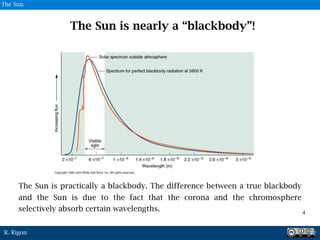
The Sun is practically a blackbody. The difference between a true blackbody
and the Sun is due to the fact that the corona and the chromosphere
selectively absorb certain wavelengths.
The Sun is nearly a “blackbody”!
12
4
The Sun
R. Rigon
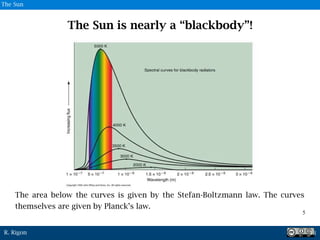
The area below the curves is given by the Stefan-Boltzmann law. The curves
themselves are given by Planck’s law.
The Sun is nearly a “blackbody”!
13
5
The Sun
R. Rigon
The complete electromagnetic spectrum
The spectrum of solar radiation stretches far beyond the visible band where,
however, nearly half the available energy is concentrated
Figure2.9
C.B.Agee
16
6
The Sun
R. Rigon
Planck’s Law
•Planck’s law is the general law for electromagnetic emission from the
surface of a blackbody*:
W =
2⇡c2
h 5
e
ch
KT 1
[Wm 2
µm 1
]
14
7
The Sun
* Stefan-Boltzmann law is just the integration of Plank’s law over wavelengths

6 c-radiation-stefan boltzman

  • 1.
  • 2.
    R. Rigon Radiation emitted emissivity Stefan-Boltzmann constant absolutetemperatureR = ✏ T4 Every body with a temperature different than T=0 K emits radiation as a function of its temperature according to the Stefan-Boltzmann law The Stefan-Boltzmann law 10 2 The Sun
  • 3.
    R. Rigon RSun =✏ T4 = 1 ⇤ 5.67 ⇤ 10 8 ⇤ 60004 ⇡ 25.12 ⇤ 109 J m 2 s 1 The physics of Radiation On the basis of the temperature of the Sun photosphere (~6000 K), and the Stephan-Boltzmann law, the total energy emitted by the Sun is 11 3 The Sun
  • 4.
    R. Rigon The Sunis practically a blackbody. The difference between a true blackbody and the Sun is due to the fact that the corona and the chromosphere selectively absorb certain wavelengths. The Sun is nearly a “blackbody”! 12 4 The Sun
  • 5.
    R. Rigon The areabelow the curves is given by the Stefan-Boltzmann law. The curves themselves are given by Planck’s law. The Sun is nearly a “blackbody”! 13 5 The Sun
  • 6.
    R. Rigon The completeelectromagnetic spectrum The spectrum of solar radiation stretches far beyond the visible band where, however, nearly half the available energy is concentrated Figure2.9 C.B.Agee 16 6 The Sun
  • 7.
    R. Rigon Planck’s Law •Planck’slaw is the general law for electromagnetic emission from the surface of a blackbody*: W = 2⇡c2 h 5 e ch KT 1 [Wm 2 µm 1 ] 14 7 The Sun * Stefan-Boltzmann law is just the integration of Plank’s law over wavelengths