Radiation Heat Transfer
P M V Subbarao
Professor
Mechanical Engineering Department
IIT Delhi
A means for basic life on earth……..
Radiative Properties
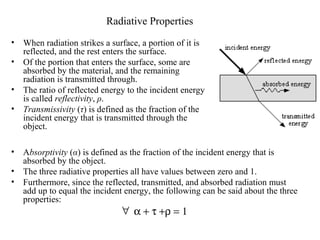
• When radiation strikes a surface, a portion of it is
reflected, and the rest enters the surface.
• Of the portion that enters the surface, some are
absorbed by the material, and the remaining
radiation is transmitted through.
• The ratio of reflected energy to the incident energy
is called reflectivity, ρ.
• Transmissivity (τ) is defined as the fraction of the
incident energy that is transmitted through the
object.
• Absorptivity (α) is defined as the fraction of the incident energy that is
absorbed by the object.
• The three radiative properties all have values between zero and 1.
• Furthermore, since the reflected, transmitted, and absorbed radiation must
add up to equal the incident energy, the following can be said about the three
properties:
∀ α + τ +ρ = 1
Emissivity
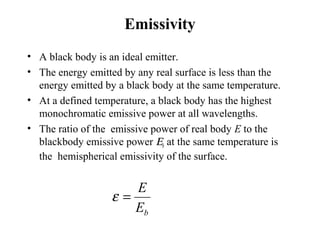
• A black body is an ideal emitter.
• The energy emitted by any real surface is less than the
energy emitted by a black body at the same temperature.
• At a defined temperature, a black body has the highest
monochromatic emissive power at all wavelengths.
• The ratio of the emissive power of real body E to the
blackbody emissive power Εb at the same temperature is
the hemispherical emissivity of the surface.
bE
E
=ε
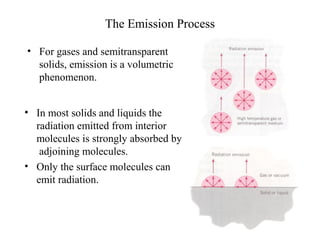
The Emission Process
• For gases and semitransparent
solids, emission is a volumetric
phenomenon.
• In most solids and liquids the
radiation emitted from interior
molecules is strongly absorbed by
adjoining molecules.
• Only the surface molecules can
emit radiation.
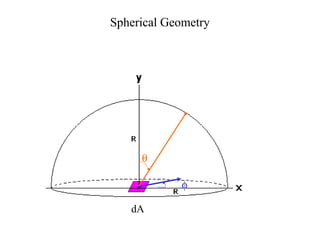
Spherical Geometry
θ
φ
dA
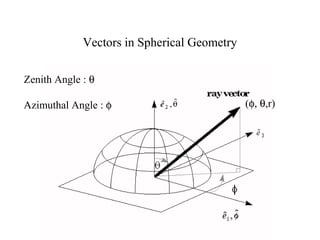
Vectors in Spherical Geometry
Zenith Angle : θ
Αzimuthal Angle : φ (φ, θ,r)
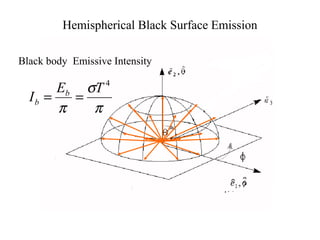
Hemispherical Black Surface Emission
π
σ
π
4
TE
I b
b ==
Black body Emissive Intensity
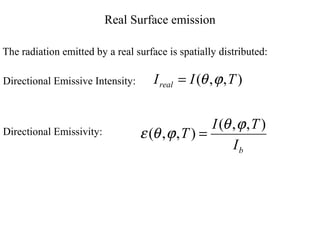
Real Surface emission
The radiation emitted by a real surface is spatially distributed:
),,( TIIreal ϕθ=Directional Emissive Intensity:
Directional Emissivity:
bI
TI
T
),,(
),,(
ϕθ
ϕθε =
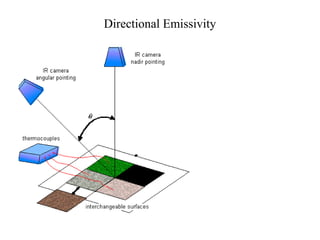
Directional Emissivity
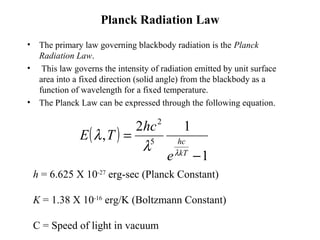
Planck Radiation Law
• The primary law governing blackbody radiation is the Planck
Radiation Law.
• This law governs the intensity of radiation emitted by unit surface
area into a fixed direction (solid angle) from the blackbody as a
function of wavelength for a fixed temperature.
• The Planck Law can be expressed through the following equation.
( )
1
12
, 5
2
−
=
kT
hc
e
hc
TE
λ
λ
λ
h = 6.625 X 10⁻²⁷
erg-sec (Planck Constant)
K = 1.38 X 10⁻¹⁶
erg/K (Boltzmann Constant)
C = Speed of light in vacuum
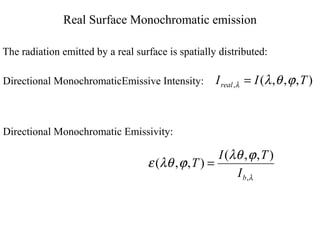
Real Surface Monochromatic emission
The radiation emitted by a real surface is spatially distributed:
),,,(, TIIreal ϕθλλ =Directional MonochromaticEmissive Intensity:
Directional Monochromatic Emissivity:
λ
ϕλθ
ϕλθε
,
),,(
),,(
bI
TI
T =
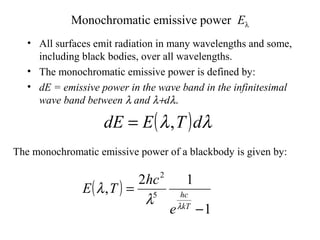
Monochromatic emissive power Eλ
• All surfaces emit radiation in many wavelengths and some,
including black bodies, over all wavelengths.
• The monochromatic emissive power is defined by:
• dE = emissive power in the wave band in the infinitesimal
wave band between λ and λ+dλ.
( ) λλ dTEdE ,=
The monochromatic emissive power of a blackbody is given by:
( )
1
12
, 5
2
−
=
kT
hc
e
hc
TE
λ
λ
λ
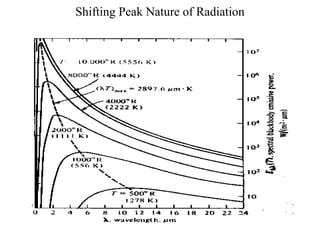
Shifting Peak Nature of Radiation
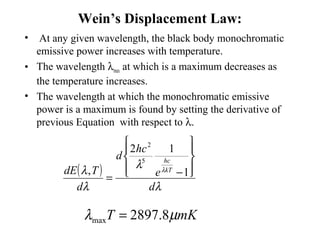
Wein’s Displacement Law:
• At any given wavelength, the black body monochromatic
emissive power increases with temperature.
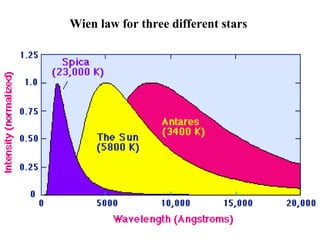
• The wavelength λmax at which is a maximum decreases as
the temperature increases.
• The wavelength at which the monochromatic emissive
power is a maximum is found by setting the derivative of
previous Equation with respect to λ.
( )
λ
λ
λ
λ λ
d
e
hc
d
d
TdE kT
hc








−= 1
12
,
5
2
mKT µλ 8.2897max =
Wien law for three different stars
Stefan-Boltzmann Law
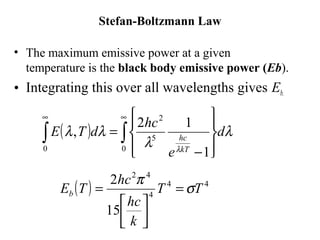
• The maximum emissive power at a given
temperature is the black body emissive power (Eb).
• Integrating this over all wavelengths gives Eb.
( ) ∫∫
∞∞








−
=
0
5
2
0
1
12
, λ
λ
λλ
λ
d
e
hc
dTE
kT
hc
( ) 44
4
42
15
2
TT
k
hc
hc
TEb σ
π
=




=
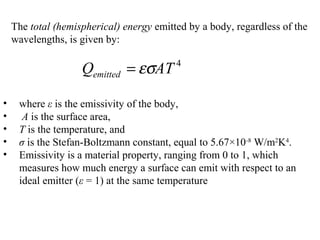
The total (hemispherical) energy emitted by a body, regardless of the
wavelengths, is given by:
4
ATQemitted εσ=
• where ε is the emissivity of the body,
• A is the surface area,
• T is the temperature, and
• σ is the Stefan-Boltzmann constant, equal to 5.67×10⁻⁸
W/m2
K4
.
• Emissivity is a material property, ranging from 0 to 1, which
measures how much energy a surface can emit with respect to an
ideal emitter (ε = 1) at the same temperature
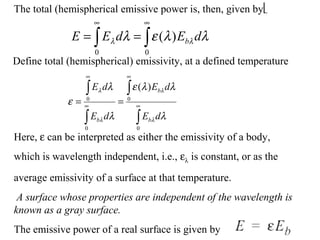
The total (hemispherical emissive power is, then, given by
Here, ε can be interpreted as either the emissivity of a body,
which is wavelength independent, i.e., ελ is constant, or as the
average emissivity of a surface at that temperature.
A surface whose properties are independent of the wavelength is
known as a gray surface.
The emissive power of a real surface is given by
∫∫
∞∞
==
00
)( λλελ λλ dEdEE b
Define total (hemispherical) emissivity, at a defined temperature
∫
∫
∫
∫
∞
∞
∞
∞
==
0
0
0
0
)(
λ
λλε
λ
λ
ε
λ
λ
λ
λ
dE
dE
dE
dE
b
b
b
Absorptivity α, Reflectivity ρ, and Transmissivity τ
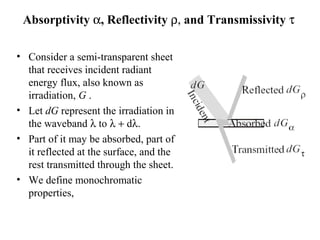
• Consider a semi-transparent sheet
that receives incident radiant
energy flux, also known as
irradiation, G .
• Let dG represent the irradiation in
the waveband λ to λ + dλ.
• Part of it may be absorbed, part of
it reflected at the surface, and the
rest transmitted through the sheet.
• We define monochromatic
properties,
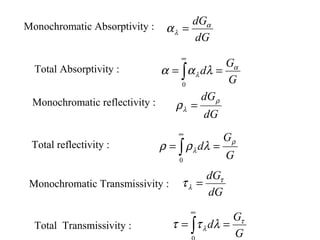
Monochromatic Absorptivity :
dG
dGα
λα =
Monochromatic reflectivity :
dG
dGρ
λρ =
Monochromatic Transmissivity :
dG
dGτ
λτ =
Total Absorptivity :
G
G
d α
λ λαα == ∫
∞
0
Total reflectivity :
G
G
d ρ
λ λρρ == ∫
∞
0
Total Transmissivity :
G
G
d τ
λ λττ == ∫
∞
Conservation of Irradiation
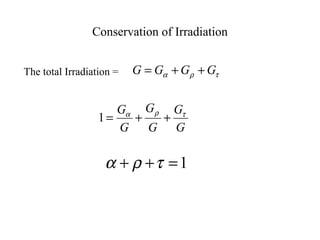
The total Irradiation = τρα GGGG ++=
G
G
G
G
G
G τρα
++=1
1=++ τρα
3..
Blackbody Radiation
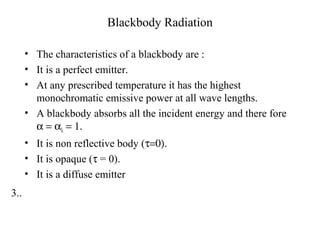
• The characteristics of a blackbody are :
• It is a perfect emitter.
• At any prescribed temperature it has the highest
monochromatic emissive power at all wave lengths.
• A blackbody absorbs all the incident energy and there fore
α = αλ = 1.
• It is non reflective body (τ=0).
• It is opaque (τ = 0).
• It is a diffuse emitter
Radiative Heat Transfer
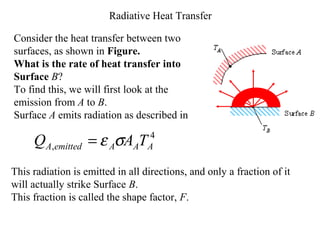
Consider the heat transfer between two
surfaces, as shown in Figure.
What is the rate of heat transfer into
Surface B?
To find this, we will first look at the
emission from A to B.
Surface A emits radiation as described in
4
, AAAemittedA TAQ σε=
This radiation is emitted in all directions, and only a fraction of it
will actually strike Surface B.
This fraction is called the shape factor, F.
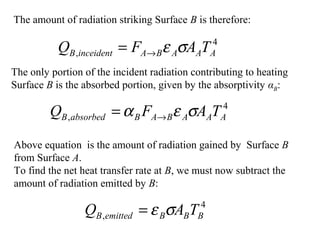
The amount of radiation striking Surface B is therefore:
4
, AAABAinceidentB TAFQ σε→=
The only portion of the incident radiation contributing to heating
Surface B is the absorbed portion, given by the absorptivity αB:
4
, AAABABabsorbedB TAFQ σεα →=
Above equation is the amount of radiation gained by Surface B
from Surface A.
To find the net heat transfer rate at B, we must now subtract the
amount of radiation emitted by B:
4
, BBBemittedB TAQ σε=
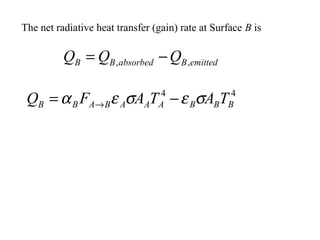
The net radiative heat transfer (gain) rate at Surface B is
emittedBabsorbedBB QQQ ,, −=
44
BBBAAABABB TATAFQ σεσεα −= →
Shape Factors
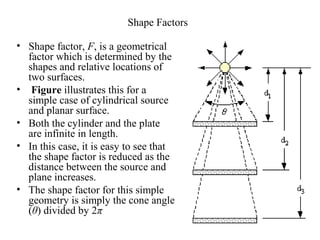
• Shape factor, F, is a geometrical
factor which is determined by the
shapes and relative locations of
two surfaces.
• Figure illustrates this for a
simple case of cylindrical source
and planar surface.
• Both the cylinder and the plate
are infinite in length.
• In this case, it is easy to see that
the shape factor is reduced as the
distance between the source and
plane increases.
• The shape factor for this simple
geometry is simply the cone angle
(θ) divided by 2π
• Shape factors for other simple
geometries can be calculated using
basic theory of geometry.
• For more complicated geometries, the
following two rules must be applied
to find shape factors based on simple
geometries.
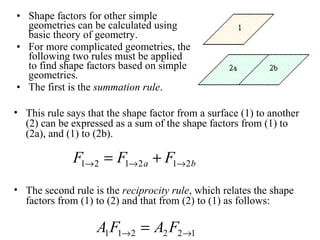
• The first is the summation rule.
122211 →→ = FAFA
• This rule says that the shape factor from a surface (1) to another
(2) can be expressed as a sum of the shape factors from (1) to
(2a), and (1) to (2b).
• The second rule is the reciprocity rule, which relates the shape
factors from (1) to (2) and that from (2) to (1) as follows:
ba FFF 212121 →→→ +=
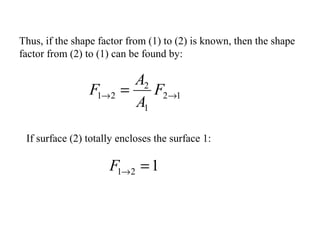
Thus, if the shape factor from (1) to (2) is known, then the shape
factor from (2) to (1) can be found by:
12
1
2
21 →→ = F
A
A
F
If surface (2) totally encloses the surface 1:
121 =→F
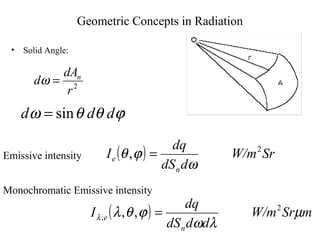
Geometric Concepts in Radiation
• Solid Angle:
2
r
dA
d n
=ω
sind d dω θ θ ϕ=
Emissive intensity ( ) SrW/m
ddS
dq
I
n
e
2
,
ω
ϕθ =
Monochromatic Emissive intensity
( ) mSrW/m
dddS
dq
I
n
e µ
λω
ϕθλλ
2
, ,, =
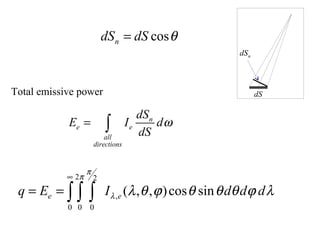
Total emissive power dS
ndS
cosndS dS θ=
n
e e
all
directions
dS
E I d
dS
ω= ∫
2 2
,
0 0 0
( , , )cos sine eq E I d d d
π
π
λ λ θ ϕ θ θ θ ϕ λ
∞
= = ∫ ∫ ∫

Radiation ppt by iit professor

  • 1.
    Radiation Heat Transfer PM V Subbarao Professor Mechanical Engineering Department IIT Delhi A means for basic life on earth……..
  • 2.
    Radiative Properties • Whenradiation strikes a surface, a portion of it is reflected, and the rest enters the surface. • Of the portion that enters the surface, some are absorbed by the material, and the remaining radiation is transmitted through. • The ratio of reflected energy to the incident energy is called reflectivity, ρ. • Transmissivity (τ) is defined as the fraction of the incident energy that is transmitted through the object. • Absorptivity (α) is defined as the fraction of the incident energy that is absorbed by the object. • The three radiative properties all have values between zero and 1. • Furthermore, since the reflected, transmitted, and absorbed radiation must add up to equal the incident energy, the following can be said about the three properties: ∀ α + τ +ρ = 1
  • 3.
    Emissivity • A blackbody is an ideal emitter. • The energy emitted by any real surface is less than the energy emitted by a black body at the same temperature. • At a defined temperature, a black body has the highest monochromatic emissive power at all wavelengths. • The ratio of the emissive power of real body E to the blackbody emissive power Εb at the same temperature is the hemispherical emissivity of the surface. bE E =ε
  • 4.
    The Emission Process •For gases and semitransparent solids, emission is a volumetric phenomenon. • In most solids and liquids the radiation emitted from interior molecules is strongly absorbed by adjoining molecules. • Only the surface molecules can emit radiation.
  • 5.
  • 6.
    Vectors in SphericalGeometry Zenith Angle : θ Αzimuthal Angle : φ (φ, θ,r)
  • 7.
    Hemispherical Black SurfaceEmission π σ π 4 TE I b b == Black body Emissive Intensity
  • 8.
    Real Surface emission Theradiation emitted by a real surface is spatially distributed: ),,( TIIreal ϕθ=Directional Emissive Intensity: Directional Emissivity: bI TI T ),,( ),,( ϕθ ϕθε =
  • 9.
  • 10.
    Planck Radiation Law •The primary law governing blackbody radiation is the Planck Radiation Law. • This law governs the intensity of radiation emitted by unit surface area into a fixed direction (solid angle) from the blackbody as a function of wavelength for a fixed temperature. • The Planck Law can be expressed through the following equation. ( ) 1 12 , 5 2 − = kT hc e hc TE λ λ λ h = 6.625 X 10⁻²⁷ erg-sec (Planck Constant) K = 1.38 X 10⁻¹⁶ erg/K (Boltzmann Constant) C = Speed of light in vacuum
  • 11.
    Real Surface Monochromaticemission The radiation emitted by a real surface is spatially distributed: ),,,(, TIIreal ϕθλλ =Directional MonochromaticEmissive Intensity: Directional Monochromatic Emissivity: λ ϕλθ ϕλθε , ),,( ),,( bI TI T =
  • 12.
    Monochromatic emissive powerEλ • All surfaces emit radiation in many wavelengths and some, including black bodies, over all wavelengths. • The monochromatic emissive power is defined by: • dE = emissive power in the wave band in the infinitesimal wave band between λ and λ+dλ. ( ) λλ dTEdE ,= The monochromatic emissive power of a blackbody is given by: ( ) 1 12 , 5 2 − = kT hc e hc TE λ λ λ
  • 13.
  • 14.
    Wein’s Displacement Law: •At any given wavelength, the black body monochromatic emissive power increases with temperature. • The wavelength λmax at which is a maximum decreases as the temperature increases. • The wavelength at which the monochromatic emissive power is a maximum is found by setting the derivative of previous Equation with respect to λ. ( ) λ λ λ λ λ d e hc d d TdE kT hc         −= 1 12 , 5 2 mKT µλ 8.2897max =
  • 15.
    Wien law forthree different stars
  • 16.
    Stefan-Boltzmann Law • Themaximum emissive power at a given temperature is the black body emissive power (Eb). • Integrating this over all wavelengths gives Eb. ( ) ∫∫ ∞∞         − = 0 5 2 0 1 12 , λ λ λλ λ d e hc dTE kT hc ( ) 44 4 42 15 2 TT k hc hc TEb σ π =     =
  • 17.
    The total (hemispherical)energy emitted by a body, regardless of the wavelengths, is given by: 4 ATQemitted εσ= • where ε is the emissivity of the body, • A is the surface area, • T is the temperature, and • σ is the Stefan-Boltzmann constant, equal to 5.67×10⁻⁸ W/m2 K4 . • Emissivity is a material property, ranging from 0 to 1, which measures how much energy a surface can emit with respect to an ideal emitter (ε = 1) at the same temperature
  • 18.
    The total (hemisphericalemissive power is, then, given by Here, ε can be interpreted as either the emissivity of a body, which is wavelength independent, i.e., ελ is constant, or as the average emissivity of a surface at that temperature. A surface whose properties are independent of the wavelength is known as a gray surface. The emissive power of a real surface is given by ∫∫ ∞∞ == 00 )( λλελ λλ dEdEE b Define total (hemispherical) emissivity, at a defined temperature ∫ ∫ ∫ ∫ ∞ ∞ ∞ ∞ == 0 0 0 0 )( λ λλε λ λ ε λ λ λ λ dE dE dE dE b b b
  • 19.
    Absorptivity α, Reflectivityρ, and Transmissivity τ • Consider a semi-transparent sheet that receives incident radiant energy flux, also known as irradiation, G . • Let dG represent the irradiation in the waveband λ to λ + dλ. • Part of it may be absorbed, part of it reflected at the surface, and the rest transmitted through the sheet. • We define monochromatic properties,
  • 20.
    Monochromatic Absorptivity : dG dGα λα= Monochromatic reflectivity : dG dGρ λρ = Monochromatic Transmissivity : dG dGτ λτ = Total Absorptivity : G G d α λ λαα == ∫ ∞ 0 Total reflectivity : G G d ρ λ λρρ == ∫ ∞ 0 Total Transmissivity : G G d τ λ λττ == ∫ ∞
  • 21.
    Conservation of Irradiation Thetotal Irradiation = τρα GGGG ++= G G G G G G τρα ++=1 1=++ τρα
  • 22.
    3.. Blackbody Radiation • Thecharacteristics of a blackbody are : • It is a perfect emitter. • At any prescribed temperature it has the highest monochromatic emissive power at all wave lengths. • A blackbody absorbs all the incident energy and there fore α = αλ = 1. • It is non reflective body (τ=0). • It is opaque (τ = 0). • It is a diffuse emitter
  • 23.
    Radiative Heat Transfer Considerthe heat transfer between two surfaces, as shown in Figure. What is the rate of heat transfer into Surface B? To find this, we will first look at the emission from A to B. Surface A emits radiation as described in 4 , AAAemittedA TAQ σε= This radiation is emitted in all directions, and only a fraction of it will actually strike Surface B. This fraction is called the shape factor, F.
  • 24.
    The amount ofradiation striking Surface B is therefore: 4 , AAABAinceidentB TAFQ σε→= The only portion of the incident radiation contributing to heating Surface B is the absorbed portion, given by the absorptivity αB: 4 , AAABABabsorbedB TAFQ σεα →= Above equation is the amount of radiation gained by Surface B from Surface A. To find the net heat transfer rate at B, we must now subtract the amount of radiation emitted by B: 4 , BBBemittedB TAQ σε=
  • 25.
    The net radiativeheat transfer (gain) rate at Surface B is emittedBabsorbedBB QQQ ,, −= 44 BBBAAABABB TATAFQ σεσεα −= →
  • 26.
    Shape Factors • Shapefactor, F, is a geometrical factor which is determined by the shapes and relative locations of two surfaces. • Figure illustrates this for a simple case of cylindrical source and planar surface. • Both the cylinder and the plate are infinite in length. • In this case, it is easy to see that the shape factor is reduced as the distance between the source and plane increases. • The shape factor for this simple geometry is simply the cone angle (θ) divided by 2π
  • 27.
    • Shape factorsfor other simple geometries can be calculated using basic theory of geometry. • For more complicated geometries, the following two rules must be applied to find shape factors based on simple geometries. • The first is the summation rule. 122211 →→ = FAFA • This rule says that the shape factor from a surface (1) to another (2) can be expressed as a sum of the shape factors from (1) to (2a), and (1) to (2b). • The second rule is the reciprocity rule, which relates the shape factors from (1) to (2) and that from (2) to (1) as follows: ba FFF 212121 →→→ +=
  • 28.
    Thus, if theshape factor from (1) to (2) is known, then the shape factor from (2) to (1) can be found by: 12 1 2 21 →→ = F A A F If surface (2) totally encloses the surface 1: 121 =→F
  • 29.
    Geometric Concepts inRadiation • Solid Angle: 2 r dA d n =ω sind d dω θ θ ϕ= Emissive intensity ( ) SrW/m ddS dq I n e 2 , ω ϕθ = Monochromatic Emissive intensity ( ) mSrW/m dddS dq I n e µ λω ϕθλλ 2 , ,, =
  • 30.
    Total emissive powerdS ndS cosndS dS θ= n e e all directions dS E I d dS ω= ∫ 2 2 , 0 0 0 ( , , )cos sine eq E I d d d π π λ λ θ ϕ θ θ θ ϕ λ ∞ = = ∫ ∫ ∫