Riccardo Rigon
IlSole,F.Lelong,2008,ValdiSella
Solar Radiation
Absorptions crossing the Atmosphere
R. Rigon
Atmosphere is a gray body
• The blackbody is an ideal object that absorb all the radiative energy it receives
• Real objects (bodies, “gray bodies”) are not capable of absorbing all radiation.
• To understand the difference between a blackbody and a gray body we need to
analyse the interactions between a surface and the electromagnetic radiation
incident onto it.
2
Absorption and transmission of short wave radiation
R. Rigon
Atmospheric absorption
3
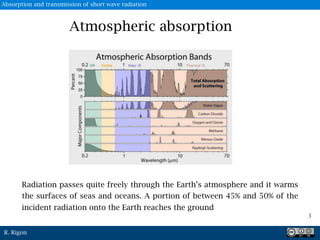
Radiation passes quite freely through the Earth’s atmosphere and it warms
the surfaces of seas and oceans. A portion of between 45% and 50% of the
incident radiation onto the Earth reaches the ground
Absorption and transmission of short wave radiation
R. Rigon
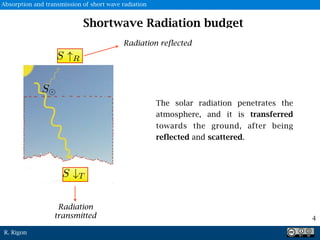
Radiation
transmitted
Radiation reflected
Shortwave Radiation budget
The solar radiation penetrates the
atmosphere, and it is transferred
towards the ground, after being
reflected and scattered.
4
Absorption and transmission of short wave radiation
R. Rigon
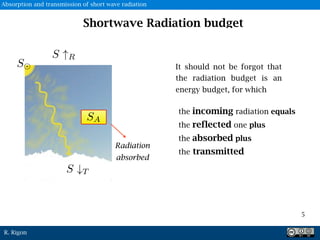
the incoming radiation equals
the reflected one plus
the absorbed plus
the transmitted
5
Shortwave Radiation budget
S It should not be forgot that
the radiation budget is an
energy budget, for which
Radiation
absorbed
Absorption and transmission of short wave radiation
R. Rigon
6
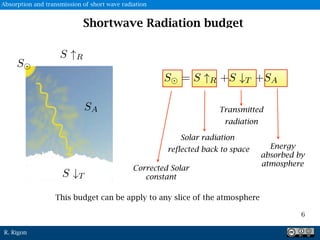
S
Energy
absorbed by
atmosphere
Transmitted
radiation
Corrected Solar
constant
Solar radiation
reflected back to space
This budget can be apply to any slice of the atmosphere
Shortwave Radiation budget
Absorption and transmission of short wave radiation
R. Rigon
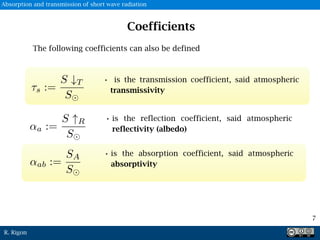
• is the reflection coefficient, said atmospheric
reflectivity (albedo)
• is the transmission coefficient, said atmospheric
transmissivity
• is the absorption coefficient, said atmospheric
absorptivity
Coefficients
The following coefficients can also be defined
7
Absorption and transmission of short wave radiation
R. Rigon
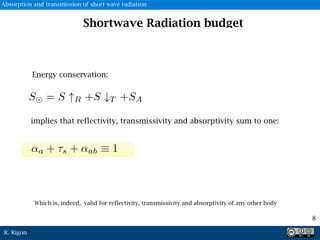
Energy conservation:
Which is, indeed, valid for reflectivity, transmissivity and absorptivity of any other body
implies that reflectivity, transmissivity and absorptivity sum to one:
8
Shortwave Radiation budget
Absorption and transmission of short wave radiation
R. Rigon
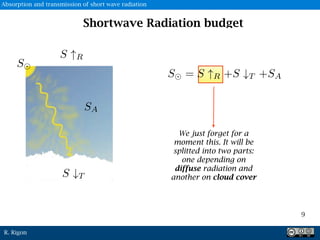
We just forget for a
moment this. It will be
splitted into two parts:
one depending on
diffuse radiation and
another on cloud cover
9
S
Shortwave Radiation budget
Absorption and transmission of short wave radiation
R. Rigon
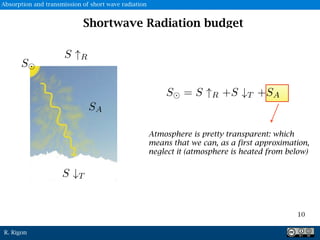
Atmosphere is pretty transparent: which
means that we can, as a first approximation,
neglect it (atmosphere is heated from below)
10
S
Shortwave Radiation budget
Absorption and transmission of short wave radiation
R. Rigon
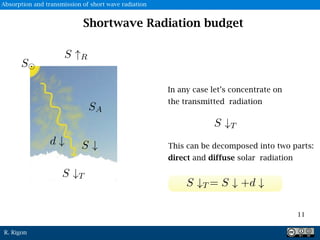
In any case let’s concentrate on
the transmitted radiation
This can be decomposed into two parts:
direct and diffuse solar radiation
11
Shortwave Radiation budget
S
Absorption and transmission of short wave radiation
R. Rigon
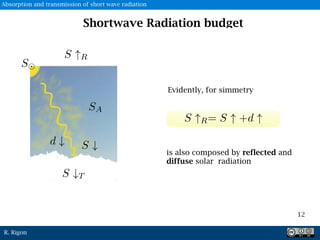
Evidently, for simmetry
is also composed by reflected and
diffuse solar radiation
12
Shortwave Radiation budget
S
Absorption and transmission of short wave radiation
R. Rigon
5
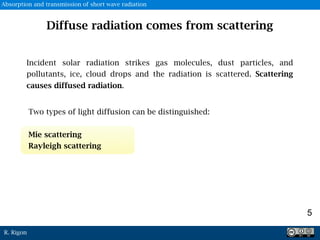
Diffuse radiation comes from scattering
Incident solar radiation strikes gas molecules, dust particles, and
pollutants, ice, cloud drops and the radiation is scattered. Scattering
causes diffused radiation.
Two types of light diffusion can be distinguished:
Mie scattering
Rayleigh scattering
Absorption and transmission of short wave radiation
R. Rigon
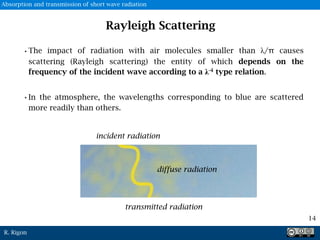
Rayleigh Scattering
•The impact of radiation with air molecules smaller than λ/π causes
scattering (Rayleigh scattering) the entity of which depends on the
frequency of the incident wave according to a λ-4 type relation.
•In the atmosphere, the wavelengths corresponding to blue are scattered
more readily than others.
incident radiation
diffuse radiation
transmitted radiation
14
Absorption and transmission of short wave radiation
R. Rigon
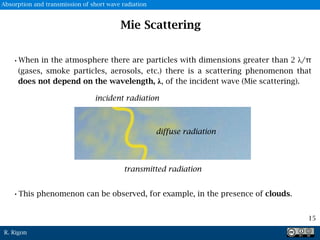
•When in the atmosphere there are particles with dimensions greater than 2 λ/π
(gases, smoke particles, aerosols, etc.) there is a scattering phenomenon that
does not depend on the wavelength, λ, of the incident wave (Mie scattering).
•This phenomenon can be observed, for example, in the presence of clouds.
Mie Scattering
15
incident radiation
diffuse radiation
transmitted radiation
Absorption and transmission of short wave radiation
R. Rigon
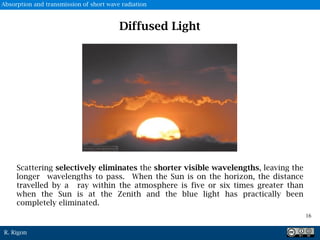
Diffused Light
Scattering selectively eliminates the shorter visible wavelengths, leaving the
longer wavelengths to pass. When the Sun is on the horizon, the distance
travelled by a ray within the atmosphere is five or six times greater than
when the Sun is at the Zenith and the blue light has practically been
completely eliminated.
16
Absorption and transmission of short wave radiation
R. Rigon
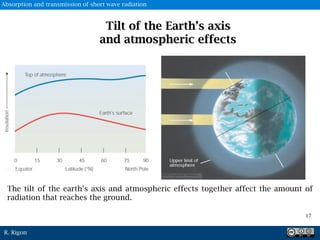
Tilt of the Earth’s axis
and atmospheric effects
The tilt of the earth’s axis and atmospheric effects together affect the amount of
radiation that reaches the ground.
17
Absorption and transmission of short wave radiation
R. Rigon
18
One way to take into account of absorption
Would be to run a full model of atmospheric transmission (e.g. Liou, 2002).
However hydrologists prefer to use parameterizations, and the
concept of atmospheric transmissivity.
Absorption and transmission of short wave radiation
R. Rigon
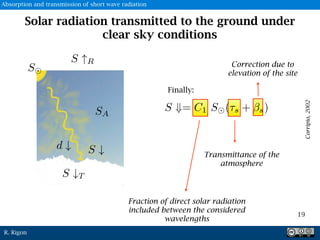
Solar radiation transmitted to the ground under
clear sky conditions
Finally:
Fraction of direct solar radiation
included between the considered
wavelengths
Transmittance of the
atmosphere
Correction due to
elevation of the site
Corripio,2002
19
S
Absorption and transmission of short wave radiation
R. Rigon
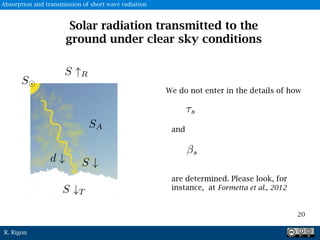
We do not enter in the details of how
and
are determined. Please look, for
instance, at Formetta et al., 2012
Solar radiation transmitted to the
ground under clear sky conditions
20
S
Absorption and transmission of short wave radiation

6 f-radiation-absorptions

  • 1.
  • 2.
    R. Rigon Atmosphere isa gray body • The blackbody is an ideal object that absorb all the radiative energy it receives • Real objects (bodies, “gray bodies”) are not capable of absorbing all radiation. • To understand the difference between a blackbody and a gray body we need to analyse the interactions between a surface and the electromagnetic radiation incident onto it. 2 Absorption and transmission of short wave radiation
  • 3.
    R. Rigon Atmospheric absorption 3 Radiationpasses quite freely through the Earth’s atmosphere and it warms the surfaces of seas and oceans. A portion of between 45% and 50% of the incident radiation onto the Earth reaches the ground Absorption and transmission of short wave radiation
  • 4.
    R. Rigon Radiation transmitted Radiation reflected ShortwaveRadiation budget The solar radiation penetrates the atmosphere, and it is transferred towards the ground, after being reflected and scattered. 4 Absorption and transmission of short wave radiation
  • 5.
    R. Rigon the incomingradiation equals the reflected one plus the absorbed plus the transmitted 5 Shortwave Radiation budget S It should not be forgot that the radiation budget is an energy budget, for which Radiation absorbed Absorption and transmission of short wave radiation
  • 6.
    R. Rigon 6 S Energy absorbed by atmosphere Transmitted radiation CorrectedSolar constant Solar radiation reflected back to space This budget can be apply to any slice of the atmosphere Shortwave Radiation budget Absorption and transmission of short wave radiation
  • 7.
    R. Rigon • isthe reflection coefficient, said atmospheric reflectivity (albedo) • is the transmission coefficient, said atmospheric transmissivity • is the absorption coefficient, said atmospheric absorptivity Coefficients The following coefficients can also be defined 7 Absorption and transmission of short wave radiation
  • 8.
    R. Rigon Energy conservation: Whichis, indeed, valid for reflectivity, transmissivity and absorptivity of any other body implies that reflectivity, transmissivity and absorptivity sum to one: 8 Shortwave Radiation budget Absorption and transmission of short wave radiation
  • 9.
    R. Rigon We justforget for a moment this. It will be splitted into two parts: one depending on diffuse radiation and another on cloud cover 9 S Shortwave Radiation budget Absorption and transmission of short wave radiation
  • 10.
    R. Rigon Atmosphere ispretty transparent: which means that we can, as a first approximation, neglect it (atmosphere is heated from below) 10 S Shortwave Radiation budget Absorption and transmission of short wave radiation
  • 11.
    R. Rigon In anycase let’s concentrate on the transmitted radiation This can be decomposed into two parts: direct and diffuse solar radiation 11 Shortwave Radiation budget S Absorption and transmission of short wave radiation
  • 12.
    R. Rigon Evidently, forsimmetry is also composed by reflected and diffuse solar radiation 12 Shortwave Radiation budget S Absorption and transmission of short wave radiation
  • 13.
    R. Rigon 5 Diffuse radiationcomes from scattering Incident solar radiation strikes gas molecules, dust particles, and pollutants, ice, cloud drops and the radiation is scattered. Scattering causes diffused radiation. Two types of light diffusion can be distinguished: Mie scattering Rayleigh scattering Absorption and transmission of short wave radiation
  • 14.
    R. Rigon Rayleigh Scattering •Theimpact of radiation with air molecules smaller than λ/π causes scattering (Rayleigh scattering) the entity of which depends on the frequency of the incident wave according to a λ-4 type relation. •In the atmosphere, the wavelengths corresponding to blue are scattered more readily than others. incident radiation diffuse radiation transmitted radiation 14 Absorption and transmission of short wave radiation
  • 15.
    R. Rigon •When inthe atmosphere there are particles with dimensions greater than 2 λ/π (gases, smoke particles, aerosols, etc.) there is a scattering phenomenon that does not depend on the wavelength, λ, of the incident wave (Mie scattering). •This phenomenon can be observed, for example, in the presence of clouds. Mie Scattering 15 incident radiation diffuse radiation transmitted radiation Absorption and transmission of short wave radiation
  • 16.
    R. Rigon Diffused Light Scatteringselectively eliminates the shorter visible wavelengths, leaving the longer wavelengths to pass. When the Sun is on the horizon, the distance travelled by a ray within the atmosphere is five or six times greater than when the Sun is at the Zenith and the blue light has practically been completely eliminated. 16 Absorption and transmission of short wave radiation
  • 17.
    R. Rigon Tilt ofthe Earth’s axis and atmospheric effects The tilt of the earth’s axis and atmospheric effects together affect the amount of radiation that reaches the ground. 17 Absorption and transmission of short wave radiation
  • 18.
    R. Rigon 18 One wayto take into account of absorption Would be to run a full model of atmospheric transmission (e.g. Liou, 2002). However hydrologists prefer to use parameterizations, and the concept of atmospheric transmissivity. Absorption and transmission of short wave radiation
  • 19.
    R. Rigon Solar radiationtransmitted to the ground under clear sky conditions Finally: Fraction of direct solar radiation included between the considered wavelengths Transmittance of the atmosphere Correction due to elevation of the site Corripio,2002 19 S Absorption and transmission of short wave radiation
  • 20.
    R. Rigon We donot enter in the details of how and are determined. Please look, for instance, at Formetta et al., 2012 Solar radiation transmitted to the ground under clear sky conditions 20 S Absorption and transmission of short wave radiation